Septic tank design: how the system actually works
By the SepticMind Editorial Team

TL;DR
- A conventional septic system has two parts: a buried tank that separates solids from liquid, and a drain field that spreads treated effluent into the soil.
- Tank size follows bedroom count, usually 1,000 to 1,500 gallons for a home.
- Soil percolation sets the drain field size.
- Together they treat household wastewater with no sewer connection.
What is a septic tank and how does the whole system work?
A septic system treats wastewater on your own property. Everything your household flushes or drains flows to a buried watertight tank, where gravity and bacteria split the waste into three layers: a floating scum layer on top, a middle liquid layer called effluent, and a settled sludge layer on the bottom. Only the middle layer leaves the tank. It flows by gravity (or by pump, in pressurized systems) to the leach field, where the soil finishes the job.
The soil is doing real work here. As effluent moves down through the ground, native bacteria and physical filtration strip out pathogens, nutrients, and leftover solids before the water reaches groundwater. That's the system running as designed. When any link in the chain breaks, you get sewage surfacing, backed-up drains, or contaminated groundwater.
The EPA's SepticSmart program puts it plainly: septic systems "treat and dispose of household wastewater on-site" and "when properly designed, constructed, and maintained, they effectively reduce or eliminate most human health or environmental threats." [1] That phrase "when properly designed" carries a lot of weight. Design mistakes cause most of the early failures you read about.
Two components have to be right: the tank and the drain field. They're separate engineering problems, and each has its own rules.
What are the main components of a septic tank design?
A standard septic tank is a buried, watertight container. Most are precast concrete, though fiberglass and polyethylene tanks show up in areas with high water tables or hard access. The tank connects to the house through an inlet pipe with a baffle (a tee or elbow fitting) that slows incoming flow so it doesn't stir up settled solids. On the outlet side, another baffle or an effluent filter holds back floating scum so only clarified liquid leaves.
Most modern tanks have two compartments. The first (roughly two-thirds of the volume) does the heavy settling. The second gives the effluent a quieter zone to clarify further before it exits. Single-compartment tanks still exist in older installs, but most state codes now require two compartments for new construction [2].
The tank needs risers and access lids at the surface for pumping and inspection. Sounds obvious. It got skipped constantly in older installs, which is why you sometimes watch someone excavate three feet of lawn to find a buried concrete lid. Risers are now required in most jurisdictions.
Below the tank, the outlet pipe carries effluent to a distribution box (d-box) or straight to a distribution manifold. The d-box splits the flow evenly among the leach field laterals. Uneven flow is one of the most common design and installation errors, and it overloads some parts of the field while others sit idle.
The leach field is perforated pipe laid in gravel-filled trenches, usually 18 to 36 inches deep depending on soil and local code. Geotextile fabric covers the gravel to keep soil from migrating down. A thin biomat (a dark layer of microorganisms) forms at the gravel-soil interface over time. That biomat is part of what treats the effluent, not a sign of trouble. See the full septic tank installation process for what happens during construction.
How is septic tank size determined?
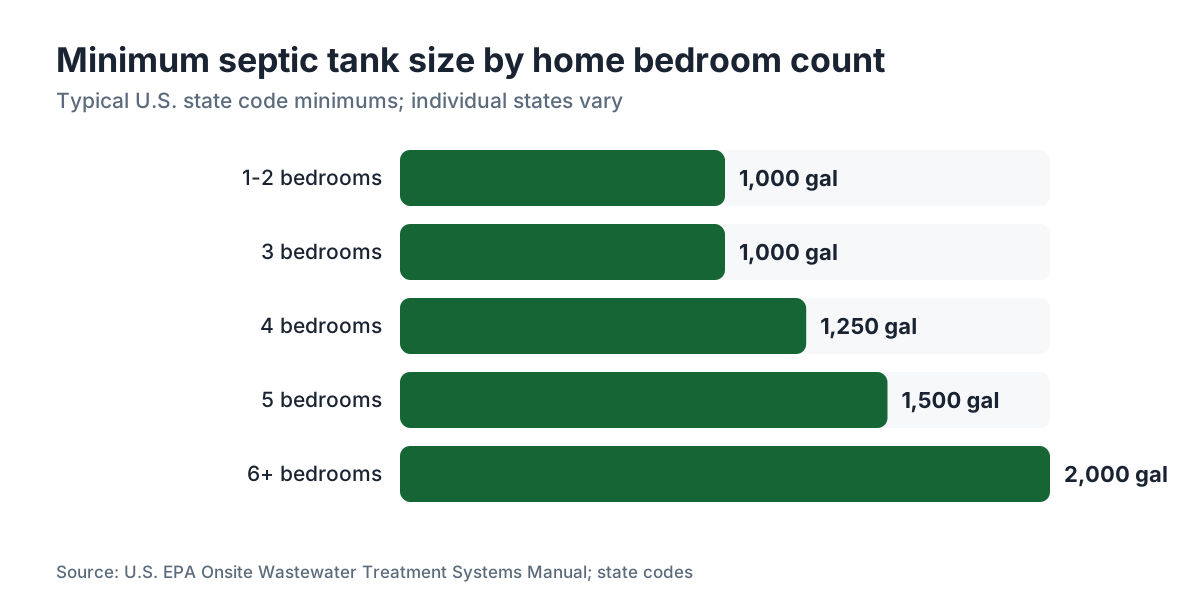
Tank size follows expected wastewater flow, and nearly every state ties minimum tank volume to bedroom count. Bedrooms stand in for occupants, and occupants drive daily flow. The most common baseline is 120 gallons per bedroom per day, though some state codes use slightly different numbers [3].
The standard sizing table looks like this:
| Bedrooms | Minimum Tank Size (gallons) |
|---|---|
| 1-2 | 750-1,000 |
| 3 | 1,000 |
| 4 | 1,200-1,500 |
| 5 | 1,500-2,000 |
| 6+ | 2,000+ or custom calculation |
Those minimums vary by state. North Carolina requires a minimum 900-gallon tank for a 3-bedroom home; California requires 1,200 gallons for the same house [4]. Check your own state's onsite wastewater code before you buy anything.
The other factor is detention time. Effluent needs to sit in the tank long enough for solids to settle, usually at least 24 hours of retention at peak flow. An undersized tank gives solids too little settling time, so it pushes wastewater with more suspended solids into the drain field, and that clogs the field faster. This is one of the cleanest cause-and-effect relationships in septic design.
Commercial jobs use measured or estimated daily flow instead of bedroom counts. A restaurant or campground calculation gets more involved, but the physics don't change.
For what a tank install actually runs, see cost to install a septic system.
What does a septic tank and leach field design actually look like?
Picture the spatial logic. The house connects through a 4-inch sloped pipe (minimum 1/8-inch drop per foot, ideally 1/4-inch) to the tank inlet. The tank sits at an elevation that lets gravity carry flow from the house. The outlet is a few inches lower than the inlet, and that elevation drop is deliberate (tanks are not level end to end). From the outlet, effluent runs downhill to the distribution box at the head of the leach field.
The trenches fan out from the d-box, running parallel, usually 6 to 10 feet apart center to center. Each lateral is perforated pipe, typically 4-inch diameter, laid level (not sloped) in a gravel bed. Level matters. If the pipe slopes, flow piles up at one end. Each lateral runs about 50 to 100 feet, and the number of laterals depends on how much total absorption area the soil requires.
The whole footprint, house to tank to drain field, has to hold setback distances from wells, property lines, streams, and foundations. Typical setbacks run 50 to 100 feet from a private drinking water well, 10 to 25 feet from property lines, and 5 to 10 feet from a foundation, but these vary a lot by state [5]. On a tight lot, setbacks alone can rule out a conventional system and force an alternative design.
Operators managing layouts across many properties can use software like SepticMind to map field layouts and track design specs alongside service records, which saves time when you're pulling up a site during an inspection or repair call.
The EPA's SepticSmart guidance says "the size of the drainfield is based on how well your soil absorbs water (percolation) and the amount of wastewater generated." [1] Those two variables are the whole ballgame.
What is perc testing and why does it drive leach field size?
The percolation test (perc test) measures how fast water soaks into your native soil. An evaluator digs test holes at the proposed drain field spot, saturates the soil, then times how many minutes the water level takes to drop one inch. That rate, in minutes per inch (MPI), is the number that sizes the leach field.
Soil that absorbs too fast (sandy, under 1 MPI in some codes) can let effluent pass before it's treated. Soil that absorbs too slow (clay-heavy, above 60 MPI in most codes) won't move enough water for a gravity system to work. The usable range is roughly 3 to 60 MPI, with the sweet spot around 10 to 30 MPI.
Once you have the perc rate, you calculate the required absorption area. The formula is simple: required area equals daily flow divided by the design loading rate. Design loading rates come from your state's code and track the perc rate. Faster-perc soil allows more gallons per square foot per day, so you need less trench. Slower soil needs more.
A 3-bedroom home producing 360 gallons a day in soil with a 30 MPI rate might need 600 to 900 square feet of trench bottom. The same home in 10 MPI soil might need 400 to 500 square feet. That gap moves your cost and lot requirements hard.
Some states require a soil morphology evaluation by a licensed soil scientist on top of or instead of a perc test. Soil texture, structure, and depth to limiting layers (bedrock, seasonal high water table, or clay hardpan) all shape the design and the approval. A failing perc test doesn't always mean the lot is dead, but it usually means an alternative system design.
What are the different types of septic system designs?
Conventional gravity systems are what most people picture: tank, d-box, gravel trenches. They work on lots with good soil, adequate setbacks, and enough elevation change. Where those conditions aren't there, alternative designs fill the gap.
Chamber systems swap gravel-filled trenches for plastic arch-shaped chambers. Effluent drips onto the native soil under the chambers. Contractors use them where crushed stone is expensive or hard to deliver, and they can fit a smaller footprint than equivalent gravel systems in some soils [6].
Pressure distribution systems use a pump to dose effluent evenly across all laterals in timed bursts. This rests the field between doses and spreads flow more uniformly than gravity. Many states require pressure distribution when perc rates are marginal (above 30 MPI).
Mound systems get built when native soil is too shallow, too slow, or the seasonal water table sits too high. A sand mound goes in above grade, and effluent is pumped up into it and treated by the sand before reaching native soil. They cost more, they're visible, and they need more maintenance, but they work where nothing else does.
Aerobic treatment units (ATUs) add an aeration chamber that pumps oxygen in to speed up bacterial digestion. The output is higher-quality effluent that can go to a smaller drain field or even surface spray in some states. ATUs need electricity, mechanical upkeep, and service contracts. They earn their keep when lot size or soil forces the issue, not as a general upgrade.
Drip irrigation systems use pressure distribution to feed treated effluent through drip emitters just under the soil surface. They work on shallow soil and on slopes where trenches aren't practical.
The right design comes down to the lot's constraints. No single design wins everywhere, and a good septic designer matches the system to the site instead of defaulting to whatever they build most.
What are the standard setback requirements for septic system placement?
Setbacks set how close your tank and drain field can be to wells, property lines, water, and foundations. State and local code writes them, not federal law. The EPA offers guidance; states write the actual rules [5]. The ranges below reflect what most states use, and yours may differ.
| Feature | Typical Tank Setback | Typical Drain Field Setback |
|---|---|---|
| Private drinking well | 50 ft | 100 ft |
| Public water supply well | 100 ft | 150+ ft |
| Property line | 5-10 ft | 10-25 ft |
| Foundation / basement | 5-10 ft | 10-20 ft |
| Surface water (stream, pond) | 25-50 ft | 50-100 ft |
| Steep slopes (>20%) | Varies | Often prohibited |
These distances interact with lot size in a way that surprises people. A half-acre lot sounds spacious until you place the house, the well, and a setback buffer around each. Some jurisdictions calculate the usable drain field area during permit review, and a lot that can't fit a field with its setbacks won't get approved.
Mounds and drip systems sometimes carry smaller setbacks to the well because the effluent leaving them is cleaner. Worth raising with your designer if you're squeezed for space.
Setback violations turn up often in septic tank inspections. If you're buying a property with an existing system, confirming that the installed system meets current setbacks (more than the ones that applied when it went in) is part of due diligence.
How long does a properly designed septic system last?
A well-designed, well-maintained conventional drain field should last 25 to 30 years, and concrete tanks often outlast that. The EPA points to 20 to 30 years as realistic when the system is pumped on schedule and not abused [1]. In practice the spread is huge.
Systems fail early for a few repeat reasons: undersized drain fields, installation errors (uneven distribution above all), skipped pumping that lets solids carry into the field, and harsh chemicals that kill the bacteria in the tank. Systems put in during the 1970s and 1980s under older, looser codes often have smaller tanks and less trench area than current designs, so they're more sensitive to anything that raises load or cuts maintenance.
The drain field almost always fails first and costs the most to fix. Tank repairs are usually manageable. A failed field means excavation, new aggregate, new pipe, and maybe a whole new location if the original site is saturated. Drain field replacement typically runs $5,000 to $20,000 or more depending on system type and local market [7]. See the leach field article for what moves those numbers.
The single most effective maintenance step is pumping on schedule, usually every 3 to 5 years for a 1,000-gallon tank serving a 3-person household [8]. See how often to pump a septic tank for the full math. Regular pumping keeps the sludge and scum layers from growing thick enough to carry into the drain field. That's the whole strategy that makes systems last.
What permits and codes govern septic tank and leach field design?
States regulate septic design and installation, and counties often add stricter local rules. There is no single national septic code. The EPA's SepticSmart program sets guidance, and many states have adopted NSF/ANSI Standard 40 for ATUs and NSF/ANSI 245 for nitrogen-reducing systems [9].
At the state level, look for "onsite wastewater treatment system" or "individual sewage disposal system" rules in your state's environmental or health department code. These spell out tank sizing, perc test methods, setbacks, required system types by soil condition, designer qualifications, and inspection steps.
Most states require a licensed designer (engineer, sanitarian, or registered soil scientist, depending on the state) to stamp system plans before a permit issues. The permit process usually runs through a site evaluation, plan review, installation inspection, and final approval. Running a system without a valid permit is illegal and creates liability when you sell.
Local health departments usually handle the permit review in practice, even where the state sets the rules. Some counties go stricter than state minimums, especially near sensitive water bodies or in dense septic development.
Two federal laws touch septic indirectly. The Clean Water Act [10] requires states to manage nonpoint source pollution, which includes septic failures that reach waterways. The Safe Drinking Water Act funds wellhead protection programs that often include septic management. Neither law directly regulates individual system design, but they drive the state programs that do.
For operators running permits across many properties, tracking which permits issued, by whom, under which code version, and with what setback variances is exactly the records problem software like SepticMind is built to handle.
What makes a septic design fail before its time?
Most early failures start with a design or installation flaw, not a maintenance miss. The common design errors: undersizing the tank for actual occupancy, placing the drain field in soil evaluated dry that performs worse when seasonally wet, and running gravity distribution on a lot whose slope causes uneven loading.
Installation errors that kill systems early include compacting the trench bottom with heavy equipment before laying pipe (which crushes the permeability you were counting on), sloppy slope control on distribution lines that loads one end, and backfilling before inspections, which hides work that wasn't done right.
Usage habits speed up failure too. Garbage disposals raise solids load by 50% or more in some estimates and pile up sludge faster [11]. Flushing non-degradables (wipes labeled "flushable" are not septic-safe in practice) builds up material that pumping can't always pull out. High-flow fixtures and big families in homes with undersized systems push more water than the field can absorb.
Chemical additives sold as tank treatments are mostly useless, and some do harm. The EPA's position is that additives are not necessary for a properly functioning system and some may harm the environment [1]. Keep the money.
A failed drain field doesn't always mean a new system. Sometimes septic system repair options like resting field sections, aerating compacted soil, or fixing a broken distribution box restore function. But a field that's been biomat-saturated for years from solids carryover usually needs replacement. See septic tank repair for what's fixable at the tank before you assume the worst.
How does septic leach field cleaning work, and when is it needed?
"Septic tank leach field cleaning" is a bit of a misleading term, because you can't flush a drain field the way you clean a pipe. What's actually on the menu is a handful of ways to restore flow in a field that's losing absorption.
Hydro-jetting the perforated laterals clears accumulated solids and biomat from inside the pipe. That helps when the clog is in the pipe. Most absorption failure sits at the gravel-soil interface, not inside the pipe, so jetting alone won't fix a saturated biomat layer.
Aeration pushes oxygen into the soil around the trenches so aerobic bacteria can break down the biomat. Some contractors drive perforated probes into the soil alongside the trenches to deliver air. Results vary, and the long-term evidence is thin. The University of Minnesota Extension has published work on drain field restoration finding that field resting (dosing one section while another rests) combined with aeration showed some recovery of absorption, but long-term controlled data remain limited [12].
The most reliable fix is replacement or rehabilitation with new gravel and pipe. For a gravity system, that's usually a full trench excavation. For some alternative designs, specific parts (the chambers, the drip emitters) can be serviced without full excavation.
Regular septic tank pumping every 3 to 5 years is what keeps you from ever needing leach field cleaning. A clean tank doesn't send floating scum into the field, and that scum is the biomat-accelerating material you most want to keep out. The septic tank pump out and septic tank emptying process is straightforward and cheap, and it's the best thing you can do for field longevity.
Frequently asked questions
What size septic tank do I need for a 3-bedroom house?
Most state codes require at least a 1,000-gallon tank for a 3-bedroom home, and some (California, for one) require 1,200 gallons. The logic runs roughly 120 gallons per bedroom per day, with enough volume to hold 24 hours of peak flow. Check your state's onsite wastewater code before buying a tank, because minimums vary by state.
How far does a septic tank need to be from a well?
The typical setback is 50 feet from a private drinking water well for the tank and 100 feet for the drain field. Some states require more, especially for public water supply wells (often 150 feet or more). These are minimums; a bigger buffer is always safer where the lot allows. Your local health department has the rules that apply to your site.
What is the difference between a septic tank and a leach field?
The septic tank is a buried watertight container that takes all household wastewater and separates solids from liquid through settling and bacteria. The leach field (drain field) takes the clarified effluent from the tank and spreads it into the soil, which finishes the treatment. Both are required; neither works without the other.
Can I design my own septic system?
In most states, no. A licensed professional (engineer, sanitarian, or registered designer, depending on the state) has to prepare and stamp the plans before a permit issues. Even in looser states, the site evaluation for perc testing and soil morphology usually needs a certified evaluator. Designing and installing without permits is illegal and creates real liability when you sell.
How deep should a leach field be buried?
Trenches typically run 18 to 36 inches deep, measured to the bottom of the gravel bed, with the perforated pipe sitting on 6 to 12 inches of gravel. Minimum depth is set by local code, but the main constraint is keeping the trench above the seasonal high water table (usually a 2-foot minimum clearance) and below frost depth in cold climates.
What happens if my perc test fails?
A failed perc test (soil too slow or too fast) doesn't automatically kill the lot. It means a conventional gravity system won't work. Alternatives like mound systems, aerobic treatment units, or drip irrigation are engineered for hard soil. The lot may still be buildable with a more complex, more expensive design. A soil scientist or licensed designer can lay out the options.
How often does a septic leach field need to be replaced?
A properly designed and maintained field should last 25 to 30 years, and many last longer. Fields fail early from solids carryover out of an unpumped tank, hydraulic overload from undersizing, or installation errors. Pumping every 3 to 5 years is the single most effective way to extend field life. Replacement typically runs $5,000 to $20,000 depending on system type and local costs.
What is a distribution box and why does it matter?
A distribution box (d-box) is a small concrete or plastic box that takes effluent from the tank outlet and splits it evenly among the leach field laterals. If it's cracked, settled, or off-level, flow concentrates in one or two laterals and overloads them while others get almost nothing. Uneven distribution is one of the most common causes of early field failure. It's easy to inspect and cheap to repair.
Do septic tank additives help the system work better?
No credible evidence supports commercial septic tank additives, and the EPA states they are not necessary for a properly functioning system and some may harm the environment. The bacteria in a healthy tank establish themselves from the waste stream on their own. Skip the additives and spend the money on pumping on schedule, which has a clear, proven benefit.
What is a mound septic system and when is it required?
A mound system is a raised drain field built above native soil and filled with engineered sand. It's required when native soil is too shallow (not enough depth above bedrock or a seasonal water table), too slow to perc conventionally, or when topography blocks burial at adequate depth. Effluent is pumped up into the mound. Mounds cost more, typically $10,000 to $30,000 or more depending on size.
How many laterals does a drain field need?
The count depends on total required absorption area (set by daily flow and perc rate) and length per lateral (typically 50 to 100 feet). Divide total required trench length by lateral length to get the number needed. A 3-bedroom home might need 2 to 6 laterals depending on soil. Laterals sit at least 6 feet apart, center to center.
Can a leach field be cleaned or rehabilitated without replacement?
Sometimes. Hydro-jetting the laterals clears pipe-level clogs. Aeration of the soil alongside the trenches can help bacteria break down a biomat layer, with mixed long-term results. Resting one section while using another lets a stressed area recover. These work best after the underlying cause (usually unpumped sludge carryover) is corrected. A field saturated for years typically needs full replacement.
What is the cost to design a septic system?
Design and permitting fees vary widely. A basic site evaluation and conventional design typically costs $500 to $2,500. Complex sites that need soil scientist evaluations, alternative designs, or multiple perc tests can run $2,000 to $5,000 or more before any installation begins. See the full breakdown at cost to put in a septic tank for what the complete project runs.
Sources
- U.S. EPA, SepticSmart Program: Septic systems treat and dispose of household wastewater on-site; additives are not necessary and some may harm the environment; typical system lifespan is 20-30 years with proper maintenance.
- U.S. EPA, Onsite Wastewater Treatment Systems Manual: Two-compartment tank designs improve effluent quality and are required by most modern state codes for new construction.
- U.S. EPA, Onsite Wastewater Treatment Systems Manual (EPA/625/R-00/008): Design flow for residential systems is commonly estimated at 120 gallons per bedroom per day for tank sizing purposes.
- California State Water Resources Control Board, Onsite Wastewater Treatment System Policy: California requires a minimum 1,200-gallon septic tank for a 3-bedroom residence under its onsite wastewater treatment system regulations.
- U.S. EPA, Septic Systems Guidance: Setback distances from wells, surface water, and property lines are set by state and local code; the EPA provides guidance but states write the rules.
- University of Minnesota Extension, Septic System Owner's Guide: Chamber systems replace gravel-filled trenches with plastic arch chambers and can achieve smaller footprints in some soil conditions compared to conventional gravel systems.
- Angi, Septic System Replacement Cost Data: Drain field replacement typically costs $5,000 to $20,000 or more depending on system type and local market conditions.
- U.S. EPA, SepticSmart: Proper Maintenance: The EPA recommends pumping a residential septic tank every 3 to 5 years as the primary maintenance strategy.
- NSF International, NSF/ANSI Standard 40 for Residential Wastewater Treatment Systems: NSF/ANSI Standard 40 sets performance requirements for aerobic treatment units; many states require NSF 40 certification for ATU approval.
- U.S. EPA, Summary of the Clean Water Act: The Clean Water Act requires states to manage nonpoint source pollution, which includes septic system failures that reach waterways.
- University of Minnesota Extension, Garbage Disposals and Septic Systems: Garbage disposals can increase solids load to a septic tank by 50% or more, accelerating sludge accumulation and increasing pumping frequency requirements.
- University of Minnesota Extension, Drainfield Restoration Research: Research on field resting and aeration showed some recovery of absorption in stressed drain fields, but long-term controlled data remain limited.
Last updated 2026-07-09