Septic system treatment: what actually works and what doesn't
By the SepticMind Editorial Team
TL;DR
- Septic system treatment means anything you do to keep the biology and machinery inside your tank and drain field working.
- That covers pumping on schedule, spreading out water use, and sometimes adding bacterial products.
- EPA research finds most commercial additives give no measurable benefit.
- Aerobic treatment units and steady maintenance habits are what actually move the needle.
What does septic system treatment actually mean?
"Treatment" is a word the septic industry throws around loosely, and that fuzziness confuses homeowners. Stripped down, septic treatment is any action or product that helps your system break down and safely disperse wastewater before it reaches groundwater or a stream.
A conventional septic system already treats its own waste in two stages. Solids settle in the tank, where anaerobic bacteria digest the organic matter. The clarified liquid moves to the drain field, where soil microbes and physical filtration strip out pathogens and nutrients. The whole thing is a self-contained biological reactor. It does not need help from a bottle to run.
Treatment becomes a real conversation in three situations. The biology gets disrupted (antibiotics, heavy bleach, solids overflow). The system is an aerobic unit that needs chemical feed and permitted maintenance. Or you are trying to buy time on a struggling drain field. Figure out which situation you're in, and the right approach usually picks itself.
Do septic tank treatment products actually work?
Honest answer: the evidence is thin, and regulators have said so out loud.
The EPA's SepticSmart program reviewed the research on biological and chemical additives and concluded there is no scientific evidence that biological additives improve the performance of a properly functioning septic system [1]. The National Onsite Wastewater Recycling Association reviewed more than 100 product studies and found most were run by manufacturers, not independent labs [10].
That does not make every product useless. There's a narrow case where bacterial inoculants might help: after a tank has been pumped bone dry, after a household runs heavy antibiotics through the system, or after a long empty stretch with nobody home. Re-seeding gives the tank population a head start. The operative word is "faster," not "necessary." A healthy tank refills with bacteria from normal household waste within a few weeks on its own.
Chemical additives are a different animal, and a genuinely dangerous one. Organic solvents (older drain cleaners, some "rejuvenator" products) can liquefy the sludge layer, push solids into the drain field, and permanently clog the soil pores that let liquid percolate. Several state codes, including Washington and Massachusetts, ban certain chemical additives outright [2][3]. Check your state's onsite wastewater rules before you pour anything down a drain.
Biological products with live cultures or enzymes are mostly harmless when used as directed, even if they aren't doing much. Want to spend $15 a month on peace of mind? A bacterial packet won't hurt anything. Just don't let it stand in for pumping.
For more on keeping the tank itself healthy, see our guide on septic tank cleaning.
What is an aerobic septic system and how does its treatment work differently?
An aerobic treatment unit (ATU) is a fundamentally different machine from a conventional tank, and the distinction matters because "aerobic septic system treatment" gets used online to mean two unrelated things.
A conventional septic tank is anaerobic. No oxygen, slow digestion, effluent quality classified as "septic." An aerobic treatment unit pumps air into the treatment chamber around the clock, creating an oxygen-rich environment where aerobic bacteria thrive. Those bacteria digest organic matter faster and more completely. The resulting effluent is typically classified as "secondary treated" and can be 85 to 95 percent cleaner than conventional septic effluent before it even hits the drain field [4].
Aerobic systems show up where sites are tight: high water tables, poor soil percolation, small lots, or lakefront property where nutrient loading is regulated. Texas permits more ATUs than any other state, largely thanks to shallow rocky soils and dense lake development in the Hill Country [5].
The tradeoff is complexity and cost. An ATU has an air compressor (or diffuser), a pump, often a chlorination or UV disinfection stage, and in most states a mandatory annual or semi-annual service contract with a licensed provider. If the compressor quits and nobody notices for two weeks, you're back to anaerobic conditions and the effluent quality drops fast. That's why most state codes require a dedicated alarm on ATUs.
Operating costs run roughly $400 to $900 a year for the required service contract, against $0 in ongoing fees for a conventional system that just needs pumping every 3 to 5 years [6]. Electricity for the compressor adds another $100 to $200 a year depending on unit size and local rates.
For more on system types and installation, see cost to install septic system.
What are the best septic system treatment products by category?
You're going to look anyway, so here's a straight breakdown by product type instead of brand.
Bacterial and enzymatic additives: Products built on Bacillus bacteria strains are the most studied and the least risky. Look for a CFU count (colony-forming units) on the label, usually in the billions per dose. Products with no listed CFU count are hard to judge. Enzymatic products (lipase, protease, cellulase) may break down specific waste like grease and paper, but the enzymes get consumed quickly and leave no lasting colony behind.
Yeast-based products: Baking yeast and commercial yeast additives are an old folk remedy. Yeast does throw off some useful enzymes. It's almost certainly harmless. It's probably not doing anything your existing bacteria aren't already doing.
Chemical drain treatments: Steer clear of anything with sulfuric acid, hydrochloric acid, or organic solvents (methylene chloride, trichloroethylene, some older commercial cleaners). These do the most real damage. Regular household bleach in normal laundry amounts won't kill your tank, but a big slug poured straight down a drain can knock back the bacterial population for a while.
Septic field "rejuvenators": Products that claim to restore a failed drain field by breaking up biomat are the most argued-over category. Some carry bacteria, some enzymes, some chemicals. The few independent studies on biomat remediation found that resting the field (routing effluent to a second field or a temporary holding tank) beat any product on its own [7].
| Product type | Independent evidence | Risk level | Typical cost/year |
|---|---|---|---|
| Bacterial/enzyme (Bacillus-based) | Weak positive at best | Low | $50-$150 |
| Yeast-based | Anecdotal only | Very low | $10-$30 |
| Chemical solvents | Negative (can cause harm) | High | Avoid |
| Field rejuvenators | Mixed, mostly poor | Medium | $100-$500 |
| Aeration/ATU upgrade | Strong positive | Low (long-term) | $400-$900/yr service |
What maintenance habits provide better treatment than any product?
This is where the real gains live, and none of it costs a dime beyond your pumping schedule.
Pump on schedule. A 1,000-gallon tank serving four people should be pumped every 3 to 5 years. Skip it and solids overflow into the drain field, which no hardware-store product can fix. EPA SepticSmart guidance says a typical household septic system should be inspected at least every three years by a professional and pumped based on tank size and use [1]. For timing, see how often to pump septic tank.
Spread out your water. A dishwasher, three loads of laundry, and two showers all on a Saturday morning sends a hydraulic surge through the tank that shoves partially treated effluent into the field before solids have settled. Running laundry across several days makes a measurable difference in what reaches the drain field.
Watch the drain. Fats, oils, and grease coat the soil in your field over time. Antibiotics suppress the bacteria doing your treatment work. Flushable wipes are not flushable in a septic system. No additive reverses any of these.
Protect the drain field. Don't drive over it, don't plant trees within 30 feet of it, and don't let roof runoff or surface water drain toward it. A saturated field can't treat effluent no matter how good your tank biology is. See our full guide on leach field care.
Get a real septic tank inspection every three years. A tech checking baffles, scum depth, and sludge depth catches problems no product will fix.
How do you treat a septic system that is starting to fail?
Slow drains, soggy ground over the field, or sewage odors in the yard mean you're past routine maintenance and into repair. No product fixes any of these.
Step one is a professional inspection to find what's actually failing. A bad tank baffle is a $150 to $400 repair. A collapsed distribution box runs $500 to $1,500. A fully saturated field that needs replacing can hit $8,000 to $25,000 depending on soil type, lot size, and local permit rules [8]. An early, accurate diagnosis is the only reliable way to stay off the expensive end of that range.
When a field has biomat buildup (a black, gelatinous layer of anaerobic bacteria clogging the soil pores), the best-supported move is resting it. You temporarily route effluent to a second field or holding tank so the existing biomat can aerobically digest over several months. Some states permit "aerating" the field soil, injecting air through perforated pipe to speed biomat breakdown. Results swing hard by soil type.
If the system is undersized for how the household actually lives, and plenty of older systems are, the real treatment is a properly designed upgrade, not a product. EPA guidance on failing systems frames replacement as an investment that protects public and environmental health, not an optional expense [1].
For specific repair paths, see septic system repair and septic tank repair.
What do state regulations say about septic treatment requirements?
Septic treatment is regulated at the state level, not federally, with county or municipal layers stacked on top. That matters because rules for aerobic units, required service contracts, approved additive lists, and setbacks all vary by state.
A few examples of how this shakes out:
Texas requires a maintenance contract with a licensed provider for every aerobic treatment system. The Texas Commission on Environmental Quality sets ATU performance and effluent standards [5]. Fail a required inspection and you can be ordered to upgrade or replace the system.
Massachusetts Title 5 is one of the most detailed onsite wastewater codes in the country. It bans certain chemical additives, sets inspection intervals, and requires a system inspection before most property sales [3].
Washington State's Department of Health keeps an approved product list for septic additives and prohibits products with pathogen-killing agents or anything that interferes with the biological treatment process [2].
The EPA doesn't set specific product rules but guides homeowners through SepticSmart, which recommends against chemical additives and pushes regular pumping, inspection, and water-use management [1].
If you run a septic service business managing maintenance contracts across multiple jurisdictions, tracking compliance across state and county codes gets complicated fast. SepticMind is built to help operators manage inspection schedules, service contract renewals, and compliance records across their whole customer base.
Always check your state environmental or health department site for the current version of your onsite wastewater code before buying a treatment product or scheduling a repair.
How much does septic treatment cost, from maintenance to full aerobic systems?
Cost hinges almost entirely on which kind of treatment you mean.
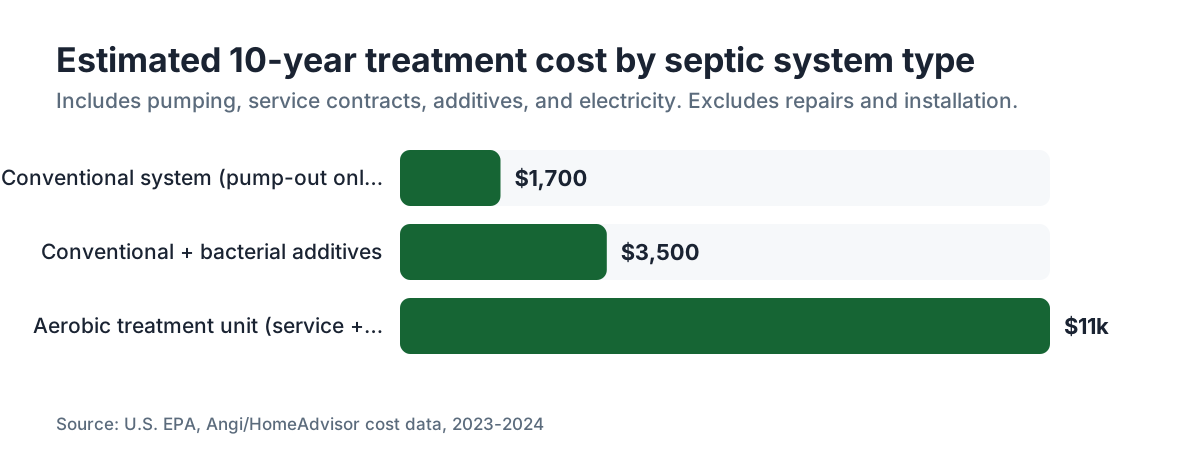
Routine maintenance for a conventional system runs $300 to $600 for a pump-out, needed every 3 to 5 years for most households [8]. Add $100 to $250 for an inspection where your state or local code requires one. Over ten years, a well-maintained conventional system runs roughly $800 to $1,700 in treatment-related costs, not counting repairs.
Bacterial additives, if you use them, run $50 to $200 a year depending on brand and dosing. That's a $500 to $2,000 optional spend over a decade for uncertain benefit.
Aerobic treatment operation is a whole different order of magnitude. The unit itself costs $8,000 to $15,000 installed for a residential system [9]. Mandatory service contracts run $400 to $900 a year. Compressor electricity adds $100 to $200 a year. Over ten years, operating cost alone is $5,000 to $11,000, on top of installation.
For a household that needs an ATU because of the site, that cost is unavoidable. For a household on a good lot with a working conventional system, upgrading purely for treatment performance is a poor return.
Drain field rehab, when it's needed, runs $1,500 to $5,000 for aeration or resting approaches and $8,000 to $25,000 for replacement [8]. See our full breakdown at cost to put in a septic tank.
A routine septic tank pump out or septic tank emptying is almost always the best-value treatment you can buy.
Are aerobic septic systems worth the extra cost?
For the right site, yes. For most sites, not as an elective upgrade.
Aerobic systems produce much cleaner effluent than conventional tanks. They earn their cost where that quality matters: lots too small for a conventional field, high water tables where effluent reaches groundwater fast, lakefront property under nutrient-loading rules, and rocky or clay soils that conventional systems can't work with.
On a standard suburban lot with decent soil and normal setbacks, a conventional system pumped on schedule meets every applicable treatment standard. Spending $10,000 to $15,000 on an aerobic upgrade, plus the service contract and electricity, buys you effluent quality that your soil would have polished just fine on its own.
Usually the site makes the call for you. If your county or state soil scientist says the lot can't support a conventional system, an ATU is the way forward. If a conventional system passes a perc test and meets setbacks, start there.
One legitimate reason to choose an ATU voluntarily: if the lot is too small for a full conventional field, the higher effluent quality can let you use a smaller dispersal area. Some state codes allow reduced setbacks or smaller fields for ATU effluent, which can make an otherwise unbuildable lot work [4].
SepticMind's operator tools include ATU service tracking that maintenance companies use to stay on top of manufacturer-specified service intervals.
What should you never put in a septic system?
A handful of things will overwhelm any treatment system, conventional or aerobic.
Large amounts of antibiotics can suppress or kill the bacteria that digest waste. A normal oral course has limited impact, since your body absorbs most of the drug before it reaches the toilet. Flushing unused antibiotics, or discharging from a medical facility into a home septic, is a different story.
Chemical drain cleaners with solvents or strong acids do two bad things. They kill beneficial bacteria, and at high concentration they dissolve the organic solids in your tank into particles small enough to slip through to the drain field. Enzyme-based cleaners or a hot-water flush are safer ways to clear a clog.
Grease and fats build up in the scum layer faster than bacteria can digest them, then clog the inlet baffle, the distribution system, and eventually the field. A grease trap on the kitchen sink is worth thinking about if you cook in volume.
Flushable wipes, feminine hygiene products, paper towels, and the like don't break down in a tank on any reasonable timeline. They pile up as solids, speed up how often you need pumping, and can clog the effluent screen or baffle.
Paint, solvents, gasoline, and pesticides are toxic to the bacteria doing your treatment work and can contaminate groundwater through the field. None of these belong in any septic system.
How does the EPA's SepticSmart program guide homeowners on treatment?
The EPA launched SepticSmart as a national education effort to cut septic failures. About 1 in 5 U.S. households rely on an onsite system for wastewater [11].
The program's core message is blunt: the best treatment is consistent maintenance, not products. SepticSmart Week (usually held in September) pushes four homeowner actions: spread out water use, keep harmful materials out of the drain, protect the field, and inspect and pump on a regular schedule.
On additives, the EPA's SepticSmart position is that biological additives have not been shown to improve system performance under normal operating conditions, and chemical additives can damage both the system and groundwater [1]. This is not a fringe view. It tracks the balance of the independent research.
SepticSmart also links out to state environmental agencies for permit, inspection, and installation rules. The EPA's septic section is a reliable first stop for any homeowner unsure which rules apply [1].
For homeowners who want to stay ahead of trouble, a regular septic tank inspection is the single highest-return action the EPA and most extension programs recommend.
Frequently asked questions
How often should I treat my septic system?
For conventional systems, the treatment that actually matters is pumping every 3 to 5 years for a standard 4-person household, per EPA SepticSmart guidance. If you use bacterial additives, most makers recommend monthly dosing, but no independent evidence says the frequency matters. Aerobic treatment systems need a professional service visit every 6 to 12 months under most state permits.
Can I use bleach in a house with a septic system?
Normal household bleach use, one load of laundry or routine toilet cleaning, does not kill your tank's bacteria. The concentration reaching the tank is quickly diluted. Trouble starts with large doses poured straight into a drain or daily high-concentration use. Chlorine-free or low-chlorine cleaners are a reasonable precaution if you're worried.
What is the best septic system treatment product to buy?
If you want to buy something, a bacterial product with a listed CFU count (billions of colony-forming units) of Bacillus bacteria is the lowest-risk option with the most evidence behind it, even if that evidence is modest. Avoid anything with chemical solvents or acids. For most well-maintained systems, regular pumping beats any additive by a wide margin. Put the product budget toward a scheduled pump-out.
How does an aerobic septic treatment system differ from a regular septic tank?
A conventional tank uses anaerobic bacteria in an oxygen-free environment. An aerobic treatment unit pumps air into the chamber, supporting aerobic bacteria that break down waste faster and more completely. ATU effluent is 85 to 95 percent cleaner before reaching the field. The tradeoff is higher install cost ($8,000 to $15,000), ongoing electricity, and mandatory service contracts in most states.
Do enzymes or bacteria in septic additives actually survive in the tank?
Enzymes are proteins that break down specific molecules, and they get consumed doing it. They don't establish a lasting colony. Bacterial additives add live bacteria, but the tank already holds billions, and the newcomers compete with an established ecosystem. Introduced strains may help short-term after a disruption. Under normal conditions, most introduced bacteria don't persist in meaningful numbers.
What kills the good bacteria in a septic tank?
Heavy antibiotic use, large doses of chemical drain cleaner or solvent, strong disinfectants poured straight into drains, and paint or petroleum products are the usual culprits. A fully pumped tank also loses most of its bacteria, which is one case where a bacterial additive has a reasonable argument. Recovery without additives takes 2 to 4 weeks of normal use.
Can septic treatment products save a failing drain field?
Rarely, and not reliably. Products claiming to break up field biomat have very little independent support. The best-supported intervention for a failing field is resting it, routing effluent away for several months so the biomat can aerobically decompose. Some states permit professionally aerated field restoration. A failed field usually needs repair or replacement, and no product substitutes for that.
Are aerobic septic systems required in certain areas?
Yes. Many states and counties require aerobic treatment units on sites with high water tables, small lots, poor percolation, or proximity to lakes and protected waters. Texas, for one, permits thousands of ATUs for Hill Country properties with shallow rocky soils. If a site can't pass a conventional perc test or meet setbacks with a standard system, an ATU may be the only permitted option.
Do aerobic septic systems smell more than conventional systems?
They can, especially if the compressor fails or the chlorination stage runs out of tablets. A working aerobic system with good airflow and disinfection usually produces less odor than a conventional one, because the process is cleaner and the effluent is more thoroughly treated before dispersal. Odor complaints on ATUs almost always trace back to a maintenance lapse, not the technology.
How do I know if my septic system needs treatment or just pumping?
Slow drains across several fixtures, soggy ground over the field, sewage odors in the yard, or water backing up into your lowest drains all point to a system problem. None of these are solved by treatment products. Call a licensed septic company for an inspection first. If the tank is overdue for pumping, start there. A pump-out can dramatically improve function in an overloaded system.
What does a septic system service contract for an aerobic unit typically include?
Most ATU service contracts cover periodic inspection visits (usually 2 to 4 a year), compressor and pump checks, replacement of chlorine or UV disinfection media, effluent testing where the permit requires it, and minor adjustments to keep the system within permitted parameters. Major component replacement is usually billed separately. Contracts run $400 to $900 a year for residential ATUs.
Is it safe to use a garbage disposal with a septic system?
A garbage disposal sharply increases the solids load on your tank, especially fats, fibrous vegetable matter, and slow-digesting food particles. The EPA and most extension programs recommend against garbage disposals on septic, or at least cutting their use way down. If you use one regularly, plan to pump every 1 to 2 years instead of 3 to 5. No additive compensates for the extra solids load.
How long do aerobic septic systems last?
A well-maintained aerobic treatment unit usually lasts 15 to 25 years before major component replacement. Air compressors typically need replacing every 7 to 10 years at $500 to $1,200. The concrete or fiberglass chamber itself can last 30 to 40 years. Systems that miss service visits degrade faster, because the compressor runs in poor conditions and nobody is watching the bacterial balance.
Do I need a permit to add septic treatment products in my state?
Most states don't require a permit for homeowner use of bacterial or enzymatic additives. But some states (Washington, Massachusetts, and others) keep approved product lists or flatly prohibit certain chemical additives under their onsite wastewater codes. Check your state environmental or health department site before using anything labeled as a drain field rejuvenator or chemical treatment. Using a banned product can complicate future permit applications.
Sources
- U.S. EPA, SepticSmart Homeowners: EPA states there is no scientific evidence that biological additives improve the performance of a properly functioning septic system, and recommends inspection at least every 3 years
- Washington State Department of Health, On-Site Sewage Systems: Washington State maintains an approved additive list and prohibits products containing pathogen-killing agents that interfere with biological treatment
- Massachusetts Department of Environmental Protection, Title 5 Septic System Inspection: Massachusetts Title 5 prohibits certain chemical additives and requires system inspection before most property sales
- University of Minnesota Extension, Septic Systems and Onsite Sewage Treatment: Aerobic treatment units produce effluent 85-95% cleaner than conventional septic effluent and may allow reduced drain field sizing under some state codes
- Texas Commission on Environmental Quality, On-Site Sewage Facilities: Texas TCEQ requires mandatory maintenance contracts with licensed providers for all aerobic treatment units and sets effluent quality standards
- Penn State Extension, Septic Systems: Aerobic treatment unit operating costs include annual service contracts and electricity for compressors that run continuously
- North Carolina State Extension: Field resting (routing effluent away from a failing drain field) was found more effective than product-based biomat treatments in reviewed studies
- U.S. EPA, Septic Systems (How to Care for Your Septic System): EPA notes routine septic pump-out costs $300-$600 and drain field replacement can run to $25,000 depending on site conditions
- Angi, Aerobic Septic System Cost Guide: Residential aerobic treatment unit installation costs $8,000 to $15,000 depending on system size and site preparation
- National Onsite Wastewater Recycling Association (NOWRA): NOWRA review of over 100 product studies found most were manufacturer-funded and lacked independent verification of treatment benefit claims
- U.S. EPA, Onsite Wastewater Treatment Systems Manual (2002): EPA estimates roughly 1 in 5 U.S. households rely on onsite septic systems for wastewater treatment
Last updated 2026-07-10