How to fit a septic tank: the complete installation guide
By the SepticMind Editorial Team
TL;DR
- Fitting a septic tank means a soil percolation test, a county permit, excavating and bedding the tank, connecting the inlet and outlet pipes, building the drain field, and passing a final inspection.
- Most jurisdictions require a licensed installer.
- Installed cost usually runs $3,000 to $12,000 depending on soil, tank size, and system type.
- DIY is legal in some states, rare in practice.
What does 'fitting a septic tank' actually involve?
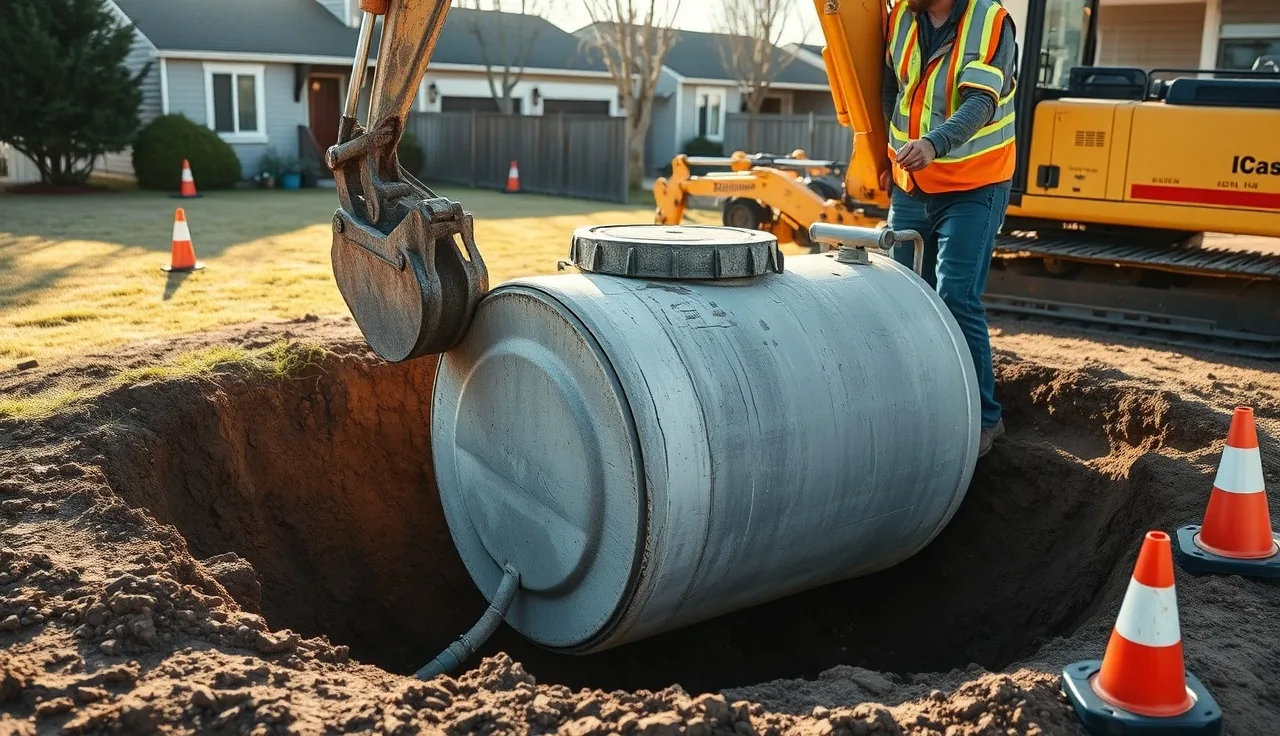
Fitting a septic tank is the whole process of putting a wastewater treatment system in the ground: soil testing, permitting, excavation, tank placement, pipe connections, drain field construction, and a county inspection before anyone flushes a toilet. It's more than dropping a tank in a hole. The drain field, also called a leach field, is half the system and usually the part that makes or breaks a site.
Most homeowners picture the tank as the main event. The tank is really just a settling chamber. Liquid effluent flows out into the drain field, where the soil finishes the treatment. If your soil can't handle that load, no tank on earth saves you.
Onsite wastewater installation is regulated at the state and county level in the US. The EPA's SepticSmart program puts it plainly: "A conventional septic system consists of a septic tank and a drainfield, or soil absorption field." [1] Almost every jurisdiction wants a permit and a licensed or certified installer. Some rural states let you install on your own property, but you'll still need a permit and a passed inspection.
Do you need a permit to install a septic tank?
Yes, in nearly every US county. The permit comes from the local health department or environmental agency in most states, not the building department. You apply with a site plan, a soil evaluation, and often a perc test report. The permit spells out tank size, setback distances, drain field dimensions, and approved materials.
Setback rules are strict. The EPA and most state codes require at least 50 feet between a septic tank and any well, 10 feet from the foundation, and 5 to 10 feet from property lines. Some states go tighter. Florida's Chapter 64E-6, for one, sets installation and setback standards that run past federal minimums. [10] Check your county health department before you buy a single length of pipe.
Skipping the permit isn't a shortcut. An unpermitted system can force you to dig it all up and redo it, and it will surface during a home sale inspection. Most title companies now want a septic inspection before closing. [2]
For a full look at what permitting adds to your budget, see our breakdown of the cost to install a septic system.
What soil tests do you need before fitting a septic tank?
Two tests matter: a percolation (perc) test and a soil profile evaluation. Together they decide whether your site supports a conventional drain field, and if not, which alternative system the county will approve.
A perc test measures how fast water drains from a test hole. The standard method in most state codes, drawn from long-standing EPA guidance, digs holes 6 to 8 inches wide down to the proposed drain field depth, soaks the soil over 24 hours, then times the water level drop across a 30-minute window. A passing rate usually falls between 1 and 60 minutes per inch. Slower than 60 mpi and a conventional system probably won't work. [1]
The soil profile evaluation (sometimes called a soil morphology evaluation) goes deeper, usually 5 to 8 feet, hunting for restrictive layers like hardpan, heavy clay, or seasonal high groundwater. A licensed soil scientist or certified evaluator handles this in most states.
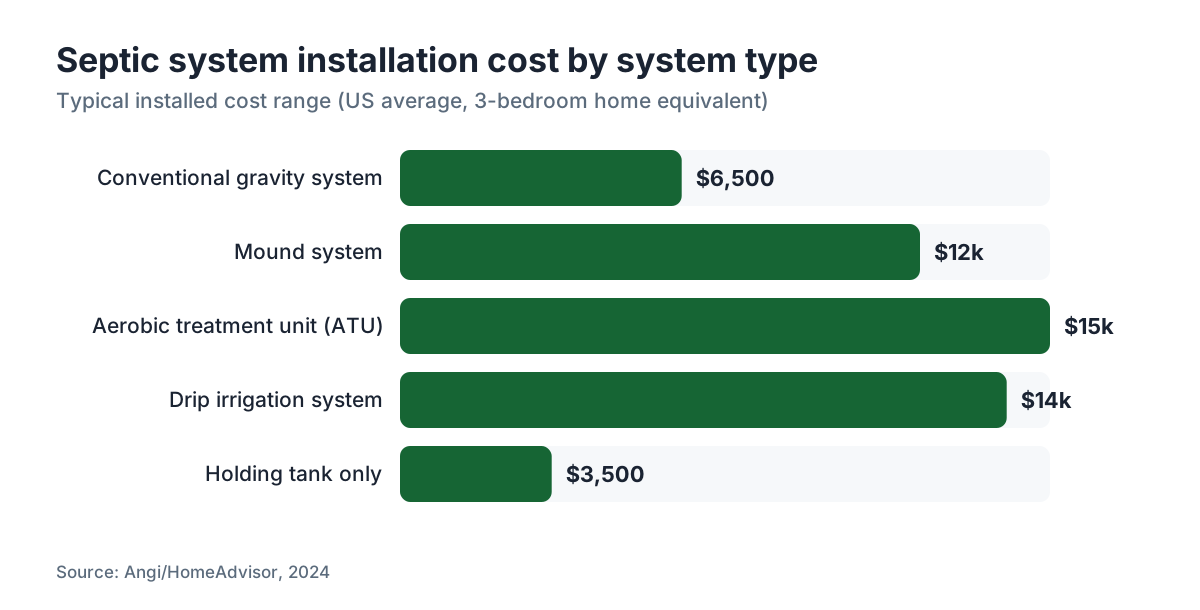
Fail the soil, and you're not automatically stuck. Mound systems, drip irrigation, aerobic treatment units (ATUs), and constructed wetlands are all approved alternatives somewhere. They cost more, often $8,000 to $20,000 and up installed, but they work where a conventional system can't. [3]
What size septic tank do you need?
Tank size is set by bedroom count and daily flow. Most state codes use bedroom count as a stand-in for occupant load. The sizing table from the EPA, adopted by most states, looks like this:
| Bedrooms | Minimum tank size (gallons) |
|----------|-----------------------------|
| 1-2 | 750 |
| 3 | 1,000 |
| 4 | 1,200 |
| 5-6 | 1,500 |
| 7+ | Engineered design required |
These are minimums. Going one size up is almost always worth the extra few hundred dollars. A larger tank buys more retention time, which means better settling and fewer solids reaching your drain field. Drain field repairs are brutal on the wallet. [4]
For a three-bedroom home, 1,000 gallons is the common minimum, but plenty of county codes now require 1,250 gallons for new construction. Concrete, fiberglass, and polyethylene (plastic) tanks all pass muster in most states. Concrete is the most common. Fiberglass and poly are lighter and easier to set in tight access, and they don't crack from frost the way concrete can up north.
See our septic tank installation guide for a full material comparison.
Step-by-step: how to fit a septic tank
Here's the actual sequence, assuming you've already passed your soil evaluation and pulled a permit.
Step 1: Mark the site and call 811
Before any digging, call 811 (the national call-before-you-dig hotline) at least two business days ahead. Utilities will mark buried lines. Skip this and you're looking at fines, liability, and a real chance of hitting a gas line. [5]
Step 2: Excavate the tank hole
The excavator digs to the depth on your permit. The hole runs wider than the tank on all sides, usually 12 to 18 inches of clearance, to leave room for bedding and adjustment. Depth is set so the inlet pipe enters at the right elevation relative to your home's drain line, holding a fall of at least 1/4 inch per foot. [6]
Step 3: Prepare the base
A 6-inch layer of compacted sand or fine gravel goes in the bottom of the hole. It gives the tank a flat, stable seat and stops the settling that would stress the inlet and outlet pipes. For concrete tanks in a high-water-table area, the base sometimes needs to be thicker, and inspectors check for it.
Step 4: Set the tank
A crane or excavator lifts the tank into place. Concrete tanks for a three-bedroom home weigh 8,000 to 12,000 pounds empty, so this takes real equipment. Fiberglass and poly tanks run 300 to 600 pounds, which sounds easy until you learn they can float right out of the ground when the water table is high and they aren't ballasted. For light tanks in wet sites, installers add concrete anchors or partly fill the tank with water before backfilling.
Step 5: Connect the inlet pipe
The inlet pipe runs from the home's main sewer line to the tank's inlet baffle. Slope has to stay consistent. A quarter inch of drop per linear foot is the standard. Too little and solids settle in the pipe. Too much and liquid races ahead, leaving solids behind. The inlet baffle inside the tank aims flow downward, slowing it so solids drop to the bottom instead of shooting straight to the outlet. [6]
Step 6: Connect the outlet pipe
The outlet baffle keeps the floating scum layer from leaving the tank. The outlet pipe runs from the tank to the distribution box (d-box) or straight to the drain field trenches. Same slope rules. In a two-compartment tank (now required in many states), effluent passes through a center wall baffle before it reaches the outlet.
Step 7: Install the distribution box
The d-box splits effluent evenly among the drain field laterals. It's usually a small precast concrete or plastic box, set dead level. Level is non-negotiable. If one side sits even 1/4 inch low, that lateral hogs the flow and the others get almost nothing.
Step 8: Install the drain field
Trenches are dug to permit specs, usually 18 to 36 inches deep and 18 to 36 inches wide, with perforated pipe surrounded by washed stone (typically 3/4 inch) and covered by geotextile fabric before backfill. Gravel-free chamber systems (like Infiltrator and similar brands) are common now and often preferred because they offer more infiltration area per linear foot. [7]
Step 9: Inspect and backfill
The county inspector comes before you cover anything. They check tank seating, pipe slope, baffle installation, d-box level, and drain field dimensions. Backfill happens after approval. The soil over the drain field gets mounded slightly, 6 to 12 inches, because it settles.
Step 10: Establish cover and mark access
Lid risers should bring the tank access ports within 6 to 8 inches of grade, or to grade if the lids are traffic-rated. Mark the location. Future septic tank pumping is far easier when you or the next owner can find the lid without a shovel and a guess.
What are the common mistakes when fitting a septic tank?
Wrong pipe slope is the mistake that causes the most near-term failures. Too flat, and solids fill the line. Too steep, and liquid outruns solids, which dry out and harden in place.
Setting the tank out of level comes next. The inlet has to sit higher than the outlet by the baffle depth. Tilt the tank side to side and a baffle wall may stop working the way it should.
Backfilling all at once is a mistake you can't see after the fact. Dumping the excavated soil back in one shot compresses unevenly and can crack concrete walls or distort a plastic tank. Do it right in 6-inch lifts, compacting each one.
Planting trees near the drain field seems obvious, and people still do it. Roots find the perforated pipes within a few years. Keep aggressive-rooted trees (willows, maples, cottonwood) at least 50 feet from the drain field edge.
And then there's skipping the as-built. Your permit may require an as-built drawing showing exactly where everything is buried. Even if it doesn't, draw one and keep it. Every septic tank inspection and every septic system repair down the road goes faster when someone knows where the d-box is.
How deep does a septic tank need to be buried?
The top of the tank usually sits 6 inches to 4 feet below finished grade, depending on the depth of your home's sewer outlet and your local frost depth. In cold climates, the inlet pipe has to run below the frost line so it won't freeze. Minnesota frost depth runs 42 to 60 inches, so components may need to go deeper there than in Georgia, where 12 inches is typical. [8]
The inlet pipe invert (the bottom inside of the pipe) has to be at least 3 inches above the outlet invert inside the tank. That elevation difference, plus the baffles, is what creates the settling zones. Most tanks are built so the inlet and outlet connections sit at fixed heights on the tank wall. You set the tank depth to match your pipe elevation, not the reverse.
If your home's sewer exit is very deep, the tank goes deep, and the drain field has to go deeper still, which starts stirring up groundwater problems. If the sewer exit is shallow, you may need a pump chamber to lift effluent to a raised drain field.
How much does it cost to fit a septic tank?
Installed cost for a conventional septic system in the US runs about $3,000 to $12,000 for a straightforward site, with the national average near $6,000 to $7,500. [9] That range covers a 1,000-gallon concrete tank, a simple gravity-fed drain field, standard excavation, and permit fees.
What pushes cost up: rock excavation (adds $1,000 to $5,000 and up), poor soil that forces an alternative system ($8,000 to $20,000 and up), a big house that needs a larger tank and more drain field footage, and county permit fees that swing from under $100 in some rural counties to over $1,000 in others.
Pump systems, mound systems, and aerobic treatment units all cost more because they carry more components and more maintenance. ATUs in particular require a service contract in many states, since their mechanical parts need regular inspection.
The tank itself is a small slice of the total. A 1,000-gallon concrete tank runs $700 to $1,200 before delivery and setting. A 1,000-gallon plastic tank runs $900 to $1,500. Labor, equipment, permits, and drain field materials are where the money goes.
For regional breakdowns, see our articles on cost to put in a septic tank and septic tank installation.
Can you install a septic tank yourself (DIY)?
In some states, yes. Plenty of rural states, including Texas, Tennessee, and parts of the Midwest, let a homeowner install a system on their own property with a permit and a passing inspection. What they won't waive is the permit, the soil evaluation, or the final inspection.
In practice DIY is uncommon. The equipment alone is the hurdle: an excavator that can dig 6 to 8 feet with control, a way to set a multi-ton concrete tank, and a compactor for the drain field bedding. Rental for a single weekend runs $1,200 to $2,500, which is more than most people plan for.
States with strict licensing (California, Florida, New York, New Jersey, Oregon, and most of the Northeast) effectively force you to hire a licensed contractor no matter what the homeowner-install statute says, because the licensed contractor is the one who can legally pull the permit and certify the work.
Seriously considering DIY? Call your county health department first. They'll tell you what license (if any) an installer must hold, what the permit requires, and what the inspection covers. Don't trust a forum post. Rules change, and they vary by county inside the same state.
How do you connect a septic tank to a house?
The connection runs from your home's main drain line, which exits the foundation as a 4-inch pipe, to the inlet of the septic tank. Most installations use 4-inch Schedule 40 PVC, though some older codes allowed cast iron or ABS.
The pipe leaves the foundation below the frost line and runs at a steady 1/4 inch per foot slope to the tank inlet. Every bend adds friction and a spot for a clog, so keep fittings to a minimum. Where you do need to turn, use long-sweep 90s or two 45-degree fittings, never standard 90-degree elbows.
At the tank wall, the pipe connects through a precast or drilled inlet fitting. Most precast concrete tanks arrive with standard 4-inch fittings already cast in. Fiberglass and poly tanks have threaded or flanged inlet and outlet ports. A rubber boot or flexible coupling makes the joint watertight and lets the pipe and tank shift a little independently without cracking.
Inside the tank, the inlet tee or baffle drops down into the liquid so incoming solids don't stir up the settled sludge. Check that the tee is seated before backfilling. You can't get to it again without septic tank pumping first.
The outlet connection uses the same pipe size and method, running from the outlet port to the d-box or drain field. Never glue the tank side of this joint. Leave it on a rubber boot so you can disconnect it for future service.
How long does it take to fit a septic tank?
The install itself, from excavator arriving to backfill done, takes one to three days for a conventional system. Rocky ground, a high water table, or an alternative system can stretch it to a week or more.
The part before installation eats the most time. Soil evaluation scheduling, permit review, and approval often run four to twelve weeks in busy counties. High-growth areas can back up six months or more. Budget for it when you're planning a new home or an addition that needs a new system.
After installation, most counties require a final inspection before you can use the system. Scheduling that adds two to ten business days in most areas. Some jurisdictions offer a same-week inspection if you call before the pour.
If you run a crew and track timelines across many jobs, a tool like SepticMind can flag permit delays and inspection scheduling gaps before they push a project week over week, which matters once you're juggling more than a handful of installs.
Once the system passes and the soil settles, keep heavy vehicles off the drain field for at least a week. The backfill hasn't compacted yet, and a loaded truck over a fresh lateral crushes the pipe.
How do you maintain a septic tank after installation?
Pumping is the maintenance task that matters most. The EPA recommends pumping every three to five years for a typical household. [1] Sludge and scum build up in the tank over time. Once the sludge layer reaches the outlet baffle, solids carry into the drain field and plug it. Drain field repairs run $3,000 to $15,000, and sometimes the whole field has to be replaced.
For most three-to-four-bedroom homes, every three to five years is right. Larger households or heavy garbage disposal use push that toward every two to three years. See our guide on how often to pump a septic tank for a schedule tuned to tank size and household size.
Beyond pumping, the rules are simple. Flush nothing but human waste and toilet paper. No wipes, no floss, no medications, no cooking grease. Skip the garbage disposal if you can; it roughly doubles the solids load. Don't park vehicles or plant trees over the drain field. Don't dump a lot of water in a short window, which hydraulically overloads the field.
Walk the drain field a couple of times a year. Soggy spots, bright green grass over the laterals, or a sewage smell near the field all point to early failure. Catching it early is the difference between a repair and a replacement. More on that in our septic tank repair guide.
For pumping and cleaning schedules, see septic tank pump out and septic tank cleaning.
Frequently asked questions
How deep does a septic tank need to be in the ground?
The top of the tank is usually 6 inches to 4 feet below finished grade. Exact depth depends on the elevation of your home's sewer outlet and your local frost depth. The inlet pipe must sit below the frost line in cold climates. In Minnesota that means 42 to 60 inches deep; in the South, 12 inches is often enough. Your county permit will specify the required depth for your site.
How far does a septic tank need to be from a house?
Most state codes require at least 5 to 10 feet from a foundation and at least 50 feet from any drinking water well. Some states go stricter. The tank must also hold setbacks from property lines, streams, and wetlands. These distances are set by your county health department or state environmental agency, and they vary. Always check local code before finalizing a tank location.
Can I install a septic tank without a permit?
No, not legally. Every US state requires a permit for a new septic system. Unpermitted systems can be ordered removed at your expense, create liability during a home sale, and may not be insurable. Some rural states allow homeowner installation with a permit; most require a licensed installer. Call your county health department to find out exactly what's required in your area before starting any work.
How long does a newly installed septic tank last?
A well-installed concrete tank lasts 40 to 50 years or more. Fiberglass and plastic tanks can last 30 to 40 years. The drain field is the likelier failure point: a well-maintained conventional field usually lasts 25 to 30 years. Neglect, mainly skipping pumping and sending solids into the field, cuts that to 10 to 15 years. Pumping on schedule is the single most effective way to extend system life.
What happens if a septic tank is not installed correctly?
A poorly installed tank can fail within months. Common results include sewage backing up into the house, drain field saturation and failure, groundwater contamination, and raw sewage breaking out at the surface. Any of these can require full system replacement costing $5,000 to $25,000 depending on the site. A failed inspection means mandatory correction before you can use the system. Getting it right the first time is far cheaper.
Do you need a drain field with every septic tank?
In almost all US jurisdictions, yes. A septic tank alone doesn't treat wastewater to a level safe for disposal; it only separates solids from liquid. The liquid effluent has to go to a drain field, mound system, drip irrigation field, or other approved dispersal method. Holding tanks that require pump-out are legal in some areas but aren't a treatment system and need frequent pump-outs, sometimes every few weeks.
What type of pipe is used to connect a septic tank to a house?
Four-inch Schedule 40 PVC is the standard for the house-to-tank line in most US codes today. Some older systems used cast iron or ABS. The pipe runs at a steady 1/4 inch per foot slope from the house drain to the tank inlet. Long-sweep bends beat standard elbows at any change of direction. The joint at the tank uses a rubber boot or flexible coupling to allow for minor movement.
How do you know what size septic tank you need?
Tank size is based on bedroom count and estimated daily water use. Most state codes require a minimum of 750 gallons for 1 to 2 bedrooms, 1,000 gallons for 3 bedrooms, and 1,200 gallons for 4 bedrooms. Going one size larger than the minimum is usually worth the extra few hundred dollars because a bigger tank retains solids better and protects the drain field. Your county permit will specify the minimum size.
Is a two-compartment septic tank better than single-compartment?
Yes, and most modern codes now require two-compartment tanks for new installs. The center baffle gives a second stage of settling before effluent reaches the outlet. That means cleaner effluent entering the drain field, which extends field life. If your code allows either and you're choosing between them, pick two-compartment.
How soon can you use a septic system after installation?
You can use the system once it passes the county final inspection. Most inspectors want to see the system before any backfill, so inspection happens mid-installation, and use can begin as soon as backfill is done and the inspection is signed off. There's no mandatory waiting period for the tank itself. Just keep heavy equipment off the drain field for the first few weeks while the backfill settles.
How do you find a licensed septic installer in your area?
Your county health department is the best starting point. They keep lists of licensed or registered installers authorized to pull permits in that county. The National Onsite Wastewater Recycling Association (NOWRA) also has a member directory. Get at least three bids, ask for references on recent installs in similar soil, and verify the license is current with your state licensing board before you sign anything.
What is the difference between a septic tank and a cesspool?
A septic tank is a sealed container that separates solids from liquid; the liquid then flows to a drain field for soil treatment. A cesspool is a pit with perforated walls that lets raw sewage leach straight into surrounding soil. Cesspools are banned for new construction in most US states because they contaminate groundwater. Many older properties still have them, and some states require replacement when a property sells.
Can you drive over a septic tank after installation?
Standard residential tanks aren't rated for vehicle traffic. Driving over a concrete tank with a loaded vehicle can crack the lid or the walls. If a vehicle crossing is unavoidable, you need a traffic-rated tank or a reinforced concrete pad over it. Never drive over the drain field at all; even a single pass with a heavy vehicle can crush the perforated pipe or compact the soil and kill the system.
How do you tell where a septic tank is buried on a property?
Check with your county health department first. Permitted systems have as-built drawings on file showing tank location. Your home's main drain line exits the foundation at a specific point; the tank is typically within 10 to 25 feet of that point in the direction the pipe runs. A probe rod pushed into the ground can locate the tank top. Some counties use metal detectors to find the lids. A septic inspector can also locate the system.
Sources
- EPA SepticSmart: How Your Septic System Works: A conventional septic system consists of a septic tank and a drainfield, or soil absorption field. EPA recommends pumping every three to five years for a typical household.
- EPA SepticSmart: Protect It and Inspect It: Regular inspections and maintenance of septic systems are increasingly required at point of home sale.
- EPA: Types of Septic Systems: Alternative systems including mound, drip irrigation, and aerobic treatment units are approved for sites where conventional systems cannot be used.
- EPA: Septic System Design and Installation: Minimum tank sizes by bedroom count are specified in EPA guidance and adopted by most state codes: 750 gallons for 1-2 bedrooms, 1,000 for 3, 1,200 for 4.
- Common Ground Alliance: 811 Call Before You Dig: All 50 states require calling 811 at least two business days before any digging to have utilities marked.
- EPA: Septic System Design and Installation: Inlet and outlet piping standards, including consistent slope and baffle function, are set in EPA and adopted state onsite wastewater guidance.
- EPA: Types of Septic Systems: Gravel-free chamber drain fields are recognized as an approved alternative to conventional stone-and-pipe trenches.
- University of Minnesota Extension: Septic Systems: Frost depth in Minnesota commonly reaches 42 to 60 inches, affecting how deep septic system components must be buried.
- Angi: How Much Does It Cost to Install a Septic Tank: Installed cost for a conventional septic system in the US ranges from approximately $3,000 to $12,000, with the national average near $6,000 to $7,500.
- Florida Department of Health: Onsite Sewage Treatment and Disposal (Chapter 64E-6): Florida's Chapter 64E-6 sets setback requirements and installation standards for onsite sewage systems that exceed federal minimum guidance.
- National Onsite Wastewater Recycling Association (NOWRA): NOWRA maintains a member directory of licensed and certified onsite wastewater professionals by state.
Last updated 2026-07-09