How does a septic tank work? A plain-language explainer
By the SepticMind Editorial Team
TL;DR
- A septic tank is a buried, watertight container that holds household wastewater long enough for solids to sink as sludge and fats to float as scum.
- That leaves a middle liquid layer called effluent, which flows out to a drain field where soil finishes the treatment.
- Most systems run on gravity alone.
- Some lots need a pump to move effluent uphill or across distance.
What is a septic tank, and who actually uses one?
About 21 million households in the United States rely on a septic system as their primary wastewater treatment, according to the EPA [1]. If your home is not connected to a municipal sewer line, you almost certainly have one. Rural areas, exurban subdivisions, and even some in-town lots on large parcels all use them.
The system is simpler than most people expect. Wastewater leaves your house through a single pipe, enters an underground tank, sits there for a day or two, and exits toward a drain field. A conventional gravity system needs no electricity. It needs no chemical additives either. Physics and bacteria do the work.
Septic systems come in several configurations: conventional gravity-fed systems, pressure-dosed systems, mound systems for high water tables, aerobic treatment units (ATUs), and chamber or drip-irrigation drain fields. This article focuses on the conventional tank because that is what most homeowners have. The tank itself works the same way even when the downstream distribution method changes.
How does a septic tank work, step by step?
Every flush, every shower, every load of laundry sends wastewater down your drain pipes to a single buried tank. Here is what happens inside.
Step 1: Separation by density. Raw sewage is not one uniform liquid. Heavy solids, grit, and fecal matter sink to the bottom and form a layer called sludge. Fats, oils, greases, and soap scum are lighter than water and float to the top. The middle zone, roughly 60 percent of the tank's volume in a working system, is the effluent, or clarified liquid. This separation happens continuously as wastewater flows in.
Step 2: Anaerobic digestion. Bacteria that live without oxygen (anaerobes) break down the organic material in the sludge layer. They shrink its volume over time, but never to zero. That is why pumping is necessary eventually. The digestion also produces gases like methane and carbon dioxide, which vent out through your home's plumbing stack.
Step 3: Effluent exits to the drain field. When new wastewater enters the tank, it displaces the same volume of clarified effluent out through the outlet baffle or tee and toward the septic drain field. The outlet sits below the scum layer and above the sludge layer, so only the middle liquid zone leaves. A well-designed tank keeps solids from reaching the field.
Step 4: Soil finishes the job. The drain field is a network of perforated pipes laid in gravel-filled trenches. Effluent percolates into the soil, where microorganisms in the top few feet remove pathogens, nitrogen compounds, and remaining organics before the water reaches the water table. This final step is why siting and soil testing matter so much before installation.
The whole system regulates itself in one sense: no valve opens to release effluent on a schedule. Every gallon that enters pushes a gallon out. High-use days push more effluent to the field. That is why spreading laundry loads across the week matters for field health.
What are the parts inside a septic tank?
Modern tanks are precast concrete, fiberglass, or polyethylene. Concrete dominates older installations. Fiberglass and plastic are lighter and show up more in new builds. All share the same internal anatomy.
Inlet baffle or tee. The inlet pipe from the house connects to a baffle or sanitary tee fitting inside the tank. Its job is to steer incoming wastewater down into the liquid zone instead of blasting it across the surface, which would disturb the scum layer and push solids toward the outlet.
Outlet baffle or tee. The outlet side has a similar fitting, typically extending 12 to 18 inches below the liquid surface. This keeps the scum layer from flowing out with the effluent. In older tanks these baffles are concrete and erode over time. In newer tanks they are often PVC sanitary tees, which last much longer.
Two chambers (in most tanks built after the 1970s). A dividing wall separates the tank into a primary and secondary chamber. Effluent moves from the larger first chamber through an opening near the bottom of the partition into the smaller second chamber before it exits. This two-stage settling removes more solids than a single-chamber design.
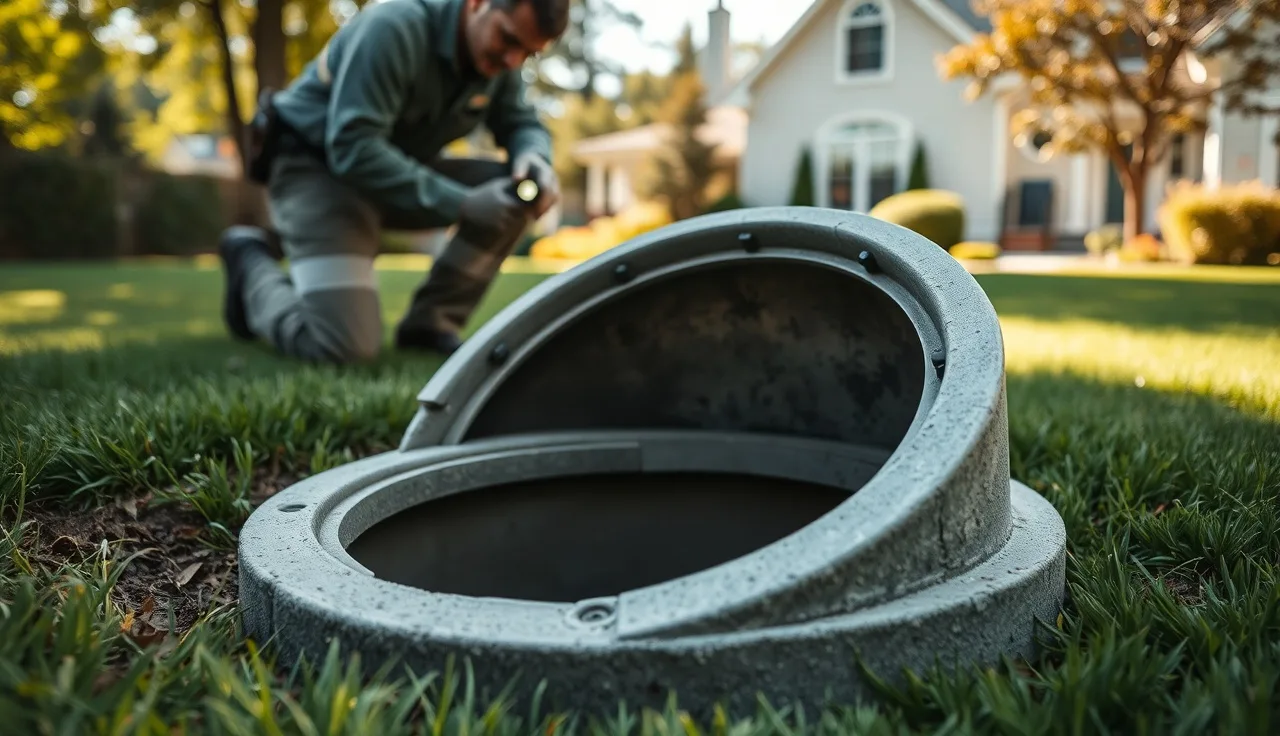
Access risers and lids. The tank is buried, sometimes a foot or more underground, and the access ports are the only way to inspect or pump it. Concrete lids at grade or septic tank risers (plastic extensions that bring the opening to ground level) make service calls faster and cheaper.
Tank size matters. The EPA and most state codes require a minimum of 1,000 gallons for a two-bedroom home, with larger tanks for larger homes [2]. Many states mandate 1,250 to 1,500 gallons as a standard minimum. A bigger tank means more retention time, which means better separation before effluent reaches the field.
What is the difference between a gravity system and a septic tank with pump system?
Gravity does the work in a conventional system. The house sits higher than the tank, the tank sits higher than the drain field, and effluent flows downhill without mechanical help. That is the simplest and cheapest setup to own and operate.
Not every lot allows this. When the drain field is uphill from the tank, when the soil type calls for pressure dosing, or when the system uses a mound or drip-distribution field, you need a pump. Pumps show up in a septic system two main ways.
Effluent pump. A septic tank effluent pump system adds a pump chamber or pump vault downstream of the tank. The tank still does its settling job. The pump then doses effluent to the drain field in timed, controlled bursts instead of a steady trickle. Pressure dosing keeps the field from getting overwhelmed during peak use and spreads flow evenly across all the trenches.
Sewage grinder pump. Some properties send raw sewage under pressure from the house to the tank or to a community septic system. A grinder pump sits in a basin at the house, grinds solids finely, and pushes the slurry uphill. These pumps need electricity and more maintenance than effluent pumps.
Pump systems add cost and complexity. An effluent pump runs $300 to $700, and the pump chamber adds to the installation bill. But they open up sites gravity cannot serve. If your control panel has an alarm light, that is the pump system telling you something is wrong. Usually it is a high water level from a pump failure or a float stuck in the off position. Take that alarm seriously and call a service provider within a day or two.
How does a septic drain field actually treat the water?
The drain field, also called a leach field or absorption field, is where septic treatment finishes. It typically covers several hundred to a few thousand square feet, depending on soil type, household size, and local code.
Effluent drains from the tank through a distribution box or manifold that splits flow evenly among several lateral trenches. Each trench runs about 18 to 36 inches deep and is filled with washed gravel or crushed stone. Perforated pipes run the length of each trench. Effluent seeps out of the pipe holes, percolates through the gravel, and enters the native soil below.
The soil's top 12 to 24 inches are the biologically active treatment zone. A community of aerobic bacteria, fungi, and other microorganisms there removes pathogens, consumes organic matter, and converts ammonia to nitrate. Soil particles also filter out suspended solids and some nutrients. The EPA states that soil is "an excellent medium for filtering out harmful bacteria, viruses, and nutrients" when the system is sited and functioning correctly [3].
Soil permeability sets how much effluent any given area can handle. A perc test (percolation test) or a soil morphology evaluation by a licensed soil scientist tells you how many square feet of drain field your lot needs. Slow-draining clay soils need more area. Fast-draining sands need careful siting so the water gets treated before it reaches the water table.
The drain field is the most expensive part to replace, often $8,000 to $25,000 or more depending on size and local labor rates [4]. Protecting it is the best financial argument for every maintenance habit: pumping on schedule, not drowning the system with water, keeping roots and vehicles off the field.
How often does a septic tank need to be pumped?
The EPA recommends inspecting a septic system every three years and pumping every three to five years for a typical household [1]. State codes vary. North Carolina ties inspection frequency to system type under its onsite wastewater rules [7]. Other states leave it to homeowner discretion.
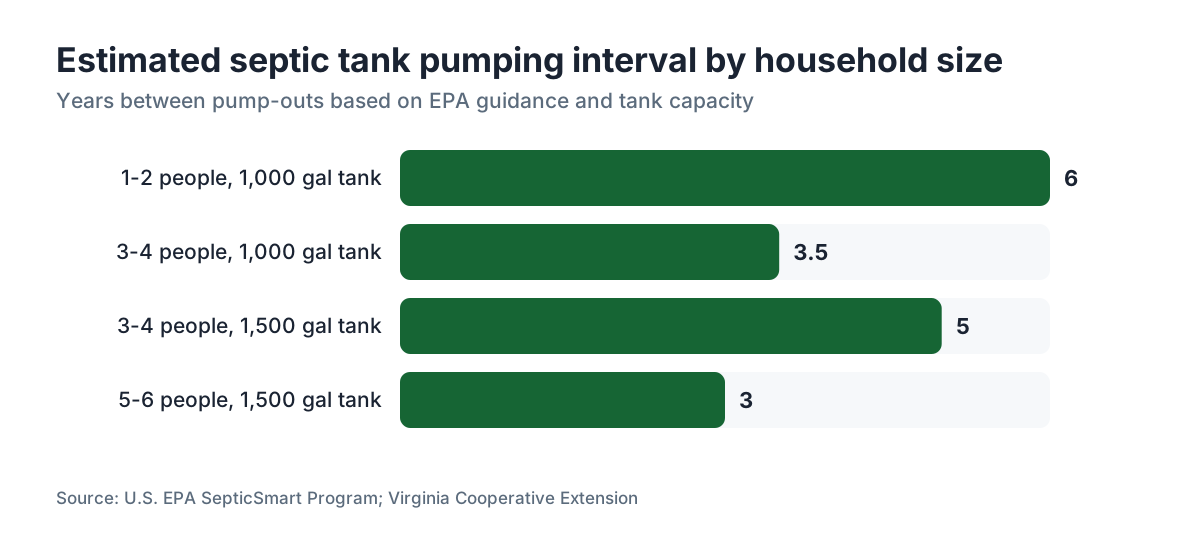
The real answer depends on tank size and household use. A 1,000-gallon tank serving a family of four fills with sludge faster than a 1,500-gallon tank serving two people. The table below shows rough pumping intervals drawn from EPA and extension guidance [10].
| Household size | Tank size | Estimated pump interval |
|---|---|---|
| 1-2 people | 1,000 gal | 5-7 years |
| 3-4 people | 1,000 gal | 3-4 years |
| 3-4 people | 1,500 gal | 4-6 years |
| 5-6 people | 1,500 gal | 2-4 years |
These are estimates. The only way to know if a tank actually needs pumping is to have a technician measure sludge and scum depth. Penn State Extension gives the working rule: pump when the sludge layer is within 12 inches of the outlet baffle, or when combined sludge and scum fill more than one-third of the tank's liquid capacity [8].
Skipping pumping is expensive. Sludge builds until it reaches the outlet, then solids ride out into the drain field. A biomat (a dense biological clog) forms in the trenches, effluent backs up, and you are looking at a field replacement instead of a pump-out. A pump-out costs $300 to $600 in most markets [4]. A new drain field costs ten to thirty times that. See our full breakdown on how often to pump a septic tank by household size and tank capacity.
What causes a septic system to fail?
Most failures trace back to a few predictable causes.
Neglected pumping. This is the most common one. Solids overflow into the drain field. The field clogs. Effluent surfaces in the yard or backs up into the house. Pumping on schedule prevents it almost entirely.
Hydraulic overload. Too much water through the system in a short window saturates the drain field before effluent can percolate. Common triggers: a leaky toilet running 200 gallons a day unnoticed, four loads of laundry on one morning, a full house of holiday guests. The fix is partly behavioral (spread water use) and sometimes structural (larger tank, pressure dosing).
Flushing things that don't break down. Wipes labeled "flushable" are not, from the drain field's point of view. They do not break down anaerobically and pile up as sludge faster than organic waste. Same story with feminine hygiene products, medications, heavy grease, and large amounts of antibacterial soap. Antibacterials kill the bacteria that make the whole system function.
Tree roots. Roots go where the water is. Drain field trenches and tank joints are full of it. Willow, poplar, and silver maple are the worst offenders. A single root breach in a distribution pipe changes flow patterns and slowly clogs trenches.
Compaction over the field. Parking vehicles or setting heavy equipment over the drain field compresses soil, breaks pipes, and destroys the biological treatment zone. That damage is permanent. Most state codes require setbacks from the field edge for exactly this reason.
Age. Concrete tanks develop cracks. Baffles erode. Inlet and outlet tees crack and fall off, letting solids pass freely. A tank older than 25 to 30 years deserves a close look at each pump-out. If baffles are missing or cracked, replacing them costs a few hundred dollars and prevents field damage worth thousands.
Once failure starts, see septic tank repair or septic system repair for what can be fixed versus what has to be replaced.
How do you know your septic tank is full or failing?
The warning signs are hard to miss once you know them. Slow drains at more than one fixture, sewage odors, and soggy ground over the drain field are the big three.
Slow drains throughout the house (more than one fixture, which rules out a simple pipe clog) often mean the tank is very full or the field is backing up. A gurgle in drains or toilets after flushing is another clue. The clearest sign is effluent surfacing in the yard above the drain field: a soggy patch of grass that is unusually green and may smell.
Inside the house, sewage odors without a visible backup suggest a broken outlet baffle or a failing drain field. Sewage coming up the lowest floor drain is a late-stage warning and means the system is completely overwhelmed.
None of these problems fix themselves. Get a licensed septic professional out for an inspection. Many state health departments keep lists of licensed inspectors; check your state environmental or health agency's website for your area.
For a pump-out, people ask about a few named services. A standard pump-out clears the tank's liquid and solids, while septic tank cleaning usually adds a rinse of the tank walls and a baffle check. A septic tank emptying service and a pump-out are usually the same thing, though the words change by region. See septic tank pump out for what to expect during the visit.
What are the rules and regulations that govern septic systems?
Septic systems are regulated at the state and local level, not federally, though the EPA publishes guidance that most states reference. The Clean Water Act gives the EPA authority over water quality generally, and the agency runs the SepticSmart program to promote proper maintenance [1]. The actual permitting, installation standards, setback requirements, and inspection mandates come from your state environmental or health agency, and often from your county too.
The EPA's guidance sets a floor on tank sizing, and most states set their own minimums, often higher. North Carolina requires 1,000 gallons for up to a three-bedroom home under its onsite wastewater rules [7]. California's Title 22 and individual county codes govern onsite wastewater systems there, and requirements swing a lot by county.
SepticMind's compliance tools help service operators track state-specific inspection schedules and keep system records digital, which matters when a county health department wants service history during a property sale.
Property sales often require a septic inspection as a condition of closing. Some states mandate it by law; others leave it to the lender or buyer. A failed inspection is a negotiating point, not always a deal-breaker, but many jurisdictions require repairs before occupancy. Know your state's rules before you list or buy a home with a septic system.
For new installations, local health departments issue permits, run soil evaluations, and inspect the system at several stages of construction. Skipping permits creates liability at resale and can void homeowner's insurance claims tied to the system.
How much does a septic system cost to install and maintain?
Installation costs swing hard by system type, lot conditions, and local labor markets. A conventional gravity system on a straightforward lot typically runs $10,000 to $20,000 installed, including the tank, drain field, and permits. Complex sites, mound systems, or lots with difficult soil can push costs to $30,000 to $50,000 or more [4].
Tank size, depth, and material matter too. A precast concrete 1,500-gallon tank costs less to buy than a comparable fiberglass tank but costs more to haul and set because of its weight. For a detailed breakdown, see cost to install a septic system or cost to put in a septic tank.
Annual maintenance is cheap if you stay on schedule. Pumping every three to five years at $300 to $600 works out to $60 to $200 a year. An inspection every three years adds $100 to $300 per visit. Set that against a drain field replacement at $8,000 to $25,000 and the math makes itself.
The table below sums up typical cost ranges for key services.
| Service | Typical cost range | Frequency |
|---|---|---|
| Septic tank pump-out | $300-$600 | Every 3-5 years |
| System inspection | $100-$300 | Every 1-3 years |
| Baffle replacement | $200-$500 | As needed |
| Effluent pump replacement | $500-$1,500 | Every 7-15 years |
| Drain field repair (partial) | $1,000-$5,000 | As needed |
| Full drain field replacement | $8,000-$25,000 | 20-30+ year life |
See septic tank pumping for a closer look at what the service includes and how to read a quote.
What can and can't you put into a septic system?
The bacteria in your tank are doing real biological work. Anything that kills them or adds solids that will not break down shortens the life of your system.
Fine in moderation: toilet paper (single-ply breaks down fastest), human waste, food scraps from a garbage disposal (though disposals speed up sludge buildup, and some codes ban them on smaller systems), and normal household cleaners in reasonable amounts.
Keep out entirely: grease and cooking oils (they form a stubborn scum layer), paint and solvents (they kill the bacteria and contaminate groundwater), medications (same), and "flushable" wipes of any brand. A 2019 Water Research Foundation study found that wipes labeled flushable caused problems in wastewater systems because they do not disintegrate in transit or in tank conditions [5].
The garbage disposal question is genuinely debated. The EPA notes that a disposal on a septic system can significantly increase the fats, oils, and grease entering the tank and may call for more frequent pumping [1]. Most septic pros I've talked with say if you have one, pump on the short end of the recommended schedule.
Chemical septic treatments and additives are heavily marketed and largely useless. The EPA and the university extension programs that have reviewed them find no convincing evidence that biological or enzyme additives improve performance in a properly functioning system [6]. A healthy system already has all the bacteria it needs. Save your money.
How do aerobic septic systems and alternative systems differ from a conventional tank?
A conventional anaerobic septic tank treats waste with bacteria that work without oxygen. Aerobic Treatment Units (ATUs) pump air into the tank to feed a different population of aerobic bacteria, which digest waste more completely and produce cleaner effluent. That effluent is often clean enough for spray irrigation in states that permit it [9].
The tradeoff is hardware. ATUs have electric air pumps, motors, and control panels that need service every six to twelve months. They cost more to install ($10,000 to $20,000 just for the treatment unit) and more to run. They make sense where drain field area is tight or where state rules require a higher level of treatment before disposal.
Mound systems put the drain field above natural grade, built up with imported soil, when the water table or bedrock sits too close to the surface for in-ground trenches. An effluent pump doses the mound from below. Mounds cost more to install and need more attention, but they can make an otherwise unbuildable lot usable.
Drip irrigation systems spread effluent through small-diameter tubing buried just below the surface, at high frequency and low volume. They need filtration, dosing pumps, and disinfection (often UV or chlorine) before distribution. They are the most mechanically complex of the common options.
For most homeowners with a conventional tank, none of this matters day to day. But if you are buying a home with a control panel, an alarm, or a spray head in the yard, you have a more complex system, and it needs more attentive maintenance.
Frequently asked questions
How does a septic tank work with a garbage disposal?
A garbage disposal sends food solids straight into the tank, which speeds up sludge buildup. The EPA notes this can significantly increase the fats and solids entering the system. If you use one, pump on the short end of the recommended interval, probably every two to three years rather than five. Some state codes and older tank designs prohibit disposals entirely on small tanks.
How does a septic tank work in winter when the ground freezes?
Tanks buried below the frost line keep working through winter. The biological processes slow in cold temperatures but do not stop. Trouble comes when the soil above the tank or field is saturated before it freezes, when systems sit unused for weeks (vacation homes), or when snow cover gets scraped off the drain field. Regular use and adequate soil cover insulate the system well in most climates.
Can a septic tank overflow into the house?
Yes. When the tank is completely full or the drain field is saturated and backing up, wastewater has nowhere to go but back up the lowest drain in the house. The lowest floor drain or a ground-floor toilet backs up first. This is a health emergency. Stop all water use immediately and do not run any water until a licensed provider pumps the tank and assesses the system.
How long does a septic tank last?
A precast concrete tank typically lasts 40 years or more if the concrete was good and the tank gets pumped on schedule. Fiberglass and polyethylene tanks last 30 to 40 years. Steel tanks, common in older installations, corrode and often fail in 15 to 25 years. The drain field generally lasts 20 to 30 years with proper care. Neglect cuts every one of these timelines short.
What is the white pipe sticking out of my yard near my septic tank?
It is most likely a cleanout, an inspection port, or a vent pipe for the system. Inspection ports let a technician check liquid levels and baffle condition without full excavation. A vent pipe relieves gas pressure from the tank or field. Some systems use green or white marker pipes above distribution boxes. If you are not sure, a licensed inspector can identify it during the next service visit.
How do septic systems work on a small lot?
Small lots create real constraints, because drain fields need setbacks from property lines, wells, buildings, and surface water. Options include chamber systems (which need less trench area), drip irrigation, or aerobic treatment units with spray disposal. A soil evaluation and site plan from a licensed designer tells you what is feasible. Some lots simply cannot support a compliant system, which affects whether you can build.
Is it safe to have a vegetable garden over a septic drain field?
Most extension services and the EPA advise against it. Root crops like carrots and beets can touch effluent in the soil. Surface-applied effluent in a failing field can contaminate produce. Shallow-rooted plants like grass or flowers are fine over the field and actually help by taking up moisture and nutrients. Keep vegetable gardens at least 10 feet from the field edge as a conservative rule.
What happens to the water that leaves a septic system?
Effluent flowing from the tank to the drain field percolates through soil, where microorganisms remove pathogens and nutrients. The treated water eventually reaches the water table and moves through the groundwater system. In a properly sited, functioning system, the water reaching the table has been adequately treated. That is why setback distances from wells and surface water are legally required, more than suggested.
Do septic additives really help a septic tank work better?
No reliable evidence supports biological or enzyme additives in a healthy, functioning system. The EPA and university extension research consistently find no performance benefit. A working tank already has a dense, well-adapted bacterial population. If a tank smells bad or backs up, the problem is almost always mechanical or hydraulic, not a bacterial shortage. Save the money for the next pump-out.
How do I find my septic tank if I don't know where it is?
Start with your county health department or environmental office. Many keep records of permitted installations with a map or permit drawing showing tank and field locations. If no records exist, follow the sewer pipe from the house outward; it runs to the tank, usually 10 to 30 feet from the foundation. A metal probe rod can locate a concrete tank, and some contractors use electronic locators. Your property records may note a permit number.
How does a septic tank effluent pump system work differently from a gravity system?
In a gravity system, effluent flows downhill from tank to field continuously. A septic tank effluent pump system adds a pump chamber after the tank. A float switch triggers the pump at set water levels, dosing the field in timed bursts. This gives the field recovery time between doses, spreads effluent evenly across all trenches, and lets fields on uphill or level ground be served. The pump needs periodic inspection and eventual replacement.
What is a septic tank riser and do I need one?
A septic tank riser is a cylindrical extension, usually plastic, that brings the tank's access opening up to ground level. Without one, the technician digs down to the lid at every visit, adding time and cost. With a riser, the lid sits at grade, inspection is faster, and emergency access is easy. Most pros strongly recommend them, and many municipalities now require them on new installs. Retrofitting an existing tank costs $200 to $400.
Sources
- U.S. EPA, SepticSmart Program: About 21 million U.S. households use septic systems; EPA recommends inspection every 3 years and pumping every 3-5 years; garbage disposals can increase fats and grease entering the system.
- U.S. EPA, Septic System Design and Sizing guidance: EPA guidance sets a minimum tank capacity of 1,000 gallons for a residence, with larger tanks for larger homes.
- U.S. EPA, How Your Septic System Works: EPA states that soil is an excellent medium for filtering out harmful bacteria, viruses, and nutrients before treated water reaches groundwater.
- U.S. EPA, Septic System Costs and Maintenance: Pump-out costs are typically $300-$600; drain field replacement can cost $8,000-$25,000 or more depending on size and location.
- Water Research Foundation, Flushability Assessment Study (2019): A 2019 Water Research Foundation study found wipes labeled flushable caused problems in wastewater systems because they do not disintegrate under normal conditions.
- University of Minnesota Extension, Septic System Additives: University extension research finds no convincing evidence that biological or enzyme additives improve performance in a properly functioning septic system.
- North Carolina Department of Environmental Quality, Onsite Wastewater Rules: North Carolina requires a minimum 1,000-gallon tank for up to a three-bedroom residence and ties inspection frequency to system type under its onsite wastewater rules.
- Penn State Extension, Septic System Operation and Maintenance: Pump when sludge is within 12 inches of the outlet baffle or combined sludge and scum layers exceed one-third of tank liquid capacity.
- U.S. EPA, Types of Septic Systems: Aerobic treatment units, mound systems, drip irrigation, and chamber systems are recognized alternative septic system designs, and ATU effluent can be clean enough for spray irrigation where permitted.
- Virginia Cooperative Extension, Septic Tank Pumping Frequency: Pumping frequency estimates by household size and tank volume range from 2-7 years depending on occupancy.
Last updated 2026-07-09