How long does a leach field last, and what kills it early?
By the SepticMind Editorial Team
TL;DR
- A well-maintained leach field usually lasts 25 to 30 years, and many run past 40 in favorable soil.
- Skipped pumping, soil compaction, root intrusion, and hydraulic overload are the main killers.
- Catch a problem early and a repair buys you years.
- Catch it late and you're paying $5,000 to $20,000 for a full replacement.
What is the average lifespan of a leach field?
The honest answer is a wide spread: 15 years on the bad end, well past 40 on the good end, with most of the industry landing around 25 to 30 years for a system that gets pumped on schedule and takes no serious abuse [1][2]. The EPA's SepticSmart guidance puts it bluntly, saying a septic system "can last for decades" with proper care and warning that neglect shortens that fast [1].
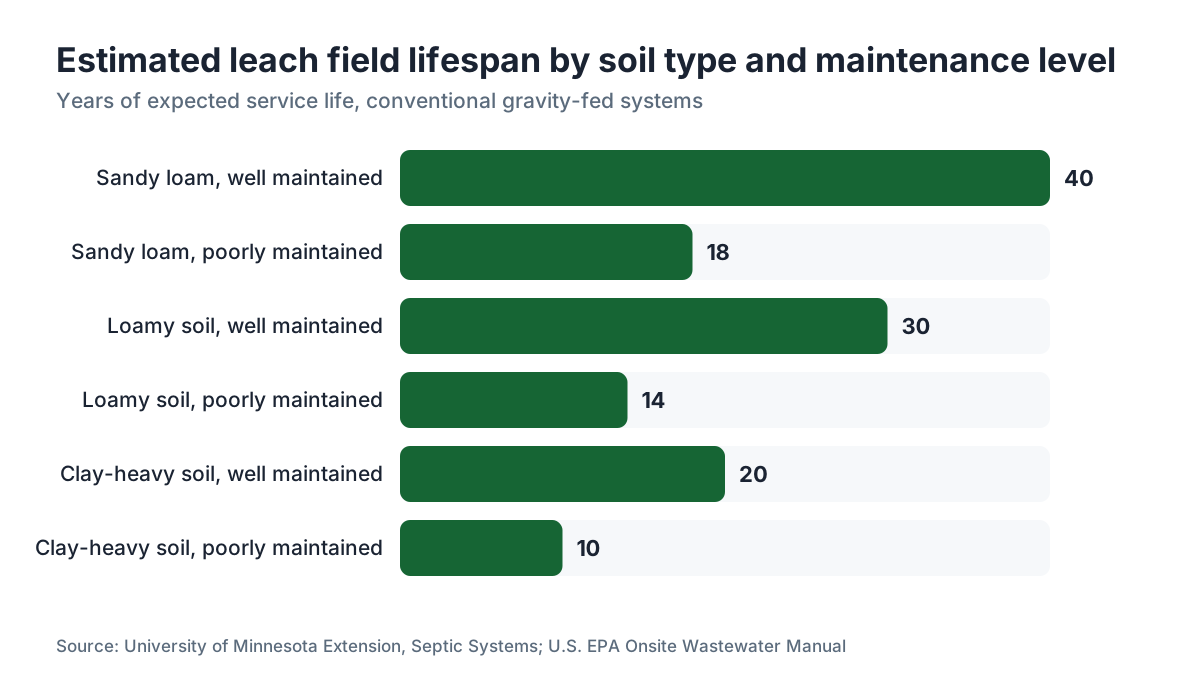
That spread is real, and it matters. A system in sandy, well-draining soil in a dry climate, pumped every three years, kept clear of heavy traffic and tree roots, can outlast the house it serves. A system in tight clay, never pumped, with a car parked on the drain field, might quit in 12 to 15 years.
The leach field, not the tank, is almost always the part that dies first. Tanks are concrete or fiberglass and can be repaired. Failed soil absorption is much harder to undo.
The University of Minnesota Extension puts the typical range at 20 to 30 years and notes that systems installed before the mid-1980s often used lower-quality pipe and aggregate that breaks down faster than modern materials [2]. If your system went in before 1990, keep that in mind when you budget.
Our deeper explainer on leach fields covers how these systems work, if you want the background before we get into what kills them.
What factors determine how long a drain field lasts?
Soil type is the single biggest variable. Sandy loam and loamy sand drain well and resist biomat buildup. Clay drains slowly to begin with, and biomat (the thin biological layer that forms where effluent meets soil) can seal it off much faster. If your perc test came back slow when the system went in, plan for a shorter life.
Hydraulic load is next. Every leach field is sized for a specific daily gallon load, calculated from bedroom count and local code. Push 40% more water than the design load, day after day, from a leaky toilet, extra occupants, or a water softener dumping brine into the system, and you saturate the biomat and collapse the field years early [3].
Pumping frequency matters enormously. When the tank never gets pumped, solids carry over into the distribution pipes and trenches. They don't break down out there the way they do inside an aerobic tank. They just pack in. The EPA and most state codes recommend pumping every three to five years for a typical household [1][4]. Our guide on how often to pump your septic tank breaks down the interval by household size.
Physical damage is easy to underestimate. One vehicle crossing the drain field can crush the distribution pipe or compact the trench enough to cut infiltration in half. Tree roots, especially willow, poplar, and maple, hunt for moisture and can get inside intact pipe within a few growing seasons. Setback rules exist for exactly this reason.
Installation quality is the part nobody sees. Fines-contaminated stone, pipe laid without proper slope, or trenches dug into saturated soil and smeared shut all bake in failure from day one, and no amount of good behavior fully fixes that [2].
What are the signs a leach field is failing?
Sewage odors outdoors, especially near the drain field, are usually the first signal. Anaerobic decomposition underground produces hydrogen sulfide, and when the soil stops absorbing effluent properly, those gases and sometimes the effluent itself come to the surface [1].
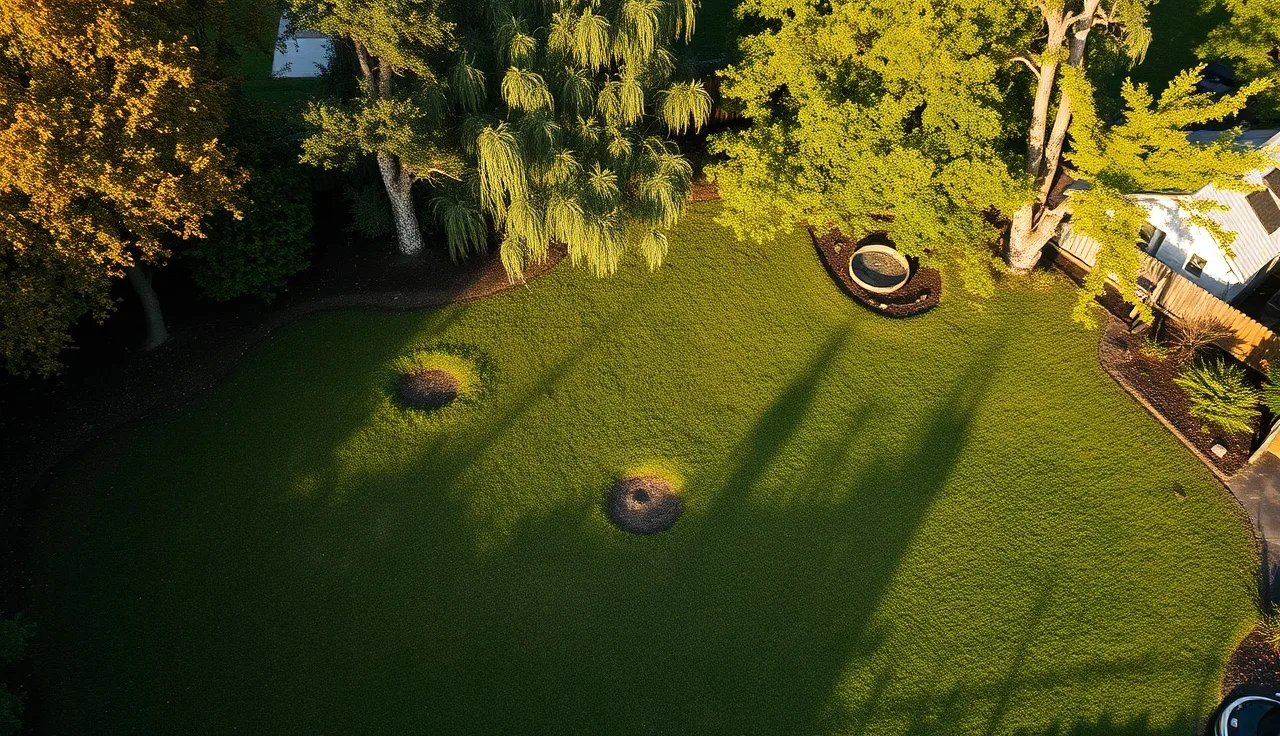
Soft, spongy, or always-wet ground over the field is a red flag. So is a strip of unusually green, fast-growing grass right above the trenches while the rest of the lawn stays normal. That lush stripe is getting fertilized by nitrogen-rich effluent sitting too close to the surface.
Slow drains and gurgling inside the house can mean a saturated field pushing back on the system. If those symptoms show up alongside outdoor odors, don't write it off as a clogged pipe. Get a septic tank inspection done before it backs up into the house.
Sewage surfacing is the endpoint. At that stage you have a public health problem and probably a code violation. Most state codes require you to report a failing system and start repair or replacement within a set window, often 30 to 90 days [3][5].
One thing worth knowing: a high water table from seasonal flooding can look exactly like drain field failure. The field isn't clogged. It just has nowhere to drain. If the symptoms show up only in wet seasons and clear up after, ask a licensed inspector to check water table depth before you replace anything.
How does biomat buildup shorten a leach field's life?
Biomat is the thin, dark, gelatinous layer of microbes and organic solids that forms naturally where effluent meets soil in every leach field. A little of it is normal and actually helps treat the effluent. Too much and the field clogs [6].
The buildup speeds up when the tank sends over solids-heavy or under-treated effluent, when water use runs too high, or when the soil gets worked hard with no rest. Systems with alternating distribution lines (dosing systems) give the soil time to oxidize the biomat between doses. Gravity-fed systems running around the clock give it no rest at all.
Once the biomat seals that interface, infiltration drops off a cliff. Some operators try biomat-reducing additives or air injection. The evidence is mixed at best. The University of Georgia Extension, reviewing the research on septic additives, found no consistent evidence that enzyme or bacterial products improve system performance or clear clogged soil [6]. Aeration treatments (injecting air into the soil around the trenches) have looked more promising in a few small studies, but they don't replace a new field when the old one is far gone.
So the practical takeaway is simple: biomat is the main biological way a field dies, and you keep it thin by pumping on schedule, not overloading the system with water, and spreading the load across the full field instead of hammering one section.
Can a failing leach field be repaired, or does it always need replacement?
It depends on how far gone the field is and what caused the failure.
A crushed or broken distribution pipe is a straightforward fix: dig, swap the pipe section, backfill. That runs about $500 to $2,000 depending on depth and access [7]. Root intrusion without major soil clogging sometimes clears up with hydrojet cleaning of the lines, which can buy years. Those are the easy ones.
Partial biomat clogging, where one zone is saturated but others still work, is the middle case. Rest the clogged zone and route flow to the working lines, and the biomat can oxidize over several months. Some systems can do this by design. Others need a licensed contractor to reconfigure the distribution.
Full biomat sealing across the whole field, or compaction damage to most of the absorption area, usually means replacement. You can try to remediate, but the odds drop fast. Bring in a licensed site evaluator to judge whether the existing footprint can be reused (sometimes it can, after a multi-year rest) or whether you need a new field location [5].
Our septic system repair guide walks through the repair-versus-replace decision in more detail.
When the soil itself is the problem (tight clay that never perced well), replacement means moving to an advanced treatment system: a mound, a drip irrigation field, or an aerobic treatment unit. Those cost more, typically $10,000 to $30,000 installed, but they're built for the soil you actually have [7][8].
How much does leach field replacement cost?
Replacing a conventional leach field runs roughly $3,000 to $15,000 across most of the country, with the middle around $5,000 to $8,000 for a standard residential system on decent soil [7][8]. Soil conditions, permit fees, required upgrades, and whether the existing tank can stay all move that number.
If your soil fails a fresh perc test, code may force you into a more complex system. Mound systems, which raise the absorption area above natural grade, typically run $10,000 to $20,000. Aerobic treatment units with drip fields hit $15,000 to $30,000 or more [8]. Some states also require engineered design and a licensed installer for any replacement, adding $1,000 to $3,000 in design fees.
Permitting varies by county but runs $200 to $1,500 for a typical residential permit. Some states tie a replacement permit to upgrading the whole system to current code, which can mean replacing the tank too. Check your state's onsite wastewater rules before you assume you can just swap out the field.
For the full picture, see our guides on cost to install a septic system and cost to put in a septic tank. Neither replaces a local quote, but both give you a baseline before those conversations.
The financial case for prevention is hard to argue with. Pumping costs $300 to $600 a visit, every three to five years. Replacement costs $10,000 and up. Do that math once and the schedule sells itself.
How do soil type and site conditions affect leach field longevity?
Soil texture decides how fast water moves and how well the soil treats effluent on the way through. The EPA's onsite systems manual sorts soils by percolation rate, from fast-draining sands (under 30 minutes per inch) to near-impermeable clays (over 60 minutes per inch) [1][3]. Fast sands absorb effluent quickly but treat it poorly, which risks groundwater contamination. Heavy clays treat it well but absorb slowly and clog fast.
Depth to the seasonal high water table matters just as much. Most state codes require at least 18 to 24 inches of unsaturated soil below the bottom of the distribution pipe, and some require 36 inches in nitrogen-sensitive areas [5]. A field built with proper separation can still fail if the water table later rises, say from upstream development changing how the land drains.
Slope affects distribution. On grades steeper than about 20%, flow concentrates at the downhill end of the trenches, overloading that zone while the uphill end sits underused. On dead-flat ground, fields can pond unless they're designed carefully.
Site history counts too. An old field location where a system already failed still holds residual biomat and compacted soil. Reuse it without a long rest, sometimes five years or more by code, and you often get another early failure.
If you're in a high water table area or a clay-heavy region, be honest with yourself: your field may not reach 25 years no matter how well you maintain it. Plan for that.
What maintenance habits actually extend leach field life?
Pump the tank on schedule. Not optional if you want the field to last. The EPA's SepticSmart program recommends every three to five years for a typical household [1]. Smaller tanks, bigger households, or a garbage disposal push that toward three. Our septic tank pumping guide walks through finding the right interval for your setup.
Watch your water use. Spreading laundry across the week instead of six loads on Saturday gives the field time to process between doses. Fix leaky toilets fast: a running flapper can add 50 to 200 gallons a day to a system that was never sized for it [1].
Keep the field clear. No vehicles, not even ATVs or lawn tractors, over the absorption area. No deep-rooted trees within 30 feet. Plant shallow-rooted grass over the field and let it grow a few inches to hold the soil without adding root depth.
Don't pour grease, harsh chemicals, large amounts of antibacterial soap, or anything non-biodegradable into the system. That kills the bacteria in the tank and disrupts the treatment that keeps solids from reaching the field.
Get a septic tank inspection every three to five years, especially if you just bought a home with an existing system. An inspection catches pipe damage, baffle rot, and early field saturation before any of it becomes a replacement bill.
Operators running many client systems can use tools like SepticMind to schedule preventive pump-outs and track system history so nothing slips through the cracks across a big service territory.
None of this guarantees 40 years. But the data is clear enough: maintained systems fail at lower rates and later ages than neglected ones [2][4].
How do you know when a leach field is past saving?
There's no single test that says "replace now." In practice you're weighing several things at once.
A licensed site evaluator or septic engineer will probe the soil in and around the trenches, check flow at the distribution box, and sometimes run a dye test or camera the lines. If effluent is surfacing, if probing shows saturated soil across most of the field, and the system is over 25 years old with a history of neglect, the honest answer is usually replacement [5].
If the system is younger and the failure is localized, repair makes sense. If it's older and the failure is widespread, repair cost often creeps up toward replacement cost without giving you the 25-year runway a new field would.
Talk to two or three licensed contractors before you decide. Get the assessment in writing. Some will push replacement because it pays better. A good one will tell you when a repair is genuinely the right call. If the quotes vary wildly, that's a sign the diagnosis itself is shaky, and an independent engineer's opinion is worth the fee.
Do alternative systems like mound or drip fields last as long as conventional leach fields?
Mound systems, maintained properly, last about as long as conventional fields: 20 to 30 years is common, longer with good care [8]. They need more active management because they depend on a pump, timer, and distribution network, each with its own way of failing. The pump typically needs replacing every 7 to 12 years, and the electrical and control parts need periodic checks.
Drip irrigation systems and aerobic treatment units are more mechanically complex. More parts to fail, and more frequent professional inspection, often annually by state requirement [5]. Their treatment is generally cleaner than a conventional system, which puts less stress on the absorption area. Whether they outlast a conventional field depends heavily on how reliably somebody services the mechanical parts.
Chamber systems, a common swap for gravel-filled trenches, use open-bottom plastic chambers that put effluent in direct contact with soil. They install faster, dodge the gravel fines problem, and generally perform at least as well as conventional systems. Their lifespan sits in the same 25 to 30 year range [2].
The honest answer is that no type automatically outlasts another. Maintenance frequency and soil suitability decide more than the technology does.
What do state and EPA regulations say about leach field lifespan and replacement?
The EPA doesn't set a mandatory replacement schedule at the federal level. It publishes guidance, most visibly through SepticSmart, that treats maintenance as the tool for extending system life [1]. Federal regulation of onsite systems is thin. The Clean Water Act hands states broad authority over discharge from septic systems.
State codes vary a lot. Most require a permit for any new install or replacement, a licensed designer or engineer for the design, and a licensed installer for the build. Many have a "failing system" definition that triggers required action. Virginia, for example, addresses failing onsite systems under its Sewage Handling and Disposal Regulations (12VAC5-610) and requires owners to correct them within a set timeframe [5]. North Carolina, Florida, and most other states have similar provisions.
Some states tie mandatory inspections to real estate sales. Massachusetts is the well-known one, with its Title 5 program. There a system must be inspected before a home sale and may need an upgrade or replacement if it doesn't meet current standards [9]. If you're buying, research your state's rules before closing.
SepticMind gives operators documentation tools that help meet state record-keeping requirements, which matters most in states with mandatory maintenance contracts for advanced treatment systems.
A few states now track aggregate failure rates in their onsite wastewater programs. The data that exists suggests roughly 10% to 20% of the estimated 21 million septic systems in the U.S. are currently failing or marginally functional, though methodology varies and the EPA treats the figure as uncertain [4].
Frequently asked questions
How long does a leach field last on average?
Most leach fields last 25 to 30 years with regular maintenance. Well-maintained systems in good soil can run 40 years or more. Systems that are never pumped, driven over, or installed in poor soil may fail in 10 to 15 years. Pumping the tank every three to five years is the single most effective thing you can do to reach or beat the average.
What shortens a leach field's lifespan the most?
Skipping tank pump-outs tops the list. Solids carry over into the trenches and permanently clog the soil. After that: hydraulic overload from high water use or a leaking toilet, vehicle compaction of the absorption area, and root intrusion from nearby trees. Any one of these can cut a field's life in half. All of them together can destroy a field in under a decade.
Can a leach field last 50 years?
It's possible but uncommon. It takes favorable sandy or loamy soil, consistent pump-outs, no hydraulic overload, no physical damage, and some luck with water table stability over those decades. Nobody has good aggregate data on 50-year survival rates. The closest estimates come from state inspection programs, which suggest it happens but is far from the norm.
How do I know if my leach field is failing?
Look for sewage odors outdoors, unusually lush or wet ground over the absorption area, slow drains inside with no obvious pipe cause, and gurgling in the plumbing. Sewage surfacing is the end stage and usually a code violation requiring immediate action. A licensed septic inspector can confirm the diagnosis before you spend money on repairs or replacement.
What happens if you never pump your septic tank?
Solids build up in the tank until they carry over into the distribution pipes and leach field trenches. Once solids reach the soil they don't break down the way they would in the tank. They pack in, seal the soil interface, and speed up biomat formation. This typically causes premature field failure, often 10 or more years earlier than a maintained system. Replacement then costs $5,000 to $20,000 or more.
How long does it take a leach field to recover after being rested?
Resting a clogged field, routing all flow elsewhere while the biomat oxidizes, can take six months to two years for partial recovery. Full biological recovery after severe clogging is unlikely unless you also fix what caused the failure. Some state codes require a minimum rest period of three to five years before a failed field location can be reused for a new install.
Does a leach field ever need to be replaced if it was properly maintained?
Eventually, yes. Even a well-maintained field has a finite life. Soil permeability drops over time from mineral precipitation, root activity, and natural biomat accumulation even in properly loaded systems. Most fields need replacement or major repair at some point past 30 years. A few outlast that. Inspections starting around year 20 give you early warning so you can plan instead of react.
How much does it cost to replace a leach field?
A conventional leach field replacement typically runs $3,000 to $15,000, with most residential jobs in the $5,000 to $8,000 range. If the soil fails a new perc test, you may need a mound system ($10,000 to $20,000) or an aerobic treatment system ($15,000 to $30,000). Permitting adds $200 to $1,500 in most counties. Get at least two local quotes; prices vary a lot by region and soil.
Can tree roots destroy a leach field?
Yes. Roots from willows, poplars, silver maples, and other water-seeking species grow straight toward the moisture in leach field trenches. They can get into pipe joints and crush lightweight distribution pipe over time. State codes typically require 10 to 30 foot setbacks between absorption areas and trees, but roots from outside the setback still sometimes reach the field. Keep deep-rooted trees well away and plant only shallow grass over the field.
Does a new homeowner need to worry about the age of an existing leach field?
Absolutely. Ask for documentation of the install date and any pump-out or repair records before closing. Have a licensed inspector assess it, especially if it's more than 15 years old. In some states, like Massachusetts, a Title 5 inspection is required before sale. If records don't exist, assume the worst-case age and budget for possible replacement within your ownership.
Is it okay to drive over a leach field?
No. Vehicle traffic compacts the soil in the trenches, cutting infiltration capacity right away. Even one crossing by a small car can crush distribution pipe in shallow systems. That damage is often irreversible without digging up and replacing the trench. Keep all vehicles, including lawn tractors and ATVs, off the drain field. Mark the boundaries if you need to keep contractors or guests off it.
How does a leach field compare to other septic system parts in terms of longevity?
The concrete or fiberglass tank can last 40 to 50 years or more with maintenance and occasional repair. Distribution boxes, baffles, and outlet pipes need attention every 10 to 20 years. The leach field is almost always the first part to reach end of life, which is why it gets so much attention. Budget for field replacement before tank replacement in most situations.
What is the best way to extend the life of a leach field?
Pump the tank every three to five years without exception. Fix leaky toilets and faucets fast. Spread laundry across multiple days. Keep the field clear of vehicles and deep-rooted plants. Have the system inspected every three to five years. Together these habits are the difference between a field that lasts 15 years and one that lasts 35 or more. No expensive product substitutes for the basics.
Sources
- U.S. EPA, SepticSmart Program: EPA states a septic system can last for decades or fail in a few years depending on maintenance; recommends pumping every three to five years.
- U.S. EPA, Onsite Wastewater Treatment Systems Manual (EPA/625/R-00/008): Soil percolation classifications and hydraulic loading design standards for conventional and alternative leach field systems.
- U.S. EPA, Septic Systems (Onsite/Decentralized Systems): Approximately 21 million septic systems in the U.S.; EPA estimates 10 to 20 percent may be failing or marginally functional.
- Virginia Department of Health, Onsite Sewage and Water Services (12VAC5-610): State onsite wastewater regulations defining failing systems, required setbacks, and replacement permitting requirements.
- University of Georgia Extension, Septic Tank Additives: Review of research found no consistent evidence that enzyme or bacterial additives improve septic system performance or clear clogged soil.
- Angi, Septic System Repair Cost Guide: Leach field repair costs from $500 to $2,000 for pipe replacement; conventional field replacement typically $3,000 to $15,000.
- Angi, Septic System Installation Cost Guide: Mound system installation costs $10,000 to $20,000; aerobic treatment units with drip fields $15,000 to $30,000 or more.
- Massachusetts, Septic Systems (Title 5): Massachusetts requires Title 5 septic inspection before real estate transfer; failed systems must be upgraded or replaced.
- University of Missouri Extension, Septic System Publications: Regular pump-outs and avoidance of compaction and root intrusion are the primary maintenance practices extending leach field life.
- University of Missouri Extension, Septic System Care: Hydraulic overload and solids carryover from unpumped tanks are leading causes of premature leach field failure.
Last updated 2026-07-09