How long does a perc test take? A complete timeline
By the SepticMind Editorial Team

TL;DR
- The on-site percolation test takes 2 to 4 hours, sometimes a full day if your county requires an overnight pre-soak.
- From the day you schedule to the day you hold official results, expect 2 to 8 weeks.
- Soil conditions, county backlog, and whether you pass on the first try all shape that window.
What actually happens during a perc test?
A percolation test measures how fast water moves through your soil. The county or a licensed soil evaluator digs a set of test holes, usually 6 to 12 inches across and 12 to 36 inches deep depending on your jurisdiction, fills them with water, and clocks how many minutes the water level takes to drop one inch [1]. That number is your "perc rate," written in minutes per inch (MPI).
Most jurisdictions want the holes presaturated before the timed test starts. That presoak runs anywhere from 30 minutes to 24 hours, and that one requirement is usually what turns a quick test into a multi-trip job. The timed readings after presaturation go fast: six or more measurements taken every 30 minutes, then averaged [1].
The number of holes matters too. A typical residential lot needs three to six holes spread across the proposed drain field. Each hole gets timed on its own. If one outlier shows dramatically slower absorption, the county may ask for more holes before signing off.
Perc tests and soil morphology evaluations are close cousins, and the same evaluator often runs both on the same day. Some states have dropped the old percolation test in favor of soil morphology alone, so what your neighbor calls a "perc test" may technically be a soil evaluation under current rules. Confirm with your county health department before you schedule anything.
How long does it take to do a perc test, step by step?
Break the timeline into honest segments and you can plan without surprises.
Scheduling (1 day to 6 weeks). Your first call goes to the county health department or planning office. Rural counties can sometimes get an inspector out in a week. Suburban growth areas often carry three- to six-week backlogs. This is usually the longest single wait in the whole process.
Site preparation (1 to 3 days before test). You or your contractor dig the test holes to the required dimensions. Many counties want the holes open and draining for at least 24 hours before the official test. Some require a preliminary water fill 24 hours ahead so the inspector can confirm presaturation depth [2].
Presoak on test day (30 minutes to overnight). If the inspector presaturates on the same day, plan for 30 minutes to 4 hours before timed readings start. If your county mandates an overnight presoak, the inspector fills the holes in the afternoon and comes back the next morning to run measurements. One visit becomes two.
Timed measurements (1 to 3 hours). With presoak done, the measurement phase runs through six 30-minute intervals. That's three hours of active timing at minimum. Inspectors working several holes in parallel can compress it, but budget a half day.
Total on-site time: 2 to 8 hours on a one-day test, or two separate visits totaling 3 to 5 hours if an overnight presoak is required.
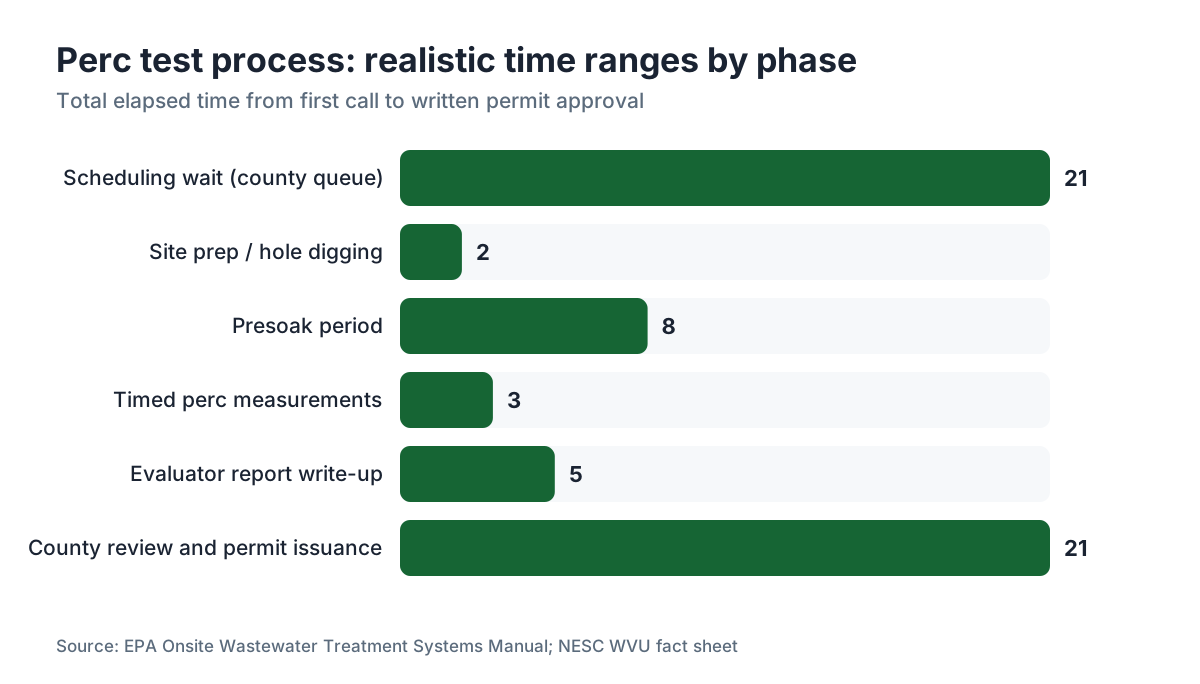
Here's a realistic phase-by-phase summary:
| Phase | Minimum | Typical | Extended |
|---|---|---|---|
| Scheduling wait | 3 days | 2 to 3 weeks | 4 to 6 weeks |
| Site prep / hole digging | 2 hours | 1 day | 2 days |
| Presoak | 30 min | 4 hours | Overnight (8 to 12 hrs) |
| Timed perc readings | 1 hour | 2 to 3 hours | 4 hours |
| Inspector write-up | Same day | 1 to 3 days | 1 week |
| County review / permit | 1 week | 2 to 4 weeks | 6+ weeks |
How long does it take to get perc test results?
Verbal results usually come the same day. Your inspector or soil evaluator will tell you on-site whether the numbers look good, marginal, or bad. That's genuinely useful, because it lets you start talking to a septic designer before any paperwork lands.
Official written results take longer. The evaluator writes the report, submits it to the county health department, and the department issues a formal approval or denial. In a straightforward case with a well-staffed department, you might have paper in hand within a week. In busy counties or states with heavier review requirements, that stretches to three or four weeks [2].
A failure arrives on roughly the same timeline, but it comes with a denial letter that explains which areas of your lot failed and sometimes whether an alternative system might work. Some counties let you retest in a different season or after soil work. Others give you one shot per lot per application cycle.
Assume two to four weeks from test day to official written approval. Budget six weeks if you're in a high-growth area or your first test comes back borderline.
What soil conditions affect perc test results and timing?
Sandy soils drain fast. Clay soils drain slow or not at all. Both extremes cause problems.
A perc rate faster than 1 minute per inch usually means soil so coarse that effluent won't get treated before it reaches groundwater, and many health departments reject a site below 1 MPI [1]. Rates above 60 MPI mean soil too slow to absorb effluent and keep a drain field working. The EPA's site evaluation guidance references 60 MPI as a common upper threshold, though state codes vary [3]. Cornell Cooperative Extension puts the workable range for conventional systems roughly between those two numbers [9].
Season moves your results hard. A hole tested during dry summer can show much faster percolation than the same hole in March when the ground is near saturation. That's why some counties require wet-season testing or an overnight presoak: to simulate worst-case conditions instead of best-case dry soil [8].
Rock fragments, caliche, and hardpan can let a test hole drain almost entirely through fractures rather than the soil itself, giving fast readings that won't hold up in a real drain field. A good soil evaluator flags these in the report. If you're buying land and the seller's perc test ran in August after a drought, ask hard questions about when and how it was done.
Soil drives so much of the outcome that a leach field working beautifully on one part of a lot can be dead 50 feet away. Test where you actually plan to install.
Who can perform a perc test, and does that change the timeline?
This varies a lot by state. In many states the county health department inspector runs the test directly, which ties your scheduling window entirely to that office's availability. In others, a licensed soil scientist, professional engineer, or registered sanitarian can run the test privately and submit results to the county for review [2].
Hiring a private evaluator almost always shortens the wait for the test itself. Instead of the county's six-week queue, a private evaluator might fit you in within a week. You still wait on county review at the back end, but total elapsed time drops.
The tradeoff is cost. County-run tests typically run $50 to $500 as a permit fee [4]. Private soil evaluators charge $300 to $1,500 or more for the full evaluation and report, depending on lot complexity and regional rates. On a tight timeline, the extra cost often pays for itself.
Make sure whoever you hire is licensed or certified under your state's rules before you pay anything. Most state health or environmental agencies publish a searchable list of approved evaluators.
What does a perc test cost, and is the fee separate from the results timeline?
Permit and inspection fees from county health departments typically fall between $50 and $500, though a handful of high-cost jurisdictions run higher [4]. That fee covers the county's time. It does not cover site prep, hole digging, or private evaluator work you pay for separately.
Hire a private soil evaluator and the full package (site visit, report, and any required soil morphology pit) often runs $500 to $1,500 for a standard residential lot. Odd terrain, large lots, or required follow-up visits push it higher.
For what comes after the test, read our guides on septic tank installation and cost to install septic system. The perc test is step one in what can be a five-figure project.
Paying the fee does not delay your results in most counties. You pay upfront when you schedule, and the clock starts there.
What happens if you fail a perc test?
A failed perc test does not mean you can't build a septic system. It means a conventional gravity-fed drain field probably won't work on your soil. That's a real distinction.
Alternative systems, including mound systems, drip irrigation, aerobic treatment units, and constructed wetlands, are built for sites that don't pass standard perc requirements [10]. The EPA notes that where soils or site conditions rule out conventional systems, alternative or innovative designs can still allow safe development. Whether one works on your lot depends on your county's rules and the specific failure mode.
A failure on one part of your lot doesn't mean the whole lot fails. Many county codes let you test additional areas if your primary drain field site fails. That secondary test means a new visit, so add two to six weeks if you're on that path.
Some counties allow retesting after soil work or after a set time interval, especially when the first test ran under unusually wet or dry conditions. Others issue a final denial with no appeal short of a variance.
If your test fails, get the written denial letter, pin down exactly which code section triggered it, and talk to both a licensed septic designer and a real estate attorney before you make any decision about the land.
How does a perc test fit into the full septic permitting timeline?
The perc test is usually step two in a four- to six-step permitting process, and knowing that keeps your schedule honest.
Step one is the site plan: most counties want a survey and proposed layout before they'll schedule a test. Step two is the perc test and soil evaluation. Step three is the permit application, built on the test results plus a system design from a licensed engineer or designer. Step four is permit issuance. Step five is installation. Step six is a final inspection before the system gets covered and used.
With good conditions and a responsive county, steps two through six can move in eight to twelve weeks. In congested markets or on a complex site, six to twelve months from soil evaluation to permitted system is not unusual.
Buying a property contingent on a passing perc test? Give your contract enough time. A 30-day inspection period is almost never enough. Sixty to ninety days is more realistic, and some deals build in specific perc-test contingency clauses with defined extensions.
Septic operators juggling multiple permit applications use scheduling software to track county timelines and avoid missed inspection windows. SepticMind builds permit-milestone tracking into its workflow tools so operators don't lose days to a blown county deadline.
After a passing test and a finished install, you'll need routine care like a septic tank inspection and regular septic tank pumping. Those sit outside the permitting timeline, but they're the ongoing cost of ownership.
Do perc test rules differ significantly by state?
Yes, and the gaps are wider than most people expect.
Texas runs the On-Site Sewage Facilities (OSSF) program through the Texas Commission on Environmental Quality, with defined soil evaluation methods, licensed authorized agents who conduct evaluations, and a set perc test protocol [5]. California counties each adopt their own sewage disposal ordinances under state authority, so Sonoma County's rules can look nothing like Riverside County's.
North Carolina uses a state-administered soil evaluation system through the Division of Public Health that leans on soil morphology rather than the timed percolation test, so you may never see a traditional perc test there [6]. Florida's Department of Health oversees septic permits through county health departments, with performance-based standards written into Chapter 64E-6 of the Florida Administrative Code [7].
The EPA's SepticSmart program lays out a national framework for homeowners but defers to state and local codes for specifics [3]. That's the honest picture: federal guidance sets the principles, state codes set the rules, county health departments enforce them.
Before you assume anything about your process, timing, or cost, call your county environmental health or building department. Ask three things directly: what evaluation method do you use, can I hire a private evaluator, and what's your current scheduling backlog. That one call saves more time than any article.
Can weather or season affect when you can schedule a perc test?
It can, and often does. Many counties limit perc testing to specific seasons, usually the wet months, because dry-season testing produces misleadingly fast percolation rates that don't reflect how the soil behaves year-round [8].
In the upper Midwest and New England, counties often ban testing when the ground is frozen. University of Minnesota Extension notes that frozen ground rules out valid testing [8]. In some Pacific Northwest counties, the testing season runs October through April to catch wet-season conditions. In the Southeast there's generally no seasonal restriction, but a summer dry spell can still push an inspector to require extra presaturation time.
Plan a spring build in a county that tests only in fall or early winter and you could face a nine-month wait just to get a test date. That trap catches plenty of buyers who find a dream lot in July without a thought for the permitting calendar.
Ask your county straight out whether they have testing-season restrictions before you set any construction timeline. If you're working with a private evaluator, ask them the same thing: some states hold evaluators to testing-season windows even when the county doesn't run the test itself [6].
Is there anything you can do to speed up the perc test process?
A few moves genuinely help.
Hire a private evaluator if your state allows it. The county queue is usually the biggest delay, and a licensed soil scientist or engineer often cuts two to four weeks off your wait.
Get your site prep done before the inspector shows up. Holes dug to spec, clearly staked, with pre-measured water levels already set, means the inspector moves fast and doesn't have to reschedule because the holes weren't ready.
Call the county and ask about cancellation slots. Plenty of homeowners book a test then delay their project, and those open slots sometimes go to whoever calls the office asking about them.
Submit a complete application. Missing documents are the single most common cause of permitting delays. If the county needs a survey, a site plan, proof of ownership, and a completed application, have all four ready on the first call.
What doesn't help: dressing up the soil to fake a better perc rate. Adding sand or gravel to your test holes is fraud, it voids your permit, and experienced inspectors catch it on sight. If your soil is marginal, work with a designer on an alternative system instead of gaming the test.
Frequently asked questions
How long does a perc test take on the day of the test?
Plan for two to four hours on a single-day test. That covers presaturation (30 minutes to 2 hours), the six timed 30-minute measurement intervals (about 3 hours), and the inspector's on-site notes. If your county requires an overnight presoak, the inspector visits twice: once to fill the holes and once the next morning to run measurements, each visit running 1 to 2 hours.
How long does it take to get perc test results back officially?
Verbal results come on test day. Written results from the county typically arrive 1 to 4 weeks after the evaluation, depending on how fast the evaluator submits the report and how fast the county processes it. In a backlogged health department, written approval can take 4 to 6 weeks. Private evaluators usually turn around their written reports faster, within a few days to a week.
What's the difference between a perc test and a soil evaluation?
A percolation test measures the rate water drains through a specific test hole, in minutes per inch. A soil evaluation (or soil morphology evaluation) examines the soil profile in a pit to assess texture, structure, color, and depth to limiting layers. Many states require both, or have moved to morphology-only evaluations because they give a fuller picture of long-term soil performance than a timed drainage test alone.
How much does a perc test cost?
County-run perc test fees typically run $50 to $500 as a permit fee. A private licensed soil evaluator costs $300 to $1,500 or more for a residential lot, covering the site visit, testing, and written report. Total out-of-pocket including site prep (hole digging) often runs $500 to $2,000 before any system design work begins.
Can a perc test be done in winter?
It depends entirely on your state and county. Many northern states restrict perc testing to periods when the ground is not frozen, creating a testing season from late spring through fall. Some wet-climate counties actually require winter testing to catch worst-case soil saturation. Call your county health department to confirm which seasons are allowed before planning your project timeline.
What perc rate is needed to pass for a conventional septic system?
Most health departments require a perc rate between 1 and 60 minutes per inch. Faster than 1 MPI usually means soil too coarse for adequate effluent treatment. Slower than 60 MPI usually means soil too dense to absorb the volume a drain field needs. Exact thresholds vary by state and county code, so verify the specific numbers with your local health department.
How many holes does a perc test require?
Most jurisdictions require three to six test holes spread across the proposed drain field for a standard residential lot. The exact count depends on lot size, proposed system size, and local code. If results vary a lot between holes, the inspector may require more testing to establish a reliable average. All holes must sit within the area actually proposed for the drain field, not the easiest-to-dig part of your yard.
What happens to the perc test holes after the test is done?
After the test, holes should be backfilled with the native soil removed during digging. You don't want open pits sitting in your proposed drain field. Backfill should be loose, not compacted, so you don't create a hardpan that interferes with future drain field installation. Your county may have specific backfill rules, so check before covering anything the inspector might want to verify.
Can you do a perc test yourself?
You can dig the holes and run informal tests for your own information, but only a county inspector or a licensed or certified private evaluator can conduct a test that counts for permitting. Official results must be documented by an approved evaluator and submitted through the county's permitting process. Self-administered tests carry no legal standing with the health department.
Does a property with a perc test already on file still need a new one?
Often yes. Most counties treat perc test results as time-limited, commonly 2 to 5 years, after which a new evaluation is required before a permit issues. An old passing test from a previous owner may or may not be accepted. Always check your county's expiration policy for existing test records before assuming a prior result still stands.
How long after a perc test can you start installing a septic system?
You can't start installation until you hold a signed permit. From test day, plan 2 to 6 weeks for the evaluator report, county review, and permit issuance. Some counties issue permits within a week of receiving a complete application with passing results; others take 4 to 8 weeks. Installation can begin the day your permit issues, assuming a contractor is available.
What should I do to prepare my property before a perc test?
Dig the test holes to the dimensions your county specifies (confirm depth and diameter first). Clear debris so the inspector can work without obstruction. Some counties require you to fill holes with water 24 hours ahead for initial presaturation, so confirm whether that's your job or the inspector's. Have your property survey and proposed system layout ready to show on arrival.
Sources
- EPA, Onsite Wastewater Treatment Systems Manual (EPA/625/R-00/008): Percolation test methodology: hole dimensions, presaturation requirements, timed measurement intervals at 30 minutes, and MPI calculation procedure
- National Environmental Services Center, West Virginia University, Percolation Testing fact sheet: Site preparation requirements, presoak timing, and typical county review timelines for perc test results
- EPA SepticSmart Program: EPA guidance that alternative systems may allow development on sites that fail conventional perc requirements; defers to state and local codes for specific testing standards
- USDA Rural Development: County perc test permit fees typically range from $50 to $500 for residential evaluations
- Texas Commission on Environmental Quality, On-Site Sewage Facilities Program: Texas OSSF program requirements for licensed authorized agents, soil evaluation protocols, and perc test procedures
- North Carolina Department of Health and Human Services, Division of Public Health: North Carolina's septic evaluation system relies primarily on soil morphology rather than timed percolation testing; testing season restrictions in some jurisdictions
- Florida Department of Health, Chapter 64E-6 Florida Administrative Code, Standards for Onsite Sewage Treatment and Disposal Systems: Florida's performance-based standards for septic permitting administered through county health departments
- University of Minnesota Extension: Seasonal restrictions on perc testing in cold climates; frozen ground prohibits testing; soil moisture effects on percolation rate variability
- Cornell Cooperative Extension: Sandy soils with rates faster than 1 MPI and clay soils slower than 60 MPI are typically outside acceptable range for conventional drain field approval
- EPA, Septic System Owner's Guide: General guidance on site evaluation requirements, drain field siting, and alternative system options for sites that fail conventional percolation tests
Last updated 2026-07-09