How does a perc test work: the complete homeowner guide
By the SepticMind Editorial Team
TL;DR
- A percolation test (perc test) times how fast water drains through soil to decide whether a site can support a septic drain field.
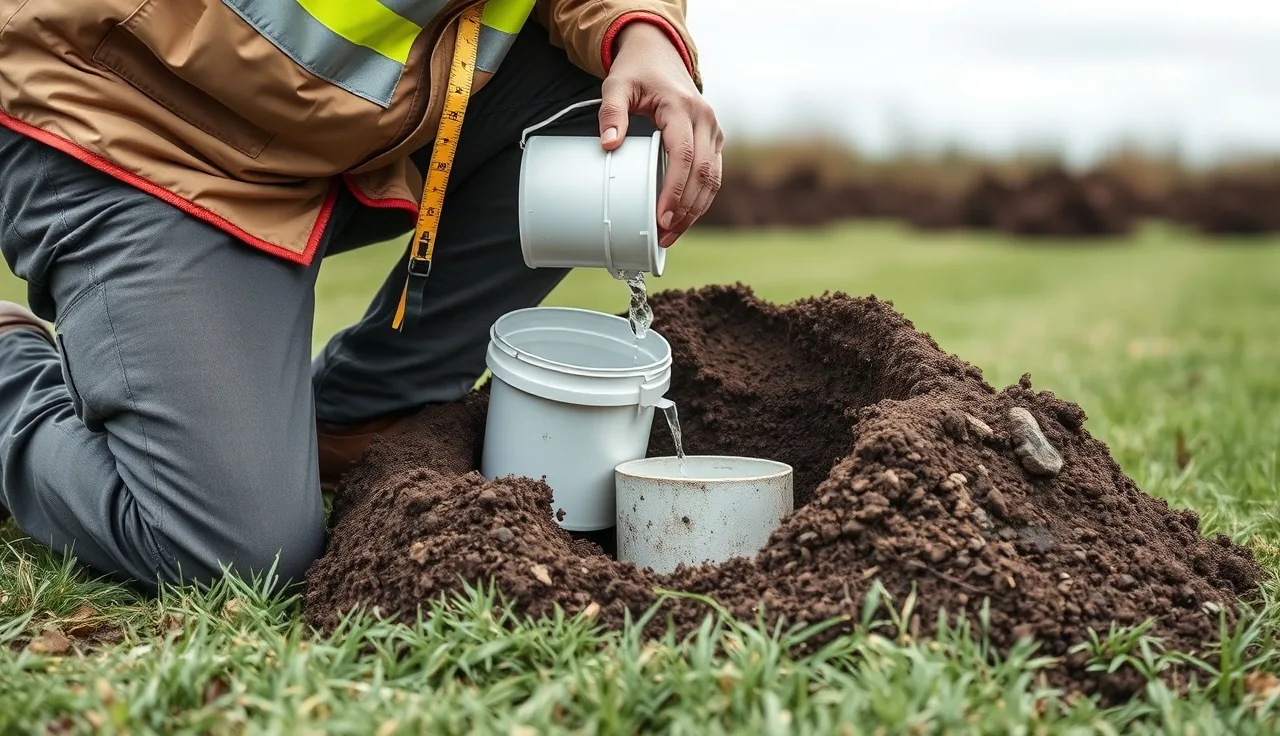
- A technician digs test holes, soaks them overnight, then times how many minutes it takes for water to drop one inch.
- Rates between 1 and 60 minutes per inch usually pass.
- Outside that range, a conventional septic system is off the table.
What is a perc test and why does it matter?
A perc test, short for percolation test, is a soil-drainage measurement that almost every county and state requires before a new septic system can be permitted. It answers one question. Can this ground absorb a household's wastewater fast enough to keep sewage from surfacing in the yard or backing up into the house?
The test matters because a septic system's leach field works by slowly releasing treated effluent into the soil, where bacteria and filtration clean it before it reaches groundwater. Drain too fast and the effluent shoots through before that biological cleaning happens. Drain too slow and the field floods, then sewage surfaces or backs up. Neither one is acceptable.
The EPA's SepticSmart program treats soil evaluation as the starting point for every onsite wastewater design, and inadequate site evaluation is one of the leading causes of early system failure [1]. That's not hype. A system sized for soil that can't actually take the load fails in months, not decades.
You need a passing perc result to pull a septic permit. No permit means no septic tank installation, no certificate of occupancy, and on raw land, often no mortgage approval.
Who performs a perc test and who requires it?
In most states a licensed soil scientist, a professional engineer, or a county sanitarian runs the test. Some counties let licensed septic contractors test their own jobs. Others demand a third-party evaluator. The permit authority is almost always the local health department or the state department of environmental quality.
Call your county health department first. They'll tell you who is authorized in your jurisdiction, the fee for the official inspection, and whether they want a soil profile evaluation (a separate but related procedure) alongside the percolation test. In a lot of states the two now happen together under a soil morphology evaluation, which digs deeper than a simple timing test and has largely replaced the old standalone perc test in places like North Carolina and Virginia [2].
Costs move around a lot. A basic perc test in a rural county runs $150 to $350 for the tester's time. Add the county permit fee (often $50 to $200) and you're usually at $200 to $500 total before any engineering [3]. Tricky sites with marginal soils, steep slopes, or high groundwater can push the site evaluation past $1,500 once a soil scientist has to hand-dig profile pits and write it up.
What equipment and materials does a perc test require?
The gear list is short. You need a way to dig the holes (hand auger, power auger, or a small backhoe), a ruler or measuring stick, enough clean water to saturate the holes, and a watch. Some evaluators use a floating gauge or a stick notched at the measurement depth.
The holes are typically 6 to 12 inches wide and 24 to 36 inches deep, though the exact specs vary by state code. The tester scratches the hole walls with a knife to knock off the compacted smear the auger leaves behind, then drops 2 inches of coarse sand or fine gravel in the bottom so the added water doesn't blast out the soil surface [4].
Nothing exotic here. That simplicity is part of why the test has stuck around for decades, and part of why it gets abused on marginal lots. A test rushed without a proper overnight soak can make slow-draining clay look fine. That's exactly why an honest evaluator won't skip the soak.
How does a perc test work step by step?
Step one is site prep, usually the afternoon or evening before the timing. The evaluator digs test holes where the health department specifies, typically two to six holes spread across the proposed drain-field area. The number and placement depend on lot size and local code.
Step two is pre-saturation. Each hole gets filled with at least 12 inches of water and left overnight, a minimum of 12 hours. Some jurisdictions want 24. This soak swells the clay particles to their wettest natural state, so the soil is in the same condition it'll face during heavy use or a wet spring. Skipping or shortening the soak is the most common way a perc test gets gamed on a marginal site.
Step three is the timed test the next morning. Water goes into each hole to a set level, usually 6 inches above the gravel layer. The evaluator then measures how far the water drops over 30 minutes, recording the drop in inches every 10 minutes (or every 30 minutes on very slow soils). The result is expressed in minutes per inch (MPI). Drop 1 inch in 15 minutes and the perc rate is 15 MPI.
Step four is calculation and recording. The average or worst-case MPI across all holes goes to the health department. That single number drives everything after it: system type, drain-field size, and whether a conventional system is even allowed.
The field work on test day takes a few hours. Count on two days minimum once you add the pre-soak. Plenty of evaluators set up holes late in the week and come back Saturday morning for the timing.
What perc test results mean: passing rates, failing rates, and the numbers in between
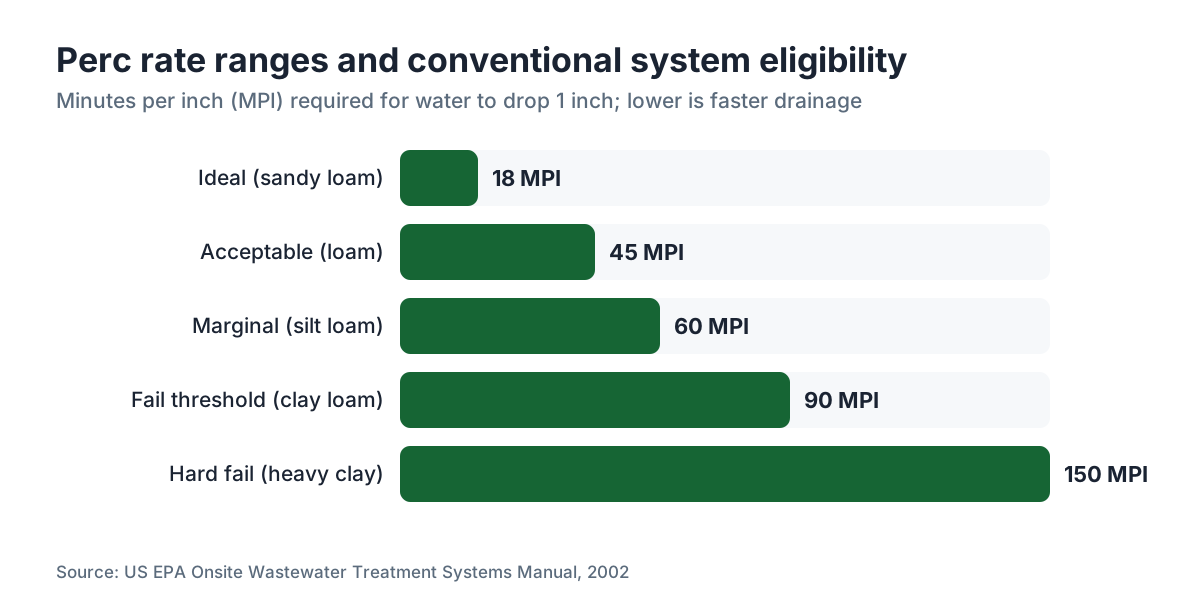
The standard acceptable range in most state codes is 1 to 60 minutes per inch [5]. Faster than 1 MPI means gravel, fractured rock, or very sandy soil where water blows through so fast that pathogens and nutrients never touch the soil long enough to be treated. Slower than 60 MPI means clay-heavy ground that can't take enough volume to handle a household's daily flow.
Here's a rough translation of what different rates mean on the ground:
| Perc Rate (MPI) | Soil Type | Typical Outcome |
|---|---|---|
| Less than 1 | Gravel / fractured rock | Fail, conventional system not permitted |
| 1 to 5 | Very coarse sand | Marginal; may need a larger or modified field |
| 6 to 30 | Sandy loam | Good; standard drain field usually approved |
| 31 to 60 | Loam / silt loam | Acceptable; may need a slightly larger field |
| 61 to 120 | Clay loam | Fail in most states; alternative system required |
| Over 120 | Heavy clay | Fail; conventional system not possible |
Many states don't draw a hard pass/fail line at 60 MPI. The rate feeds a loading-rate formula that sets how much drain-field square footage you need per bedroom. A slower rate demands more square footage for the same daily flow. If a lot is big enough, a 90 MPI soil might still earn a permit for an oversized conventional field or a mound system [6].
A fast fail (under 1 MPI) is harder to design around. Some jurisdictions allow engineered fill systems, but those cost real money and need site-specific design.
How much does a perc test cost?
For a standard residential lot in the lower 48, plan on $150 to $500 for the test itself [3]. That covers the professional's time and materials. It does not include the county permit fee (usually $50 to $200), an engineering report, or soil profile pits if your county wants those separately.
Some states bundle the perc test and soil morphology evaluation into one site evaluation permit. North Carolina issues an improvement permit through the county health department that covers the full evaluation, and county fees there run roughly $350 to $800 depending on complexity [2].
If you're on a tight lot with marginal soils, budget for a second evaluation. Fail the first test and you typically pay again to check other locations or other depths. A failed test on land you're thinking about buying is not wasted money. It's cheap insurance against buying a lot you can never build on.
See our full breakdown of cost to install a septic system and cost to put in a septic tank for what comes after a passing test.
What happens if your property fails a perc test?
A failed perc test does not mean the land is unbuildable. It means a conventional gravity-fed drain field won't work there. What comes next depends on why it failed and what your local code allows as a substitute.
If the soil drains too slow (above 60 MPI), your options include mound systems (a raised field built on imported sand fill), pressure-dosed systems, drip irrigation, or aerobic treatment units (ATUs) that produce cleaner effluent slower soils can still handle. These alternatives cost more, often 50 to 150 percent more than a conventional system, and they need more hands-on maintenance [7].
If the soil drains too fast, the choices get narrower. Some jurisdictions allow a gravel-less chamber system with an engineered media layer, or a constructed wetland. Others just won't permit onsite septic on extremely fast-draining soils at all.
You can also ask for a re-test at a different spot on the property, a different depth, or a different season. Soils behave differently dry in August than saturated in April. If your county allows it, testing in early spring at the wettest gives the most conservative and most defensible result.
For a system that's already in the ground and failing, the path looks different. See septic system repair for what that involves.
How is a perc test different from a soil morphology evaluation?
This one trips up a lot of homeowners. A perc test measures drainage speed. A soil morphology evaluation (also called a soil profile evaluation or soil classification) reads the physical characteristics of the soil: color, texture, mottling, and the depth to seasonal high groundwater.
Mottling, those reddish-brown or gray streaks in a soil profile, marks where the water table climbs seasonally. In many states that depth matters more than perc rate, because effluent has to stay a set distance above seasonal groundwater (often 2 to 4 feet, depending on state code) to keep it from contaminating the water table [8].
Several states, including North Carolina, Virginia, and much of New England, have mostly dropped the standalone perc test for soil morphology evaluation done by a licensed soil scientist. The Soil Science Society of America treats morphology-based evaluation as more accurate and harder to manipulate than timed percolation alone [9].
If your county wants both, the soil scientist digs profile pits (usually with a backhoe, 4 to 6 feet deep) next to the perc holes and documents what the soil shows. The two data sets together hand the designer everything needed to spec the right system.
How long does a perc test take, start to finish?
The field work takes two days: a few hours on day one to dig and soak the holes, and two to four hours on day two for the timed test. Add a few days to a week for scheduling with the permit office.
Turnaround on official results is all on the county. Some health departments stamp results same-day. Others take two to four weeks, especially where permit applications are stacked up. If you're buying raw land with a perc-test contingency, write at least 30 days into that contingency window to be safe.
Total elapsed time from scheduling to a permitted result: one to three weeks in a fast county, four to eight weeks in a slow one. Plan around the slow county.
Can you do a perc test yourself, or do you need a professional?
You can run an informal perc test yourself to get a feel for your soil before you spend money on professionals. The procedure is the same: dig a hole, soak it, time the drop. But no health department will accept a homeowner-run test for permitting. The official test has to be done, or at minimum witnessed, by whoever your jurisdiction authorizes.
DIY testing earns its keep in one situation. You're eyeing a lot and want a rough read before paying for a professional evaluation. A bucket of water, a 12-inch-deep hole, and a watch tell you fast whether you're looking at gravel that drains in seconds, decent loam that drops an inch in 20 minutes, or clay that barely moves. That's enough to decide if the lot is worth chasing.
For anything official, permits, real estate deals, or system design, hire the professional.
How does a perc test affect septic system design and sizing?
The perc rate is the main input for drain-field sizing. Most state codes turn it into a loading rate: gallons of effluent allowed per square foot of drain field per day. Faster-draining soil gets a higher loading rate, so you need less square footage. Slower soil gets a lower loading rate, so you need more trench.
For a typical three-bedroom home putting out roughly 300 gallons a day, here's how loading rates translate to trench length under a common design standard [6]:
| Perc Rate (MPI) | Loading Rate (gal/sq ft/day) | Trench Length Needed (approx.) |
|---|---|---|
| 1 to 5 | 1.2 | ~125 linear feet |
| 6 to 15 | 0.9 | ~167 linear feet |
| 16 to 30 | 0.72 | ~208 linear feet |
| 31 to 45 | 0.48 | ~313 linear feet |
| 46 to 60 | 0.36 | ~417 linear feet |
Those numbers are illustrative. Your state code's own loading table governs the real design. The point holds: a marginal 50 MPI result can still work, it just needs a much bigger drain field. Bigger field means more land, more pipe, more gravel, more cost.
The perc result also decides whether your system needs a pump. Gravity systems work on flat lots with good drainage. On sloped lots or slow soils, a pressure-dosed system with a pump spreads effluent more evenly across the field and stretches its life. If you land a pump-dependent system, septic tank pumping and maintenance matter even more.
Does a perc test expire, and when do you need a new one?
Yes, perc tests expire. Most county health departments set validity at two to five years, with three years being the most common window [5]. Pull a permit but don't start construction inside that period and you'll need a fresh test.
Soils don't shift much in three to five years, but the reasoning behind the expiration holds up. Land use can change. Grading, fill, and tree removal all affect drainage, and requiring a new test keeps people from running a septic system off decades-old results on a completely altered site.
In a real estate deal, old perc results from a previous owner sometimes sit in county records. They're handy for reference but may not satisfy a current permit application. Always check with the health department whether an existing result is still valid before you lean on it.
What regulations govern perc testing in your state?
There's no single federal perc test standard. The EPA sets general guidance through its SepticSmart program and its Onsite Wastewater Treatment Systems Manual [1], but permitting authority sits entirely with states and counties. Every state runs its own onsite wastewater code with its own rules for hole dimensions, pre-soak time, number of test locations, and acceptable MPI ranges.
The EPA's 2002 Onsite Wastewater Treatment Systems Manual states that "the percolation test does not measure all the hydraulic properties of the soil" and recommends supplementing it with soil morphology evaluation [4]. That's a federal agency admitting the limits of the test it technically endorses.
A few examples of how states differ: Texas requires at least two test holes and uses 30-minute perc intervals for slow soils; in California, local agencies control septic permitting under their own onsite standards; Florida's Chapter 64E-6 spells out hole dimensions and pre-soak requirements in detail [10]. Start with your county health department, not a national website, for the rules that actually cover your lot.
Operators tracking test scheduling and permit paperwork across multiple counties usually lean on job-tracking software to keep compliance deadlines from slipping. SepticMind is built for septic service operators handling exactly that kind of multi-jurisdiction coordination.
If you're planning a new install, the septic tank inspection that follows installation picks up right after the perc and permitting phase. And if you're buying land with a system already on it, knowing how often to pump a septic tank is worth having in hand too.
Frequently asked questions
How deep are the holes for a perc test?
Most state codes call for holes 24 to 36 inches deep and 6 to 12 inches wide. Depth matters because it puts the test in the soil zone where the drain field will actually operate. Some codes require testing at two different depths to read the full profile. Check your county health department's specs before you dig.
How much water do you need for a perc test?
Plan on 20 to 50 gallons per hole for the overnight soak, depending on hole size, soil type, and how fast the first fill drains. Sandy soils can drain the first fill in an hour and need refilling several times overnight. Clay may hold that first fill through the whole soak. Bring more water than you think you need.
Can a perc test be done in winter?
It depends on the state and whether the ground is frozen. Most health departments prohibit testing in frozen soil because ice in the pores throws the reading off in either direction. Some states allow winter testing when frost depth is shallow. Spring testing, when soils are naturally saturated, gives the most conservative result and is often preferred for systems in marginal soils.
What does a perc test fail mean for property value?
A hard fail with no feasible alternative can make land unbuildable for a home, which tanks its value. A marginal result (slow but workable) usually just means higher septic installation costs, which buyers fold into their offers. Many rural real estate contracts include a perc test contingency so buyers can walk if the soil won't support a system.
Is a perc test the same as a perk test?
Yes. 'Perk' is an informal spelling of 'perc,' short for percolation. You'll see both on contractor invoices, county permit forms, and real estate listings. They mean the identical test. Some older literature calls it a 'soil absorption test' or 'soil percolation test,' all pointing to the same timed water-drainage measurement.
How many perc test holes does a site need?
Most jurisdictions require two to six holes depending on lot size and the system proposed. A small lot with a single conventional drain field might need just two. A large lot with several possible field locations or a complex design may need five or six to read soil variability across the site. Your county code sets the minimum.
Can you build a septic system without a perc test?
Not legally in any US state for a new install on a parcel that's never been tested and permitted. Some jurisdictions offer a waiver for replacement systems on lots with existing valid permits, but even those usually want a current site evaluation. Skip the test and install without a permit and you're exposed to fines, mandatory removal, and title problems when you sell.
What perc rate is considered good?
A perc rate of 10 to 30 minutes per inch is generally ideal. Fast enough to handle normal household flow without the field backing up, slow enough to give the soil real contact time to treat the effluent. Rates in this range produce the smallest required drain fields and work with standard gravity-fed designs, which keeps installation costs down.
How does soil type affect perc test results?
Sandy soils drain fast (sometimes under 5 MPI) because water moves freely between large particles. Clay soils drain slow (often over 60 MPI) because the particles are tiny and pack tight. Loam, a mix of sand, silt, and clay, usually lands in the 10 to 45 MPI range and is the most favorable for conventional septic. Organic topsoil and peat run all over the place and get excluded from the test zone.
Does a perc test measure depth to groundwater?
No. A perc test only measures drainage speed. Depth to seasonal groundwater is measured separately through soil morphology evaluation, where a soil scientist reads mottling and gleying in a profile pit. Many states require both together. Groundwater depth is often the binding constraint for system design, especially in coastal, low-lying, or seasonally wet areas.
How do I find the perc test results for a property I'm buying?
Contact the county health department or department of environmental quality with the parcel address or tax ID number. Most counties keep records of issued improvement permits and test results going back decades. Results may also show up in a title search or come from the seller directly. Always confirm with the county whether an existing result is still inside its validity window before you rely on it.
What is a failing perc test rate in most states?
Most states set the upper limit at 60 minutes per inch for standard system approval. Soils slower than 60 MPI can't absorb enough daily effluent for a conventional drain field serving a household putting out 150 to 450 gallons per day. Some states stretch the limit to 90 or 120 MPI with alternative systems or oversized fields, but each state's onsite wastewater code sets the exact threshold.
Sources
- US EPA, SepticSmart Program: Soil evaluation is the foundation of any onsite wastewater system design; inadequate site evaluation is a leading cause of early system failure
- North Carolina DHHS, Division of Public Health (Improvement Permit and Authorization to Construct): North Carolina uses an improvement permit process covering full site evaluation; NC county fees typically run $350 to $800
- Angi, Perc Test Cost Guide: Typical perc test professional fee ranges from $150 to $500 for a standard residential lot
- US EPA, Onsite Wastewater Treatment Systems Manual (2002): The EPA manual states that 'the percolation test does not measure all the hydraulic properties of the soil' and recommends supplementing it with soil morphology evaluation; also specifies gravel layer and hole wall preparation procedures
- US EPA, Onsite Wastewater Treatment Systems Manual (2002): Acceptable perc rate range of 1 to 60 minutes per inch for conventional systems; perc test permits typically valid for two to five years depending on jurisdiction
- University of Minnesota Extension: Perc rate determines loading rate (gallons per square foot per day), which sets required drain field trench length for a given household flow
- US EPA, Septic Systems (Alternative Technologies): Alternative systems including mound systems, pressure-dose systems, and ATUs can serve sites with slow-draining soils and typically cost 50 to 150 percent more than conventional systems
- Virginia Department of Health: Effluent must be maintained a set distance (commonly 2 to 4 feet depending on state) above seasonal high groundwater to prevent contamination
- Soil Science Society of America: Soil morphology-based evaluation is more accurate and less susceptible to manipulation than timed percolation testing alone
- Florida Department of Health, Chapter 64E-6 (Standards for Onsite Sewage Treatment and Disposal Systems): Florida Chapter 64E-6 specifies hole dimensions and pre-soak requirements for percolation testing
Last updated 2026-07-09