Arkansas septic system requirements, karst risks, and alternative system costs
By the SepticMind Editorial Team
TL;DR
- Arkansas requires onsite wastewater systems to meet APCEC Regulation 21 standards, and homes on karst (limestone/dolomite) terrain almost always need an engineered alternative system.
- Expect to pay $8,000, $30,000 or more depending on soil depth, system type, and county.
- A licensed soil evaluator and site-specific engineer are mandatory before any permit is issued.
What are Arkansas's basic septic system requirements?
Arkansas regulates all onsite wastewater treatment systems under the Arkansas Pollution Control and Ecology Commission Regulation 21 ("Reg 21"), administered by the Arkansas Department of Health (ADH). Every new system, replacement system, or repair to an existing system needs a permit from your county sanitarian before a single shovel of dirt moves. [1]
The minimum requirements under Reg 21 include a soil evaluation by a licensed evaluator, a site plan showing setbacks from wells, property lines, and water bodies, and a design stamped by a licensed engineer when an alternative system is required. Standard setbacks are 50 feet from a potable water well, 10 feet from a property line, and 25 feet from any drainage ditch or intermittent stream. For karst terrain those numbers frequently go up because groundwater pathways are so unpredictable. [1]
Arkansas uses a conventional septic system as its baseline: a septic tank, distribution box, and gravel-trench drain field. The minimum tank size is 1,000 gallons for a three-bedroom home, and the drain field sizing is calculated from daily design flow and soil percolation or soil morphology data. [1] If your soil can't pass a perc test, or if the bedrock sits too shallow, you don't get a conventional system. You get an alternative. That's where the real costs start.
For routine maintenance on any system you install, see our guide to septic tank pumping for schedules that keep you in compliance with state inspection requirements.
What is karst topography and why does it matter for septic systems in Arkansas?
Karst is terrain formed from soluble bedrock, mostly limestone, dolomite, and marble, that over thousands of years dissolves into a network of sinkholes, caves, springs, and underground conduits. Arkansas has extensive karst geology across the Ozark Plateau in the north and northwest, including Benton, Carroll, Boone, Newton, and Searcy counties, plus parts of the Ouachita Mountains. [2]
The problem for septic systems is simple. A conventional drain field depends on soil to filter and biologically treat effluent before it reaches groundwater. In karst, "groundwater" can sit 6 inches below your surface or it can channel straight into a cave system that resurfaces a mile away as a spring somebody is drinking from. The soil layer between the surface and bedrock is often less than 18 inches, sometimes less than 6. Reg 21 requires a minimum of 18 inches of naturally occurring soil above seasonal high groundwater or bedrock for a conventional system. Karst routinely fails that test. [1]
The Arkansas Natural Resources Commission and the Arkansas Geological Survey have mapped high-vulnerability karst areas in detail, and county sanitarians in those regions see mostly alternative system applications. The University of Arkansas Division of Agriculture notes that poorly designed systems in karst "can directly pollute springs, streams, and wells with little attenuation of pathogens or nutrients." [3] That's the technical problem stated plainly.
Sinkholes are the most dramatic karst feature homeowners notice. But solution pipes (vertical conduits in the rock), epikarst (the weathered upper zone of bedrock), and fracture-dominated flow are just as dangerous for septic purposes even when no obvious sinkhole sits nearby. A standard perc test tells you almost nothing about whether your effluent will end up in a neighbor's spring.
What alternative septic systems are approved for Arkansas karst sites?
Arkansas Reg 21 lists several alternative and advanced treatment technologies that county sanitarians can approve when conventional systems aren't feasible. [1] The most common ones used in karst terrain are:
Mound systems. Effluent is pumped up to an engineered mound of imported sand or gravel built above the natural ground surface. This creates the missing soil separation that karst can't provide. Works well when you have enough open land and the right geometry.
Low-pressure pipe (LPP) systems. Small-diameter pipes distribute effluent under low pressure across a larger field area, giving you more uniform loading and buying more treatment time. Often paired with a treatment unit when soil depth is marginal.
Drip irrigation/drip dispersal systems. Pretreated effluent drips through small emitters buried 6 to 12 inches in the soil. Requires an aerobic treatment unit (ATU) or other pretreatment step upstream. More mechanically complex, but very precise loading control.
Aerobic treatment units (ATUs). ATUs treat wastewater aerobically before dispersal, producing a much cleaner effluent. Arkansas requires a service contract on ATUs because they need routine mechanical maintenance. The treated effluent can then go to a smaller or shallower dispersal field than raw septic tank effluent would require. [1]
Constructed wetlands. Occasionally permitted for larger flows or clustered systems. Rare for single-family use.
Cluster or community systems. In karst areas where individual lots genuinely can't support any onsite system, some counties have moved toward small community collection systems that pipe to a central treatment site with better geology. These cost a lot to build but may be the only legal path on extremely thin-soiled ridge tops.
For any of these, the engineer's site evaluation comes first. No reputable installer will quote a final price without soil borings and, on karst sites, sometimes a geophysical survey (ground-penetrating radar or electrical resistivity) to map subsurface voids. Skipping that step is how people spend $20,000 on a system that fails in two years. [3]
How much does a septic system cost in Arkansas on karst terrain?
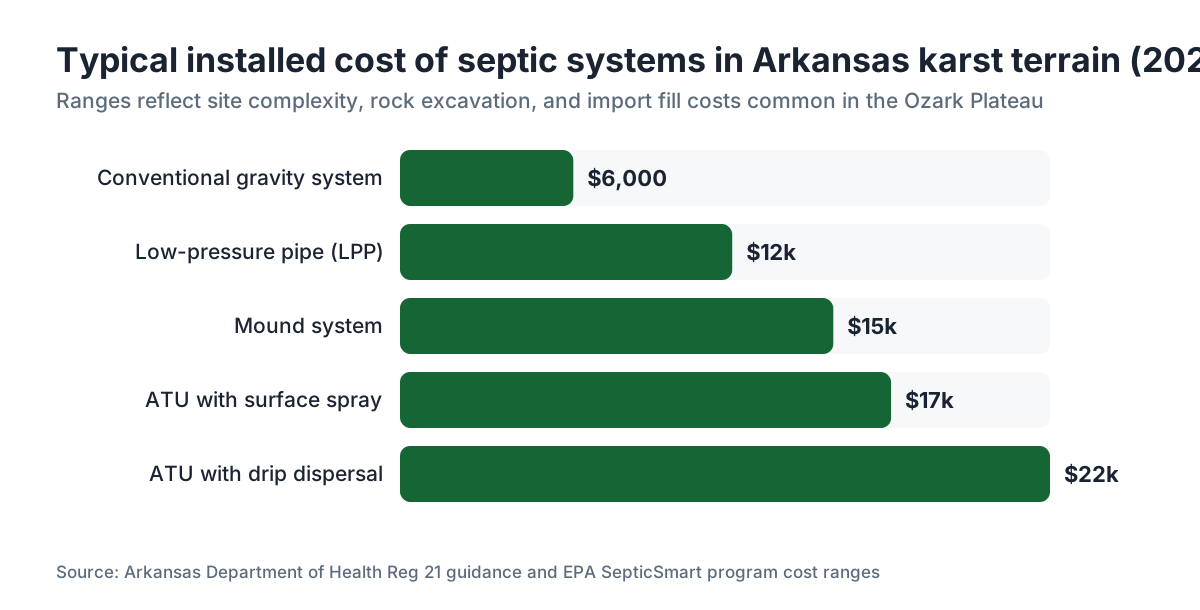
Cost varies enormously depending on system type, site complexity, distance to materials, and contractor availability. The table below gives honest ranges based on what installers and county sanitarians in northwest Arkansas and the Ozark region typically report. These are 2024 to 2025 figures and should be confirmed with local bids.
| System type | Typical installed cost (Arkansas) | Notes |
|---|---|---|
| Conventional gravity system | $4,000, $8,000 | Rarely feasible on karst |
| Mound system | $10,000, $20,000 | Needs pumping system, import fill |
| Low-pressure pipe (LPP) | $8,000, $15,000 | Good for shallow, fractured sites |
| ATU with drip dispersal | $15,000, $30,000 | Highest upfront, lowest land use |
| ATU with surface spray | $12,000, $22,000 | Requires setbacks from neighbors |
| Cluster/community connection | $5,000, $20,000 per lot | Depends on share of infrastructure |
Site work adds to every line item. Rock excavation in the Ozarks can run $150, $300 per hour of equipment time, and a karst site may require blasting or heavy cut-and-fill before any system component goes in. Engineering and soil evaluation typically runs $800, $2,500 separately and isn't usually included in installer quotes. The permit fee itself stays modest, usually $100, $300 through the county health unit, but the engineering work is what you're really paying for. [1][4]
For comparison, the national average installed cost of a conventional septic system runs $3,000, $10,000 according to the EPA's SepticSmart program, so an Arkansas karst site isn't anomalous. It just lands consistently at or above the top of that range. [5]
Don't forget ongoing costs. ATUs require a maintenance contract, typically $150, $400 per year, and the pump in a mound or LPP system needs inspection every 1 to 3 years. See our page on cost to install a septic system for a broader national comparison. Annual pumping of the septic tank (every 3 to 5 years on average) is a separate cost; our septic tank pump out guide has current pricing.
What site evaluation steps are required before you can get an Arkansas septic permit?
The ADH permit process starts with a site evaluation, and on karst terrain this is no formality. Here's the actual sequence:
- Hire a licensed soil evaluator or licensed engineer. Arkansas requires that onsite soil evaluations be conducted by someone holding a current ADH license. A list is available from the ADH Division of Environmental Health Services. [1]
- Soil borings and morphology assessment. The evaluator digs or cores test holes, typically at least 60 inches deep, to characterize soil texture, structure, color (for redoximorphic features that indicate seasonal saturation), and depth to bedrock or restrictive layers.
- Percolation test if required. Reg 21 allows soil morphology alone to size many conventional systems. For some alternative systems, perc data gets collected too. On karst, rapid perc rates (sometimes less than 1 minute per inch) are a red flag, not a green light. Fast drainage into fractured rock does not equal treatment.
- Geophysical survey on high-risk sites. Not required by regulation but increasingly standard practice in heavily karsted areas. Ground-penetrating radar or electrical resistivity profiling can locate subsurface voids before you put a $20,000 system over one. Engineers who work the Ozarks routinely recommend it. [3]
- Engineer's design and stamped drawings. Required for any alternative system. The design specifies system type, loading rates, component specs, and inspection points.
- County sanitarian review and permit issuance. The sanitarian reviews the engineer's package against Reg 21. If the site truly cannot support any approved system, no permit is issued. This does happen, and it renders some lots effectively unbuildable for individual wastewater purposes.
The whole process from first soil boring to permit in hand takes 4 to 12 weeks on an uncomplicated site. On a contested karst site requiring engineering revisions, six months is not unusual. Plan accordingly if you're in the middle of a real estate transaction.
A septic tank inspection of any existing system on the property should happen before closing on land in karst terrain. Systems that were grandfathered in may not meet current standards, and replacement could fall on the new owner.
Which Arkansas counties have the most karst-related septic restrictions?
The core of Arkansas karst is the Springfield Plateau and Salem Plateau of the Ozarks, and the counties hit hardest are Benton, Carroll, Boone, Marion, Baxter, Stone, Searcy, Newton, and Madison. Benton and Carroll counties in the northwest corner are among the most intensively developed karst areas in the state, driven by population growth around Bentonville and the Buffalo River recreation corridor. [2][3]
Benton County has its own county health unit actively applying Reg 21 restrictions, and local installers there report that the majority of new residential lots in rural subdivisions require alternative systems. Carroll County, which sits partly in the Buffalo National River watershed, gets extra scrutiny because the Buffalo is a federally designated wild and scenic river; the National Park Service and ADH have both been involved in wastewater management planning there. [6]
Washington County (home of Fayetteville and the University of Arkansas) has significant karst in its eastern portions but more urban infrastructure in its western areas. Sebastian County along the Ouachita has different geology but some similar shallow-soil challenges.
If you're buying or building in any of these counties, ask the county sanitarian directly about the specific parcel. Parcel-level geology varies. A ridge top a quarter mile from a neighbor's working conventional system may be unfeasible for any onsite system.
What regulations specifically protect the Buffalo National River watershed from septic failures?
The Buffalo National River in Newton and Searcy counties is the first national river designated in the United States and is federally administered by the National Park Service. The watershed has been a flashpoint for septic and agricultural wastewater concerns for years, because karst geology means surface contaminants move directly and quickly into the river and its tributary springs. [6]
A 2017 study published in the journal Environmental Science and Technology found elevated nutrient concentrations in Buffalo River tributaries downstream of a concentrated animal feeding operation, and the broader concern about individual septic systems in the karst watershed has been documented by the Arkansas Department of Health and the NPS. [7]
Arkansas does not have a separate Buffalo River-specific septic regulation as of 2025, but county sanitarians in Newton and Searcy counties apply Reg 21 with particular rigor, setback variances are rarely granted, and engineered alternative systems with ATU pretreatment are often required even for sites that might pass a basic soil evaluation in another county. Some conservation organizations and the NPS have pushed for a dedicated watershed overlay regulation, though none has been enacted as of this writing.
If you own or are buying property in the Buffalo watershed, assume the highest standard applies and budget accordingly. The leach field guide on this site explains how conventional drain field sizing works, which helps clarify why karst soils so often disqualify that approach.
How do I find a qualified septic installer and engineer in Arkansas's karst regions?
Start with two lists. The Arkansas Department of Health maintains a registry of licensed soil evaluators and licensed wastewater system installers. [1] The Arkansas State Board of Registration for Professional Engineers and Land Surveyors maintains a roster of licensed engineers. You want someone who has engineered systems in karst, not a general civil engineer who has done one or two septic projects.
Ask explicitly: "How many karst sites have you evaluated in this county?" A good evaluator will have a quick, specific answer. A vague answer tells you to keep looking.
The Arkansas Environmental Health Association and the Arkansas Onsite Wastewater Association are the main professional groups; members typically have more continuing education in alternative systems than non-members. Word of mouth from county sanitarians helps too. They see the work product of every local installer and know who submits clean packages versus who they have to send back three times.
Get at least two quotes for any alternative system. On a $20,000 job, quotes can vary $4,000, $6,000 for identical work, partly due to access to materials and equipment, partly due to how busy the installer is. The cheapest quote is not always the right one, especially when the difference between a good and bad installation is an ATU sitting in a void over fractured limestone.
SepticMind's operator directory can help you find licensed contractors who work in northwest Arkansas and the Ozark region and who have documented experience with alternative system types.
What are the ongoing maintenance requirements and costs for alternative systems in Arkansas?
Alternative systems cost more to maintain than a simple gravity conventional system. Here's what to budget for:
ATU service contracts. Arkansas Reg 21 requires a written maintenance contract for all ATUs. These contracts cover periodic inspection of the blower, aeration chamber, and effluent quality. Cost is typically $150, $400 per year depending on the manufacturer and contractor. Some contracts include one pump-out annually; many don't. [1]
Pump system maintenance. Mound systems and LPP systems use a pump in a dosing chamber. The pump itself lasts 5 to 15 years and costs $300, $800 to replace. The float switches and control panel should be inspected annually.
Septic tank pumping. Even alternative systems have a primary tank that accumulates solids. Every 3 to 5 years is the standard guidance from the EPA SepticSmart program, though heavy household use can shorten that interval. [5] See our how often to pump septic tank guide for the factors that affect your specific schedule. For pricing, our septic tank cleaning page has current regional numbers.
Drip emitter flushing. Drip dispersal systems need periodic flushing of the emitter lines to prevent clogging. Frequency depends on effluent quality; ATU-pretreated effluent clogs emitters less than partially treated effluent.
Inspection and reporting. Some Arkansas county sanitarians require annual inspection reports submitted by the homeowner's service provider. Check your permit conditions.
Over a 20-year ownership period, a conventional gravity system might cost $1,500, $3,000 in cumulative maintenance (mostly pumping). An ATU-based alternative system on a karst site might cost $5,000, $10,000 over the same period once you account for contracts, pump replacement, and periodic component rebuilds. That's real money, but it's still far less than the cost of a system failure and required replacement.
What happens if a septic system fails in Arkansas karst terrain?
System failure on a karst site is more than a household inconvenience. Effluent can reach a spring or well within hours because there's no soil buffer to slow it down. The ADH has authority under the Arkansas Water and Air Pollution Control Act to require immediate corrective action, and on karst sites that almost always means an engineered replacement system, not a patch. [8]
If you see sewage surfacing in the yard, smell sulfur at a spring, or notice unexplained illness in household members using well water, treat it as an emergency. Stop using the system, contact the county sanitarian, and have your well water tested. E. coli contamination from failing septic systems is the most common result and can cause serious illness.
Replacement costs are at least as high as new installation, often more, because the failed system has to be decommissioned (pumped, abandoned, and sometimes excavated) before the new one goes in. The ADH can issue compliance orders with deadlines and fines for non-compliance. Fines under the Water and Air Pollution Control Act can reach $10,000 per day for serious violations, though residential cases rarely hit that ceiling. [8]
For repair guidance before a full replacement is required, see our septic system repair and septic tank repair pages, which cover what can be fixed versus what needs full replacement.
If you're in a real estate transaction and discover the existing system is failing or questionable, use that information to negotiate. A failed system in a karst county can mean $15,000, $25,000 in replacement cost that should come out of the sale price or be remediated by the seller before closing.
Are there financial assistance programs for Arkansas homeowners who need alternative systems?
Yes, though tracking them down takes effort. A few sources worth knowing:
USDA Rural Development Section 504 loans and grants. For very low-income homeowners in rural areas (which includes most of karst Arkansas), USDA RD offers loans and grants specifically for sanitation repairs. The grant program is for homeowners 62 or older who cannot repay a loan. Income limits apply and change annually. [9]
Arkansas Natural Resources Commission (ANRC) Community Development Block Grant funds. Some county and municipal governments in Arkansas have used CDBG funds for community-wide septic remediation in areas with documented groundwater contamination. These aren't individual homeowner programs but can fund cluster systems in affected areas. [10]
Arkansas Development Finance Authority (ADFA). Occasionally offers low-interest home improvement loans that can be applied to septic system replacement.
Buffalo River watershed grant programs. The Nature Conservancy, the National Park Foundation, and various federal conservation programs have in the past offered cost-share arrangements for landowners in the Buffalo watershed who upgrade failing systems. These programs come and go; contact the Newton County or Searcy County extension office for current availability.
Tax treatment. Septic system installation or replacement on a primary residence is generally not deductible as a home improvement for federal income tax purposes (it's a capital improvement, not a repair), but it does add to your cost basis, which matters at sale. Consult a tax professional on your specific situation.
The EPA's SepticSmart program provides guidance on finding state and local funding, though the specific programs available in Arkansas require checking with ADH and ANRC directly. [5]
Frequently asked questions
How do I know if my Arkansas property is in a karst area?
Check the Arkansas Geological Survey's karst and geology maps (geology.arkansas.gov) and ask your county sanitarian. If your property sits in Benton, Carroll, Boone, Marion, Baxter, Stone, Newton, Searcy, or Madison counties, karst is the default assumption until a site evaluation proves otherwise. A soil evaluator can confirm with borings and inspection of the bedrock character.
Can I get a variance from Reg 21 setback requirements in Arkansas?
Variances exist but are rarely granted for karst sites. The ADH has authority to grant setback variances case by case when engineering evidence shows the modification is safe. On karst terrain, proving safety is extremely difficult because groundwater flow paths are unpredictable. County sanitarians in the Ozark region say variance requests on karst sites are almost always denied or require such extensive engineering that the applicant usually redesigns the system instead.
What's the difference between a mound system and a low-pressure pipe system in Arkansas?
A mound system builds imported sand fill above grade to create vertical separation from shallow bedrock or groundwater, and the effluent moves by gravity or pressure through that fill. An LPP system distributes effluent under low pressure through small-diameter pipes across a larger horizontal area at or near grade, relying on whatever native soil exists. Mounds cost more (fill and earthwork) but work on shallower sites. LPP is cheaper when there's enough lateral space and at least 12 to 18 inches of workable soil.
Does Arkansas require a perc test or can soil morphology alone be used?
Arkansas Regulation 21 allows soil morphology (texture, structure, and color-based saturation indicators) as the primary sizing method for conventional systems. A percolation test may still be required by the county sanitarian or by the engineer for certain alternative system designs. On karst sites, rapid perc rates from fractured bedrock are actually a warning sign, not a sign that the soil can handle effluent. Soil morphology combined with engineering judgment is the more reliable approach on complex sites.
How long does the Arkansas septic permit process take?
On a straightforward site with good soils, 4 to 8 weeks from soil evaluation to permit is typical. On a karst site requiring an engineered alternative system, expect 8 to 16 weeks. If the engineer's package requires revisions or the county sanitarian requests additional data (which is common on complex sites), six months is possible. Plan your construction schedule accordingly and don't break ground without a permit in hand.
Who is responsible for maintaining an ATU service contract in Arkansas?
The homeowner is responsible for maintaining a current service contract on any aerobic treatment unit, as required by Reg 21. The contract must be with a licensed service provider. If you buy a home with an existing ATU, verify the contract is active and transfer it at closing. A lapsed contract is a permit violation and can trigger an ADH compliance notice.
Can a septic system be installed near a sinkhole in Arkansas?
Reg 21 does not specify a numeric setback from sinkholes, but any engineer and county sanitarian will require substantial horizontal separation, typically 50 to 100 feet or more depending on the sinkhole's apparent connection to subsurface flow. In practice, a lot with an active sinkhole within 100 feet of the buildable area may not be permittable for any individual onsite system. Geophysical investigation (ground-penetrating radar) is strongly recommended before spending money on engineering on such a site.
What does it cost to decommission an old failing septic system in Arkansas?
Decommissioning (pumping, abandoning, and sometimes excavating a failed tank and field) typically costs $500, $2,500 depending on tank size and accessibility. On karst sites where excavation hits bedrock, costs can go higher. This expense is usually on top of the replacement system cost, so a $15,000 replacement project becomes $16,000, $17,500 when decommissioning is included. Get a line-item quote that explicitly covers both.
Are there septic requirements specific to the Buffalo National River watershed?
No single separate regulation exists as of 2025, but county sanitarians in Newton and Searcy counties apply Reg 21 with heightened scrutiny because the Buffalo is a federally designated wild and scenic river with karst-dominated hydrology. Engineered alternative systems with ATU pretreatment are routinely required. The National Park Service and ADH have both flagged the watershed as a wastewater sensitivity area, and regulatory tightening is periodically discussed.
How often should I pump my septic tank if I have an alternative system in Arkansas?
The EPA SepticSmart program recommends every 3 to 5 years as a baseline regardless of system type. ATUs with high-rate biological treatment may accumulate sludge differently than conventional tanks; some manufacturers recommend annual inspection of the primary tank. In practice, a household of four using an ATU-based system should plan on pumping every 2 to 3 years. Your service contract provider can advise based on observed sludge levels at each inspection.
Does karst geology affect the resale value of Arkansas property with a septic system?
Yes, meaningfully. Buyers who understand karst geology (or who have a good inspector) will ask about the system type and permit history before closing. A properly permitted, well-maintained alternative system actually reassures buyers compared to an old system of unknown origin. A failing or unpermitted system on a karst lot can be a deal-killer because the replacement cost is so high and the permitting path uncertain. Always keep your permit documents and service records.
Can I convert my Arkansas karst property to a cluster septic system shared with neighbors?
Cluster systems are permittable under Reg 21 when individual lots cannot support onsite systems, but they require agreement among all participating property owners, a shared maintenance entity (usually a legally binding easement or homeowners association structure), and a design that meets the same treatment standards as individual systems. The upfront cost is typically shared, but the legal and engineering complexity is substantial. County sanitarians can advise whether clustering is being pursued in a particular area.
What should I look for in a septic system inspection when buying land in Arkansas karst country?
Ask for the original permit, the engineer's design, and all service records. Verify the system type matches what's in the ground (have a licensed inspector physically locate and inspect all components). If there's an ATU, confirm the service contract is current. Look for any signs of surface breakout (wet spots, odor, unusually green grass over the field). On karst properties, also have the well water tested for coliform and nitrates, even if the system appears functional.
Sources
- Arkansas Department of Health, Division of Environmental Health Services, Regulation 21 (Onsite Wastewater Systems): Arkansas Reg 21 governs all onsite wastewater systems, sets minimum setbacks, soil evaluation requirements, tank sizing, and requires engineered designs for alternative systems with mandatory ATU service contracts.
- Arkansas Geological Survey, Karst and Cave Resources: Arkansas has extensive karst geology across the Ozark Plateau including Benton, Carroll, Boone, Newton, and Searcy counties, characterized by sinkholes, caves, springs, and underground conduit flow.
- University of Arkansas Cooperative Extension Service, Water Quality and Onsite Wastewater: Poorly designed septic systems in karst terrain can directly pollute springs, streams, and wells with little attenuation of pathogens or nutrients; geophysical surveys are recommended before installation on high-risk sites.
- Arkansas Department of Health, Sanitarian Services, Permit Fees: County health unit permit fees for onsite wastewater systems in Arkansas are typically $100, $300; engineering and soil evaluation costs are separate from permit fees.
- U.S. Environmental Protection Agency, SepticSmart Program: EPA SepticSmart reports national average septic system installation costs of $3,000, $10,000 for conventional systems and recommends tank pumping every 3 to 5 years.
- National Park Service, Buffalo National River: The Buffalo National River is the first federally designated national river in the United States and lies in karst-dominated Newton and Searcy counties; the NPS has flagged wastewater management as a water quality concern in the watershed.
- Koenig et al., Environmental Science and Technology, 2017, 'Water quality impacts from a concentrated animal feeding operation in a karst watershed': A 2017 Environmental Science and Technology study found elevated nutrient concentrations in Buffalo River tributaries downstream of pollution sources, illustrating the rapid transport of contaminants through karst hydrology.
- Arkansas Water and Air Pollution Control Act, Ark. Code Ann. Title 8, Chapter 4: The ADH has authority under the Arkansas Water and Air Pollution Control Act to require corrective action for failing septic systems; civil penalties can reach $10,000 per day for serious violations.
- USDA Rural Development, Section 504 Home Repair Loans and Grants: USDA Rural Development Section 504 provides loans and grants to very low-income rural homeowners for sanitation improvements including septic system repair and replacement; grants are available for homeowners 62 and older who cannot repay a loan.
- Arkansas Natural Resources Commission, Community Development Programs: ANRC administers Community Development Block Grant funds that some Arkansas counties have used for community-wide septic remediation in areas with documented groundwater contamination.
Last updated 2026-07-09