Arkansas perc test license: who can test, who issues it, what it costs
By the SepticMind Editorial Team
TL;DR
- In Arkansas, a perc test (formally a soil evaluation or percolation test) must be run by someone credentialed under the Arkansas Department of Health's onsite wastewater program, usually a licensed professional engineer or a certified sanitarian.
- The state grants that authority through ADH.
- Tests run roughly $200 to $600 for a standard lot, and complex sites cost more.
What is a perc test in Arkansas and why does licensure matter?
A perc test tells you whether the soil on a property can absorb wastewater fast enough to run a septic system. Too slow, and effluent backs up into the yard or the house. Too fast, and raw sewage reaches groundwater before the soil treats it. Either result means a conventional leach field won't work there.
Arkansas ties this test straight into its public health rules. The Arkansas Department of Health (ADH) regulates all onsite wastewater systems under Arkansas Code Annotated § 14-236-101 et seq. and the rules ADH adopts under that authority [1][9]. A soil evaluation decides whether a family's wastewater gets treated in the soil or seeps into a creek, so the state requires the person running the test to hold a recognized credential. An unlicensed neighbor with a coffee can and a stopwatch cannot produce a result the county will accept.
Here's the practical effect. Before you pull a permit for a septic tank installation on a new lot, or before you subdivide land, a credentialed evaluator has to perform the soil test and sign the findings. That signed report is what the county sanitarian reviews when deciding on your permit.
Who is licensed to perform a perc test in Arkansas?
Two kinds of people can legally run a soil evaluation for onsite wastewater permitting in Arkansas. That's the state's formal name for the work. "Perc test" is just common shorthand [1][6].
The first is a licensed Professional Engineer (PE) with soils or environmental experience. Arkansas licenses PEs through the Arkansas State Board of Licensure for Professional Engineers and Professional Surveyors [2]. A PE doesn't need a separate ADH credential to evaluate soil, because the engineering license already carries legal accountability. Most PEs doing this work specialize in civil or environmental engineering.
The second, and the common one for residential lots, is a Registered Environmental Health Specialist (REHS) or sanitarian working for a county health unit under ADH. These county staff handle the bulk of residential evaluations. They hold ADH certification, not a separate license you'd shop for privately. When a homeowner calls the county health unit, this is usually who shows up.
Some private soil scientists perform these tests too. Arkansas has no standalone "soil evaluator" license separate from PE or REHS status, so a private consultant doing this work is almost always a PE or a credentialed environmental health professional operating under an engineering firm. If you hire privately, ask for the credential number and verify it before you pay.
Installers are a separate category. A septic system installer may hold an ADH installer license, but that license does not authorize the formal soil evaluation that comes before permitting. Different credential, different scope.
How does the Arkansas Department of Health issue and oversee this authorization?
ADH is the central authority for onsite wastewater in Arkansas, and its environmental health program sets the technical standards for soil evaluation [1]. Those standards spell out the acceptable methods: backhoe pit inspection for a soil profile, percolation testing, or both, depending on soil type and system size.
For county staff, ADH credentials people internally through training tied to the National Environmental Health Association's (NEHA) REHS credential plus ADH-specific onsite wastewater coursework [3]. County sanitarians renew through continuing education requirements ADH sets.
For private practitioners, there's no ADH "perc test license" you apply for directly. You're either a licensed PE (through the state licensure board [2]) or a credentialed REHS. What ADH does publish is the permit process itself: the applicant submits a site evaluation report signed by a qualified professional, and the county sanitarian reviews it against ADH standards before issuing or denying the construction permit.
One practical note. ADH works through county health units, one in each of the state's 75 counties. Your first call on any new construction or failing system project should go to your local county health unit, not the state office. They'll tell you what paperwork they want, which test methods they accept, and whether they have staff free to do the evaluation or whether you'll need to hire a private PE.
What does a perc test actually cost in Arkansas?
The honest answer is that the range is wide. Cost depends on who does the work, what methods the site requires, and how complicated the ground is.
For a standard residential lot evaluated by the county health unit, the ADH permit fee is set under state rules and stays modest, often $50 to $150 for the basic evaluation and permit application [1]. That fee does not cover site prep. Clearing brush and digging test holes with a backhoe falls on the property owner. Backhoe rental or hire runs roughly $300 to $600 for a half-day on a rural lot, based on regional equipment rental rates.
Private PE or consulting evaluations, common on larger parcels, subdivisions, or tricky soils, usually run $300 to $800 total for a straightforward residential job. Difficult sites with poor drainage, heavy clay, or multiple required test pits can push past $1,000. Some consultants bill by the test pit instead of a flat fee.
The cost to install a septic system in Arkansas usually lands between $3,000 and $12,000 depending on the system type, so the perc test is a small slice of the total. Don't skimp here. A bad evaluation that saddles you with the wrong system design costs far more to fix than a thorough test up front.
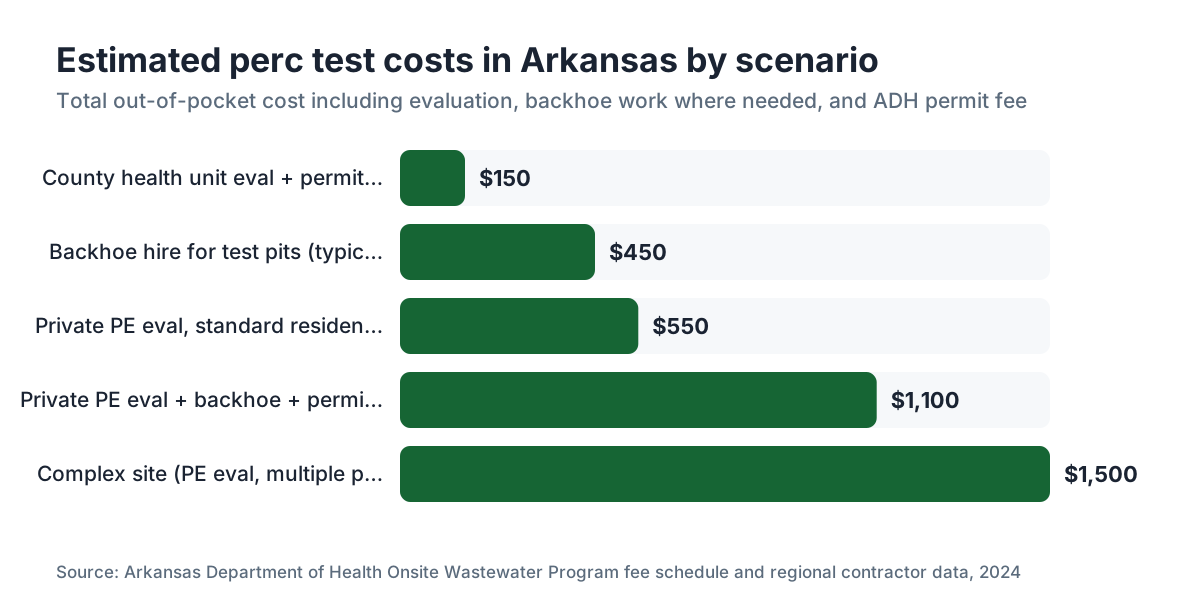
| Scenario | Estimated Cost Range |
|---|---|
| County health unit evaluation + ADH permit fee | $50 to $250 (plus backhoe costs) |
| Backhoe hire for test pit excavation | $300 to $600 |
| Private PE evaluation, standard lot | $300 to $800 |
| Private PE evaluation, complex site | $800 to $1,500+ |
| Full package (PE eval + backhoe + permit) | $600 to $2,000 |
What methods does Arkansas accept for soil evaluation?
Arkansas ADH rules recognize two soil evaluation methods, and the evaluator picks the one that fits the soil conditions [1].
The backhoe soil profile method is the preferred approach for most sites. A backhoe digs a pit at least 48 inches deep, and the evaluator reads the soil horizons for texture, structure, color (mottling flags seasonal saturation), and restrictive layers like hardpan or rock. This method tells you more than a timed perc test does, because it shows the soil profile down through the depths instead of one absorption rate at a single point.
The traditional percolation test is also accepted. The evaluator digs several test holes (usually 6 to 12 inches deep, a few inches across), pre-soaks them, then times how fast the water drops. Results come back in minutes per inch. ADH sets acceptable perc rates by system type. Soil that absorbs faster than about 3 minutes per inch, or slower than 60 minutes per inch, generally can't carry a conventional absorption field under Arkansas rules [1][10].
Alternative systems change the math. Aerobic treatment units, drip irrigation, and mound systems each use different evaluation criteria, so a perc rate that rules out a conventional field might still work for an alternative design. This is where a PE beats a standard permit checklist, because a PE can engineer around marginal soils.
The EPA's SepticSmart program calls proper site evaluation "the most important step in designing a septic system that will work for a long time" [5]. That isn't hype. The soil is the treatment system.
How do you find a licensed perc test evaluator in Arkansas?
Start with your county health unit. Every Arkansas county has one, and ADH publishes a county contact directory [1]. For most single-family permits, the county sanitarian will either run the evaluation or tell you exactly what a private evaluator needs to provide.
For private evaluators, the state licensure board keeps an online tool where you can confirm a PE's status and license number [2]. Search for civil or environmental engineers in your county. The Arkansas section of the American Society of Civil Engineers and the Arkansas Environmental Federation can also point you to qualified practitioners.
Ask any private consultant straight out: "Are you licensed as a PE in Arkansas, and have you had soil evaluations accepted by my county health unit?" County sanitarians know which consultants turn in clean reports, and a consultant who works your county regularly beats one who doesn't know the local soil.
Don't hire on price alone. A report the county rejects because it used the wrong method or missed a seasonal high water table sends you back to square one, and the money's already gone. For operators running projects across several counties, tracking which evaluators consistently produce approvable reports is the kind of detail SepticMind's operations software handles for you instead of leaving it to memory.
What happens after the perc test, and what permits come next?
A passing perc test is the foundation of the ADH permit application, not the finish line. Here's the sequence:
- A qualified professional completes the soil evaluation and documents the results in a site evaluation report.
- The homeowner or contractor submits that report with a permit application to the county health unit.
- The county sanitarian reviews the report, does a site inspection, and either approves the system design or asks for revisions.
- ADH issues a construction permit authorizing the specific system design.
- An ADH-licensed septic installer does the installation.
- The county sanitarian inspects the system before it's backfilled.
- ADH issues an operating permit (for systems that require one) or a final approval.
The septic tank inspection before backfilling is one step people try to skip. Don't. In Arkansas, installing without a permit or covering a system before inspection breaks Arkansas Code § 14-236-115 and can trigger a mandatory dig-up [9].
For a conventional system on a lot with passing soil, the whole permit run usually takes two to six weeks from evaluation to permit issuance, assuming no revisions. Complex sites and alternative systems take longer because the design needs more engineering documentation.
What if the perc test fails in Arkansas?
A failed perc test doesn't mean no septic system ever. It means a conventional absorption field won't work on that site as tested. You've got several paths forward.
Alternative system designs come first. Arkansas ADH authorizes aerobic treatment units (ATUs), mound systems, drip irrigation, and constructed wetlands for sites where a conventional system won't fit [1]. These need a PE design and cost a lot more to build. The cost to put in a septic tank with an alternative system in Arkansas can run $15,000 to $30,000 or more depending on complexity.
Try a different area of the lot. If the property is large enough, the soils may vary across it. A PE can find spots with better drainage. Sometimes shifting the proposed drain field 50 feet makes all the difference.
Retest, if you have grounds. If the test was run wrong (wrong season, poor pre-soaking, a damaged test hole), you can ask for a retest. Perc tests done in dry summer soil often read differently than tests done in spring when the ground is at seasonal saturation. ADH generally wants testing done during or near the period of highest groundwater.
And sometimes the property genuinely can't support any onsite system. Then connection to a municipal sewer, if one's available, or a change in land use are the realistic options. That's rare, but it happens on sites in floodplains or with very shallow restrictive layers.
Are perc test results transferable in Arkansas, and how long do they last?
Arkansas ADH soil evaluation results attach to a specific permit application for a specific site. They don't follow the property automatically when it sells or when the permit application expires.
ADH construction permits are typically valid for one year from issuance, and many counties will tell you the supporting soil evaluation needs to be from the last two to three years to stay usable for a new application [1]. If your evaluation is old and conditions have shifted (drainage, nearby development, seasonal groundwater), the county sanitarian may require a fresh one.
For real estate deals, this matters. A soil evaluation done for a seller five years back isn't automatically good enough for the buyer's lender or for pulling a new permit. If you're buying a lot that will need a new septic tank installation, budget for a fresh evaluation as part of due diligence. That's cheaper than buying land you can't build on.
The evaluation is site-specific but not usually system-specific. Change the proposed system type or location and you may need supplemental testing, but the underlying soil profile data usually carries over.
How does Arkansas compare to neighboring states on perc test licensing?
Most states run the same basic pattern: soil evaluations for onsite wastewater need a licensed PE, a state-credentialed soil scientist, or a public health official. The credential names and issuing bodies are what change [6].
Tennessee uses licensed soil scientists and PEs for onsite sewage system evaluations [7]. Missouri relies on licensed professional engineers and sanitarians under the Missouri Clean Water Law. Oklahoma requires licensed engineers or trained county health staff for evaluations under its onsite wastewater rules [8].
Here's what Arkansas does differently. Its county sanitarian network is relatively deep and accessible, so many homeowners get a county-run evaluation instead of paying a private firm. In states where county programs are underfunded, hiring a private PE is basically mandatory. The trade-off in Arkansas is that county sanitarians can carry long wait times during spring building season.
Texas, by comparison, has a full "Licensed Soil Evaluator" credential separate from PE licensure, which created a bigger pool of qualified private evaluators. Arkansas hasn't gone that way. There's a fair argument that a standalone evaluator credential would add capacity and cut wait times, but that's a policy conversation ADH hasn't had in public.
What should septic contractors and operators know about Arkansas perc test rules?
If you run a septic installation or service business in Arkansas, the licensing rules shape your workflow in one specific way: you can't do the evaluation yourself unless you hold a PE license or REHS credential. But you're often the one coordinating the whole process for the homeowner.
Knowing the ADH permit timeline and knowing which county sanitarians or private PEs in your area produce clean, approvable reports is a real edge. Contractors who can say "here's who we use, here's the typical timeline, here's what it costs" close more jobs than the ones who say "you'll need to figure out the evaluation separately."
When you're juggling multiple projects and permits across several counties, tracking evaluation status, permit numbers, inspection dates, and license expirations by hand or in a spreadsheet is where things slip. Operations software like SepticMind tracks all of it per job so nothing falls through while you're out on-site.
The installer license is separate from everything above. ADH licenses septic installers under its own program, and keeping that license current, along with insurance and bonding, is your ongoing compliance job. Make sure whoever does your soil evaluations is credentialed, keep your own license current, and document everything. The county sanitarian who approves your permits also has the authority to file a complaint that can hit your installer license.
Frequently asked questions
Does Arkansas have a specific 'perc test license' you can apply for?
No. Arkansas doesn't issue a standalone perc test license. The authority to run a formal soil evaluation for onsite wastewater permitting comes from holding a Professional Engineer license through the state licensure board, or from being a credentialed Registered Environmental Health Specialist working under ADH. There's no separate state-issued perc test credential you shop for.
Can a homeowner dig their own perc test holes in Arkansas?
A homeowner can dig test holes or hire a backhoe operator to dig them. But the evaluation itself, reading the soil profiles, timing the absorption, and signing the report for ADH permitting, has to be done by a licensed PE or a county health sanitarian. A homeowner-conducted test has no standing with the county health unit and won't support a permit application.
How much does a perc test cost in Arkansas?
County health unit evaluations cost roughly $50 to $150 in state permit fees, plus $300 to $600 for backhoe work the homeowner arranges separately. Private PE evaluations run $300 to $800 for a standard residential lot, and difficult sites can reach $1,500 or more. Total out-of-pocket for a complete privately-arranged evaluation with backhoe and permit fees usually lands between $600 and $2,000.
Who do I call first to schedule a perc test in Arkansas?
Call your county health unit. ADH works through offices in all 75 Arkansas counties, and county sanitarians handle most residential soil evaluations. They'll tell you what site prep is needed, which test method applies, and their current scheduling. If your project is complex or on a tight timeline, ask whether a private PE can submit an evaluation for their review instead.
How long does a perc test take to complete in Arkansas?
The physical test takes two to four hours for a standard lot, including excavation, soil profile examination, pre-soaking the test holes, and timing the absorption. Scheduling with the county health unit can add days to weeks depending on staff workload, especially in spring when building peaks. Private PE evaluators can often move faster but cost more.
What perc rates does Arkansas require for a conventional septic system to be approved?
Under ADH rules, conventional absorption fields are generally approved for soils with perc rates between about 3 and 60 minutes per inch. Soil faster than 3 min/in is too coarse and won't treat effluent well. Slower than 60 min/in is too tight and the system backs up. Sites outside that range need alternative system designs.
Can a perc test from a previous owner be used when I buy a property in Arkansas?
Sometimes, but not automatically. ADH construction permits typically expire after one year, and county sanitarians generally want soil evaluations from the past two to three years to support a new permit application. On an undeveloped lot, treat a fresh evaluation as part of due diligence. An old evaluation is a useful starting point but may need confirmation or supplemental testing.
What happens if a perc test is done without a licensed evaluator in Arkansas?
The county health unit won't accept the report for permitting. Building a septic system without a proper permit breaks Arkansas Code § 14-236-115 and can require mandatory removal of the system at the owner's expense. Beyond the legal exposure, an unevaluated system that fails can contaminate groundwater and create liability for the property owner.
How do I verify a PE's license in Arkansas before hiring them for a perc test?
The Arkansas State Board of Licensure for Professional Engineers and Professional Surveyors keeps an online license lookup on its official website. Search by name or license number and confirm the license is current and in good standing. Always do this before hiring. Ask the consultant for their PE number up front; any legitimate practitioner gives it without hesitation.
Do perc test requirements differ for commercial properties versus residential lots in Arkansas?
Yes, in meaningful ways. Commercial or large-volume sites typically require more complex evaluations, often with multiple test locations, hydraulic loading calculations, and full PE-stamped design documents. ADH applies tighter review to commercial systems because flow volumes are larger and the consequences of failure are greater. Single-family residential lots get the most straightforward pathway.
What is the difference between a perc test and a full site evaluation in Arkansas?
In Arkansas, the ADH-preferred method is a backhoe soil profile evaluation rather than a traditional timed perc test. The backhoe method reads soil texture, mottling, and restrictive layers across depth, which tells you more. A timed perc test measures absorption rate at one point and depth. ADH accepts both, but the backhoe profile is generally preferred for new construction because it reveals more about long-term site suitability.
Can an Arkansas septic installer also be a licensed perc test evaluator?
Not under the installer license alone. An ADH-licensed septic installer is authorized to build systems, not to run the formal soil evaluation for permitting. If an installer also holds a PE license or REHS credential, they could do both, but that overlap is rare. The evaluator and installer are kept separate on purpose, so no one grades their own homework on site suitability.
Does the EPA set any rules on who can run a perc test?
The EPA sets general guidance for onsite wastewater through its SepticSmart program and publishes technical manuals on septic design, but the authority to set licensing and evaluation requirements rests entirely with states. Arkansas ADH is the controlling authority. EPA guidance shapes Arkansas rules indirectly through funding conditions and best-practice recommendations, but there's no federal perc test license.
Sources
- Arkansas Department of Health, Onsite Wastewater Program: ADH regulates all onsite wastewater soil evaluations in Arkansas, sets percolation test standards, and issues construction permits through county health units in all 75 counties
- Arkansas State Board of Licensure for Professional Engineers and Professional Surveyors: The state board licenses Professional Engineers in Arkansas; a PE license authorizes soil evaluations for onsite wastewater permitting without a separate ADH credential
- National Environmental Health Association, REHS/RS Credential: REHS credentialing requirements and continuing education standards for environmental health specialists, including those conducting onsite wastewater evaluations
- U.S. EPA SepticSmart Program: EPA SepticSmart states that proper site evaluation is 'the most important step in designing a septic system that will work for a long time'
- U.S. EPA, Onsite Wastewater Treatment Systems Manual (EPA/625/R-00/008): Federal technical guidance on soil evaluation methods and qualifications for onsite wastewater system design; basis for state-level licensing frameworks
- Oklahoma Department of Environmental Quality: Oklahoma requires licensed engineers or trained county health staff for soil evaluations, a comparable framework to Arkansas
- Arkansas Code Annotated § 14-236-101 et seq., Regulation of Sewage Disposal Systems: Arkansas statutory authority for ADH to regulate onsite wastewater systems including permitting, inspection, and enforcement provisions under § 14-236-115
- U.S. EPA, How Your Septic System Works: Soil absorption field function and the role of soil permeability in effluent treatment, supporting the explanation of perc rate thresholds
Last updated 2026-07-10