How much does it cost to install a septic tank in 2025?
By the SepticMind Editorial Team
TL;DR
- Installing a new septic tank costs $3,000 to $15,000 on average, with most homeowners spending $5,000 to $9,000 for a conventional gravity-fed system including tank, drain field, and labor.
- Alternative systems (mound, aerobic, drip) push costs to $10,000, $20,000+.
- Permits, soil testing, and site conditions are the biggest swing factors.
What is the average cost to install a septic tank?
"Septic tank installation" is almost always a full system installation. You're buying more than a tank. You're paying for permits, a perc test, excavation, the tank itself, distribution pipe, and a drain field. Those pieces together land most homeowners between $5,000 and $9,000 for a standard gravity system on an easy lot [1].
The range runs wide. A simple plastic tank swap on a lot with good soil and existing lateral lines can come in under $3,000 in a low-cost rural area. A full system on rocky ground with a high water table and a mound field can top $20,000 before the permit fees hit. Neither extreme is rare.
The EPA's SepticSmart program says septic systems serve about 21 million homes in the United States, and installation costs vary a lot by region, soil type, and system design [1]. National averages are a starting point, not a quote.
For a line-by-line breakdown, see our full septic tank installation guide.
What factors drive the cost of a septic system installation up or down?
Soil is the single biggest variable. A percolation (perc) test measures how fast water drains through your ground. Sandy, fast-draining soil is cheap to work with. Clay-heavy or impermeable soil either forces an engineered alternative or kills the project. The perc test itself costs $250 to $1,000 depending on your state and how many test holes are needed [2].
System size is the next lever. In most state codes, tank size is driven by bedroom count, not actual water use. A 3-bedroom home usually needs a 1,000-gallon tank minimum; a 5-bedroom home may need 1,500 gallons or more. Bigger tanks and longer drain fields mean more material and more digging [3].
Here are the main cost drivers in plain terms:
| Factor | Low-cost scenario | High-cost scenario |
|---|---|---|
| Soil condition | Sandy, well-draining | Clay, rock, high water table |
| Lot topography | Flat, open | Sloped, wooded, tight access |
| System type | Conventional gravity | Mound, aerobic, drip irrigation |
| Tank material | Plastic | Concrete, fiberglass |
| Permit complexity | Simple county permit | Multi-agency review |
| Depth of excavation | Shallow (<4 ft) | Deep or blasted rock |
| Distance from house | Short runs | Long pipe runs to field |
Excavation depth is the one contractors don't always flag upfront. Rocky soil that needs blasting can add $2,000 to $5,000 on its own. Ask your installer to walk the lot and hand you a written scope before you sign anything.
How much does each part of a septic system cost separately?
Breaking the project into components lets you read a contractor's quote intelligently.
Permits and inspections: Most counties charge $200 to $1,500 for a septic permit. Some states require a licensed engineer's stamp, which adds $500 to $2,000. Budget for a final inspection fee too, usually $100 to $400 [2].
Perc test and soil evaluation: $250 to $1,000 in most states. Some states require a licensed soil scientist rather than just the installer, which pushes cost toward the top of that range [4].
Tank purchase and delivery:
- Plastic (polyethylene): $500 to $1,500 for a 1,000-gallon tank
- Fiberglass: $1,000 to $2,000
- Concrete: $700 to $2,000 (heavier, needs a crane or large equipment)
Excavation and tank placement: $1,500 to $4,000. This is usually the largest labor line item.
Distribution system and drain field: $2,000 to $8,000 for a conventional leach field. The leach field is where the most cost variation lives, because field size scales with daily wastewater flow and soil absorption rate.
Alternative system components:
- Mound system: adds $5,000 to $15,000 over conventional
- Aerobic treatment unit (ATU): $10,000 to $20,000 total
- Drip irrigation system: $8,000 to $18,000 total
Get three quotes. Installer pricing on the same job routinely varies by 20 to 40 percent inside the same ZIP code.
How much do different types of septic systems cost?
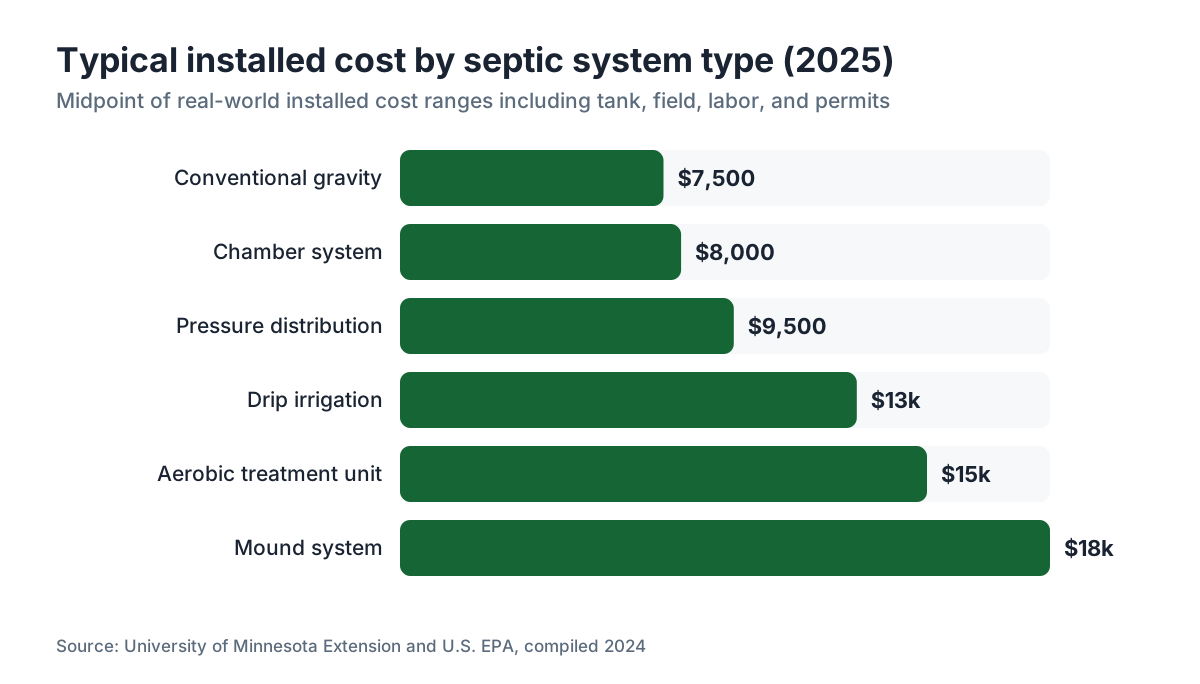
System type is where you have the least control and the most cost exposure. The engineer or health department tells you what the site can support. You don't get to pick the cheapest option if the soil won't allow it.
| System type | Typical total installed cost | Best for |
|---|---|---|
| Conventional gravity | $5,000 to $10,000 | Good soil, flat lot, code-standard layout |
| Pressure distribution | $7,000 to $12,000 | Moderate soil, uneven distribution |
| Mound system | $12,000 to $25,000 | High water table, poor drainage |
| Aerobic treatment unit | $10,000 to $20,000 | Small lots, near water bodies |
| Drip irrigation | $8,000 to $18,000 | Sites with limited drain field space |
| Constructed wetland | $10,000 to $20,000 | Specific ecology/code situations |
| Chamber system | $5,000 to $11,000 | Good soil, reduced trench width |
Conventional systems use gravity to move effluent from the tank to perforated pipes buried in gravel trenches. They're the cheapest to install and the simplest to maintain. If your perc test allows it, take it every time [3].
Mound systems are what happens when your water table sits too high for conventional burial depth. Sand and gravel get imported and mounded above grade, which means trucking material to the site. That material cost plus extra labor is why a mound can double your bill.
Aerobic treatment units treat wastewater to a higher standard using oxygen-driven bacteria, which lets you discharge in areas where conventional systems are banned. They work well. They also have mechanical parts (air pumps, timers) that need maintenance contracts in most states. Annual maintenance runs $100 to $300 on top of the higher upfront cost [5].
How much does a septic system cost by state or region?
Regional cost differences come from three things: local labor rates, state regulatory requirements, and soil and geology. The Northeast tends to run most expensive because of rocky terrain, dense regulations, and high labor costs. The South and Midwest are generally cheaper, though Florida and coastal states add setback complexity near water [2].
Rough regional ranges for a full conventional system installation:
| Region | Low end | High end |
|---|---|---|
| Northeast (NY, MA, CT) | $8,000 | $20,000+ |
| Mid-Atlantic (VA, MD, PA) | $6,000 | $15,000 |
| Southeast (GA, SC, TN) | $4,500 | $12,000 |
| Midwest (OH, IN, MO) | $4,000 | $10,000 |
| South Central (TX, OK, AR) | $3,500 | $9,000 |
| Mountain West (CO, ID, MT) | $5,000 | $14,000 |
| Pacific Coast (WA, OR, CA) | $7,000 | $18,000 |
These ranges come from state extension and regulatory published figures [4]. Your specific county can sit outside them even within a state. A rural county with light regulatory overhead runs cheaper than a suburban county with engineered plans and multiple inspection stages.
For a breakdown that maps to your region, see our cost to install septic system guide.
How do you actually install a septic tank? What does the process look like?
Knowing the process helps you ask better questions and catch problems before they cost you money.
Step 1: Site evaluation and soil testing. Before any permits, a licensed evaluator (in many states this has to be a soil scientist or PE) digs test holes and runs a perc test. Results decide what system type your lot can support and how large the drain field must be. This takes 1 to 3 days [4].
Step 2: Permit application. You or your contractor submit the design to the county or state health department. Review times run from 2 days to 8 weeks depending on jurisdiction. Some states have online permit portals; others still want paper submissions and in-person review [2].
Step 3: System design. A licensed designer or engineer draws the site plan: tank location, setbacks from property lines, wells, and structures, pipe routes, and field dimensions. Most states require setbacks of 50 to 100 feet from drinking water wells [6].
Step 4: Excavation. A backhoe or excavator digs the tank pit and the drain field trenches. Rocky or root-heavy ground adds time and cost here.
Step 5: Tank placement. The tank (plastic, fiberglass, or concrete) drops into the pit and gets leveled. Inlet and outlet baffles are checked or installed. The tank connects to the house sewer line.
Step 6: Drain field installation. Perforated pipe, gravel, and geotextile fabric go into the trenches in a specific layered order. Chamber systems skip the gravel and use plastic arch chambers instead.
Step 7: Inspection. Most jurisdictions require an inspection before backfill. Don't let a contractor skip this. If the inspector finds a problem after backfill, you're looking at an expensive dig-up.
Step 8: Backfill and restoration. Soil goes back in, the site gets graded, and grass or another approved cover goes down. Never plant trees or deep-rooted shrubs over the field [7].
The whole process, from perc test to final inspection, usually takes 4 to 12 weeks. Most of that wait sits in the permit queue, not on the contractor's schedule.
Can you install a septic tank yourself to save money?
A handful of states allow owner-installation on your own property under specific conditions. In practice, it's a bad idea for most homeowners.
The permit and inspection process requires licensed professionals in the majority of states. Even where DIY is legal, you'll need the perc test done by a licensed evaluator, a PE-stamped design in many counties, and inspection at multiple stages. The excavation equipment alone means renting or hiring a machine operator. And if the system fails from a faulty install, you own the cleanup, which can top $20,000 [6].
What you can legitimately do yourself: clear brush and other minor site prep, dig by hand where access is very tight (rarely practical), and watch progress closely during install. The real way to save money is three competitive bids, asking each contractor whether the permit fee is included, and choosing a simple system design if your soil supports it.
Some homeowners save by buying the tank straight from a supplier and having the installer set an owner-furnished tank. This works in some jurisdictions and can save $200 to $500, but check with the installer first. Some won't warranty work on materials they didn't supply.
For an unvarnished look at what's negotiable, see our cost to put in a septic tank breakdown.
Are there financial assistance programs or ways to reduce the cost?
Yes, and they're underused. The USDA Rural Development program offers loans and grants for septic installation and repair in rural areas through its Section 504 program and the Water and Environmental Programs. Income-qualified homeowners can get grants up to $10,000 and loans up to $40,000 for water and waste disposal improvements [8].
The EPA points to state revolving fund programs that offer low-interest financing for water infrastructure including septic, though access varies by state [1]. Some states run their own programs separately. North Carolina, Maryland, and Vermont have operated state-level septic assistance programs, though funding availability changes every year.
Local health departments sometimes offer grant help for failing systems that pose a public health risk, especially near water bodies. Call your county health department before you assume you're on your own.
For new construction, the biggest financial decision is system type. If your site can support a conventional gravity system, fight to keep it conventional. Every step up in complexity adds cost upfront and in annual maintenance for the life of the system. A mound system that rescues a lot might be necessary. A mound system chosen because the installer skimped on soil evaluation is just money lost.
Operators managing customer records and maintenance schedules across many properties use tools like SepticMind to track system types and service intervals, which keeps the long-term cost of ownership visible instead of hidden.
What are the ongoing costs after installation?
The install cost is what you pay once. Ongoing costs run for the life of the system, and ignoring them is how a $500 pump-out turns into a $15,000 drain field replacement.
Pumping is the non-negotiable routine expense. A conventional system needs pumping every 3 to 5 years on average, though household size and tank capacity shift that. The EPA SepticSmart program recommends pumping when the scum and sludge layers together fill more than one-third of the tank volume [1]. A standard pump-out costs $300 to $600; see our septic tank pumping guide for the full breakdown.
Aerobic systems add a maintenance contract, usually $100 to $300 a year in most states, because they have mechanical parts that have to be inspected quarterly or semi-annually by law in many jurisdictions [5].
Inspections every 1 to 3 years ($150 to $400) catch problems before they turn catastrophic. Our septic tank inspection guide covers what inspectors look at and what findings mean.
| Ongoing expense | Frequency | Typical cost |
|---|---|---|
| Pumping | Every 3 to 5 years | $300 to $600 |
| Inspection | Every 1 to 3 years | $150 to $400 |
| ATU maintenance contract | Annual | $100 to $300 |
| Effluent filter cleaning | Every 1 to 2 years | $50 to $150 (often bundled) |
| Minor repairs (baffles, risers) | As needed | $100 to $500 |
The average American on septic spends roughly $300 to $500 a year once you amortize pumping and inspections. That sits well below the $600 to $1,200 a year a typical municipal sewer bill runs in most metro areas [9].
For what happens when maintenance lapses, see our septic tank repair and septic system repair guides.
How long does a septic system last, and when does replacement make sense?
A well-maintained concrete or plastic tank can last 40 years or more. The drain field is more variable. Expect 20 to 30 years for a conventional field that's been loaded properly and never flooded by surface water or roots [3].
Systems fail for a few specific reasons. Sludge overflow from under-pumped tanks clogs the field with solids. Root intrusion from trees planted too close breaks pipes and clogs gravel. Compaction from driving over the field destroys the pore structure. Overloading from garbage disposals or large households shortens field life by years.
Partial failures sometimes allow targeted repair instead of full replacement. A cracked distribution box ($500 to $1,500 to replace), a failed effluent filter ($100 to $300), or a single clogged lateral line ($500 to $2,000 to treat or replace) are all repairable. Full drain field replacement is $3,000 to $15,000 and starts the clock over.
Buying a home with a septic system? A pre-purchase inspection is not optional. Inspectors pump the tank, probe the field, and run flow tests. Failing systems that weren't disclosed can become your problem under most purchase agreements the moment you close. See our septic tank inspection page for what to ask.
The repair-versus-replace math is usually simple. If repair costs approach 50 percent of a new system and the system is over 20 years old, replacement often wins, because you're also buying another 25 to 30 years of service life.
If you run a service business and track system ages across a customer portfolio, that data flags which customers are heading toward replacement. SepticMind is built for exactly that kind of operational record-keeping.
What questions should you ask before hiring a septic installer?
Contractor selection is where homeowners lose money most often. A low bid that skips permits or lowballs field size is not a bargain.
Ask every installer these questions before signing:
- Are you licensed in this state and county for septic installation? (Verify the license number yourself on the state licensing board website.)
- Will you pull the permit, or is that on me? (Reputable installers usually pull permits. If they push it to you, ask why.)
- Is the perc test and soil evaluation included in your quote, or separate?
- What tank material are you recommending, and why? Is there a warranty?
- What's the drain field design, and how was it sized? Can I see the percolation results?
- Do you offer a warranty on your installation, and what does it cover?
- Will there be a county inspection before backfill? Who schedules it?
- What are your payment terms? Never pay more than 10 to 20 percent upfront before work begins.
Get every answer in writing, more than verbally. A contractor who can't or won't answer these clearly before you sign is showing you how they'll communicate when something goes wrong mid-project.
For cost tracking after installation, keep records of every pump-out and inspection. How often you need to pump depends partly on household size; our how often to pump septic tank guide has the full decision tree.
Frequently asked questions
How much does it cost to install a 1,000-gallon septic tank?
A 1,000-gallon tank itself costs $500 to $2,000 depending on material (plastic, fiberglass, or concrete). But the tank is only part of the cost. With excavation, delivery, placement, and connection to the house, tank installation alone runs $2,000 to $5,000. That still leaves out the drain field, which adds $2,000 to $8,000 more. Total system cost with a 1,000-gallon tank typically lands between $5,000 and $10,000.
How long does septic system installation take?
Physical installation takes 2 to 5 days of active work for a conventional system. The real timeline is driven by permits, which can take 2 days to 8 weeks depending on your county. Soil testing and design add another 1 to 2 weeks before permits are even filed. Realistically, budget 6 to 12 weeks from first soil test to final inspection and backfill.
Do I need a permit to install a septic system?
Yes, in every U.S. state. Septic systems are regulated at the state and local level through health department or environmental agency permits. Installing without one is illegal, voids homeowner's insurance under most policies, and creates disclosure problems when you sell. Permit costs run $200 to $1,500. Some states also require a licensed PE to stamp the design before the permit gets issued.
What size septic tank do I need?
Most state codes size tanks by bedroom count, not actual occupancy. A 1-2 bedroom home usually needs 750 to 1,000 gallons; 3 bedrooms needs 1,000 gallons minimum; 4-5 bedrooms needs 1,250 to 1,500 gallons. Your state's onsite wastewater code specifies the minimum. Check your state health department's rules directly, since undersizing at installation is a code violation you'll have to fix before you get a final permit.
Can I install a septic system myself?
A small number of states allow owner-installation on your own property under specific conditions, but most require licensed contractors for all or part of the work. Even where DIY is permitted, you still need a licensed evaluator for soil testing, a PE-stamped design in many counties, and county inspections. Equipment rental alone runs $300 to $1,000 a day. For most homeowners, the liability and complexity make professional installation the right call.
How much does it cost to replace a drain field?
Drain field replacement costs $3,000 to $15,000 depending on size, soil conditions, and system type. This is separate from any tank work. If the existing tank is in good shape, it may be reused. If access is tight or the replacement field needs a mound design, costs push toward the top of that range. A failed drain field is the most expensive routine repair a septic homeowner faces.
What is a perc test and what does it cost?
A percolation test measures how fast water drains through soil at a specific depth. It decides whether conventional septic is feasible and what size drain field you need. The test involves digging holes, saturating the soil, and timing the drop in water level. Cost is $250 to $1,000 depending on how many holes your county requires and whether a licensed soil scientist must run it. Results are usually valid for 2 to 5 years.
Are there government programs to help pay for septic installation?
Yes. The USDA Rural Development Section 504 program offers loans up to $40,000 and grants up to $10,000 for rural homeowners with very low income for water and waste disposal improvements including septic. State revolving fund programs administered through the EPA provide low-interest financing in many states. Some county health departments also run grant programs for failing systems near water bodies. Call your county health department first.
How much does an aerobic septic system cost compared to conventional?
An aerobic treatment unit (ATU) system costs $10,000 to $20,000 installed, against $5,000 to $10,000 for a conventional gravity system. ATUs also require annual maintenance contracts of $100 to $300 a year and quarterly or semi-annual inspections mandated by state code in most jurisdictions. The higher cost is justified when lot size or proximity to water bodies makes conventional systems legally prohibited.
How do I know if my soil will pass a perc test?
There's no reliable way to know before the test. Sandy loam soils pass easily; heavy clay or bedrock close to the surface often fails or forces an engineered alternative. A trained eye can make an educated guess from surface texture and vegetation patterns, but the formal test is the only number your permit authority will accept. If you're buying land, make the purchase contingent on a passed perc test.
What happens during a septic system inspection?
An inspector pumps or observes the tank to check scum and sludge levels, examines inlet and outlet baffles, looks for cracks or structural issues, checks the distribution box if accessible, and evaluates the drain field for surfacing effluent or soggy ground. A full inspection with pumping takes 1 to 3 hours and costs $300 to $600. See our septic tank inspection guide for what specific findings mean.
Does installing a septic system add value to a home?
A functioning, code-compliant septic system is necessary for a home to be sold and financed in most markets, so it's baseline value rather than added value. A failed or aging system actively drops sale price, often by more than replacement cost, because buyers discount for risk and hassle. New system installation before listing typically recovers close to full cost in sale price, though data on this is thin and market-specific.
How far does a septic system need to be from a well?
Most state codes require septic components to sit at least 50 to 100 feet from any drinking water well. The EPA recommends a minimum 50-foot setback from a private well to the septic tank and 100 feet from the drain field. Some states require 150 feet or more for the field. Your county health department's onsite wastewater code specifies the exact distances for your jurisdiction.
What maintenance does a new septic system need in the first year?
In the first year, use the system normally. Avoid large quantities of antibacterial soap, don't flush anything except toilet paper and human waste, and don't plant trees near the field. A baseline inspection at 1 to 2 years is smart to confirm everything works as designed. The first pump-out usually isn't needed for 3 to 5 years, though household size shifts that timeline a lot.
Sources
- U.S. EPA, SepticSmart Program: Septic systems serve about 21 million homes in the United States; EPA recommends pumping when scum and sludge together occupy more than one-third of tank volume.
- U.S. EPA, Onsite Wastewater Treatment Systems Manual: Permit costs, inspection stages, and setback requirements vary by jurisdiction; state and local health departments govern septic installation permitting.
- Penn State Extension: Tank size is driven by bedroom count in most state codes; conventional systems have an expected service life of 20-30 years for the drain field with proper maintenance.
- University of Minnesota Extension, Septic Systems: Percolation testing costs $250, $1,000 depending on state requirements; regional cost ranges for conventional system installation vary significantly across the U.S.
- U.S. EPA, Types of Septic Systems: Aerobic treatment units have mechanical components requiring annual maintenance contracts of $100, $300 per year and quarterly or semi-annual inspections required by state code in many jurisdictions.
- U.S. EPA, How Your Septic System Works: Setback requirements from drinking water wells are typically 50 to 100 feet for septic tanks and up to 100 feet for drain fields under most state codes.
- U.S. EPA, SepticSmart Homeowner Guidance: Trees and deep-rooted shrubs should not be planted over the drain field; roots can damage pipes and disrupt soil structure.
- USDA Rural Development, Water and Environmental Programs: USDA Rural Development Section 504 program offers grants up to $10,000 and loans up to $40,000 for water and waste disposal improvements including septic systems for rural income-qualified homeowners.
- American Water Works Association: Average municipal sewer bills in U.S. metro areas run $600, $1,200 per year, providing context for the relative annual cost of septic system ownership.
- University of Georgia Extension: Regional cost ranges and system type cost comparisons for conventional, mound, and aerobic septic systems based on state-level data.
Last updated 2026-07-09