How much does a new septic tank cost in 2025?
By the SepticMind Editorial Team
TL;DR
- The tank itself runs $500 to $3,000.
- Installed, a standard residential system usually lands between $3,000 and $10,000.
- Hard sites, alternative systems, or oversized tanks can push the total past $15,000.
- Labor, permits, soil testing, and the drain field drive the price, not the tank.
- Get three bids before you commit.
What is the average cost of a new septic tank?
The tank is the cheap part. A concrete, plastic, or fiberglass septic tank costs $500 to $3,000 for the unit alone [1]. Add excavation, labor, permits, inspections, and a hookup to a drain field, and you're usually at $3,000 to $10,000 for a straightforward install on a cooperative lot.
Hard sites change the math fast. High water tables, rocky soil, or lots that need a mound system or aerobic unit can push total installed costs to $15,000 or past $20,000. The EPA's SepticSmart program says onsite systems serve about 20 percent of U.S. households, and what you pay swings hard by region and site [2].
Here's what most homeowners actually pay at different points in the range:
| Scenario | Typical total installed cost |
|---|---|
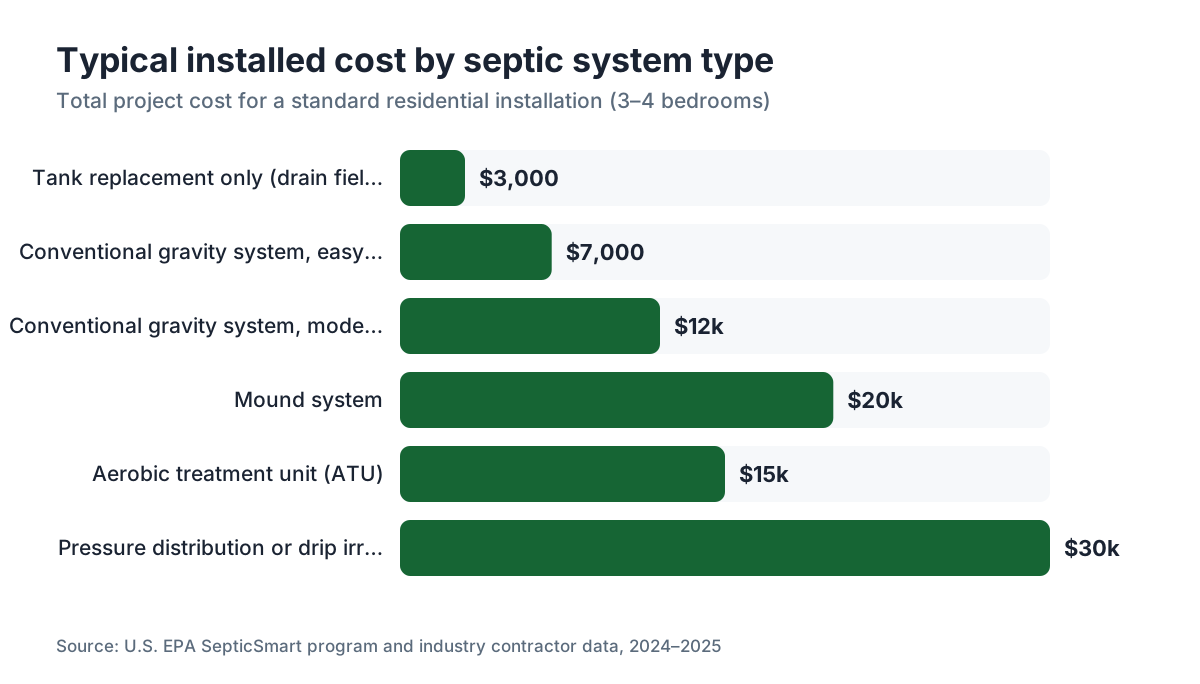
| Tank replacement only (existing system, good drain field) | $1,500 to $5,000 |
| New conventional system, easy site | $3,000 to $10,000 |
| New conventional system, moderate complexity | $8,000 to $15,000 |
| Mound or alternative system, difficult site | $15,000 to $25,000+ |
These ranges come from contractor quotes across multiple states. Your local market matters a lot. Crews in New England or the Pacific Northwest charge more than crews in the rural South or Midwest, sometimes double for the same job.
What does a septic tank itself cost before installation?
The tank is a commodity, and its price tracks material and size more than anything else. Three materials own the market: concrete, plastic (polyethylene), and fiberglass.
Concrete is the standard in most states. A 1,000-gallon concrete tank costs $700 to $1,500 delivered [1]. It's heavy, which makes transport and setting pricier, but it lasts 40 years or longer as long as the soil isn't acidic enough to eat it.
Plastic tanks run $500 to $1,200 for a 1,000-gallon unit. They're lighter, easier to drop into tight spots, and they don't corrode. The catch: they can float in a high water table if the installer skips proper anchoring.
Fiberglass costs $1,200 to $2,500. It sits in the middle: lighter than concrete, more rigid than plastic, corrosion resistant. Less common, but a smart pick where soil acidity or access is a real headache.
Size drives cost as much as material does. Most homes use 1,000 to 1,500-gallon tanks. More than four bedrooms or heavy water use may call for 1,500 or 2,000 gallons. Some states set minimum sizes by code no matter your bedroom count.
| Tank size | Concrete | Plastic | Fiberglass |
|---|---|---|---|
| 750 gallon | $500 to $900 | $400 to $700 | $900 to $1,500 |
| 1,000 gallon | $700 to $1,500 | $500 to $1,200 | $1,200 to $2,000 |
| 1,250 gallon | $900 to $1,800 | $700 to $1,400 | $1,500 to $2,500 |
| 1,500 gallon | $1,100 to $2,200 | $900 to $1,800 | $1,800 to $3,000 |
What adds to the cost beyond the tank itself?
This is where the surprises live. The tank is usually less than a third of your total bill. Here's where the rest goes.
Excavation is often the single biggest line item, running $500 to $3,000 depending on soil, depth, and access. Rocky ground or a slope that needs grading costs more. Some contractors bill excavation by the hour, others fold it into a flat quote, so ask straight out which it is.
Permits and inspections are mandatory in every state. Fees run from $200 in rural counties to $1,000 or more in states with strict onsite wastewater programs. Most jurisdictions require a final inspection before you cover the system, and some require a soil scientist or licensed engineer to sign off. The EPA and state agencies set the framework; counties or towns run it day to day [2].
Soil testing (a perc test or soil evaluation) is usually required before a new-install permit is issued. Budget $200 to $800 for a perc test, more for a full soil morphology evaluation by a certified soil scientist.
The drain field (leach field) often costs more than the tank. A conventional gravel-and-pipe field for a three-bedroom home runs $3,000 to $7,000. Alternative fields or mound systems run $8,000 to $20,000. Our guide to leach fields breaks it down further.
Connection plumbing, risers, lids, inlet and outlet baffles, and an effluent filter add $200 to $800 in materials. Some states now require risers and lids at or near grade. That adds cost upfront but saves you on every future pumping.
Backfilling, seeding, and putting the yard back together can run $500 to $2,000 if the site got torn up.
How much does it cost to replace versus install a new septic tank?
These are different jobs. A full new install assumes no existing system and covers every component above. A replacement means the drain field and lateral lines are still good, and only the tank is failing or due for an upgrade.
Tank-only replacement is cheaper because the expensive parts (soil testing, drain field, most of the permitting) are already behind you. Plan on $1,500 to $5,000 for a tank swap on a conventional system with easy access. Bad access, a cracked concrete tank that needs demolition, or a tank buried unusually deep pushes that up.
If your drain field is failing too, which happens a lot when a tank sat neglected for years, you're back to a full system replacement. A new tank won't fix a dead field. Get a septic tank inspection before you commit so you know exactly what you're buying.
For the full build from bare ground, our cost to install a septic system guide covers every line item.
How much does it cost to empty a septic tank?
Pumping out a septic tank is routine maintenance, not replacement, and it's cheap by comparison: $250 to $600 for a standard residential tank in most of the country [3]. Dense urban markets or states with strict disposal rules run $400 to $800. Very large tanks, or tanks that haven't been touched in years and are packed with sludge, cost more because the job takes longer.
The EPA recommends pumping every three to five years for a typical household, though the right interval depends on household size, tank size, and water use [2]. A four-person household with a 1,000-gallon tank generally pumps every three to four years. One person in the same house might stretch to five to seven. For a schedule built around your numbers, see how often to pump a septic tank.
Some contractors pair pumping with a basic inspection for $350 to $700. That's money well spent, because the inspector can flag bad baffles, cracked lids, or early drain field trouble before any of it turns expensive. Our septic tank pump out guide walks through what happens during service.
Don't confuse pumping with cleaning. Pumping removes liquid and floating scum. Cleaning goes further, using high-pressure water or mechanical scrubbing to strip grease and biomat off the tank walls. Cleaning costs $400 to $900, and most tanks never need it unless they've been badly neglected. Our septic tank cleaning guide explains when it's actually warranted.
What type of septic system costs the most and why?
Conventional gravity systems are the cheapest. When the soil percs well and the lot has room for proper setbacks, a conventional system handles most homes and keeps you at the low end of the range.
Alternative systems show up when the lot fails a standard perc test, has a high water table, runs short on space, or sits near a water body with strict nutrient limits. They cost more to build and more to keep running.
Mound systems are the most common alternative. They build a raised drain field above grade with imported sand and aggregate, and they cost $15,000 to $25,000 installed. University of Minnesota Extension notes these are common across the upper Midwest, where a seasonal high water table or poor soil percolation rules out conventional systems [7].
Aerobic treatment units (ATUs) add an aeration chamber that breaks down waste before it hits the drain field. They cost $10,000 to $20,000 installed and need electricity, a service contract (mandatory in many states), and yearly inspections. They treat effluent better, which is why they're often required near sensitive water.
Pressure distribution systems, drip irrigation, and constructed wetlands are other options that run $20,000 to $40,000+ depending on scale. Some of these rarely fit a standard house but turn up in environmentally sensitive areas.
Your state's onsite wastewater rules mostly decide what you're allowed to install. Most states built their standards on EPA guidance, but the specifics vary a lot [3].
What factors affect the cost most in your specific situation?
Soil is the biggest wild card. Sandy or loamy soil that drains well lets you run a simple conventional field. Clay-heavy or rocky soil that fails a perc test forces you into an alternative system and easily doubles or triples the project. That's why two neighbors on the same street can get quotes $10,000 apart.
Lot size and setbacks matter too. State and county codes set minimum distances between the system and property lines, wells, water bodies, and the house. A small or oddly shaped lot may leave you few options, or none, for a conventional layout.
Depth to bedrock or the water table drives a lot of cost. Shallow bedrock in New England is a constant headache for designers and raises the bill through blasting or the need for a mound.
Equipment access adds to excavation. A backyard that only fits a mini excavator instead of a full-size machine costs more to work in. Steep slopes burn time and fuel.
Local labor rates vary more than people expect. A $6,000 job in rural Mississippi can hit $12,000 in suburban Connecticut with the same tank, the same design, and nearly identical soil. Get at least three bids, and confirm each bidder is licensed for onsite wastewater work in your state.
Timing and material prices move too. Concrete costs, fuel surcharges on pump trucks, and contractor availability all shift with the economy. The ranges here run through 2024 and 2025. If you're reading this years later, adjust upward for inflation.
Are there permits required and do they affect cost?
Yes, and you can't legally skip them. Every state requires a permit for new septic installation, and most require one even for a tank replacement. Some counties pile on local rules over the state ones.
The process usually runs like this: a soil evaluation or perc test, a system design from a licensed engineer or designer, a permit application with fees, and one or more inspections during and after the work [2]. Some states require the designer to be a licensed professional engineer or a certified onsite wastewater designer specifically.
Permit fees alone run from around $200 in rural counties to over $1,000 in tightly regulated jurisdictions. Florida, for example, routes permits through county health departments under the state Department of Health's onsite sewage program, and fees and requirements shift county to county [4].
Never hire a contractor who floats skipping the permit. An unpermitted system is a real problem: selling your home gets ugly when a title search or buyer's inspection turns it up, and some lenders won't close on a property with an unpermitted septic system. Liability for any environmental damage lands on you.
For tracking maintenance and permit records, operators managing multiple properties use tools like SepticMind to keep service history and permit documentation in one place, which matters most when a property changes hands.
How can you reduce the cost of a new septic tank or system?
Get competitive bids. Three quotes is the floor; four or five is better for a job this size. Prices between licensed contractors for identical work often differ 20 to 40 percent, and at this level a higher price buys you nothing extra. Ask each one for a line-item breakdown so you're comparing the same thing.
Time the job right. Spring and fall are the busy seasons, which means less room to negotiate. Late summer or winter installs (where the ground isn't frozen) sometimes get you a better number because crews have gaps to fill.
Don't over-spec the tank. Bigger isn't automatically better. Your designer sizes the tank to code minimums for your bedroom count and usage. Buying up for a feeling of safety usually isn't needed and can cost an extra $300 to $600.
If you're replacing a tank and the field is genuinely fine, push back on any contractor who insists on replacing it too. Get a second opinion. A camera inspection or a pressure test of the laterals can confirm the field's condition before you spend $5,000 on something you don't need. Our septic tank repair guide covers the cases where a repair is all it takes.
Check for state or local financing. Some states run low-interest loans or grants for septic upgrades, especially in impaired-watershed areas. USDA Rural Development has long funded rural water and waste infrastructure, including septic systems, for qualifying low-income rural households [5].
Keep the system you have alive. The cheapest new septic tank is the one you don't need yet. Pump every three to five years, flush nothing but waste and toilet paper, and keep heavy vehicles off the drain field, and you can add decades of life. Our septic tank pumping guide covers what regular service looks like.
How long does a septic tank last before you need a new one?
Concrete tanks typically last 30 to 50 years in neutral soils, according to North Carolina State University Extension. Acidic soils speed up corrosion and can cut that to 20 years [6]. Plastic and fiberglass tanks are effectively immune to corrosion, though UV damage and physical cracks are risks if one ever gets exposed.
The tank itself rarely blows up all at once. What usually fails first is the drain field, the baffles, or the distribution box. A tank with a cracked baffle or a corroded outlet tee can be repaired without swapping the whole thing. Our septic system repair guide covers those.
Actual structural failure, a collapse or a major crack, shows up most in old concrete tanks where the mix wasn't built for long soil contact or where roots got in. Tanks from the 1960s and 1970s still in service are often at or past their design life.
Buying a home with an older system? A septic tank inspection is one of the smarter pre-closing moves you can make. An inspector who pumps the tank and scopes the outlet can tell you whether it has years left or needs replacing soon. That answer is worth real money at the negotiating table.
For a rough benchmark, most U.S. home septic systems get replaced or heavily upgraded every 25 to 30 years, though well-maintained systems in good soil routinely beat that.
What should you ask a contractor before hiring them for septic tank installation?
Ask for their state onsite wastewater license number and verify it with your state's licensing board. Non-negotiable. In most states only licensed contractors can legally install septic systems, and that license is separate from a general contractor's [9].
Ask who pulls the permit. The answer should be the contractor, not you. A contractor who wants you to pull your own permit is usually dodging accountability.
Ask for a full line-item quote in writing: tank, excavation, drain field, permits, soil testing (if not already done), backfill, and any site restoration. Open-ended contracts on a job this size breed disputes.
Ask about insurance. General liability and workers' comp both matter. If a worker gets hurt on your property and the contractor carries no workers' comp, you could be on the hook.
Ask for references from similar jobs in the past year, then call them. Did the work land on time and on budget? Did the county pass the final inspection on the first try?
Ask what happens if they hit rock or groundwater higher than expected. Change orders for surprise conditions are common on excavation jobs. A good contractor explains how they handle it upfront instead of dropping a bill on you mid-project.
For a closer look at the whole build, our septic tank installation guide and cost to put in a septic tank guide cover each stage.
Frequently asked questions
How much is a new septic tank for a 3-bedroom house?
For a three-bedroom house, plan on a 1,000-gallon tank (the code minimum in most states) at $700 to $1,500 for concrete. Total installed cost with excavation, drain field, and permits typically runs $5,000 to $12,000 for a conventional system on good soils. Difficult soil, a high water table, or an alternative design can push that to $20,000 or more.
How much does a concrete septic tank cost versus plastic?
A 1,000-gallon concrete tank costs $700 to $1,500 delivered; a plastic tank of the same size runs $500 to $1,200. Concrete is heavier and slightly pricier to set, but it's the standard in most regions. Plastic wins where access is tight or soil acidity is a problem. Both hold up well when properly installed and anchored.
How much does it cost to empty a septic tank?
Pumping a standard residential septic tank costs $250 to $600 in most markets, more in dense metro areas or for tanks packed with years of sludge. The EPA recommends pumping every three to five years. Pairing the pump-out with a basic inspection for $350 to $700 is usually worth it to catch small issues before they turn into big repairs.
Is it cheaper to repair a septic tank or replace it?
Repair is almost always cheaper when one component fails, like a cracked baffle, broken riser, or shot lid. Those repairs run $150 to $1,000. A full tank swap costs $1,500 to $5,000 just for the tank. Replace the whole tank only for structural failure (major cracks, collapse, or heavy root intrusion) that can't be patched.
How long does it take to install a new septic tank?
The physical install of a conventional system takes one to three days on site. Start to finish, including soil testing, permit approval, and final inspection, often runs four to twelve weeks. Where permit offices are backlogged, the wait stretches longer. Plan ahead, because you can't rush the permitting timeline no matter how ready your site is.
Does homeowner's insurance cover a new septic tank?
Most standard policies exclude septic system damage or wear. Some cover sudden, accidental damage (like a pipe rupture) but not gradual failure or maintenance replacement. Septic-specific endorsements or riders exist from some insurers. Read your policy before assuming you're covered, and call your agent with a direct question about septic system replacement so you get a clear answer in writing.
What permits do I need to install a new septic tank?
Most states require a soil evaluation or perc test, a system design from a licensed designer or engineer, and a permit from the county or state health or environmental agency before any work starts. A final inspection is typically required before the system gets covered. Permit fees range from $200 to over $1,000. Your licensed contractor handles most of this in practice.
Can I install my own septic tank to save money?
In most states, no. Septic installation requires a licensed contractor and permitted work. A few rural states allow owner-installation with restrictions, but you still need approved permits, inspections, and usually a licensed designer to sign off on the plan. Installing without permits risks fines, a forced removal, and serious trouble when you go to sell the property.
How much does a mound septic system cost compared to a conventional one?
A conventional gravity system typically costs $5,000 to $12,000 installed. A mound system, required when soils fail a perc test or the water table is too high, typically costs $15,000 to $25,000 installed. The extra covers imported sand fill, a pressure dosing pump, and heavier design work. Annual maintenance also costs more because of the pump and timer components.
How often should a septic tank be pumped after it's installed?
The EPA recommends pumping every three to five years for a typical household. The exact interval depends on tank size and household size. A 1,000-gallon tank serving four people generally needs pumping every three to four years. A big household, frequent guests, or heavy water use shortens that. Skip pumping and sludge overflows into the drain field, causing expensive damage.
Are there any financial assistance programs for septic system installation?
Yes. USDA Rural Development offers grants and loans for water and waste infrastructure, including septic systems, for qualifying low-income rural residents. Some states run revolving loan funds for septic upgrades in impaired-watershed areas. Contact your county health department or your state environmental agency to ask what programs are open in your area right now.
What size septic tank do I need for my house?
Most state codes size tanks by bedroom count, not actual occupancy. A three-bedroom home typically requires a 1,000-gallon minimum; four bedrooms require 1,250 gallons; five or more require 1,500 gallons or larger, though minimums vary by state. Your system designer or the permit office confirms the required size for your jurisdiction and household.
How do I know if my septic tank needs to be replaced versus just pumped?
Signs that point to replacement rather than a routine pump include sewage odors that linger after pumping, wet spots over the drain field that never dry out, sewage backing up into the house, or a visible collapse of the tank lid or walls. A licensed inspector can pump the tank, check the baffles, and judge whether the tank and field have usable life left.
What is the difference between septic tank emptying and septic tank cleaning?
Emptying (pumping) removes the liquid contents and the floating scum layer. It's routine maintenance and costs $250 to $600. Cleaning goes further with high-pressure water or mechanical scrubbing to strip grease and biomat off the tank walls and baffles. Cleaning costs $400 to $900 and is typically needed only for badly neglected tanks or those with heavy grease from commercial or rental use.
Sources
- HomeAdvisor / Angi, Septic Tank Installation Cost Guide: Concrete septic tanks typically cost $700 to $1,500 for a 1,000-gallon unit; plastic tanks run $500 to $1,200; fiberglass $1,200 to $2,000 in similar sizes.
- U.S. EPA, SepticSmart Program: The EPA recommends pumping every three to five years and notes that about 20 percent of U.S. households rely on onsite septic systems.
- U.S. EPA, Septic System Factsheet: Alternative septic systems including mound and aerobic treatment units are required where conventional systems fail site conditions, and installation costs are substantially higher than conventional systems.
- Florida Department of Health, Onsite Sewage Programs: Florida routes septic system permits through county health departments under state onsite sewage rules, with fees and requirements varying by county.
- USDA Rural Development, Water and Environmental Programs: USDA Rural Development offers grants and loans for water and waste disposal infrastructure, including septic systems, for qualifying low-income rural households.
- North Carolina State University Extension, Septic System Owner's Guide: Concrete septic tanks last 30 to 50 years in neutral soils; acidic soils accelerate corrosion and can significantly shorten tank lifespan.
- University of Minnesota Extension, Septic System Maintenance: Mound septic systems are common in the upper Midwest where seasonal high water tables or poor soil percolation prevent use of conventional systems, and they cost more to build and maintain.
- U.S. EPA, Onsite Wastewater Treatment Systems Manual: Permit requirements for new septic installations include soil evaluation, system design by a qualified professional, and post-installation inspection in most states.
- National Onsite Wastewater Recycling Association (NOWRA): Only licensed onsite wastewater professionals can legally install septic systems in most U.S. states; licensing is separate from general contractor licensing.
- Texas Commission on Environmental Quality, On-Site Sewage Facilities: State environmental agencies set and enforce rules for onsite sewage facility design, installation, and maintenance, with permitted systems required for all new construction.
Last updated 2026-07-09