Camper septic systems: how they work and how to maintain them
By the SepticMind Editorial Team
TL;DR
- A camper septic system is a self-contained waste setup built into your RV or trailer: a black water tank for toilet waste and a gray water tank for sink and shower drainage.
- You empty them at dump stations or a home hookup.
- Most tanks need emptying every 3 to 5 days of full-time use.
- Permanent residential hookups require permits and real septic or sewer infrastructure.
What is a camper septic system and how does it work?
An RV or camper does not carry a miniature treatment system the way a house does. Instead, it stores waste in holding tanks until you can discharge it properly. That is the whole model: collect, transport, empty.
Most rigs have two separate tanks. The black water tank holds toilet waste, including everything that goes down the commode plus the flush water. The gray water tank holds wastewater from sinks and showers. Keeping them separate matters because black water is regulated much more strictly than gray water in most states, and combining them limits your dump options for no good reason [1].
Waste flows by gravity from the toilet and drains into the respective tanks, which sit in an insulated or semi-protected compartment under the floor. When a tank gets full, you drive (or connect a hose) to a dump point and open the tank valve. There is no active treatment happening. Nothing breaks down significantly inside the tank during a normal camping trip. You are storing waste until you can deal with it properly.
Some high-end motorhomes add a macerator pump, which grinds solids before discharge and lets you use a smaller diameter hose over a longer run. That helps for permanent or semi-permanent setups where the dump point is not right next to your rig. A macerator is not a treatment system either. It just changes the physical form of what you are moving.
What is the difference between black water and gray water in an RV?
Black water is toilet waste. Full stop. It contains fecal coliform bacteria, pathogens, and the kind of contamination that is regulated as sewage under EPA guidelines and every state health code [1][2].
Gray water is drainage from sinks and showers. It carries soap, food particles, grease, skin cells, and hair, but generally does not carry the same pathogen load as black water. This distinction matters legally. Several western states allow gray water surface discharge under specific conditions, typically in dispersed camping areas on public land. California, for example, permits gray water reuse under Health and Safety Code Section 17922.12 for certain residential graywater systems, though RV gray water discharge rules on public land are enforced separately by land management agencies [3]. Never assume gray water can go on the ground without checking the specific land use rules for where you are parked.
Here is the practical implication for tank management: your gray tank almost always fills faster than your black tank. Showers and dish washing move a lot of water. Many campers run a 40-gallon black tank paired with a 60- or 80-gallon gray tank for this reason. When planning a trip, budget roughly 5 to 10 gallons of gray water per person per day and about 1 to 3 gallons of black water per person per day, though this varies enormously with habits.
How often do you need to empty a camper's holding tanks?
The honest answer depends on tank size and how many people are using the rig. A practical rule for full-time or heavy use is every 3 to 5 days for black water and every 2 to 4 days for gray water [4].
A common beginner mistake is letting the black tank get too full because opening a full tank is unpleasant. The opposite mistake is dumping too early. Black tanks flush and clean better when they are at least two-thirds full, because the volume and weight of the liquid carries solids out during the dump. Dumping a black tank that is only one-quarter full often leaves pyramided waste and dried deposits behind.
For a solo traveler using a typical 40-gallon black tank and showering daily, a week of moderate use might be realistic before a dump is needed. A family of four with the same tank size might need to dump every two days.
For pump-out frequency principles that apply whether your tank is in a house or a vehicle, see our article on how often to pump septic tank.
Here is a gray water trick worth stealing: some campers deliberately keep a few gallons in the gray tank as a rinse for the hose and fittings after a black water dump. That means timing the gray dump to follow the black one. It is a good habit.
How do you dump an RV at a dump station?
Dump stations are the standard solution when you camp without full hookups. They exist at most RV parks, many state and national park campgrounds, some truck stops, and dedicated waste stations run by municipalities. The fee is typically $5 to $25 [4].
Here is the process, step by step. Park so your sewer outlet sits directly above or very close to the dump station inlet. Put on gloves before touching anything. Connect your sewer hose (usually a 3-inch diameter flexible hose) from your tank outlet to the dump station inlet. Open the black water valve first. Let it drain completely. Close it. Open the gray water valve. The gray water flushes residue from the hose. Close the gray tank valve. Disconnect the hose from the inlet, rinse it with the dump station's water supply if there is one, stow it in a dedicated compartment (never near your drinking water equipment), and clean up any spill immediately.
After dumping your black tank, add a couple gallons of water plus a tank treatment chemical before driving away. This keeps solids from drying out on the tank floor and walls during transit. Enzyme-based treatments work reasonably well. Formaldehyde-based treatments are banned in many states because they pass through to septic systems and kill the beneficial bacteria that make residential septic treatment work [5].
Never dump at an unapproved location. Dumping black water on the ground or into a storm drain is illegal under federal Clean Water Act provisions and carries real fines [2].
Can you hook a camper directly to a home septic system?
Yes, but you have to do it correctly, and in most states you need a permit. This is one of the most frequently mishandled parts of permanent or semi-permanent RV living at a residential property.
The basic hookup connects the RV's 3-inch sewer outlet to a clean-out access point on the home's drain line, upstream of where it enters the septic tank. That gives the RV's waste a direct gravity path into the household septic system. You can also tap into a vent stack or install a dedicated inlet riser on the septic tank lid, but that approach needs a licensed plumber or septic contractor in virtually every state.
Here is the problem. Your home's septic system was designed for a specific daily flow based on bedroom count. Adding an RV full-time can easily push that system past its design load. Most state codes calculate residential septic design flow at 150 gallons per day per bedroom [6]. A family living in an RV on the property adds real volume. An overloaded system fails faster. The leach field is usually what suffers first because it cannot absorb more effluent than it was built for.
Get a permit before connecting. Depending on your state, connecting an RV to a residential septic without approval can void your system warranty, create liability if the system fails, and result in fines. Check with your county health department. The EPA's SepticSmart program recommends that homeowners consult local authorities before any modification to their system [5].
What does it cost to set up a permanent camper septic hookup?
Costs range widely, depending on whether you are tapping an existing system or installing new infrastructure.
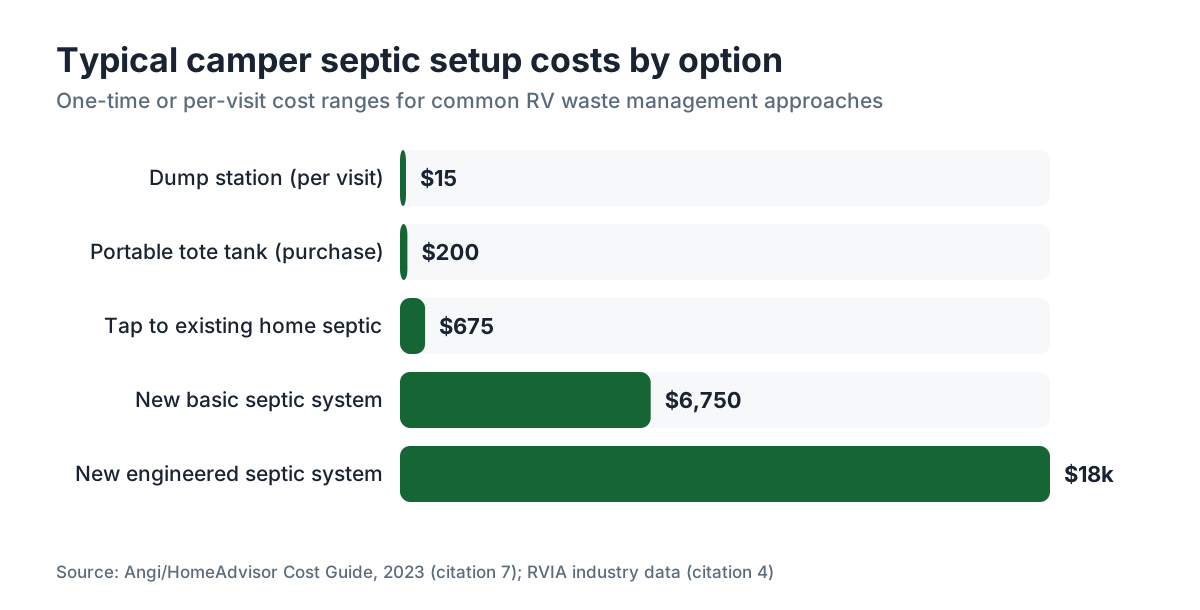
Connecting to an existing residential system with a licensed plumber doing a clean-out tap typically costs $200 to $800 for the plumbing work alone, not counting permits, which run $50 to $300 in most counties [7].
If the property has no existing septic system, or the existing system cannot handle more load, you are looking at installing a new tank and drain field. A standard residential septic installation runs $3,500 to $10,000 for a basic gravity system, and $10,000 to $25,000 or more for engineered systems on difficult soils [7]. For full cost breakdowns see our articles on cost to install septic system and cost to put in a septic tank.
For truly mobile use, a portable waste tank (also called a tote tank or blue boy) lets you collect and transport gray or black water to a dump station without moving your rig. These run $80 to $350 for a 15- to 42-gallon unit. That is a practical solution for campers set up in backyards or remote spots where a dump station visit is occasional rather than daily.
| Setup type | Typical cost range | Notes |
|---|---|---|
| Dump station use (per visit) | $5 to $25 | Most common for traveling campers |
| Tote/portable waste tank | $80 to $350 | One-time purchase, still needs dump access |
| Tap to existing home septic | $250 to $1,100 with permits | Requires load capacity check |
| New septic system (basic) | $3,500 to $10,000 | Gravity system, favorable soil |
| New septic system (engineered) | $10,000 to $25,000+ | Poor soil, mounded or drip systems |
What permits and regulations apply to RV septic hookups?
This is the part most campers skip and then regret. Regulations operate at three levels: federal, state, and local.
At the federal level, the Clean Water Act prohibits discharge of untreated sewage to waters of the United States, which includes storm drains that lead to waterways [2]. The EPA enforces this through the National Pollutant Discharge Elimination System. In practice that means you cannot dump your black tank anywhere other than an approved facility or a permitted sewage connection.
At the state level, every state has an onsite wastewater or individual sewage disposal code that governs septic systems. These codes set minimum tank sizing, setback distances from wells and property lines, and the permit process for any new connection. The EPA maintains a directory of state onsite wastewater program contacts [1].
At the local level, counties and municipalities often add rules specifically about RV occupancy on residential property. Some counties allow a camper to be connected to a home septic as a temporary or accessory dwelling, with time limits. Others prohibit it outright or require a separate approved system.
Here is the practical checklist. Call your county health department before any physical work. Ask specifically about onsite wastewater permits for an RV connection. If you are on a public sewer rather than septic, call the local sewer authority instead. Permits typically require a licensed inspector to approve the finished connection, which is worth it because a bad connection that leaks sewage into the soil can result in remediation costs that dwarf the permit fee.
For a septic tank inspection before adding RV load to an existing system, hire a licensed inspector who can assess whether your current system has capacity to spare.
How do you maintain the tanks and avoid common camper septic problems?
Most camper septic problems fall into three buckets: pyramid plugs in the black tank, sensor probe failures, and odors.
A pyramid plug forms when solid waste builds up in a cone below the toilet opening while toilet paper and other material dry and pack around it. This happens when someone habitually dumps a barely-full tank, when the rig sits stationary for weeks without water flushing through, or when campers use too-thick toilet paper (regular household toilet paper does not dissolve quickly enough in a tank with low water volume). Use RV-specific or 1-ply toilet paper. Always add water to the tank after each dump. Some full-timers flush the black tank with a dedicated rinse wand once a month.
Sensor probes for tank level tend to get coated with waste and give false readings, often showing full when the tank is actually half-empty. Enzyme-based tank treatments help keep probes cleaner. Dedicated probe cleaning products are available and work better than most people expect. If probes are completely unreliable, track usage and dump on a schedule rather than relying on the sensors.
Odors usually come from one of three places: a dry P-trap (add water to any sink you have not used recently), an open or improperly seated tank valve, or a tank treatment that is not working. Keeping an inch or two of water in the black tank at all times, by partially filling it after each dump, is the single most effective odor control step.
For tank cleaning principles that parallel residential septic maintenance, our guides on septic tank cleaning and septic tank pumping cover the residential side of what happens when waste accumulates.
What chemicals and treatments are safe to use in a camper holding tank?
Not all tank treatments are equal, and some are actively harmful.
Formaldehyde-based treatments were the original RV holding tank product. They kill odor by killing everything bacterial in the tank, which works fine for a short-term storage tank. The problem shows up later. When that waste reaches a dump station connected to a septic system, the formaldehyde kills the anaerobic bacteria in the septic tank that do the actual treatment work. Many states have banned formaldehyde-based tank treatments entirely for this reason. California, for example, prohibits their use under Health and Safety Code Section 117690 [3]. Even where they are legal, do not use them.
Enzyme-based and bacterial treatments break down waste biologically. They work more slowly than chemical treatments but do not harm downstream systems. These are the right choice for most campers.
Bio-enzyme treatments also help with the solid waste accumulation issue. Products containing Bacillus bacteria species are broadly effective. Look for products certified safe for septic systems.
Water is your most important tank treatment. A tank with ample water moves and drains better than a dry or low-water tank. Many experienced full-timers add a gallon of water to the black tank after every dump before leaving the station, just to keep the interior wet during transit.
The EPA's SepticSmart program, which focuses on residential systems, notes that "what goes down the drain affects your septic system," a principle that applies equally to RV holding tanks and the residential systems that receive their waste [5].
How is a camper septic hookup different from a full residential septic system?
The fundamental difference is treatment. A residential septic system actively treats wastewater. The tank provides anaerobic digestion that breaks solids into sludge and scum layers, with clarified effluent flowing out to a drain field where aerobic bacteria and soil filtration finish the treatment before the water returns to the groundwater table [6].
A camper holding tank does none of that. It is a sealed storage vessel. No treatment occurs. The waste goes in, stays there, and comes out essentially as it went in.
That is why the two systems are regulated differently and why you cannot substitute one for the other. An RV tank cannot replace a residential septic system. An RV parked permanently on a property still needs a legal discharge point, whether that is a connection to the home's septic, a new dedicated system, or access to a dump station.
For homeowners thinking about installing any permanent system, whether for a guest unit, an accessory dwelling, or an RV pad, the septic tank installation process involves soil testing, design by a licensed engineer or sanitarian, permit approval, and licensed construction. It is not a DIY project in any state.
Operators managing service calls for properties with RV hookups often find the added load was never permitted and the system was never sized for it. Software like SepticMind can track system capacity notes alongside service history, which helps operators flag at-risk accounts before a failure call comes in.
When a system does fail under load, our guides on septic system repair and septic tank repair cover what to expect.
What should full-time RV dwellers know about long-term waste management?
Full-time living in an RV creates a waste problem that part-time campers never face. You cannot dump every few days at a campground station if you are parked in one place long-term.
Here are the options for full-timers, roughly in order of cost and complexity.
Regular dump station visits using a tote tank. Park your RV at a fixed location, collect waste in a portable tote, and drive the tote to a dump station. Works fine for moderate use but becomes a chore at scale.
A direct connection to municipal sewer, if the property has one. This needs a permitted connection through a licensed plumber. Many municipalities have no objection if the connection is proper and permitted. Cost to tap an existing sewer lateral is typically $500 to $2,500 depending on local labor rates and access.
A connection to a residential septic system, as described above, with a capacity check and permit.
A dedicated small septic or holding tank system installed specifically for the RV. Some manufactured holding tanks designed for this use hold 500 to 1,500 gallons and need periodic septic tank pump out service by a licensed pumper, typically every one to three months for one or two full-time occupants. The septic tank emptying process for these small tanks is identical to residential pump-out: a truck vacuums the tank and hauls waste to an approved treatment facility.
For any permanent arrangement, document everything: permits, installer invoices, inspection records. If you ever sell the property or renew a permit, that paperwork matters. SepticMind's service record tools are built for exactly this kind of ongoing documentation on the operator side, and the data transfers easily if ownership changes.
What are the signs that a camper's holding tank system is failing or needs attention?
Persistent bad odor even after dumping and treating is usually the first sign. If you can smell sewage inside the RV with the tanks empty, check the P-traps first (all of them, including under-utilized sinks and the shower). If the P-traps are fine, check the tank vent. RV black tanks vent through a pipe that exits the roof. A clogged vent creates negative pressure that pulls odors through the toilet seal.
Slow draining from the toilet or sinks suggests either a partial blockage in the tank or a blockage in the drain line between the fixture and the tank. Do not ignore slow drains. A blockage that seals off the tank entirely while waste keeps coming in is a very unpleasant problem to fix.
Tank level sensors that read full right after you emptied the tank usually mean coating on the probes, but occasionally mean a valve is not fully closing and waste is backing up. Check the valve seals if cleaning the probes does not resolve it. Valve seals and gate valve assemblies are inexpensive parts (usually $15 to $60), but replacement requires getting under the rig.
Leaks around fittings or the dump outlet connector smell bad and contaminate soil wherever you park. Check fittings periodically, especially after a season of heavy vibration from road travel. Replace any fitting that shows cracking or UV degradation in the plastic.
Frequently asked questions
Can you use a regular house toilet in an RV if connected to a septic system?
Technically yes, but RV toilets are designed to use very little water per flush (half a gallon to one gallon versus the 1.28 to 1.6 gallons of a WaterSense residential toilet) because holding tank capacity is limited. If you connect directly to a home septic and want to swap in a residential toilet, the plumbing is a different size and the installation is a real renovation. Most people keep the RV toilet and just connect the RV's drain line to the septic.
How do I find a dump station near me?
The RV Dump app and SaniDumps.com aggregate user-reported dump station locations across North America and are the most complete resources. The Good Sam directory also lists sites. Many Walmart locations, Flying J truck stops, and state welcome centers have free or low-cost dump stations. Always call ahead to confirm availability, especially for free municipal stations, which sometimes close seasonally.
Is it legal to dump gray water on the ground while camping?
It depends entirely on where you are and the rules of that specific land. On some Bureau of Land Management dispersed camping areas, limited gray water discharge is tolerated but not officially permitted. In developed campgrounds, National Parks, and state parks, ground discharge of any wastewater is prohibited. Many states regulate gray water discharge through their health codes. Always check the specific land use rules for your location. When in doubt, dump at a proper station.
How big are RV holding tanks typically?
Black water tanks in most travel trailers and Class C motorhomes range from 20 to 50 gallons. Class A motorhomes often carry 40 to 70 gallons of black water capacity. Gray water tanks typically run larger than black tanks, from 30 to 90 gallons depending on rig size. Some large fifth-wheels have two gray tanks. Tank size is listed in your RV owner's manual and is one of the key specs to confirm when buying used.
Do I need a permit to connect my RV to my home's septic system?
In most states and counties, yes. Adding any new connection to an existing septic system is a modification that requires a permit and often a licensed plumber or septic contractor. The permit process typically involves a review of your system's capacity relative to household size and the added load. Connecting without a permit can void warranties, create liability if the system fails, and result in enforcement fines. Call your county health department first.
What toilet paper should I use in an RV holding tank?
Use RV-specific toilet paper or any 1-ply paper that dissolves quickly in water. Here is the test: drop two sheets in a jar of water, shake it a few times, and the paper should break apart within 30 seconds. Most single-ply papers pass. Standard 2- or 3-ply household tissue often does not dissolve fast enough and contributes to pyramid plug formation in low-water-volume tanks.
How do I clean and deodorize an RV black water tank that smells bad?
Start by filling the tank completely with water and letting it sit for several hours, then dump. This dilutes and dislodges most buildup. Use a tank rinse wand through the toilet opening while the tank is partially full. Add an enzyme-based treatment after each dump. If odors persist, check the roof vent for blockages (leaves, bird nests) and confirm all P-traps have water in them. Avoid formaldehyde-based deodorizers, which are banned in many states.
Can I leave my RV connected to a sewer hookup permanently with the valve open?
No. Leaving the black tank valve permanently open causes a phenomenon called 'caking,' where solid waste dries and builds up on the tank floor and walls while water drains away continuously. Always keep the black tank valve closed until the tank is at least two-thirds full, then dump completely. The gray tank valve can be left open at sites with full hookups because it holds no solids that would cake.
How much does it cost to have a portable RV waste tank (tote) pumped out?
If you take the tote to a dump station yourself, the cost is $5 to $25 per use. If you call a septic pump-out service to come to your site and vacuum a permanent or semi-permanent holding tank, expect to pay $75 to $200 for a small tank under 500 gallons, with rates varying by region. Urban markets trend higher. Rural markets with competitive pumpers can be lower.
What happens to RV waste at a dump station?
Most dump stations connect to the local municipal sewer system. Your waste flows into the same wastewater treatment plant that handles residential sewage. Some rural dump stations connect to a holding tank that is periodically pumped by a licensed waste hauler and taken to an approved wastewater treatment facility. Either way, the waste undergoes full treatment before any discharge to the environment. That is the whole point of using approved dump facilities.
Can a small dedicated septic system be installed just for an RV?
Yes. A small septic tank (typically 500 to 1,000 gallons) with a properly designed drain field can serve one or two full-time RV occupants. This requires the same permit process as a residential septic installation: soil evaluation, design by a licensed professional, permit approval, and licensed installation. Expect costs in the $4,000 to $12,000 range depending on soil conditions and local requirements. The tank will need periodic pump-out service, typically every 1 to 3 months for one person.
Are there any federal regulations specifically about RV waste disposal?
The Clean Water Act prohibits discharge of sewage to navigable waters or storm drains connected to waterways. The EPA enforces this nationally, with state programs implementing the specific rules on the ground. There is no single federal RV-specific waste code, but the prohibition on illegal dumping is clear and enforced. The EPA's SepticSmart program provides guidance on responsible waste management that applies to RV waste discharged to septic systems.
Sources
- EPA, SepticSmart Homeowner Resources: EPA provides national guidance on septic system function, regulated waste categories, and state program contacts.
- EPA, Clean Water Act Overview: The Clean Water Act prohibits discharge of pollutants including untreated sewage to waters of the United States without a permit.
- California Legislative Information, Health and Safety Code Section 117690: California prohibits formaldehyde-based holding tank treatments and regulates graywater reuse under Health and Safety Code provisions.
- Recreation Vehicle Industry Association (RVIA), RV Owner's Manual Guidelines: Industry guidance for RV holding tank management recommends dump intervals and dump station fee ranges.
- EPA, Onsite Wastewater Treatment Systems Manual: EPA manual establishes 150 gallons per day per bedroom as the standard design flow for residential septic systems.
- HomeAdvisor (Angi), Septic System Installation Cost Guide: National average costs for septic system installation range from $3,500 to $10,000 for basic gravity systems and up to $25,000 for engineered systems.
- NSF International, RV Plumbing Standard NSF/ANSI 14: NSF sets performance standards for RV plumbing materials and holding tank construction used by manufacturers.
- Bureau of Land Management, Recreation and Visitor Services Guidance: BLM land use regulations govern wastewater discharge rules at dispersed camping areas on public lands.
Last updated 2026-07-09