Can I do my own perc test? What homeowners need to know
By the SepticMind Editorial Team

TL;DR
- In most U.S.
- states, you cannot legally run your own perc test for a permit.
- A licensed soil scientist, engineer, or county health official has to perform and certify it before you get a septic permit.
- A few rural counties let homeowners dig the pits, but the county still controls the method.
- Budget $300 to $1,500 for a professional perc and soil evaluation.
What is a perc test and why does it matter for septic?
A percolation test, usually just called a perc test, measures how fast water drains through your soil. The result is minutes per inch: how many minutes it takes the water level in a test hole to drop one inch. That number decides whether your land can support a septic drain field and, if it can, how big that field has to be. [1]
The EPA's SepticSmart program describes the drain field as the component where "wastewater is filtered by the soil as it percolates through it." [2] Drain too fast (under about 1 minute per inch in most codes) and effluent reaches groundwater before the soil treats it. Drain too slow (over 60 minutes per inch in many states) and the field saturates and sewage backs up. Both are health hazards.
A perc test is almost always required before a new septic tank installation gets permitted. You also need one when you add a bedroom to a house on septic, when you replace a failed leach field, or when a real estate deal calls for a site evaluation.
Know what a perc test measures and you'll understand why most states won't let you run one yourself.
Can you do your own perc test, or does it have to be professional?
Almost certainly not for a permit. The exact rule depends on your state and county, but the pattern is the same nearly everywhere.
All 50 states regulate onsite wastewater systems, and each sets its own standard for who can run a soil evaluation. In most states, the perc test has to be performed or directly witnessed by a licensed professional engineer (PE), a licensed soil scientist, a licensed onsite wastewater evaluator, or a county health department sanitarian. [3] Your county health department is the one source to check before you do anything. They issue the permit and they set the local rules.
Some rural counties in Texas, Oklahoma, and parts of the Midwest still let a homeowner dig the test pits. Even there, a county official or approved evaluator usually oversees the saturation period, takes the official measurements, and signs the report. You're digging a hole, not running the test.
Here's why states went this way. Early DIY perc tests were all over the map. Hole dimensions varied, saturation got skipped, and people cherry-picked the best-draining spot on a lot. Modern codes require standardized hole dimensions (typically 6 to 8 inches across and 12 to 24 inches deep for percolation, plus a separate deep soil boring to 5 to 8 feet), a 24-hour or overnight presaturation period, and measurements at fixed intervals under a set head of water. [4] Without a licensed pro following that protocol, the result means nothing to the health department and can't support a permit.
So here's the split. If you want a permit and a legal install, hire a professional. If you just want to size up your land before buying property or starting the permit process, dig some holes and watch them drain. You'll still need the professional test afterward.
Do I need a perc test, or can I skip it in some situations?
You almost always need a perc test for a new septic system. The exceptions are narrower than most people hope.
You may not need a new one if you're replacing a tank on an existing permitted system where the drain field is intact and working. The permit file at the health department may already hold soil data from the original install. Call the county first. They often keep records going back decades.
You may also skip a full perc test if your county accepts an alternative onsite sewage system that doesn't rely on native soil absorption, like a mound system or a drip irrigation system. Those have their own design rules, and the soil acceptance rate matters less. You'll still typically need a soil morphology evaluation to confirm groundwater depth and soil layering. [5]
Real estate deals are a gray area. A "perc test" for a sale is sometimes just a review of the existing permit file plus a visual inspection, not a new soil test. Lenders and buyers mix these two up constantly. A formal septic tank inspection before purchase is a different thing from a percolation test.
On a lot that already has a working system and you're just doing routine work like a septic tank pump out, you need no perc test at all. Perc tests are about new construction and system design, not maintenance.
How does a professional perc test actually work?
Knowing what a pro does shows you exactly what you'd be taking on, and why the protocol matters so much.
A licensed evaluator usually starts with a deep soil boring, using a hand auger or powered rig to reach 5 to 8 feet down. They read soil horizons, color (mottling patterns flag seasonal high groundwater), texture, and structure. This morphology data often matters more than the perc number. A restrictive layer at 3 feet can kill a site no matter how fast the surface soil drains. [6]
For the perc test itself, the evaluator digs or bores 2 to 6 test holes per site (many states want multiple holes to get an average) down to the proposed absorption depth, usually 12 to 36 inches. Hole dimensions and layout have to follow the state code exactly. Then the holes get saturated, either by slowly filling them and letting them drain over and over across 24 hours, or by soaking them overnight. Skipping saturation is the most common mistake in informal tests, and it produces wildly optimistic drainage rates.
After saturation, the evaluator fills each hole to a set depth, typically 6 inches of water above a reference point, and measures the drop every 30 minutes over 4 hours. The perc rate usually comes from the last two or three readings, once the rate settles. [4]
Those results feed straight into drain field sizing. Most state codes use tables that turn perc rate into required square footage of absorption area per bedroom. Soil at 10 minutes per inch needs far less field area than soil at 45. [1] For a 3-bedroom house, that gap runs into hundreds of square feet of trench, which moves the cost to install a septic system a lot.
What does a perc test cost, and what's included?
A professional perc test and soil evaluation runs $300 to $700 for most residential lots under an acre. Costs climb to $1,000 to $1,500 on larger properties, sloped sites, or lots needing multiple test areas. States that require a licensed engineer to stamp the report push you toward the high end. [7]
Be clear about what you're buying. Some evaluators charge separately for:
- The site visit and test
- The written report with perc rates and soil morphology
- The permit application prep
- Drain field design and sizing
A permit-ready soil evaluation that includes design is worth paying for upfront. Hiring a second professional later to turn raw perc numbers into a permitted design adds cost and weeks of delay.
If the test fails and your site can't support a conventional system, you're not finished. You'll need a site assessment for alternative systems, which is its own charge. Some evaluators fold this into the initial fee when a site looks borderline, so ask before you hire.
| Perc Test Service Component | Typical Cost Range |
|---|---|
| Basic perc test (residential lot) | $300 to $700 |
| Soil morphology / deep boring | Often bundled; $100 to $200 if separate |
| Written report for permit | Bundled or $100 to $300 extra |
| Full site evaluation + system design | $800 to $2,000 |
| Re-test after failed first test | $150 to $400 |
What happens if you do an informal perc test without a permit?
An informal test tells you something useful about your land. It cannot replace the real thing.
Dig holes, saturate them, watch the drain rate, and you'll get a rough read on your soil's absorption. That's genuinely useful before you pay a professional, because you'll catch the obvious failures (standing water, tight clay, bedrock at 18 inches) before spending money on a formal test that would fail anyway.
But an informal test produces no legal documentation, satisfies no permit, and won't survive any lender or health department review. Installing a septic system without a permit off your own soil test is a serious mistake. Unpermitted systems expose you to fines that vary by jurisdiction but commonly run $500 to $5,000 per violation where enforcement is active, and some states can make you excavate and remove the whole system at your own cost. [8] The system also won't show up in property records, which becomes a real headache when you sell.
There's a physical risk too. Someone without soil science training misses the quiet stuff: a perched water table that only shows as faint mottling, a fragipan layer that causes hydraulic failure in wet years, a seasonal high groundwater sitting inches below the hole bottom. Miss those and you build a system that fails in a few years. A failed drain field means septic system repair that routinely runs $3,000 to $15,000 or more.
How to find a licensed perc test professional in your area
Start with your county health department, every time. Most counties keep a list of approved evaluators, soil scientists, and engineers cleared to submit perc results for permitting. Some counties only accept results from their own staff, in which case you schedule straight through the health department.
State licensing boards for professional engineers, soil scientists, and environmental health professionals publish rosters of licensed practitioners. For soil scientists, the Soil Science Society of America keeps a registry of Certified Professional Soil Scientists (CPSS) at soils.org. [9]
When you call for quotes, ask:
- Are you approved by my county health department to submit perc test results?
- Does your fee include the written report in the format the county requires?
- How many test holes do you run for a lot my size?
- What's your turnaround for the report?
Stay away from anyone who offers to test without pulling a county permit for the evaluation itself. In most states the evaluation is a permitted activity, and skipping that step creates problems down the line.
If you manage several properties, or you run septic service and track compliance across sites, tools like SepticMind help you keep permit records, test results, and inspection dates in one place instead of chasing down county files one at a time.
How do I prepare my property for a perc test?
Good prep cuts your odds of paying for a retest.
The evaluator needs clear access, so mow tall grass, clear debris piles, and mark underground utilities before test day. Call 811 (the national dig-safe line) at least three business days ahead. Hitting a utility line during excavation means liability and delays. [10]
Don't irrigate or add any water to the test area for at least a week before. Artificially wet soil drains fast at first, then slow once it saturates, and that skews the reading. Testing right after heavy rain does the same, giving misleadingly slow results because the soil already sits near field capacity.
Know where your lot corners are. Test holes have to land inside the area proposed for the drain field, and that area carries setbacks from property lines, wells, surface water, and buildings. Pull your property survey before the appointment and you save everyone time.
Got problem spots? Places that stay wet in spring, patches with iron staining on disturbed soil? Tell the evaluator. They're not trying to fail your site. They want to find the best area to test, and what you know helps them do it.
What perc test results mean for your drain field size
The perc rate translates straight into system size, and system size drives cost. Faster-draining soil accepts more effluent per square foot, so you need less field. Slower soil needs more.
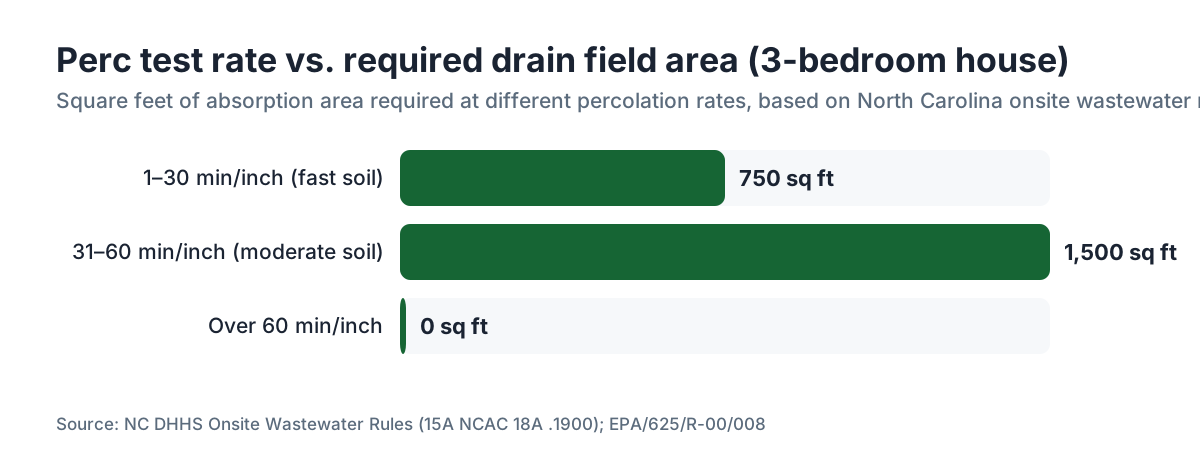
Most state codes use a table that assigns a loading rate in gallons per day per square foot of absorption area based on the perc rate. North Carolina's onsite wastewater rules, one of the more detailed state codes available publicly, require 0.60 gallons per square foot per day for soils at 1 to 30 minutes per inch, and drop that to 0.30 gallons per square foot per day for soils at 31 to 60 minutes per inch. [11] For a 3-bedroom house generating roughly 450 gallons per day, that's a 750-square-foot field in fast soil versus a 1,500-square-foot field in slow soil. Double the field, and installation cost jumps hard.
If your perc rate tops 60 minutes per inch, most states won't approve a conventional gravity-fed trench system. You get steered toward alternatives: low-pressure pipe systems, mound systems, aerobic treatment units, drip irrigation. They work fine. They cost more. A conventional system might run $6,000 to $12,000 installed. A mound or ATU system often runs $15,000 to $25,000 or more. [12] That's why the perc result matters so much before you commit to a property.
The leach field sizing tables in your state code are public. Pull them before your test and the evaluator's report reads plainly.
Perc tests, property sales, and what buyers should know
Buying raw land or a property with a failing system? Who pays for the perc test and when it happens is negotiable in the contract, so pin it down.
For raw land, make the purchase contingent on a satisfactory perc test. Run it before you close, never after. If the land won't perc and can't support any onsite system, you want that answer before you own it. Tying into a nearby municipal sewer is one alternative, but that can cost $5,000 to $30,000 or more depending on distance and local tap fees. [7]
For existing homes with septic, the question shifts from "will the land perc" to "does the existing system work." A septic tank inspection with a load test or dye test tells you far more than a perc test at that point. Many contracts call for a septic inspection but use the term "perc test" loosely. Be specific in the contract language.
Agents sometimes suggest a passing perc test from 20 years ago covers a sale. That may satisfy the county, but it says nothing about a drain field that's been in service two decades. The soil hasn't changed. The biomat in the trenches certainly has. Push for a current inspection over an old test result.
What state and federal rules govern perc testing?
There's no single federal perc test standard. The EPA sets general guidance on onsite wastewater and has published technical manuals, but it defers to states for the specific testing and permitting rules. The EPA's "Onsite Wastewater Treatment Systems Manual" (EPA/625/R-00/008) gives design guidance including soil evaluation methods, but it's a reference document, not a federal regulation. [2]
A few federal touchpoints matter. The Clean Water Act (33 U.S.C. §1251 et seq.) sets the framework for protecting water quality including groundwater, which is why states regulate septic in the first place. The Safe Drinking Water Act gives the EPA authority over underground injection, including some wastewater systems. But the actual testing protocols and who runs them are entirely state law. [13]
Every state has a primary onsite wastewater code, usually run by the state department of environmental quality, department of health, or both. These codes spell out:
- Test hole dimensions and depth
- Presaturation requirements
- Measurement intervals and head of water
- Who is licensed to run the test
- How results must be reported
- Minimum and maximum acceptable perc rates
Your state's code is almost always online. Search "[your state] onsite wastewater regulations" or "[your state] septic system rules" and find the official agency version, not a summary. Reading the protocol section takes about 20 minutes and answers most questions about what you can and can't do yourself. [3]
At SepticMind, the state code database we keep for operators covers all 50 states and updates when agencies publish rule changes, which helps if you work across state lines.
Frequently asked questions
Can I do my own perc test for a permit application?
No, in almost all U.S. states. A licensed soil scientist, professional engineer, or county health official has to conduct and certify the perc test before the health department accepts it for a permit. A few rural counties let homeowners dig the pits under official supervision, but the county still controls the protocol and signs the result. An informal self-run test has no legal standing.
How much does a professional perc test cost?
For a standard residential lot, a professional perc test and soil evaluation typically costs $300 to $700. Complex sites, larger properties, or states requiring a stamped engineering report push costs to $1,000 to $1,500. Ask upfront whether the fee includes the written report in the format your county health department requires, and whether drain field design is part of it.
What is a failing perc test result?
A perc test fails when soil drains too fast or too slow for a conventional system. Most state codes reject rates above 60 minutes per inch (soil too tight) and sometimes flag rates under 1 minute per inch (soil too coarse, effluent reaches groundwater untreated). A failing result doesn't always mean no septic is possible. It often means you need an alternative system like a mound or ATU.
How long does a perc test take?
The full process takes two days. Day one is digging test holes and saturating them over 24 hours. Day two is the measurement period, usually 4 hours of timed water-level readings after resaturation. The written report typically follows within a few days to two weeks, depending on the evaluator's workload and how fast the county processes the application.
Do I need a perc test to sell my house?
If your house already has a permitted septic system, you usually don't need a new perc test to sell. Most lenders and buyers require a current septic inspection and sometimes proof the system has capacity for the home's bedroom count. A new perc test is generally only required for new construction, a bedroom addition, or a complete system replacement on a previously unsited parcel.
Can a perc test result expire?
Yes. Most state health departments put an expiration on perc test results, commonly 2 to 5 years from the test date. If you don't pull a septic permit before it expires, you'll need a new evaluation. Check your county's rules. Some jurisdictions extend a result if site conditions haven't changed and you can document that with a short supplemental review.
What's the difference between a perc test and a soil evaluation?
A perc test measures drainage rate. A soil evaluation is broader, with a deep boring to assess soil horizons, texture, mottling (indicating seasonal high groundwater), and restrictive layers. Most state codes now require both before issuing a septic permit, because a fast perc rate in the top foot means nothing if there's a clay hardpan at 30 inches. Evaluators usually do both in one visit.
How many perc test holes do I need on my property?
Most state codes require a minimum of 2 to 6 test holes per proposed drain field area. The exact number depends on lot size, proposed system type, and state rules. Results are typically averaged, though some codes use the slowest reading as the design rate. Your evaluator knows your state's requirement. Don't let anyone run a single-hole test and call it done.
What happens if my land fails a perc test?
A failed perc test doesn't necessarily mean you can't build or install a septic system. It means a conventional gravity-fed trench system won't work in that soil. You may qualify for an alternative: a mound system, low-pressure pipe system, aerobic treatment unit, or drip irrigation system. These typically cost $15,000 to $25,000 or more, compared to $6,000 to $12,000 for a conventional system.
Can weather affect perc test results?
Yes, a lot. Testing during or shortly after heavy rain produces slower results because the soil already sits near saturation. Long dry spells produce artificially fast results. Responsible evaluators account for soil moisture and note it in the report. Many state codes require that testing not happen when soils are frozen or when groundwater is within the test zone.
Do I need a perc test for a replacement drain field?
In most states, yes. Replacing a failed drain field requires a new permit, which typically requires a new soil evaluation showing the proposed replacement area can support the system. The original test area is no longer valid for a new field location. Budget for both the new perc test and the field replacement cost when planning a drain field repair.
Is a perc test the same as a perk test?
Yes, exactly the same thing. 'Perk' is just an informal spelling of 'perc,' short for percolation. You'll see both spellings in common use, but every official state code and health department uses 'percolation test' or 'perc test.' The test, the methodology, and the legal requirements are identical no matter how it's spelled.
Sources
- EPA, Onsite Wastewater Treatment Systems Manual (EPA/625/R-00/008): Percolation rate in minutes per inch is used directly in sizing drain field absorption area
- EPA SepticSmart Program: Drain fields filter wastewater as it percolates through the soil; EPA defers specific testing protocols to states
- National Environmental Services Center (NESC), West Virginia University: State licensing requirements for perc test professionals vary; most states require licensed soil scientists or engineers
- University of Minnesota Extension, Onsite sewage treatment: Standard perc test protocol requires 24-hour presaturation, standardized hole dimensions, and measurements at 30-minute intervals
- EPA, Decentralized Wastewater Treatment: Alternative onsite systems including mound and drip irrigation have different soil evaluation requirements than conventional systems
- EPA, Onsite Wastewater Treatment Systems Manual (EPA/625/R-00/008): Soil morphology including restrictive layers and mottling can disqualify a site regardless of surface percolation rate
- Angi, Perc Test Cost Guide: Professional perc test costs range from approximately $300 to $1,500 depending on site complexity and state requirements
- Virginia Department of Health, Onsite Sewage Regulations (12VAC5-610): Installing an unpermitted septic system is a violation subject to fines and potential mandatory removal
- Soil Science Society of America, Certified Professional Soil Scientist Registry: CPSS registry lists licensed soil scientists qualified to conduct official soil evaluations
- Common Ground Alliance, Call 811 Before You Dig: Homeowners and contractors must call 811 at least three business days before excavating to locate underground utilities
- North Carolina Department of Health and Human Services, Onsite Wastewater Section Rules (15A NCAC 18A .1900): NC rules specify loading rates of 0.60 gpd/sqft for perc 1-30 min/inch and 0.30 gpd/sqft for 31-60 min/inch
- EPA, Types of Septic Systems: Alternative septic systems including mound and aerobic treatment units typically cost more than conventional gravity systems
- U.S. EPA, Laws and Regulations (Clean Water Act, 33 U.S.C. §1251): The Clean Water Act establishes the federal framework for water quality protection that underlies state septic regulations
Last updated 2026-07-09