Can you do a perc test in the winter?
By the SepticMind Editorial Team
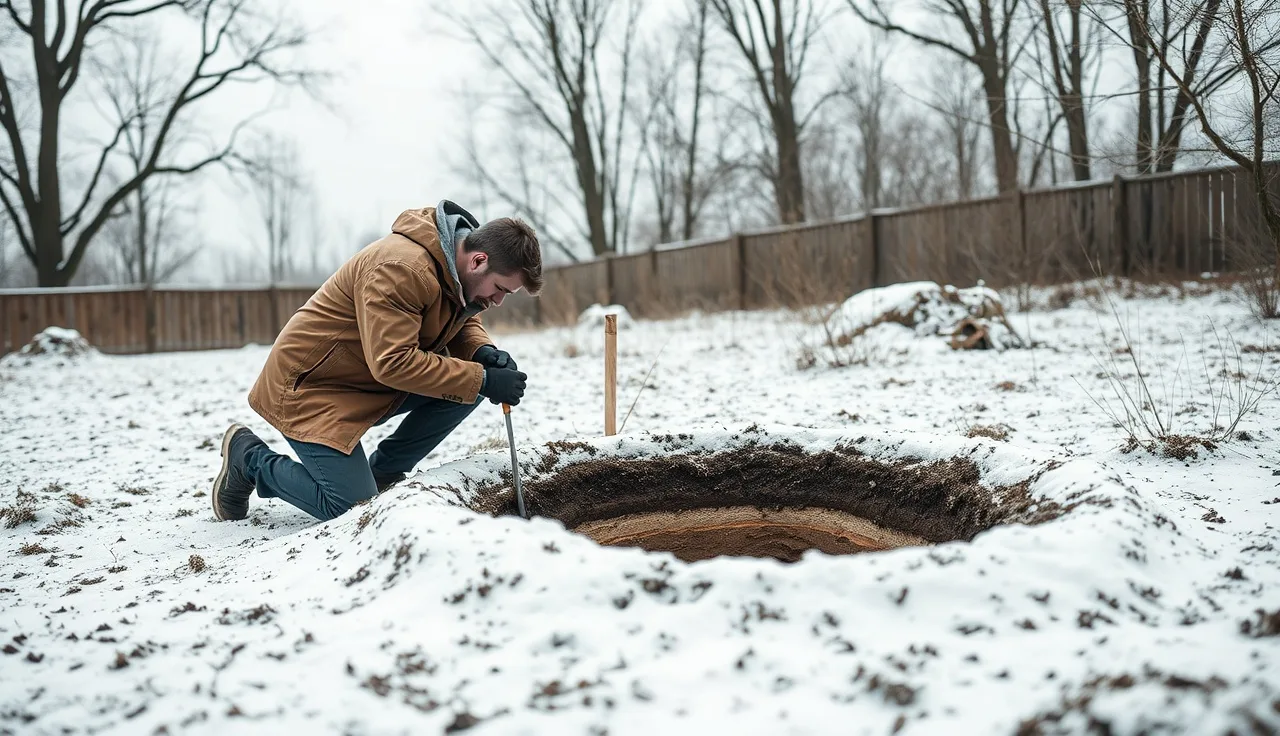
TL;DR
- You can run a perc test in winter in most states, but frozen soil, snow cover, and saturated ground often produce numbers regulators reject.
- Many counties ban winter testing or require a second confirmation test in spring.
- Before you schedule anything between November and March, call your local health department and ask if a winter result will actually pull a permit.
What is a perc test and why does the season matter?
A percolation test, usually just called a perc test, measures how fast water drains through the soil at a proposed drain field site. The result comes back in minutes per inch (MPI). That number tells the designer how large the leach field needs to be and whether the site can support a conventional septic system at all [1].
Season matters because soil isn't static. Its ability to soak up water swings with temperature, moisture, and biology. Frozen soil has ice filling the pore spaces that would normally pass water. Soil saturated from snowmelt is already sitting at or near field capacity. Both conditions make the ground look worse than it really is during the months a septic system actually runs, which is all of them. A test done in those conditions can hand you an artificially slow rate that costs you a workable site. Or it can hand you a deceptively fast rate through frost-opened cracks that approves a site destined to fail come July.
The EPA's SepticSmart program treats site evaluation as the base a working system stands on, and its guidance points to testing under conditions that represent the site through the year. That idea, representative seasonal conditions, is exactly where the whole fight over winter testing happens [2].
Is a perc test in winter legally allowed in most states?
There's no single federal answer. Perc testing is regulated at the state and often county level under each state's onsite wastewater or individual sewage disposal code, and the rules vary more than you'd guess [3].
Some states flatly prohibit testing when the ground is frozen, when frost depth passes a set threshold (commonly 2 to 4 inches), or when soil moisture hits saturation. Minnesota's onsite rules, for one, require soil evaluations to happen when soils are not frozen or saturated, a standard that rules out much of November through April across the northern part of the state [4]. Vermont and Maine carry similar language in their subsurface wastewater rules.
Other states hand the call to the local authority. There, a county sanitarian or health department engineer decides yes or no based on what the site looks like the day of the test. A few warmer states, mostly in the Southeast and Southwest, have no seasonal restriction at all because hard freezes are rare or short.
Here's the practical rule. Call your county health department or environmental services office before you spend a dime scheduling. Ask flat out whether there's a written ban on testing frozen or saturated ground, and whether a winter result needs a confirmation test in another season. Get the answer in writing if you can. A test that can't pull a permit is money you pay twice.
How does frozen or saturated soil change the test results?
When soil freezes, water in the small pores expands into ice and shuts those pathways. That's why ground that passes easily in September can fail in January. The ice works like a temporary plug. Pour water into a test hole during a freeze and it hits that plugged matrix and drains slow, giving you an MPI number higher than the soil's real performance.
The frost effect isn't uniform. Sandy soils freeze shallow and thaw fast. Clay-heavy soils freeze deep and hold ice long, sometimes into May in northern states. Gravel and cobble can drain faster in winter because the pores are wide enough that ice never fully blocks them. So the distortion runs both directions depending on texture [5].
Saturation from snowmelt or early rain creates the opposite trap. Saturated soil already holds all the water it can. Add water to a test hole in that ground and it moves sideways instead of down, faster than it would in a dry August when the surrounding soil is pulling it in. You end up with an unrealistically fast rate that green-lights a site which backs up every spring. That's arguably the worse error, because a failed field harms groundwater and a septic system repair costs far more than repeating a test.
The USDA Natural Resources Conservation Service says it plainly in its soil survey guidance: soil evaluation should happen when the water table sits at its seasonal high and the soil is not frozen, so the test reflects the hardest conditions the system will face [6]. A saturated winter test, oddly enough, often misses that seasonal high because it catches surface snowmelt before the deep water table has recharged.
What time of year gives the most accurate perc test results?
Late fall before hard freeze, and late winter or early spring just after thaw, are the windows regulators tend to trust most. The reasoning holds up: those stretches catch the water table near its seasonal high, the soil is moist but not frozen, and the numbers land near worst case. A site that passes a conservative test almost always works through drier summer months.
Most licensed soil scientists and site evaluators favor late March through May in northern states, and October through November in warmer ones. That window gives you unfrozen soil, honest moisture, and enough runway to finish permitting before summer construction [7].
Midsummer testing is convenient and can lie to you. In dry-summer regions, sandy soils in drought drain absurdly fast. Size a drain field off a summer rate and the system may choke during wet springs when real conditions run far slower. Some states flag this directly and make designers apply a seasonal correction factor.
Short version: spring is usually best, late fall is fine in most climates, summer flatters the soil, and winter is the most likely to hand you invalid or rejected results. Only run it in winter when your local code allows it in writing and you've confirmed the ground isn't frozen at the test depth.
How deep does frost have to be before a perc test is invalid?
There's no universal number. Most state and county codes that address frost at all set the line somewhere between 2 and 6 inches of frozen soil at the test depth as grounds to reject or postpone [4]. Test depth matters here. Standard perc holes run 24 to 36 inches below grade depending on local code, and surface frost doesn't mean frost at that depth, especially early in the season.
A soil evaluator usually probes the pit walls before starting. If the soil breaks clean at depth, it's not frozen. If it crumbles into icy chunks or fights a probe past the first few inches, the test is going to produce garbage data.
Some jurisdictions lean on frost depth maps from their state climatology office or pull USDA soil temperature readings from the nearest station to make the call. A licensed site evaluator will know the local standard. If you're running this yourself, ask the health department exactly how they define frozen for testing and who decides that on the day.
What happens if you do a perc test in winter and it fails?
A failed winter perc test isn't the end. Most jurisdictions let you retest, and if you ran the first test in questionable conditions, you've got a fair argument that the results were unreliable. Document everything: air temperature, soil temperature at depth, frost depth, recent precipitation and snowmelt, the date. That record backs a request to retest under better conditions.
If the result gets accepted and a permit is denied off a winter test, you still have moves. Appeal the determination and present evidence that conditions were atypical. Request a second evaluation from a different licensed soil scientist. Or redesign toward an alternative system, such as a mound, drip irrigation, or another advanced treatment option, which run under different soil criteria that a marginally slow site might still meet [8].
What you don't want is to swallow a winter failure without asking whether the conditions wrecked the test. A site that could carry a conventional septic system is worth a few hundred dollars for a spring retest. The alternative, no system at all or an engineered setup that can run $30,000 to $60,000 depending on state and type [9], makes that retest fee look like nothing.
Can a perc test be done in winter for real estate transactions?
This is where winter perc testing comes up most. A buyer wants to close in January. The seller has no perc test on record. The real question is whether you can get a valid, permit-ready result before the closing date.
Honest answer: sometimes. Check two things. First, does your county accept winter test results for permitting? Second, will the lender and title company accept a result that may hinge on a spring confirmation? Some lenders want a valid, permit-ready perc result before funding a construction loan. If the county won't stamp a winter test until it's confirmed in spring, that box stays unchecked until spring no matter what.
Real estate attorneys in northern states often write this as a contingency. The purchase agreement makes the perc result a condition of closing, with a deadline pushed to spring when winter testing isn't viable. That beats rushing a winter test that may bounce.
If you're buying land to build and you're eyeing a septic tank installation soon after closing, a proper site evaluation done right is small money against the full cost to install septic system. Don't let a closing date push you into a test that hands back numbers you can't trust.
How much does a perc test cost and does winter timing change the price?
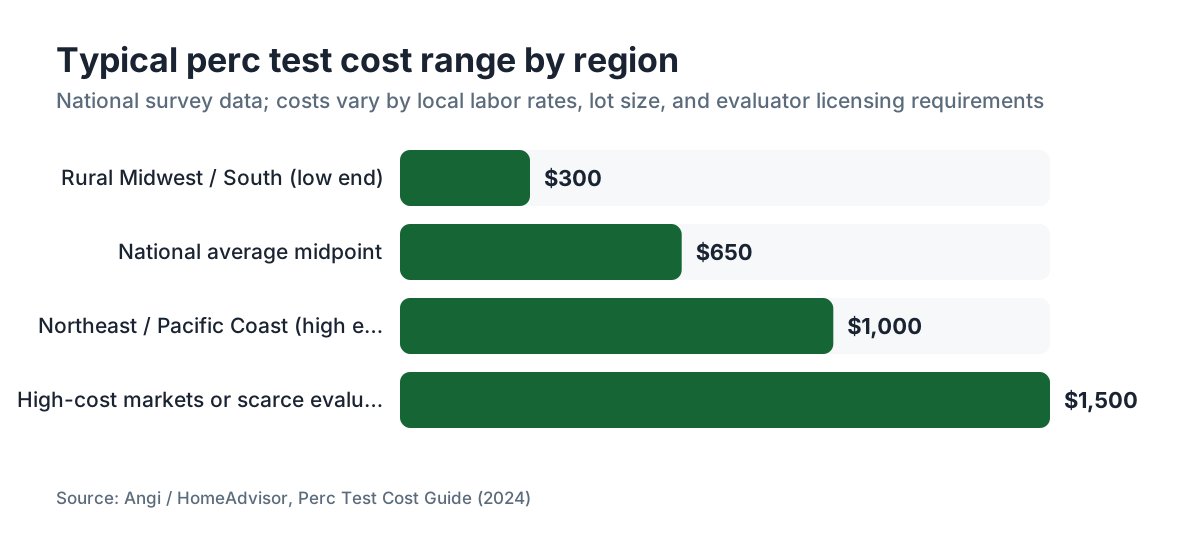
A standard perc test runs $300 to $1,000 across most of the country, though fees in coastal markets or where licensed soil scientists are thin can top $1,500 [10]. That price usually covers digging the test holes, running the test, and filing results with the local health department.
Winter doesn't add a set surcharge, but it can cost you more if:
- The ground is too hard for hand-dug test pits and a machine is required.
- The evaluator has to make a second trip because conditions weren't acceptable the first time.
- Your jurisdiction demands a confirmation test in spring after a winter result, meaning you pay for two.
The confirmation requirement is the real risk. Some counties charge two separate filing fees. If there's any chance a winter test triggers a mandatory spring confirmation, budget for two tests from the start.
For scale, a perc test is a small line item in the full cost to put in a septic tank, which can run $10,000 to $25,000 or more depending on system type and local labor.
What do state and EPA regulations actually say about winter perc testing?
The EPA publishes no federal rule on perc test timing. Onsite wastewater is mostly a state and local matter under the Clean Water Act framework, with states holding primary enforcement authority [3]. The EPA's Onsite Wastewater Treatment Systems Manual recommends evaluating sites under representative soil conditions but stops short of naming specific seasonal windows.
State codes are the law you actually work under. A sampling of what states say:
| State | Key restriction |
|---|---|
| Minnesota | Soil evaluation prohibited when frozen or saturated [4] |
| Vermont | Testing not permitted when soil is frozen or standing snow is in the test area [11] |
| Wisconsin | County sanitarian may reject tests done in frozen or saturated soils [12] |
| Maine | Requires evaluations when soils are not frozen to representative depth |
| Texas | No statewide seasonal restriction; county rules vary |
| Florida | No seasonal restriction; ground rarely freezes |
| Pennsylvania | DEP guidance recommends avoiding frozen conditions; some counties ban it outright |
The EPA's SepticSmart materials point to site evaluation as the factor that decides how long a system lasts, and regulators lean on that reasoning when they require representative conditions [2].
If you handle septic permitting across multiple jurisdictions, tools like SepticMind help track county-level rule differences so a local policy you'd never heard of doesn't blindside you.
The takeaway: pull your specific state code, then call the county. The state sets the floor. Counties stack their own rules on top.
What should you do if you need a perc test done this winter?
Start with a call, not a calendar invite. Reach your county health department or environmental services office and ask two things: do they accept perc tests run when ground temperatures are below 32°F, and does a winter result need spring confirmation before a permit issues? Write down who you spoke with and when.
If testing is allowed, hire a licensed soil scientist or site evaluator, not a general contractor. In most states, a perc test has to be run or directly supervised by a licensed professional to count for permitting. Soil scientists read soil morphology and can judge whether a given day's conditions will produce a valid test.
Schedule during a stretch of stable, above-freezing weather. If a warm spell has held five or more days and the soil isn't frozen at the test depth, conditions may work. Mid-winter thaws in late January or February are real windows across many northern climates.
If conditions don't cooperate, wait. It's almost always better to delay than to grab a result that costs you a viable site or forces a redo. Spring is closer than it feels in February. The cost of waiting is small. The cost of acting on bad data, a failed system or a rejected permit, is not.
For maintenance planning once the system is in, bookmark how often to pump septic tank and septic tank inspection now so you have them when you need them.
How is a perc test different from a soil morphology evaluation, and does that matter in winter?
A perc test and a soil morphology (profile) evaluation are related but not the same. A perc test measures drainage directly by timing how fast water drops in a pre-soaked hole. A soil morphology evaluation has a licensed soil scientist examine a pit or core to read texture, structure, color, redoximorphic features (rust and gray mottling that mark historic water saturation), and horizon depths [6].
Many states have moved away from the old-style perc test and now prefer or require soil morphology because it gives a fuller picture of long-term suitability. Mottling patterns show where the seasonal high water table has historically sat, regardless of what the water table is doing the day you're standing there. A single perc measurement can't tell you that.
Soil morphology is less sensitive to winter than perc testing, because you're reading permanent soil features rather than current drainage. A skilled soil scientist can often run a valid morphological evaluation in winter as long as the pit can be dug and the profile read. That's one reason some jurisdictions that ban winter perc tests still allow winter soil morphology work.
If you're on a tight timeline and your jurisdiction accepts morphology for preliminary site approval, that may be the smarter winter play. Confirm whether a morphology-based approval covers your permit or whether a perc test is still required.
Frequently asked questions
Can a perc test be done in the winter in northern states like Minnesota or Maine?
Generally no, not legally. Minnesota's onsite sewage treatment rules prohibit soil evaluations when soils are frozen or saturated, and Maine uses similar language. In those states you usually wait for spring thaw, when the soil is unfrozen to the test depth and not saturated from snowmelt. A test run in those conditions will likely give results the health department won't accept for permitting.
How do I know if the ground is too frozen for a valid perc test?
Probe the soil at the test depth, usually 24 to 36 inches below grade. If you hit ice crystals, the soil breaks into frozen chunks, or a rod won't penetrate, it's too frozen. Surface frost alone isn't always disqualifying if the test horizon sits below the freeze line. A licensed soil scientist makes this call on-site. When in doubt, reschedule.
Will my county reject perc test results done in frozen soil?
Many will, either through a written rule or the site evaluator's on-site judgment that conditions were invalid. Some counties require soil temperature and conditions noted in the test report, and a sanitarian can flag results from questionable conditions. Call your county health or environmental services office before scheduling to confirm their policy. A rejected test means paying twice.
Does saturated soil from spring snowmelt cause the same problem as frozen soil?
Yes, but the error runs the other way. Saturated soil can produce artificially fast perc rates because water moves sideways through an already-full matrix instead of testing true vertical absorption. A system sized on a wet rate may fail in future spring wet seasons. Some states require testing at seasonal high water table to catch this on purpose, but unexpected saturation at test time should be noted.
Can you do a perc test in winter in southern states like Texas or Florida?
Usually yes. Southern states rarely have frozen ground, and most have no seasonal restriction on perc testing. Texas leaves testing rules to county discretion, and Florida's mild climate means hard freezes are rare and short. Even in the South, check your specific county rules, but seasonal timing matters far less than it does in northern or mountainous regions.
What happens to a real estate deal if the perc test can't be done until spring?
The purchase agreement is typically written with a perc test contingency. The closing date extends or the deal hinges on a spring result. Some buyers and sellers agree to a price adjustment or escrow funds pending the outcome. Construction lenders often require a valid, permit-ready perc result before funding, so a winter test that needs spring confirmation may not satisfy the lender until spring.
How much does a perc test cost in winter versus other times of year?
The base fee is the same, typically $300 to $1,000 depending on location and who runs it. Winter can add cost indirectly: frozen ground may force machine excavation instead of hand digging, and if your county requires a spring confirmation test, you pay for two. Budget for a second test if there's any doubt whether your jurisdiction accepts winter results outright.
Is a soil morphology evaluation a valid alternative to a perc test in winter?
Often yes, and it's less weather-sensitive than a perc test because you're reading permanent soil characteristics rather than current drainage. Many states now prefer or require soil morphology over the traditional perc test. If your jurisdiction accepts it for site approval, a licensed soil scientist may complete valid work in winter as long as the pit can be safely dug and examined. Confirm with your local health department.
How long should I wait after a hard freeze before scheduling a perc test?
There's no universal number, but most practitioners wait until the soil at the test depth (typically 24 to 36 inches) has been above freezing for at least 5 to 7 straight days and any ice in the profile has fully melted. A few warm days may thaw the surface without reaching the test horizon. A licensed soil evaluator can probe the pit on test day to make the final call.
What is the best time of year to schedule a perc test for the most accurate results?
Late March through May is the preferred window in most northern states. The soil is unfrozen, moisture sits near seasonal high, and the test lands near worst case. A system that passes in spring almost always works through summer. Late October and early November work well in milder climates. Avoid midsummer in dry regions, where drought can produce optimistically fast rates that won't hold in wetter seasons.
Do I need a licensed professional to conduct a perc test, or can I do it myself?
In most states, perc tests for permitting must be run or directly supervised by a licensed soil scientist, professional engineer, or certified site evaluator. A homeowner-run test typically has no legal standing for a permit. Some states require the county sanitarian present during the test. Check your state's onsite wastewater regulations and your county health department's requirements before hiring anyone.
Can a failed winter perc test be appealed or retested in better conditions?
Yes. Most jurisdictions allow retesting, especially if you can show conditions at the original test were atypical: frozen soil, saturated ground, recent heavy snowmelt. Record air temperature, soil temperature at depth, frost depth, and date. Present that record when you request a retest. A site that failed under winter conditions is worth retesting in spring before you accept a permit denial or redesign around an alternative system.
How does a perc test relate to septic system design and drain field sizing?
The perc rate, in minutes per inch (MPI), is the main input for drain field sizing. A slower rate means the soil absorbs water slower, so you need more drain field area to handle the same daily flow. Most residential systems are designed for 150 to 300 gallons per bedroom per day. An invalid winter rate, whether artificially slow or fast, feeds straight into wrong drain field sizing and long-term failure.
Sources
- EPA, Onsite Wastewater Treatment Systems Manual (EPA/625/R-00/008): Percolation rate expressed in minutes per inch (MPI) is the primary design parameter for drain field sizing in conventional onsite systems
- EPA SepticSmart Program: Proper site evaluation is the foundation of a functioning onsite system; soil conditions at testing should reflect representative seasonal conditions
- EPA, National Pollutant Discharge Elimination System (NPDES) and State Program Authority: Onsite wastewater regulation is primarily a state and local matter; states hold primary enforcement authority under the Clean Water Act framework
- Minnesota Pollution Control Agency, Subsurface Sewage Treatment Systems Program (Minn. R. 7080): Minnesota's onsite sewage treatment regulations require soil evaluations to be conducted when soils are not frozen or saturated
- University of Minnesota Extension: Late March through May is the recommended window for soil evaluations in northern states; provides unfrozen soil near seasonal high water table
- EPA, Septic Systems (alternative and advanced treatment systems): Mound systems, drip irrigation systems, and other advanced treatment options are governed by different soil criteria that may be met on sites that fail conventional perc requirements
- Angi, Septic System Cost Guide (national survey data): Engineered alternative septic systems can cost $30,000 to $60,000 or more depending on system type, state, and local labor rates
- Angi, Perc Test Cost Guide (national survey data): A standard perc test costs between $300 and $1,000 in most parts of the country; fees in high-cost markets or scarce-evaluator areas can exceed $1,500
- Vermont Agency of Natural Resources, Wastewater and Potable Water Program: Vermont prohibits perc testing when soil is frozen or when standing snow is present in the test area
- Wisconsin Department of Safety and Professional Services, Private Onsite Wastewater Treatment Systems (SPS 383): Wisconsin county sanitarians may reject perc test results obtained in frozen or saturated soil conditions
Last updated 2026-07-09