Can you drive over a septic drain field? What actually happens
By the SepticMind Editorial Team
TL;DR
- You should not drive over a septic drain field.
- Vehicle weight compacts the soil, collapses perforated pipes, and can crack distribution boxes or the tank itself.
- Even a single pass by a heavy truck can cause damage that costs $5,000 to $20,000 to fix.
- Pedestrian foot traffic is generally fine; anything with an engine usually is not.
What actually happens when a vehicle drives over a drain field?
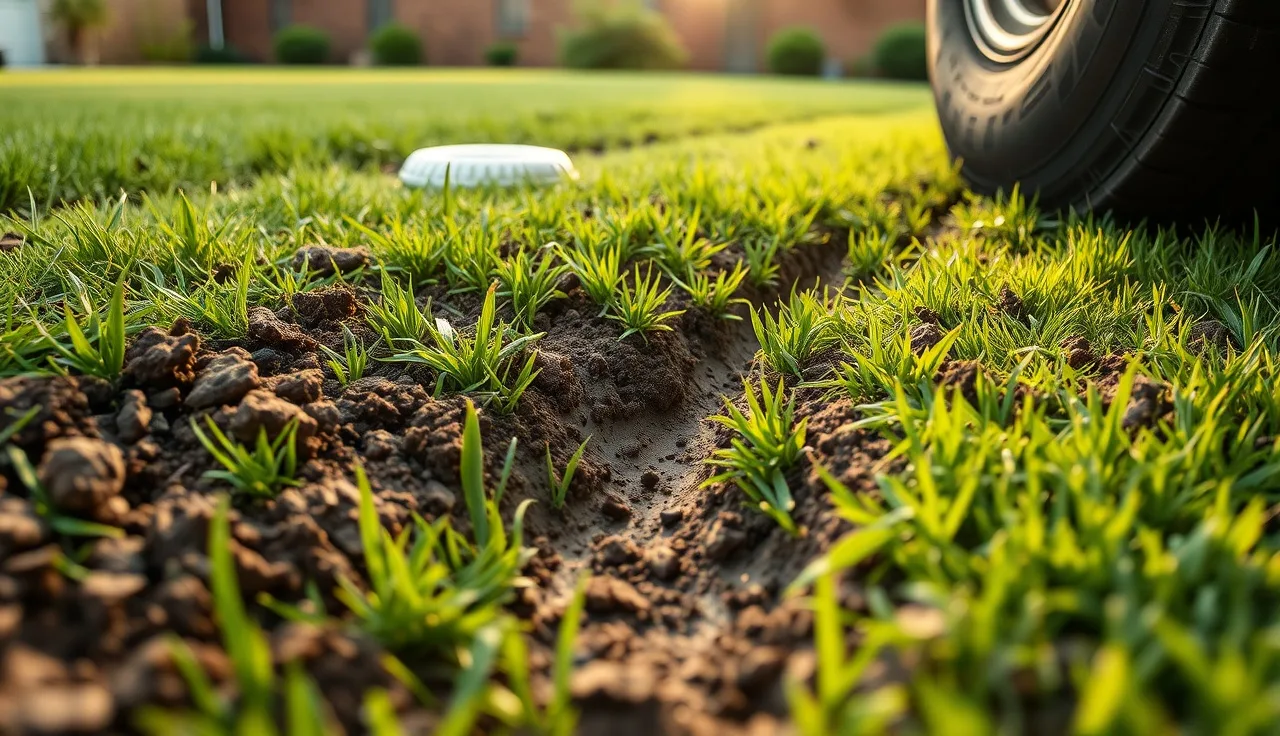
The soil does not spring back. That is the whole problem. A drain field works because the soil between and around the perforated pipes is loose and biologically active, and that matrix of pores is where effluent gets filtered and absorbed. Compact that soil with a wheel load and you shut down absorption the same way packing wet sand shuts down a drain.
The damage happens in layers. First, surface compaction closes the macro-pores that let water move downward. Second, lateral pressure on the gravel around the leach pipes pushes it against the pipe walls, restricting flow and sometimes cracking the pipe. Third, if the vehicle is heavy enough, it collapses the pipe entirely or cracks a distribution box. Each failure carries a different repair cost, and they often stack on top of each other.
The EPA's SepticSmart program tells homeowners to "never drive over or park on your drainfield" and lists it as one of the most common causes of premature system failure [1]. That is not cautious boilerplate. University extension research on onsite wastewater systems has documented the soil compaction problem for decades, and the failure mode is consistent: reduced percolation leads to surfacing effluent, which leads to a failed perc test, which leads to replacement [2].
Here is the detail most homeowners miss. Damage is not always visible right away. A light truck crossing a dry field in summer may show no symptoms for six to eighteen months. Then a wet winter saturates the field, absorption slows, sewage backs up into the house, and the homeowner has no idea why. The vehicle crossing months earlier is the actual cause.
Does vehicle weight actually matter, or is any driving a problem?
Weight matters enormously, and so does soil moisture at the time of crossing. A riding lawnmower (roughly 400 to 600 lbs) spread across four wheels produces a very different ground pressure than a septic pumping truck (commonly 26,000 lbs gross vehicle weight or more) on two rear axles.
Ground pressure, not total weight, is what compacts soil. The calculation is simple: total weight divided by the contact area of all tires touching the ground. Wide flotation tires on a lawnmower produce low ground pressure. Narrow dual tires on a loaded truck produce high ground pressure at depth. The compaction force reaches deeper into the soil profile as weight increases, and drain fields typically sit 18 to 36 inches below the surface [3].
Soil moisture multiplies the risk. Saturated soil compacts far more easily than dry soil. Many drain field collapses happen in spring, when the water table is high and a delivery truck, a moving van, or a contractor's pickup crosses a field that looked perfectly solid. The soil simply had no structural strength that day.
The table below gives a rough picture of relative risk by vehicle class. These figures are illustrative ranges based on published gross vehicle weight ratings and typical tire configurations, not controlled test data.
| Vehicle type | Approx. GVW | Relative compaction risk |
|---|---|---|
| Person walking | 200 lbs | Negligible |
| Riding lawn mower | 400 to 700 lbs | Very low |
| ATV / side-by-side | 800 to 1,500 lbs | Low, moderate |
| Passenger car | 3,000 to 5,000 lbs | Moderate (dry soil), high (wet soil) |
| Pickup truck (unloaded) | 5,000 to 7,000 lbs | Moderate, high |
| Pickup truck (loaded) | 7,000 to 14,000 lbs | High |
| Delivery van / box truck | 10,000 to 26,000 lbs | Very high |
| Septic pump truck | 20,000 to 33,000 lbs | Extremely high |
A passenger car crossing a dry field once is not guaranteed to destroy the system, but it is a gamble with a five-figure downside. Trucks and vans should never cross a drain field, period.
Can you drive over the septic tank itself?
This is a separate question from the drain field, and the answer depends on how the tank was built and how much dirt sits over it. Most residential concrete septic tanks are not designed for vehicle traffic. Precast concrete lids and risers crack under load, and a failed lid drops a vehicle axle into an unsupported void over a several-thousand-gallon tank. That is a serious safety hazard, more than a plumbing problem.
Some tanks are sold as traffic-rated, typically designated H-10 or H-20 under AASHTO load ratings. H-10 tanks are designed for 10-ton axle loads; H-20 tanks handle 20-ton axle loads. These are required in commercial settings where tanks sit under driveways or parking lots [4]. A standard residential tank almost certainly is not traffic-rated unless the installer specifically built it that way.
If you need a driveway or parking pad over a tank, the standard approach is to install a traffic-rated tank and extend risers to grade with traffic-rated lids. That work needs a permit in most states. Do not assume the existing tank can handle it. A septic tank inspection by a licensed inspector can tell you whether your tank lid and burial depth are adequate before you pour concrete over it.
For septic tank repair after a vehicle crossing cracks the lid or inlet baffle, costs typically run $300 to $1,500 for lid replacement and $500 to $2,000 for baffle repair, depending on access and material.
What does drain field repair actually cost after vehicle damage?
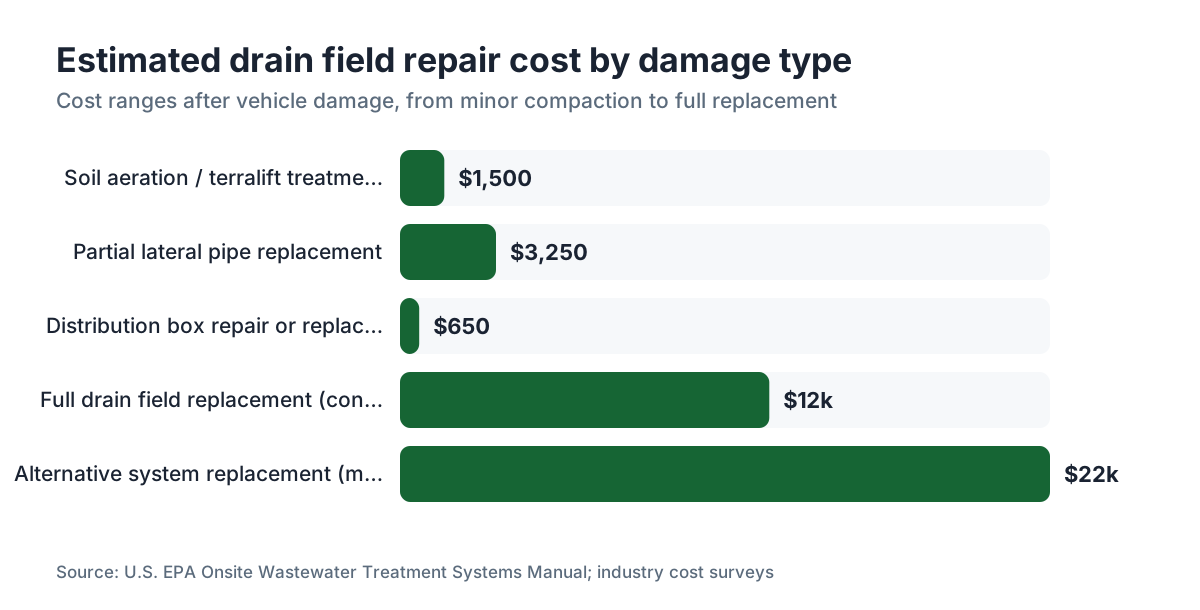
The honest range is wide because damage severity varies so much. Minor compaction that has not yet crushed pipe might respond to aeration (sometimes called soil fracturing or terralift treatment) at $500 to $2,500. That is the best case, and it only works if the pipes are still intact and the compaction is not too deep.
If pipes are crushed, a targeted repair replacing sections of laterals typically runs $1,500 to $5,000. If the distribution box is cracked or offset, add $300 to $1,000. A full drain field replacement is the worst case: $5,000 to $20,000 for a conventional system, and significantly more for an engineered alternative system on a difficult lot [5].
Those numbers assume you still have suitable soil area for a new field. If the vehicle compacted the only viable area on the property, the cost of finding and installing an alternative system can push past $30,000, especially in states that require mound systems, drip irrigation, or other alternatives when conventional absorption is not feasible. See cost to install septic system for a full breakdown of what replacement involves.
Here is the math that should make you nervous. The EPA estimates a conventional septic system costs between $3,000 and $10,000 to install initially [5]. A single vehicle crossing that destroys a drain field can cost as much as a brand-new system. The risk-reward is not close.
Are there any situations where driving near a drain field is unavoidable?
Yes, a few situations genuinely require it. The most common is the septic pumping truck itself. Pump trucks need to reach the tank access point, which is sometimes located near the drain field. A good septic tank pump out contractor will extend hose as far as necessary to avoid crossing the field, but on some properties the geometry makes a close approach unavoidable.
In those cases, the standard fix is to spread the load with plywood sheets or steel road plates under the tires, and to schedule pumping during dry weather when the soil is firmest. Timing matters more than most people realize. Pumping in February after a wet month is a much higher-risk proposition than pumping in August after several dry weeks. Talk to your septic tank pumping company about their vehicle size and routing before they arrive.
Construction is the other big one. Additions, outbuildings, grading work, and landscaping all bring heavy equipment near septic systems. Before any contractor starts, you or your septic service provider should walk the property and mark the drain field boundary with flags or paint. Most state codes require contractors to avoid loading septic system components, but enforcement is after the fact. Marking the field proactively is the only reliable protection.
If you are scheduling routine maintenance, knowing how often to pump septic tank in advance lets you plan pump-out timing around dry weather windows, which cuts compaction risk every time the truck visits.
What can you safely do on and around a drain field?
Foot traffic is fine. Walking, gardening, and mowing with a push mower or lightweight riding mower (under about 600 lbs) are generally acceptable and will not harm a properly installed system. Planting is a different concern: deep-rooted trees and shrubs can infiltrate and clog pipes, but shallow-rooted groundcovers and grass are actually good for the field because they take up moisture and prevent erosion.
The EPA SepticSmart program specifically recommends planting grass over the drainfield and keeping trees or shrubs with invasive roots out of the area [1]. Shallow-rooted native plants are an acceptable alternative to grass in drier climates.
What you should not do, beyond driving: parking a vehicle or trailer on the field is just as damaging as driving over it, since static load compacts soil too. Do not build structures, pour concrete, or install impervious surfaces. Do not direct roof drains, sump pump discharge, or landscape irrigation onto the field. Saturating the field from above limits its ability to absorb effluent from below.
Keeping the field surface clear and undisturbed is the single most effective thing a homeowner can do to extend system life. University of Minnesota Extension research found that properly maintained conventional drain fields can last 25 to 30 years or more; systems that experience vehicle loading or hydraulic overloading fail much sooner [2].
How do you know if your drain field is already damaged from vehicles?
The clearest signs are soggy or mushy ground over the field even during dry weather, sewage odors in the yard, slow drains inside the house, and sewage backup. Any one of those symptoms says the field is not absorbing properly.
Less obvious signs include unusually lush or green grass directly over the drain field trenches (effluent is fertilizing the surface because it is not soaking downward) and soft spots that sink slightly underfoot where pipe collapse has created a void.
A septic tank inspection by a licensed inspector can confirm whether the field is failing. In some states, inspectors use a probe or camera inspection to assess pipe condition without excavation. A dye test, where a colored dye goes in at the tank and inspectors watch for surface emergence, is another diagnostic tool, though it is not universally reliable.
If you suspect damage, do not wait. A failing field that surfaces effluent creates a public health hazard, can violate state code, and gets more expensive to fix the longer the compaction keeps blocking treatment. Get a professional assessment quickly.
What do state codes say about protecting drain fields?
Most state onsite wastewater codes prohibit vehicle traffic over drain fields explicitly. The details vary, but the regulatory logic is consistent: drain fields are permitted engineered structures, and altering them without approval violates the installation permit.
For example, the North Carolina Administrative Code (15A NCAC 18A .1950) requires that "the area over a system shall be kept free of vehicular traffic" as a condition of system approval [6]. Minnesota's Private Sewage Treatment Program rules similarly prohibit any loading or alteration of the soil treatment area without a new permit [7]. The EPA does not directly regulate residential septic systems (that authority sits with states and counties), but its SepticSmart guidance matches every state code I am aware of on this point.
Violating these provisions can create liability exposure if a system fails and wastewater reaches a neighbor's property or a water body. In some states, knowingly allowing prohibited activity on a permitted system can result in fines or a required system replacement at the owner's expense under public health enforcement.
If you are buying a home with a septic system, a septic tank inspection before closing is worth the $300 to $600 it typically costs. An inspector can flag obvious signs of past vehicle damage before it becomes your problem.
How do you protect a drain field when contractors need to work nearby?
The most effective protection is physical barriers. Orange construction fencing staked around the field boundary costs almost nothing and makes it unambiguous to any equipment operator where not to go. Combine that with a conversation at the job start: show every operator the field boundary before work begins, not after.
For unavoidable crossing points, temporary ground protection systems (interlocking HDPE panels or steel road plates) spread the load over a wider area and cut peak ground pressure sharply. These rent at equipment yards for roughly $50 to $150 per panel per week. A few panels at a crossing point can mean the difference between no damage and a crushed lateral.
Spell out vehicle routing in the contractor's scope of work. Ask specifically what equipment will be on site, what its GVW is, and how they plan to route around the drain field. A contractor who cannot answer those questions clearly deserves a follow-up conversation before any machine starts.
Septic service operators managing a field crew across multiple job sites can track field locations, pump-out records, and site access notes systematically. SepticMind's service operations platform is one tool contractors use for exactly that kind of site-by-site documentation, which becomes especially useful on properties where access routing matters for protecting the customer's system.
After any construction project, have the drain field inspected before declaring success. If any equipment did cross the field, document it and get the inspection done while the contractor's general liability policy is still in play.
What should you do if someone already drove over your drain field?
First, stop additional traffic immediately. One crossing might not cause catastrophic damage; repeated crossings over compacted soil accelerate failure quickly.
Second, get the system inspected. A licensed septic inspector or your county environmental health department can assess whether pipes are intact and whether the soil percolation rate has been compromised. Do this before any symptoms appear if you know a heavy vehicle crossed the field.
Third, document everything. If a contractor, delivery company, or neighbor's vehicle caused the damage, photographs of tire tracks, the vehicle, and any symptoms (wet spots, odors) build the evidentiary foundation for a liability claim. Contractor general liability policies typically cover this kind of damage, but only if you can demonstrate causation.
For septic system repair after vehicle damage, get multiple quotes. The range is wide and so is the quality of contractors. A reputable company will camera-inspect the laterals before quoting, rather than assume the extent of damage. Ask specifically whether they are replacing damaged sections only or the entire field, and why.
In the meantime, conserve water. Cut back on laundry, showers, and dishwasher loads. The less hydraulic demand you put on a stressed drain field, the slower any damage progresses. This is not a permanent fix, but it buys time to make an informed repair decision.
Is there anything that makes a drain field more resistant to vehicle damage?
Yes, though none of these factors make a field safe for regular vehicle traffic. Installation depth helps: a field buried 24 to 36 inches deep has more soil buffer than one buried 12 inches deep. Gravel aggregate around the pipes distributes some load. Sandy loam soils resist compaction better than clay soils, which compact readily and recover slowly.
Some alternative designs hold up better. Chamber systems (using plastic arch chambers instead of gravel-and-pipe) resist mechanical damage somewhat better than conventional perforated pipe because the chambers keep void space without relying on loose gravel. They are not vehicle-proof, but they tolerate a light crossing better than conventional pipe in some conditions [3].
The only genuinely traffic-tolerant solution is a traffic-rated system designed and installed for that purpose, with adequate burial depth, structural backfill, and traffic-rated access lids. That is a specialty installation and costs more upfront. If your property layout makes vehicle crossings unavoidable (a gate, a driveway that must cross the field), designing for it at installation is far cheaper than repairing an unrated field after the damage is done.
For properties where the drain field sits under or near a proposed driveway, work with your installer to route the driveway around it or specify a traffic-rated design from the start. See leach field for more detail on drain field construction types and what affects their longevity.
Frequently asked questions
Can you drive over a septic system at all?
Driving over the tank is risky unless the tank is specifically rated for traffic loads (H-10 or H-20 AASHTO rating). Driving over the drain field is something you should avoid entirely. Even a single pass by a loaded pickup truck can compact soil enough to reduce absorption permanently. The EPA's SepticSmart program lists vehicle traffic as one of the leading causes of premature drain field failure.
How much weight can a drain field handle before it gets damaged?
There is no published universal threshold because it depends on soil type, moisture level, burial depth, and pipe material. As a practical rule, anything heavier than a lightweight riding mower (roughly 600 lbs) poses real risk on a standard residential drain field, especially in wet conditions. Heavy vehicles like delivery trucks, dump trucks, and septic pump trucks should never cross a conventional drain field under any circumstances.
Can a car parked on a drain field cause damage?
Yes. Static load from a parked vehicle compacts soil just as effectively as a moving one, sometimes more so because the weight sits in one spot continuously. Parking on a drain field is specifically prohibited by most state septic codes for exactly this reason. Even a passenger car parked repeatedly in the same location can significantly reduce the field's ability to absorb effluent over time.
Is it safe to mow over a septic drain field?
Push mowers and lightweight walk-behind mowers are fine. Light riding mowers under about 600 lbs are generally acceptable on dry ground. Heavy zero-turn mowers or garden tractors above 1,000 lbs loaded weight should be used carefully, and you should avoid making repeated passes in exactly the same path. Never mow with any equipment when the soil is saturated.
What happens if a septic pump truck drives over the drain field?
Pump trucks typically weigh 20,000 to 33,000 lbs fully loaded, which is enough to collapse lateral pipes and deeply compact the soil in a single pass. A good pump contractor will extend hose to reach the tank without crossing the field. If the site geometry makes that impossible, ask them to use ground protection panels and schedule the pump-out during dry weather when soil strength is highest.
How long does it take for a drain field to fail after vehicle damage?
It varies. Severe damage from a very heavy vehicle can cause immediate backup or surfacing effluent. More often, moderate compaction reduces absorption gradually, and symptoms show up six to eighteen months later, typically during the first wet season after the damage. That delay makes it easy to misdiagnose the problem. If a heavy vehicle crossed your field, get an inspection even if the system seems fine.
Can a damaged drain field be repaired, or does it need full replacement?
It depends on the extent of damage. Minor compaction sometimes responds to soil aeration treatments costing $500 to $2,500. Crushed pipe sections can be replaced for $1,500 to $5,000. A fully compacted or collapsed field typically requires complete replacement at $5,000 to $20,000 or more. A camera inspection of the laterals is the only reliable way to know which situation you are dealing with before committing to a repair approach.
Does homeowners insurance cover drain field damage from vehicles?
Standard homeowners insurance policies typically exclude septic system damage, including drain field failure. If a contractor's vehicle caused the damage, their general liability policy may cover it. If a neighbor's vehicle caused it, their auto liability or umbrella policy may apply. Document the vehicle, the tracks, and any system symptoms immediately. Coverage disputes are much harder to win without contemporaneous evidence.
How do you mark a drain field so contractors don't accidentally cross it?
The most reliable method is orange construction fencing on stakes around the entire field perimeter, installed before any contractor arrives. Flag every corner and extend the fence at least 10 feet beyond the field boundary. Supplement the physical barrier with a conversation: walk every equipment operator around the boundary before work starts. If you don't know your field location, your county health department should have the as-built drawing on file.
Can you build a driveway over a drain field?
Not over a conventional residential drain field. Impervious surfaces like asphalt or concrete prevent oxygen from reaching the soil, preventing treatment, and vehicle loads damage pipes and compact soil. If your property layout creates a genuine conflict, the solution is to redesign the driveway routing, not to pave over the field. Some jurisdictions allow driveways over specially designed traffic-rated systems with adequate depth and structural fill, but that requires a new permit and engineered design.
What plants are safe to grow over a drain field?
Grass is the classic recommendation and genuinely good: it takes up moisture and prevents erosion without damaging pipes. Shallow-rooted native groundcovers work in drier climates. Avoid any tree, shrub, or plant with deep or aggressive root systems within 10 feet of the field. Willows, maples, and poplars are especially aggressive and can infiltrate pipes from 50 feet away. Vegetables grown in the field soil are not safe to eat due to pathogen contamination risk.
Does driving over the field always leave visible damage right away?
No, and that is the core danger. Compacted soil may show no symptoms for months. The field keeps working at reduced capacity through dry weather, then fails visibly in the first wet season when the water table rises and the compacted soil simply cannot handle the hydraulic load. By then, the vehicle crossing is long forgotten. This is why a proactive inspection after any known vehicle crossing is worthwhile, even without symptoms.
How far from the drain field should vehicles stay?
A 10-foot clearance from the field boundary is a reasonable minimum for passenger vehicles. For heavy equipment, 20 to 25 feet is safer because heavy loads cause lateral soil stress that extends beyond the tire footprint. The distribution box and header pipes connecting the tank to the field also need protection; treat the entire septic system footprint plus a buffer as a no-drive zone.
Sources
- U.S. EPA, SepticSmart homeowner guidance: EPA SepticSmart advises homeowners to never drive over or park on a drainfield, listing vehicle traffic as a leading cause of premature system failure, and recommends planting grass over the drainfield.
- University of Minnesota Extension, Septic System Owner's Guide: University of Minnesota Extension research indicates properly maintained conventional drain fields can last 25 to 30 years or more, while systems subject to vehicle loading fail significantly sooner.
- National Environmental Services Center (NESC), Decentralized Wastewater Treatment Technology Fact Sheet: Chamber Systems: Drain fields typically sit 18 to 36 inches below the surface; chamber systems maintain void space without loose gravel and tolerate incidental light loads somewhat better than conventional pipe-and-gravel systems.
- American Association of State Highway and Transportation Officials (AASHTO), H-load rating standards referenced in precast concrete tank specifications: Traffic-rated septic tanks are designated H-10 (10-ton axle load) or H-20 (20-ton axle load) per AASHTO standards; standard residential tanks are not rated for vehicle traffic.
- U.S. EPA, Onsite Wastewater Treatment Systems Manual (EPA/625/R-00/008): The EPA estimates conventional septic system installation costs between $3,000 and $10,000; full drain field replacement after damage ranges from $5,000 to $20,000 or more depending on system type and site conditions.
- North Carolina Department of Health and Human Services, 15A NCAC 18A .1950, Sewage Treatment and Disposal Systems rules: North Carolina Administrative Code 15A NCAC 18A .1950 requires that the area over a permitted septic system shall be kept free of vehicular traffic as a condition of system approval.
- Minnesota Pollution Control Agency, Private Sewage Treatment Program rules (Minn. R. 7080): Minnesota's Private Sewage Treatment Program rules prohibit any loading or alteration of the permitted soil treatment area without a new site evaluation and permit.
- U.S. EPA, SepticSmart Week resources and fact sheets: EPA SepticSmart program explicitly lists vehicle traffic and parking on the drainfield among the most common homeowner practices that damage septic systems.
- Penn State Extension, Homeowner's Guide to Septic System Maintenance: Penn State Extension guidance confirms that soil compaction from vehicle traffic is a primary cause of drain field failure, reducing soil permeability and preventing effluent absorption.
- Virginia Cooperative Extension, Septic System Maintenance publication 448-407: Virginia Cooperative Extension advises that trees and shrubs with deep root systems should not be planted within 10 feet of drain field laterals, and that vehicles must be kept off the drain field area at all times.
Last updated 2026-07-09