Can you drive over a leach field? What every homeowner must know
By the SepticMind Editorial Team

TL;DR
- Don't drive over a leach field.
- Vehicle weight compacts the soil, which kills the aerobic bacteria that treat wastewater, and can crush the distribution pipes buried just 6 to 24 inches down.
- One pass by a heavy truck can trigger a failure that costs $5,000 to $20,000 to fix.
- Foot traffic is fine.
- Everything heavier is a real risk.
Why driving over a leach field is a problem
A leach field (also called a drain field or absorption field) is more than dirt with some pipes in it. It's a living system. Wastewater flows out of your septic tank, spreads through perforated pipes, and percolates down through a conditioned layer of soil packed with aerobic microorganisms. Those microbes break down pathogens and nutrients before the water reaches the groundwater table. The soil structure, especially its porosity and air content, is what makes the whole thing work.
Drive a vehicle over that soil and you compress the air pockets. Compacted soil moves water much more slowly or stops moving it at all. The aerobic bacteria zone gets damaged or destroyed, because those organisms need oxygen to live. And compacted soil doesn't bounce back when the vehicle leaves. You've changed the physical structure, sometimes for good.
The pipes are a separate problem. Most residential leach field laterals are 4-inch perforated PVC or corrugated HDPE, buried 6 to 24 inches down depending on local code and site conditions [1]. A heavy vehicle concentrates enormous pressure at the tire contact patch and drives it downward. At shallow burial depths, that's more than enough to crack or flatten the pipe.
Soil compaction and crushed pipe are both hard to fix. Aeration and deep tilling sometimes recover mildly compacted soil, but a badly damaged field often needs full replacement. That's an expensive lesson.
What does vehicle weight actually do to leach field soil?
Vehicle weight crushes the air pockets that make the soil work. Compaction is measured by bulk density (grams per cubic centimeter) and penetration resistance (pounds per square inch). Research from the USDA Natural Resources Conservation Service shows that fine-textured soils become functionally impermeable when bulk density passes roughly 1.6 g/cm³ for silty soils and around 1.8 g/cm³ for sandier soils [2]. A single pass from a loaded pickup (roughly 6,000 to 8,000 lbs) can shove moist, unprotected soil well past those thresholds.
Moisture matters a lot. Wet soil compacts far more easily than dry soil. If your yard has had rain in the past 24 to 48 hours, the risk from any vehicle jumps. This is exactly why septic installers often demand dry conditions before heavy equipment goes near the field.
Here's the part people miss: the damage adds up. One careful drive across a dry field in a small car might do little harm. But that same car twice a week for a year is a different story. Soil scientists call it traffic-induced compaction, and the USDA notes that most compaction happens in the first one or two passes, while repeated passes keep deepening the affected zone [2].
Pipe failure compounds all of this. Even if the soil survives, a vehicle at 5,000 lbs or more can generate enough point load to crack a 4-inch PVC lateral. Once a lateral cracks, you get a blockage (effluent backs up) or a surface breakout (sewage pools on the lawn). Neither is fun.
Which vehicles are safe to drive over a leach field and which are not?
No single federal weight cutoff exists, but most state onsite wastewater codes and the EPA treat any vehicle heavier than a passenger car as a serious risk, and many prohibit heavy vehicles outright [3].
Here's a practical breakdown:
| Vehicle type | Typical weight | Risk level |
|---|---|---|
| Person walking | 150 to 300 lbs | Very low |
| Lawn mower (push) | 60 to 90 lbs | Very low |
| Riding lawn mower | 400 to 900 lbs | Low to moderate |
| ATV / UTV | 600 to 1,800 lbs | Moderate |
| Passenger car (small) | 2,500 to 3,500 lbs | Moderate to high |
| SUV or pickup truck | 4,500 to 7,000 lbs | High |
| Delivery truck | 10,000 to 26,000 lbs | Very high (often prohibited by code) |
| Concrete truck | 60,000 to 80,000 lbs loaded | Extreme (virtually always prohibited) |
The EPA SepticSmart program says it plainly: "Never drive or park vehicles or heavy equipment on your drain field" [3]. Note the word vehicles, not heavy vehicles. That's the conservative but honest recommendation.
Riding mowers are the common gray area. Most homeowners mow over their fields for years with no visible damage. The risk is real but low if the soil is dry and the mower stays on a consistent path. The catch is you may not see the damage until the field is already failing.
ATVs deserve more concern than they get. They're light, but riders use field areas for recreation, which means repeated passes in every direction. That pattern compacts more evenly and deeply than one vehicle on a set path.
Delivery trucks and septic pumping trucks (typically 15,000 to 30,000+ lbs loaded) need to stay on defined access routes, off the field itself. If your pumping company is backing a truck across the field to reach the tank, have a conversation about routing.
Can you park on a leach field?
No, and parking is worse than driving over. When a vehicle drives, the load moves and spreads across the soil. A parked vehicle presses one spot for a long stretch. That gives the stress more time to compress soil pores and deform the pipes below.
Stationary loads are also harder to recover from. The soil under a parked car can experience what engineers call creep, a slow, ongoing deformation under sustained stress. On a moist day, a few hours of parking can do damage that would take multiple drive-overs otherwise.
Most state regulations say so directly. North Carolina's onsite wastewater rules, for example, prohibit placing "structures, impervious materials, vehicles, or heavy equipment" over the repair area or the primary system components [4]. Plenty of other states use equivalent language.
Don't park there. Not once. Not for a quick errand. If a party needs overflow parking, set up cones or rope off the area. That's not an overreaction.
What happens if a leach field gets compacted or damaged?
The failure usually unfolds like this. Compacted soil starts taking effluent more slowly. Your tank fills faster than the field can drain. Eventually effluent backs up into the house (slow drains, or sewage in the lowest fixture) or breaks out to the surface as a wet, foul-smelling puddle on the lawn.
Surface breakout is a public health problem, more than a nuisance. Raw or partially treated sewage can carry E. coli, enterococci, hepatitis A virus, and various helminths. The EPA notes that "poorly functioning septic systems can contaminate nearby water bodies, wells, and shellfish beds" [3].
Once you have a failing field, your options depend on the damage:
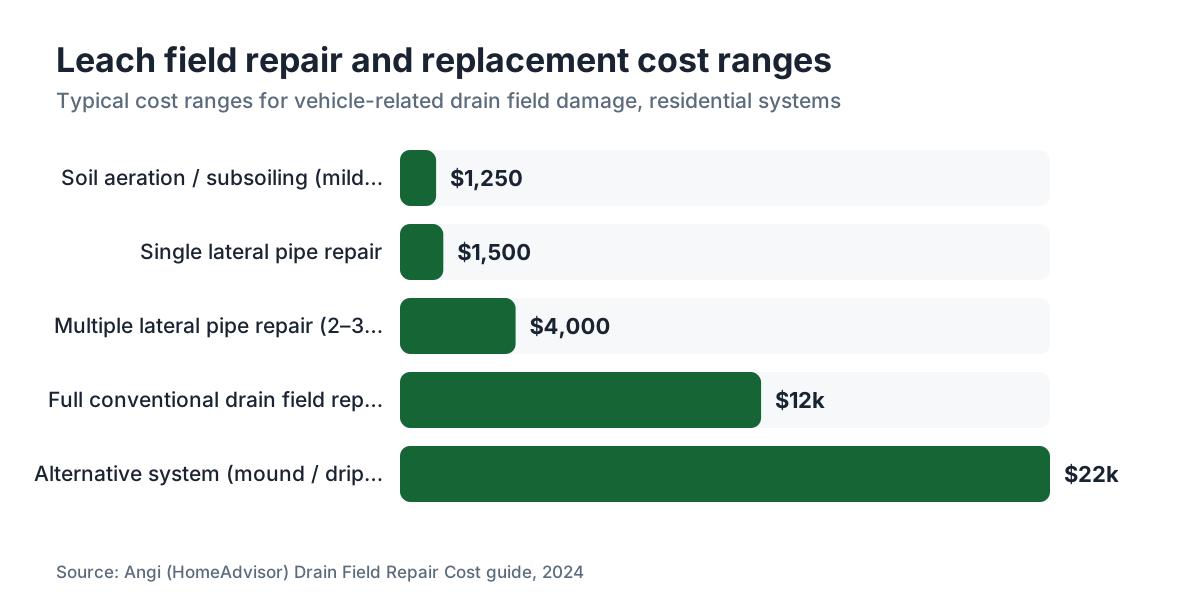
- Soil restoration. If compaction is mild and caught early, some contractors deeply till or fracture the soil using air injection or mechanical subsoiling. It can help, but it's no guarantee and does nothing for crushed pipe.
- Lateral pipe repair. If one or two pipes are cracked, a targeted repair (excavate, replace the damaged section) may run $500 to $2,000 per lateral depending on depth and access [5].
- Full drain field replacement. Extensive damage means excavation, aggregate removal, re-grading, and new pipe. National estimates for full replacement run $5,000 to $20,000 for a standard residential system, with complex sites going higher [5].
- Alternative system. If your site can't support another conventional field (soil too damaged, or not enough footprint), you may need a more intensive system like a mound or drip irrigation setup, which can run $10,000 to $30,000 or more.
See our full guide to leach field issues and septic system repair for more on diagnosing drain field problems.
Are there any situations where it's okay to drive over a leach field?
Occasionally, yes. A few narrow situations accept or require vehicle access over part of the system:
Septic pumping access. Your pumper needs the tank lid, and the access route sometimes runs near or at the edge of the field. The truck should stay on firm, dry ground on the shortest possible route. If your installer set up a proper access path, use it.
Initial installation. Heavy equipment is unavoidable on site during install. Good installers deliberately compact specific access routes and leave the field area untouched during grading. The field goes in last for this reason.
Emergency utility work. If a water line breaks or conduit needs repair under the yard, you may have no choice. Minimize the area, restore the soil carefully afterward, and document the access path for your records.
Low-load inspection on dry ground. A homeowner or inspector walking the field, or a light ATV on dry, well-structured soil, carries low but nonzero risk. That's generally accepted. Checking inspection ports or clean-outs on foot during a dry stretch is fine.
The thread running through all of these is dry soil, minimal passes, lightest load, defined routes. Break any one of those and you slide from low risk to real risk fast.
If you run a septic service business and manage routing across many properties, tools like SepticMind help you document site-specific access restrictions so crews don't accidentally cross a field they shouldn't.
How deep are leach field pipes and does that change the risk?
Depth is one of the biggest variables, and it swings a lot. EPA guidance references typical cover of 6 to 24 inches over the distribution laterals, depending on climate, frost depth, and local code [1]. In cold climates like Minnesota or Wisconsin, pipes go deeper to stay below frost line. In the Southeast, shallow installs of 6 to 12 inches are common [10].
Shallower pipe means higher structural risk from vehicle loads. At 6 inches of cover, the 30 to 40 square inch tire patch from a passenger car transmits enough stress to crack standard schedule 40 PVC. At 24 inches of cover in compacted native soil, the same car poses far less risk to the pipe, though it still compacts the treatment zone.
Corrugated HDPE (the flexible black pipe) handles point loads a bit better than rigid PVC because it can deflect slightly. But both fail under heavy vehicles, and neither recovers well from deep soil compaction.
You probably don't know your field's exact depth unless you have the original install record or an inspection. Your local health department usually has the permit records with site plans showing depth and layout. If you're unsure, get a septic tank inspection that covers the field, or pull the permit records, before making any call about vehicle access.
How can you tell if your leach field has already been damaged by vehicle traffic?
The earliest signs are subtle and easy to miss. Here's what to watch for:
Slow drains throughout the house, especially when every fixture is affected rather than just one. That points to a system-wide drainage problem, not a simple clog.
A wet, soggy patch of grass over the field, particularly one that lingers well after rain stops. Saturated soil over the lines means effluent isn't percolating down.
Unusually green, lush grass in one strip over the field. Effluent acts as fertilizer. If a lateral leaks at or near the surface, the grass above it often turns visibly greener.
Odor near the field. Partially treated sewage has a distinctive sulfur and ammonia smell. Any odor on a dry day is a warning.
Septic alarm or pump alert, if your system has a pump chamber. When effluent backs up because the field won't accept it, a high-water alarm may trigger.
Two or more of these together mean call a licensed septic professional before it gets worse. Early intervention almost always beats a full replacement on cost. A pro can run a hydraulic load test on the field or scope the laterals with a camera to see what's happening underground.
For routine system health, see our guides on how often to pump septic tank and septic tank inspection.
What does state and local code say about driving over a leach field?
Federal law doesn't regulate what you do in your own yard over the field, but many states do. The rules come as onsite wastewater or individual sewage disposal codes, which require systems be protected from damage and set out prohibited uses.
North Carolina's rules (15A NCAC 18E) prohibit placing vehicles or heavy equipment over the system components or the designated repair area [4]. Virginia's onsite sewage regulations (12VAC5-613) require systems be protected from damage and traffic loading [6]. Most other states with active onsite wastewater programs, including Texas, Florida, Minnesota, and Washington, carry some version of this prohibition.
For permits and local variation, your county health department or environmental services department is the place to check. When a system goes in, the permit typically includes a site plan showing the field location and required setbacks. That plan is worth tracking down if you don't have it, because it tells you exactly where the field is and how much of your yard is at risk.
One practical note: if you sell your home, many state disclosure laws require you to report known septic damage. A failed or vehicle-damaged field caught during a real estate inspection can derail a sale or knock tens of thousands off the price. The cost to install septic system makes this a major line item in any home transaction.
How can you protect your leach field from accidental vehicle damage?
The best protection is making the field's location obvious, so nobody drives over it by accident. Here's what actually works:
Mark the corners. Drive a few small stakes at the corners and string a low, visible barrier during events or construction. You don't need a fence. You need something conspicuous enough that a driver slows down and reroutes.
Post signs. A simple "Septic Area, No Vehicles" sign costs a few dollars and does the job. Contractors, delivery drivers, and guests follow it when they see it.
Talk to your delivery services. Amazon, UPS, USPS, and contractors have no idea where your field is. A note in the delivery instructions or a quick conversation with your general contractor before any project starts prevents the most common accidental damage.
Divert driveway runoff. Separate from vehicle damage but worth handling at the same time: rainwater running off a driveway onto the field adds to saturation. Grade or channel that runoff away.
Plant the right things over it. Low-growing grass is ideal cover. Deep-rooted shrubs and trees invade the pipes and belong 30 to 50 feet away depending on the species [9]. Shallow groundcover keeps the soil surface intact and quietly discourages parking.
Building an addition, putting in a pool, or doing any excavation? Make sure your contractor has a copy of the site plan before anyone breaks ground. Plenty of fields have been dug up or driven over by contractors who simply didn't know the system was there.
For operators managing service records and site notes across many properties, tracking site-specific access restrictions in a platform like SepticMind means that information reaches your crew before every job, instead of only when you're on-site to brief them.
What's the cost to repair or replace a leach field damaged by vehicles?
It depends entirely on how much damage was done. Mild soil compaction with no pipe damage may respond to aeration or subsoiling at $500 to $2,000 for a typical residential field, though nothing guarantees it restores full function. Pipe repair for one or two cracked laterals runs $500 to $2,000 per lateral, including excavation and backfill [5].
Full drain field replacement is the outcome to avoid. National averages put it at $5,000 to $20,000 for a conventional gravity-flow system, with the wide range reflecting soil conditions, local labor rates, system size, and permit fees [5]. If your site needs an engineered alternative (mound, drip dispersal, aerobic treatment unit), add $5,000 to $15,000 to those figures.
Insurance usually won't cover septic damage from vehicle traffic. Homeowners policies typically exclude damage to underground systems caused by owner negligence, and driving over a leach field generally counts as negligence. Some riders or specialty policies cover septic systems, so verify the specific terms with your insurer.
The math is unfriendly. A concrete truck, delivery van, or even a service vehicle making one wrong turn can cause $10,000 to $20,000 in damage. Putting up a $20 sign and sending a contractor a one-paragraph email about the field location is the cheapest maintenance you'll do all year.
See also: cost to put in a septic tank and septic tank repair for related cost context.
Frequently asked questions
Can a riding lawn mower damage a leach field?
A riding mower usually weighs 400 to 900 lbs, light enough that the risk stays low on dry, well-structured soil. The bigger concern is repeated passes over the same lines season after season. If you've mowed the field for years without trouble, you're probably fine, but vary your path and skip the area when it's wet to hold down cumulative compaction.
Can one car driving over a leach field ruin it?
Usually not, but it depends on conditions. A single light car on dry, deep-cover soil is low risk. The same car on saturated soil, or over laterals buried just 6 inches down, can crack pipes or cause compaction that degrades field performance. The risk is never zero, so avoid it entirely rather than bank on luck.
How do I know where my leach field is?
Check with your county health department for the original permit and site plan, which shows the field's location and dimensions. You can also hire a licensed septic professional to locate and map the system. Some homeowners use probe rods or inspection ports visible at grade as reference markers. Knowing exactly where the field sits before any vehicle or construction work is worth the effort.
Can you build a driveway over a leach field?
No. A driveway over a field causes the exact problems you're trying to avoid: repeated heavy loads, soil compaction, and pipe damage. Most state codes prohibit paving or placing impervious material over drain fields, both because it compacts soil and because it blocks the oxygen exchange the treatment zone needs. If you need a driveway there, the field has to move first.
Can emergency vehicles like fire trucks drive over a leach field?
A fire truck can weigh 40,000 to 60,000 lbs, enough to crush pipes and deeply compact soil in one pass. Emergency response is outside your control, but you can cut the odds by keeping good road access so trucks don't need to cut across the yard. After any heavy emergency vehicle crosses the field, have a septic professional inspect the area as soon as you can.
Does driving over a leach field void any warranty?
Many installer warranties and service agreements void coverage if the system is damaged by vehicle traffic, unauthorized construction, or misuse. Check your original installation contract and any service agreement. Even without a formal warranty, documenting vehicle damage incidents helps if you ever need to pursue the responsible party for repair costs.
Can you put a shed or structure over a leach field?
No. A shed or permanent structure over a field is prohibited under most state codes and creates several problems: it blocks access for maintenance and inspection, the foundation loads compact the soil, and roof runoff over-saturates the field. Structures also prevent the drying cycle the field needs. Keep the area clear and accessible at all times.
What should I do if a contractor accidentally drove over my leach field?
Document it right away with photos of tire tracks, wet areas, or visible pipe damage. Contact a licensed septic professional to inspect within a few days, before symptoms appear. Get a written report. Then contact the contractor; if they caused damage, their liability insurance may cover repair. Don't wait to see if symptoms develop, since early intervention is cheaper and gives you clearer causation for a claim.
Can you drive over a leach field in a dry summer when the soil is hard?
Dry, firm soil resists compaction far better than wet soil, so the risk genuinely drops in a dry summer. But pipe damage risk doesn't vanish with dry conditions; a heavy vehicle can still crack shallow laterals regardless of moisture. And compacted hard soil, once driven over, takes the next rain cycle to reveal its reduced permeability. Lower risk in dry conditions is not no risk.
How long does it take a damaged leach field to show symptoms?
It varies. A crushed pipe may cause backup within days. Soil compaction damage often takes months or a year or two to show, because remaining soil capacity and tank buffering mask the reduced performance. By the time you see wet spots or slow drains, the damage has often been there a while. That delay is one reason vehicle damage costs so much: it's usually diagnosed late.
Is it safe for children or pets to play on a leach field?
Yes. Foot traffic from kids and pets is safe and causes no meaningful compaction or structural damage. A field that's working properly is not a health hazard to walk on. If the field is actively failing and you see surface sewage breakout, keep people and pets off the area and call a professional. A healthy, grass-covered field is just lawn.
Do all leach fields have the same vehicle load limits?
No. Depth of cover, pipe material, soil type, and moisture all affect how much load a field tolerates. A field with 24 inches of cover over HDPE pipe in dry sandy soil handles light vehicles very differently than one with 6 inches of cover over PVC in wet clay. Without site-specific information, the conservative answer is always to keep vehicles off entirely.
Sources
- EPA, "Septic Systems" (Onsite Wastewater Treatment Systems): Typical leach field lateral burial depths range from 6 to 24 inches depending on climate and local code
- EPA, "SepticSmart" homeowner guidance: EPA SepticSmart guidance states: "Never drive or park vehicles or heavy equipment on your drain field," and warns poorly functioning systems can contaminate water bodies, wells, and shellfish beds
- North Carolina DHHS, Division of Public Health, 15A NCAC 18E Onsite Wastewater Rules: NC rules prohibit placing vehicles or heavy equipment over system components or the designated repair area
- Angi (HomeAdvisor), "Drain Field Repair Cost" guide: Full drain field replacement costs $5,000 to $20,000 for a conventional residential system; alternative systems can run $10,000 to $30,000 or more
- Virginia Department of Health, 12VAC5-613 Sewage Handling and Disposal Regulations: Virginia onsite sewage regulations require protection of systems from damage and traffic loading
- University of Minnesota Extension, Onsite Sewage Treatment Program: Vehicle traffic and parking over septic system components is a leading cause of premature drain field failure
- EPA, "Septic Systems" homeowner resources: Poorly functioning septic systems can contaminate nearby water bodies, wells, and shellfish beds
- Penn State Extension, septic system resources: Trees and deep-rooted plants should be kept 30 to 50 feet from leach field lines; grass is the preferred cover
- University of Florida IFAS Extension, "Septic Tanks and Drainfields": Shallow Southern installations commonly place laterals at 6 to 12 inches of cover, increasing structural vulnerability to vehicle loads
Last updated 2026-07-09