Septic tank water treatment: what actually works
By the SepticMind Editorial Team
TL;DR
- Septic tank water treatment covers everything you put into or do to a septic system to keep the biological process running, from enzyme additives and bacterial supplements to effluent filters and aerobic treatment units.
- Most healthy tanks need no additive.
- A tank pumped every 3 to 5 years, with careful water use, beats any monthly treatment product sold.
What does 'septic tank water treatment' actually mean?
The phrase gets used two ways, and the gap between them matters. One meaning is the treatment happening inside the tank, the anaerobic digestion where bacteria break down solids before the liquid flows to the drain field. The other meaning, the one filling your search results, is the products and services marketed to help that process along: bacterial additives, enzyme packets, aerobic units.
A septic tank is already a biological treatment device. Wastewater enters, heavy solids settle to the bottom as sludge, greases float to the top as scum, and the clarified liquid in the middle (effluent) exits to the leach field, where soil microbes finish the job. That process runs fine without any additive when the tank is sized right, pumped on schedule, and not flooded with solids or harsh chemicals [1].
So the honest starting point is this: the treatment is already happening. The real question is whether you can improve it, and what the evidence says about the products that promise to.
Does a healthy septic tank need any water treatment additives?
No, with one narrow exception below. A working septic tank holds billions of anaerobic bacteria that arrived in ordinary household wastewater. You don't need to seed or feed them from a bottle. The EPA's SepticSmart program puts it flatly: "there is no scientific evidence that septic tank additives improve the performance of a properly functioning septic system" [2].
The exception is small. If your tank was just pumped completely dry and you want to restart digestion fast, a small dose of bacterial inoculant can theoretically speed up seeding. But normal pumping leaves a residual film of bacteria behind, and your household wastewater rebuilds the population within days. You're paying real money for a benefit measured in hours.
The harm side is better documented. Products with surfactants, solvents, or strong acids can kill the bacterial community, push settled solids back into suspension, and drive them into the drain field, where they clog the soil. New Hampshire's Department of Environmental Services tested 35 additive products and found some increased the export of suspended solids to the drain field by more than 20 percent [3].
A healthy system needs pumping, careful water use, and nothing else from a store shelf.
What are the main types of septic tank treatment products?
Products sold as septic treatments fall into four buckets. Knowing what each one does, and doesn't do, keeps you from wasting money or wrecking your tank.
Bacterial and enzyme additives. The most common category, sold as packets, tablets, or liquids flushed monthly. Bacteria-based products contain dormant or freeze-dried anaerobic strains (usually Bacillus species) and claim to replenish the tank's biology. Enzyme-only products contain amylase, lipase, or protease to break down starches, fats, and proteins. Combination products carry both. The research consensus: they don't harm a healthy system, and they don't measurably help one either [2][3]. If you insist on using something, a plain bacterial packet is the lowest-risk pick.
Chemical additives. Acids (sulfuric, muriatic), alkalis, and solvents like methylene chloride. These were more common in older products and are now banned or restricted in several states. They damage the bacterial process, and in some states using them in a septic system is illegal [3]. Stay away.
Aerobic treatment units (ATUs). These are engineered systems, not something you grab at the hardware store. An ATU pumps air into the tank or a second chamber, shifting digestion from anaerobic to aerobic, which is much better at cutting biochemical oxygen demand (BOD) and total suspended solids (TSS). ATU effluent can be 90 percent cleaner than a conventional tank's output [4]. Installed cost runs $10,000 to $20,000 or more, they need maintenance contracts, and they show up where soil or lot size rules out a normal drain field. This is real water treatment technology.
Effluent filters. Physical filters that sit in the tank outlet baffle and trap solids before they reach the drain field. The filter itself costs $50 to $200, plus installation labor. Unlike most additives, these have clear mechanical evidence behind them: they catch the fine solids that clog drain field soil over years. The University of Minnesota Extension recommends effluent filters as a legitimate protective step [5]. They need cleaning at every pump-out.
| Product type | Evidence of benefit | Risk of harm | Typical cost |
|---|---|---|---|
| Bacterial/enzyme additive | Weak to none | Low (bacteria-only) | $5-$15/month |
| Chemical additive | None | High | $10-$30/use |
| Aerobic treatment unit | Strong | Low (if maintained) | $10,000-$20,000 installed |
| Effluent filter | Moderate-strong | Very low | $50-$200 + labor |
What is the best monthly septic tank treatment?
If you're set on a monthly routine, the safest choice is a bacteria-only product with no enzymes, surfactants, or solvents. Products listing Bacillus licheniformis, Bacillus subtilis, or similar anaerobic strains as the sole active ingredient are unlikely to cause harm. Whether they do any measurable good is a separate question, and the research keeps answering it with "probably not."
The best monthly treatment you can actually do is behavioral, not chemical. The EPA's SepticSmart initiative points to the habits that genuinely protect a system: spread laundry across several days instead of one marathon Saturday, fix leaking toilets (a running toilet can dump 200 gallons a day into a system designed for 300), and keep fats, oils, and grease out of the drain [2]. Those actions cut hydraulic overload and hard-to-digest material far more than any product does.
Still want something to flush monthly? A bacterial packet from a reputable brand, under $10 a month, is a reasonable low-cost habit. Just don't ask it to do a job it can't. No monthly product reverses an overloaded drain field, seals a cracked tank, or stands in for a pump-out that's four years late.
How does septic effluent treatment work and why does the drain field matter?
The tank is only stage one. The effluent leaving it still carries pathogens, nitrogen, phosphorus, and dissolved organic matter. Secondary treatment happens in the drain field, where effluent percolates through a biomat (a layer of beneficial microbes) and then through native soil. The soil strips out most pathogens within a few feet of horizontal travel [1][4].
The leach field is where the whole system is most fragile. When too many solids escape the tank, they clog the biomat and plug the soil pores, and percolation stops. That's how most septic failures begin. Protecting the drain field is, in plain terms, the entire point of tank maintenance.
This is why an effluent filter beats an additive. The filter on the outlet baffle blocks the exact mechanism behind most drain field failures. A bacterial additive in the tank only nudges a job a healthy microbe community already handles. The downstream risk is where your money does more.
Once a drain field is in trouble, options narrow fast. Some operators inject bacteria or oxygen into clogged laterals, with mixed results. The reliable fix is resting the failed section while another carries the load, or replacing it. That gets expensive quickly. Septic system repair for a drain field replacement runs $3,000 to $15,000 depending on soil and system size [6].
What does the EPA actually say about septic additives?
The EPA's position is clear and has held for years. Its SepticSmart program, the agency's main homeowner outreach on onsite wastewater, tells people not to lean on additives and states that "regular pumping is the most important maintenance task for your septic system" [2].
The EPA doesn't ban additives federally, and it hasn't endorsed any. Several states go further. Massachusetts restricts the sale of certain chemical additives. South Carolina requires certification before biological additives can be sold. Iowa and Washington have banned specific product types. To find out what's legal where you live, check your state's department of environmental quality or onsite wastewater program [7].
The EPA recommends a septic tank inspection every three years for most households and pumping every 3 to 5 years depending on household size and tank volume. Those intervals, not product choices, hold the whole system together.
How often should you pump your septic tank versus using a treatment product?
These aren't alternatives, and treating them as such is how people end up with a failed drain field. Pumping removes the accumulated sludge and scum that no biological additive can eliminate. Bacteria digest some solids, never all, and the leftover inorganic and undigested material piles up regardless of what you pour in. When sludge and scum together fill more than about one-third of the tank's liquid depth, it's time to pump [1].
For most households that lands at every 3 to 5 years. A 1,000-gallon tank serving two people might stretch to five or six. The same tank serving five people might need pumping every two. The only way to know your number is an inspection that measures sludge depth, which a technician does with a sludge judge or similar tool during a septic tank pump out.
Standard septic tank pumping runs $300 to $600 in most markets, though rural areas and hard access push it higher [8]. Against a drain field replacement at $3,000 to $15,000, or a new system at $15,000 to $30,000 and up, routine pumping is the best value in septic maintenance by a wide margin [6][9].
Monthly additives run $5 to $15, or $60 to $180 a year. Over five years that's $300 to $900 spent on something with weak evidence behind it. That sum covers most of a pump-out. The math does not flatter the additive industry.
Can water softeners or household chemicals hurt your septic system's treatment process?
Yes, and this risk gets overlooked. High-salt discharge from ion-exchange water softeners has long been suspected of disrupting the tank's biology, and some extension services recommend against routing softener backwash into the septic system [5]. Two things worry them: the salt load and the volume of backwash water, since hydraulic overload is a real failure path on its own.
Antibacterial soaps and disinfectants, used in bulk, can knock down the tank's bacterial population. Normal use of dish soap and laundry detergent is fine; the population bounces back. But someone sanitizing tools with bleach every day, or running a daycare from home, should think about the cumulative load.
Prescription antibiotics flushed down the toilet pose some theoretical risk, but a single household dose spread through a full tank is generally too dilute to do lasting damage. The bigger problem is pharmaceutical compounds reaching groundwater, which a conventional septic tank doesn't fully address [4].
Cleaners labeled "septic safe" are usually formulated to avoid heavy biocide loads. That label isn't federally regulated. Products that pass NSF/ANSI Standard 46 certification (which covers septic additives and components) have at least cleared third-party testing criteria [10].
Are aerobic treatment units worth the cost for residential septic systems?
An aerobic treatment unit is worth it when a conventional system can't work, not as an upgrade to one that can. If your lot is too small for a standard drain field, your soil drains too slowly (common in clay), or you're in an area with regulated nitrogen loading to groundwater, an ATU may be the only permitted option [4][7].
ATU effluent is dramatically cleaner than conventional tank output. A well-running ATU cuts BOD by 85 to 95 percent and TSS by similar margins before the water even reaches the soil. In nitrogen-sensitive spots like coastal zones or ground near drinking water wells, some ATU models add a denitrification stage that reduces total nitrogen, something a conventional tank can't do [4].
The cost and complexity are the catch. ATUs need electricity for the air compressor or aerator. They need professional service on a schedule, usually twice a year, under a contract. Many states require the owner to hold a maintenance agreement as a condition of the operating permit. When the aerator fails, and they do fail, the system falls back to anaerobic treatment until it's fixed. Parts and service contracts add $200 to $600 a year on top of installation.
For a homeowner with good soil and enough room, an ATU is a poor spend. For someone facing septic tank repair on a tight site or near sensitive water, it may be the only real path.
Operators juggling multiple ATU accounts live and die by scheduling and compliance tracking. SepticMind's maintenance scheduling tools are built for this kind of recurring service work, which matters when you have a dozen ATU contracts on different intervals with different state reporting rules.
How do you protect your septic system's treatment process long-term?
The practices that stretch a septic system's life are dull and real. None of them come in a bottle.
Water conservation is the biggest lever you've got. Every gallon you send to the tank is a gallon it has to process. High-efficiency toilets, low-flow showerheads, and repaired leaks cut hydraulic load in a way you can measure. A household dropping from 100 gallons per person per day to 70 gives the tank's biology 30 percent more residence time to work.
Keep the drain field clear. Tree and shrub roots infiltrate distribution lines and can crush them. Parking vehicles or setting heavy planters over the field compacts the soil and chokes percolation. Plant the drain field with shallow-rooted grass and nothing else.
What you flush decides what the tank has to digest. Wipes (even the "flushable" ones), feminine hygiene products, condoms, and coffee grounds don't biodegrade in a septic system. They pile up as sludge. Every item that shouldn't go down shortens the gap between pump-outs and raises the odds of solids reaching the drain field.
Regular septic tank inspection and scheduled septic tank cleaning are the two things you don't skip. Everything else, the monthly products on the shelf included, sits below those two.
If you want your pump-out history, system records, and maintenance schedule in one place, SepticMind's homeowner tools are built for that. Good records pay off most when you sell, since buyers increasingly ask for septic inspection reports.
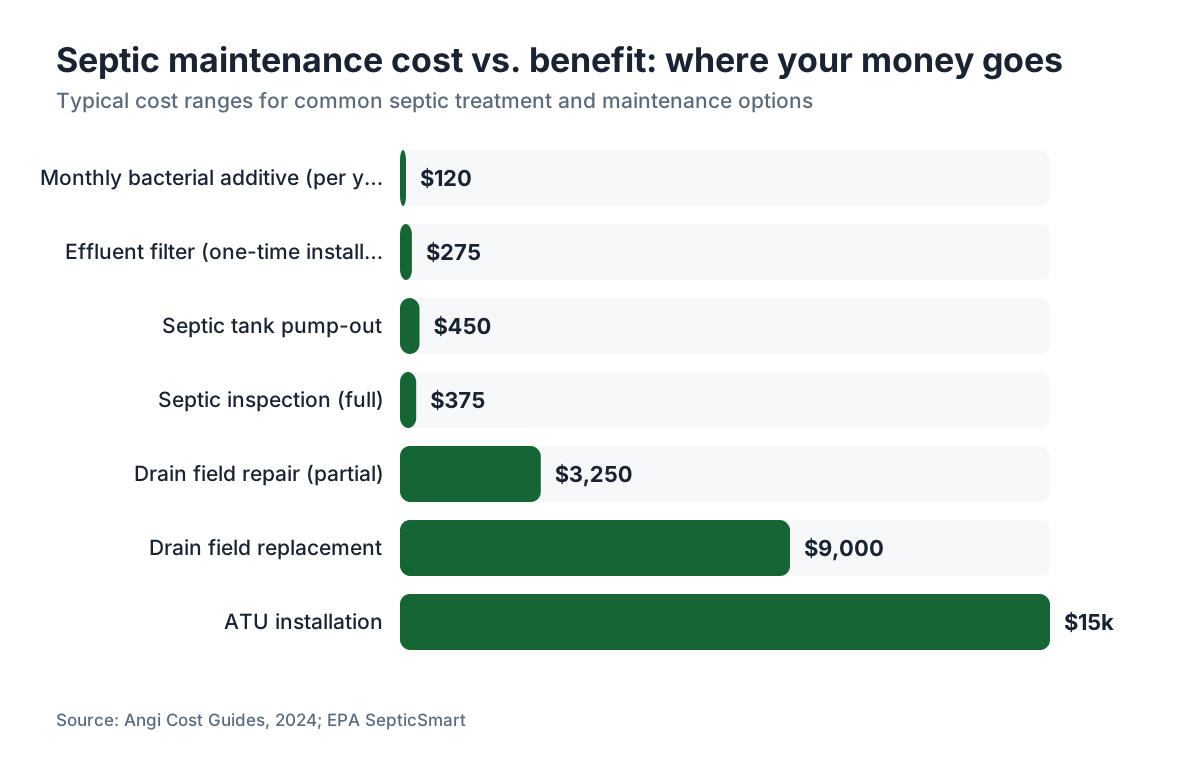
What does septic treatment cost across different approaches?
The range is wide, from a few dollars a month to tens of thousands, and the link between cost and effectiveness is not clean.
Monthly bacterial additive: $5 to $15 a month, $60 to $180 a year. Low evidence of benefit. Low risk of harm.
Effluent filter installation: $150 to $400 total including labor at your next pump-out. Clear mechanical benefit. Needs cleaning at every pump-out.
Standard septic tank pumping: $300 to $600 every 3 to 5 years for most households [8]. High evidence of benefit. The base everything else builds on.
Septic tank inspection: $100 to $300 for a visual check, $250 to $500 for a full inspection with sludge measurement and flow test.
Aerobic treatment unit installation: $10,000 to $20,000 installed, plus $200 to $600 a year in service contracts and electricity [4][9].
Drain field repair or replacement: $1,500 to $5,000 for partial repair, $3,000 to $15,000 for full replacement [6].
New septic system installation: $15,000 to $30,000 or more depending on system type and site. See cost to install septic system for the full breakdown.
The cheapest path to a long-lived system is steady pumping plus an effluent filter. The most expensive path is skipping pumping until the drain field dies.
Frequently asked questions
Do septic tank treatment tablets actually work?
Bacteria-based tablets are unlikely to harm a healthy system, but the evidence they improve one is weak. The EPA and several state environmental agencies found no scientific proof that biological additives measurably improve a properly functioning system. If your tank is healthy and pumped on schedule, tablets are an optional low-risk add-on, not a necessity.
What is the best monthly septic tank treatment I can buy?
The best monthly treatment is a bacteria-only product (no solvents, no surfactants) listing anaerobic strains like Bacillus subtilis. Most cost under $10 a month. No product has beaten another in peer-reviewed testing. Behavioral habits, fixing leaks, spreading laundry loads, avoiding grease, have stronger evidence behind them than any commercial treatment.
Can I use too much septic treatment product?
With bacterial products, overdosing does no extra good; the tank population regulates itself. With enzyme or chemical products, heavy use can push suspended solids into the drain field or disrupt the bacteria. Follow the directions, and avoid any product listing acids, solvents, or strong surfactants as active ingredients.
Is it safe to use bleach if you have a septic tank?
Normal use, a load of laundry, occasional toilet cleaning, is generally fine. The bacterial population in a full tank is large enough to absorb intermittent exposure and rebound. Trouble starts with heavy, repeated disinfectant use, like daily bleach down the drain. At that level you can genuinely suppress the biological treatment process and speed up sludge buildup.
How does a septic tank treat wastewater without chemicals?
A septic tank treats wastewater through gravity separation and anaerobic biological digestion. Heavy solids settle as sludge, greases float as scum, and naturally occurring bacteria digest much of the organic material in the middle liquid layer. The clarified effluent exits to the drain field, where soil microbes and filtration finish the treatment. No added chemicals are needed.
Will yeast help my septic tank?
Flushing a packet of yeast is a popular home remedy. Yeast (Saccharomyces cerevisiae) can break down some carbohydrates, but it isn't the main organism in anaerobic digestion, and it doesn't persist well in the tank. No peer-reviewed evidence shows it beats a healthy system's native biology. It's harmless, but there's no strong reason to bother.
What chemicals should you never put in a septic tank?
Never put paint, paint thinner, solvents, motor oil, antifreeze, or strong acid-based drain cleaners into a septic system. These kill the bacteria, contaminate groundwater, and in many states count as illegal hazardous waste disposal. Chemical drain cleaners like lye and sulfuric acid are especially damaging. Keep prescription medications out too; they don't fully degrade in conventional treatment.
How do I know if my septic treatment is working?
The signs of a working system are simple: no sewage odor inside or out, no wet or spongy ground over the drain field, toilets and drains flowing freely, and a pump-out inspection showing sludge depth in normal range. If all four are true, your treatment process is fine. No additive changes those indicators in any measurable way.
Does an aerobic septic system need different treatment than a conventional one?
Yes. An aerobic treatment unit needs professional service, usually twice a year, to inspect the aerator, clean air lines, check chlorine or UV disinfection, and verify effluent quality. Many states require a maintenance contract as a permit condition. Don't use bacterial additives in an ATU without checking the manufacturer's guidance, since the aerobic environment differs from a conventional anaerobic tank.
Can a septic treatment product save a failing drain field?
No product reliably saves a failed drain field. Some operators inject oxygen or specialized bacteria into clogged laterals with mixed, short-term results, but no additive reverses advanced biomat clogging or soil compaction. Once a drain field fails, the real options are resting the failed zone, repairing distribution lines, or replacement. For what that involves, see septic system repair.
How does water usage affect septic treatment effectiveness?
High water use directly cuts treatment effectiveness. Excess flow shortens the time wastewater spends in the tank, reducing digestion, and can push sludge and scum toward the outlet. The EPA recommends spreading water use across the day and week. Fixing a leaking toilet, which can waste 200 gallons a day, may do more for your system than any product you buy.
What is an effluent filter and should I have one?
An effluent filter is a mesh or foam cartridge in the outlet baffle of your septic tank that catches fine solids before they reach the drain field. At $50 to $200 plus installation, it's one of the most cost-effective septic improvements you can make. University extension services and many state programs recommend them. Have one installed at your next pump-out and cleaned at every one after.
Does a new septic tank need to be seeded with bacteria?
A new tank doesn't strictly need seeding. Normal household wastewater carries the bacteria that establish the anaerobic community. Full biological activity usually develops within a few weeks. Some installers suggest a bacterial starter to speed it up, which is harmless. The tank works without it. See how often to pump septic tank for the first pump-out schedule.
Are there state laws about what septic treatment products you can use?
Yes. Several states restrict or ban specific additive types. Massachusetts and Washington restrict chemical additives. Some states require products meet NSF/ANSI Standard 46 to be sold or used. Check your state's department of environmental quality or onsite wastewater program for current rules. The EPA doesn't regulate additives federally and endorses none of them.
Sources
- EPA, How Your Septic System Works: Septic tanks function through gravity separation and anaerobic biological digestion; pumping every 3-5 years is the most important maintenance task.
- EPA SepticSmart Program: "There is no scientific evidence that septic tank additives improve the performance of a properly functioning septic system."
- New Hampshire Department of Environmental Services, Septic System Additives: NH DES tested 35 additive products and found some increased export of suspended solids to the drain field; certain chemical additives are harmful to the bacterial community.
- EPA, Onsite Wastewater Treatment Systems Manual (EPA/625/R-00/008): Aerobic treatment units can reduce BOD by 85-95 percent; secondary soil treatment removes most pathogens within a few feet of travel; ATUs are appropriate where soil conditions or lot size preclude conventional systems.
- University of Minnesota Extension, Septic Systems: Effluent filters are recommended as a protective measure; softener backwash routed to the septic system can be a concern.
- HomeAdvisor / Angi, Septic System Repair Cost Guide: Drain field repair runs $1,500-$5,000 for partial repair and $3,000-$15,000 for full replacement depending on system size and site conditions.
- EPA, Septic Systems Overview (state regulations context): Septic system permitting and additive regulation occur at the state level; the EPA recommends inspection every three years and pumping every 3-5 years.
- HomeAdvisor / Angi, Septic Tank Pumping Cost Guide: Standard septic tank pumping costs $300 to $600 in most U.S. markets.
- HomeAdvisor / Angi, Septic System Installation Cost Guide: Aerobic treatment unit installation costs $10,000 to $20,000; new septic system installation costs $15,000 to $30,000 or more depending on type and site.
- NSF International, Septic System Products and NSF/ANSI Standard 46: NSF/ANSI Standard 46 provides third-party testing criteria for septic additives and components; products certified under this standard have met defined performance thresholds.
Last updated 2026-07-09