Septic system risers: what they are, what they cost, and whether you need them
By the SepticMind Editorial Team

TL;DR
- Septic risers are vertical pipe extensions that bring your tank's access lids up to ground level, so nobody has to dig before a pump-out.
- Plastic risers cost $200 to $600 installed.
- Concrete costs a bit more and lasts longer.
- Most septic pros push hard for them.
- They pay for themselves in three to four pump-out cycles.
What is a septic system riser and what does it actually do?
A septic riser is a cylindrical tube, usually 12 to 24 inches across, that sits on your tank's access opening and runs straight up to grade (ground level). The lid rests on top of the riser instead of on the tank. That's the whole idea. Simple, but it changes every future service call.
Without risers, a technician has to find your tank (often with a probe or an electronic locator), then dig down 12 to 36 inches through soil and whatever landscaping you've got to reach the lid. That digging adds $50 to $200 per lid to your bill, and most tanks have two lids [1]. With risers, the lid is right there at the surface. The tech lifts it, does the job, walks away. The visit takes a fraction of the time.
Risers matter for inspections too. When you sell, the buyer's inspector wants the tank opened fast. A buried tank with no riser turns a 20-minute inspection into a half-day dig.
The EPA's SepticSmart program tells homeowners to "know where your septic tank and drainfield are located" and keep them reachable, which in practice means risers [1]. Some state onsite wastewater codes now require risers on new installs or at the time of any major repair.
What types of septic risers are available?
Three materials run the market: polyethylene plastic, PVC, and concrete. Each has real trade-offs.
Polyethylene (HDPE) risers dominate new installs. They're light, easy to cut to height, don't corrode, and connect to tank openings with rubber gaskets or sealant. Most makers offer 12-, 16-, 20-, and 24-inch diameters to match different access sizes. Wall thickness runs 0.20 to 0.30 inches [9]. They hold up well underground, but the cheap ones warp if heavy equipment rolls over the lid.
PVC risers are stiffer than HDPE and cost a little more. Some installers like them where the ground moves a lot, since PVC flexes less. For most homeowners the difference is negligible.
Concrete risers have been in use for decades, and plenty of older tanks already wear them. Concrete is heavy (a 24-inch section runs 60 to 100 pounds per foot), so labor costs more. But concrete handles traffic loading better than plastic, which makes it the right call under a driveway or anywhere vehicles cross [9]. The downside: concrete cracks over time and is harder to seal tight against groundwater and odor.
Fiberglass is a fourth option, mostly in commercial jobs. For a house, polyethylene handles about 95% of installs fine.
| Material | Approx. installed cost | Load rating | Weight | Expected lifespan |
|---|---|---|---|---|
| Polyethylene (HDPE) | $200 to $450 | Light to moderate foot traffic | Light | 30 to 50 years |
| PVC | $250 to $500 | Light to moderate | Light | 30 to 50 years |
| Concrete | $300 to $600 | Vehicle traffic capable | Heavy | 50+ years |
| Fiberglass | $350 to $700 | High | Moderate | 40+ years |
How much do septic risers cost to install?
One riser over one lid runs $200 to $600 installed, depending on material, tank depth, and local labor rates. Most tanks have two access points, inlet side and outlet side, so budget $400 to $1,200 to riser both lids right. Larger tanks or ones with inspection ports may have three or four openings.
Tank depth is the biggest cost driver. A tank buried 12 inches takes maybe 30 minutes of labor. A tank buried 36 inches may need multiple riser sections stacked and sealed, adding 45 to 90 minutes. Septic labor generally runs $75 to $150 per hour depending on region [3].
Many pumping companies install risers during a scheduled pump-out at a discount, since the tank is already located and open. If you've got a septic tank pump out coming up, ask about bundling the riser in. That's the smartest time to do it.
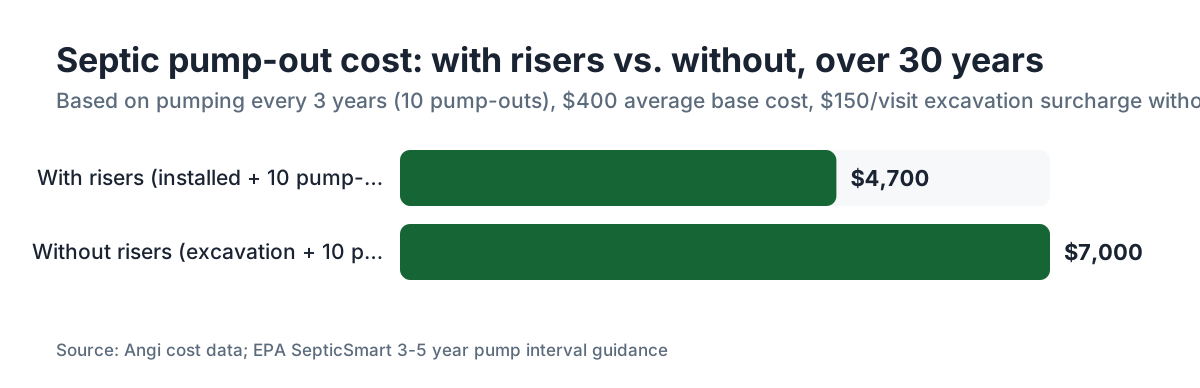
The payback math is plain. Say each pump-out costs $150 extra in excavation (fair for a tank buried 18 to 24 inches) and you pump every three years. Over 30 years that's ten pump-outs, or $1,500 in digging. A $500 riser install wipes out most of that. It pays for itself in three to four pump-outs.
Do septic risers need to be at exact ground level or can they sit higher?
You want the lid flush with or slightly above finished grade, usually no more than 1 to 2 inches proud. Too low and surface water, soil, and debris pool around the lid. Too high and you've got a trip hazard and a target for the lawn mower.
Some homeowners run risers 2 to 4 inches above grade on purpose, so the lid stays visible and they can mark it before snow flies. That's a fair move in snow country. Just confirm the lid is rated for whatever crosses it, including snowblowers and lawn tractors.
State codes differ on the specifics. Florida's onsite sewage rule requires that septic tank access be reachable without excavation [5]. North Carolina's rules put access openings at or near finished grade. Check your state's onsite wastewater regulations for the exact language, because those are the rules that decide permitting and resale inspections.
The lid needs a secure latch. The EPA and most state codes call for tamper-resistant or lockable lids, because an open or loose septic lid is a confined-space fall hazard [1]. Standard green or black snap-ring lids are usually enough. Bolted lids or child-resistant latches cost more and earn their keep if you have kids or pets in the yard.
How are septic risers installed and can a homeowner do it?
Here's how the install goes. The tank gets located and dug out. The old lid comes off. The riser base sets on the tank collar with sealant or a gasket (most use butyl rope sealant or a pre-formed foam gasket). More riser sections stack and lock together if the depth calls for it. The whole stack gets checked for plumb and level. The lid goes on. Then backfill goes around the riser, compacted carefully so it doesn't settle into a depression later.
Can a homeowner do it? Technically, yes. HDPE and PVC riser kits sell at farm supply stores and online for $80 to $200 in hardware. You need to know your tank's collar diameter (12, 16, 20, or 24 inches are common) and how far below grade the lid sits. You also need to be fine working over an open septic tank, which puts off hydrogen sulfide and methane. The EPA and OSHA classify septic tanks as confined spaces and warn against entering them without proper gear, but installing a riser only means working over the open access opening, not climbing in [10].
Most homeowners should hire this out. The gap between a DIY install and a pro one is $100 to $200. A badly sealed riser base lets in groundwater and odor, and chasing that later isn't worth the small savings. If you're already booking a septic tank inspection or a pump-out, have the crew add risers on the same trip.
How long do septic risers last and when do they need replacing?
A properly installed polyethylene or PVC riser should last 30 to 50 years, which likely outlives your tank [9]. Concrete risers have gone 50 years and more. The weak points aren't the tube. They're the lid and the seal at the tank collar.
Lids crack. Sun degrades plastic lids left exposed above grade. A cracked or broken lid needs replacing right away, both for safety and because an open tank takes on surface water, which dilutes it and can push the system toward early failure. Replacement lids run $20 to $80 depending on size and material.
The base seal can fail if the ground settles unevenly or roots work into the joint. Watch for odors near the riser base after rain (surface water sneaking in) or oddly high water at pump-out time. A pro reseals a riser base with hydraulic cement or polyurethane for $50 to $150 in most cases.
Buying a home with existing risers? Check the lid and the seal during the septic tank inspection. It takes 60 seconds to catch a problem before it becomes a headache.
Are septic risers required by code and will they affect a home sale?
It varies by state. Some mandate risers on all new septic installs. Some require them at any permitted repair. Others have no explicit rule but effectively demand accessible lids for inspection. The EPA's SepticSmart guidance doesn't mandate risers, but it treats accessibility as core maintenance practice [1].
For sales, risers matter a lot in practice even where the law is silent. Most buyers' inspectors want the tank opened during the inspection. A tank with no risers either gets skipped (a question mark hanging over the deal) or triggers a costly dig. Either way you risk a delay or a price fight. Installing risers before you list removes a common friction point for $400 to $1,200, almost always less than the hit you'd take at the negotiating table.
Selling and the tank needs septic tank repair anyway? Add risers at the same time. It's cheaper and simpler.
Some state disclosure rules make sellers report the location and condition of the septic system. Accessible risers plus a stack of recent pump-out records read far better than a buried tank with no paper trail. That's not legal advice. It's how these inspections actually play out.
What about riser lids: green vs. black, locking vs. standard?
Riser lids come in green, black, gray, and tan to blend with the yard. Color is cosmetic, nothing more. Green is traditional because it hides better in grass, though neither green nor black disappears.
The choice that matters is locking versus not. A standard friction or snap-fit lid is fine for low-traffic yards where only adults are around. Locking lids with a key, bolt, or child-resistant latch cost $15 to $40 more and earn it if you have kids, visiting grandkids, or a property the public can reach (rentals, land near trails). The EPA names open septic lids as a fall hazard and recommends secure lids [1].
Traffic-rated lids are a separate thing. If your riser sits in a driveway, parking area, or anywhere vehicles cross, you need a lid rated for that load. Standard residential plastic lids handle foot traffic only. Concrete lids and heavy-duty polymer lids rated to H-20 loading (roughly 32,000 pounds per axle) exist for a reason. Put an undersized lid in a driveway and it cracks, usually at the worst moment.
Operators running many properties use a platform like SepticMind to track which sites have locked risers, traffic-rated lids, or known seal problems, so nobody shows up with the wrong equipment or gets surprised by a buried tank.
Can a riser be added to an old concrete or fiberglass tank?
Yes, and it's one of the most common riser jobs. Older concrete tanks often carry heavy concrete lids sitting right on the tank under a foot or more of soil. Adding a riser means matching the riser base to the existing collar opening, which isn't always a clean standard dimension on tanks built before the 1990s.
For concrete tanks, a concrete riser section cut or poured to match is sometimes the cleanest fix, though it's heavy. Plastic risers with flexible or adjustable base flanges handle non-standard collars, usually with hydraulic cement or expanding foam to fill gaps between the base and the tank.
Fiberglass tanks pose similar questions. Their collar diameter runs more consistent (often 20 or 24 inches), and sealing a plastic riser to fiberglass is easy with the right adhesive or gasket.
Got an older tank and you're unsure about its shape? Run a septic tank inspection before adding risers. No sense spending $500 on risers for a tank that needs septic system repair or replacement in two years.
How do risers affect septic tank pumping and maintenance?
Risers make every service call faster and cheaper. A pump-out that needs digging might run two hours total. The same job with risers takes 30 to 45 minutes. That time shows up in your bill, or at fixed-price shops it means the truck hits two more stops a day.
For pumping to work, the tech needs to reach both the inlet and outlet compartments. One riser over the inlet beats nothing, but a second riser over the outlet lets the tech check effluent clarity, inspect the outlet baffle, and clean both compartments properly. If you're adding risers, do both [7]. Our guide to septic tank pumping covers why both access points matter.
Risers also feed the maintenance-frequency problem. The EPA recommends pumping every three to five years for a typical household [8]. Without risers, some homeowners skip pump-outs because the process feels disruptive and expensive. Risers kill that friction. Nobody has run a formal study tying risers to on-schedule pumping, but the connection is hard to miss.
Keep a log of pump-out dates, volumes pumped, and notes (baffle condition, water level, lid condition). Good practice for a homeowner, table stakes for an operator. If you run dozens of accounts, septic tank cleaning records and riser notes can live digitally so the next tech already knows what's waiting. SepticMind is built for that.
For pump-out intervals matched to your household size, see how often to pump a septic tank.
What can go wrong with septic risers and how do you fix it?
The most common problem is a broken or missing lid. Plastic lids crack from mower hits, sun, and freeze-thaw cycles. Replace a cracked lid immediately. Standard HDPE riser lids run $20 to $80 from plumbing suppliers and online. Don't leave a cracked lid sitting there. The fall hazard is real and the water infiltration adds up.
The second common problem is a failed base seal. Smell sewage near the riser after rain? That usually means surface water is slipping into the tank through a gap at the seal and carrying the smell back up. A plumber or septic tech opens the riser, cleans the joint, and reseals with hydraulic cement or polyurethane. Cost runs $75 to $150.
Some older concrete risers crack straight down the side from settlement or frost heave. A cracked concrete riser lets soil fall into the tank or opens an infiltration path. Small cracks take hydraulic cement. Big cracks, or a riser that's shifted out of line, usually mean replacement.
Misalignment (the riser tilts because one side settled more) makes the lid hard to seat and leaves a gap. It happens more with plastic risers set without enough compaction around the base. The fix: dig it out, reset it plumb, recompact.
For bigger tank problems, including baffles, tank walls, or distribution boxes, see our guides to septic tank repair and septic system repair.
Are risers worth it if you're planning to replace the tank soon?
Probably not. If the tank is two to four years from replacement (structural cracks, a failing outlet baffle that can't be fixed, chronic backups), dropping $400 to $1,200 on risers for it doesn't add up. Put that toward the new system. See cost to install a septic system or cost to put in a septic tank for what that runs.
New tanks almost always come with risers, either included or offered as an add-on. If you're getting a new tank, write risers-to-grade into the contract and confirm the lid type before install day.
If the tank is in decent shape with 10 or more years left, risers are worth it. The payback window (three to five pump-out cycles) is short enough that even a middling tank comes out ahead before its time runs out.
Frequently asked questions
What diameter riser do I need for my septic tank?
Most residential tanks have access openings of 12, 16, 20, or 24 inches. Measure the inside diameter of the existing tank collar before ordering anything. If you can't find the tank or reach the opening, a septic inspector or pumping company can measure it during a service visit. The wrong diameter risks a poor seal at the base, which brings infiltration and odor problems.
Can septic risers cause odor problems?
A properly installed and sealed riser shouldn't smell at all. If you catch sewage near the riser, the likely cause is a failed base seal, a cracked lid, or a lid that isn't seated right. Reseal the base joint and swap any damaged lid. Septic odors at ground level are worth chasing down fast, since they can point to a failing baffle or high tank water rather than just a riser.
How deep can a septic tank be and still use a riser?
There's no practical maximum depth. Risers stack, so a tank buried 4 feet down can run four 12-inch sections sealed together. The only real limit is cost, since deeper installs need more sections and more labor. Very deep tanks (more than 5 feet to the lid) may also call for extra safety precautions during pump-out, because the worker is leaning into a deep, open access point.
Do I need a permit to install septic risers?
In most places, adding risers to an existing tank counts as routine maintenance and needs no permit. But some states and counties require a permit for any change to a septic system, risers included. Check with your local health department or onsite wastewater permitting office before you start. Where a permit is required, it usually runs $25 to $75.
How do I find my septic tank if it has no riser?
Start with any as-built drawing from when the home or system was built. Your local health department often keeps these on file. No drawing? A septic technician can find the tank with a metal probe, a soil probe, or an electronic locator. Once they find it, they mark the lid locations so you or a future owner can find them again. That's the moment to add risers.
Can I drive over a septic riser?
Only if the riser and lid are rated for vehicle traffic. Standard residential plastic lids handle foot traffic only and crack under vehicle weight. If the riser sits in a driveway or parking area, you need a traffic-rated lid (H-10 or H-20) and ideally a concrete riser body, which takes compressive loads far better than plastic. A lid cracked by a vehicle is a safety hazard and needs replacing immediately.
How much does a septic pump-out cost without risers vs. with risers?
A standard pump-out with accessible risers costs $300 to $600 across most U.S. regions. The same job on a buried tank adds $50 to $200 per lid for excavation, often pushing a two-lid tank to $450 to $900. Over ten pump-outs across 30 years, that surcharge stacks up to $1,000 to $4,000, well above the one-time riser install cost of $400 to $1,200.
Will adding risers disturb my drain field or yard?
The work stays local to the tank access points and means a hole roughly 18 to 30 inches across and 12 to 36 inches deep per lid. It won't touch your drain field, since risers sit on the tank, nowhere near the leach lines. The disturbed patch settles and re-greens within a growing season. Some homeowners set a low ground cover or a flat stone over the lid to blend it in.
Are plastic risers better than concrete risers for residential use?
For most homes, polyethylene wins: lighter, easier to install, just as durable underground, and less likely to crack from freeze-thaw. Concrete is the right call where vehicles cross the riser, since plastic lids aren't rated for that load and concrete takes compressive weight much better. If the riser sits in a lawn or garden with no vehicle access, plastic wins on ease and cost.
How do I keep bugs and pests out of my septic riser?
A properly seated lid with a good gasket seal keeps insects and rodents out. Finding bugs in or around the riser? Check that the lid is fully seated and the gasket isn't cracked or crushed. Some homeowners add a fine mesh insect screen inside the riser just below the lid as a backup barrier. Pests that keep showing up after you've sealed the lid warrant a call to a septic pro to check for cracks in the riser body.
Can I add a riser to a septic tank that has a pump chamber?
Yes. Systems with pump chambers (common in pressure-dosed or mound systems) usually have access to both the main tank and the pump chamber, and both gain from risers. A pump chamber riser also lets you check the float switch and pump without digging. Confirm the riser diameter matches each chamber's collar, since the pump chamber collar can differ from the main tank collar.
What is the green lid I see in some yards and is that a septic riser?
Almost certainly yes. Green circular lids sitting at or near ground level in residential yards are typically polyethylene septic riser lids. They're green to hide in grass. If you spot one in a yard you're buying, take it as a good sign: the previous owner added risers and the tank has accessible service points. Check the lid for cracks, confirm it's locked or lockable, and find any second lid for the outlet side.
Does the leach field need any risers or access points?
The drain field doesn't get risers the same way, but many systems include a distribution box (D-box) between the tank and the leach field that benefits from an accessible lid or riser. The D-box splits effluent evenly across the field's lateral lines, and reaching it without digging helps diagnose uneven loading or field trouble. Ask your installer or inspector whether your system has a D-box and whether it has accessible covers.
Sources
- EPA SepticSmart program (epa.gov/septic): EPA SepticSmart guidance on knowing tank location, keeping access reachable, treating open or broken lids as fall hazards, and recommending tamper-resistant lids.
- Angi Septic Tank Pumping Cost Guide: Septic labor rates of $75 to $150 per hour and pump-out costs of $300 to $600 for accessible tanks.
- Florida Department of Health, Onsite Sewage Program (Chapter 64E-6, F.A.C.): Florida onsite sewage rules require that septic tank access be reachable without excavation.
- University of Minnesota Extension: Septic system owner's guidance: Extension guidance on septic tank access, maintenance scheduling, and the value of riser systems for reducing pump-out barriers.
- Penn State Extension: Septic system maintenance: Guidance that most residential tanks have two access ports (inlet and outlet) and that both should be accessible for proper pump-out.
- EPA: Septic system frequently asked questions: EPA recommends pumping septic tanks every three to five years for a typical household.
- National Environmental Services Center, West Virginia University: Technical guidance on riser types, wall thickness, installation, and expected service life for polyethylene, concrete, and fiberglass risers.
- OSHA Permit-Required Confined Spaces Standard, 29 CFR 1910.146: OSHA standard classifying septic tanks as confined spaces due to atmospheric hazards including hydrogen sulfide and methane.
Last updated 2026-07-10