Septic inspection in Central Islip, NY: what to expect and what it costs
By the SepticMind Editorial Team
TL;DR
- A septic inspection in Central Islip, NY costs $300 to $600 and takes two to four hours.
- Suffolk County requires an inspection at point of sale and for certain building permits.
- The inspector checks the tank, distribution box, and leach field.
- A failed inspection means pumping, a repair, or full replacement, depending on what went wrong.
Why does Central Islip have strict septic inspection rules?
Central Islip sits in the middle of Suffolk County on Long Island, and Long Island has a serious groundwater problem. The whole island drinks from a sole-source aquifer, a designation the EPA applied to the Upper Glacial and Magothy aquifers back in 1978 [1]. A failing septic system doesn't just soak your yard. Nitrogen from untreated wastewater seeps into that aquifer and into the bays and tidal wetlands that ring the coast.
Suffolk County pushed back hard. The county's Department of Health Services (SCDHS) runs Article 6 of the Suffolk County Sanitary Code, which governs onsite sewage disposal throughout the county, Central Islip included [2]. That code sets minimum lot sizes for septic systems, requires inspections when a property changes hands, and spells out which construction or renovation permits need a health department sign-off.
The practical upshot: you can't quietly sell a Central Islip house with a mystery septic system. Buyers want documentation. So do lenders and the county. Buy, sell, or do a big renovation, and you're getting an inspection.
What does a septic inspection in Central Islip actually cover?
A thorough inspection here runs through three parts: the tank, the distribution box, and the leach field.
The tank. The inspector finds the access lids, opens them, and measures the liquid level against the outlet baffle. They check for inlet and outlet baffles or tees (these keep scum and sludge from flowing into the drain field). They measure scum depth at the top and sludge depth at the bottom. If combined scum and sludge fills more than a third of the tank's working volume, the system needs septic tank pumping before the inspection can finish. Most inspectors won't sign off on a tank they can't fully see. The tank gets checked for cracks, corrosion, and structural condition.
The distribution box (D-box). Not every older Central Islip system has a working D-box, but most do. The box takes effluent from the tank and splits it among the leach field laterals. An inspector looks for flooding inside the box, uneven flow to the outlets, and backflow, which is effluent running back from the field into the box. Backflow is a red flag for a saturated or failed field.
The leach field. Inspectors probe the soil around the field lines and look for surface breakout, which is sewage reaching the surface. They check for lush green stripes of grass (high nutrient loading in the soil), soft or spongy ground, and odors. Some run a dye test: fluorescent dye goes through the system and they watch for it to surface. A camera scope of the pipe runs from tank to field is not always in a basic inspection, but you can add it, and it's worth it on any system over 20 years old.
New York doesn't license septic inspectors at the state level the way it licenses home inspectors. Suffolk County issues no separate "septic inspector" license distinct from a plumber's or engineer's license. Look for a licensed professional engineer, a licensed master plumber, or a company the SCDHS has accepted as a registered installer. Those folks tend to have the most field time with local soil and code [2].
How much does a septic inspection cost in Central Islip?
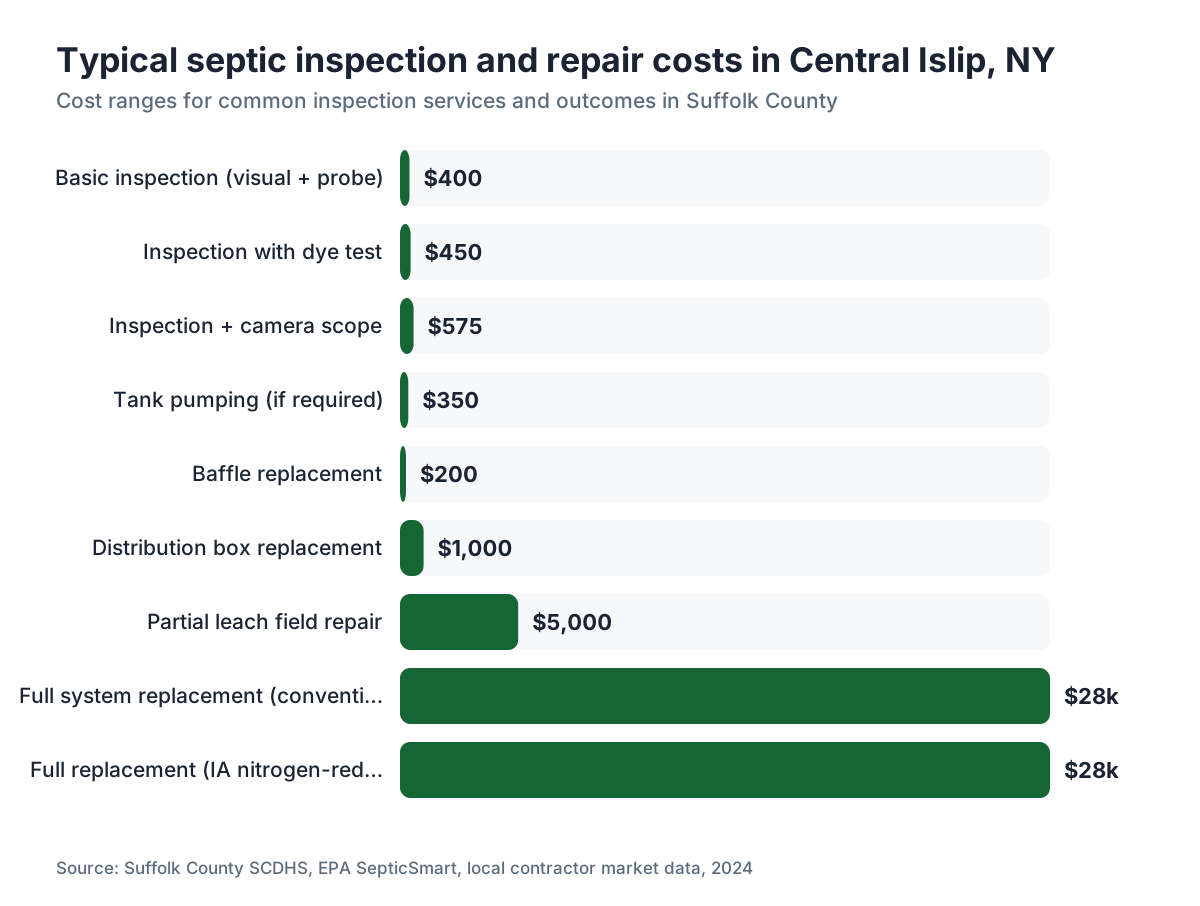
Expect $300 to $600 for a standard visual and probe inspection with pumping access, meaning the inspector opens the tank but doesn't necessarily pump it. If pumping is part of the job, add $250 to $450 for that separately. See septic tank pump out for what that involves.
Here's a rough picture of the Suffolk County market:
| Service | Typical cost range |
|---|---|
| Basic inspection (visual + probe + D-box) | $300, $500 |
| Inspection with dye test | $350, $550 |
| Inspection + camera scope of lines | $450, $700 |
| Pumping (if required during inspection) | $250, $450 |
| SCDHS property transfer form filing | $75, $150 (some inspectors include this) |
These ranges come from what Long Island septic companies publicly advertise and what Suffolk County real estate attorneys report as typical. The low end fits newer, accessible systems on small lots. The high end shows up when the lids are buried deep, there are multiple tanks, or the field is large.
Buying a home where the seller pays for the inspection? Push for a scope of the lines. The $100 to $200 upcharge is nothing next to finding a crushed lateral after closing.
When is a septic inspection required by Suffolk County law?
Two main triggers under Suffolk County rules.
First, any transfer of ownership of a property with an onsite sewage disposal system requires an inspection and certification that the system is in acceptable condition, or disclosure of any deficiencies [2]. This is the inspection you hear about at real estate closings. The SCDHS has a specific form (the Certificate of Existing Sewage Disposal System) that the seller or their contractor submits.
Second, certain building permits trigger a health department review of the existing system. Adding bedrooms, converting a garage to living space, or increasing fixture counts can all force a capacity check. Suffolk County calculates system capacity by bedroom count, at 110 gallons per day per bedroom [2].
Outside those two triggers, no law forces you to inspect a system you're just living with. But skipping routine inspections is how systems fail quietly, right up until the failure gets expensive. The EPA's SepticSmart program recommends inspecting a conventional system at least every three years [3].
What can cause a septic system to fail an inspection in Central Islip?
The most common failures, in rough order of how often inspectors and county records show them:
Saturated or failed leach field. Central Islip soils are mostly sandy glacial outwash, which drains well when the field works. But a field overloaded for years, or one fed wipes and grease, eventually clogs. Once the biomat (the biological layer that forms in the soil under the field) turns impermeable, effluent backs up. You can't clean a truly failed leach field. It gets replaced.
Broken or missing baffles. The inlet and outlet baffles inside the tank keep solids where they belong. Older concrete tanks in Central Islip often have concrete or cast-iron baffles that corrode over decades. A missing outlet baffle means solids move into the field every time a toilet flushes. Replacements are usually PVC tees installed through the access opening. That's a repair, not a replacement, and it's cheap: $100 to $300 for parts and labor. See septic tank repair.
Cracked or collapsed tank. Concrete tanks crack. On Long Island, where frost drives a couple feet into the ground each winter, freeze-thaw cycles speed up cracking in older tanks. A structurally shot tank is a health hazard and a code violation. Depending on how bad it is, it might take hydraulic cement or epoxy, or it might need full replacement.
High water table or surface breakout. In wet seasons, the water table in parts of Central Islip rises. If an older system wasn't built with enough separation between the field and the seasonal high water table, effluent surfaces or sewage backs up. SCDHS requires at least two feet of separation between the bottom of the leach field and the seasonal high groundwater table [2].
Undersized system. Many Central Islip homes went up in the 1950s and 1960s, when families were smaller and water use was lower. A house that started as a two-bedroom and later gained a bedroom may run a system that was never sized for the current load. The county's capacity formula flags this during a permit-related inspection.
How do you find a qualified septic inspector in Central Islip?
A few concrete steps.
Call the SCDHS Division of Environmental Quality directly. They keep a list of registered installers and can confirm whether a contractor is in good standing. The office is at 360 Yaphank Avenue in Yaphank [2].
Ask any candidate whether they've filled out the SCDHS Certificate of Existing Sewage Disposal System before. If they hesitate, keep looking. Suffolk County's forms and submission process are specific, and a contractor who mostly works Nassau County or New York City may not know the drill.
Get at least two quotes. The inspection fee spread in Suffolk County is wide enough that a second call often saves $100 or more. Don't let a company that's also trying to sell you a new system be your only opinion on whether the current one is failing. That's not a shot at anyone. It's just common sense.
For operators running inspection workflows across Central Islip and the wider Suffolk County market, tools like SepticMind help track scheduling, customer records, and permit documents in one place, which matters when you're juggling the county's specific form requirements at scale.
One more thing: your real estate attorney may keep a short list of inspectors they've worked with on Central Islip deals. Ask for it. An inspector who's done dozens of closings in a specific zip code already knows the local soil, the common tank makes and vintages, and the SCDHS reviewers, which smooths the whole thing out.
What happens after a failed inspection, and what does repair or replacement cost?
If the inspection turns up a problem, the path forward depends entirely on what failed.
A baffles-only fix or a pump-and-observe situation (the tank needed pumping but the field looks fine) might run $200 to $500 total and pass after the fix. Best case.
A distribution box replacement runs $500 to $1,500 with excavation and the new box.
A partial leach field replacement, if only one lateral arm failed, runs $3,000 to $7,000 in Suffolk County depending on soil and access.
A full system replacement in Central Islip typically runs $15,000 to $40,000. The wide range reflects lot size, bedroom count, soil percolation rates, and whether the county requires an engineered design (which adds $1,500 to $3,000 in engineering fees). See cost to install septic system and septic tank installation for a full breakdown.
Suffolk County has run subsidy programs for upgrades, especially nitrogen-reducing systems. The county's Reclaim Our Water initiative and its Septic Improvement Program have offered grants and low-interest loans for homeowners who swap conventional systems for advanced treatment units [4]. Program terms change year to year, so check the SCDHS website for current availability.
If the inspection was for a real estate deal and the system failed, New York law doesn't dictate a fix. It's a negotiation between buyer and seller, and buyers hold the stronger hand. Sellers who don't want to replace the system often take a price cut equal to or above the replacement cost, sometimes more, because buyers want a cushion for the disruption.
How often should you get a septic inspection in Central Islip?
The EPA recommends inspecting a conventional septic system at least every three years and pumping it every three to five years depending on household size [3]. That's a national guideline, not local law, but it rests on real data: systems inspected and pumped on schedule last a lot longer than ignored ones.
For a typical Central Islip household of four with a 1,000-gallon tank, pumping every three to four years is reasonable. A two-person household can often stretch to five years. A household that leans hard on a garbage disposal should pump every two. See how often to pump septic tank for the full math.
Suffolk County's sandy soils forgive you in some ways. They drain well, so the leach fields don't saturate as fast as they would in the clay-heavy soils upstate. But that same permeability means anything past the tank moves quickly through the soil toward the water table. You don't get much warning before a leaking system starts hitting groundwater. That's exactly why routine inspection matters more here, not less.
What should you do before a septic inspection appointment?
Know where your tank is. If you have a property survey or an old inspection report, dig it out. If you don't know where the tank sits, the inspector will probe for it, but that eats time and sometimes costs extra. The SCDHS may have your system's location and design on file, since systems installed after about 1970 generally required county permits [2].
Don't pump the tank right before the inspection just to look tidy. An inspector needs real liquid levels and sludge accumulation to judge whether the system works. A freshly pumped tank tells them nothing about loading. Some inspectors will flat-out decline to certify a system pumped within 48 hours of their visit.
Make the access lids reachable. If they're buried under two feet of soil, the inspector has to dig them out. Some companies bring a small hand excavator; others charge a separate excavation fee. Risers (extensions that bring the lids to or near grade) are cheap to install during a pumping visit and make every future inspection faster and cheaper. Septic tank cleaning visits are a good time to add risers if you don't have them.
Tell the inspector the system's age if you know it, how many people live in the house, and whether you've had recent backups or slow drains. That context shapes what they check first.
What do Central Islip property buyers need to know about septic inspections?
If you're buying in Central Islip, the septic inspection is not optional and not a formality. Long Island has the highest density of onsite sewage systems in the northeastern United States, and a lot of them are old. The EPA has named Long Island's groundwater quality as a concern tied to nitrogen loading from septic systems [1].
During your inspection period, order a septic-specific inspection from a contractor who knows Suffolk County requirements. A general home inspector's walk-by observation isn't enough. The home inspector may note visible concerns, but they usually don't open tanks, probe fields, or fill out county certification forms.
If the seller hands you a certificate they obtained, read it closely. Check the date. A certificate from three years ago tells you almost nothing about the field's condition today. Insist on a current inspection, ideally one you or your attorney ordered independently.
Budget a contingency. On a house with a system over 25 years old, a $5,000 to $15,000 repair contingency is not excessive. Replacing a failed system, plus the mess of digging up a yard, is the biggest surprise cost many Long Island homeowners ever hit. Go in with eyes open.
For a sense of what a new system runs if the existing one needs replacing, see cost to put in a septic tank.
Are there nitrogen-reducing septic systems required in Central Islip?
This part of Suffolk County regulation keeps changing, and the answer depends on exactly where your property sits and what you're doing with it.
Suffolk County adopted a policy in 2020 requiring nitrogen-reducing or "innovative/alternative" (IA) onsite wastewater treatment systems for new construction and full replacements in certain areas, especially near surface water bodies [4]. Central Islip is inland, but parts of the hamlet drain toward wetlands and waterways inside targeted nitrogen reduction zones.
For a plain like-for-like replacement of a conventional system at an existing home that isn't near a sensitive water body, a conventional system may still be allowed. But if you're near Willowbrook Park, the Connetquot River area, or any tidal wetland, expect the county to require an IA system.
IA systems cost more upfront, typically $20,000 to $35,000 installed, but the county's Septic Improvement Program has helped fund these upgrades [4]. Then there's the ongoing cost: an annual maintenance contract, usually $300 to $600 a year, because these systems have mechanical parts that need service.
Facing a full replacement? Call the SCDHS before you get contractor bids, just to confirm what type of system the county will approve for your parcel. That one phone call can save you from collecting bids on a system the county won't permit.
SepticMind's operator platform is one tool Suffolk County service companies use to manage IA maintenance contracts alongside conventional service routes, though any well-organized contractor can handle it with the right systems in place.
Frequently asked questions
How long does a septic inspection take in Central Islip?
Most inspections take two to four hours. A straightforward, accessible system with lids at grade on a small lot can be done in 90 minutes. A system with buried lids, multiple tanks, or a large leach field can take four hours or more. If pumping is needed as part of the process, add another 30 to 60 minutes for the pump truck.
Does the seller or buyer pay for the septic inspection in a Central Islip real estate transaction?
In Suffolk County, the seller customarily pays for the inspection and certification required at transfer of ownership. Buyers often order their own independent inspection on top of that, which the buyer pays for. This is negotiable, but a seller who won't pay for a standard county-required inspection is worth being cautious about.
Can I get a certificate of existing sewage disposal without pumping the tank?
Sometimes. If the tank's sludge and scum levels are within acceptable limits, the inspector can certify the system without pumping. If levels are too high to properly assess the tank's structure or baffle status, they'll require pumping first. Practically speaking, if the system hasn't been pumped in three or more years, budget for pumping as part of the inspection.
What is the Suffolk County Certificate of Existing Sewage Disposal System?
It's the official SCDHS form that certifies a residential septic system was inspected and found in acceptable working condition at the time of inspection. It's required for property transfers in Suffolk County. The form includes the system's location, tank size, condition findings, and the inspector's license number. Without it, a real estate closing in Suffolk County typically can't proceed.
How deep are septic tanks buried in Central Islip?
Typically one to three feet below grade, but it varies. Tanks installed before 1970 are sometimes deeper, and tanks near driveways or patios may have been partially buried by later landscaping. If you don't know where your lids are, the inspector will probe for them. Installing risers during your next pumping visit is a good investment that makes future access immediate.
What is a sole-source aquifer and why does it matter for septic systems on Long Island?
A sole-source aquifer designation from the EPA means the aquifer supplies more than 50% of an area's drinking water with no reasonably available alternative. Long Island's aquifer system got this designation in 1978 [1]. Because nearly all drinking water on the island comes from this source, septic failures that let nitrogen and pathogens reach groundwater are a direct public health issue, which is why Suffolk County's rules run stricter than most.
Can a septic system fail inspection just because it's old?
Age alone isn't a legal basis for failing an inspection under Suffolk County's code. An inspector must document specific deficiencies: structural failure, inadequate capacity, surface breakout, failing field, or missing components. That said, a 40-year-old concrete tank with deteriorated baffles and a marginally functioning field will often fail on those specifics. Age is a proxy for risk, not a failure criterion by itself.
Are there grants available to replace a septic system in Central Islip?
Yes. Suffolk County's Septic Improvement Program has offered grants (up to $10,000) and low-interest loans for homeowners who replace conventional systems with nitrogen-reducing innovative/alternative systems [4]. Program funding and terms change annually. Income limits and proximity to water bodies affect eligibility. Contact the SCDHS Division of Environmental Quality for the current program status before assuming you qualify.
What's the difference between a septic inspection and a Title V inspection?
Title V is Massachusetts's onsite septic regulation, not New York's. In Suffolk County, inspections fall under Article 6 of the Suffolk County Sanitary Code. New York has no statewide inspection statute equivalent to Massachusetts Title V. Don't let a contractor quote you Title V procedures for a Central Islip property. The authority here is the SCDHS.
How do I find out if my Central Islip property has a septic system or is on the sewer?
Call the Suffolk County Water Authority or your local municipality. The town of Islip maintains sewer district maps. Parts of Central Islip run on municipal sewers, particularly closer to commercial areas. If you're in a sewer district, you have a connection fee and a property tax surcharge, not a septic system to maintain. If your property survey shows no sewer lateral, you're almost certainly on septic.
How often does Suffolk County require septic pumping for residential systems?
Suffolk County's Article 6 does not set a mandatory pumping interval for residential systems. The EPA's SepticSmart guidance recommends pumping every three to five years for a typical household [3]. The county does require the system to be in working condition at point of sale. Routine pumping every three to four years is the most practical way to stay ahead of problems and keep inspection certifications clean.
What size septic tank do I need for a three-bedroom house in Central Islip?
The SCDHS minimum for a three-bedroom single-family home is generally a 1,000-gallon tank, based on a design flow of 110 gallons per day per bedroom [2]. Most new construction uses 1,200 to 1,500-gallon tanks for a larger buffer. If you're replacing a tank, sizing up is almost always worth the modest cost difference. A bigger tank means longer intervals between pumping and better protection for the leach field.
Can I inspect my own septic system in Central Islip?
You can open the lids and look, but you cannot certify your own system for a Suffolk County property transfer. The county requires the certificate to be signed by a licensed professional (engineer or plumber) or a registered installer. For routine maintenance, doing your own visual check between professional inspections is reasonable. Watch for surface breakout near the field, slow drains in the house, and odors around the tank or field.
Sources
- U.S. EPA, Sole Source Aquifer Protection Program: Long Island's Upper Glacial and Magothy aquifers are designated sole-source aquifers, meaning they supply more than 50% of the area's drinking water with no reasonable alternative, a designation in place since 1978.
- Suffolk County Department of Health Services, Division of Environmental Quality, Article 6 Sanitary Code: Suffolk County Article 6 governs onsite sewage disposal, requires inspections at point of sale, sets 110 gallons per day per bedroom design flow, and mandates a minimum two-foot separation between leach field bottoms and seasonal high groundwater.
- U.S. EPA, SepticSmart Program: The EPA's SepticSmart program recommends inspecting a conventional septic system at least every three years and pumping every three to five years depending on household size.
- Suffolk County Reclaim Our Water, Septic Improvement Program: Suffolk County's Septic Improvement Program has offered grants up to $10,000 and low-interest loans for homeowners replacing conventional systems with nitrogen-reducing innovative/alternative systems; the county also adopted requirements for IA systems in new construction and full replacements near sensitive water bodies.
- New York State Department of Health, Appendix 75-A Wastewater Treatment Standards: New York State's Appendix 75-A sets minimum standards for individual household sewage treatment systems, which local counties including Suffolk County build upon with more stringent requirements.
- U.S. EPA, Septic Systems (Onsite/Decentralized Wastewater): EPA guidance on septic system design, inspection intervals, maintenance, and homeowner responsibilities for onsite wastewater treatment systems.
- U.S. Geological Survey, Long Island Groundwater Studies: USGS Long Island groundwater studies document nitrogen loading from onsite sewage disposal systems as a primary contamination pathway in the sole-source aquifer.
- Cornell Cooperative Extension, Septic System Resources: Cornell Cooperative Extension guidance on septic system maintenance, inspection frequency, and drain field care for New York homeowners.
Last updated 2026-07-09