Septic system replacement cost in NJ: what to expect in 2025
By the SepticMind Editorial Team
TL;DR
- Replacing a septic system in New Jersey usually costs $15,000 to $50,000, with most homeowners landing between $20,000 and $35,000.
- The spread comes down to lot conditions, system type, and county permit fees.
- Conventional gravity systems cost the least.
- Mound and drip-irrigation systems push toward the top.
- County permit and design fees add $2,500 to $6,000 before any digging starts.
What does septic system replacement cost in NJ?
Most New Jersey homeowners who replace a full septic system, tank plus drain field, spend between $20,000 and $35,000. The floor is around $15,000 for a simple conventional system on a large, flat lot with good soil. The ceiling runs past $50,000 for an engineered alternative system on a tight or wet lot.
Those figures track contractor pricing reported across NJ counties and line up with onsite wastewater cost data published by the Rutgers New Jersey Agricultural Experiment Station, which has studied septic costs in this region for decades [1]. They don't include landscaping restoration. Expect that to add $2,000 to $8,000 depending on how much you care about the yard after the excavator leaves.
Need only the drain field replaced while keeping the existing tank? Budget $8,000 to $20,000. Tank-only replacement runs $3,000 to $8,000.
Full system replacement is the scenario this guide focuses on, because that's what most homeowners hit when a system fails or a home sale forces an upgrade to current code.
What factors drive the cost up or down in New Jersey?
New Jersey is a small state with wildly different ground under it. Bergen County has rocky glaciated soil. Cape May County has sandy coastal soil. The Pinelands carries strict environmental rules. Each condition changes what a contractor has to build and what your county health department will approve.
Here are the main cost drivers.
Soil percolation rate. A perc test measures how fast your soil absorbs water. Fast-draining sandy soil often allows a smaller, cheaper leach field. Slow clay soil demands more square footage of lateral lines or forces a switch to an alternative system [2]. On the Pinelands, the NJ Pinelands Commission adds a review layer that can slow permitting and raise engineering costs [3].
Lot size and setbacks. NJ rules under N.J.A.C. 7:9A (the Standards for Individual Subsurface Sewage Disposal Systems) set minimum distances from property lines, wells, and surface water. A small or oddly shaped lot may not have room for a standard system, which pushes you toward a pricier alternative design [4].
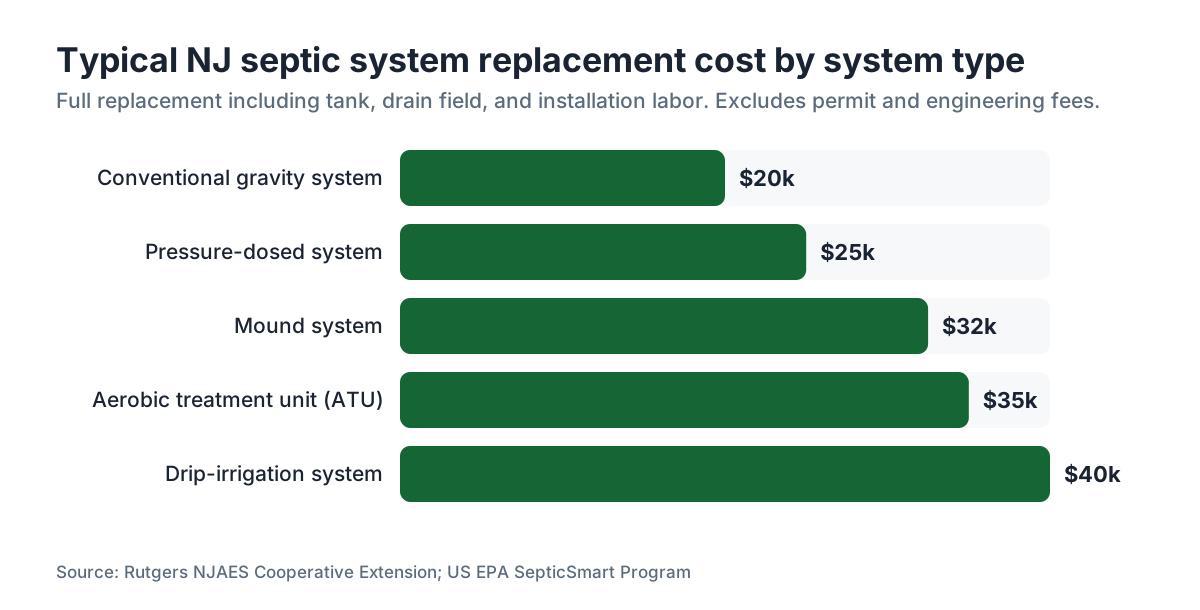
System type. Conventional gravity systems cost the least to install. Pressure-dosed systems add a pump and controls. Mound systems need imported fill soil. Drip-irrigation systems need sophisticated controls and higher-grade treatment. Each step up adds $5,000 to $15,000 over the baseline.
Depth to groundwater and seasonal high water table. This is the single biggest hidden variable in NJ. If the seasonal high water table sits within 2 feet of the surface, a conventional system won't pass inspection. A mound or drip system becomes the requirement, and those cost more.
Access. If an excavator can't reach the installation area easily, expect a surcharge. Rocky subsoil needs rock-breaking equipment. Tree removal adds cost too.
Contractor market. Northern NJ (Essex, Bergen, Morris, Passaic counties) tends to run 15 to 25% higher in labor than South Jersey for the same scope. Get at least three bids.
How much does each type of NJ septic system cost?
| System Type | Typical NJ Cost Range | When It's Required |
|---|---|---|
| Conventional gravity | $15,000, $25,000 | Good soils, adequate lot size, low water table |
| Pressure-dosed (low-pressure pipe) | $20,000, $30,000 | Marginal soils, uneven terrain |
| Mound system | $25,000, $40,000 | High seasonal water table, poor perc |
| Drip-irrigation (drip dispersal) | $30,000, $50,000+ | Very tight lots, high water table, Pinelands proximity |
| Aerobic treatment unit (ATU) | $25,000, $45,000 | Poor soil, small lot, near sensitive waterways |
These are full-replacement figures covering tank, distribution system, and drain field. Rutgers Cooperative Extension has noted that engineered alternative systems in NJ can run two to three times the cost of a conventional system once engineering, permitting, and installation are totaled [1].
If you only need the leach field replaced without touching the tank, the cost roughly halves. You still pay for perc testing, design, and permits.
What do NJ septic permits and design fees cost?
Permitting is not optional and it's not cheap. New Jersey requires a site evaluation, soil log, percolation test, and engineered design before any permit gets issued. All of it runs through your county health department, not the state, so fees vary by county.
Expect to pay:
- Soil evaluation and perc test: $500, $1,500 (done by a licensed site evaluator)
- Engineer design fee: $1,500, $4,000 for a standard system, $3,000, $8,000 for alternative systems
- County health department permit fee: $300, $1,200 depending on county
- Construction inspection fee: $200, $600 (some counties bundle this into the permit)
Total pre-construction fees land between $2,500 and $6,000 before anyone digs a hole. Most online cost estimators leave these out of their headline numbers.
After installation, NJ requires a final inspection and a Certificate of Completion before the system can be used. Some counties want a licensed engineer to certify the as-built conditions. Budget another $300 to $800 for final inspections.
The NJ Department of Environmental Protection runs the statewide framework through N.J.A.C. 7:9A, but enforcement and fee-setting is delegated to county health departments [4]. Call your county's environmental health office before you collect contractor bids. They'll tell you exactly what's required on your specific parcel.
Does NJ have any financial assistance for septic replacement?
Yes, though the programs are limited and carry income or location requirements.
The NJ Department of Environmental Protection has run grant and low-interest loan programs for septic repairs and replacements in priority watersheds, including the Barnegat Bay watershed [5]. Funding availability shifts year to year, so check with NJDEP directly before counting on it.
USDA Rural Development offers grants and loans through its Section 504 program and the Water and Waste Disposal Loan and Grant Program for rural homeowners who meet income thresholds [6]. In New Jersey, this mostly reaches rural counties like Salem, Cumberland, and parts of Warren and Hunterdon.
Some NJ counties run their own septic assistance programs. Ocean County has offered assistance for properties near sensitive water bodies. Morris County has offered low-interest loan programs through its planning department. Check with your specific county.
For most middle-income NJ homeowners on suburban lots, the honest answer is you'll pay out of pocket or finance it. A home equity line of credit is the most common route. The interest may be tax-deductible if the work qualifies as a capital improvement, but confirm that with a tax professional.
How do I know if I need a full replacement vs. a repair?
This is the question worth real time, because the gap between a repair and a replacement is often the gap between $3,000 and $30,000.
Signs that lean toward repair:
- Wet spot or odor near the tank but the drain field is dry and working
- Slow drains in the house that clear after pumping
- A single cracked baffle or broken distribution box
- Tank pumped recently but the effluent filter is clogged
Signs that lean toward full replacement:
- Sewage surfacing over the drain field that doesn't resolve after pumping
- Multiple slow drains that don't improve after pumping while the field stays saturated
- System is more than 30 to 40 years old and county health requires an upgrade to current code on sale
- Perc test shows the existing field is biomat-clogged beyond recovery
- Your county inspector condemns the system during a sale inspection
A septic tank inspection by a licensed inspector is the right first step. They can camera the tank, check the baffles, inspect the distribution box, and rough-assess the field. That costs $200 to $500 and can save you from replacing something that only needs a repair.
For what repairs look like and what they cost, see our guide to septic system repair.
One practical note. If your system is failing and you plan to sell within a few years, NJ real estate practice essentially requires disclosure and often remediation before closing. A failed system found during a buyer inspection costs you more in negotiation than proactive replacement would have.
What does the NJ replacement process actually look like from start to finish?
The timeline surprises most homeowners. This is not a two-week project.
Step 1: Hire a licensed site evaluator (2 to 4 weeks to schedule). In NJ, site evaluations must be done by someone certified under N.J.A.C. 7:9A. Your contractor usually knows one, or your county health department keeps a list. The evaluator drills soil borings, logs the soil profile, and runs perc testing.
Step 2: Engineering and permit application (4 to 12 weeks). A licensed engineer draws the system design from the soil data and submits it to the county health department. Review times vary hard. In a busy county during peak season, 8 to 12 weeks is realistic.
Step 3: Permit issuance. Once approved, the county issues a construction permit. It carries an expiration date, usually 1 to 2 years.
Step 4: Installation (1 to 5 days of actual work). The contractor excavates, sets the tank, installs the distribution system and drain field, and backfills. A conventional system on a cooperative lot takes 2 to 3 days. A mound system or ATU can take 4 to 5.
Step 5: Final inspection and certificate. The county inspector visits, checks that the installation matches the approved design, and issues a Certificate of Completion.
Total elapsed time from first phone call to a working system: 3 to 6 months is common. 9 to 12 months isn't unusual if you hit scheduling or review delays. Plan for it if you're in a home sale.
Operators running multiple projects in NJ can track permit timelines and scheduling across jobs with SepticMind's operations software, built for septic service companies working high permit-volume markets.
How do NJ septic replacement costs compare to neighboring states?
New Jersey ranks among the most expensive states in the country for septic work. The reasons stack up: high labor costs, dense regulation, high land values that squeeze lot sizes, and a large share of systems that need alternative designs because of soil and water table conditions.
A rough comparison:
| State | Typical Full Replacement Range |
|---|---|
| New Jersey | $20,000, $50,000 |
| Pennsylvania | $15,000, $35,000 |
| New York (suburban) | $20,000, $45,000 |
| Connecticut | $18,000, $40,000 |
| Virginia | $12,000, $30,000 |
| National median (all states) | $11,000, $25,000 |
The national numbers come from the EPA SepticSmart program, which puts tank-only work in the $3,000 to $7,000 range and full system replacement at up to $20,000 or more nationally [7]. NJ sits well above that, which reflects the state's regulatory load and cost of living.
If a NJ quote looks far higher than something you saw online, geography explains almost all of the gap.
What should I ask contractors before hiring one for NJ septic replacement?
NJ requires septic installers to be licensed. Ask any contractor for their NJ licensed site evaluator certificate number or their NJ Home Improvement Contractor (HIC) registration. Do not hire anyone who can't produce those credentials.
Questions worth asking every bidder:
- Does your quote include the perc test, engineering, and permit fees, or are those separate?
- Have you worked with [my county] health department before, and how long does permit review usually take there?
- What system type are you proposing, and why, given my soil conditions?
- What's your experience with alternative systems (mound, ATU, drip) if that's what I need?
- What does the warranty cover, and what's excluded?
- Who is the licensed engineer on the design?
- What happens if you hit rock or unexpected groundwater during excavation?
Question 7 reveals how a contractor handles scope creep. You want a clear answer on what triggers a change order and how pricing for unforeseen conditions works.
Get at least three bids. In NJ's septic market, the spread between the lowest and highest qualified bid on the same scope can hit $8,000 to $15,000. That spread is real and worth the time it takes to collect multiple quotes.
How can I keep my new system from failing prematurely?
A well-kept NJ septic system should last 25 to 40 years. Neglect cuts that to 10 to 15. The EPA's SepticSmart guidance puts it plainly: "Properly maintaining your septic system saves money. Failing septic systems are expensive to repair or replace." [7]
The most useful thing you can do is pump the tank on schedule. For a 1,000-gallon tank serving a household of four, that's every 3 to 5 years. Not sure of your tank size or last pump-out date? Start with a septic tank pump out to set a baseline. Our guide on how often to pump a septic tank works through the math for different household sizes.
Beyond pumping:
- Don't plant trees or shrubs over the drain field. Root intrusion is a common field killer.
- Keep roof drains and sump pumps from discharging near the field. Clean-water overload damages a field as badly as sewage overload.
- Don't park vehicles or set heavy structures over the field.
- Use water efficiently. Fix leaky toilets fast. A running toilet can dump 200 gallons a day into your system.
- Don't flush wipes, even ones labeled flushable, pharmaceuticals, cooking grease, or harsh chemical cleaners. The drain field's biological treatment layer is fragile.
Regular septic tank cleaning and periodic inspections cost far less than premature replacement. A $400 pump-out beats a $30,000 replacement cycle every time.
Septic service operators managing customer maintenance across multiple NJ accounts can set automated reminders and job tracking with SepticMind at septicmind.com.
Does homeowners insurance cover septic replacement in NJ?
Mostly no. Standard homeowners insurance in NJ treats the septic system as part of the home's structure, and most policies exclude repair or replacement of systems that fail from age, normal wear, or gradual deterioration. That covers the vast majority of septic failures.
There are narrow exceptions. If a falling tree crushes your tank in a storm, that's typically covered as a sudden and accidental event. If a contractor doing unrelated work ruptures a sewer line, liability coverage may apply.
Some insurers sell septic system riders or service line protection endorsements. These vary widely and often carry low sub-limits ($5,000, $10,000) that don't come close to replacement cost. Read the exclusions before paying for one.
A few NJ municipalities and utilities offer home warranty programs through companies like HomeServe that include septic coverage. They have coverage caps and waiting periods, but for someone with an aging system, they can offset part of a repair bill.
The practical advice: don't buy a NJ home with an unknown or aging septic system and assume insurance will cover replacement if it fails. It almost certainly won't.
Frequently asked questions
How long does a septic system last in New Jersey?
A conventional septic system in NJ typically lasts 25 to 40 years with regular pumping and proper use. Alternative systems like mounds and ATUs have more mechanical parts and may need major service or component replacement in 15 to 25 years. The drain field is usually the first part to fail, often from biomat buildup or root intrusion. Pumping every 3 to 5 years is the single best thing you can do to extend system life.
How much does a mound septic system cost in NJ?
A mound system in NJ typically costs $25,000 to $40,000 for a full replacement, covering the tank, pump system, and the mound structure with imported fill. They're required when the seasonal high water table sits too close to the surface for a conventional field. Engineering and permitting add another $3,000 to $7,000. Mound systems also need an annual operation and maintenance contract in most NJ counties, which runs $300 to $600 per year.
How long does NJ septic permit approval take?
Plan on 4 to 12 weeks for county health department review of a septic permit application in NJ, though some counties move faster. The soil evaluation and perc test have to finish first, which takes 2 to 4 weeks to schedule. Complex alternative systems or properties in sensitive watersheds like the Pinelands or Barnegat Bay take longer. Total time from first step to permit in hand is usually 2 to 4 months.
Can I sell a house in NJ with a failing septic system?
Yes, but it complicates the deal. NJ has no statewide mandatory point-of-sale septic inspection law, though some counties require one. Sellers must disclose known defects, including septic failures. Buyers' inspectors often flag visible signs of failure. Most lenders financing a home with a failed or condemned septic system require remediation before closing. It's usually cheaper to fix it before listing than to negotiate a price cut.
What is the cheapest type of septic system allowed in NJ?
A conventional gravity-fed septic system is the least expensive option, typically $15,000 to $25,000 installed in NJ. It requires good soil percolation, adequate lot size, and a seasonal high water table well below the field bottom. If your site qualifies for a conventional system, don't let a contractor upsell you to an alternative design without a clear explanation of why site conditions require it.
Does NJ require a septic inspection when selling a home?
There is no statewide mandatory septic inspection law in NJ for home sales, but several counties have their own requirements. Ocean, Monmouth, and other counties have enacted local ordinances. Even where it's not required by law, most buyers request one as a purchase condition, and most real estate attorneys advise sellers to disclose known system issues. A pre-listing inspection costs $200 to $500 and avoids surprises at closing.
How much does replacing just the drain field cost in NJ?
Replacing only the drain field in NJ, keeping the existing tank, typically costs $8,000 to $20,000 depending on field size, soil conditions, and system type. You still need a permit and perc test, which adds $2,000 to $4,000. If the existing tank is old or failing, most contractors and county engineers recommend replacing it at the same time, since the incremental cost is lower than a separate mobilization later.
Are there grants for septic replacement in NJ?
Yes, but eligibility is limited. NJ DEP has offered grants for septic repairs and replacements, mostly for properties in priority watersheds like Barnegat Bay. USDA Rural Development offers loans and grants for rural homeowners who meet income thresholds under its Section 504 program. Some NJ counties run their own assistance programs. Availability changes yearly, so contact NJDEP and your county health department directly to check current funding.
What NJ regulations govern septic system design and installation?
New Jersey's individual septic systems are governed by N.J.A.C. 7:9A, the Standards for Individual Subsurface Sewage Disposal Systems, administered by the NJ Department of Environmental Protection. County health departments enforce the code locally and issue permits. Properties in the Pinelands face additional review by the NJ Pinelands Commission. Engineers and site evaluators must be licensed under state standards.
How does the NJ Pinelands affect septic replacement cost?
Properties in the NJ Pinelands face additional regulatory review from the NJ Pinelands Commission, which has strict water quality protection rules. That adds engineering complexity, review time, and cost. System designs must meet Pinelands-specific standards for nitrogen reduction in some management areas. Expect permit and engineering costs to run $2,000 to $5,000 higher than comparable non-Pinelands sites, and add 2 to 4 months to the overall timeline.
What happens if I replace a septic system without a permit in NJ?
Installing a septic system without a permit in NJ violates N.J.A.C. 7:9A and can result in fines, a stop-work order, and a requirement to excavate and redo the work with proper permits. An unpermitted system surfaces as a serious problem during any future home sale. No reputable licensed contractor in NJ will install a system without pulling the required county permit.
How do I find a licensed septic contractor in NJ?
NJ licenses septic installers through the Division of Consumer Affairs as Home Improvement Contractors. Your county health department's environmental health office keeps a list of site evaluators and contractors familiar with local requirements. The National Onsite Wastewater Recycling Association (NOWRA) also maintains contractor directories. Always verify the contractor has pulled permits in your county before, and ask for references on recent similar projects.
How much does a 1,000-gallon septic tank replacement cost in NJ?
Replacing a 1,000-gallon concrete septic tank alone in NJ costs $3,000 to $6,000, including excavation, the new tank, and backfill. Switching to a larger tank (1,250 or 1,500 gallon) adds $500 to $1,500 to the tank cost but may be required if the household has grown or the home was expanded. Tank-only replacement still needs a permit in most NJ counties. If the drain field is also aging, replacing both at once saves mobilization cost.
Sources
- Rutgers New Jersey Agricultural Experiment Station, Cooperative Extension: Engineered alternative septic systems in NJ can run two to three times the cost of a conventional system when engineering, permitting, and installation are totaled
- NJ DEP, Division of Water Quality (onsite wastewater and N.J.A.C. 7:9A guidance): Percolation rate determines required field size and whether alternative systems are mandated
- NJ Pinelands Commission, Official Site: Properties in the NJ Pinelands require additional review by the NJ Pinelands Commission with nitrogen-reduction standards in some management areas
- NJ Department of Environmental Protection (N.J.A.C. 7:9A, Standards for Individual Subsurface Sewage Disposal Systems): NJ requires minimum setbacks from property lines, wells, and surface water, and county health departments enforce and set permit fees under the state framework
- NJ Department of Environmental Protection (watershed grant and loan programs, Barnegat Bay priority area): NJDEP has offered grants and low-interest loans for septic repairs and replacements in priority watersheds including Barnegat Bay
- USDA Rural Development, Water and Waste Disposal Loan and Grant Program: USDA Rural Development Section 504 provides grants and loans for rural homeowners meeting income thresholds for septic and water system improvements
- US EPA, SepticSmart Program: EPA SepticSmart states: 'Properly maintaining your septic system saves money. Failing septic systems are expensive to repair or replace.' EPA estimates full system replacement can cost $20,000 or more.
- US EPA, Onsite Wastewater Treatment Systems resources: State agencies administer the framework for individual septic systems and delegate enforcement and permitting to local health departments
- NOWRA, National Onsite Wastewater Recycling Association: Industry body for onsite wastewater; maintains contractor directories and cost benchmarking for alternative system types
- NJ Division of Consumer Affairs, Home Improvement Contractor Registration: NJ requires septic contractors to be registered as Home Improvement Contractors through the Division of Consumer Affairs
Last updated 2026-07-09