Septic system service: what it includes, when you need it, and what it costs
By the SepticMind Editorial Team
TL;DR
- Septic system service includes pumping (every 3 to 5 years for most households), inspections, drain field maintenance, and repairs.
- Pumping runs $300 to $600 for a typical tank; a full inspection adds $100 to $300 more.
- Skipping service is the fastest way to turn a $400 pump-out into a $10,000-plus drain field replacement.
- The EPA recommends inspections every 3 years and pumping every 3 to 5 years.
What does septic system service actually include?
Septic system service means four things done together: pumping the tank, inspecting it, checking the drain field, and handling any repairs the inspection turns up. Most homeowners think it means pumping. It doesn't. Pumping is one piece of the job.
A pump truck operator who opens the lid, vacuums the tank, and leaves in 20 minutes has done that one piece. If nobody checks the baffles, the inlet and outlet tees, the effluent filter, or the distribution box, you can end up with a clean tank that's quietly routing raw sewage toward your yard.
The EPA's SepticSmart program groups the basics into four jobs: inspect the system (at least every three years for conventional systems, annually for anything with pumps or mechanical parts), pump as needed, use water efficiently, and protect the drain field [1]. Reputable service companies build their programs the same way.
Systems with an aerobic treatment unit (ATU), a pump chamber, or a pressure-dosed drain field need more. Those have motors, timers, and alarm floats that a technician has to physically check, so state code usually requires quarterly or semi-annual visits. Texas requires a licensed maintenance provider to visit ATU systems at least every four months and file service reports with the local authority [2].
So when you call a company and ask about "service," make them get specific. What are they inspecting? What do they test? What's in the report you'll get?
How often does a septic system need to be serviced?
Pump every 3 to 5 years, inspect at least every 3 years, and service any mechanical parts once a year or more. That's the short version, and it covers most households.
The EPA ties pumping frequency to four things: household size, total wastewater generated, the volume of solids in that wastewater, and tank size [1]. A family of four with a 1,000-gallon tank usually hits the 3-year mark. A retired couple in the same house might stretch to 5 or 7 years. Nobody should go past 7 years, though, because even a lightly used tank builds enough sludge and scum to damage baffles and load up the drain field [11].
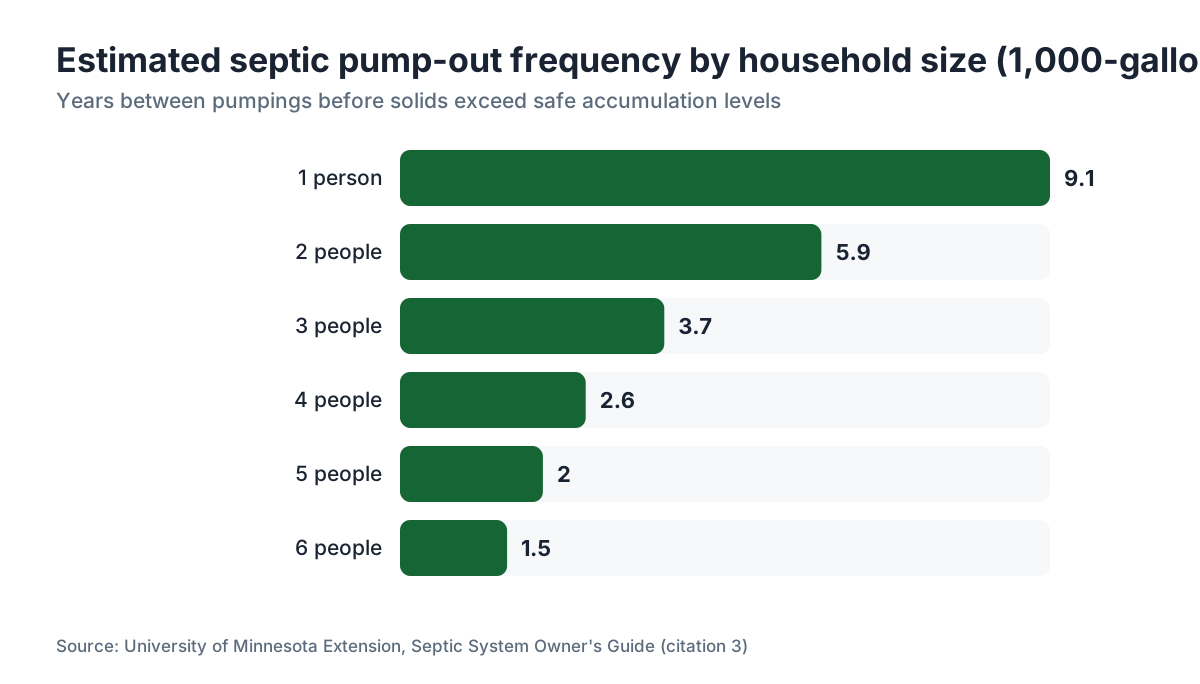
The University of Minnesota Extension publishes one of the most cited pumping tables in the trade [3]. Their numbers show a 1,000-gallon tank serving 2 people needs pumping about every 5.9 years; the same tank serving 6 people needs it every 1.5 years. That's a huge spread. A company quoting "every 3 to 4 years" without asking how many people live in the house is guessing.
Mechanical and alternative systems run on the schedule your state code sets. Most states that allow ATUs require annual or more frequent maintenance under a signed contract as a condition of the permit. If you own an Orenco, Infiltrator, or similar advanced system and you're not on a contract, you may be out of compliance right now.
Want to calculate your exact interval? See our breakdown of how often to pump your septic tank.
One practical note. If you just bought the house and don't know the service history, treat the system as overdue. A pump-out and inspection in your first month is the best $400 to $700 you'll spend on the place.
What does septic system service cost?
Cost depends on your region, tank size, how hard the tank is to reach, and what's actually included. Here's an honest range table built from industry pricing surveys and state extension figures.
| Service | Typical cost range | Notes |
|---|---|---|
| Routine pump-out (conventional tank, up to 1,500 gal) | $300-$600 | Higher in Northeast and West Coast metros |
| Pump-out + basic inspection | $400-$750 | Covers tank condition, baffles, risers |
| Full system inspection (with drain field probing) | $200-$500 additional | Camera inspection costs more |
| Effluent filter cleaning | $50-$150 | Often bundled into a pump-out |
| Riser installation (access lid at grade) | $200-$600 per riser | One-time cost; saves labor on future visits |
| ATU maintenance contract (annual) | $150-$400/year | Covers 2 to 4 visits; parts may be extra |
| Drain field restoration service | $1,000-$5,000 | Varies widely; not a guaranteed fix |
| Drain field replacement | $5,000-$20,000+ | Depends on soil, system type, local labor |
The biggest money mistake is treating every service call as a bill to shrink. A $400 pump-out every 3 to 4 years works out to about $100 a year. A drain field failure that needs full replacement can run $10,000 to $25,000, and it's almost always traceable in part to service that got skipped. The math isn't hard.
A septic tank pump out on a large commercial or restaurant tank can hit $800 to $1,500, because there's far more solids to haul and some jurisdictions require a separate disposal manifest.
Planning something bigger? See cost to install a septic system for full replacement and new-build pricing.
What happens during a standard septic tank service visit?
A real service visit is more methodical than most homeowners expect. Here's the order it should run in.
The technician locates the tank and opens both lids (inlet and outlet compartments, if it's a two-compartment tank). If the lids are buried, you pay for the dig-up time, which is exactly why septic tank risers earn their keep. A riser pays for itself in 2 or 3 visits by killing that charge.
Before pumping, the tech measures the sludge and scum layers. This matters. Those numbers tell you whether the tank was genuinely due or whether your interval is right. A good tech writes them down. If yours doesn't, ask.
During or after pumping, the tank walls and bottom get checked for cracks, and the baffles or tees get checked for integrity. The outlet baffle matters most, because it keeps floating scum from riding into the drain field. A missing or corroded outlet baffle is one of the most common reasons drain fields clog early [4].
The effluent filter, if there is one, gets cleaned and put back. The distribution box, if you can reach it, should be checked for level and even flow. The tech should also walk the ground over the drain field, looking for ponding, bright green stripes, or odors.
Then you should get a written service record. Every state that adopted the EPA's model onsite program requires records to be kept, and many require them filed with the local health department. If the company hands you nothing in writing, ask for it out loud.
A septic tank cleaning that skips the inspection steps is a partial service. Better than nothing. Still not the full job.
What septic system services do you actually need vs. what's upselling?
A little knowledge saves real money here. Some add-ons earn their price. Some don't.
Worth it:
- Riser installation if your lids sit more than 6 inches down. Pay once, save on every future visit.
- Effluent filter installation if your tank lacks one. A filter costs $50 to $150 and is one of the best documented ways to extend drain field life [4].
- Camera inspection of the outlet pipe if you're buying a house or haven't looked in 10-plus years.
- Drain field probing if you're seeing surface symptoms (wet spots, odors, slow drains).
Not worth it for most systems:
- Biological additives and "tank treatments." The EPA is blunt: "Biological additives... do not appear to improve the performance of a properly functioning septic system" [1]. A healthy tank grows the bacteria it needs from ordinary household waste. You don't add more.
- Annual pump-outs for a small household with a big tank. If your sludge and scum sit at 10 to 15 percent of tank depth, you're not due. A company pushing yearly pump-outs no matter the measurements is selling a schedule, not a service.
- Septic "shock" treatments after a party or a full house. Same logic.
For what a pump-out covers and what it skips, see our septic tank pumping guide.
If the tank itself is broken, that's septic tank repair work, separate from routine service. Don't let a tech quote you a repair mid-visit without getting a second opinion on scope and price.
How do you find and vet a reputable septic service company?
Licensing rules swing a lot state to state. Most states require septic pumping contractors to hold a specific license, and many require registration with the state environmental or health agency. Verify the license before you hire. Your state health department or environmental agency site usually has a lookup tool; if it doesn't, the National Onsite Wastewater Recycling Association (NOWRA) keeps a member directory [5].
Beyond the license, here's what separates the good companies from the mediocre ones.
They measure before they pump. A pro records sludge and scum depths. That's how they know whether you needed the service and how they set your next interval.
They give you a written report, not a receipt. An actual condition report on the tank, the baffles, and what they saw over the drain field.
They explain findings in plain English. If a tech says "looks good" and drives off, you learned nothing.
They don't push additives. This one's a reliable tell. A company that leads with biological treatment products is selling margin, not skill.
Ask directly: "What does your service include? What's in the report? Do you check the outlet baffle and the effluent filter?" A confident, specific answer is the green light.
For operators running fleets of accounts, scheduling and documentation are where most companies bleed time. That's the workflow SepticMind is built around: tracking service records, customer history, and maintenance schedules in one place for operators managing dozens or hundreds of accounts.
What septic system services are required by state codes?
State rules vary, but a few patterns hold nationwide. Conventional gravity systems rarely require a mandatory service contract by code. Advanced systems almost always do. And nearly everywhere, new installs and major repairs need a permit and an inspection before the system gets covered.
Conventional gravity systems (the most common type) don't usually require a service contract, but most county health departments require a permit and inspection for any new install or major repair. That inspection has to happen before anyone backfills [6].
Alternative and advanced treatment systems almost always require a maintenance contract as a condition of the operating permit. Not optional. If you have an ATU, a mound system, or a pressure-dosed field, pull your original permit documents. You're likely required to have a licensed provider perform and document visits on a set schedule.
Some states go further. Washington's RCW 70A.305 framework and its associated rules let counties require an inspection at point of sale [10]. The Virginia Department of Health requires certain alternative systems to run under a service contract with a licensed operator [8]. North Carolina requires annual inspections for all systems with pumps or dosing equipment [9].
The EPA sets no federal mandate for septic service frequency. It provides guidance through programs like SepticSmart and, for systems that discharge to surface water, the National Pollutant Discharge Elimination System (NPDES) [7]. Enforcement lives at the state and local level.
To find your state's rules, start at the EPA's septic program pages, which link out to state programs [7]. Your county health department is usually the fastest route to local requirements.
For septic drain field systems with advanced distribution, your permit almost certainly names an inspection schedule. Read it before you assume you're fine.
What are signs that your septic system needs service right now?
Some of these are obvious. Some people miss them for years.
Obvious warning signs:
- Sewage backing up into the lowest drains in the house (floor drains, basement toilets)
- Standing water or muddy, saturated soil over the drain field
- Strong sewage odor inside the house or near the tank or field
- Every drain running slow at once (one slow drain is usually a pipe; all of them slow points to a full tank or a saturated field)
Subtle signs people miss:
- Bright green, unusually lush grass in stripes right over the drain field lines, compared to the rest of the lawn. Nutrient-rich effluent is surfacing.
- Gurgling in the drains after you run water
- Toilets that flush fine but take longer than normal to refill
Any one of the obvious signs means call a service company today. Don't run more water. Don't flush more toilets. Surface sewage is a public health hazard, and many states legally require you to fix a failing system within a set timeline once it's identified.
If the symptoms point to the field, read our septic drain field guide before you call. Knowing what you're describing gets you an accurate quote and keeps you from getting sold a full replacement when a targeted repair might do. See also septic system repair for what your options look like once the problem is diagnosed.
How does septic service differ for alternative and advanced systems?
A conventional gravity system is simple to service. Everything else changes the rules and the requirements in real ways.
Aerobic treatment units (ATUs): These aerate the wastewater to speed bacterial breakdown, so the effluent comes out cleaner than a conventional system's. The tradeoff is mechanical complexity. ATUs have air compressors or blowers, spray heads or drip emitters, and chlorination systems. Most states require quarterly or semi-annual professional maintenance, and the visit covers mechanical testing, a chlorinator refill, alarm checks, and effluent quality verification [2].
Mound systems: Built above grade when soil or a high water table won't allow a buried field, mounds need all the usual tank service plus periodic inspection of the pressure distribution and the mound surface. Channeling, surface breakthrough, or changing vegetation on the mound are early warnings.
Drip irrigation systems: High-end systems that dose effluent through small-diameter tubing. They need filter cleaning and periodic line flushing, usually under a maintenance contract.
Chamber systems (like Infiltrator chambers): Service resembles a conventional system, but because chambers hold more water and recover faster from a heavy flow, the tech has to look hard at the chamber sidewalls and check for sediment piling up at the ends of the rows.
Replacing or upgrading a failing conventional system? See septic tank installation for what a new system actually involves.
What records should you keep from septic service visits?
This question sounds dull until you're trying to sell the house.
Keep every service record, as far back as you have them. Each one should show the date, the company and technician, the sludge and scum depths measured, what got pumped, what got inspected and its condition, and any recommendations. If the company issued a pass/fail or a written rating of components, keep that too.
When you sell, many states now require disclosure of the septic system's condition and recent service history. Some states require an inspection within 6 to 12 months of sale. Buyers and their inspectors will ask for records. A seller who can produce five years of clean reports negotiates from a stronger spot than one holding nothing.
For operators running customer accounts, records are also a compliance matter. Many state programs require service records submitted to the local authority, and some require retention for a minimum term (commonly 3 to 5 years). Operators who fall behind on documentation carry the same liability as homeowners who defer service.
SepticMind's platform is built for exactly this. It auto-generates and stores compliant service records and keeps the documentation ready when a regulator or customer asks.
Store paper records in a waterproof folder with the rest of your home's mechanical documentation. Cloud backups are a smart second copy.
How does septic service protect your drain field long term?
The drain field is the priciest part to replace and the most sensitive to neglect. Every service decision comes back to protecting it.
The failure mechanism is simple. Solids that don't get pumped out of the tank drift into the drain field. They clog the biomat, the living layer that forms where effluent meets soil, and the field slowly loses its ability to absorb water. Once the biomat is overloaded past the soil's recovery point, the field fails. Restoration is sometimes possible. Replacement is often the answer.
Regular pumping is the first line of defense. Pump on schedule and the solids stay in the tank where they belong. Defer it a few years in a busy household and the risk of solids escaping into the field climbs fast. The University of Minnesota Extension estimates a 1,000-gallon tank serving 4 people should be pumped about every 2.6 years to keep solids from carrying over [3].
Effluent filters are the second line. Mounted at the outlet baffle, they physically stop particles above a set size from leaving the tank. EPA guidance on septic technology notes that effluent screens reduce the total suspended solids leaving the tank, which protects the soil below [4].
A few habits you control also stretch field life: spread laundry across the week instead of five loads on Saturday; fix leaky faucets and running toilets (a running toilet can dump 200 gallons a day of extra load); and never plant deep-rooted trees or shrubs within 10 feet of the field.
For a focused look at field care and troubleshooting, our septic drain field guide covers the soil science and restoration options in depth.
Frequently asked questions
How often should a septic system be serviced?
The EPA recommends inspecting a conventional septic system at least every three years and pumping every three to five years, depending on household size and tank volume. Systems with pumps, floats, or mechanical parts should be inspected annually or more often. A 1,000-gallon tank serving four people typically needs pumping every 2.5 to 3 years, per University of Minnesota Extension data.
What is included in a septic system service call?
A complete service call includes measuring sludge and scum layers, pumping accumulated solids, inspecting the tank walls and baffles for damage, cleaning the effluent filter if present, and checking the drain field area for saturation or failure. You should get a written condition report. Pumping alone, with no inspection, is only part of a full service visit.
How much does septic system service cost?
Routine pumping for a standard 1,000 to 1,500-gallon tank costs $300 to $600 in most markets, more in high-cost metros. A full inspection adds another $100 to $300. ATU maintenance contracts run $150 to $400 per year covering multiple visits. Drain field restoration or replacement can cost $5,000 to $20,000 or more.
Can I service my own septic system?
You can do a few things yourself: keep records, conserve water, avoid flushing harmful materials, and keep access lids reachable. But pumping requires a licensed vacuum truck and disposal at an approved facility. In most states, septic pumping must be done by a licensed contractor. DIY pumping is neither legal nor practical for a residential system.
Do septic additives and treatments actually work?
The EPA's position is that biological additives do not appear to improve the performance of a properly functioning septic system. A healthy tank already holds the bacteria it needs. Some chemical additives can actively harm the system by disrupting the biological process or passing chemicals into the drain field. Save the money.
What happens if you don't service your septic system?
Solids build up in the tank until they spill into the drain field. That clogs the soil biomat and eventually fails the field. Symptoms move from slow drains and odors to sewage surfacing in the yard or backing into the house. A $400 pump-out deferred too long can turn into a $10,000 to $25,000 drain field replacement.
How do I find a licensed septic service company?
Check your state health or environmental agency website for a licensed contractor lookup. NOWRA (National Onsite Wastewater Recycling Association) also keeps a member directory. Verify the license before hiring. A good company measures sludge levels before pumping, gives you a written report after, and doesn't push additives or treatments you don't need.
Is septic system service required by law?
For conventional systems, most states don't require a service contract but do require permits and inspections for new installs and major repairs. For alternative or advanced systems (aerobic treatment units, mound systems, drip systems), a maintenance contract is usually required by the operating permit. Requirements are set at the state and county level, not federally.
What does septic service for an aerobic treatment unit (ATU) include?
ATU service typically covers checking and testing the air blower or compressor, inspecting spray heads or drip emitters, verifying alarm function, refilling the chlorination system if used, and documenting effluent quality. Most states require ATU service every four to six months as a permit condition, performed by a licensed maintenance provider.
How does a septic service visit differ from a septic inspection?
A service visit focuses on maintenance: pumping, filter cleaning, baffle condition, and field observation. A formal inspection goes further, often including probing or camera inspection of the outlet pipe, flow testing of a distribution box, and a written pass/fail. Inspections are commonly required at sale. Service visits are routine maintenance, not formal evaluations.
What records should I keep after a septic service visit?
Keep the written service report showing the date, company, technician name, sludge and scum depths measured, what was pumped, and any component conditions noted. Retain records indefinitely if you can; at minimum keep the last 5 to 10 years. These records are often required for disclosure during a home sale and may be requested by local health authorities.
How soon after buying a house should I have the septic system serviced?
Right away if you have no documented service history. Treat an unknown system as overdue for pumping and inspection. A pump-out and inspection in your first month tells you the system's condition, sets a baseline, and keeps you from inheriting someone else's deferred maintenance. Budget $400 to $750 for a combined pump-out and inspection.
Can septic service restore a failing drain field?
Sometimes. If the failure is early-stage and caused by organic clogging, rest periods paired with remediation have shown limited success in some documented cases. Hydro-jetting and terralift aeration are also used. But a severely failed field almost always needs replacement. Service can slow the decline; it rarely reverses advanced failure. Get an honest assessment from a licensed pro before spending on restoration.
What's the difference between septic tank emptying and septic system service?
Septic tank emptying (pumping or pump-out) removes liquid and solids from the tank, which is one part of a full service visit. Full septic system service also inspects tank components, checks the effluent filter, assesses the drain field, and produces a written report. Emptying is a task; service is a process. Both matter, but they're not the same thing.
Sources
- U.S. EPA, SepticSmart: Homeowner Information: EPA recommends inspecting conventional septic systems at least every 3 years, pumping every 3-5 years, and states that biological additives do not appear to improve performance of a properly functioning septic system
- Texas Commission on Environmental Quality (TCEQ), On-Site Sewage Facilities Program: Texas requires licensed maintenance providers to visit ATU systems at least every four months and file service reports with the local authority
- University of Minnesota Extension, Septic System Owner's Guide: A 1,000-gallon tank serving 2 people needs pumping approximately every 5.9 years; the same tank serving 6 people needs pumping every 1.5 years; and serving 4 people approximately every 2.6 years
- U.S. EPA, Types of Septic Systems: Effluent filters at the outlet baffle prevent solids carryover into the drain field and reduce total suspended solids in tank effluent
- National Onsite Wastewater Recycling Association (NOWRA), Member Directory: NOWRA maintains a directory of licensed and professional onsite wastewater service providers nationally
- U.S. EPA, Onsite Wastewater Treatment Systems Program: State and county health departments typically require permits and inspection before covering new septic installations and major repairs
- U.S. EPA, National Pollutant Discharge Elimination System (NPDES): The EPA does not set a federal mandate for septic service frequency; enforcement is at state and local level; systems that discharge to surface water may be subject to NPDES requirements
- Virginia Department of Health, Onsite Sewage and Water Services: Virginia requires certain alternative septic systems to be under a service contract with a licensed operator
- North Carolina Department of Environmental Quality: North Carolina requires annual inspections for septic systems with pumps or dosing equipment
- Washington State Legislature, RCW 70A.305, Onsite Sewage Systems: Washington state's RCW 70A.305 framework enables county requirements for inspection at point of sale for certain septic systems
- University of Minnesota Extension, Septic System Maintenance: Pumping frequency depends on household size, wastewater volume, solids content, and tank size; no household should go more than 7 years without pumping
Last updated 2026-07-09