Septic system sizes: what size do you actually need?
By the SepticMind Editorial Team
TL;DR
- Most residential septic tanks hold 1,000 to 1,500 gallons.
- The right size comes down to bedroom count, daily wastewater flow, and local code.
- Undersize it and you get backups and early field failure.
- Oversize it and you pay more upfront but pump less often.
- Your state health department or a licensed designer sets the final number, not a rule of thumb.
What actually determines septic system size?
Three things drive sizing: how much water flows in per day, how many people live in the house, and what your soil can absorb on the drain field side. Tank size and field size are separate calculations. Both matter.
Most state codes tie tank volume to bedroom count because bedrooms predict how many people live there. The EPA's SepticSmart program puts it plainly: the tank has to hold enough volume for solids to settle out before liquid moves to the drain field, which means at least 24 hours of retention time [1]. Fall short of that and raw sewage carries solids into the field and clogs it in months.
The drain field calculation is a different animal. It runs off a perc test (percolation test) or a soil morphology evaluation that tells you how fast the native soil absorbs water. Sandy loam might need 150 square feet of field per bedroom. Slow clay might need five times that. You can't size one without knowing the other.
Local codes add another layer. Some states set a minimum tank size no matter the occupancy. North Carolina, for example, puts the floor at 1,000 gallons for any new installation [2]. Virginia's Sewage Handling and Disposal Regulations require a 900-gallon minimum for a two-bedroom home but jump to 1,250 gallons at three bedrooms [3]. Check your state's onsite wastewater code first.
What size septic tank do I need for my house?
The short honest answer: start with bedroom count, then confirm with your local health department.
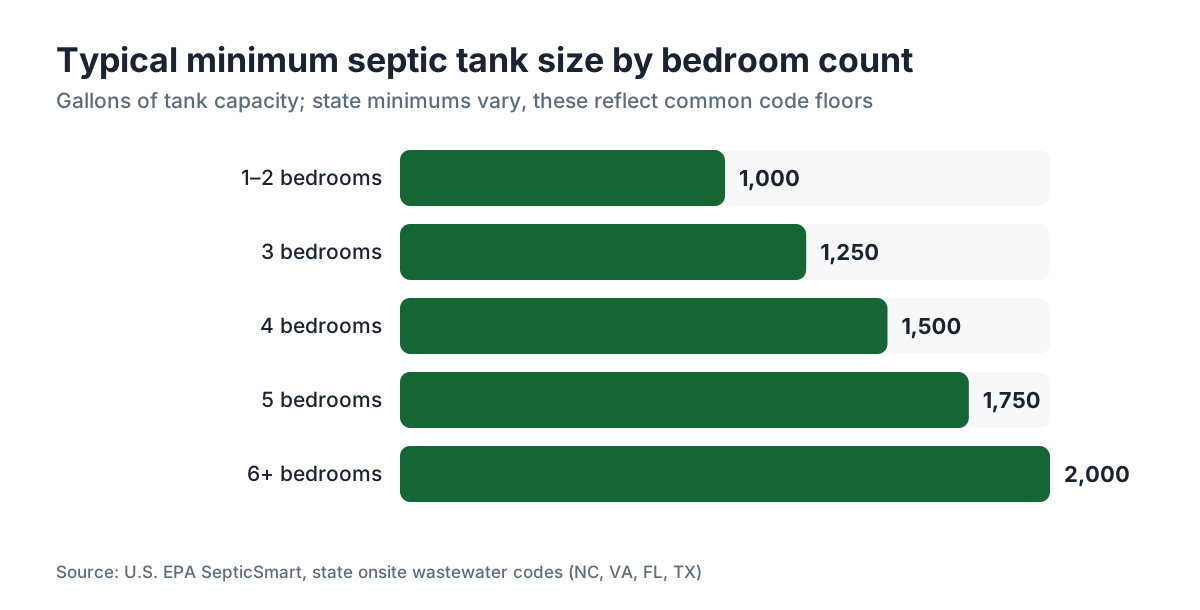
Here is the table most designers and inspectors use as a starting point. State minimums vary, so treat this as a floor, not a ceiling.
| Bedrooms | Estimated daily flow (gallons) | Typical minimum tank size |
|---|---|---|
| 1 to 2 | 150 to 250 | 750 to 1,000 gal |
| 3 | 300 to 450 | 1,000 to 1,250 gal |
| 4 | 400 to 600 | 1,250 to 1,500 gal |
| 5 | 500 to 750 | 1,500 to 2,000 gal |
| 6+ | 600 to 900+ | 2,000+ gal |
The EPA recommends a minimum 1,000-gallon tank for homes with up to three bedrooms, and larger tanks for higher flows [1]. If your household burns through water (garbage disposal, large family, frequent guests), the designer bumps the tank up.
A few things push you toward a larger tank even at the same bedroom count: a garbage disposal (roughly 50% more solids load), a home-based laundry business, or a bunch of teenagers. A few things might let you size down, though it's rare: a vacation home used fewer than 90 days a year.
One practical note. If you're replacing an existing tank and you're stuck between sizes, go bigger. The material cost difference between a 1,000-gallon and a 1,500-gallon concrete tank runs $200 to $500; the excavation and labor cost barely moves either way [4]. A larger tank needs pumping less often and buys you a buffer if the household ever grows.
How is septic system size measured and specified?
Tank size is measured in liquid gallons of working capacity, which is the volume below the outlet pipe. Total tank volume runs higher, but working capacity is what the permit specifies.
Drain fields are sized in linear feet of trench or total square feet of infiltrative surface, depending on your state's method. Some states use a loading rate in gallons per day per square foot. Others use a fixed trench length per bedroom. Soil data from the perc test or soil evaluation sets the loading rate.
Mound systems and drip irrigation systems add another step: designers calculate a required dose volume and rest cycle. These systems have a pressure distribution network and a pump, and the pump tank carries its own size requirement separate from the septic tank.
The permit documents for your system show three numbers: tank size in gallons, field size in square feet or linear feet, and design daily flow in gallons per day. All three should match your local code tables. Buying a home with an existing system? The inspection report should pull these numbers straight from the permit record. See our guide to septic tank inspection for what inspectors actually look for in those documents [5].
What are the standard septic tank sizes available?
Precast concrete tanks come in standard increments from most manufacturers: 500, 750, 1,000, 1,250, 1,500, and 2,000 gallons for residential use. Commercial tanks climb much higher, 5,000 to 10,000 gallons and beyond.
Polyethylene (plastic) tanks show up more in rural areas where hauling a concrete tank from the plant gets expensive. They run similar sizes: 500, 750, 1,000, 1,250, 1,500, 2,000, and 2,500 gallons. Fiberglass tanks cover about the same range.
Single-compartment versus two-compartment is a real choice. Most modern codes require a two-compartment tank or two tanks in series, because the second compartment gives effluent another chance to settle before it hits the field [6]. If your jurisdiction still allows a single-compartment tank, it should carry an effluent filter on the outlet.
For large homes or commercial properties, you can run tanks in series instead of buying one huge custom unit. Two 1,500-gallon tanks in series often beat one 3,000-gallon tank on both price and transport, and you get better solids separation out of the deal.
500-gallon tanks are legal in some states for small cabins or seasonal structures with composting toilets handling the solids. Don't assume a 500-gallon tank works for a full-time residence. In most places it flat out doesn't.
How does a perc test affect septic system size?
The percolation test measures how fast water drains through your soil. The result comes in minutes per inch: how many minutes the water level takes to drop one inch in a test hole. Fast soil might perc at 5 minutes per inch. Slow soil might be 60 minutes per inch or worse.
Fast percolation means the soil drains quickly, so a smaller drain field handles your daily flow. Slow percolation means the soil drinks water sluggishly, so you need a bigger field. If the soil won't perc at all (usually anything slower than 60 to 120 minutes per inch, depending on the state), a conventional gravity system gets denied and you need an alternative: mound, drip irrigation, aerobic treatment unit (ATU), or recirculating sand filter [7].
The perc result sets the square footage of your drain field directly. Double the perc time and you roughly double the required field area. A home in clay-heavy soil might need a drain field covering a third of an acre. The same home on sandy soil might need under 2,000 square feet. See the leach field guide for a full breakdown of field design and maintenance.
Soil morphology evaluations, where a licensed soil scientist reads the soil profile with a backhoe or hand auger, are replacing or backing up perc tests in many states because they give more reliable long-term permeability data. Your designer or county health department tells you which method applies in your area.
What size septic system does a 3-bedroom house need?
Three bedrooms is the most common scenario, so here are the numbers.
Most state codes assume 100 to 150 gallons per bedroom per day, which lands a three-bedroom home at 300 to 450 gallons per day of design flow. A 1,000-gallon tank is the legal minimum in many states for that load, but a 1,250-gallon tank is the practical standard most designers recommend because it gives you more buffer before the next septic tank pumping.
The drain field for a three-bedroom home in average soil (perc around 30 to 45 minutes per inch) typically runs 300 to 600 square feet of infiltrative area, which works out to roughly 200 to 400 linear feet of trench at a standard 18-inch width. In slow soil that number can double.
North Carolina's rule (15A NCAC 18E) spells this out: 480 linear feet of trench for a three-bedroom home in Group I soil (perc 1 to 30 min/inch), climbing to as much as 960 linear feet in Group III soil (perc 46 to 60 min/inch) [2]. That's a published state range, not a guess.
Thinking about adding a fourth bedroom someday? Talk to your designer before you pour concrete. Designing for four bedrooms now costs almost nothing extra on paper. Redesigning the system later costs thousands.
How much does septic system size affect the cost?
Tank size moves the total project cost less than most people expect. Excavation, permits, piping, and labor dominate the bill no matter what tank you drop in.
A 1,000-gallon concrete tank typically runs $700 to $1,200 installed in the hole, before any field work [4]. A 1,500-gallon tank runs $900 to $1,600. The gap is real, but it rarely decides a project that totals $10,000 to $30,000 once the drain field is in.
What does swing the cost is field size. More field means more pipe, more gravel or chamber units, more labor, more land disturbance. In slow-percing soil, the field can cost more than everything else combined. Mound and alternative systems pile on pump tanks, controls, and maintenance contracts.
For a full cost breakdown by system type and region, see our articles on cost to install septic system and cost to put in a septic tank.
Pumping cost tracks tank size too, though not by much. A 1,500-gallon tank costs a little more to pump than a 1,000-gallon tank (the truck makes one trip either way, but a bigger tank may need a second pass). The real effect of tank size on pumping is frequency. A larger tank needs pumping less often. The EPA estimates a 1,000-gallon tank serving a family of four needs pumping roughly every 2 to 3 years, versus every 4 to 5 years for a 1,500-gallon tank serving the same family [1]. See how often to pump septic tank for the full frequency table.
Can a septic system be too big?
Yes, in specific situations.
Drop a very large tank on a very small household and the solids sit so long that the anaerobic bacteria work through them more completely. Sounds good. But the sludge layer compacts denser at the bottom and gets harder to pump, and the scum layer up top can thicken into a mat that bridges across the tank. Neither one is a disaster. Both are real maintenance headaches.
An oversized drain field causes more trouble, especially in cold climates. Biomat, the thin layer of biological material that forms on the field's soil surface and actually does treatment work, needs steady hydraulic loading to stay alive. A very large field fed by very low flow can dry out in sections, the biomat dies off, and treatment quality drops. Designers in cold regions sometimes size fields toward the smaller end (still within code) to keep the biomat working through winter.
Oversizing is a far rarer problem than undersizing. My advice: size to code minimums, add one size step if your household is large or your water use is heavy, and skip the extra steps 'just to be safe.'
What size septic system do I need for a commercial property?
Commercial sizing runs off design daily flow, not bedroom count. The EPA's Design Manual for Onsite Wastewater Treatment and Disposal Systems lists flow estimates by business type [8]. A few examples from that manual:
- Restaurant with no bar: 35 to 40 gallons per seat per day
- Office building: 15 to 20 gallons per employee per day
- Campground (no flush toilets): 25 to 30 gallons per campsite per day
- School (no cafeteria): 15 gallons per student per day
A restaurant with 80 seats works out to 2,800 to 3,200 gallons per day of design flow, which might need two or three 2,000-gallon tanks in series and a drain field measured in thousands of square feet. Pretreatment (grease trap, aerobic unit) is almost always required ahead of the septic tank.
Commercial systems in most states need a professional engineer, more than a licensed installer, to stamp the design. The permit review runs harder and the inspection schedule runs tighter. If you manage a portfolio of commercial properties with onsite systems, scheduling software built for septic operations (SepticMind does exactly this) can track permit compliance dates, pump-out records, and inspection cycles across every site.
For a small commercial building, a single-office suite or a farm stand with one restroom, some states allow residential-equivalent sizing if design flow stays under 1,000 gallons per day. Verify with your county health department.
How do I know if my existing septic system is the right size?
Pull the permit. Every permitted system should have a county health department record showing design daily flow, tank size, and field size. If that record matches your current bedroom count and typical occupancy, your system is probably sized fine.
Red flags that point to undersizing: slow drains that worsen after heavy rain, sewage odors near the drain field, soggy spots over the field when it hasn't rained, or a tank that fills with scum and solids in under two years between pumpings. Those are signs the system is working too hard.
Added bedrooms since the original permit? Converted a garage to living space? Built a mother-in-law suite? There's a real chance the system is now undersized for your actual load. In most states that's a code issue, more than a performance issue.
A licensed septic tank inspection measures actual sludge and scum depths, checks effluent quality leaving the tank, and assesses field performance. If the system looks undersized, the inspector flags it and a designer figures out whether you need a larger tank, a field expansion, or a full replacement. For more on what goes wrong and how to fix it, see our septic system repair guide.
What sizing rules do state and federal regulations actually set?
Federal law doesn't directly regulate septic system sizing. The EPA sets guidelines and funds research, but permitting authority sits with states, and often with county health departments under state delegation. The EPA's SepticSmart initiative offers design principles and nudges states toward modern standards, but it doesn't override local codes [1].
State rules vary more than you'd guess. Here is a sample from published state regulations:
| State | 3-bedroom min. tank | Regulatory source |
|---|---|---|
| North Carolina | 1,000 gal | 15A NCAC 18E [2] |
| Virginia | 1,250 gal | 12VAC5-610 [3] |
| Florida | 1,050 gal | Chapter 64E-6 FAC [9] |
| Texas | 1,000 gal | 30 TAC Chapter 285 [10] |
| California | 1,000 gal | California Plumbing Code / county [11] |
EPA guidance states: "The minimum recommended septic tank capacity is 1,000 gallons" for most residential applications [1]. That's guidance, not a mandate, and several states set minimums higher or lower by household size.
County rules can be stricter than the state floor. Some counties in the Chesapeake Bay watershed require nitrogen-reducing technology on top of standard sizing, which changes the system type entirely. Always verify with the local authority having jurisdiction (AHJ), usually the county health department or environmental services office.
For operators managing compliance across jurisdictions, this exact variation is why a centralized system matters. SepticMind tracks jurisdiction-specific permit requirements and service intervals so operators aren't guessing at deadlines state by state.
How does tank size affect how often I need to pump?
More volume means more time between pumpings, everything else equal. The relationship is roughly linear: double the tank size and you roughly double the time before solids build up to the pump point.
The EPA publishes a pumping frequency table based on household size and tank size. For a family of four:
- 900-gallon tank: pump every 2 years
- 1,000-gallon tank: pump every 2 to 3 years
- 1,500-gallon tank: pump every 4 to 5 years
- 2,000-gallon tank: pump every 5 to 7 years
These are estimates. A household with a garbage disposal, heavy laundry loads, or teenagers taking 20-minute showers builds solids faster. Two people in a three-bedroom home build them slower.
The practical point: don't skip pumping just because your tank is large. The standard recommendation is to inspect annually and pump when the sludge layer reaches one-third of the tank's liquid depth, no matter how much time has passed [1]. A septic tank pump out that happens a year early costs a few hundred dollars. A field replacement from solids breakthrough costs $5,000 to $30,000. The math isn't close.
For a full schedule by household size, see our guide on how often to pump septic tank.
Frequently asked questions
What is the minimum septic tank size allowed in most states?
Most states set a floor of 1,000 gallons for new residential installations, though some allow 750 or 900 gallons for very small homes or seasonal properties. A handful, including Virginia and parts of Florida, put the minimum at 1,050 to 1,250 gallons for three-bedroom homes. Always check your county health department's onsite wastewater rules, because local minimums sometimes beat the state floor.
Can I install a smaller tank to save money?
You can install whatever size your permit allows, but the savings are smaller than people think. The difference between a 1,000-gallon and 1,250-gallon concrete tank runs $200 to $400 in material. Labor, excavation, and permit fees are the same either way. Undersizing leads to more frequent pumping and faster drain field loading, which can cost thousands more over a decade than the upfront savings.
How do I find out what size septic system my house already has?
Start with your county health department or environmental services office. Every permitted system should have a file with the as-built drawing showing tank size and field dimensions. Your deed file or home inspection records from purchase may also include a site plan. If records are missing, a licensed pumper or inspector can measure the tank during a pump-out and probe the field to estimate its layout.
Does a garbage disposal change what size septic tank I need?
Yes, meaningfully. Garbage disposals add a big solids load because food waste breaks down much slower in a septic tank than toilet waste. Most designers add 250 to 750 gallons of extra tank capacity when a disposal is present, and some counties require it by code. The EPA's SepticSmart program specifically recommends against garbage disposals on septic systems, or using them sparingly.
What septic system size do I need for a 4-bedroom house?
A four-bedroom home typically needs a 1,250 to 1,500-gallon tank under most state codes, with a design daily flow of 400 to 600 gallons. Drain field size depends on soil perc rate, but plan for 400 to 800 square feet of infiltrative area in average soil. Slow-draining soil pushes the field much larger. Get a perc test done before you budget.
How big of a septic system do I need for a mobile home or manufactured home?
Sizing runs off bedroom count and design flow, same as a site-built home. A three-bedroom manufactured home typically needs a 1,000 to 1,250-gallon tank, identical to a stick-built three-bedroom. Some counties require a larger tank if the home has a laundry hookup on top of the bathrooms, because laundry effluent adds significant volume. Check with your county permitting office.
What size pump tank do I need for an advanced treatment system?
Pump tanks (dose tanks) for drip irrigation, mound, or pressurized distribution systems are typically sized to hold at least one day's design flow plus the volume of the distribution network. For a three-bedroom home with 400 gallons per day design flow, that usually means a 500 to 1,000-gallon pump tank separate from the main septic tank. Your designer specifies the exact size from dose volume calculations.
Is a 500-gallon septic tank big enough for a small cabin?
It depends on the state and how the cabin gets used. Some states allow 500-gallon tanks for seasonal cabins with low occupancy, usually defined as fewer than 90 days per year. For a full-time residence, even a one-bedroom, most codes require at least 750 to 1,000 gallons. If the cabin has a composting toilet handling solids, a smaller tank may be allowed for greywater only.
What happens if my septic system is too small for my household?
An undersized system shows symptoms fast: slow drains, gurgling pipes, sewage smells indoors or near the field, and a tank that fills in under two years. Long-term, solids carry over to the drain field and clog the soil. Once the field clogs, options range from field resting and restoration treatments to full replacement. Full drain field replacement costs $5,000 to $20,000 or more depending on size and soil.
How does the number of bathrooms affect septic system size?
Bathroom count matters less than bedroom count in most state codes, because bedrooms predict how many people live there, which predicts daily flow. Adding a half-bath or a second full bath in an existing bedroom layout usually doesn't require a larger system. Adding a bedroom with an attached bath does, because it changes the design occupancy. Always check with your local health department before a permitted addition.
Do larger septic tanks need more maintenance?
Not dramatically more, but there are differences. A larger tank takes longer to reach the pump threshold, so you pump less often. When you do pump, the truck may need more passes or a larger hose setup. Access port placement and baffles in larger tanks deserve a careful inspection. The annual inspection routine is the same regardless of tank size.
What is the right septic system size for a two-family or duplex property?
A duplex is typically treated as the sum of both units for sizing. Two three-bedroom units would need a system sized for a six-bedroom load, meaning at least 2,000 gallons of tank capacity and a proportionally larger drain field. Some jurisdictions require separate systems for each unit. Others allow a shared system with a written maintenance agreement. Verify with your county health or building department before designing.
Can I add to my existing septic system if I expand my house?
Sometimes. If your current system has permitted capacity beyond your current bedroom count, the county may approve the addition without touching the field. If you're at or above permitted capacity, you'll need to expand the drain field, add another tank, or in some cases install an entirely new system elsewhere on the lot. A permit is required for any bedroom addition that changes your design flow.
Sources
- U.S. EPA, SepticSmart Program: EPA recommends a minimum 1,000-gallon tank for most residential applications and provides pumping frequency estimates by household size and tank volume
- North Carolina Department of Environmental Quality, Onsite Wastewater rules 15A NCAC 18E: North Carolina sets a 1,000-gallon minimum tank size and specifies trench lengths by bedroom count and soil group for drain field sizing
- Virginia DEQ, Sewage Handling and Disposal Regulations 12VAC5-610: Virginia requires a 1,250-gallon minimum tank for three-bedroom homes under 12VAC5-610
- Angi, Septic Tank Installation Cost Guide: Installed concrete tank costs range approximately $700 to $1,600 depending on size, with labor and excavation making up most of total project cost
- U.S. EPA, A Homeowner's Guide to Septic Systems: Permit records for an existing system contain design daily flow, tank size, and field dimensions that an inspector can verify against actual conditions
- U.S. EPA, Types of Septic Systems: Two-compartment tanks or tanks in series improve effluent quality by providing a second settling stage before discharge to the drain field
- University of Minnesota Extension, Septic Systems: Soils failing to perc within accepted limits (typically 60 to 120 min/inch depending on state) require alternative systems such as mound, drip irrigation, or aerobic treatment units
- U.S. EPA, Design Manual: Onsite Wastewater Treatment and Disposal Systems (EPA 625/1-80-012): Commercial design daily flow estimates by business type: restaurants 35 to 40 gpd per seat, offices 15 to 20 gpd per employee, schools 15 gpd per student
- Florida Department of Health, Onsite Sewage Program (Chapter 64E-6 FAC): Florida sets a 1,050-gallon minimum tank for three-bedroom homes under Chapter 64E-6 FAC
- Texas Commission on Environmental Quality, On-Site Sewage Facilities (30 TAC Chapter 285): Texas requires a minimum 1,000-gallon tank for residential installations under 30 TAC Chapter 285
- California State Water Resources Control Board, Onsite Wastewater Treatment Systems (OWTS) Policy: California uses county-level administration of onsite wastewater, with typical minimum tank sizes of 1,000 gallons for residential three-bedroom homes under state and local codes
Last updated 2026-07-09