Septic tank biological treatment: what actually works
By the SepticMind Editorial Team
TL;DR
- Biological septic tank treatments add live bacteria or enzymes to help break down solids and keep the microbial balance your tank needs.
- Most healthy tanks don't need them.
- They can help after antibiotic use, a long vacancy, or a system restart.
- No additive replaces pumping.
- Costs run $10 to $50 per dose.
What is biological septic tank treatment?
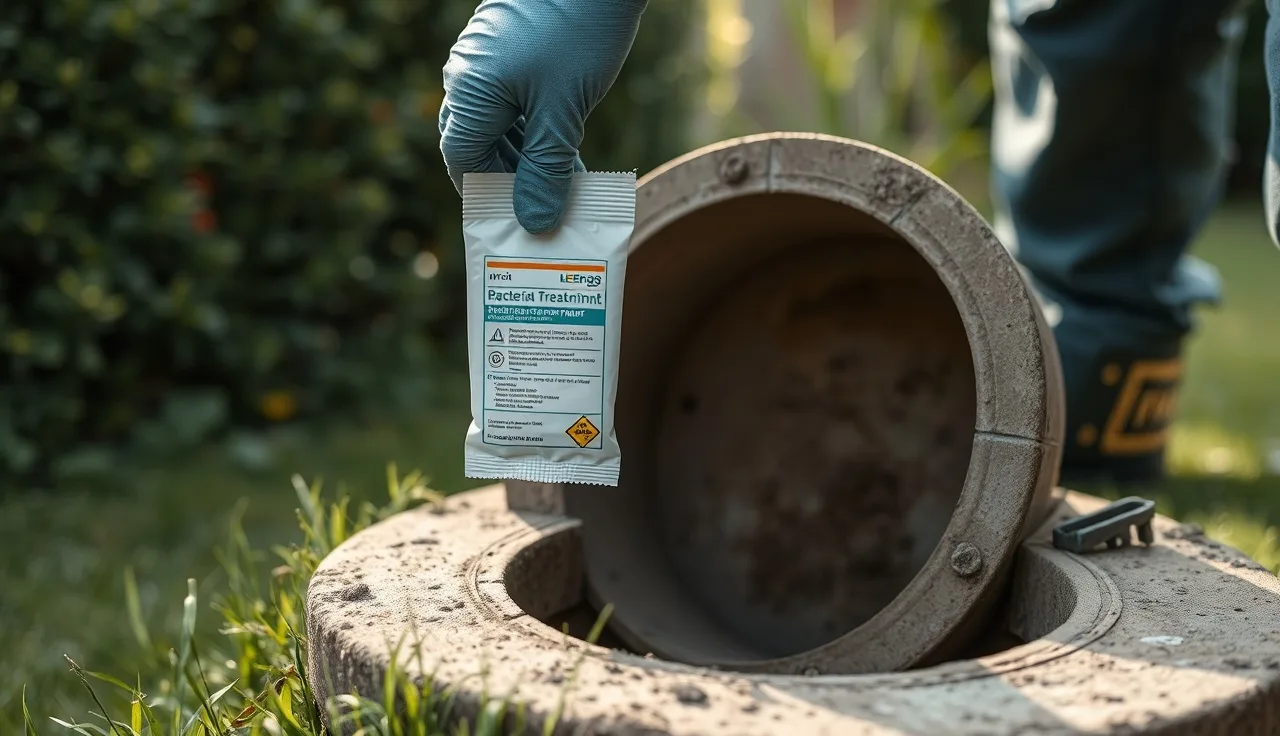
Biological septic tank treatment means adding live microorganisms, bacterial spores, or enzymes to your tank to support or restart the natural digestion that breaks down household waste. The tank already runs on biology. Billions of anaerobic bacteria colonize the liquid and sludge layers and digest organic solids around the clock. A biological additive is just an attempt to supplement or restock that population.
Three broad categories exist. Bacterial additives contain dormant or live cultures, usually Bacillus strains, that wake up once they hit the warm, wet environment inside the tank. Enzyme treatments supply specific proteins like lipases, proteases, and cellulases that speed the chemical breakdown of fats, proteins, and fiber before bacteria finish the job. Combination products layer bacteria and enzymes together and claim to handle the full digestion cycle faster.
None of these are regulated as pesticides or pharmaceuticals by the EPA, so manufacturers face no federal requirement to prove their claims before selling. The EPA's SepticSmart program notes that "the performance of these products has not been adequately demonstrated" in peer-reviewed studies at scale [1]. That doesn't mean every product is useless. It means the burden of proof sits on you, the buyer, not on the company selling the bottle.
The split between bacterial and enzyme products matters more than most labels admit. Enzymes work fast, then they're gone. Bacteria, if the strains survive your specific tank chemistry, can in theory establish a colony and keep working. Most real-world evidence favors bacterial products over straight enzyme additives for lasting results, though the data is thin on both sides.
How does a septic tank's natural biology work?
Your septic tank is a sealed anaerobic reactor. Wastewater enters, heavy solids sink to the bottom as sludge, grease and lighter material float as scum, and the clarified middle layer (effluent) flows out to the leach field. The bacteria doing the heavy lifting are mostly strict anaerobes: they die in oxygen. They come from human gut flora and from organisms already living in your pipes and soil.
Digestion happens in stages. Hydrolysis breaks large molecules into smaller ones. Fermentation converts those into volatile fatty acids. Acetogenesis and methanogenesis turn those acids into methane and carbon dioxide. Each stage depends on a different microbial community, and each community has slightly different pH, temperature, and nutrient preferences.
A healthy tank reaches a rough steady state where sludge accumulates about as fast as bacteria digest it. That balance is never perfect. Sludge still builds at roughly 1 to 3 cubic feet per person per year in a working system [2]. That's why septic tank pumping every 3 to 5 years stays non-negotiable no matter what additives you pour in.
Temperature matters a lot. Bacterial metabolism slows sharply below 50°F. A tank buried in a cold yard with poor insulation digests solids more slowly in winter, and an additive dosed in January may do almost nothing until spring warms the tank.
Does biological septic tank treatment actually work?
Honestly, the evidence is mixed and the best studies are old. A 1998 review by the University of Minnesota Extension examined commercial septic additives and found that bacterial products showed some ability to cut short-term BOD (biochemical oxygen demand) in the lab, but field performance was inconsistent and no product reliably reduced sludge enough to stretch pumping intervals [3]. A later EPA literature review reached the same place: lab studies sometimes show benefit, field studies rarely repeat it [1].
Biological treatment shows the most plausible benefit during a system restart or after a disruption. If a tank gets dosed with a big volume of antibiotics (after someone finishes a long antibiotic course, say), or if a vacation home sits idle for months and the bacterial population starves out, a concentrated bacterial product can help rebuild the microbial community faster than waiting for natural recolonization. This isn't proven at clinical-trial standards. It's the mechanism that makes the most sense, and it's what most extension services and wastewater engineers actually recommend in those cases.
For a normal tank with regular use and no big disruptions, a weekly bacterial packet is almost certainly a waste. Your gut flora restocks the tank every day. The organisms are already there.
One honest caveat: nobody has good long-term data tracking thousands of tanks with and without additives over a decade. The closest thing is the EPA literature synthesis, which found no controlled studies showing additives extend the life of a leach field [1]. Absence of evidence isn't proof of no effect. But it should calibrate your expectations before you spend $300 a year on monthly treatments.
What can harm the biology in your septic tank?
Before you spend money on additives, understand what kills or slows the microbial population you already have.
Antibacterial soaps and household disinfectants are the most common culprits. Products with triclosan, bleach, quaternary ammonium compounds, or pine oil can reach the tank in concentrations that harm anaerobic bacteria, especially when several people use them heavily every day. Occasional bleach in small amounts (one laundry load with a standard dose) usually causes no trouble. Daily toilet-bowl tablets that drip actives into the system nonstop are a bigger worry.
High-strength antibiotics, flushed or excreted in large doses, suppress bacterial populations for a while. The effect is real but usually short, because recolonization from gut flora happens within days to weeks.
Chemical drain cleaners, especially lye-based ones, shift tank pH enough to slow or halt bacterial activity. If you've dumped a large volume of caustic drain cleaner and you have a septic system, that's exactly the case where a bacterial additive earns its place as a recovery step.
Foaming agents and surfactants in bulk can break up the scum layer and mess with settling. This matters more for a high-use commercial kitchen on septic than for a typical home.
A severely overloaded tank, taking far more waste than its design capacity, has its biology suppressed by sheer hydraulic and organic load. No additive fixes that. The fix is a larger tank or less loading. If you see backup or wet spots in the yard, read our guide to septic system repair before you assume a biological product will help.
What types of biological products are available and how do they compare?
The market breaks into roughly four product forms, each with different costs and delivery.
| Product form | How it works | Typical cost per dose | Best use case |
|---|---|---|---|
| Dissolvable packets (bacteria) | Flush down toilet monthly | $10 to $25 | Maintenance dosing |
| Liquid bacterial concentrate | Pour into drain or toilet | $15 to $40 | Restart after disruption |
| Enzyme liquid | Pour into drain | $8 to $20 | Fat/grease breakdown |
| Combination bacteria + enzyme | Flush or pour | $20 to $50 | General maintenance, post-antibiotic restart |
Bacillus-based bacterial products dominate the market because Bacillus species form heat-resistant spores that survive packaging and shipping, then activate in the tank. They're aerotolerant, so they don't die the instant they touch oxygen during the flush, which helps them actually reach the tank. Strict anaerobic cultures are harder to keep alive through packaging and are less common.
Enzyme-only products act quickly on specific substrates. A lipase-heavy product can visibly break up grease in a drain within hours. But enzymes are proteins that degrade fast and don't reproduce. Once they're used up or broken down, the effect ends. For a septic tank rather than a grease trap, pure enzyme products offer little lasting benefit.
When you read septic tank treatment reviews online, check the reviewer's starting point. Someone who says a product "saved my system" often had a system failing from sludge buildup, hydraulic overload, or a crushed pipe, and the additive didn't fix any of that. Cross-check glowing reviews against whether the reviewer also had the tank pumped around the same time.
Are there any biological treatments that are actually proven?
The three most defensible uses, backed by at least some peer-reviewed or extension evidence, are these.
Post-antibiotic recolonization. After a household antibiotic course, especially a broad-spectrum drug like amoxicillin-clavulanate, adding a bacterial packet for a few weeks is cheap insurance. The mechanism is sound, the cost is low, and there's no real downside.
System startup after vacancy. A tank empty or unused for months (vacation home, new construction) has a depleted bacterial population. Seeding it with a concentrated bacterial product at startup gives the tank a head start instead of waiting for the population to build from the first few days of use. Some state extension programs specifically recommend this [3].
Drain field pre-treatment in at-risk systems. A handful of proprietary products get marketed for drain field restoration, usually injected into the distribution box. The evidence here is limited and mixed. The EPA endorses no specific brand. Some operators report anecdotal success in borderline systems before field replacement becomes necessary. Given that field replacement can cost $5,000 to $30,000, a $300 treatment attempt is a reasonable low-risk experiment in an early-failure case, as long as you know it may do nothing. See our overview of leach field problems for the full picture of when replacement is unavoidable.
Biological treatment is not proven to eliminate or significantly reduce pumping frequency, restore a fully failed drain field, dissolve pipe blockages, or replace any mechanical repair. A product claiming otherwise is a red flag.
How do biological septic additives interact with state regulations?
Several states explicitly regulate or restrict septic additives. South Carolina, for example, bans chemical additives in septic systems and keeps a conditional approval list for biological and organic products. Washington State's Department of Ecology maintains a registered product list for on-site sewage additives [4]. Indiana and a few other states run similar approval frameworks.
The EPA SepticSmart program offers federal-level guidance but doesn't regulate additives directly. It defers to state onsite wastewater codes [1]. If you're in a state with an approval list, using a non-listed product could in theory affect your system's standing with the county health department, though enforcement is rare.
For operators running fleets of systems, this state-by-state patchwork matters. A product you use routinely in one jurisdiction may be restricted in the next one over. Keeping track of that across a service territory is exactly the kind of compliance detail that scheduling and recordkeeping software handles. SepticMind, for instance, lets operators log treatment products used at each service visit next to state-required maintenance records, which helps if a county health inspector asks for documentation.
Always check your state's department of environmental quality or department of health website for the current approved product list before you recommend or use a biological additive commercially. The Washington State Department of Ecology page and the NSF International listing are two good starting points [4][5].
What do active septic tank treatment reviews tell you?
Consumer reviews for biological septic tank treatment products are noisy. The core problem: healthy septic systems show no symptoms, so people who dose a healthy system and then see nothing go wrong credit the product. That's confirmation bias, plain and simple.
The more credible signal in active septic tank treatment reviews comes from reviewers who describe specific before-and-after situations: a backed-up drain that cleared, a system restarted after a long idle stretch, or a tank that was pumped and then reseeded. Even those anecdotes are confounded, because pumping alone would have cleared most acute backups.
Three brands show up most in high-volume reviews: Rid-X, Cabin Obsession, and Bio-Active. Rid-X leads the category by sales volume and uses a mix of enzymes and bacterial spores. Independent extension reviews found it no better or worse than competitors on the metrics a lab can measure [3]. Cabin Obsession and similar products target the vacation-home restart. Bio-Active uses a wider range of bacterial strains and charges more for it.
If you're going to use any product, monthly dosing as directed beats sporadic use. A single dose after a major disruption beats nothing. But skip any product claiming to eliminate pumping, restore failed fields, or dramatically cut odors without independent data. Odor from a septic system usually means something is wrong mechanically or hydraulically, not that the biology needs a supplement.
How often should you use biological septic treatment?
For a standard residential system in normal continuous use, the honest answer is you probably don't need scheduled biological treatment at all. The EPA and most state extension programs don't recommend it as routine maintenance for healthy systems [1].
If you do use a product, monthly dosing is the most common manufacturer guidance and matches how fast bacterial populations cycle in a tank. Annual dosing has little rationale, since you'd be adding bacteria that either thrive and self-replicate (making more doses pointless) or die quickly (making a single annual dose useless).
There are specific windows where biological treatment makes more sense:
- Right after the tank is pumped. Pumping removes a big share of the bacterial population along with the sludge. A bacterial dose within 24 hours of a septic tank pump out helps rebuild the community faster.
- After finishing a 10+ day course of oral antibiotics in the household.
- When opening a vacation property in spring after winter closure.
- After any event where large volumes of disinfectant or cleaning agents entered the system.
Beyond those, money spent on monthly biological treatment is better spent on your next septic tank cleaning or inspection. A family of four should budget for pumping every 3 to 5 years. No additive changes that math.
What does biological septic treatment cost, and is it worth the money?
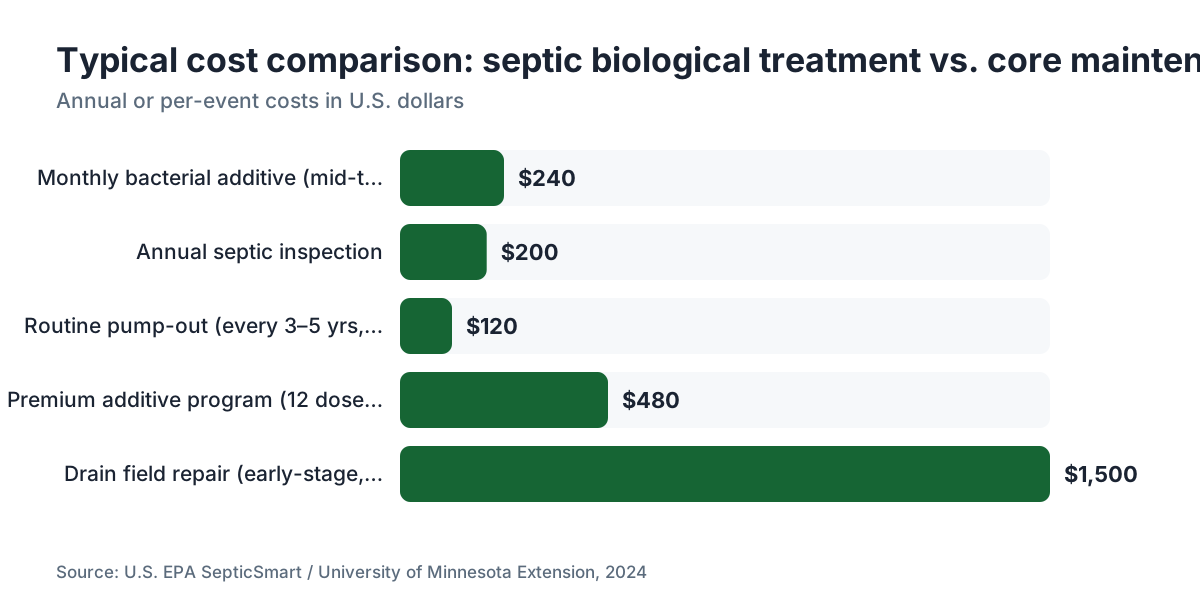
A single dose of a mid-tier bacterial product costs $15 to $30. Monthly use over a year runs $180 to $360. Premium combination products at $40 to $50 per dose push annual costs over $500.
Set that against the real costs in the septic ecosystem. A routine pump-out runs $300 to $600 in most U.S. markets [6]. A septic tank inspection costs $100 to $300. Drain field replacement typically runs $5,000 to $20,000 depending on soil and system type [7]. Against those numbers a $20-a-month additive with uncertain efficacy is a minor expense, but it's also money that could fund more frequent inspections or an earlier pump-out.
My honest take: spend the additive budget on getting your tank pumped a year earlier than you otherwise would. If you have a specific scenario, a post-antibiotic restart or a vacation-home opening, buy one quality bacterial product and use it as directed for 2 to 3 months. Don't sign up for a subscription based on marketing claims.
For operators pricing biological treatment as an add-on service, the margin math works if you're straight about what the product does and doesn't do. Selling monthly bacterial packets bundled with an annual service visit is a legitimate recurring-revenue model. Selling it as a way to extend pumping intervals or prevent field failure is a claim you can't back up, and it will eventually cost you your reputation. Operators building recurring service relationships at scale can track treatment histories and schedule follow-ups with platforms like SepticMind.
What should you never put in a septic tank?
This comes up around biological treatment because several products marketed as drain-safe or septic-safe actually harm the bacterial community.
Avoid these no matter what additive program you're running.
Chemical drain cleaners (lye, sulfuric acid formulations) kill bacteria and shift pH. A single heavy dose can disrupt the tank's biology for weeks. For slow drains, try enzyme drain cleaners or a plumber's snake first.
Antibacterial dish and hand soaps in large volume add triclosan or benzalkonium chloride to the wastewater stream. Standard dish soaps are fine in normal amounts.
Household bleach in large amounts. One cup a week through laundry is fine. Daily toilet-bowl tablets with continuous bleach release become a problem over time.
Flushable wipes. Even the ones labeled septic-safe don't break down fast enough. They pile up as a mat the bacteria can't digest at normal rates and drive premature solids buildup.
Medications, especially antibiotics, flushed instead of dropped at take-back programs. The EPA and FDA both recommend against flushing most medications [8].
Fats, oils, and grease in large amounts. Cooking grease poured down a drain cools and hardens in the tank, forming a scum layer that resists breakdown and can eventually clog the outlet baffle. A small lipase-rich enzyme product helps modestly with grease, but the real fix is never pouring grease down the drain in the first place.
For a full picture of a healthy maintenance schedule, our guide to how often to pump septic tank covers frequency by household size and tank volume.
How do you choose a biological septic treatment product?
With no federal regulation, you're doing your own evaluation. Here's a practical framework.
Look for NSF/ANSI 40 or NSF 245 certification on the label. NSF International tests wastewater products for performance claims and environmental safety [5]. A product with NSF 245 certification has met at least some third-party testing for septic additive performance. Most products on pharmacy shelves don't carry it.
Check whether your state keeps an approved-products list and confirm the product appears on it. Washington, South Carolina, and several other states maintain these lists [4].
Read the ingredient disclosure. A legitimate bacterial product lists the genus and species of bacteria included (say, Bacillus subtilis, Bacillus licheniformis) and reports CFU (colony-forming unit) counts per dose. Higher CFU counts aren't automatically better if the strains aren't matched to septic conditions, but a product that won't disclose its CFU count or species is a poor bet.
Skip any product claiming to eliminate pumping. That claim has no scientific support and ignores how a septic system physically works. Sludge accumulates regardless of microbial activity. Pumping stays necessary. If a brand's central pitch is that you'll never pump again, move on.
For ongoing maintenance, the cheapest sensible path is a basic Bacillus-based packet used only after the specific trigger events above. The fancier multi-strain, multi-enzyme products cost three to five times as much, and the independent evidence doesn't show proportionally better results.
Frequently asked questions
Does Rid-X actually work to maintain a septic tank?
Rid-X contains Bacillus bacterial spores and several enzymes. In the lab it shows measurable breakdown of fats and proteins. Field evidence for meaningful sludge reduction or longer pumping intervals is weak, and the University of Minnesota Extension found no product in its category reliably cuts pumping needs. It's a reasonable choice for post-pump reseeding or post-antibiotic recovery, but not a substitute for scheduled maintenance.
Can I use biological treatment to avoid pumping my septic tank?
No. Sludge accumulates mechanically as heavy inorganic solids settle and partly digested organic material collects over time. Biology can slow organic accumulation slightly, but no additive dissolves inorganic solids. The EPA and every state extension program with a position on additives affirm that pumping every 3 to 5 years stays necessary no matter what treatment products you use.
How do I restart my septic tank biology after antibiotic use?
Flush a quality bacterial packet (look for Bacillus subtilis or B. licheniformis, with CFU counts disclosed on the label) within a day or two of finishing the antibiotic course. Repeat weekly for 2 to 4 weeks. Avoid antibacterial soaps and heavy disinfectant use during that stretch. The tank's bacterial population usually recovers within a few weeks even without additives, but dosing speeds it up.
What is the best biological septic tank treatment for a vacation home?
For a property idle several months a year, look for a high-CFU bacterial concentrate marketed for system restart. Dose it the first time you flush water through the system in spring. Cabin Obsession and similar products target this case. Follow with one more dose two weeks later. After that, normal use restocks the tank naturally through the season.
Are biological septic additives safe for the drain field?
Yes. Standard Bacillus-based bacterial products don't harm a functioning drain field. The bacteria added are naturally occurring soil and gut organisms. Enzyme products are proteins that break down harmlessly. Neither category introduces chemicals that would damage soil structure or kill beneficial soil bacteria in the field. The concern with additives isn't safety, it's efficacy.
How often should I add bacteria to my septic tank?
For a normally functioning tank in continuous household use, you don't need a scheduled regimen at all. If you choose to add bacteria, monthly dosing after specific disruptions (antibiotic use, system restart, large disinfectant exposure) is reasonable. Ongoing monthly dosing as a default has no strong evidence behind it and costs $180 to $360 a year for a result you can't measure.
Can biological treatment fix a failing drain field?
Not reliably. A failing drain field usually suffers from biomat formation, hydraulic overloading, soil compaction, or structural damage to the distribution system. Products injected into the field can sometimes reduce biomat slightly in early-stage failure, but the evidence is anecdotal and inconsistent. Most field failures need resting the field, redistributing loading, or physical replacement.
What bacteria strains are in septic tank biological treatments?
Most commercial products use aerotolerant Bacillus species, particularly Bacillus subtilis, B. licheniformis, B. amyloliquefaciens, and B. pumilus. These form hardy spores that survive packaging and activate in the wet, warm tank. Some premium products add Lactobacillus or Clostridium strains for specific substrates, but Bacillus dominates the category because of its shelf stability.
Is biological septic treatment the same as chemical treatment?
No. Biological treatments add living bacteria or organic enzymes. Chemical treatments add acids, bases, or synthetic surfactants. Most wastewater professionals and state environmental agencies prefer biological products because chemicals can disrupt tank pH, kill beneficial bacteria, and in some cases leach harmful compounds through the drain field into groundwater. Several states ban chemical additives outright.
Do I need biological treatment after having my septic tank pumped?
It's one of the better-justified uses. Pumping removes a big share of the tank's bacterial community along with the sludge. Dosing a quality bacterial product within 24 hours of the pump-out helps repopulate the tank faster. Normal household use will restock it naturally within a few weeks anyway, but the head-start argument is mechanistically sound and the cost is low.
Can you use too much biological treatment in a septic tank?
Overdosing a bacterial product is unlikely to cause harm, since you're adding naturally occurring organisms that simply die off if the tank can't support the population. Overdosing enzymes in large amounts could in theory break up the scum layer too fast and push partly digested solids toward the outlet baffle, but at normal commercial-product doses that isn't a realistic concern.
What does the EPA say about septic tank additives?
The EPA's SepticSmart program states that the performance of septic additives has not been adequately demonstrated and that no additive reduces or eliminates the need for regular pumping. The EPA does not approve or endorse any specific product. It defers to state onsite wastewater regulations for product-specific guidance. The relevant guidance sits at epa.gov under the SepticSmart program.
How can I tell if my septic tank biology is working properly?
You can't tell directly without a professional inspection and sample testing. Indirect signs of healthy biology: no sewage odors in the yard, no slow drains without a plumbing cause, effluent that runs clear when the tank is opened (not black and foul), and a sludge layer that grows predictably rather than explosively between pump-outs. A septic tank inspection every 1 to 3 years is the most reliable check.
Sources
- U.S. EPA, SepticSmart Program: EPA SepticSmart states 'the performance of these products has not been adequately demonstrated' and that no additive eliminates the need for pumping
- U.S. EPA, Onsite Wastewater Treatment Systems Manual (EPA/625/R-00/008): Sludge accumulates at roughly 1 to 3 cubic feet per person per year in a functioning septic tank
- University of Minnesota Extension, Septic System Owner's Guide: 1998 review found bacterial products showed some lab-level BOD reduction but no product reliably reduced sludge accumulation enough to extend pumping intervals
- Washington State Department of Ecology, On-Site Sewage System Additives: Washington State maintains a registered product list for on-site sewage additives and regulates their use under state onsite wastewater code
- NSF International, NSF/ANSI 245 Wastewater Treatment Systems: NSF 245 certification provides third-party testing verification for septic additive performance and environmental safety claims
- U.S. EPA, Septic Systems Overview: Routine septic pump-out costs $300, $600 in most U.S. markets
- University of Minnesota Extension, Septic System Costs: Drain field replacement typically costs $5,000, $20,000 depending on soil conditions and system type
- U.S. FDA, Drug Disposal: FDA's Flush List: The EPA and FDA recommend against flushing most medications and direct consumers to take-back programs
- U.S. EPA, Septic System Maintenance: EPA recommends pumping a septic tank every 3 to 5 years for a typical household regardless of additive use
- North Carolina State University Extension, Septic System Additives: Extension guidance indicates bacterial additives are most justified after system restart, post-antibiotic disruption, or following vacancy periods
Last updated 2026-07-10