Septic inspection in Bay Shore, NY: what to expect and what it costs
By the SepticMind Editorial Team
TL;DR
- A septic inspection in Bay Shore, NY costs $250 to $600 and takes two to four hours.
- Suffolk County Department of Health Services regulates every onsite wastewater system here under Article 6 of the Sanitary Code.
- Inspectors check the tank, baffles, distribution box, and leach field.
- You usually need one before a home sale or after a failure complaint.
Why does Bay Shore need septic inspections at all?
Bay Shore sits on the South Shore of Long Island, in the Town of Islip, and the ground under it is coarse, sandy soil over a shallow aquifer. That aquifer is the sole source of drinking water for roughly 2.8 million people on Long Island [7]. A failing septic system here does more than back up into your basement. It leaches nitrogen and pathogens straight into groundwater that feeds public and private wells, and it drains into the Great South Bay, which has been under nitrogen-driven ecological stress for decades.
Suffolk County writes some of the strictest onsite wastewater rules in New York for that exact reason. The county banned cesspools for new construction in 2015 and built the Reclaim Our Water initiative to move homeowners toward nitrogen-reducing systems [2]. All that regulatory pressure turns inspections into more than paperwork. They are the tool the county uses to catch failures before they become public health events.
For a Bay Shore homeowner, an inspection matters at three moments: when you sell, when you notice symptoms of a failing system (slow drains, wet spots over the leach field, sewage odors), and when the county's point-of-sale requirement triggers one under Article 6 of the Suffolk County Sanitary Code [3].
What does a septic inspector actually check in Bay Shore?
A qualified inspector works a fixed sequence, and the sequence matters, because skipping steps is how problems slip past. The inspection covers the tank, baffles, distribution box, leach field, and county permit records.
First, the inspector locates and exposes the tank. In Bay Shore, most pre-1980 homes have a cesspool instead of a true septic tank with a separate drain field. Knowing which system you have changes what the inspector looks for. If your system predates 1972, there is a real chance it has no inlet or outlet baffles at all.
Once the tank is open, the inspector checks:
- Structural integrity of the tank walls and lid
- Inlet and outlet baffles (or tees), which keep solids from flowing into the drain field [8]
- Scum depth and sludge depth, which tell you whether pumping is overdue (EPA guidance says pump when sludge sits within 12 inches of the outlet baffle) [4]
- Water level relative to the outlet pipe. A high water level can mean the drain field is backing up.
- Roots, cracks, or collapsed sections
After the tank, the inspector checks the distribution box (D-box) if one exists. The D-box splits effluent evenly among the leach field laterals. A tilted or cracked D-box sends all the flow to one lateral and burns it out fast.
The leach field gets a visual and sometimes a probe inspection. The inspector hunts for saturated soil, surfacing effluent, dead or dying grass in suspicious patterns, and odors. Sometimes a dye test is used: a fluorescent dye goes into the system, and the inspector walks the yard watching for it to surface.
Last, the inspector pulls the county's records for your property. Suffolk County DOHS keeps files on permitted systems, and a good inspector cross-references the field findings against what the permit says should be down there [9].
What does a septic inspection cost in Bay Shore?
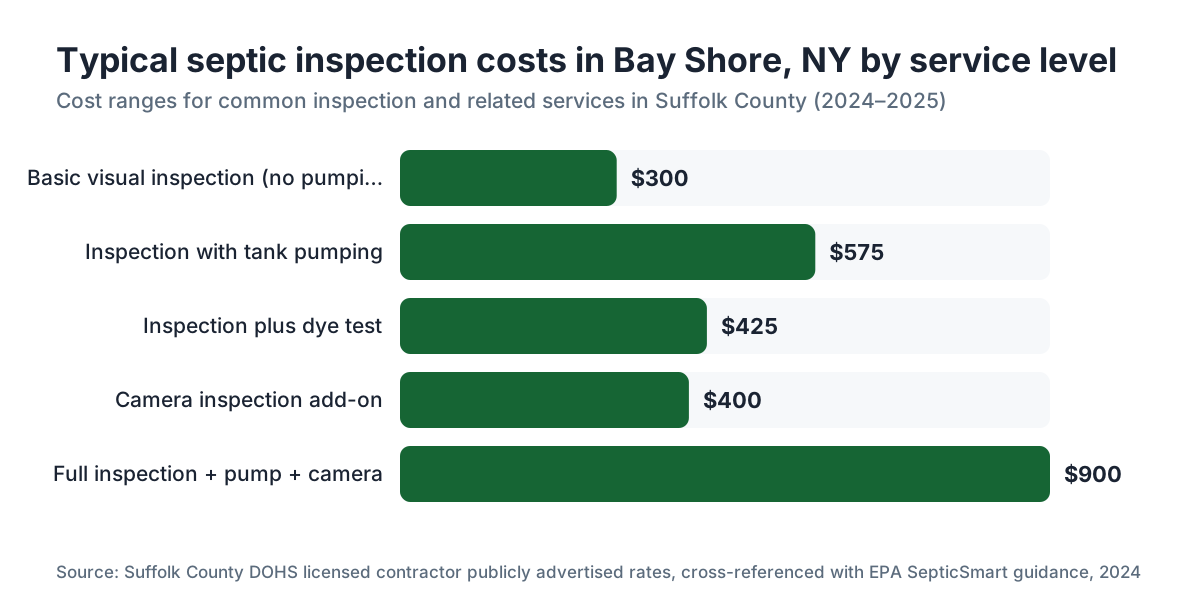
A basic visual inspection in Bay Shore runs $250 to $350, and a full inspection with pumping and a camera run climbs to $700 to $1,100. Prices here beat national averages because Long Island carries a dense licensed-inspector market with high overhead, and Suffolk County's documentation requirements add time.
Expect to pay:
| Service | Typical Bay Shore range |
|---|---|
| Basic visual inspection (no pumping) | $250, $350 |
| Inspection with tank pumping included | $450, $700 |
| Inspection plus dye test | $350, $500 |
| Camera inspection of lines | $300, $500 add-on |
| Full inspection + pump + camera | $700, $1,100 |
Those ranges come from publicly advertised prices from Suffolk County-licensed pumpers and inspectors during 2024 and 2025. Prices move with fuel and labor, so treat them as planning estimates, not quotes.
One thing catches homeowners off guard: the inspection fee and the pumping fee are usually separate, even when one truck does both jobs. If your tank needs pumping to finish the inspection (and it often does, because the inspector has to see the bottom of the tank to judge sludge depth and baffle condition), that shows up as its own line item. A septic tank pump out in Suffolk County usually costs $350 to $550 on its own.
Repairs are where the bill jumps. A distribution box replacement runs $500 to $1,500. Baffle replacement is $200 to $500. Full septic system repair or drain field remediation can reach $5,000 to $20,000 depending on scope.
Who is licensed to do septic inspections in Bay Shore and Suffolk County?
Here is where Bay Shore homeowners trip up. New York State does not issue a single statewide "septic inspector" license. Suffolk County DOHS regulates who can perform and certify onsite wastewater inspections under its own code instead.
For a point-of-sale inspection, Suffolk County typically requires the work to be performed or directly supervised by a licensed professional engineer (PE) or registered architect who signs and stamps the report, or by a Suffolk County DOHS-approved inspector working under that umbrella [3]. A plumber's license alone does not cover the official certification.
For your own peace of mind before you list, hire any qualified septic pumping contractor to run a pre-inspection. Plenty of Bay Shore homeowners do exactly that: pay a pumper $400 to $500 for a look-see, learn what needs fixing, fix it quietly, then go through the formal inspection. That sequence saves money and saves surprises.
Always ask the inspector:
- Are you or your supervising engineer licensed to certify this inspection for Suffolk County DOHS?
- Will you give me a written report I can submit to the county if needed?
- Do you carry liability insurance?
The New York State Department of Environmental Conservation (NYSDEC) also holds jurisdiction over systems near surface water, which pulls in properties along Sumpwams Creek or close to Great South Bay [5].
What are Suffolk County's rules for point-of-sale septic inspections?
Article 6 of the Suffolk County Sanitary Code is the document that runs this. Under Article 6, sellers of most residential properties must disclose the type of sewage disposal system and, in certain circumstances, have it inspected before title transfers [3].
The Reclaim Our Water initiative adds another layer. Properties in designated nitrogen-sensitive areas (which covers much of the South Shore, Bay Shore included) may have to upgrade to an Innovative and Alternative Onsite Wastewater Treatment System (I/A OWTS) rather than simply repair a failing conventional system [2]. Suffolk County has offered subsidies to offset I/A OWTS costs, though funding shifts year to year.
Key rules that apply in Bay Shore:
- Cesspools that served as the primary treatment system for homes built before 1973 are generally considered substandard under current code. A sale can trigger a mandatory upgrade depending on lot size, proximity to water, and system age.
- Any system within 150 feet of a surface water body gets stricter scrutiny under both county and NYSDEC rules [5].
- If a system fails inspection, the seller typically has a defined window (often 30 to 60 days, set by the county) to repair or replace before the sale can close.
The practical read: if you are selling a Bay Shore home and you suspect your cesspool or septic system is old or marginal, get a pre-inspection six months before you list. That buys you time to repair or upgrade without losing a buyer to a stalled closing.
How do you find and evaluate septic inspectors near Bay Shore?
Start with Suffolk County DOHS's list of registered onsite wastewater haulers and service providers. The county maintains that list, and it is the most reliable place to begin [9]. You can also search the New York State licensed professional engineers database for PEs who specialize in onsite wastewater.
After that, run the standard screening questions:
- How long have you been inspecting systems specifically in the Town of Islip and Suffolk County?
- Can you show me a sample report?
- Do you pull county records before the inspection, or do you work only from what you find on site?
- What happens if you find a problem? Do you do the repairs yourself, or refer me out?
That last question matters more than most homeowners realize. An inspector who also does repairs has a financial reason to find problems. That does not disqualify them, but you should know it going in. If an inspector tells you that you need a full system replacement and they happen to install systems, get a second opinion before you sign anything.
Call two to three weeks out for scheduling. Suffolk County is thick with older systems, and the good inspectors stay booked, especially in spring and early summer when the real estate market moves.
Operators juggling inspection jobs across the South Shore sometimes lean on scheduling and documentation tools like SepticMind to keep Suffolk County paperwork straight across many properties at once.
What are the signs that your Bay Shore septic system might fail an inspection?
Some warning signs are loud. Others stay quiet until the inspector finds them. The obvious ones are backups, odors, and wet ground over the field. The quiet ones are age, missing pumping records, and additions that outgrew the original permit.
Obvious signs:
- Sewage odors in your yard or near the tank lid
- Wet, spongy, or lush green patches over the leach field, especially in dry weather
- Toilets and drains backing up or running slow
- Gurgling in the plumbing after a flush
Less obvious signs:
- The system has never been pumped. If you bought the house and cannot find pumping records, treat that as a red flag. Cornell Cooperative Extension of Suffolk County documents how commonly Long Island cesspools go under-maintained and how much nitrogen they load into groundwater [7].
- The home was built before 1970. Most pre-1970 Bay Shore homes sit on concrete cesspools now 50-plus years old and near the end of their working life.
- You added bedrooms or bathrooms since the original permit. System capacity gets sized at permit time, and an undersized system fails faster.
- The yard was regraded or paved over the leach field. That cuts off oxygen and kills the bacterial action a drain field runs on.
Buying a Bay Shore home where any of these apply? Push hard for a septic tank inspection as a contingency in your offer. Do not waive it.
Before and after an inspection, keeping the tank on a real pumping schedule is the single highest-leverage thing a homeowner can do. EPA's SepticSmart program recommends pumping every three to five years for a typical household [4]. For a family of four with a 1,000-gallon tank, that usually means every three years. Our guide on how often to pump septic tank walks the full calculation.
What happens after the inspection report?
The inspector hands you a written report (and sometimes the county, if this is a mandatory point-of-sale inspection). That report lands in one of three outcomes: pass, conditional pass, or fail.
Pass: The system is working, the tank is in acceptable shape, and there are no immediate failures. You might still get recommendations, like pump soon or reseal the lid, but you can move ahead with a sale or just file the report.
Conditional pass: The system has minor deficiencies that need correction inside a defined window. Common examples are a cracked baffle, joints that need resealing, or a tank that needs pumping to bring sludge back into range. You fix the items, the inspector signs off.
Fail: The system is failing or substandard in a way that demands significant repair or replacement before the property sells or keeps operating. This is where costs run up fast. A failed conventional cesspool in a nitrogen-sensitive zone in Bay Shore may require replacement with an I/A OWTS, which can cost $15,000 to $30,000 installed, though Suffolk County's subsidy programs have historically covered $10,000 to $15,000 of that for qualifying homeowners [2].
A fail result is not a reason to panic. Get a second opinion and a repair estimate first. Then read the cost to install septic system and septic tank installation guides so you understand what a replacement actually involves before you commit to any contractor's quote.
How does the Bay Shore regulatory environment compare to the rest of New York?
Suffolk County is one of the most regulated counties in New York for onsite wastewater. Most upstate counties run on the New York State Department of Health's Part 75 regulations as their baseline, with few add-ons [6]. Suffolk County runs its own parallel code under Article 6 of the Sanitary Code, tighter on nitrogen limits, setback distances, and technology requirements.
A few comparisons show the gap:
| Requirement | Typical Upstate NY County | Suffolk County |
|---|---|---|
| Minimum lot size for conventional septic | Often 20,000 to 40,000 sq ft | Often 40,000 sq ft or more in restricted areas |
| Nitrogen-reducing system mandate | Rare, site-specific | Widespread in nitrogen-sensitive zones |
| Point-of-sale disclosure requirement | Varies by municipality | County-wide under Article 6 |
| Cesspool new-installation ban | Not universal | Banned since 2015 |
The takeaway: if you moved to Bay Shore from upstate or another state, do not assume what passed at your last home passes here. The rules are meaningfully different, and the county enforces them.
For ongoing compliance, homeowners can track maintenance schedules and inspection records digitally. SepticMind, an AI-powered septic operations platform, is one option operators use to manage documentation across many properties in high-compliance counties like Suffolk.
What should you do before the inspector arrives?
A little prep makes the inspection go faster and cuts the odds of a bad result from something preventable. Find your records, clear the lid, and lay off the water.
Locate your tank and system records first. Suffolk County DOHS keeps permit records for many systems, and your county file may hold an as-built diagram showing where the tank, D-box, and leach field sit [9]. If you do not have it, call the DOHS Office of Wastewater Management before the inspection.
Do not pump the tank right before the inspection unless the inspector asks you to. Inspectors need to see the actual sludge and scum levels to judge whether the system is being maintained. Pumping it clean the day before hides that.
Do clear the ground around the tank lid. Inspectors will not spend an hour excavating your landscaping. If the lid is buried under more than a few inches of soil, mark it and pre-excavate.
Skip heavy water use in the 24 hours before the inspection. Laundry, dishwasher, long showers all push effluent into the system. A waterlogged system at inspection time can read like a failing drain field when it is only temporarily saturated.
Have your maintenance history ready. Pumping receipts, prior inspection reports, and repair records all help the inspector read the system's trajectory. A well-maintained system with good records almost always inspects better than one with no paper trail.
For regular septic tank cleaning and septic tank pumping schedules, see those dedicated guides.
How long does a septic inspection take in Bay Shore?
Plan for two to four hours at the property, depending on system complexity and access. A simple single-cesspool system with a visible lid and clean records can wrap in under two hours. A complex system drags longer.
A multi-compartment system with a distribution box and a conventional leach field, especially with a buried lid and incomplete records, can run four hours or more.
If the inspector is also pumping the tank (common, and worth doing), add 30 to 60 minutes for that plus time for the truck to show. Most Bay Shore inspectors who also pump will time the pump truck to arrive during the inspection, not after.
For county-submitted point-of-sale inspections, the written report usually turns around in three to seven business days after the site visit. Plan your closing timeline around that. Rushing an inspection the week before a scheduled closing is a common mistake that creates real stress.
After the inspection, if septic tank repair is needed, contractor availability in Suffolk County can add two to six weeks to your timeline, especially in the busy spring selling season.
Frequently asked questions
Is a septic inspection required to sell a home in Bay Shore, NY?
Suffolk County Article 6 of the Sanitary Code requires sellers to disclose their sewage disposal system type. In many cases, especially for older homes and properties in nitrogen-sensitive zones, a formal inspection is also required before the sale can close. Check with Suffolk County DOHS and your real estate attorney early, because the requirements depend on system age, location, and proximity to water.
How much does a septic inspection cost in Bay Shore?
A basic visual inspection in Bay Shore runs $250 to $350. If pumping is included, expect $450 to $700. Adding a dye test or camera inspection brings the total to $500 to $1,100 depending on what is needed. These beat national averages because of Suffolk County's regulatory requirements and Long Island's cost of living.
How do I find my septic tank location in Bay Shore?
Suffolk County DOHS keeps permit and as-built records for many systems. Call their Office of Wastewater Management or check their permit records. You can also run a plumbing snake with a locator transmitter from the cleanout, look for depressions or green patches in the yard, or hire a septic locating service, which usually costs $75 to $150 in Suffolk County.
What is the difference between a cesspool and a septic tank in Bay Shore?
A cesspool is a single underground pit that both holds solids and lets liquids seep into the surrounding soil through its walls. A true septic system has a sealed tank that separates solids from liquids, then sends effluent to a drain field through a distribution box. Most Bay Shore homes built before 1972 have cesspools. Suffolk County has banned new cesspools since 2015.
How often should I pump my septic system in Bay Shore?
EPA recommends every three to five years for a typical household. For a family of four with a 1,000-gallon tank, three years is more realistic. Bay Shore cesspools may need pumping more often if they are old or if soil absorption has degraded. Keeping a pumping log helps, especially before a point-of-sale inspection.
What is an I/A OWTS system and does my Bay Shore home need one?
I/A OWTS stands for Innovative and Alternative Onsite Wastewater Treatment System. These are nitrogen-reducing systems Suffolk County now requires in many situations instead of conventional septic replacement. If your system fails inspection in a nitrogen-sensitive zone, the county may require I/A OWTS installation rather than a like-for-like swap. Costs run $15,000 to $30,000, but county subsidy programs have historically offset $10,000 to $15,000.
Can I do my own septic inspection in Bay Shore?
You can open a tank lid and look inside, but a DIY inspection carries real risk and has no legal standing for county purposes. Septic tanks hold hydrogen sulfide gas, which can be lethal in seconds. For a point-of-sale inspection, Suffolk County requires the report to be certified by a licensed PE or approved inspector. Do not try to inspect a tank yourself.
What do inspectors look for in the leach field during a Bay Shore inspection?
Inspectors look for surfacing effluent, waterlogged or spongy soil over the field, odors, unusual lush grass growth in dry weather, and standing water. They may probe the soil to check saturation depth. A dye test, where dye is flushed through the system, can confirm whether effluent is reaching the surface. A failed drain field is one of the most expensive repairs in Bay Shore, often $5,000 to $20,000.
How long does it take to get a septic inspection report in Bay Shore?
Most inspectors deliver a written report within three to seven business days after the site visit. For county-submitted point-of-sale certifications, allow extra time for DOHS review. If you are on a tight closing timeline, tell the inspector upfront. Rushing this the week of closing is a common and avoidable source of delays.
What repairs are most commonly needed after a Bay Shore septic inspection?
The most common findings are cracked or missing baffles ($200 to $500 to replace), a tilted or cracked distribution box ($500 to $1,500 to replace), and sludge levels needing immediate pumping ($350 to $550). Full drain field or cesspool replacement is less common but expensive, ranging from $5,000 to $30,000 depending on system type and nitrogen-reduction requirements.
Does Suffolk County offer financial help for septic upgrades in Bay Shore?
Yes. Suffolk County's Reclaim Our Water initiative and associated grants have historically provided $10,000 to $15,000 toward I/A OWTS installation for qualifying homeowners. Funding availability changes annually based on appropriations. Contact Suffolk County DOHS or the Suffolk County Water Authority for current program status before planning a major upgrade.
What should I avoid doing before my septic inspection?
Do not pump the tank the day before, because inspectors need to see actual sludge and scum levels. Skip large amounts of water in the 24 hours before, because a saturated system can mimic a failing drain field. Do not pour septic additives in ahead of time. They do not fix structural problems and may complicate the inspector's assessment.
Sources
- Suffolk County Government, Reclaim Our Water / I/A OWTS program: Suffolk County banned cesspools for new construction in 2015 and created subsidy programs for I/A OWTS upgrades in nitrogen-sensitive areas including the South Shore.
- Suffolk County Sanitary Code, Article 6 (Sanitary Code of Suffolk County): Article 6 of the Suffolk County Sanitary Code governs onsite wastewater systems, including point-of-sale disclosure and inspection requirements for residential properties.
- US EPA, SepticSmart: Homeowner's Guide to Septic Systems: EPA SepticSmart recommends pumping every three to five years and notes that sludge within 12 inches of the outlet baffle signals the tank needs pumping.
- NYSDEC, wastewater and water quality programs: NYSDEC has jurisdiction over onsite wastewater systems located near surface water bodies in New York, including properties along tidal creeks and bays.
- New York State Department of Health, Part 75 Regulations for Individual Household Systems: New York State Part 75 regulations serve as the baseline for onsite wastewater in most upstate counties, with fewer nitrogen-reduction requirements than Suffolk County's Article 6.
- Cornell Cooperative Extension of Suffolk County: Suffolk County extension research documents the prevalence of Long Island cesspools and their contribution to nitrogen loading in groundwater and surface waters, and Long Island's dependence on a sole-source aquifer.
- US EPA, SepticSmart: How Your Septic System Works: EPA describes the function of inlet and outlet baffles in preventing solids from entering the drain field and outlines standard septic system components.
- Suffolk County DOHS, Office of Wastewater Management: Suffolk County DOHS Office of Wastewater Management maintains permit records and as-built diagrams for onsite systems and lists approved inspectors and haulers.
Last updated 2026-07-09