Septic system components: what every part does and why it matters
By the SepticMind Editorial Team
TL;DR
- A conventional septic system has four main parts: the inlet pipe from the house, the septic tank (where solids settle and scum floats), the distribution system, and the drain field (also called a leach field) where liquid effluent filters into soil.
- Aerobic systems add an air pump and a disinfection chamber.
- Each part has its own lifespan and its own way of failing.
What are the main components of a septic system?
Every septic system, old or fancy, moves wastewater through the same sequence: out of the house, into a tank, through some kind of distribution, and finally into the ground or a treatment device. Parts vary by system type. The logic never does. Separate the solids, treat the liquid, get rid of it safely.
For a conventional gravity-fed system, the EPA names four core components: the household plumbing and inlet pipe, the septic tank, the effluent distribution network, and the soil absorption area (drain field or leach field) [1]. Aerobic treatment units (ATUs) add mechanical aeration, a clarification zone, and a disinfection step, usually chlorine tablets or UV light.
Here is every major component and its main job:
| Component | Primary job | Typical material | Typical lifespan |
|---|---|---|---|
| Inlet pipe | Carries wastewater from house to tank | PVC, cast iron | 25-50 years |
| Septic tank | Separates solids, liquids, gases | Concrete, fiberglass, HDPE | 25-40+ years |
| Inlet/outlet baffles | Directs flow, prevents scum carryover | Concrete, PVC sanitary tee | 5-20 years (plastic lasts longer) |
| Distribution box (D-box) | Splits effluent evenly to field lines | Concrete, plastic | 20-30 years |
| Drain field pipes | Distributes effluent across soil | Perforated PVC | 20-30 years |
| Soil absorption zone | Final treatment and dispersal | Native soil | Decades if not overloaded |
| Effluent filter | Catches fine solids before drain field | Plastic cartridge | Clean every 1-3 years |
| Riser and lid | Access to tank for pumping/inspection | Concrete, HDPE | 20-50 years |
| ATU air pump (aerobic) | Introduces oxygen for aerobic bacteria | Electric motor | 5-10 years |
| ATU disinfection chamber | Kills pathogens before discharge | Fiberglass/plastic vessel | 20+ years |
Most failures trace back to one neglected part, not the system as a whole. Once you know what each piece does, figuring out what went wrong gets a lot easier.
How does the septic tank work, and what is inside it?
The septic tank is the heart of the system. It is a watertight buried vessel, usually concrete or fiberglass, that catches all the wastewater from the house. Inside, three layers sort themselves out: a top layer of grease and soap scum, a middle layer of clarified liquid called effluent, and a bottom layer of heavy solids called sludge.
Anaerobic bacteria (the kind that live without oxygen) digest some of the sludge and scum, but they never clear it out completely. Solids pile up over the years. That is why pumping is non-negotiable. The EPA recommends pumping most household tanks every 3 to 5 years [1]. Let sludge climb past about a third of the tank volume and solids start slipping into the drain field. That is the expensive kind of problem.
The tank has two openings at opposite ends: the inlet where raw wastewater comes in, and the outlet where clarified effluent leaves toward the drain field. Both openings have baffles. The inlet baffle pushes incoming flow downward so it does not stir up the settled layers. The outlet baffle (or effluent filter, in newer tanks) keeps floating solids from escaping.
Size matters. A single-family home usually needs a 1,000-gallon tank at minimum, and many state codes now require 1,050 gallons or more for a three-bedroom home [10]. Undersized tanks fill faster and need more frequent pumping. If you are on a septic tank pumping schedule and the pumper keeps finding a full tank at two years instead of four, your tank may be too small for how much water you actually use.
Concrete tanks crack, usually around the inlet and outlet risers, and that lets groundwater in or effluent out. Fiberglass and high-density polyethylene (HDPE) tanks skip the cracking problem, but they can float out of the ground if the water table is high during install or pumping. A good installer plans for buoyancy with anchor straps or concrete deadmen.
What do septic tank baffles and effluent filters actually do?
Baffles get skipped at most inspections, and that oversight causes a surprising share of drain field failures. The outlet baffle matters most. It is the last thing standing between effluent and the field.
Older concrete tanks had baffles cast right into the tank wall. Those tend to fall apart within 15 to 20 years because hydrogen sulfide gas, a byproduct of anaerobic digestion, eats concrete [4]. You end up with a crumbling or missing baffle that lets scum float straight out of the tank. If your system is over 20 years old and nobody has confirmed the baffles are intact, make your next inspection check them.
Modern concrete tanks use PVC sanitary tees as baffles [4]. They last far longer and are cheap to swap if they do fail. Fiberglass and HDPE tanks use plastic fittings too. Replacing a missing or damaged baffle during a pump-out is minor, usually $50 to $200 for parts and labor [3].
Effluent filters go a step beyond baffles. They sit inside the outlet tee and strain the effluent as it leaves, catching hair, fine particles, and anything that got past the baffle. Zoeller, Polylok, and Orenco are common brands. These filters do a lot to extend drain field life, but they need cleaning every one to three years. A clogged filter backs sewage up into the house before it damages the field, which is the whole point: the filter sacrifices itself so solids never reach the soil.
Some older properties have no filter at all. Adding one during a septic tank pump out is one of the best-value upgrades a homeowner can make.
What is the distribution system and why does it fail?
Once effluent leaves the tank, it has to spread across the drain field evenly. How that happens depends on the design.
The most common setup uses a distribution box, called a D-box. It is a small concrete or plastic box between the tank outlet and the start of the drain field trenches. Effluent flows in through one pipe and gets split among several outlet pipes, each feeding a separate trench. The key word is evenly. If the D-box settles, tips, or clogs with roots, one trench drowns while the others sit dry.
A D-box out of level by half an inch can send most of the flow to a single trench. That trench saturates and fails while the rest go barely used [6]. It happens all the time, and it is one reason a system can fail long before the soil is actually worn out.
Other distribution methods include serial distribution (trenches linked end-to-end, so each fills before the next starts) and pressure distribution. Pressure distribution uses a pump in a pump chamber (also called a dosing chamber) to push effluent through small-diameter perforated pipes under low pressure. Every hole gets roughly the same flow, no matter the slope or settling. It works better, and many states now require it for sites with tough soil or topography [2].
Gravity systems have no moving parts in the distribution network. That is a real advantage. Pressure distribution systems run a pump that will eventually wear out. Replacing a pump in a dosing chamber typically costs $400 to $900 depending on pump size and access [3].
How does a drain field (leach field) treat wastewater?
The drain field is where the real treatment happens, and it is the most expensive part to replace. Understand how it works and protecting it gets a lot simpler.
In a conventional system, the drain field is a set of trenches, usually 18 to 36 inches deep and 1 to 3 feet wide, dug into native soil. Perforated PVC pipe sits in a bed of washed gravel inside each trench. Effluent drips out through the perforations into the gravel, then percolates down through the soil. Each trench gets topped with geotextile fabric to keep soil out of the gravel, then backfilled.
The soil does the treatment. A thin layer called biomat forms at the gravel-soil interface. This layer of bacteria and organic material handles much of the final pathogen removal [7]. Below it, the native soil filters out what is left as effluent moves toward the water table. That is why a percolation test (perc test) or soil evaluation comes before any system design: the soil has to drain fast enough to take the effluent without ponding, but slow enough to treat it before it reaches groundwater [1].
Drain field area varies by state and soil type. As a rough guide, most state codes require 150 to 300 square feet of trench bottom per bedroom [2]. A three-bedroom home might need 500 to 900 square feet. This is why soil results matter so much at septic tank installation time.
The number one cause of drain field failure is solids from an overfull or broken tank reaching the field and clogging the biomat past recovery. Second is hydraulic overload, pushing far more water through than the design allows. Spacing out laundry loads, fixing leaky toilets, and keeping cars and heavy equipment off the field all buy you years. The leach field guide goes deeper on failure signs and repair options.
What components does an aerobic septic system have that a conventional one does not?
Aerobic treatment units (ATUs) show up where conventional systems cannot work: poor soil, high water tables, or small lots. They treat wastewater to a much higher standard before it leaves the system, but they do it with more mechanical parts and higher running costs.
A typical aerobic system has five zones instead of two or three:
- A trash trap or pretreatment chamber. A small settling tank where large solids and grease drop out before wastewater hits the aeration zone. Some systems skip this and settle in the main tank.
- An aeration chamber. An electric air pump (compressor) pumps air into the wastewater around the clock. That feeds aerobic bacteria, which chew through organic material much harder than anaerobic bacteria do. The effluent leaving this stage is cleaner than what a conventional tank produces.
- A clarification or settling chamber. After aeration, the mix moves into a quiet zone where leftover suspended solids settle before the effluent goes on. Some designs use a cone-shaped clarifier; others use a simple baffled chamber. NSF/ANSI 40 testing covers effluent quality from these stages [9].
- A disinfection chamber. Effluent passes through or over a disinfectant. Most residential ATUs use chlorine tablets in a basket or tube; some use UV lamps. This step drops pathogens low enough to discharge to a spray irrigation system, a surface drip system, or a reduced-size drain field.
- The discharge system. Aerobically treated effluent may get sprayed over a yard with sprinkler-style heads, drip-irrigated through buried emitters, or sent to a conventional or reduced-size drain field.
The air pump breaks most often. It runs continuously and typically lasts 5 to 10 years before the diaphragm or motor gives out. A replacement pump runs $150 to $400 for the unit alone [3]. Between that, chlorine refills, and the annual or semi-annual inspections a licensed operator does in most states, aerobic systems cost more to own than conventional ones. Most states that permit ATUs require a service contract with a licensed maintenance provider [2].
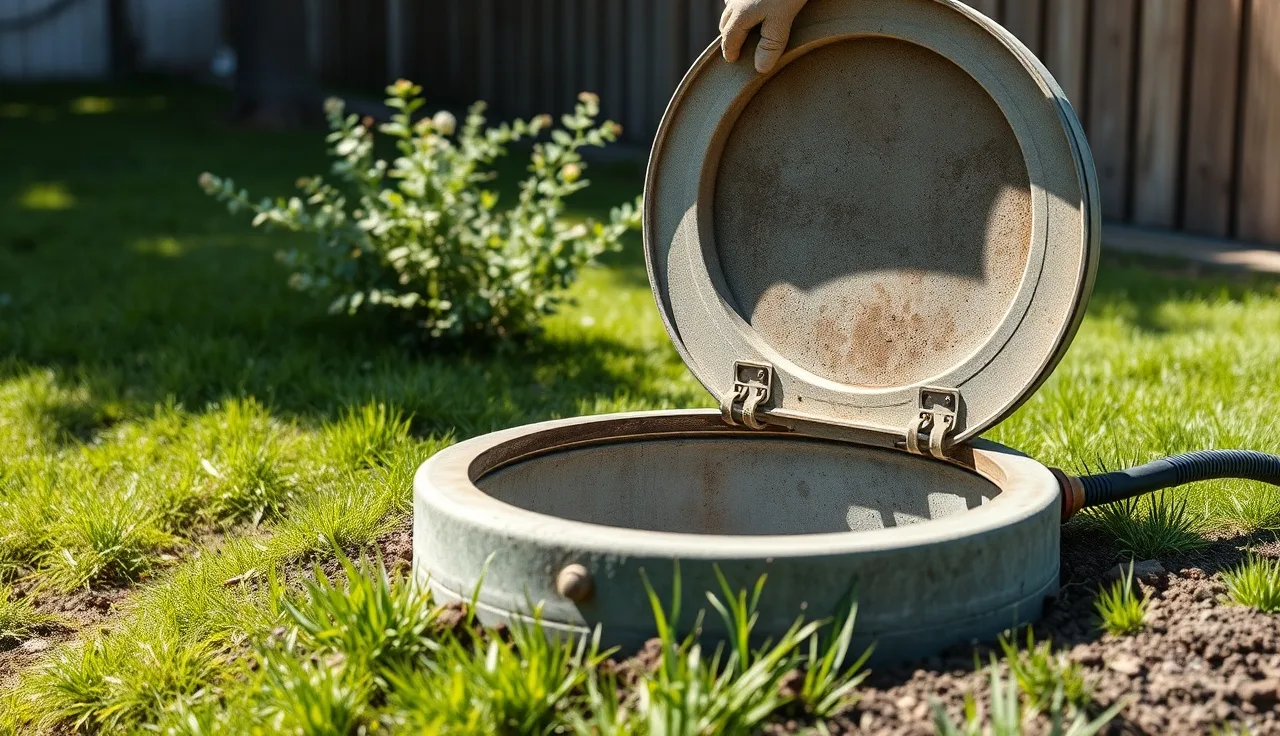
Aerobic septic system covers deserve a mention because they confuse homeowners. The small green or tan dome-shaped caps in yards on ATU properties cover the air pump cleanout ports, spray emitter heads, or access risers for the aeration and disinfection chambers. They are not decoration. They shield the components from UV damage, lawnmowers, and unauthorized access. If one cracks or goes missing, replace it fast: exposed spray heads clog with dirt, and exposed risers are both a safety hazard and a code violation in many places.
What are septic system risers and lids, and do you need them?
Older systems got buried with their access openings down at tank depth, sometimes four feet under or more. Every pump-out or inspection meant digging to find them. That costs money and it kills any motivation to do routine maintenance.
Risers are vertical pipes, usually concrete or HDPE, that run from the tank's access openings up to ground level or just below it. A lid snaps or bolts onto the top of each riser. Most tanks have two access points, one over the inlet end and one over the outlet. Some have a third opening in the center.
HDPE risers are lighter, easy to cut to height, and will not crack like concrete. They are the standard for new installs and for retrofitting older tanks. The lids are usually friction-fit or screw-down, and they come in green or black to disappear into a lawn.
Riser lids have to be watertight and secured. An unsecured lid is a drowning hazard for children and pets. Some state codes require locking lids. Most HDPE systems offer a bolt-down security lid, and the extra $20 to $40 is worth it.
If your tank has no risers to grade, adding them at your next septic tank cleaning is one of the smartest moves you can make. It runs $200 to $600 per opening depending on depth and material [3], and it pays for itself after one or two pump-outs because the pumper stops charging you to dig.
How do you know when a septic component is failing?
Each part fails in its own way. Learn the signs and you catch problems before they turn into disasters.
A failing inlet or outlet baffle usually shows up as solids in the drain field (visible on a camera inspection) or as frequent backups. A cracked or worn concrete tank shows up as groundwater infiltration (the tank fills between pump-outs far faster than your water use explains) or as sunken spots in the yard above it.
A D-box out of level tends to leave one wet, soggy patch over one trench while the rest of the yard looks fine. Effluent surfacing over part of the field while other parts stay dry is the classic D-box tell.
Drain field failure has several warning signs: sewage odors in the yard, wet or spongy ground over the field, slow drains throughout the house (more than one fixture), and sewage backing up into the lowest fixtures. Not every slow drain means a dying field; sometimes it is just a clogged pipe. But if slow drains line up with soggy ground over the field, assume the field until proven otherwise.
An aerobic system's air pump often warns you out loud. It gets louder before it dies, or the alarm light on the control panel comes on. Most ATU panels have a red alarm light wired to a float switch that senses high water in the aeration chamber, which is what happens when the pump quits and aeration stops.
A proper septic tank inspection checks every reachable component: baffle condition, sludge and scum levels, tank integrity, riser condition, the effluent filter if there is one, and any visible field issues. That guide walks through what operators look for and what the checklist covers.
How much do septic system components cost to repair or replace?
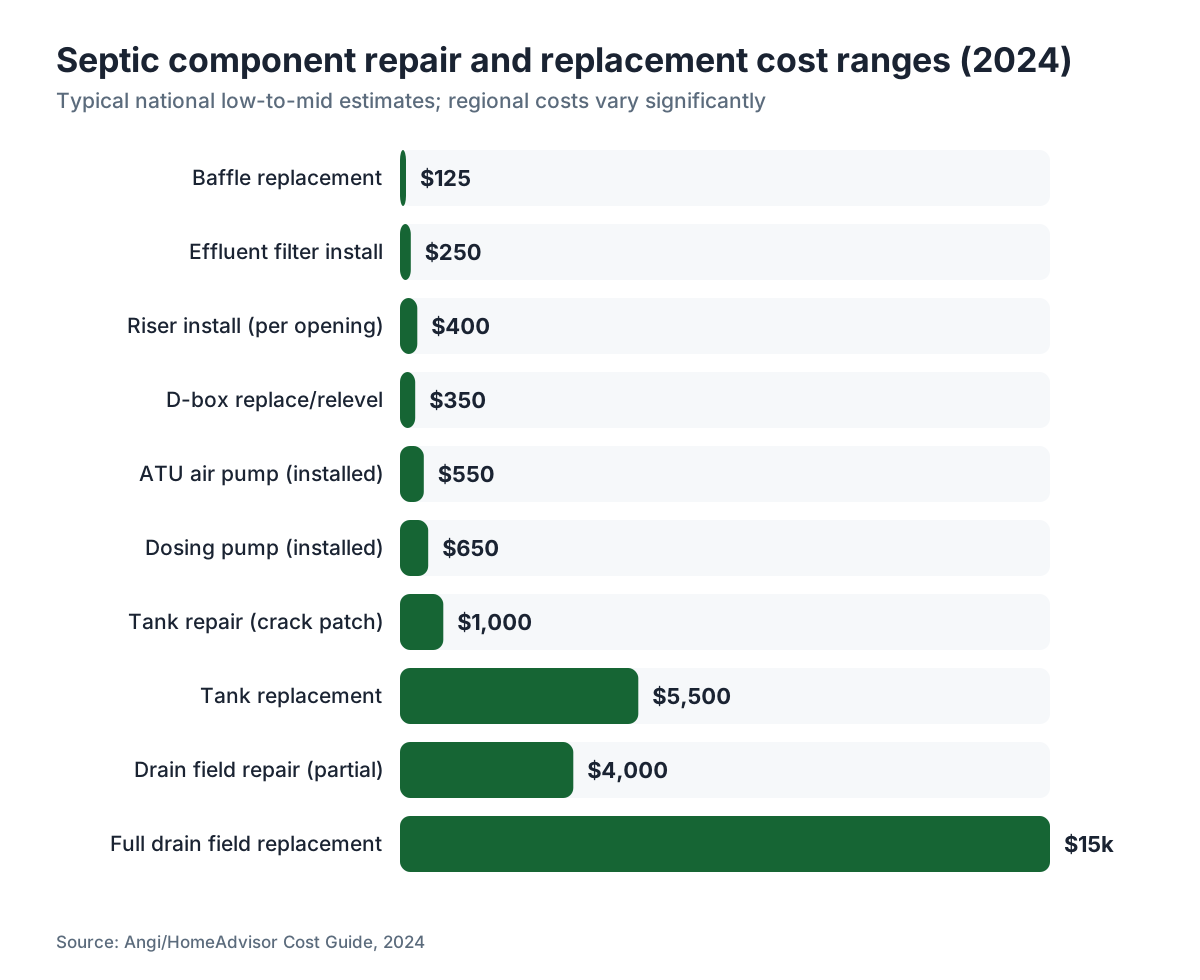
Costs swing hard by region, access, and how long a problem sat ignored. These are honest national ranges from contractor pricing data; your local quote will land somewhere inside or near them.
| Component | Repair or replacement cost (2024 estimates) |
|---|---|
| Baffle replacement (at pump-out) | $50-$200 |
| Effluent filter installation | $150-$350 |
| Riser installation (per opening) | $200-$600 |
| D-box replacement or releveling | $200-$500 |
| ATU air pump replacement | $300-$800 installed |
| Dosing pump replacement | $400-$900 installed |
| Septic tank repair (crack patching) | $500-$1,500 |
| Septic tank replacement | $3,000-$8,000 |
| Drain field repair (partial) | $2,000-$6,000 |
| Full drain field replacement | $5,000-$25,000+ |
The pattern is plain. The further downstream the failure, the more it costs to fix. A $150 effluent filter installed today can save you a $15,000 drain field five years out. That math is not hard.
For the full picture on a new install, the cost to install septic system article breaks it down by system type, soil, and region. If you are weighing component repairs against starting fresh, the cost to put in a septic tank guide covers it.
Operators running service routes get real value from tracking which components failed at which properties and how often. That is the kind of data SepticMind was built to organize. Predictive maintenance based on component age and service history means fewer emergency calls and tighter scheduling.
What alternative septic system components exist for difficult sites?
Not every lot can support a conventional gravity drain field. When soil drains too fast (sandy or gravelly) or too slow (heavy clay), or the water table sits too high, or the lot is just too small, engineers design around it with alternative components [8].
Mound systems build the drain field above natural grade, using imported sand fill to create the soil depth needed above the seasonal high water table. Effluent gets pumped up to the mound. Mounds are bigger and more visible than conventional fields, and they need a pump chamber with a pump, float switches, and a control panel.
Drip irrigation systems use small-diameter tubing buried just below the surface, delivering effluent in timed doses right to the root zone. They need filtration (to keep emitters clear), a pump, and careful pressure control. They pair well with aerobic systems because the highly treated ATU effluent is less likely to clog emitters.
Constructed wetlands and recirculating sand filters turn up occasionally on residential lots, though they are more common at small community systems. They produce genuinely high-quality effluent, but they take space and need active management.
Evapotranspiration (ET) systems are built for arid climates, where solar evaporation and plant uptake dispose of effluent with no soil percolation at all. Parts of the Southwest use them, and they live or die by the weather. They fail badly if water use spikes during a cool, wet stretch.
Every alternative system asks more of you on operation and maintenance than a conventional one does. Knowing every part of your specific system is the only way to know what to inspect and how often. Your state's onsite wastewater rules (often called the state sanitary code) spell out which alternatives are allowed and under what conditions [2].
How often should each septic system component be inspected or serviced?
No single schedule fits every system, but here is a workable framework built on EPA guidance and common industry practice.
The septic tank should be pumped and inspected every 3 to 5 years for a typical household [1]. The EPA's SepticSmart program puts its baseline this way: "have your system inspected (every three years) by a professional and pumped as recommended by your inspector (generally every three to five years)" [1]. Households with garbage disposals, more people than the system was designed for, or smaller tanks may need pumping every year or two.
The effluent filter should be cleaned every 1 to 3 years. Doing it at pump-out is easiest.
Baffles should be eyeballed at every pump-out. Replacement is as-needed, but a system over 20 years old with original concrete baffles deserves a careful look [4].
The D-box should be checked for level and root intrusion every 3 to 5 years. It rarely needs replacing, but releveling is a common, cheap service.
Aerobic components run on tighter schedules. Most state rules require ATU inspection every 6 to 12 months by a licensed technician [2]. The air pump diaphragm may need replacing every 3 to 5 years even while the pump still runs, because a worn diaphragm runs less efficiently. Chlorine tablet levels in the disinfection chamber should be checked every 3 to 6 months.
Drain field resting and rotation, if your system has alternating field capability, can add real years to field life. Most homeowners have no idea whether they have alternating distribution; a quick look at the D-box or valve chamber tells you.
Not sure how often to pump septic tank for your household size and tank volume? That guide has a table mapping occupancy and tank size to a pumping interval. For operators juggling dozens of accounts across different system types and service histories, SepticMind's scheduling tools automate these intervals so nothing slips.
Frequently asked questions
What are the four main components of a conventional septic system?
The four main components are: (1) the inlet pipe from the house, (2) the septic tank where solids settle and anaerobic bacteria digest waste, (3) the distribution system (either a gravity D-box or a pressurized pump chamber) that spreads effluent evenly, and (4) the drain field where clarified effluent filters through soil. Each has a different lifespan and a different way of failing.
What is the difference between a conventional and an aerobic septic system?
A conventional system runs on gravity and anaerobic bacteria. An aerobic system adds an electric air pump that feeds oxygen to aerobic bacteria in an aeration chamber, producing much cleaner effluent. Aerobic systems also include a disinfection chamber (usually chlorine or UV) and often discharge through spray or drip irrigation instead of a standard drain field. They cost more to run and need more frequent servicing.
How long do septic system components last?
Concrete tanks typically last 25 to 40 years or more if the soil is not corrosive. Fiberglass and HDPE tanks last longer. Baffles inside concrete tanks may deteriorate in 15 to 20 years from hydrogen sulfide exposure. Drain field pipes can last 20 to 30 years, but the field itself can last decades if it is never overloaded with solids or excess water. ATU air pumps typically last 5 to 10 years.
What does an effluent filter do and how often does it need to be cleaned?
An effluent filter sits in the outlet tee of the septic tank and strains fine solids and hair from effluent before it reaches the drain field. That protects the field from early clogging. Clean it every 1 to 3 years. A clogged filter causes slow drains or backups inside the house, which is by design: it warns you before the drain field takes damage.
What does the distribution box (D-box) do, and how do you know if it fails?
The D-box splits effluent evenly among the drain field trenches. If it settles or tips out of level, one trench takes most of the flow and saturates while others go unused. Signs of a failed or tilted D-box include one soggy patch over the field while the rest looks dry, and effluent surfacing in a concentrated area. Releveling or replacing a D-box typically costs $200 to $500.
Why does an aerobic septic system have covers in the yard, and what are they?
Aerobic septic system covers are protective caps over the spray emitter heads, air pump cleanout ports, and access risers on an ATU system. They shield those components from UV damage, lawnmowers, and accidental access. They are not decoration. Replace a cracked or missing cover promptly: exposed spray heads clog with debris, and uncovered risers are a safety hazard and often a code violation.
Can septic system components be repaired, or does the whole system need to be replaced?
Most components can be repaired or replaced on their own. Baffles, effluent filters, D-boxes, risers, and air pumps are all straightforward swaps. Septic tanks can sometimes be patched for cracks, though severe structural failure means a full tank replacement. Drain fields are the toughest: partial restoration is sometimes possible, but a fully failed field usually needs replacing. See the septic system repair guide for specifics.
What happens if septic tank baffles are missing or broken?
Without a working outlet baffle, floating scum runs straight from the tank into the drain field. That scum clogs the biomat layer far faster than clarified effluent would. A missing inlet baffle lets incoming flow disturb the settled sludge, stirring solids toward the outlet. Both problems speed up drain field failure. Check baffles at every pump-out; replacement is cheap when you catch it early.
What is a pump chamber (dosing chamber) in a septic system?
A pump chamber is a separate watertight tank installed after the septic tank. It holds clarified effluent and contains a submersible pump, float switches, and often an alarm float. The pump doses effluent to the drain field in timed, measured batches rather than a steady trickle. That rests the field between doses and is required for pressure distribution systems and mound systems. Pumps typically last 7 to 15 years.
How do I find out what components my septic system has?
Start with the as-built drawing (sometimes called the record drawing or septic permit), which should be on file with your county or local health department. It shows tank location, tank size, distribution method, drain field layout, and system type. If no drawing exists, a licensed inspector can probe the yard, camera the lines, and document what is there. Some states keep online permit databases searchable by address.
What are the most common septic system component failures?
The most common failures, roughly in order: (1) outlet baffle deterioration in older concrete tanks, (2) effluent filter clogging in tanks that have one, (3) drain field saturation from solids carryover or hydraulic overload, (4) D-box settling and uneven distribution, and (5) ATU air pump failure. Most are preventable with regular pumping and inspection on the EPA's recommended 3 to 5 year cycle.
Is a garbage disposal bad for my septic system components?
Yes, meaningfully so. Garbage disposals add far more solids to the tank than a household without one. The EPA SepticSmart program notes that disposals increase the amount of solids entering the system, which increases the need for pumping [11]. Those extra solids fill the tank faster, raise the risk of solids reaching the drain field, and add organic load that can overwhelm anaerobic digestion. If you have a disposal, shorten your pumping interval, or think about removing it.
Do all septic systems have a drain field, or are there alternatives?
Most conventional and aerobic residential systems discharge to some kind of soil-based system, but the layout varies. Options include conventional trenches, mound systems built above grade, drip irrigation tubing, and evapotranspiration beds for arid climates. A few specialized systems discharge treated effluent to surface water or use constructed wetlands, but those are rare for homes and heavily regulated. The drain field or its equivalent is always the final treatment step.
Sources
- US EPA, SepticSmart: How Your Septic System Works: The EPA identifies four core components of a conventional septic system and recommends pumping every 3 to 5 years; SepticSmart guidance states 'have your system inspected (every three years) by a professional and pumped as recommended by your inspector (generally every three to five years).'
- US EPA, Onsite Wastewater Treatment Systems Manual (EPA/625/R-00/008): State onsite wastewater codes typically require 150 to 300 square feet of drain field trench bottom per bedroom; pressure distribution and alternative systems are required for challenging soil or topography; aerobic treatment systems require state-approved service contracts.
- HomeAdvisor (Angi), Septic System Repair and Replacement Cost Guide: Baffle replacement at pump-out costs $50 to $200; riser installation costs $200 to $600 per opening; ATU air pump replacement installed runs $300 to $800; full drain field replacement ranges $5,000 to $25,000+.
- National Environmental Services Center (NESC) at West Virginia University, Septic System Owner's Guide: Outlet baffles in concrete tanks deteriorate within 15 to 20 years due to hydrogen sulfide gas attack on concrete; PVC sanitary tees are the recommended modern replacement.
- University of Minnesota Extension, Septic System Owner's Guide: Distribution boxes settling out of level cause uneven loading across drain field trenches, leading to premature failure of the overloaded trench while others remain underutilized.
- North Carolina Cooperative Extension, Septic Systems and Their Maintenance: A garbage disposal significantly increases solids load in the septic tank, requiring more frequent pumping; drain field biomat provides final pathogen removal in soil-based systems.
- Virginia Department of Health, Onsite Sewage and Water Services: Alternative septic components including mound systems, drip irrigation, and aerobic treatment units are permitted for sites where conventional gravity drain fields cannot function due to soil or site constraints.
- NSF International, NSF/ANSI 40 Standard for Residential Wastewater Treatment Systems: Aerobic treatment units must meet NSF/ANSI 40 performance standards, which include testing effluent quality from the aeration, clarification, and disinfection chambers.
- Florida Department of Health, Onsite Sewage Treatment and Disposal Systems (Chapter 64E-6, F.A.C.): Minimum tank size requirements for new installations in Florida are 1,050 gallons for up to a three-bedroom home; state code mandates effluent filters on new tank installations.
- US EPA, How to Care for Your Septic System: EPA SepticSmart guidance explicitly notes that garbage disposals increase the amount of solids entering the septic system, increasing the need for pumping.
Last updated 2026-07-09