Septic inspection in Aquebogue, NY: what to expect and what it costs
By the SepticMind Editorial Team
TL;DR
- A septic inspection in Aquebogue, NY costs $300 to $700 and takes two to four hours.
- Suffolk County Health Services requires a licensed inspector and a flow test.
- Most home sales here trigger an inspection.
- Older cesspools, common on this stretch of the North Fork, often fail and require replacement with an innovative/alternative (I/A) system under Suffolk County's rules.
Why does Aquebogue have stricter septic rules than most of New York?
Aquebogue sits over a sole-source aquifer that supplies drinking water to most of Suffolk County, and that single fact drives everything about the rules here. The hamlet is part of the Town of Riverhead on the North Fork of Long Island. The groundwater table runs shallow, sometimes only four to eight feet below grade, and the surrounding Peconic Estuary has documented nitrogen problems traced partly to failing septic systems. So Suffolk County went well past New York State's baseline.
In 2020, the county passed Local Law 38, which established the Suffolk County Septic Improvement Program and created financial incentives to swap conventional cesspools and septic systems for nitrogen-reducing innovative/alternative (I/A) systems [1]. The county also enforces Article 19 of the Suffolk County Sanitary Code, which governs design, siting, and inspection for all onsite wastewater systems [2]. Both apply to every property in Aquebogue.
Here's what that means for you. If you're buying or selling, adding a bedroom, or your system gets reported as failing, you deal with the Suffolk County Department of Health Services (SCDHS) Office of Wastewater Management as much as any private inspector. Understand that relationship before you hire anyone. It saves a lot of confusion later.
What does a septic inspection in Aquebogue actually involve?
A thorough inspection here has five parts. Skip any of them and you get the kind of failure that surfaces six months after closing.
First, the inspector locates and uncovers the system. Many older Aquebogue properties have cesspools instead of conventional two-compartment tanks with a separate leach field. A cesspool is a single buried concrete ring that handles solids and effluent in one chamber. The inspector has to physically expose the lid, which sometimes means digging. Expect $50 to $150 extra if the lid sits more than a foot deep.
Second, the tank or cesspool gets measured for solids. Most inspectors use a measuring stick or an electronic probe. A cesspool more than one-third full of solids is functionally compromised. A conventional tank with the sludge layer within six inches of the outlet baffle needs pumping before anyone can fairly judge the drain field.
Third, the flow test. The inspector runs water from several fixtures at once for 15 to 30 minutes while watching for surfacing effluent, slow drainage, or sewage odor. This is where leach fields and cesspool absorption fields show their true condition. A healthy system takes the flow. A failing one backs up.
Fourth, component check: inlet and outlet baffles or tees, the distribution box if there is one, and the risers. Broken baffles are one of the most common defects in Suffolk County inspections. They let raw solids push straight into the absorption field and speed up failure.
Fifth, the written report. If the inspection is for a real estate transaction, that report may go to SCDHS depending on the system type and local rules. Ask your inspector upfront whether their report format meets Suffolk County's documentation standards.
Our septic tank inspection guide breaks down what any home septic inspection covers.
How much does a septic inspection cost in Aquebogue?
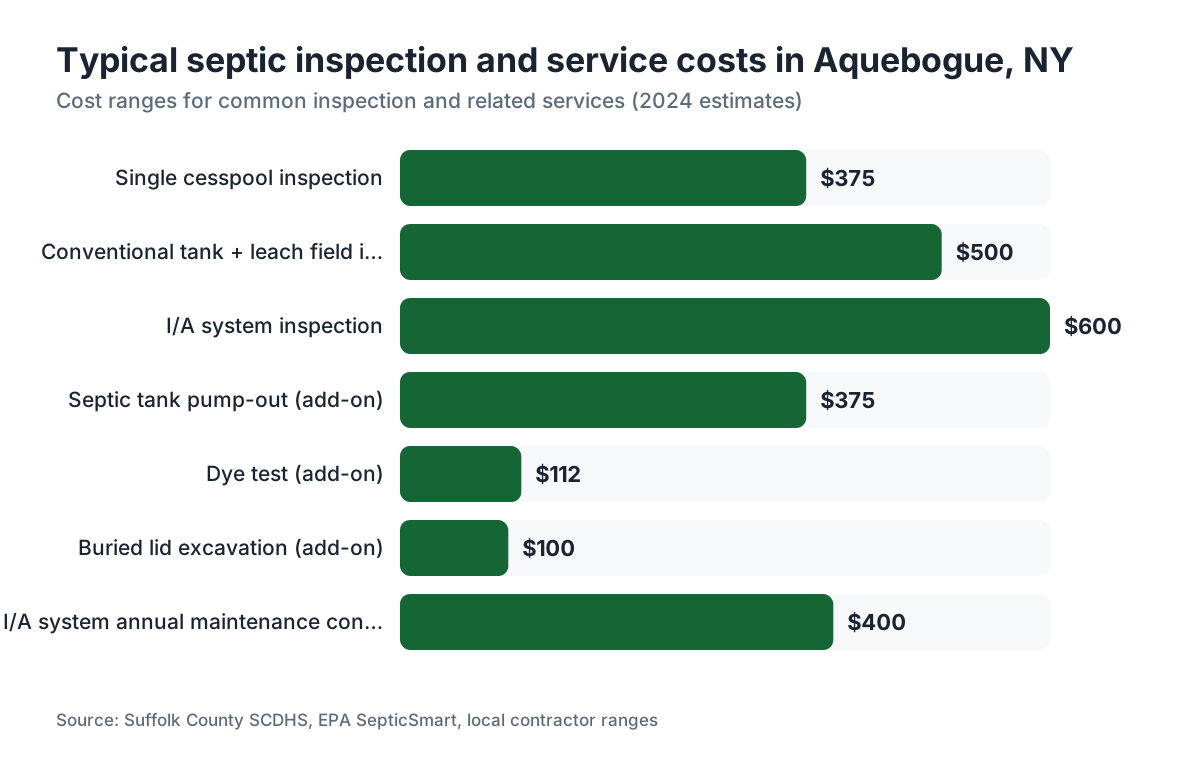
The honest range is $300 to $700 for a standard inspection in Aquebogue and the surrounding North Fork. That's wider than you'd see in, say, suburban New Jersey, because the type of system changes the job a lot.
A single cesspool on a small lot inspects faster than a two-compartment tank with a distribution box feeding a 1,000-square-foot leach field. Inspectors price by time and complexity.
| System type | Typical inspection cost (Aquebogue area) | Notes |
|---|---|---|
| Single cesspool | $300 to $450 | Most common on older properties |
| Conventional septic tank + leach field | $400 to $600 | Includes flow test |
| I/A (innovative/alternative) system | $500 to $700 | Extra components to check |
| Dye test add-on | $75 to $150 extra | Some lenders require this |
| Lid excavation (if buried) | $50 to $150 extra | Very common on older lots |
Pumping is almost always separate. If the tank needs emptying before the inspection can continue, add $250 to $500 for a septic tank pump out in Suffolk County. Some companies bundle a basic pump with the inspection fee. Most don't. Confirm when you book.
One thing I'd flag: the cheapest inspector in the area is rarely the right call. Aquebogue's groundwater sensitivity and the county's enforcement posture mean one missed defect can cost you tens of thousands in mandated upgrades. Pay for someone who knows Suffolk County's system types.
Who is qualified to perform a septic inspection in Aquebogue?
New York State licenses professional engineers (PE) and registered sanitarians to perform and certify septic inspections. In Suffolk County, SCDHS keeps its own roster of licensed professionals for inspections tied to permits and real estate transactions [2].
For a standard home sale, most buyers hire either a licensed home inspector with a septic specialty or a licensed engineer. The engineer costs more but produces a report that carries more legal weight and is more likely to satisfy lenders who want engineering certification.
Certified technicians from the National Association of Wastewater Technicians (NAWT) are another solid option. NAWT trains inspectors specifically on onsite systems and issues its own certification [3]. That credential doesn't replace a PE stamp for permit work, but for a buyer's due-diligence inspection it means something.
Avoid the general home inspector who tacks septic on as an add-on and has never opened a cesspool in Suffolk County. The cesspool-heavy inventory here is different from conventional systems elsewhere. You want someone who has seen enough rings to tell one in advanced failure from one that just needs pumping.
What are the most common septic failures found during Aquebogue inspections?
Cesspools at the end of their absorption life. This is the single most common finding on the North Fork. A cesspool has a finite surface area for effluent to percolate into the soil. Once that soil clogs with biomat (a layer of organic material that seals the pores), the cesspool backs up. There's no real repair short of replacement. EPA's SepticSmart program notes that clogged soil absorption areas are the leading cause of system failure nationwide [4].
Broken or missing baffles. The inlet baffle slows incoming flow so solids settle to the bottom instead of blowing straight through. The outlet baffle keeps floating scum from heading out to the drain field. Both wear down over time, especially concrete baffles in systems installed before the 1980s.
Structural cracks. Older concrete rings crack from soil movement, vehicle traffic overhead, or tree roots. A cracked cesspool lets groundwater in (which overwhelms the system) or lets raw effluent leak into surrounding soil before treatment.
Saturated drain fields. On properties with conventional leach fields, a leach field failure gets expensive fast. Heavy clay soils in parts of Aquebogue drain poorly, and an undersized system saturates the field faster than the design allows.
Inspectors also find systems that were expanded, with an added bedroom or accessory dwelling, without a matching system upgrade. That violates both the original permit and Article 19 of the Sanitary Code.
What happens if a septic system fails inspection in Aquebogue?
It depends on whether the failure is a maintenance problem or a structural one. That distinction sets the price and the timeline.
A maintenance issue, like a full tank or a broken baffle, is fixable. You pump the tank, replace the baffle, and re-inspect. Costs stay manageable: a few hundred dollars for septic tank repair on the baffle, plus pumping.
A structural or absorption failure is a different animal. SCDHS can issue a Notice of Violation and require a system upgrade within a set timeframe. Under the Septic Improvement Program, homeowners replacing a failed system may qualify for grants (up to $20,000 as of 2023) and low-interest loans toward a nitrogen-reducing I/A system [1].
Replacing a cesspool with a full conventional system or an I/A system in Suffolk County runs roughly $15,000 to $40,000 depending on site conditions, soil percolation, and the specific I/A technology. Our cost to install septic system overview gives a broader sense of what these projects involve.
In a real estate deal, a failed inspection usually triggers negotiation. Buyers can ask sellers to repair or replace before closing, take a price credit, or walk. In the current market, sellers who already swapped cesspools for I/A systems often use that as a selling point, and they should.
Does Suffolk County require a septic inspection when selling a home in Aquebogue?
New York State has no statewide mandatory septic inspection law for home sales. But Suffolk County and the Town of Riverhead have their own requirements that make inspections standard practice in most transactions here.
SCDHS requires a Certificate of Compliance for any system serving a property being sold if the system was installed under a county permit after a certain date, or if the property sits in a designated sensitive area. The North Fork, including Aquebogue, falls within the county's Peconic Estuary watershed protection zone, which draws heightened scrutiny [2].
Mortgage lenders push it further. They almost universally require a septic inspection before funding a loan on a property with an onsite system. FHA and VA loans carry specific septic adequacy requirements. A system with a documented failure won't clear underwriting.
My recommendation: don't wait for the buyer to order the inspection. Get your own pre-listing inspection. It costs $300 to $700 and either confirms you have no problem or gives you time to handle the issue on your schedule instead of the buyer's closing clock.
How does Suffolk County's I/A septic program affect Aquebogue homeowners?
The county's Reclaim Our Water initiative and Local Law 38 built one of the most active cesspool replacement programs in the country. The goal is to cut nitrogen loading to the Peconic Bay system by replacing conventional cesspools with I/A systems that reduce total nitrogen in effluent by 70% or more [1].
For Aquebogue homeowners, this matters two ways.
First, if your cesspool fails and SCDHS requires replacement, they will almost certainly require an I/A system rather than a conventional tank and leach field. The county keeps an approved list of I/A technologies; common ones include AdvanTex (Orenco Systems), the BioMicrobics FAST system, and Hydro-Action systems. Each needs an ongoing maintenance contract, usually $300 to $500 per year, because they have mechanical or biological parts that need professional servicing.
Second, even if your system hasn't failed, you might replace it early to access grant funding. The Suffolk County Septic Improvement Program has issued over 4,000 grants since its 2017 launch [1]. Funding availability shifts every year, so check directly with SCDHS or the Suffolk County Department of Economic Development and Planning for the current grant cycle.
Operators managing multiple properties here have to track inspection schedules and maintenance contracts across a whole client base. Tools like SepticMind handle that kind of multi-property workflow for operators working in regulatory environments like Suffolk County's.
How often should Aquebogue homeowners pump and inspect their septic systems?
EPA recommends pumping most household septic tanks every three to five years [4]. That's a fair baseline, but it's often too infrequent for Aquebogue cesspools, which hold less effective volume than a properly sized two-compartment tank.
For a single cesspool serving a family of four, many experienced Suffolk County pumpers recommend every two to three years. For a two-compartment conventional system with a healthy leach field and typical water use, three to five years is usually right.
What pushes you toward more frequent service: garbage disposals (they add a lot of solids), more people than the system was designed for, water softeners (excess brine disrupts the bacteria), and any history of the system running slow or backing up.
Inspections and pumping don't have to happen together, but combining them is efficient. When a pumper is already on-site with the lid open, a visual check of baffles, inlet, and outlet takes ten minutes. Ask your pumper to include it.
See our guides on how often to pump septic tank and septic tank cleaning for more on intervals and what a pump-out looks like.
How do you find a reputable septic inspector in Aquebogue?
Start with the Suffolk County Department of Health Services. The SCDHS Office of Wastewater Management keeps a list of licensed professional engineers and sanitarians approved for inspections tied to county permits and compliance certificates [2]. If your inspection has to satisfy a county requirement, that list is where you begin.
For buyer's inspections that don't need county certification, ask your real estate attorney or agent for referrals. North Fork attorneys deal with septic issues constantly and generally know who does good work and who misses things.
When you call an inspector, ask directly: How many cesspools have you inspected in Riverhead Township this past year? Do you carry errors and omissions (E&O) insurance? Will your report satisfy SCDHS if the county needs documentation? What's your plan if the lid is buried more than two feet down?
Get at least two quotes. The price gap between competent inspectors in the same market rarely tops $100 to $150. If someone quotes $150 for a full septic inspection in Aquebogue, they're either skipping steps or using it as a loss leader to upsell.
One more thing: septic tank pumping companies that have worked Aquebogue for years often know the local system inventory better than a general home inspector. Some offer inspections. Just confirm the inspector is separately licensed and more than the truck driver.
What should Aquebogue homeowners do to maintain their system between inspections?
The basics aren't exciting, but they work. Spread laundry across the week instead of six loads on Saturday. Fix leaky toilets fast, because a running toilet can push 200 gallons of extra water a day through a system designed for 75 gallons per bedroom per day. Keep vehicles and heavy equipment off the ground above your cesspool or drain field.
Don't treat the toilet as a trash can. Wipes (even the ones labeled flushable), feminine hygiene products, paper towels, and medications all cause trouble. EPA's SepticSmart guidance is blunt: "Never flush anything besides human waste and toilet paper" [4].
Go easy on additives. The scientific consensus is that biological additives (bacteria, enzymes) are generally unnecessary in a normally functioning system, and chemical additives can damage soil permeability. University of Minnesota Extension's review of the research found no consistent evidence that commercial septic additives improve performance or extend system life [5].
Plant grass over your cesspool or leach field, never trees or shrubs. Root intrusion is a real problem and can crack concrete rings or clog distribution pipes.
For anything past these basics, including septic system repair or component replacement, hire a licensed professional. SCDHS does not look kindly on unpermitted work on onsite systems in sensitive groundwater areas.
Frequently asked questions
How long does a septic inspection take in Aquebogue?
Most inspections run two to four hours start to finish. That covers locating and uncovering the system, measuring solids, running the flow test, checking components, and writing notes. If the lid is buried deep or the system is complex (multiple cesspools or an I/A system), plan for four hours or more. The written report usually lands within 24 to 48 hours after the site visit.
Can I use a home inspector for a septic inspection, or do I need an engineer?
For a standard buyer's due-diligence inspection, a licensed home inspector with documented septic experience can do the job. But if the inspection is tied to a Suffolk County permit, a Certificate of Compliance, or a lender wanting engineering certification, you need a licensed professional engineer (PE) or a SCDHS-approved sanitarian. When in doubt, ask the county office or your real estate attorney which credential the transaction requires.
Does Suffolk County offer financial help for septic replacement in Aquebogue?
Yes. The Suffolk County Septic Improvement Program offers grants up to $20,000 plus low-interest financing for homeowners replacing cesspools or conventional systems with nitrogen-reducing I/A systems. Aquebogue falls within the Peconic watershed area, which qualifies. Funding is allocated annually and can run out mid-year, so apply early. Contact the Suffolk County Department of Economic Development and Planning for the current application cycle.
What is the difference between a cesspool and a septic tank, and which is more common in Aquebogue?
A cesspool is a single concrete ring that takes raw sewage directly; solids settle at the bottom and liquid seeps out through perforations into the soil. A septic tank is a two-compartment sealed vessel that separates solids from effluent before the liquid moves to a drain field. Cesspools dominate older North Fork inventory, and Aquebogue has a lot of them, most installed before the 1970s. They have a finite lifespan and generally can't be repaired once absorption capacity is gone.
Will a dye test be required for my real estate transaction in Aquebogue?
Some lenders, especially those issuing FHA or VA loans, require a dye test as part of septic adequacy documentation. The test adds colored dye to household drains and watches for it to surface above ground near the septic area, which signals a surfacing failure. Not every transaction requires it, but some do. Confirm with your lender before the inspection so the inspector can add it in one site visit instead of a return trip.
How much does it cost to replace a cesspool with an I/A system in Aquebogue?
Gross costs typically run $20,000 to $40,000 for a single-family home in Suffolk County, depending on soil conditions, lot size, required capacity, and which I/A technology is used. After the county grant (up to $20,000), net out-of-pocket can land at $5,000 to $20,000. Get at least three quotes from contractors on the SCDHS approved list. Costs have climbed with material and labor prices since 2021, so older estimates online may read low.
Can a seller in Aquebogue refuse to fix a failed septic system?
In a private sale, a seller isn't automatically obligated to repair a failed system before closing unless there's a violation order from SCDHS or the contract requires it. But an undisclosed known defect creates legal liability. Most deals resolve failed findings through price negotiation or a seller credit. If the county already issued a Notice of Violation, the seller must disclose it, and the remediation obligation may transfer or need resolution before title can transfer cleanly.
What soil conditions in Aquebogue affect septic system performance?
The North Fork has variable soils. Sandy loam with good drainage supports healthy leach field function. Areas with heavier clay, particularly low-lying spots near the bays and creeks, drain poorly and can saturate fields faster. The shallow water table (sometimes four to eight feet below grade) also limits the vertical treatment distance between the bottom of the system and groundwater, one reason Suffolk County pushes I/A systems that treat effluent before it reaches the soil.
How do I know if my Aquebogue property has a permit on file for its septic system?
SCDHS keeps permit records for onsite systems going back decades. You can request a property file search through the Office of Wastewater Management. Older systems, especially cesspools installed before county permitting was routine, may have no permit on file. That's common and doesn't automatically mean the system is illegal, but it means there's no approved-design document to compare against current conditions during the inspection.
Is it safe to buy a home in Aquebogue if the septic system is a cesspool?
It can be, but price and plan for it. An older cesspool in decent condition with remaining absorption capacity and no current violations isn't an emergency, but it's a finite asset. Get the inspection, learn the condition, and factor likely replacement costs into your offer if the cesspool is aging. The county's grant program helps, but replacement still takes time and some out-of-pocket money. A cesspool in early failure is a serious negotiating point.
What records should I have before a septic inspector arrives?
Pull together any septic permits, the original system design if you have it, records of past pump-outs, and previous inspection reports. If you don't have permits, request the property file from SCDHS before the inspection. Knowing where the system sits saves digging time and inspection fees. If there's an as-built drawing, hand it to the inspector so they can verify the system was built to design and check every component.
Do I need to pump my septic tank before the inspection?
Not necessarily before, but possibly during. If the tank or cesspool is full, the inspector may not be able to assess baffle condition or evaluate drainage accurately. Many inspectors prefer to inspect first, then pump, then re-check. Others coordinate with the pumping company on the same visit. Ask about their workflow. If you know the system hasn't been pumped in over five years, scheduling a pump-out close to the inspection is smart planning.
Sources
- Suffolk County, NY, Septic Improvement Program: Suffolk County Local Law 38 (2020) established the Septic Improvement Program offering grants up to $20,000 for I/A system installations; over 4,000 grants issued since 2017 launch.
- Suffolk County Department of Health Services, Office of Wastewater Management: Article 19 of the Suffolk County Sanitary Code governs design, siting, and inspection of onsite wastewater systems; SCDHS maintains approved professional lists for inspections tied to permits.
- National Association of Wastewater Technicians (NAWT): NAWT offers a specialized inspector certification program for onsite wastewater systems.
- U.S. EPA, SepticSmart: EPA SepticSmart recommends pumping every 3 to 5 years, advises never flushing anything besides human waste and toilet paper, and notes clogged soil absorption areas are the leading cause of system failure nationwide.
- University of Minnesota Extension: University of Minnesota Extension reviewed research and found no consistent evidence that commercial septic additives improve system performance or extend system life.
- New York State Department of Health, Environmental Health: New York State does not have a statewide mandatory septic inspection law for home sales; baseline onsite system standards are set at state level with local county authority to adopt stricter rules.
- Suffolk County, NY, Reclaim Our Water Initiative: The North Fork including Aquebogue falls within the Peconic watershed; nitrogen loading from septic systems identified as a documented contributor to estuary water quality degradation.
- U.S. EPA, How to Care for Your Septic System: EPA notes that clogged soil absorption areas are the leading cause of septic system failure nationwide.
Last updated 2026-07-09