Septic inspection in Amagansett, NY: what to expect and what it costs
By the SepticMind Editorial Team
TL;DR
- A septic inspection in Amagansett costs $300 to $700 for a standard visual-and-probe check, and $700 to $1,200 with a full pump-out and dye test.
- Suffolk County's Department of Health Services enforces the county sanitary code, and most Town of East Hampton home sales need a passing inspection before title transfers.
Why does Amagansett have stricter septic rules than most of New York?
Amagansett sits inside the Town of East Hampton on the South Fork of Long Island, and the ground under it is sole-source aquifer. That aquifer system is the only source of drinking water for roughly 2.7 million people on Long Island [1]. The sandy, fast-draining soils that make the Hamptons easy to build on are the same soils that let untreated wastewater reach groundwater in days instead of years. That combination is why regulators here treat every septic system as a possible threat to the drinking supply.
Suffolk County's Department of Health Services (SCDHS) runs Article 6 of the Suffolk County Sanitary Code, which governs individual sewage disposal [2]. East Hampton Town stacks its own local rules on top of the county code. For a homeowner or buyer in Amagansett, that means the rules bite. Enforcement is active. Skipping an inspection before a sale or a renovation is a reliable way to stall a closing or trigger a stop-work order.
Nitrogen from old cesspools and conventional septic systems has measurably degraded water bodies on the East End, including Georgica Pond. Regulators used that data to require nitrogen-reducing systems in some areas. If your parcel sits in or near a nitrogen-sensitive overlay district, the inspection standard climbs. A good inspector knows which districts touch your lot before they ever open the tank.
What exactly does a septic inspection in Amagansett cover?
A standard inspection has four parts: document review, locating and opening the tank, a visual check of the tank and distribution system, and a leach field evaluation.
Document review means the inspector pulls your property's sanitary permit history from SCDHS records. That tells them what was permitted, when it went in, and whether earlier inspections flagged anything. On older Amagansett properties this step sometimes shows the installed system doesn't match the permit, which is a problem you want to catch before a buyer's attorney does.
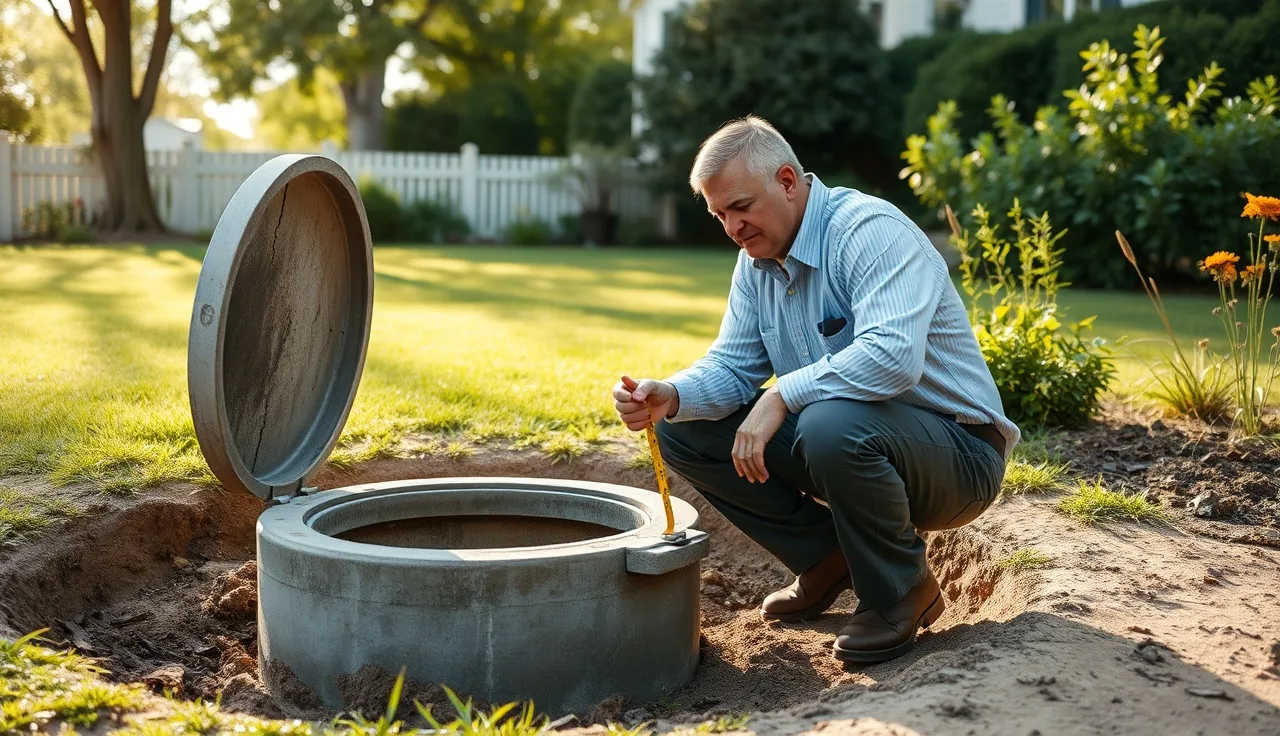
Locating and opening the tank sounds simple. It often isn't. On heavily landscaped Hamptons lots, tanks hide under mature plantings or pavers. Some inspectors fold basic locating into the fee. Others charge $50 to $150 extra to probe or camera-locate a buried lid. Once the tank is open, the inspector measures the scum and sludge layers. EPA's SepticSmart program says a tank needs pumping when the sludge reaches within 12 inches of the outlet baffle [3]. Hit that threshold and the inspector will call for a pump-out before they can finish a valid assessment.
The leach field is where inspectors split apart. A basic inspection probes the soil surface for soft spots, soggy ground, or surfacing effluent, and checks for odors. A thorough one adds a dye test: the inspector flushes fluorescent dye through the system, then watches field areas, ditches, and nearby surface water for dye breakthrough, which signals failure. Some local inspectors also run a camera on the outlet line between tank and field. Buy the higher-end inspection any time you're purchasing. The price gap is tiny next to what a failed field costs to replace.
A failed leach field is the most expensive outcome of a bad inspection. Replacing a drain field in Amagansett runs $15,000 to $50,000 or more depending on lot constraints and the system type required. Paying an extra $200 for a thorough pre-purchase inspection is simple math.
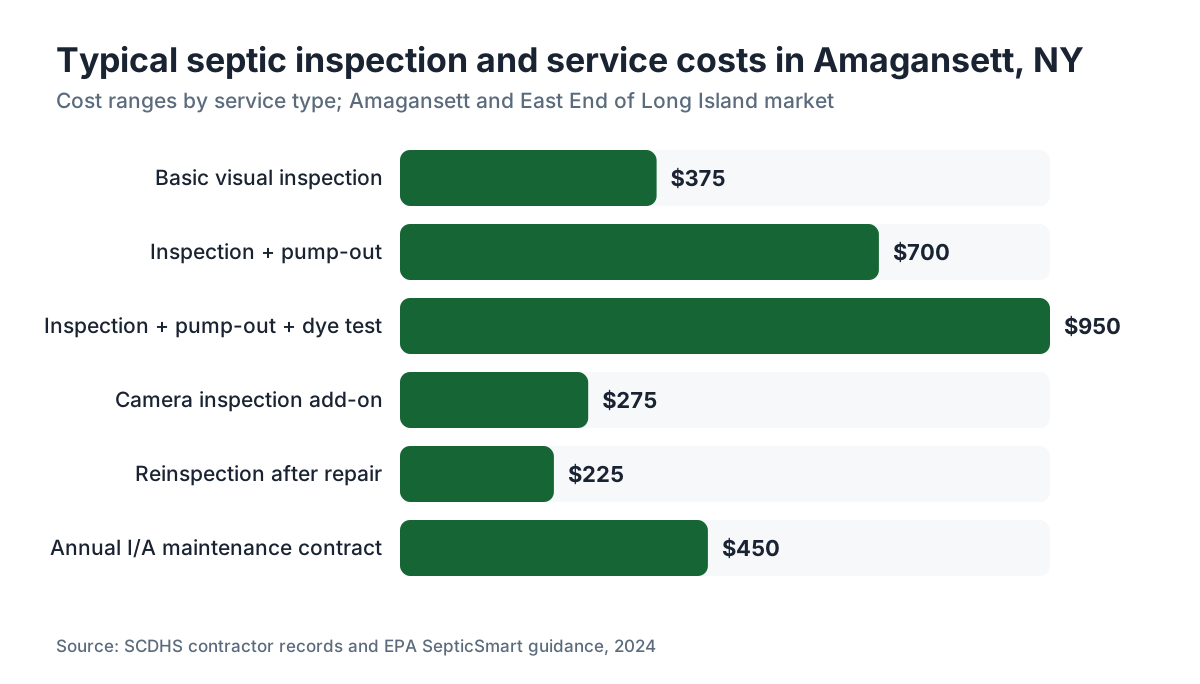
How much does a septic inspection cost in Amagansett?
Prices in Amagansett and the wider East Hampton market run above the national average. There are fewer qualified inspectors here, and demand spikes hard in spring and early summer as the real estate market moves.
| Inspection type | Typical cost range |
|---|---|
| Basic visual inspection (no pump-out) | $300, $450 |
| Full inspection with pump-out | $500, $900 |
| Inspection + pump-out + dye test | $700, $1,200 |
| Camera inspection of lines | $150, $400 add-on |
| Locating buried tank or lid | $50, $200 add-on |
| Reinspection after repair | $150, $300 |
These ranges come from licensed inspectors active in Suffolk County and from SCDHS permit records showing contractor-reported costs. There's no single published survey of Amagansett-specific inspection fees, so treat the numbers as honest estimates, not guarantees. They line up with what New York State-licensed engineers and sanitarians report charging on the East End.
One thing to know: many inspectors here also pump tanks. That's not a conflict of interest as long as you know it going in. If an inspector recommends a pump-out and also does pumping, ask for the pump-out price in writing before you agree. A septic tank pump out in this market costs $400 to $700 for a standard tank, and you can shop it.
If your inspector recommends septic tank cleaning as part of the process, that usually means hydro-jetting the outlet line or baffle area rather than just emptying the tank. It adds cost but gives a cleaner look at the system's real condition.
When do you legally need a septic inspection in Amagansett?
Three situations make an inspection effectively mandatory, and one just makes it smart.
First, real estate sales. The Town of East Hampton requires an inspection of the sanitary system as part of the transfer of title for most residential properties. The buyer's lender almost always requires it too, on its own. The inspection has to be done by an SCDHS-approved inspector, and a failing system usually has to be repaired or replaced before the property can transfer. The procedural requirement runs through the East Hampton Town Building Department [7].
Second, building permits. Add a bedroom, finish a basement into habitable space, or do any construction that changes your sewage design flow, and SCDHS requires a sanitary review. In practice that means confirming the existing system is sized for the new load, or requiring an upgrade. Pulling a building permit without the sanitary review is a routine way to get a certificate of occupancy held up.
Third, complaint-driven inspections. If a neighbor or a code officer sees surfacing sewage, files an odor complaint, or reports a discharge to surface water, the county can order an inspection. These aren't common, but they aren't rare in the denser parts of Amagansett where lots are small and neighbors are close.
Fourth, the smart-but-not-required case: routine maintenance. With no sale pending, a septic tank inspection every 3 to 5 years gives you early warning before a $300 maintenance visit becomes a $30,000 drain field replacement.
Who is qualified to inspect a septic system in Amagansett?
New York has no single statewide septic inspector license the way some states do. County health departments handle local compliance under Public Health Law and 10 NYCRR Part 75 [6]. In Suffolk County, SCDHS keeps a list of approved engineers and registered sanitarians authorized to conduct sanitary surveys and sign off on inspection reports for property transfers [2]. For a real estate deal, your inspector has to be on that list. A home inspector with a general license but no SCDHS authorization can't sign a sanitary transfer report.
For a routine maintenance inspection with no sale attached, you have more room. Licensed plumbers, engineers, and experienced septic tank pumping contractors can all judge system condition competently, even if their report wouldn't satisfy SCDHS for a title transfer.
When you vet an inspector, ask three things straight out: Are you on the SCDHS approved list? Do you carry E&O insurance? How many systems in East Hampton or Amagansett have you inspected in the past year? Local experience matters a lot here. Soil types, field conditions, and the mix of systems in this area (old cesspools, standard leach fields, and now I/A systems) differ from what you'd find in western Suffolk or Nassau County.
Expect 3 to 5 business days to schedule off-season, and 2 to 3 weeks in spring when the transaction market is hot. Book early if you're working toward a closing.
What are the most common septic failures found during Amagansett inspections?
The sandy soil on the South Fork drains fast, so systems that would fail by ponding in clay soil instead fail by sending poorly treated effluent into the aquifer. Inspectors here look for a slightly different failure pattern than in the rest of the state.
The most common finding on older Amagansett properties is an undersized or degraded cesspool rather than a true septic system. Many homes built before 1973 never had a conventional tank and leach field. They used a single cesspool or a string of linked cesspools. SCDHS has been phasing out cesspools in sensitive areas, and if your property still has one, a pre-purchase inspection will almost certainly flag it as a deficiency requiring upgrade [2].
Other common findings:
- Cracked or collapsed concrete tank lids (a safety hazard and a maintenance failure)
- Missing or deteriorated outlet baffles (lets solids reach the field and clog it)
- Sludge above the pump-out threshold (fixed by septic tank emptying)
- Tree root intrusion into the outlet line
- Broken distribution box with uneven flow to field laterals
- Setback violations from wells, property lines, or surface water (needs engineering review to resolve)
Setback violations are the hardest to fix because they're geometric, not mechanical. If a tank or field sits too close to a well or a water body, you can't just repair it. You have to move it, which usually means a full replacement designed to fit inside current setbacks. On small Amagansett lots with existing wells, that gets genuinely tight and sometimes expensive.
For problems short of full replacement, septic tank repair or broader septic system repair can handle baffles, lids, distribution boxes, and line breaks at a fraction of new-system cost.
What is an I/A septic system and does your Amagansett property need one?
I/A stands for Innovative and Alternative, the New York term for advanced treatment systems that cut nitrogen in effluent before it reaches the soil. A standard residential septic system removes maybe 20 to 25% of the nitrogen in household wastewater. A certified I/A system removes 70 to 90% [4]. That gap matters a lot when your property drains toward an estuary or a sole-source aquifer.
New York's Clean Water Infrastructure Act funded advanced septic installation in nitrogen-sensitive areas, including Suffolk County [9]. Suffolk County extended the I/A requirement to all new construction and significant reconstruction in nitrogen-sensitive watersheds. Article 19 of the Suffolk County Sanitary Code and the county's groundwater management zones define which areas are covered [2].
In Amagansett specifically, properties near Georgica Pond, Hook Pond, and the Atlantic shoreline sit in or beside nitrogen-sensitive overlay areas. If an inspection shows your system needs full replacement, the SCDHS permit for the new system will almost certainly require I/A technology rather than a conventional leach field.
I/A systems cost more upfront. A conventional replacement in this market runs $20,000 to $40,000 installed. An I/A system runs $25,000 to $60,000 depending on the technology and site conditions. The upside: New York State and Suffolk County have offered grant and low-interest loan programs to offset the upgrade cost, administered through SCDHS [5]. Those programs have been oversubscribed in active years, so check current availability directly with SCDHS rather than assuming money is waiting.
I/A systems also require an annual maintenance contract and inspection by a certified service provider. That's an ongoing cost of $300 to $600 a year that a conventional system doesn't carry. Budget for it before you commit.
How should you prepare for a septic inspection on your Amagansett property?
Prep is simple, and it changes how the inspection goes and what it costs.
Find your as-built drawing before the inspector shows up. SCDHS has sanitary permit records for most properties and your inspector can pull them, but having the as-built in hand confirms the layout and saves time. If the previous owner left nothing in the house file, call the SCDHS Office of Wastewater Management and request records for your parcel.
Know your last pump-out date. If you can't document a pump-out inside the last 3 to 5 years, assume you'll need one as part of the inspection. A septic tank pumping company active in the area can pump on the same visit if you coordinate ahead, which saves a second mobilization fee.
Clear access. If the tank lid sits under a planting, a stone patio, or a shed that's been moved since the system went in, sort that out before the inspector arrives. An inspector standing around while you dig up rosebushes is billing you for the wait.
Go easy on the system for 12 to 24 hours before a field inspection. A field saturated by heavy morning laundry can look worse than it is. That isn't gaming the test. It's giving the system a fair look.
Ask your inspector ahead of time what the report will contain and how fast it lands. For a sale in Amagansett, closing attorneys routinely need the report in 48 to 72 hours. Set that expectation at booking, not after the inspection.
What happens if your Amagansett septic system fails inspection?
A failing report triggers a required repair or replacement before the property can transfer in a sale, or before the county clears a building permit application. The path forward depends on what failed.
For minor failures like a cracked lid, a missing baffle, or a line break, septic tank repair handles it. Costs run $200 to $1,500 depending on the fix. A reinspection confirms the repair.
For a cesspool that needs upgrading to a full septic system, or a leach field that's failed, the job becomes a full replacement design. That means hiring a licensed engineer to design a system that fits current SCDHS setbacks and soil conditions, submitting for a permit, then installing. The process takes 4 to 12 weeks in a clean case, longer with setback variances or nitrogen-sensitive overlay requirements.
In a sale, a failing inspection usually opens negotiation. The buyer can ask the seller to repair before closing, ask for a price cut, or accept an escrow holdback until repairs finish. What a buyer should never do is waive the inspection to win a bidding war. Septic failure on a Hamptons property isn't a small problem. It's a five-figure to six-figure problem.
EPA's SepticSmart guidance says it plainly: "Failing septic systems can contaminate groundwater and surface water" [3]. In Amagansett, where groundwater is your drinking supply, that's not abstract. It's your well.
How often should you pump and inspect your septic tank in Amagansett?
EPA recommends pumping a standard residential septic tank every 3 to 5 years [3]. The right interval for your tank depends on tank size and household size. A 1,000-gallon tank serving four full-time residents needs pumping closer to every 3 years. A 2,000-gallon tank serving two people who are only around seasonally might stretch to 5 to 7 years.
Amagansett adds a wrinkle: many properties are seasonal, packed in summer and quiet the rest of the year. A system slammed in July and August with a full house of guests piles up solids fast during those months, faster than the calendar suggests. Rent the place short-term and the math speeds up more. A rental occupied at high density through the summer belongs on a 2 to 3 year pump cycle, not 5.
For how often to inspect beyond the pump-out, how often to pump septic tank lays out the general framework. In Amagansett, pair the pump-out with a quick check of the baffles and distribution box every time. It adds maybe $50 to $100 to the bill and gives you a current condition record.
For I/A owners, the annual maintenance contract inspection is non-negotiable. Your operating permit requires it, and SCDHS tracks compliance. Miss an annual I/A inspection and you can put your operating permit at risk.
How does SepticMind help operators managing inspections in markets like Amagansett?
For septic companies working the East End, managing inspection scheduling, report delivery, and permit paperwork across many deals at once is genuinely hard. An inspector working Amagansett in spring may be juggling 15 to 20 open real estate transactions at a time, each with a closing attorney waiting on a signed report.
SepticMind's operations software is built for that kind of multi-job, document-heavy business. It handles scheduling, technician dispatch, report generation, and customer communication in one place, which matters when your inspector has to deliver a report to a closing attorney in 48 hours and can't afford to lose it in an email thread. Run a septic inspection or pumping company on Long Island, and it's worth seeing what structured job management does for turnaround time.
For homeowners, the takeaway is simpler: when you hire an inspector, ask how they deliver reports and how fast. A well-run inspection company sends a signed PDF within 48 hours. If an inspector gets vague about that, it's a decent proxy for how organized the rest of their operation is.
What does a new septic system cost if you need to replace one in Amagansett?
Full replacement is the outcome homeowners most want to dodge, so the cost range matters for negotiation and budgeting.
A conventional leach field system on an Amagansett lot where site conditions allow runs $20,000 to $40,000 installed, including excavation, tank, distribution box, and field. Add engineering and permit fees of $3,000 to $8,000. That's a $23,000 to $48,000 total range for a straightforward replacement.
An I/A system, now required in nitrogen-sensitive areas and often the only permitted option for replacements in Amagansett, runs $28,000 to $65,000 installed depending on the technology (I/A units from vendors like Fuji Clean and Hydro-Action are common in New York). Engineering and permits add the same $3,000 to $8,000.
For a wider look at cost ranges, cost to install septic system and cost to put in a septic tank cover the national and regional frameworks. Amagansett lands at the high end because of labor costs, permitting complexity, and the likelihood of I/A requirements.
New septic tank installation alone, when only the tank needs replacing and the field is intact, runs $3,000 to $8,000 on the East End. That's a much cheaper outcome than full replacement, which is exactly why a thorough inspection that tells a tank problem from a field problem earns back its cost.
Frequently asked questions
Do I need a septic inspection to sell my house in Amagansett?
Yes, effectively. The Town of East Hampton requires a sanitary system inspection as part of the property transfer process for most residential sales, and buyers' lenders require it on their own. A failing inspection usually has to be remediated before title transfers. The inspection must be done by an SCDHS-approved engineer or sanitarian, not a general home inspector.
How long does a septic inspection take in Amagansett?
A standard inspection takes 1.5 to 3 hours on site. That covers tank locating, opening, condition assessment, and a leach field walkover. Add another 1 to 2 hours if a pump-out is included. If a dye test is in scope, add 30 to 60 minutes after flushing to check for breakthrough. Complex properties or hard-to-find tanks run longer.
Can a home inspector do a septic inspection in New York?
A licensed home inspector can do a visual look at septic components as part of a general home inspection. But for a Suffolk County property transfer report that satisfies SCDHS, the inspector must be on the SCDHS-approved list of engineers and sanitarians. Verify your inspector's authorization before booking if the inspection is for a real estate transaction.
What is the difference between a cesspool and a septic system in Amagansett?
A cesspool is a single underground chamber that collects solids and liquids together, relying on surrounding soil to absorb effluent with almost no treatment. A septic system has a tank that separates solids from liquids, then a leach field that treats and disperses the effluent. Most Amagansett homes built before 1973 have cesspools, which SCDHS is progressively requiring owners to upgrade, especially near sensitive water bodies.
How much does it cost to replace a septic system in Amagansett?
Full replacement in Amagansett runs $23,000 to $65,000 depending on whether a conventional leach field or an I/A nitrogen-reducing system is required. Engineering and permits add $3,000 to $8,000. I/A systems are now required in many parts of Amagansett because of nitrogen-sensitive overlay districts. Suffolk County has offered grant programs to offset I/A upgrade costs; check current availability with SCDHS.
What is an I/A septic system and is it required in Amagansett?
I/A stands for Innovative and Alternative, the New York term for advanced treatment systems that reduce nitrogen in effluent by 70 to 90% versus conventional systems. Suffolk County requires I/A systems for new construction and replacement systems in nitrogen-sensitive watersheds under Article 19 of the Suffolk County Sanitary Code. Many Amagansett parcels near ponds and shorelines fall inside those zones.
How often should I pump my septic tank in Amagansett if I rent it out seasonally?
Every 2 to 3 years, not the 3 to 5 year standard. Short-term rentals see intensive seasonal use that speeds up sludge and scum buildup. A house running 8 to 10 guests through July and August for 10 weeks piles up solids faster than the calendar suggests. Get a pump-out and quick inspection each fall after the rental season ends.
What setback distances apply to septic systems in Amagansett?
The Suffolk County Sanitary Code requires minimum setbacks from septic components to wells (typically 100 feet from the tank, 150 to 200 feet from the leach field), property lines (10 feet from the tank), and surface water. Exact setbacks depend on the component type and the receiving water body classification. East Hampton may add local setback rules. Your engineer confirms parcel-specific requirements during permit design.
What happens if I buy a house in Amagansett without a septic inspection?
You take on full liability for whatever condition the system is in. If the cesspool or leach field fails in year one, the repair or replacement cost, anywhere from $5,000 for a minor fix to $60,000 for a full I/A installation, is yours. You may also face SCDHS enforcement if the failure causes a discharge. Skipping the inspection on a Hamptons property is a very expensive gamble.
Does Suffolk County offer financial help for septic upgrades in Amagansett?
Yes. Suffolk County has administered grant and low-interest loan programs for I/A system upgrades under New York's Clean Water Infrastructure Act funding. Availability has varied year to year, and funds have been oversubscribed in active years. Contact the SCDHS Office of Wastewater Management directly to ask about current program status before planning your upgrade budget.
Can I do any of my own septic maintenance to reduce inspection findings?
Yes. Keep accurate pump-out records, flush nothing but human waste and toilet paper, go light on the garbage disposal, and protect the leach field from vehicle traffic and deep-rooted plantings. These habits slow sludge buildup and cut the chance an inspector finds a compacted or root-invaded field. You can't swap DIY maintenance for professional pumping, but you can stretch the interval between serious problems.
How do I find a SCDHS-approved septic inspector for an Amagansett property?
Contact the Suffolk County Department of Health Services Office of Wastewater Management directly and ask for the current list of approved engineers and sanitarians authorized to conduct sanitary surveys in Suffolk County. You can also ask your real estate attorney or the East Hampton Town Building Department for inspectors they've seen active in recent deals. Verify the inspector's specific SCDHS approval before booking.
Sources
- EPA, Sole Source Aquifer Program (Long Island aquifer system): The Long Island aquifer system is the sole source of drinking water for approximately 2.7 million people on Long Island.
- Suffolk County Department of Health Services, Sanitary Code: SCDHS administers Article 6 of the Suffolk County Sanitary Code governing individual sewage disposal systems, and Article 19 governing nitrogen-sensitive watersheds and I/A system requirements.
- EPA SepticSmart, Homeowner's Guide to Septic Systems: EPA recommends pumping septic tanks every 3-5 years and states tanks should be pumped when sludge is within 12 inches of the outlet baffle; also states failing septic systems can contaminate groundwater and surface water.
- New York State Department of Environmental Conservation: Certified I/A septic systems remove 70-90% of nitrogen from household wastewater compared to approximately 20-25% for conventional systems.
- Suffolk County Department of Health Services, Wastewater Management: Suffolk County has administered grant and low-interest loan programs to offset I/A septic upgrade costs for eligible homeowners under New York's Clean Water Infrastructure Act.
- New York State Department of Health, Drinking Water and 10 NYCRR: New York State regulates individual water supply and sewage disposal under Public Health Law and 10 NYCRR Part 75, with county health departments administering local compliance.
- Town of East Hampton: The Town of East Hampton administers property transfer inspections and sanitary permit requirements for residential properties in East Hampton including Amagansett.
- EPA, Septic Systems Overview: Decentralized septic systems serve about 20% of US households and require proper siting, design, and maintenance to protect groundwater quality.
- New York State Environmental Facilities Corporation, Clean Water Infrastructure Act: New York's Clean Water Infrastructure Act provided funding for advanced septic system installation in nitrogen-sensitive areas including Suffolk County.
- Suffolk County Department of Health Services, Wastewater Management: SCDHS defines groundwater management zones that determine sewage design flow limits and construction setbacks applicable to parcels in Amagansett and the rest of Suffolk County.
Last updated 2026-07-09