How to make a septic system: a complete installation guide
By the SepticMind Editorial Team
TL;DR
- Building a septic system means pulling permits, running a perc test, sizing the tank to your home's daily flow, excavating and setting the tank, then installing a drain field.
- The full process takes 2 to 8 weeks depending on your county and soil.
- Skipping any licensed step is illegal in every U.S.
- state and can fail the system within years.
Can a homeowner legally build their own septic system?
Yes in some states. No in most. The honest answer depends on where you live.
A handful of states (Texas and parts of the rural Midwest, for example) allow an owner-installer exception, meaning you can pull your own permit and do your own installation if you own and occupy the property. Most states require a licensed septic installer or master plumber for every phase: design, excavation, tank placement, and final inspection. Some states require a separate licensed designer just to draw the plans.
The EPA's SepticSmart program says the rules sit at the state and local level, so your county health department is your first call, not a YouTube tutorial [1]. Before you buy a single piece of pipe, call your county environmental health office and ask three things: (1) Does my parcel have an approved soil evaluation on file? (2) Can a homeowner pull the permit? (3) Who has to sign off on the final inspection?
Work done without permits does more than risk a fine. It makes your home uninsurable and unsellable, because a real estate transaction surfaces an unpermitted system during the septic tank inspection every buyer's lender now requires.
What are the basic components of a septic system?
A conventional septic system has four parts working in sequence.
The house sewer line carries all wastewater from your plumbing fixtures to the tank. It has to slope at least 1/4 inch per foot of horizontal run, per the International Plumbing Code, to move solids reliably without clogging.
The septic tank is a buried, watertight container, usually concrete, fiberglass, or polyethylene, that separates solids from liquids. Heavier solids sink to form sludge. Greasy material floats to form scum. The clarified liquid in the middle (effluent) flows out to the drain field [2].
The distribution system moves effluent from the tank outlet to the drain field, either by gravity or, in pressurized systems, through a pump and manifold.
The drain field (also called a leach field or absorption field) is a network of perforated pipes in gravel-filled trenches that releases effluent into the soil for final treatment. Soil microbes and filtration do the real work of removing pathogens and nutrients. A well-designed leach field lasts 25 to 50 years. A poorly designed one fails in under 10.
Some systems add a fifth component: a pretreatment unit, required when soil percolation is too slow for a conventional field. These include aerobic treatment units (ATUs), mound systems, and drip-irrigation systems. They cost more but open up sites that would otherwise be unbuildable.
What permits and soil tests do you need before you start?
This is the step most DIYers skip, and it's the one that ruins projects. Every state requires at least a site evaluation (sometimes called a soil survey) and a construction permit before any digging begins. The site evaluation has two parts.
Soil profile: A licensed evaluator digs test pits, usually 4 to 6 feet deep, and reads the soil layers for texture, structure, and restrictive layers like rock or seasonally high groundwater (shown by mottling). The profile decides whether a conventional system is allowed at all.
Percolation test (perc test): Holes get dug at the proposed drain field depth, soaked with water for 24 hours to saturate the soil, then timed to see how fast the water drops. Results come in minutes per inch (mpi). Most state codes allow conventional systems in soil that percs between 1 and 60 mpi. Faster than 1 mpi means the soil is too coarse for pathogen removal. Slower than 60 mpi means it won't absorb enough effluent, and you need an alternative system [3].
Once you have acceptable soil data, a licensed designer draws a site plan showing tank location, setbacks (typically 10 feet from property lines, 50 to 100 feet from wells, and 50 feet from surface water), and drain field dimensions. You submit that plan to the county health department and pay a permit fee, which runs $200 to $1,500 depending on jurisdiction.
Don't start digging until the permit is in your hand. Inspectors can and do make you expose buried work for verification, so documenting every step matters.
How do you size a septic tank correctly?
Tank size follows daily wastewater flow, and flow follows the number of bedrooms, not the number of people living there. Regulators use bedrooms as a stand-in for potential occupancy.
The EPA's onsite manual uses 150 gallons per bedroom per day as residential design flow [2]. Most state codes set minimum tank sizes like this:
| Bedrooms | Minimum tank size (gallons) |
|---|---|
| 1 to 2 | 750 to 1,000 |
| 3 | 1,000 to 1,250 |
| 4 | 1,250 to 1,500 |
| 5 | 1,500 to 2,000 |
| 6+ | Engineer-sized |
These are minimums. Sizing up by one tier is almost always the right call. A larger tank means longer solids retention time, which means fewer pump-outs and less stress on the drain field. A 1,000-gallon tank for a three-bedroom home costs maybe $300 more than a 750-gallon tank at installation. Over 30 years the extra capacity more than pays for itself in reduced septic tank pumping frequency.
Homes with garbage disposals add roughly 50% more solids load. If you use one regularly, size up. Same goes for water softeners that backflush into the septic system, a practice some states now prohibit outright because the brine disrupts the bacterial balance in the tank.
For commercial properties or anything other than a single-family home, daily flow gets calculated from the fixture unit tables in your state's code, not from bedrooms.
How do you install the septic tank step by step?
Once permits are in hand and the site is staked out, here's the actual sequence.
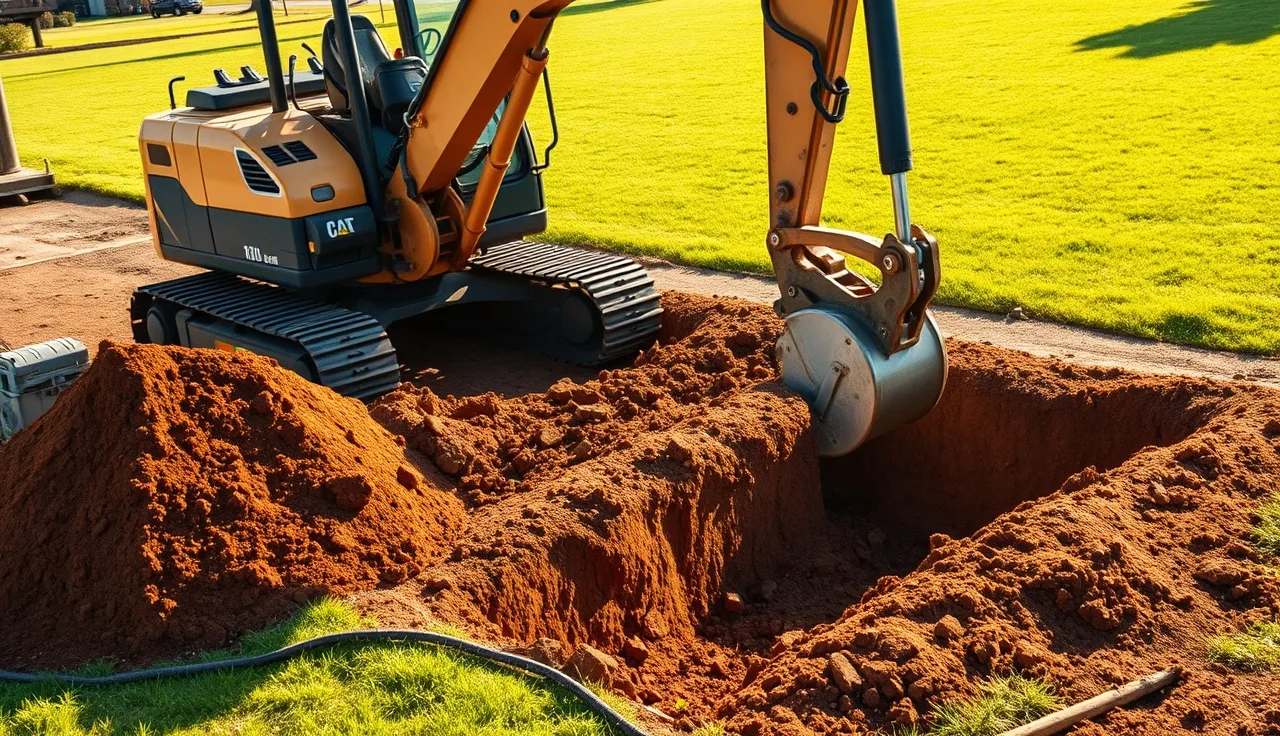
Step 1: Excavate the tank hole. The hole has to be big enough to set the tank with 12 inches of clearance on all sides for backfill compaction. Depth follows your inlet invert elevation, which comes from the slope of the house sewer line off the foundation. A 4-inch sewer line dropping 1/4 inch per foot over a 40-foot run puts the inlet 10 inches below the point it exits the foundation.
Step 2: Prepare the base. Set the tank on 6 inches of compacted, level sand or pea gravel. Concrete tanks crack if they settle unevenly. Your inspector will check this.
Step 3: Set the tank. Concrete tanks weigh 6,000 to 10,000 pounds. You need a crane or an excavator with a lift attachment. Fiberglass and polyethylene tanks are lighter (500 to 1,500 lbs) but have to be anchored against buoyancy in high-water-table areas, usually with concrete deadmen or a ballast slab.
Step 4: Connect inlet and outlet. The inlet pipe from the house ties into an inlet baffle or tee inside the tank, which keeps incoming sewage from disturbing the settled sludge. The outlet has a similar baffle or an effluent filter (required in many states since the 1990s) that stops scum and solids from escaping to the drain field. Install these before backfilling.
Step 5: Install the inspection ports and risers. Risers bring the tank lids to grade (or near grade) so inspectors and pump trucks reach them without digging. Skip risers now and every future septic tank pump out costs an extra $50 to $200 in excavation labor.
Step 6: Partial backfill and inspection. Most jurisdictions require an open-hole inspection before you backfill. The inspector checks tank placement, inlet and outlet elevations, baffle installation, and setbacks. Call for this inspection before you shovel a single cubic yard of dirt back in.
How do you design and install a drain field?
The drain field is where most systems live or die, and most failures trace back to design errors, not bad luck.
Drain field sizing uses your perc rate and your daily flow. The formula: absorption area (sq ft) equals daily flow (gpd) divided by the loading rate (gpd/sq ft) allowed for your soil's perc rate. State codes publish loading rate tables. A soil percing at 30 mpi might carry a loading rate of 0.40 gpd/sq ft, so a three-bedroom home generating 450 gpd needs about 1,125 square feet of absorption area [3].
Conventional trench systems spread that area across multiple trenches, typically 18 to 36 inches wide and 18 to 36 inches deep (below the distribution pipe), with at least 6 feet between trench centerlines. The distribution pipe (3- or 4-inch perforated pipe) sits on 6 to 12 inches of washed stone, gets covered with another 2 inches of stone, then a layer of geotextile fabric before backfill. The fabric keeps soil fines from migrating down and clogging the stone.
For gravity systems, the distribution box (D-box) splits effluent evenly between trenches. Level the D-box perfectly. Even a 1/4-inch tilt concentrates flow in one trench and starves the others, killing the field early.
For pressurized systems (required on sloped lots or where gravity can't reach), a pump chamber holds effluent until a timer or float triggers the pump to dose the field in timed intervals. Pressure distribution stretches field life because it rests sections between doses, letting the biomat that forms around the pipe dry out periodically.
Always install a reserve area. Most state codes make you identify and protect a second drain field equal to 100% of the primary field, left undisturbed in case the first one ever needs replacement. Don't plant trees there. Don't park equipment there. Don't build on it.
What are the full steps in order from start to finish?
Here's the honest sequence for a conventional gravity system on a suitable site. Timelines swing hard with county backlog and contractor availability.
- Hire a licensed site evaluator for soil profiles and perc tests. Cost: $300 to $1,000. Timeline: 1 to 3 weeks including scheduling.
- Hire a licensed designer to draw the site plan and system design. Cost: $500 to $2,000. Timeline: 1 to 2 weeks.
- Submit the permit application to county environmental health. Cost: $200 to $1,500. Timeline: 1 to 6 weeks for approval, depending on county workload.
- Hire a licensed septic installer (or pull a homeowner permit if your state allows it). Get at least three bids.
- Excavate and set the tank. 1 to 2 days with equipment.
- Schedule and pass the open-hole inspection.
- Install the distribution system and drain field. 1 to 3 days.
- Schedule and pass the drain field inspection.
- Backfill and grade the site. Seed or sod over the drain field (shallow-rooted grass only).
- Final permit sign-off. The county records the as-built drawing, which becomes a permanent land record.
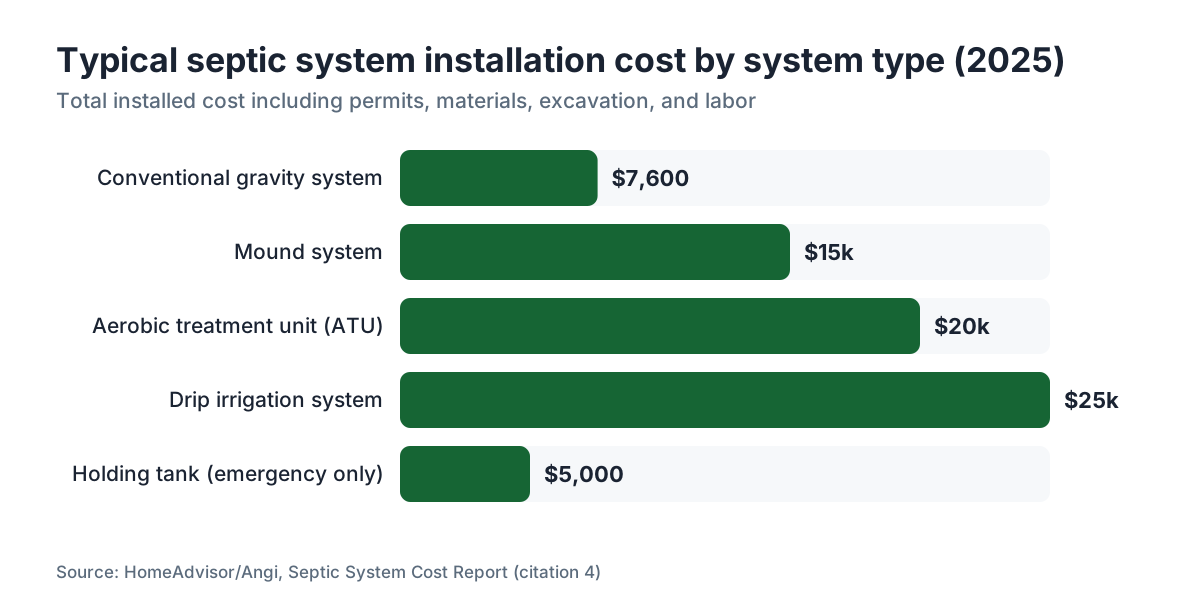
Total elapsed time: 2 to 8 weeks for a straightforward site. Total installed cost for a conventional system: $3,500 to $15,000, with the national average around $7,000 to $9,000 depending on region and soil [4]. Complex systems (mounds, ATUs, drip irrigation) run $15,000 to $30,000 and up.
Want a handle on your specific cost before talking to contractors? Our cost to install septic system guide breaks it down by system type and region.
What are the most common installation mistakes that cause early failure?
After reading failure investigations from state extension services, a few errors show up over and over.
Compacting the drain field during installation. Heavy equipment driven over trench areas smears and compacts the soil sidewalls, cutting absorption by 50% or more [6]. All excavation should happen from the side, never over the trench itself.
Wrong tank depth. Set the tank too shallow and lids get crushed by vehicle traffic. Too deep and the house sewer line has to drop steeply, which causes velocity problems and throws off the outlet elevation for the drain field.
Skipping the effluent filter. If your state doesn't require one, install one anyway. An effluent filter at the tank outlet is the cheapest insurance you can buy for drain field longevity, typically $50 to $200 at installation [9]. It keeps the solid particles that slip past the baffles from reaching and clogging the absorption trenches.
Ignoring seasonal groundwater. A perc test done in August on a northern site can look great. The same site in April, with snowmelt raising the water table, can have groundwater 18 inches from the surface, above the bottom of your drain field. State codes set minimum vertical separation between the drain field bottom and seasonal high groundwater, typically 12 to 24 inches [3]. Make sure your evaluator measures for seasonal high water, more than dry-season conditions.
Undersizing for actual use. The bedroom formula is a floor. If you work from home, host frequent guests, or run a home-based business with heavy water use, design for more. An undersized system getting 150% of its design flow will fail. Not might. Will.
What are the alternatives to a conventional septic system?
Not every site supports a conventional system. When soil or site constraints rule it out, these are the real options.
Mound system: A raised bed of sand and soil sits above grade, and effluent gets pressure-dosed into it. Used where the seasonal high-water table or bedrock is too close to the surface. Costs roughly $10,000 to $20,000 installed [4].
Aerobic treatment unit (ATU): Injects air to speed up bacterial breakdown in the tank, producing a much cleaner effluent that can go into smaller or shallower fields, or even surface spray in some states. Needs electricity and more maintenance. Annual service contracts run $300 to $500.
Drip irrigation system: High-quality effluent drips from small-diameter tubing buried just below the surface across a large area. Flexible for tough sites, but it needs filtration, UV disinfection, and a pump. Costs $15,000 to $30,000 and up.
Constructed wetland: Effluent passes through a gravel bed planted with wetland species. Niche application, used in some rural states. Regulatory acceptance varies a lot.
Holding tank: A sealed tank with no drain field, pumped out on a schedule. Not a long-term answer for a primary residence, because you'd need pump-outs every 1 to 4 weeks. Legal in some jurisdictions only for seasonal or emergency use.
Dealing with a failed system and weighing repair against replacement? The septic system repair guide walks through the decision tree in detail.
How do you maintain a new septic system after installation?
A new system is not set-it-and-forget-it. The EPA's SepticSmart program lists four core practices: inspect the system regularly, pump the tank on schedule, use water efficiently, and protect the drain field [1].
Get a professional inspection within the first year to confirm everything works as designed. After that, follow your state's inspection schedule. Some states require inspections every 1 to 3 years for alternative systems.
Pump the tank on a schedule based on household size and tank volume, not a flat "every 3 years" rule. A family of five on a 1,000-gallon tank may need pumping every 2 years. A couple on a 1,500-gallon tank might go 5. The pumpout frequency table in EPA's 2002 Onsite Wastewater Treatment Systems Manual gives solid baseline numbers by tank size and occupancy [2]. For the math, the how often to pump septic tank guide runs the numbers.
For the drain field: no parking, no trees within 30 feet, no roof drains or surface water routed over it. Keep the grass mowed (roots stay shallow) and keep the field covered, because bare soil erodes and compacts.
What goes down the drain matters. No grease, no wipes (even the "flushable" ones), no medications, minimal harsh cleaners. The bacteria in your tank are doing real work, and they're easy to disrupt. Operators who manage many accounts use tools like SepticMind to track service schedules and send maintenance reminders across big customer bases, which is the kind of follow-through that keeps new systems out of failure.
Budget for septic tank cleaning as a routine line item, not an emergency. That cost is predictable. Drain field replacement is not.
What does it cost to build a septic system in 2025?
Cost ranges swing more than almost any home project because they ride on soil, system type, local labor markets, permit fees, and site conditions. Here's an honest breakdown.
| Component | Typical cost range |
|---|---|
| Soil evaluation and perc test | $300 to $1,000 |
| System design / engineering | $500 to $2,000 |
| Permit fees | $200 to $1,500 |
| Concrete septic tank (1,000 to 1,500 gal) | $800 to $2,000 (materials only) |
| Excavation (tank + drain field) | $1,500 to $5,000 |
| Drain field materials (pipe, stone, fabric) | $500 to $2,500 |
| Installation labor (total) | $1,500 to $5,000 |
| Risers, filters, distribution box | $300 to $800 |
| Conventional system total | $5,000 to $15,000 |
| Mound system total | $10,000 to $20,000 |
| ATU or drip system total | $15,000 to $30,000+ |
HomeAdvisor/Angi survey data puts the national average for a new septic system near $7,600, but that figure hides enormous geographic spread [4]. Rural areas with loose soil and cheap labor might land at $4,000 total. Rocky coastal New England or Hawaii can run $20,000-plus for a conventional system because of shallow bedrock and steep excavation costs.
For a breakdown by region and system type, the cost to put in a septic tank article goes deeper. If you already have a tank and only need field work, costs will be lower but still site-dependent.
One honest opinion: don't make the bid price your main selection criterion. A low bid that fails a drain field in eight years costs you $10,000 to $20,000 to replace. Ask for references, check license status with your state contractor board, and verify they pulled a permit on every job.
Frequently asked questions
Can I build my own septic system without a contractor?
In some states, yes. Owner-builder permits exist in states like Texas and parts of the rural Midwest for homeowners installing systems on their own occupied property. Most states require a licensed installer. Check with your county environmental health department before buying anything. Unpermitted systems are illegal everywhere and make your property uninsurable and hard to sell.
How long does it take to install a septic system from start to finish?
The physical installation takes 2 to 5 days once permits are approved. Getting to that point, including soil testing, design, and permit approval, takes 2 to 8 weeks in most counties. Backlogged rural counties can push that to 3 months. Plan well ahead of any construction deadline.
How deep does a septic tank need to be buried?
The top of the tank typically sits 6 inches to 4 feet below grade, depending on the inlet pipe elevation from your house and local frost depth. In cold climates, lids must be below frost depth or insulated. Most states require risers to bring access ports within 6 to 8 inches of the surface for inspection and pumping.
What size septic tank do I need for a 3-bedroom house?
Most state codes require a minimum 1,000-gallon tank for a 3-bedroom home. Sizing up to 1,250 gallons is worth the modest extra cost. With a garbage disposal or large household, consider 1,500 gallons. Tank sizing runs off estimated daily flow, typically 150 gallons per bedroom per day per EPA guidance.
What happens if you fail a perc test?
A failed perc test (soil too slow or too fast) means a conventional system isn't approved for that site. You have options: hire an engineer to evaluate alternative systems (mound, ATU, drip), test a different area of the parcel, or in some cases petition for a variance. It doesn't automatically mean the land is unbuildable, but it does raise system cost a lot.
How far does a septic system need to be from a well?
Most state codes require at least 50 feet between a septic tank and a potable well, and 100 feet between the drain field and a well. Some states set 100 feet as the minimum for the tank too. Check your specific state code; setbacks also apply to property lines, buildings, surface water, and slopes.
What kind of soil is needed for a septic drain field?
Loamy soil percolating between 1 and 60 minutes per inch is ideal for conventional systems. Sandy soil percs faster (sometimes too fast for pathogen removal). Clay percs too slowly and needs an alternative system. Soil also needs adequate depth to seasonal high groundwater, typically 12 to 24 inches of separation between the drain field bottom and the water table.
How long does a septic system last?
A well-installed, well-maintained conventional system lasts 25 to 50 years. The tank often outlasts the drain field. Drain fields fail sooner when overloaded, compacted, or starved of pumping. The EPA notes that pumping every 3 to 5 years is one of the most effective ways to extend system life.
Can I put a septic system in rocky soil?
It depends on how close the rock sits to the surface. Bedrock less than 4 to 5 feet below grade often rules out a conventional system and forces a mound or engineered alternative. Shallow bedrock drives up excavation costs fast. A licensed evaluator has to assess the site; you can't judge this accurately with a shovel.
Do I need an engineer to design a septic system?
Many states let a licensed site evaluator or certified designer (not necessarily a PE) design conventional systems on straightforward sites. Complex sites, large systems, or alternative types almost always require a licensed professional engineer. Check your state's onsite wastewater rules; the requirements are published by the state environmental or health agency.
What is the minimum lot size for a septic system?
There's no universal minimum, but most states require enough land to meet all setbacks (from wells, property lines, buildings, and water) and to fit both a primary drain field and a 100% reserve area. In practice, lots under half an acre often struggle to site a conventional system with all required setbacks. Your county health department can tell you if your parcel works.
How often does a septic tank need to be pumped after installation?
The EPA recommends pumping every 3 to 5 years for the average household, but actual frequency depends on tank size and number of people. A 1,000-gallon tank serving four people should be pumped roughly every 3 years. Inspecting the tank at each pumping is good practice and catches problems before they reach the drain field.
Can a septic system be installed in winter?
Yes in many areas, though it complicates things. Frozen ground adds excavation effort and cost. Perc tests can't be done accurately on frozen soil, so most jurisdictions require testing when the ground is thawed. Some contractors work through winter in milder climates. In northern states, installation usually pauses from December through March.
What is a reserve drain field area and do I need one?
A reserve area is a second drain field site, equal to 100% of the primary field, left undisturbed in case the primary field fails and needs replacement. Most state codes require you to identify and protect this area at installation. Building over it, parking on it, or planting trees there wipes out your replacement option, which can mean very expensive alternatives later.
Sources
- U.S. EPA, SepticSmart Program: Onsite wastewater systems are regulated at the state and local level; homeowners should contact their local health department for rules. EPA recommends inspecting, pumping, using water efficiently, and protecting the drain field.
- U.S. EPA, Onsite Wastewater Treatment Systems Manual (EPA/625/R-00/008, 2002): EPA guidance uses 150 gallons per bedroom per day as residential design flow and provides tank sizing and pumpout frequency tables.
- HomeAdvisor / Angi, Septic System Installation Cost Report: National average cost for a new septic system installation is approximately $7,600; mound systems run $10,000 to $20,000 and alternative systems can exceed $30,000.
- U.S. EPA, SepticSmart Homeowners: EPA recommends pumping every 3 to 5 years and regular inspections as core maintenance practices to extend system life.
- North Carolina State University Extension, Septic Systems and Their Maintenance: Compacting drain field soil during installation can reduce absorption capacity by 50% or more; all excavation equipment should work from the side.
- Texas Commission on Environmental Quality (TCEQ), On-Site Sewage Facilities: Texas allows owner-installer permits for homeowners on their own occupied property under the On-Site Sewage Facility rules.
- Washington State Department of Health, Wastewater Management: Washington State requires licensed designers and installers for onsite sewage systems; homeowner exemptions are limited to specific rural conditions.
- Penn State Extension, Septic System Basics: Effluent filters at the tank outlet are among the most effective and affordable ways to protect drain field longevity, typically costing $50 to $200 at installation.
- U.S. EPA, How Your Septic System Works: A conventional septic system consists of a tank that separates solids from liquids and a drain field where clarified effluent is treated by soil microbes and filtration.
- Virginia Department of Health, Onsite Sewage and Water Services: Virginia requires a licensed operator and a final inspection before any onsite wastewater system is placed in service; as-built drawings are recorded as permanent land records.
- University of Georgia Extension, Septic Tank Systems: Reserve drain field areas equal to 100% of the primary field are commonly required by state codes to be identified and protected at time of installation.
Last updated 2026-07-09