How to build a septic system: permits, design, and installation
By the SepticMind Editorial Team
TL;DR
- Building a septic system takes a perc test, a permitted site plan, approval from your county health department, and licensed installation in most states.
- A conventional gravity system costs roughly $3,000 to $15,000 depending on lot conditions and tank size.
- Most states do not let you install your own system without a permit and a licensed contractor.
Can you build a septic system yourself, or do you need a licensed contractor?
It depends on your state, and the rules are stricter than most homeowners guess. In most states, the installation has to be done by a licensed septic installer or a licensed plumber.
Every state has an onsite wastewater code run at either the state or county level. A handful of states, including Texas and parts of rural Appalachia, let a property owner install a system on their own primary residence with a permit. Even then, they usually require an engineer or licensed designer to draw the site plan and a health department inspector to sign off at several stages [1].
The EPA's SepticSmart program is direct about the risk. It tells homeowners to have the system inspected "by a qualified professional" and points to improper installation as a leading cause of early failure [2]. State regulators say the same thing in code. Florida's Chapter 64E-6 rules require that all septic systems be installed by a registered septic tank contractor [3].
Call your county health department before you price a single tank. Ask three things: does owner-installation need a permit, do you need a licensed engineer or soil scientist for the site plan, and what are the inspection stages? Those answers shape the whole project.
If you want a realistic budget before you commit, see our guide on the cost to install septic system for a state-by-state breakdown.
What site conditions determine whether you can even build a septic system?
Your lot either passes or it doesn't. The two gating factors are soil permeability and setbacks.
Soil permeability gets measured with a percolation (perc) test. A soil scientist or licensed evaluator digs test holes, soaks them, and times how fast the water drops. The result is minutes per inch (MPI). Most state codes accept roughly 1 to 60 MPI for a conventional drain field. Anything slower than 60 MPI usually fails a standard perc and forces an alternative system [4]. More than one in five U.S. households runs on a septic or other onsite system, and failing perc results are the most common reason a rural lot can't support a conventional one [2].
Setbacks are the minimum distances your system has to keep from property lines, wells, foundations, water bodies, and utility lines. Typical minimums (they vary by state) look like this:
| Feature | Typical minimum setback |
|---|---|
| Drinking water well | 50 to 100 ft |
| Property line | 5 to 10 ft |
| Foundation or basement | 10 to 25 ft |
| Surface water (stream, pond) | 25 to 100 ft |
| Irrigation ditches | 25 ft |
| Trees (large canopy) | 10 ft |
These come from state code ranges, and your county may want more [1][3]. If the lot is tight, you might need an engineered alternative, or the lot simply can't be served at all.
Beyond perc and setbacks, the designer looks at seasonal high groundwater depth (most states want 2 to 4 feet of separation between the drain field bottom and the water table), slope, and whether there's enough usable area for both a primary field and a reserve area.
What permits and approvals do you need before installation starts?
Get the permits first. Building without them creates title problems, possible mandatory removal, and personal liability if the system fails and contaminates a neighbor's well.
Here's the typical approval sequence:
- Soil and site evaluation. A licensed soil scientist or evaluator runs the perc test and examines the soil profile. That produces a signed soil report that rides along with the permit application.
- System design. A licensed designer or engineer produces a site plan showing tank location, line depths, drain field dimensions, and setbacks. Some states accept the evaluator's report plus a standard design table; others require a stamped engineer drawing.
- Permit application. You or your contractor submits the design, soil report, and a fee to the county health department or state environmental agency. Fees typically run $200 to $800 depending on the county [5].
- Construction permit issued. The health department reviews, then approves, requests changes, or denies. Turnaround runs from a few days to six weeks in busy rural counties.
- Inspections during installation. Most states require at least a mid-installation inspection (before backfilling) and a final inspection. Some add a third at tank placement.
- Final approval or operating permit. Once everything passes, the health department issues a final approval or operating permit, which the county records. A future buyer's inspector will ask to see it.
Skip any stage and you can't get the final permit, which means you can't legally occupy or sell the property. That's not a technicality worth gambling on.
How do you design the right septic system for your property?
Design starts with two numbers: your household's daily wastewater flow and your soil's absorption capacity.
Wastewater flow gets estimated by household size. Most state codes use 75 to 120 gallons per bedroom per day for design flow. A three-bedroom home usually designs to 300 to 450 gallons per day [4]. The tank has to hold at least two to three days of that flow, which is why a 1,000-gallon tank is the code minimum for most single-family homes and a 1,500-gallon tank is common for three- to four-bedroom houses.
The drain field (also called a leach field) area gets calculated by dividing the design flow by the long-term acceptance rate (LTAR) for your soil type. LTAR is a conservative, derated version of the perc rate. Sandy loam might have an LTAR of 0.6 to 0.8 gallons per square foot per day. Clay loam might be 0.2 gpd/ft². A 400 gpd design flow at an LTAR of 0.4 gpd/ft² needs 1,000 square feet of drain field. That's a real number you can use to check your designer's math.
Choosing the system type comes down to what your soil and budget allow.
Conventional gravity system. Effluent flows by gravity from the tank through a distribution box into perforated pipes buried in gravel trenches. Cheapest and most reliable option where the soil supports it.
Pressure distribution system. A pump doses effluent at timed intervals to distribution laterals, spreading the load evenly. Good for slower soils or when the field sits uphill from the tank.
Mound system. When the seasonal high water table or bedrock sits too close to the surface, a mound of imported fill sand builds the separation you need. More expensive to build and maintain.
Aerobic treatment unit (ATU). Adds aeration to raise treatment before effluent reaches the field. Required in some states for lots near surface water or with high nitrogen concerns.
For a closer look at what the drain field involves during installation, see our leach field article.
If you manage multiple properties or operator accounts and want to track system types across jobs, SepticMind lets service operators log system specs alongside job and inspection records.
Step-by-step: how is a conventional septic system actually installed?
Assume the permits are in hand and the site is staked and approved. Here's how a conventional gravity system actually goes in.
Step 1: Excavate the tank pit. An excavator digs a pit sized to the tank plus a few feet of working room on all sides. The bottom sits at the design depth, accounting for the inlet pipe's required slope from the house (usually a 1/4 inch drop per foot of horizontal run).
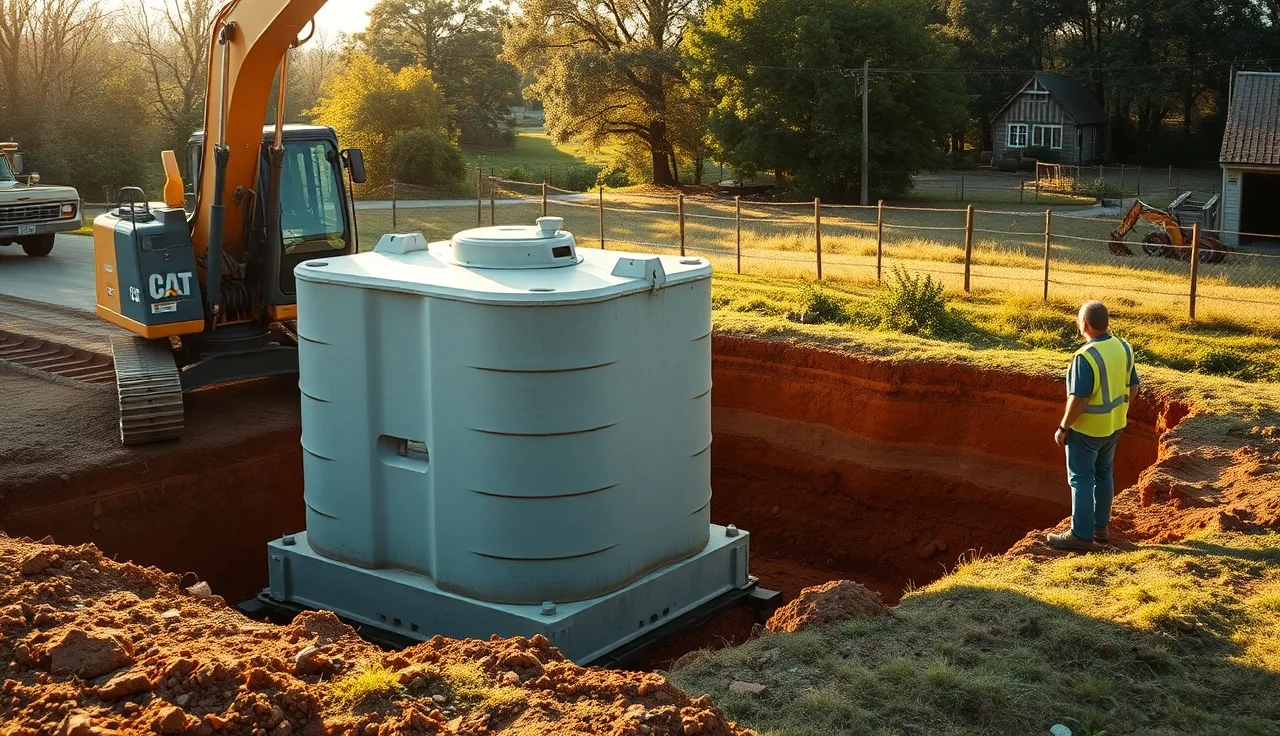
Step 2: Set the tank. A precast concrete tank (the most common choice) arrives by truck and drops into the pit with a crane or the excavator bucket. Concrete tanks run 8,000 to 12,000 pounds for a 1,000-gallon unit, so you need the right equipment on site. Plastic and fiberglass tanks are lighter but need careful backfill so they don't float in high water table conditions. Level the tank, then confirm the inlet and outlet baffles are intact and at the right heights.
Step 3: Connect the building sewer. The 4-inch PVC pipe from the house ties into the tank's inlet. Keep the slope consistent. Bad slope makes solids either back up or race past the liquids and clog the field early.
Step 4: Install the distribution system. For a gravity system, a concrete or plastic distribution box (D-box) sits at the head of the drain field at a dead-level elevation. The D-box takes effluent from the tank outlet and splits the flow equally among the laterals. Getting the D-box level is not optional. If one lateral gets more flow than the others, that trench saturates and the system fails early.
Step 5: Excavate and prepare the trenches. Trenches run 2 to 3 feet wide, 18 to 36 inches deep, and as long as the design requires. Scarify the bottom of each trench (scratch it up) to keep the soil from smearing and sealing. Then place six inches of washed stone (1.5 to 2.5 inch clean aggregate) in the bottom.
Step 6: Lay the perforated pipe. Perforated 4-inch PVC or ADS pipe goes on the stone bed with a slight pitch (0 to 1/4 inch per foot; perfectly flat is fine and sometimes better for spreading flow). Perforations face down. More stone goes over the pipe to the top of the trench, usually ending 6 inches below finished grade.
Step 7: Cover with geotextile fabric and backfill. A layer of non-woven geotextile fabric goes over the stone before backfill. It keeps soil from migrating into the gravel and clogging it. Backfill goes over the fabric, mounded a little to allow for settling.
Step 8: Call for inspection. In most states, the inspector has to see the system before you backfill the trenches. Skip this and you'll be digging it back up.
Step 9: Final grading and restoration. Grade the disturbed area to drain surface water away from the field, seed it with grass (no trees or shrubs over the field), and mark the tank with riser lids for future access.
Step 10: Final inspection and permit close-out. The inspector returns, confirms everything matches the approved plan, and issues final approval. You're legal.
What does it cost to build a septic system in 2025?
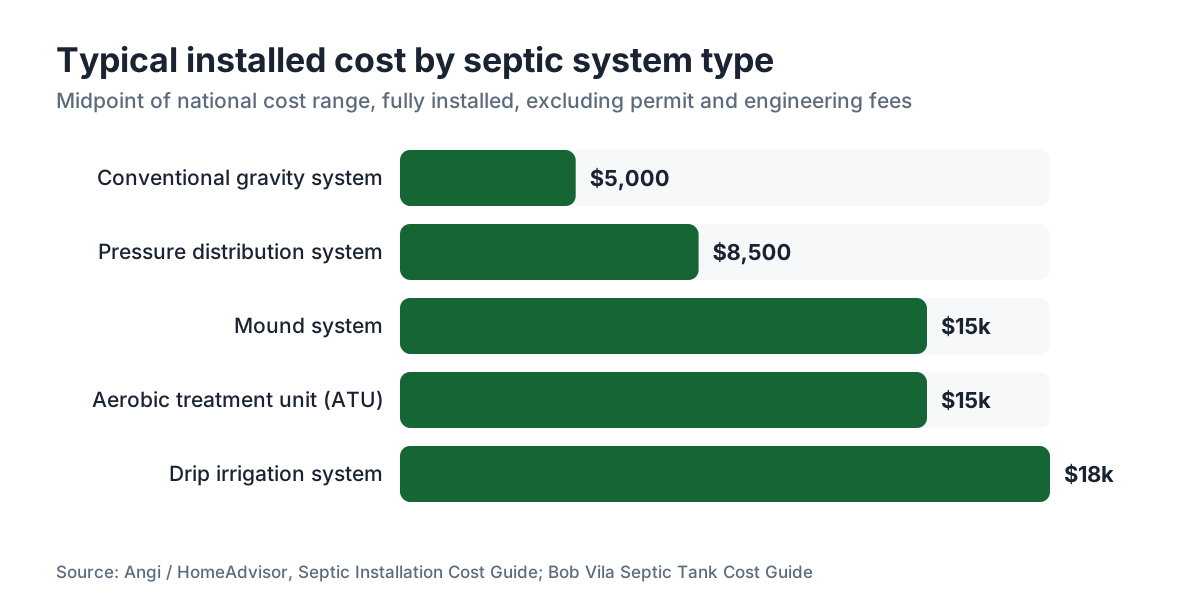
Costs swing hard based on system type, soil conditions, tank size, local labor rates, and how much site work is involved. For a conventional gravity system on a lot with decent soil, the rough national range is $3,000 to $15,000 fully installed [5][6].
Here's a breakdown by system type:
| System type | Typical installed cost range |
|---|---|
| Conventional gravity (concrete tank) | $3,000, $7,000 |
| Pressure distribution system | $5,000, $12,000 |
| Mound system | $10,000, $20,000+ |
| Aerobic treatment unit (ATU) | $10,000, $20,000+ |
| Drip irrigation system | $12,000, $25,000+ |
Costs climb fast when the site fights you: high groundwater, rocky soil, steep slopes, or long runs from the house to the field all add excavation time and materials. Permit fees ($200 to $800), soil evaluation fees ($300 to $1,000), and engineering fees (if required, $500 to $3,000) sit on top of installation costs [5].
Tank size alone accounts for a few hundred to a few thousand dollars of the spread. A 1,000-gallon precast concrete tank runs roughly $500 to $1,000 for the tank itself; a 1,500-gallon tank runs $800 to $1,500 [6]. Delivery and setting adds another few hundred.
For a fuller picture of what drives septic installation costs, see cost to put in a septic tank and our detailed septic tank installation guide.
What are the most common mistakes that cause a new septic system to fail early?
Installers with decades on the job point to the same short list of errors. These aren't rare edge cases. They're the calls that fill repair schedules.
Smearing the trench bottom. Dragging excavator teeth across wet soil compacts and glazes the interface. Effluent can't move through a glazed surface. Scarifying after digging is mandatory, and digging in wet conditions is a gamble.
A D-box that isn't level. Tilt the box half an inch and one lateral takes nearly all the flow, so biomat piles up fast. A shifted or damaged D-box on an existing system is one of the leading reasons people call for septic system repair.
Undersized tank for actual use. Sizing to code minimum for a household that really generates 400 or 500 gallons a day (big family, constant laundry) means solids carry into the field faster than the design assumed. One tank size larger at installation costs a few hundred dollars and can buy years of life.
Tree or shrub roots near the field. Roots chase moisture and can wreck perforated pipe and clog aggregate within a few years. No ornamentals, no gardens, no trees over a drain field. Grass only.
No seed after backfill. Bare soil compacts under rain and erodes into the stone. Seed right after final grading.
Wrong slope on the building sewer. Too flat and solids settle in the pipe. Too steep and liquids outrun solids, leaving a dry sludge that builds up. The standard 1/4 inch per foot exists for a reason.
Ignoring the maintenance schedule. A new system isn't self-maintaining. Most need pumping every 3 to 5 years. Skip pumping and sludge climbs until it reaches the outlet baffle and pushes into the field. See our how often to pump septic tank guide for frequency by household size.
How do alternative systems differ from a conventional build?
When a site fails a conventional design because of high water table, slow soil, or too little lot area, regulators usually require an alternative system. The build is more involved and the cost is higher, but these systems can serve lots that would otherwise be unbuildable.
Mound systems import and compact a bed of clean fill sand on top of the native soil to make the required separation from the water table or bedrock. The mound rises 2 to 4 feet above natural grade in many cases and needs a pressure distribution pump, because gravity won't move effluent uphill. The finished mound is a visible landscape feature, usually 50 to 100 feet long and 10 to 20 feet wide for a standard household.
Aerobic treatment units (ATUs) add an aeration chamber and often a clarifier between the primary settlement zone and the discharge. They treat effluent to a higher standard (lower biological oxygen demand and total suspended solids) before it reaches the field or a drip emitter network. Most states require quarterly or semi-annual service by a licensed maintenance provider. ATUs also carry more mechanical parts: air pumps, timers, floats, sometimes UV disinfection. Maintenance contracts run $100 to $300 per visit, which adds up.
Drip irrigation systems push pressure-dosed, filtered effluent through small-diameter tubing and drip emitters just below the surface. They work on steep slopes, in shallow soil, or to irrigate landscape areas. The filter and pump need regular service and are sensitive to grease and solids from the tank, so a well-kept tank matters even more here.
If you're looking at a site with borderline conditions, a licensed soil scientist's honest read is worth every penny before you commit to a purchase or a design.
How do you find and vet a licensed septic installer?
Your state's licensing board for septic installers or plumbers keeps a public database. Start there. In most states, searching "[state name] septic installer license lookup" lands you on the board's verification page.
A few things to confirm before you sign a contract.
Active license status. Check the database directly, more than the contractor's word. Licenses lapse.
Insurance. The installer should carry general liability (at least $1 million per occurrence) and workers' compensation. Ask for certificates naming you as additional insured.
Permit history. Ask whether they pull the permit or expect you to. In most states, the licensed installer pulls the installation permit, which means they take on responsibility for code compliance.
References on similar systems. If your soil needs a mound system, ask for references from mound jobs. That's a different skill set from a basic gravity build.
Get at least two bids. Prices on the same design can vary by $2,000 to $4,000 between qualified installers, especially on materials like concrete tanks versus plastic.
Ask what the warranty covers. Most installers warranty their workmanship for one to two years. Tank manufacturers usually offer longer on the tank itself, often 10 to 30 years on precast concrete. Get every warranty in writing.
Septic service operators running installation jobs across multiple crews can track license status, inspection milestones, and permit records in SepticMind, which is built for onsite wastewater service companies.
What maintenance does a new septic system need to keep working?
Installation is the beginning, not the end. A system that gets no maintenance will fail. Period.
The biggest maintenance task is pumping. EPA SepticSmart guidance recommends pumping every three to five years for a typical household, though the real frequency depends on tank size and how many people live in the home [2]. A one-person household with a 1,500-gallon tank might go seven years between pumpings. A five-person family with a 1,000-gallon tank might need it every 18 to 24 months. See how often to pump septic tank for a size-and-occupancy table.
Past pumping, the basics are mostly about what you don't do.
Don't pour fats, oils, and grease down the drain. They float in the tank and clog the outlet baffle.
Don't flush non-dispersibles: wipes (even "flushable" ones), feminine hygiene products, medications, or paper towels. They pile up in the tank and can block the outlet.
Don't plant anything over the drain field except grass. Roots are persistent and destructive.
Don't drive over the drain field. Compacted soil can't absorb effluent, and crushed pipes are expensive to replace.
Don't dump large volumes of water into the system at once. Running load after load of laundry, filling a hot tub, and flushing at the same time sends a hydraulic slug that pushes solids past the outlet baffle. Spread heavy water use across the day.
For a newly installed system, scheduling your first septic tank inspection two or three years in is a reasonable way to confirm it's performing as designed before problems get expensive. If something goes wrong with the tank itself, see septic tank repair for what's fixable versus what needs replacement.
What are the rules around building a septic system near a well or surface water?
Setbacks from drinking water sources are the most strictly enforced part of onsite wastewater codes, because a failing system that reaches a well is an immediate public health problem.
The EPA recommends at least a 50-foot setback between a septic system and a private drinking water well, but many states require 75 to 100 feet, and some require more depending on soil type and groundwater flow direction [2][7]. Georgia, for example, requires 75 feet from any individual well to the nearest part of the system under its Rules for On-Site Sewage Management Systems [8]. Minnesota's rules require 50 feet from a well to the tank and 75 feet from a well to the drainfield in many soil conditions [9].
Surface water setbacks vary widely. Most states require 25 to 100 feet from streams, ponds, lakes, and wetlands. Coastal states and states with high-quality water resources often push stricter buffers. Florida requires 75 feet from the mean high water line of surface water for a standard septic system [3].
Groundwater separation (the vertical distance between the bottom of the drain field and the seasonal high water table) is typically 2 feet minimum, 4 feet in many states and for some soil types [4]. That's why mound systems exist: they manufacture the separation when native soil can't give it.
If your property is near any protected water body, wetland, or shoreline, expect extra review from your state's environmental or natural resources agency on top of the standard health department permit. The process runs longer and may add design requirements beyond the base code.
Frequently asked questions
How do you build a septic system step by step?
Start with a soil evaluation and perc test, then hire a designer to produce a permitted site plan. Submit the plan to your county health department for approval. Once the permit is issued, excavate and set the tank, connect the building sewer, install the distribution box, excavate and line trenches with gravel, lay perforated pipe, cover with geotextile fabric, and backfill. Health department inspections happen before backfilling and at completion.
Can a homeowner install their own septic system?
In some states, yes, with a permit. Texas allows owner-installation on a primary residence under certain conditions. Most states require a licensed installer. Even where owner-installation is allowed, you still need a licensed soil evaluator, an approved design, and health department inspections at each stage. Check your state's onsite wastewater rules or call your county health department before assuming DIY is an option.
How much does it cost to build a septic system?
A conventional gravity system runs roughly $3,000 to $7,000 fully installed in most areas. Pressure distribution systems cost $5,000 to $12,000. Mound systems and aerobic treatment units often run $10,000 to $20,000 or more. Permit fees, soil evaluation, and engineering add $500 to $4,000 on top of installation. Difficult sites with rocky soil, high water tables, or long pipe runs push costs toward the high end of every range.
How long does it take to build a septic system?
The physical installation of a conventional system takes one to three days for the crew once permits are in hand. Permitting is the longer part: soil evaluation takes a day, design takes a few days to two weeks, and health department review runs anywhere from a few days to six weeks depending on county workload. Plan for four to twelve weeks from starting the permit process to a system ready to use.
What size septic tank do I need for a 3-bedroom house?
Most state codes require a minimum 1,000-gallon tank for a three-bedroom home, using a design flow of roughly 300 to 450 gallons per day. Many installers recommend a 1,250- or 1,500-gallon tank for a three-bedroom home, especially if the household is larger than average or has a garbage disposal. The larger tank holds more solids and stretches pumping intervals, which is worth the modest extra cost at installation.
How deep does a septic system need to be?
The septic tank usually sits so the inlet pipe is 18 to 36 inches below grade. Drain field trenches run 18 to 36 inches deep, with at least 6 inches of gravel below the pipe and 6 inches of cover above the stone. Minimum vertical separation between the trench bottom and the seasonal high water table is 2 to 4 feet depending on the state. Frost depth in northern climates also drives trench depth requirements.
What is a perc test and do I need one?
A percolation test measures how fast water drains through the soil. You need one before you can design or permit a septic system in nearly every jurisdiction. The result, in minutes per inch, tells the designer what size drain field your soil requires and whether a conventional system is feasible at all. Soil that drains faster than 1 MPI or slower than 60 MPI usually falls outside the range for a conventional gravity system.
What is the difference between a septic tank and a drain field?
The septic tank is a buried, watertight container that receives all household wastewater. Solids settle to the bottom as sludge, grease floats to the top as scum, and the liquid layer in between (effluent) flows out through the outlet baffle. The drain field (leach field) is a network of perforated pipes buried in gravel-filled trenches that lets the effluent slowly absorb into the soil, where soil microbes keep treating it. Both parts are required for a complete system.
How long does a septic system last?
A well-built, properly maintained conventional septic system can last 25 to 40 years or more. The drain field usually limits the system's life. Fields flooded by hydraulic overload, clogged by solids from a rarely pumped tank, or invaded by tree roots fail sooner, sometimes in 10 to 15 years. Pumping every 3 to 5 years and avoiding the standard list of prohibited inputs (grease, wipes, harsh chemicals) is what gets a system to full life expectancy.
Do I need a permit to replace an existing septic system?
Yes. Replacing a septic system, or even making major repairs, requires a permit in nearly every state. Replacement often triggers a new soil evaluation and design, because codes may have changed since the original installation. Some jurisdictions allow a like-for-like tank replacement without a full redesign, but any change to the drain field location or size requires a new permit. Never replace a system without confirming permit requirements with your health department first.
What can I plant over my drain field?
Grass is the best choice. Shallow-rooted native grasses or turf grass protect the field from erosion without sending roots into the aggregate or pipe. Avoid trees, shrubs, and deep-rooted perennials. Even plants considered moderate in root depth can damage drain field pipe and gravel over time. Gardens over drain fields are also a health concern, because raw effluent is not treated enough to be safe for food crops.
How often does a new septic system need to be pumped?
EPA guidance recommends pumping every 3 to 5 years for a typical household. The real interval depends on tank size relative to occupancy. A 1,500-gallon tank serving two people might go 6 to 8 years between pumpings. A 1,000-gallon tank serving five people may need it every 18 to 24 months. The safest approach is to have the tank inspected at the 3-year mark of a new system to see how fast solids are building up.
What happens if you build a septic system without a permit?
You face several serious consequences. The health department can require you to dig it up and redo it, at your expense. You may face fines. You can't get title insurance or close a sale on the property with an unpermitted system. If the system fails and contaminates a neighbor's water supply or nearby surface water, you carry personal liability. No legitimate inspector will sign off on an unpermitted installation, and lenders won't finance a property with one.
Is concrete or plastic better for a septic tank?
Precast concrete is the traditional standard and performs well when the concrete is dense and properly cured. It can crack over decades, and older tanks sometimes have corroded baffles, but a well-made concrete tank routinely lasts 40 or more years. Plastic and fiberglass tanks are lighter, easier to move on tight sites, and resistant to corrosion, but they need careful backfill to prevent flotation in high water table areas. Both are code-approved in most states; the choice often comes down to site access and installer preference.
Sources
- Texas Commission on Environmental Quality, On-Site Sewage Facilities Rules (30 TAC Chapter 285): Texas allows owner-installation of septic systems on primary residences under specific permit conditions; licensed evaluators and health department inspections are still required.
- U.S. Environmental Protection Agency, SepticSmart Program: EPA SepticSmart states more than one in five U.S. households uses a septic or other onsite system; recommends pumping every 3-5 years and inspection by qualified professionals.
- Florida Department of Health, Chapter 64E-6 F.A.C., Standards for Onsite Sewage Treatment and Disposal Systems: Florida requires all septic systems to be installed by a registered septic tank contractor and sets a 75-foot setback from surface water mean high water line.
- Penn State Extension, Onsite Wastewater Treatment: Conventional perc acceptance range is approximately 1 to 60 minutes per inch; groundwater separation of at least 2 feet is required below the drain field trench bottom.
- Angi, Septic System Installation Cost Guide: Permit fees for septic systems typically run $200 to $800 depending on county; overall conventional system installed costs range from roughly $3,000 to $15,000.
- Bob Vila, Septic Tank Cost Guide: A 1,000-gallon precast concrete tank costs roughly $500 to $1,000 for the unit itself; 1,500-gallon tanks run $800 to $1,500, with delivery and setting additional.
- U.S. Environmental Protection Agency, Septic Systems and How to Care for Them: EPA recommends a minimum 50-foot setback between a septic system and a private drinking water well.
- Georgia Department of Public Health, Rules for On-Site Sewage Management Systems (Ga. Comp. R. & Regs. 511-3-1): Georgia requires a minimum 75-foot setback from an individual drinking water well to any part of an on-site sewage management system.
- University of Minnesota Extension, Septic System Owner's Guide: Minnesota rules require 50 feet from a well to the septic tank and 75 feet from a well to the drainfield in most soil conditions; mound systems are required when water table separation cannot be met in native soil.
- North Carolina State Extension, Septic Systems and Their Maintenance: Scarifying trench bottoms before gravel placement is required to prevent soil glazing that blocks effluent absorption; trees and deep-rooted plants over drain fields damage pipe and clog aggregate.
Last updated 2026-07-09