Septic inspection in Sagaponack: what homeowners need to know
By the SepticMind Editorial Team
TL;DR
- Sagaponack sits in Suffolk County, New York, where septic inspections follow county sanitary code and state DEC rules.
- A standard inspection runs $300 to $700, covers tank condition, distribution box, and leach field, and is expected at most real estate transfers.
- Fail the inspection and you're looking at repair or full replacement, which can run $15,000 to $50,000-plus on the East End.
Why septic inspections in Sagaponack are different from most of the country
Sagaponack is a small incorporated village in the Town of Southampton, Suffolk County, New York. That geography matters more than you'd think. All of Suffolk County sits on Long Island, and its drinking water comes from a single underground aquifer system. There is no bedrock barrier between the soil surface and that aquifer. Wastewater that escapes a failing septic system can reach groundwater in hours to days, not years.
Because of that hydrogeology, Suffolk County has some of the strictest onsite wastewater rules in the Northeast. The county operates under the Suffolk County Sanitary Code, Article 6, which governs all private sewage disposal systems [1]. State oversight comes from the New York State Department of Environmental Conservation and the State Department of Health. Stack those two layers on top of each other and you get a permitting and inspection regime far more involved than what you'd face upstate or across most of the Midwest.
Sagaponack picked up another layer in 2019, when New York enacted the Onsite Wastewater Treatment System (OWTS) Technology Law requiring nitrogen-reducing septic systems in certain sensitive areas [2]. Parts of the Hamptons, including areas in and around Sagaponack, fall within designated nitrogen-sensitive watersheds. If your system fails inspection and needs full replacement, you may be required to install an Innovative/Alternative (I/A) OWTS instead of a conventional septic system. That changes the cost picture in a hurry.
One more local wrinkle. Sagaponack's property values rank among the highest in the United States. Real estate deals here routinely involve attorneys, environmental consultants, and title companies that demand thorough inspections. A quick visual pass will not satisfy most buyers' attorneys in this market.
What does a septic inspection in Sagaponack actually involve?
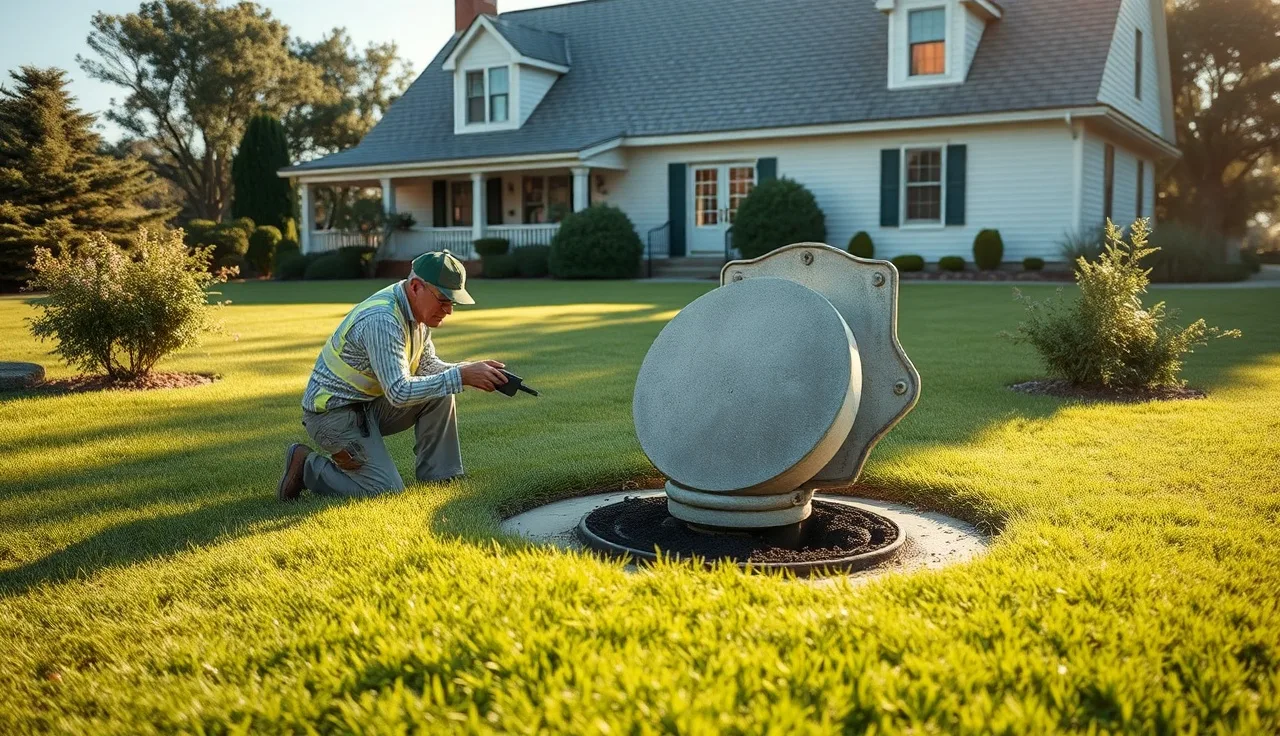
A standard septic inspection has four parts: locating and opening the tank, inspecting the tank interior, checking the distribution box (D-box), and evaluating the leach field. A thorough inspection in Suffolk County usually goes past that bare minimum.
Locating the tank is step one, and it's harder than it sounds. Many Sagaponack properties have older systems with no as-built drawings on file. The inspector may use a sewer camera, a soil probe, or a metal detector to find the tank before anyone digs. Suffolk County Department of Health Services (SCDHS) keeps records of permitted systems, and a good inspector pulls those records before the site visit [1].
Once the tank is open, the inspector checks liquid level relative to the outlet pipe (high liquid suggests the leach field is saturated or failing), looks for cracks or structural damage, measures the scum and sludge layers, confirms the baffles are intact, and checks the lid and risers. If the tank hasn't been pumped recently, most inspectors will pump it during the inspection so they can see the bottom and walls clearly. You cannot do a real inspection through murky liquid. Our guide on septic tank pump out covers that process on its own.
The distribution box sits between the tank and the leach field trenches. The inspector opens it and looks for cracks, uneven flow among the laterals, and signs of solids carrying over from the tank. A broken or tilted D-box is a common failure point on Long Island systems that have settled over the decades.
Leach field evaluation is where inspections vary most. A basic visual check hunts for wet spots, odors, and unusually lush grass. A thorough approach probes the soil above the trenches to feel for saturation, and sometimes runs a dye test or a camera inspection of the laterals. Suffolk County does not mandate a specific leach field test for resale inspections, but any inspector worth hiring does more than look at the grass.
For properties near water, which describes a lot of Sagaponack, some inspectors or buyers' attorneys request a water quality test of the nearest well or surface water body. That's separate from the septic inspection itself but often bundled into the same visit.
How much does a septic inspection cost in Sagaponack?
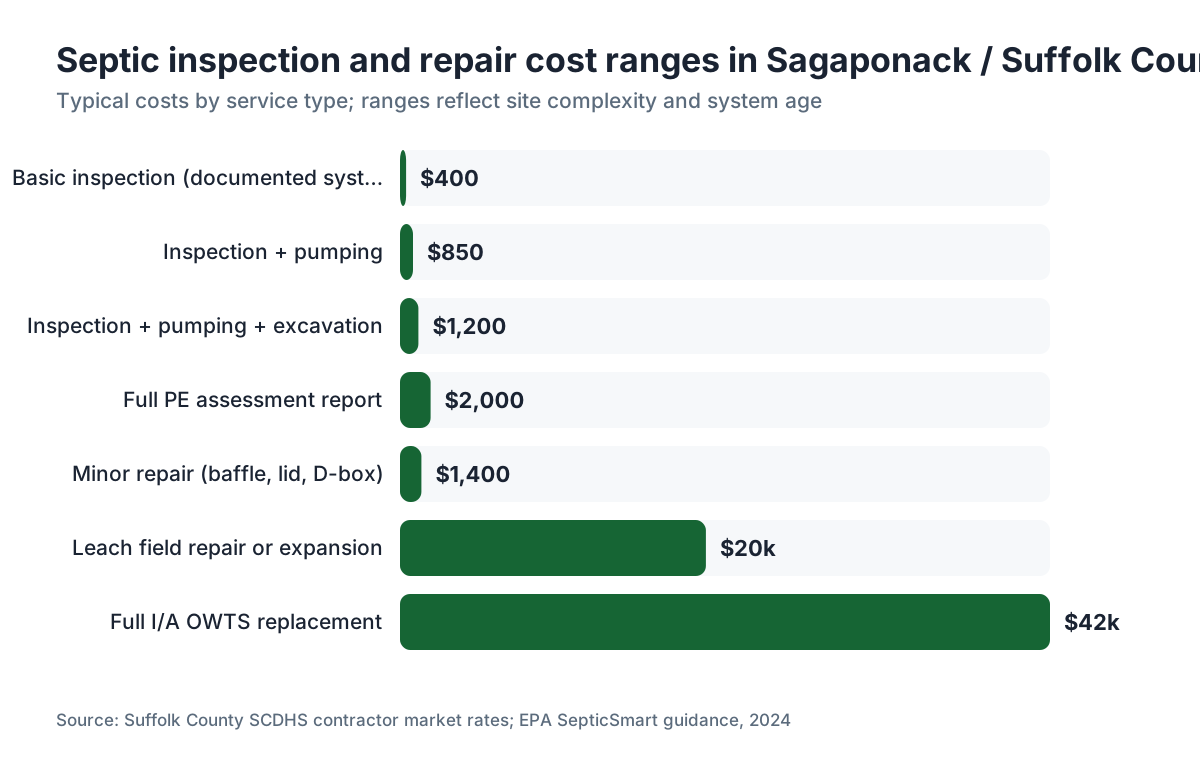
Expect to pay $300 to $700 for a standard inspection by a licensed Suffolk County inspector, before any pumping or excavation. That range reflects real variation. A straightforward tank-locate-and-inspect on a well-documented property costs less than a multi-hour dig on an older estate with no records and a system that's been expanded over the years.
Pumping during the inspection adds $300 to $600 depending on tank size. A standard 1,000-gallon residential tank sits toward the low end. A 2,000-gallon tank on a big estate runs higher. See our full breakdown in septic tank pumping.
If the inspector can't locate the tank without excavation, or the D-box needs digging to access, add $200 to $500 for a mini-excavator and labor. On some older properties, this is unavoidable.
Specialized services layer on top. A camera inspection of the laterals runs $150 to $400. A dye test adds $100 to $200. If an environmental consultant rather than a standard inspector does the work (common on high-value deals or when lenders require a third-party report), the full assessment package can reach $1,500 to $2,500.
None of those numbers include repairs. Find a problem and costs escalate fast. Suffolk County labor rates are high, equipment access on narrow village roads gets complicated, and the regulatory approval process adds time and money. A modest repair like replacing a D-box might run $800 to $2,000. A leach field repair or expansion can run $10,000 to $30,000. A full replacement with an I/A OWTS, required in nitrogen-sensitive areas, can run $25,000 to $60,000 or more depending on site conditions [3].
For context on what a new system costs, see our article on cost to install septic system.
What are the Suffolk County rules for septic inspections at real estate closings?
Suffolk County has no single blanket law requiring a septic inspection at every residential sale, but it gets close. SCDHS requires that any septic system modification or new installation be permitted, and most real estate contracts in this market include an inspection contingency as a practical matter [1]. Some towns within Suffolk County have gone further with local ordinances.
The Town of Southampton, which governs Sagaponack, has its own Building Department and Health Division with inspection requirements tied to certain permits and certificate-of-occupancy processes. If a property has had any unpermitted additions or system work, that can trigger a mandatory inspection before the sale can close.
New York State's OWTS Technology Law (enacted as Environmental Conservation Law Section 17-0745) requires that any replacement of a failing system within a designated nitrogen-sensitive area use an I/A OWTS rather than a conventional septic system [2]. The DEC has mapped these areas, and much of the coastal and wetland-adjacent land in Sagaponack falls within them. That statutory requirement matters because it means a failing inspection in Sagaponack is more than a repair question. It's potentially a $30,000 to $60,000 system replacement question.
For buyers, the practical takeaway is simple: get the inspection done early in the due diligence period, not at the last minute. If the system is marginal or failing, you need time to loop in SCDHS, gather repair estimates, and negotiate with the seller. A week before closing is not enough time.
What commonly causes septic systems to fail inspection in Sagaponack?
The failures in Suffolk County's coastal communities follow a predictable pattern.
Age is the biggest factor. Many Sagaponack properties have systems installed in the 1970s and 1980s. Concrete tanks from that era often develop cracks, and the leach fields have been absorbing effluent for 40 or 50 years. Soil in parts of the South Fork is very fine sand with low organic content, which can bio-clog over time even though the texture looks like it should drain well.
High water table is a recurring problem. Sagaponack sits near Sagaponack Pond and other coastal wetlands. Seasonal swings in the water table can saturate leach field trenches from below, making them hydraulically ineffective even when they're structurally intact. An inspector visiting in March after a wet winter may see a saturated field that looks fine again by July. A good inspector accounts for this by checking recent water table data for the area.
Oversized homes on existing systems are another common issue. The Hamptons have seen decades of teardown-and-rebuild activity where a modest 1960s cottage gets replaced with a 6,000-square-foot house, but the septic system never gets upgraded to match the new bedroom count. Suffolk County sizes systems by bedroom count, and a system permitted for three bedrooms serving a six-bedroom house is undersized by definition [1].
Baffles fail over time, especially in older concrete tanks. A missing or deteriorated inlet baffle lets raw sewage flow straight toward the outlet. A missing outlet baffle lets scum escape to the leach field, causing rapid bio-clogging. Both are fixable with a baffle replacement, one of the cheaper repairs you can make. Our article on septic tank repair covers what that looks like.
Distribution box problems are frequent in older systems. The D-box can crack, tilt from soil settling, or fill with solids if the tank has been sending partially treated effluent downstream. An uneven D-box overloads one or two leach field laterals while starving the others, which pushes the whole field toward early failure.
Who can perform a septic inspection in Sagaponack?
In New York, septic inspections aren't licensed through a single unified credential the way home inspectors are. The landscape is fragmented, and it pays to know who you're actually hiring.
Licensed home inspectors in New York (regulated under Article 12-B of General Business Law) can perform visual septic inspections as part of a general home inspection, but their scope is typically limited to visual observation without pumping or excavation [4]. For a property in Sagaponack, a visual-only inspection is rarely enough.
Engineers licensed by the New York State Education Department (PE or RA licenses) can perform full engineering assessments of septic systems and sign off on system designs for SCDHS permit applications [9]. On complex properties, or where a buyer's lender requires an engineering report, hiring a PE is the right call.
Master plumbers and licensed septic contractors in Suffolk County can perform operational inspections that include pumping, probing, and D-box evaluation. They work under SCDHS contractor registration requirements. Ask any contractor you hire to confirm their SCDHS registration number.
Environmental consultants (often with backgrounds in geology, hydrology, or environmental engineering) get hired on high-value transactions. They produce written reports with professional liability attached, which some buyers and lenders specifically require.
The practical answer for most Sagaponack real estate deals: hire a licensed septic contractor with SCDHS registration who has real experience on the East End. Add a licensed PE or environmental consultant if the property is large, the system is old and undocumented, or the transaction value justifies the extra cost. Referrals from real estate attorneys who close in Southampton Town regularly are usually the best source for names.
How do Innovative/Alternative (I/A) septic systems work and why does Sagaponack require them?
A conventional septic system does a good job removing solids and most pathogens, but it removes only about 20 to 30% of the nitrogen in household wastewater before that water reaches the soil [5]. On Long Island, where groundwater flows toward bays, ponds, and the ocean, that nitrogen loads coastal waters and drives algae blooms, fish kills, and eelgrass loss. Sagaponack Pond and the surrounding waters have documented nitrogen impairment.
New York's OWTS Technology Law answered this by requiring I/A systems in nitrogen-sensitive areas. An I/A OWTS uses extra treatment steps, typically biological nitrogen removal (denitrification), to cut total nitrogen from the roughly 40 to 60 mg/L typical of conventional septic effluent down to 19 mg/L or less, the standard set by SCDHS [3]. Some systems reach 10 mg/L or lower.
SCDHS maintains an approved product list of I/A OWTS technologies [8]. These include systems from manufacturers like Fuji Clean, Hydro-Action, and Norweco, among others. All of them require an annual maintenance contract and inspection by a certified O&M provider, a recurring cost conventional systems don't carry. Annual O&M contracts typically run $400 to $800 per year in Suffolk County.
Here's the key point for Sagaponack homeowners whose systems fail inspection. If your property is in a nitrogen-sensitive area and your system needs replacement, you cannot simply drop in a new conventional septic system. You'll need an I/A system, SCDHS approval, and an ongoing maintenance contract. The Suffolk County Reclaim Our Water program offers rebates of up to $14,000 toward I/A OWTS installation for qualifying properties [3]. That rebate offsets a real chunk of the cost premium over a conventional system.
For a broader look at what replacement involves and what it costs, see cost to put in a septic tank and septic tank installation.
What happens if a Sagaponack septic system fails inspection?
A failed inspection does not automatically mean you can't buy or sell the property. It means you have a problem to solve, and the path forward depends on what failed and how badly.
A minor failure like a cracked lid, deteriorated baffles, or an overfull tank that just needs pumping can be fixed quickly and cheaply. The inspector re-inspects after repairs, and the deal proceeds. These fixes run $200 to $2,000 in most cases.
A D-box failure or limited leach field damage may need a partial repair. Suffolk County allows repair and expansion of existing systems under certain conditions, subject to SCDHS permit approval. These repairs take weeks to months to permit and cost $5,000 to $20,000 depending on scope.
A complete leach field failure means the absorption area can no longer handle the hydraulic or organic load. That requires full replacement. In nitrogen-sensitive areas of Sagaponack, full replacement means an I/A OWTS. From the moment you start the permit application to the day the system passes its final inspection, allow six months to a year in Suffolk County. The regulatory process is not fast. Buyers and sellers need to plan around it, through a price adjustment, an escrow holdback, or a seller-side repair commitment with a realistic timeline.
If the property can't support a code-compliant replacement (insufficient lot area, unfavorable soil, high water table, setback conflicts), the situation gets more serious. Suffolk County has provisions for variances, but they aren't guaranteed. In rare cases a property has no viable path to a compliant system, which creates real complications for financing and sale.
Operators running inspection programs across multiple East End properties often need to track inspection status, repair timelines, and permit approvals in one place. SepticMind's workflow tools are built for this kind of multi-property service coordination.
How often should Sagaponack homeowners inspect and pump their septic systems?
The EPA's SepticSmart program recommends inspecting septic systems every one to three years and pumping every three to five years, depending on household size and system capacity [6]. Those are national averages. In Sagaponack, lean toward the more frequent end.
Seasonal occupancy is the main variable. Many Sagaponack homes sit empty for long stretches, then fill with houseguests through summer. A system that sees almost no use from October through May, then handles a full house plus guests for 12 weekends straight, takes hydraulic shocks that are harder on it than steady year-round use. Pumping before summer starts is a smart move for heavy summer-use properties.
The EPA states that "a household septic system should be inspected at least every three years by a professional" and that "pumping frequency depends on the size of the household, the total wastewater generated, the volume of solids in the wastewater, and the size of the septic tank" [6]. For a 1,000-gallon tank serving four people, the typical pumping interval is three to five years. For a 2,000-gallon tank serving two people intermittently, you might stretch to seven years, but it's not worth risking a backup that ruins a summer weekend.
For a data-driven guide to pumping schedules, see our article on how often to pump septic tank. For what cleaning the tank involves separately from a full inspection, see septic tank cleaning and septic tank emptying.
One practical tip. Keep a log of every inspection, pumping, and repair with the date and contractor name. When you go to sell, that log is worth real money in negotiation, because it shows a maintained system rather than an unknown.
What should buyers ask for in a Sagaponack septic inspection contingency?
New York real estate contracts typically include a home inspection contingency, but the septic language is often vague. In Sagaponack, vague septic language is expensive ambiguity.
A well-drafted contingency should spell out who pays for the inspection and pumping (usually the seller, though it varies), what the inspection scope covers (tank interior, D-box, leach field probe, more than a visual), what license or credential the inspector must hold, what happens if the system is undersized for the current bedroom count, and what repair threshold triggers a credit or renegotiation.
Buyers should specifically ask whether the existing system is permitted for the current number of bedrooms. This is the question that catches people on the East End, where bedroom additions and home expansions routinely outpaced system upgrades. An undersized permitted system is a known future liability even if it passes inspection today.
Ask to see the SCDHS permit file for the property. Suffolk County Health Services keeps records for permitted systems, and you or your attorney can request them. If there's no permit on file, or the system in the ground doesn't match the permitted design, that's a serious red flag.
Ask whether the property falls within a nitrogen-sensitive area designation. If it does and the system is aging, you want to understand what a replacement would cost before you close, not after.
For the leach field, ask whether the inspection happened during or shortly after a wet period. A field that passes in August after a dry summer can behave very differently in April. Some buyers' attorneys request a second inspection in spring specifically to catch seasonal high-water-table issues.
For a broader look at what inspections cover across different system types, see our detailed guide on septic tank inspection.
Typical inspection cost and timeline: a comparison
The table below shows what you can realistically expect for different inspection scenarios in Sagaponack and the surrounding Southampton Town area. These are real-world ranges based on Suffolk County market conditions. Individual quotes will vary.
| Scenario | Typical Cost | Typical Timeline |
|---|---|---|
| Basic inspection (documented system, recent pump) | $300 to $500 | 2 to 4 hours on site |
| Inspection + pumping (standard tank) | $600 to $1,100 | 3 to 5 hours on site |
| Inspection + pumping + excavation to locate tank | $800 to $1,600 | Full day |
| Full assessment with PE report | $1,500 to $2,500 | 1 to 3 days including report |
| Inspection + camera of laterals | $700 to $1,300 | 4 to 6 hours on site |
| Minor repair (baffle, lid, D-box) | $800 to $2,000 | 1 to 3 days |
| Leach field repair or expansion | $10,000 to $30,000 | 2 to 6 months (permitting + work) |
| Full I/A OWTS replacement | $25,000 to $60,000+ | 6 to 12 months (permitting + work) |
The permitting timelines are not padding. SCDHS is a real bottleneck. Applications require soil borings, site surveys, engineered drawings, and review cycles that routinely take months. Plan for it.
For homeowners managing a contractor relationship, SepticMind's service scheduling and document tracking keep permits, inspection reports, and maintenance records in one place. That cuts the scramble when a buyer's attorney requests documentation at 5pm on a Friday before a Monday closing.
What questions should you ask a Sagaponack septic inspector before hiring them?
Most homeowners hire the first name their real estate agent suggests. That's fine if the agent works this market regularly, but spend five minutes vetting the inspector yourself.
Ask whether they're registered with SCDHS as a septic contractor. It's a factual yes-or-no question. If they can't answer it immediately, move on.
Ask how many inspections they perform in the Southampton Town area specifically. Someone who works mostly in Nassau County or western Suffolk County may not know the local soil conditions, the SCDHS permit history quirks, or which SCDHS field staff to call with questions.
Ask what the inspection includes. A good answer covers tank locate-and-open, scum and sludge measurement, baffle check, D-box access and inspection, and leach field probe or evaluation. If the answer is just "we look at the tank," that's not enough for a Sagaponack property.
Ask whether they pull the SCDHS permit file before the inspection. A good inspector does this as a matter of course. It tells them the permitted system design, the permitted bedroom count, and any prior violations or repairs on record.
Ask what happens if they find a problem. Do they give you a repair estimate on the spot, or just write a report? For a real estate deal, you often need a rough repair cost fast to make decisions. Some inspectors will hand you ballpark numbers. Others stick to inspection-only.
Ask whether they carry professional liability (E&O) insurance. For a high-value property, this matters. If the inspector misses a failing leach field and you close without knowing, liability coverage is the difference between an expensive problem and a catastrophic one.
Ask for references from other Sagaponack or Southampton Town inspections in the last 12 months. A contractor with real experience in this market should be able to hand them over without hesitation.
Frequently asked questions
Is a septic inspection required to sell a home in Sagaponack?
No single New York State law mandates a septic inspection at every home sale, but in practice it's nearly universal in Sagaponack. Buyers' attorneys routinely require it as a contract contingency, lenders may require it, and Southampton Town can trigger inspections through permit or CO requirements. Treat it as a practical requirement, not an optional courtesy, especially on properties with older or undocumented systems.
How long does a septic inspection take in Sagaponack?
A straightforward inspection on a documented, recently pumped system takes two to four hours on site. Add two to three hours if pumping is included. If the contractor needs to excavate to locate the tank or access the distribution box, plan on a full day. The written report typically arrives one to three business days after the site visit, longer if a professional engineer is signing off.
What is the difference between a conventional septic system and an I/A OWTS in Sagaponack?
A conventional septic system treats wastewater in a tank and distributes effluent to a leach field, removing solids and pathogens but only about 20 to 30% of nitrogen. An Innovative/Alternative OWTS adds a biological treatment stage that cuts nitrogen to 19 mg/L or below. New York State requires I/A systems for replacements in nitrogen-sensitive areas, which includes much of coastal Sagaponack. I/A systems cost more upfront and need annual maintenance contracts of $400 to $800 per year.
Does the Suffolk County Reclaim Our Water program offer rebates for Sagaponack homeowners?
Yes. The Suffolk County Reclaim Our Water initiative offers rebates of up to $14,000 toward installing an approved I/A OWTS for qualifying properties. Sagaponack homeowners in nitrogen-sensitive areas are generally eligible. The rebate offsets a real chunk of the cost premium over a conventional system. Contact SCDHS or the program directly to confirm current eligibility criteria, since funding availability can change.
How do I find the SCDHS permit record for my Sagaponack septic system?
Contact the Suffolk County Department of Health Services, Division of Environmental Quality. You can request records by property address. The file includes the original system design, permitted bedroom count, soil test results, and any prior inspection or repair records. Many real estate attorneys and experienced inspectors pull these records as a standard step. Having the file before the inspection saves time and sometimes surfaces surprises like unpermitted additions.
Can I use a standard home inspector for my Sagaponack septic inspection?
A New York licensed home inspector can perform a visual septic inspection, but their scope is limited to what they can observe without pumping, excavating, or probing. For most Sagaponack properties, especially older homes or those near water, a visual-only inspection isn't adequate. Hire a licensed septic contractor with SCDHS registration, and consider a licensed professional engineer if the transaction value or system complexity warrants it.
What is the typical leach field lifespan for septic systems in Sagaponack?
With proper maintenance, a conventional leach field can last 25 to 40 years. Many Sagaponack systems are approaching or past that age. High-water-table conditions near the coast can shorten field life by causing hydraulic saturation from below. Systems overloaded by large homes exceeding their permitted bedroom count tend to fail faster. A field showing signs of stress but not fully failed may recover with a period of reduced loading.
Who pays for the septic inspection in a Sagaponack real estate transaction?
There's no fixed rule. In practice it varies by negotiation. Many contracts call for the seller to pay for the inspection and any required pumping, since the system is their property and they have an interest in showing it passes. Buyers sometimes pay when they want to control the choice of inspector. Repair costs, if any turn up, are typically subject to separate negotiation between buyer and seller.
What happens if a Sagaponack home has an unpermitted septic system?
An unpermitted system creates real problems at sale. SCDHS may require a permit application for the existing system, which triggers soil testing and design review. If the system doesn't meet current standards, it needs to be brought into compliance. Buyers should ask to see the SCDHS permit file before making an offer. An unpermitted system in a nitrogen-sensitive area is especially complicated, because any new permit will require I/A OWTS standards.
How often should I pump my Sagaponack septic tank?
Every three to five years is the standard recommendation for a typical residential tank under regular use. For Sagaponack properties with heavy seasonal summer use, pumping at the start of each summer season is a smart practice many East End service contractors recommend. A 2,000-gallon tank serving two people most of the year can sometimes go longer, but the inspection at pumping time is worth more than the few dollars you save by stretching the interval.
Can a failing leach field in Sagaponack be repaired rather than replaced?
Sometimes. SCDHS allows repair and limited expansion of existing leach fields under permit, if the lot has sufficient area and the soil supports it. A rested field where loading has been temporarily reduced can sometimes recover partial function. But a fully failed field in a nitrogen-sensitive area that needs SCDHS permitting for any work will likely trigger the I/A OWTS requirement for any significant intervention. Get a professional assessment before assuming a repair is possible.
What is the nitrogen limit for I/A septic systems in Suffolk County?
The Suffolk County Department of Health Services sets the performance standard at 19 mg/L total nitrogen or less for approved I/A OWTS in nitrogen-sensitive areas. Some systems on the approved product list reach 10 mg/L or lower under normal operating conditions. For comparison, conventional septic effluent typically contains 40 to 60 mg/L of total nitrogen before soil treatment.
Do Sagaponack vacation rentals need more frequent septic inspections?
No Suffolk County ordinance specifically requires more frequent inspections for short-term rental properties, but the usage pattern absolutely warrants it. A vacation rental that hosts multiple full-capacity groups per summer puts substantially more hydraulic load on the system than a primary residence. Annual inspection and pumping as needed is a reasonable practice, and some rental operators fold it into their yearly property preparation.
Sources
- Suffolk County Department of Health Services, Sanitary Code Article 6: Suffolk County regulates all private sewage disposal systems under Sanitary Code Article 6, including permit requirements and system sizing by bedroom count
- New York State Department of Environmental Conservation (OWTS Technology Law, ECL 17-0745): New York State enacted the Onsite Wastewater Treatment System Technology Law requiring I/A OWTS in nitrogen-sensitive areas; replacements in those areas must meet nitrogen reduction standards
- Suffolk County Reclaim Our Water Program: Suffolk County offers rebates of up to $14,000 toward I/A OWTS installation; SCDHS sets 19 mg/L total nitrogen as the performance standard for approved systems
- New York State Department of State, Division of Licensing Services (Home Inspection, Article 12-B General Business Law): New York home inspectors are licensed under Article 12-B of General Business Law; their scope is typically limited to visual observation without pumping or excavation
- US EPA, Septic Systems (SepticSmart): Conventional septic systems remove only about 20 to 30% of nitrogen in household wastewater before it reaches groundwater
- US EPA, How to Care for Your Septic System: EPA recommends inspecting septic systems every one to three years and pumping every three to five years; states that 'a household septic system should be inspected at least every three years by a professional'
- New York State Department of Health, Environmental Health: New York State Department of Health provides oversight of onsite wastewater treatment systems alongside DEC, with standards applicable to Suffolk County systems
- Suffolk County Department of Health Services, I/A OWTS Program: SCDHS maintains an approved product list of I/A OWTS technologies and requires annual O&M contracts for all approved systems in nitrogen-sensitive areas
- New York State Office of the Professions, Licensed Professions: Licensed professional engineers in New York can perform engineering assessments of septic systems and sign off on system designs for SCDHS permit applications
- US EPA, Septic Systems (inspection and maintenance guidance): EPA guidance describes the components of a standard septic inspection: tank condition, scum and sludge levels, baffle integrity, and leach field evaluation
Last updated 2026-07-09