Septic drain field help: diagnose, fix, or replace your leach field
By the SepticMind Editorial Team
TL;DR
- A failing drain field shows up as soggy ground over the field, sewage odors outdoors, slow indoor drains, and sewage backing up into the house.
- Causes range from too much water to biomat buildup to tree-root damage.
- Targeted repairs run $1,500 to $5,000.
- Full replacement averages $10,000 to $20,000, more if your soil is bad.
What does a septic drain field actually do?
The drain field (also called a leach field or soil absorption system) is the last stage of your septic system. Wastewater leaves the tank as clarified liquid called effluent, flows through perforated pipes buried in gravel-filled trenches, and slowly soaks into the soil around them. The soil does the real cleaning. Bacteria in the top few feet break down pathogens and nutrients before the water reaches the water table.
The EPA describes the drain field as a shallow covered excavation made in unsaturated soil that pretreats and disperses wastewater. That soil layer is the last thing standing between your household waste and your drinking water. When it quits, nothing downstream cleans the water for you [1].
Most conventional drain fields last 20 to 30 years with decent maintenance. Some push 40. Some die in 10. The difference almost always comes down to three things: how much water goes in, how well the tank is maintained, and what the native soil is like. If you want the mechanical detail on trench geometry and soil perc rate, read our piece on the leach field.
What are the warning signs of drain field problems?
The signs get hard to miss once you know them. The trouble is that most homeowners never think about the septic system until something goes wrong, and by then the cheap fixes are off the table.
Here are the common warning signs, roughly in order from early to late:
| Warning sign | What stage it usually means |
|---|---|
| Slow drains inside the house | Early, could still be a tank issue |
| Gurgling sounds from drains or toilets | Early to mid |
| Sewage odors inside the house | Mid |
| Sewage odors outside near the field | Mid to late |
| Soggy, spongy ground or standing water over the field | Late |
| Unusually green, lush grass over the field | Late (effluent is fertilizing the turf) |
| Sewage backing up into sinks, tubs, or toilets | Very late, system overwhelmed |
| Positive dye test or high nitrates in a nearby well | Late, possible groundwater impact |
Odors near the field are serious, but they don't always mean the field is done. Sometimes it's a cracked distribution box or a broken pipe upstream of the field. A licensed inspector tells you which part of the system failed. Don't skip that step and assume you need a whole new field.
EPA's SepticSmart guidance notes that a foul odor is not always the first sign of a failing system, and that regular inspections are the only reliable way to catch problems early [1]. That tracks with what happens in the field. A drain field can be biomat-clogged and dying while the yard still looks fine.
What causes septic drain field problems?
Five things cause most failures. Almost every dead field comes down to one of these, or a couple stacked together.
1. Too much water (hydraulic overloading). More water goes in than the soil can take, so it either surfaces on top of the field or backs up into the house. This is the most common cause and the most preventable one. The EPA recommends spreading laundry across multiple days, fixing leaky fixtures, and installing high-efficiency toilets to cut daily load [1]. A standard field is sized for roughly 50 to 100 gallons per bedroom per day. A family of four running four loads of laundry on Saturday morning can blow past that in an afternoon.
2. Biomat buildup. Over time a dense layer of bacteria and organic gunk (the biomat) forms on the trench floor and walls. A little biomat is normal and even helps with treatment. Too much of it seals the soil and stops absorption cold. Biomat grows faster when the tank isn't pumped, because undigested solids and grease flow into the field and feed it [2].
3. Tank neglect. Skip pumping (generally every 3 to 5 years for a typical household) and solids overflow into the field. Those solids clog the gravel and pipes in ways that are very hard to undo. Easiest failure to prevent. See how often to pump your septic tank for numbers tuned to your household.
4. Physical damage. Tree roots crush perforated pipe. Trucks parked on the field compact the soil. Bad grading dumps rainwater into the trenches. Any of these can wreck the absorption bed mechanically.
5. Soil and age. Clay soil drains slowly from day one. As a field ages, its percolation rate drops on its own. A field that was sized correctly in 1990 may be badly undersized for a house that added a bathroom and two teenagers since then.
How do you diagnose a drain field problem yourself?
You can do a solid first pass on your own before you call anyone. It won't tell you everything, but it narrows things down and saves you a service call for something obvious.
First, find the field. Pull the permit drawing (usually on file with your county health department) or probe for it. The field almost always sits downhill from the tank, and the inspection port caps (small plastic caps or risers) mark the corners or ends of the trenches.
Then just look. Walk the field after a dry stretch of several days. Hunt for wet spots, dips, or bright green strips of grass. Sniff for sewage. If you have a backup indoors, figure out whether it hits every drain or just one. A single slow drain is usually a pipe clog, not a field problem. When every drain in the house is slow or backing up, the field or the tank is the likely cause.
Check the tank first. A septic tank inspection costs less than a full field investigation and rules out the simplest fixes. If the tank is packed with solids, pump it, wait a few weeks, and watch whether symptoms clear. If a septic tank pump out doesn't fix it, the investigation moves to the field.
For a real diagnosis, a licensed pro can run a dye test (flush fluorescent dye and watch for it in the yard or nearby water), push a camera into the distribution pipes, or pressure-test the laterals. Some inspectors use a soil probe to check moisture in the gravel trenches directly. Pay for this before you authorize any big repair or replacement. It's the cheapest insurance you'll buy on this whole project.
What are the repair options for a failing drain field?
Good news: replacement isn't always the answer. Bad news: the options that actually work are fewer than the septic-additive industry wants you to believe.
Rest, and nothing else. If too much water is the problem, cutting water use hard for weeks or months sometimes lets the soil dry out and recover. Works best on a young field with a thin biomat. Rarely works on a badly clogged one.
Pipe jetting and aeration. High-pressure jetting can break up biomat in the lateral pipes. Injecting air into the soil around the trenches can reopen pore space. Some contractors report good results. The published evidence is mixed, and the EPA endorses no additive or aeration product as a reliable repair [1]. Still, for a field that's moderately loaded and not physically broken, jetting is a reasonable thing to try before you spend on a new field. Figure $500 to $2,000.
Distribution box replacement. If the d-box is cracked, tilted, or clogged, one arm of the field floods while the others stay dry. Swapping the box is a simple job at $200 to $600, and it can bring back a field that looked dead but really just had lopsided distribution.
Pipe replacement or spot repair. Broken laterals from roots or physical damage can sometimes be replaced without tearing up the whole field. Cost swings a lot: $500 to $3,000 depending on how much pipe you're replacing and how deep it sits.
Hydrogen peroxide biomat treatment. This one is controversial. Some contractors flood the trenches with diluted hydrogen peroxide to burn off the biomat. University of Minnesota Extension research on onsite systems has looked at chemical restoration methods, and short-term percolation gains are possible while long-term data stays thin [3]. It's not a cure. It may buy time.
Full replacement. When the soil is sealed for good, the pipes are extensively broken, or the site fails a perc test, replacement is the only real fix. That means excavating the old trenches (sometimes the old gravel stays), perc-testing a fresh area of the lot, pulling a permit, and installing new trenches. It's a real project. Expect a few days to a week on site, your county health department involved for permits and inspections, and $10,000 to $20,000 for a conventional system [2].
If your lot has no good soil left for a conventional field, you're into alternative territory: mound, drip, aerobic unit, or similar. Those run $15,000 to $50,000 or more depending on your state and site. Our septic system repair guide breaks the options down in full.
How much does drain field repair or replacement cost?
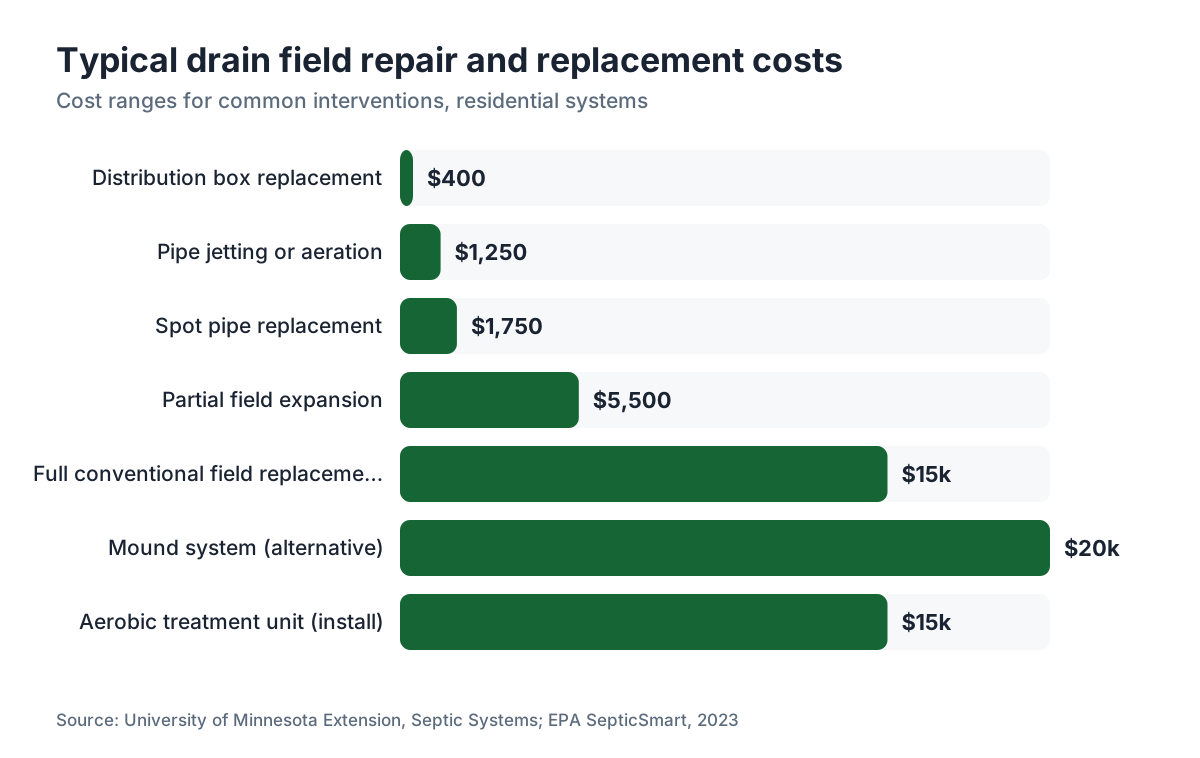
Cost is the question everybody actually wants answered, and the honest answer is that it varies enough to make one number nearly useless. Here's a real breakdown built on typical contractor pricing and state extension data.
| Repair type | Typical cost range | Notes |
|---|---|---|
| Distribution box replacement | $200 to $600 | Cheapest real fix |
| Pipe jetting or aeration | $500 to $2,000 | May need repeat treatments |
| Spot pipe replacement | $500 to $3,000 | Depends on depth and length |
| Partial field expansion | $3,000 to $8,000 | Only works if the lot has suitable soil |
| Full conventional field replacement | $10,000 to $20,000 | Most common full replacement |
| Mound system (alternative) | $15,000 to $25,000 | For poor soil or high water table |
| Aerobic treatment unit | $10,000 to $20,000 install + $500 to $1,000/yr | High-maintenance alternative |
Permits add $200 to $1,000 in most counties. Soil testing (perc and permeability) adds $300 to $800. Inspection fees vary by jurisdiction. Some states also make you pay a licensed engineer to stamp the design.
The National Association of Wastewater Technicians and state extension programs in places like Minnesota, Virginia, and North Carolina publish regional cost guides that beat any national average for your area [3][9]. Check your state's department of environmental quality or health for local permit rules. Virginia's Department of Health runs the state's onsite sewage and well programs and keeps public permitting guidance online [5].
One cost most homeowners forget: if you need a new field, you may also need a new septic tank if the old one is damaged or undersized. That's another $2,000 to $7,000. Get a full system assessment before you set a budget.
Can you restore a drain field without full replacement?
This is where a lot of money gets burned on products that don't work, so I'll be blunt.
Septic additives, biological or chemical, are not proven to bring back a dead field. The EPA has stated that research does not support claims that additives improve system performance or replace regular maintenance, and that some chemical additives can actually harm the system and contaminate groundwater [1]. That's a clear position from the agency that regulates these systems.
The methods with some real support are resting the field (cutting water use sharply), mechanical aeration of the trench walls, and occasionally hydrogen peroxide flooding. None are guaranteed. None do a thing on a field with collapsed pipes or soil that's sealed for good.
My honest take. If a field is under 15 years old and biomat is the main problem, spending $1,000 to $2,000 on an aeration or jetting attempt is worth it before you commit to replacement. If the field is 25 years old, the soil flunked a perc test, and you've had raw sewage in the yard, get replacement quotes and stop feeding money to a system that's finished.
If you manage several properties or just want to stop guessing which system is overdue, SepticMind lets you set pump and inspection schedules so small problems get caught before they turn into field failures.
How long does a drain field last, and how do you make it last longer?
A well-maintained conventional drain field lasts 25 to 30 years on average, per the EPA and multiple state extension programs [1][3]. Fields in well-drained sandy loam with disciplined maintenance can hit 40 or more. Fields in clay or heavy-use homes can die by 15.
The biggest thing you control is what goes into the system.
Pump the tank on schedule. For a three-bedroom home with a 1,000-gallon tank, that's every 3 to 5 years for a typical family [2]. The exact interval depends on household size and tank capacity. Get it pumped. Don't guess. Solids overflowing into the field speed up biomat growth faster than anything else you can do to it. Our septic tank pumping guide has interval tables.
Spread water out. Run the dishwasher and laundry on different days. Fix leaking toilets the day you notice them. A running toilet can waste around 200 gallons a day, according to EPA WaterSense [6]. That alone can shove a marginal field over the edge.
Keep the field clear. No cars, trucks, or heavy equipment over it, ever. No large shrubs or trees within 30 feet of the trenches. Willows, maples, and poplars are the worst offenders for root intrusion. Keep grass on the field, but don't over-water it.
Steer runoff away. Downspouts, sump pump discharge, and grading that funnels rain toward the field saturate the soil and eat the hydraulic capacity you need for effluent.
Keep junk out of the drains. Wipes (even "flushable" ones), feminine products, medications, and heavy cooking grease all drag down treatment in the tank and speed up clogging downstream.
Inspect on a schedule. The EPA recommends inspecting conventional systems every 3 years [1]. Alternative systems with pumps and aerators often need it yearly. Don't wait for a symptom to remind you.
Do you need a permit to repair or replace a drain field?
Yes, in almost every jurisdiction in the country. Drain field work falls under state onsite wastewater codes, and most states require a permit for any repair that changes the system's design, location, or size. Minor work like replacing one broken pipe may or may not need a permit, depending on your county.
Pulling a permit usually means a soil evaluation and perc test if you're siting a new field. Many states require the design to be stamped by a licensed soil scientist, PE, or certified designer. Inspections before and after installation are non-negotiable under most codes.
Here's why this matters beyond staying legal. An unpermitted field may not be covered by your homeowner's insurance when it fails and floods something. It also blows up at closing when you sell. Real estate deals increasingly require septic inspections, and an unpermitted repair surfaces fast.
State codes vary a lot. Minnesota's rules for onsite sewage treatment systems (Minnesota Rules Chapter 7080) are among the most detailed in the country [7]. Virginia's are in the Sewage Handling and Disposal Regulations (12 VAC 5-610) [5]. North Carolina's are in 15A NCAC 18A .1900 [4]. Check your state health or environmental quality department's website for the rules where you live before you touch anything.
What happens if you ignore drain field problems?
Short version: it gets worse, it gets more expensive, and eventually a health problem forces your hand.
A field that's surfacing effluent is a public health violation in every state. Raw or partly treated sewage carries pathogens: bacteria like E. coli and salmonella, plus viruses and parasites. Kids, pets, and adults who touch the wet area are at risk. The EPA counts failing septic systems as a large source of groundwater contamination and a documented cause of waterborne disease outbreaks in the United States [11].
Your county health department can issue an abatement order that makes you stop using the system or repair it by a deadline. Ignore it and you face fines, legal action, and sometimes condemnation of the property as uninhabitable until you fix it.
Nearby wells can go bad. If you or a neighbor pulls drinking water from a shallow well within a few hundred feet of a failing field, nitrate and pathogen contamination is a real risk. The EPA's maximum contaminant level for nitrate in drinking water is 10 mg/L, and failing systems in dense areas regularly push groundwater past that line [8].
The money compounds too. A system you could have saved with a $1,500 aeration job becomes a $15,000 replacement. A lot that could have taken a conventional field becomes a $25,000 alternative system, because years of surface overflow ruined the last patch of good soil you had.
Spot any warning sign above? Book an inspection this week, not next season.
How do you find a qualified drain field repair contractor?
The quality gap between contractors here is huge, and a low bid can cost you far more than a high one.
Start with the license. Every state that regulates onsite wastewater (which is most of them) requires a specific license to design, install, or repair septic systems. In many states design and installation are separate licenses. Ask for the license number and verify it with your state board. That one filter kills a lot of problems.
Look for contractors certified through the National Association of Wastewater Technicians (NAWT) or credentialed by the National Environmental Health Association (NEHA) [9][10]. Neither is a universal requirement, but both signal someone who treats this as a trade, not a side hustle.
Get at least three quotes on any job over $3,000. Make each contractor explain what they found, what they propose, and why. A contractor who says "you need a new field" without a camera or a soil assessment is skipping steps. A contractor who says "we'll jet it and see" on a 30-year-old dead field may be collecting a fee for something that can't work. Ask each one what happens if the fix doesn't hold.
For a septic tank repair or a full system replacement, check references from jobs in your own county. Local experience counts, because soil types, permit offices, and common failure modes shift with geography.
SepticMind is used by service operators to manage inspection scheduling, service history, and compliance documents across their customers. If your contractor runs it, they can pull your system's history before they even reach the driveway.
What alternative systems exist when the original drain field can't be replaced in the same location?
Sometimes you run out of good soil on your lot. The original field is shot and no nearby patch passes a perc test. That's when alternative systems come in.
Mound system. Sand fill gets built up above the native soil to give the absorption depth the ground can't. These work where the water table is high or bedrock is shallow. Cost runs $15,000 to $25,000 for most homes. They're permitted and installed under the same state codes as conventional fields [3].
Drip irrigation. Highly treated effluent goes out through small-diameter drip emitters just under the surface, usually over a bigger area than a conventional field. These need an aerobic treatment unit upstream, regular maintenance, and a service contract in most states. Figure $15,000 to $30,000 installed.
Aerobic treatment unit (ATU). These pump oxygen into the tank to speed up biological treatment, producing effluent clean enough for surface or subsurface drip dispersal. They need electricity, regular servicing, and disinfection (usually chlorine tablets). Maintenance contracts run $400 to $1,000 a year. States like Texas have tens of thousands of them because lots often can't support conventional fields [4].
Constructed wetlands and other experimental designs. Some jurisdictions allow constructed wetland dispersal or other innovative setups. They're approved case by case, they're uncommon, and they usually need a licensed engineer.
Which alternative you get comes down to your lot's soil science, local code, and budget. A licensed soil scientist and your county health department are the right first calls. Whatever you install, understand the ongoing cost before you sign. An aerobic system that saves you $10,000 up front can cost you $15,000 more over 15 years in service contracts than a conventional mound. Read our cost to install a septic system guide before you make the call.
Frequently asked questions
Can a drain field be repaired without replacing it completely?
Sometimes. If the problem is a broken distribution box, cracked pipes, or moderate biomat, targeted repairs like pipe replacement, jetting, or aeration can restore function. These are most realistic for fields under 20 years old with no soil test failures. A severely clogged or physically collapsed field usually can't be saved without replacement. Get a camera inspection and soil assessment before committing to either path.
How do I know if my drain field is failing or if it's a septic tank problem?
Start by having the tank inspected and pumped. If the tank is overdue and full of solids, that alone can back up the system and look exactly like drain field failure. If symptoms persist after a pump-out, the field is likely the problem. A licensed inspector can run a dye test or camera the distribution pipes to pinpoint whether the issue is in the tank, the distribution box, or the field trenches.
What is the average lifespan of a septic drain field?
A properly maintained conventional drain field lasts 25 to 30 years on average, with some reaching 40 years in good soil under low water loads. Fields in clay soils, heavy-use households, or systems that were never pumped often fail in 15 years or fewer. The EPA and multiple state extension programs cite this 25 to 30 year range as the standard expectation for well-maintained systems.
Is it safe to have a failing drain field on my property?
No. A surfacing drain field is a public health hazard. It exposes your family, pets, and neighbors to pathogens including E. coli, viruses, and parasites in partly treated sewage. It's also a legal violation in every state, and your county health department can issue an abatement order requiring emergency repair. If you have standing effluent in your yard, keep people and animals away from the area and call a licensed contractor immediately.
How long does drain field repair or replacement take?
Simple repairs like a distribution box swap or a pipe section replacement take one to two days. Full replacement usually takes three to five working days on site, not counting the permit process. Permitting alone can add two to eight weeks depending on your county's backlog and whether new perc testing is required. In busy construction seasons, contractor scheduling can add another two to four weeks.
Will homeowner's insurance cover drain field replacement?
Standard homeowner's policies usually exclude drain field failure because they treat it as a maintenance issue, not a sudden accident. Some insurers offer septic riders or endorsements that cover failure, typically for another $50 to $150 per year. Read your policy and ask your agent about available endorsements. An unpermitted system or repair is almost always excluded no matter what coverage you carry.
Do septic additives really help a failing drain field?
The EPA's position is that research does not support claims that septic additives improve performance or make up for lack of maintenance. Biological additives (enzyme or bacteria packets) are generally harmless but have no proven benefit for a struggling field. Some chemical additives can actually harm the system or contaminate groundwater. Save your money. The one intervention with some evidence behind it is mechanical aeration or jetting, done by a licensed contractor.
How much does a new septic drain field cost?
A full conventional replacement typically costs $10,000 to $20,000 for a standard residential system, including excavation, gravel, perforated pipe, distribution box, and labor. Add $200 to $1,000 for permits and $300 to $800 for soil testing. Alternative systems (mound, aerobic, drip) run $15,000 to $50,000 depending on site conditions and type. Costs swing a lot by region, soil, and local permit rules.
Can I drive over my septic drain field?
No. Vehicles compact the soil in the absorption trenches, crush the gravel bed, and cut the permeability the field needs to work. Even a single pass by a heavy vehicle can do lasting damage. Keep all vehicles, heavy equipment, and trailers off the field permanently. Foot traffic is fine, but don't park or drive anything heavier than a lawnmower over the field area.
What plants or trees should I avoid planting near the drain field?
Keep all trees at least 30 feet from the field boundary, and aggressive species like willow, poplar, maple, and elm even farther. Their roots chase moisture and can crush or invade perforated pipes and collapse trench walls. Shallow-rooted grasses and ground covers are ideal over the field. Avoid vegetable gardens directly over it because of possible pathogen contact with edible crops.
How often should a drain field be inspected?
The EPA recommends inspecting a conventional septic system, including the drain field, every three years. Alternative systems with mechanical parts (pumps, aerators, disinfection) usually need yearly inspection, and many states require annual service contracts as a permit condition. Don't wait for symptoms. A routine inspection costs $150 to $500 and can catch a distribution box problem or early biomat before it turns into a $15,000 replacement.
What is a perc test and when do I need one for my drain field?
A percolation test (perc test) measures how fast water drains through the soil at your site. Most states require it before a new or replacement field can be permitted. Crews dig test holes and time how fast a set volume of water soaks in. Results set the field size and design type. Cost is typically $300 to $800. You'll need one for a new field, and sometimes for a repair permit, depending on your county.
Can a drain field be restored by resting it (not using the system)?
Sometimes, for fields with mild biomat and no physical damage. Cutting household water use hard for weeks to months can let the soil dry out and recover some absorption capacity. It works best on fields under 20 years old with good underlying soil. It rarely works on severely clogged fields, fields with broken pipes, or fields where the soil has sealed for good. Try it before major repairs, but only with professional guidance.
What should I do if sewage is backing up into my house from the septic system?
Stop using water in the house right away. Don't flush toilets or run drains. Call a licensed septic contractor the same day. A big backup can mean a fully saturated field or a blocked outlet in the tank. This is an emergency, not a wait-and-see. While you wait, avoid contact with any backed-up wastewater, which carries pathogens. A tank pump-out often gives immediate temporary relief while the underlying problem gets diagnosed.
Sources
- U.S. EPA, SepticSmart Homeowners: EPA description of drain field as shallow covered excavation in unsaturated soil; statement that research does not support additive claims; recommendation to inspect every 3 years and spread water use
- U.S. EPA, How Your Septic System Works: Solids overflow from an unpumped tank accelerate drain field clogging; typical pump interval 3 to 5 years; drain field lifespan and maintenance guidance
- University of Minnesota Extension, Septic Systems: Drain field median lifespan 25 to 30 years; mound system cost ranges; hydrogen peroxide biomat treatment research findings; regional cost guidance
- NC State Extension: Alternative system types and cost ranges; state-specific regulatory references (15A NCAC 18A .1900); aerobic treatment unit maintenance costs
- Virginia Department of Health, Environmental Health: Virginia Sewage Handling and Disposal Regulations 12 VAC 5-610; permitting and inspection requirements for drain field repair and replacement
- U.S. EPA WaterSense: A running toilet can waste around 200 gallons of water per day, adding significant hydraulic load to a septic system
- Minnesota Pollution Control Agency: Minnesota Rules Chapter 7080 onsite sewage treatment system requirements; among the most detailed state onsite wastewater codes in the U.S.
- U.S. EPA, Ground Water and Drinking Water: EPA maximum contaminant level for nitrate in drinking water is 10 mg/L; failing septic systems are a documented source of groundwater nitrate contamination
- National Association of Wastewater Technicians (NAWT): NAWT provides certification for septic system inspectors and service technicians; publishes regional cost and service guidance
- National Environmental Health Association (NEHA): NEHA provides credentialing for environmental health practitioners including onsite wastewater professionals
- U.S. EPA, Septic Systems: Failing septic systems are a significant source of groundwater contamination and a documented cause of waterborne disease outbreaks in the United States
Last updated 2026-07-09