How often to pump a septic tank for a family of 2
By the SepticMind Editorial Team
TL;DR
- Two people on a 1,000-gallon tank should pump every 5 to 7 years under average water use.
- EPA's general guidance is 3 to 5 years for a typical household, but a small household with a correctly sized tank runs on the long end.
- Tank size, a garbage disposal, and laundry habits move that window by years.
What is the pumping schedule for a family of 2?
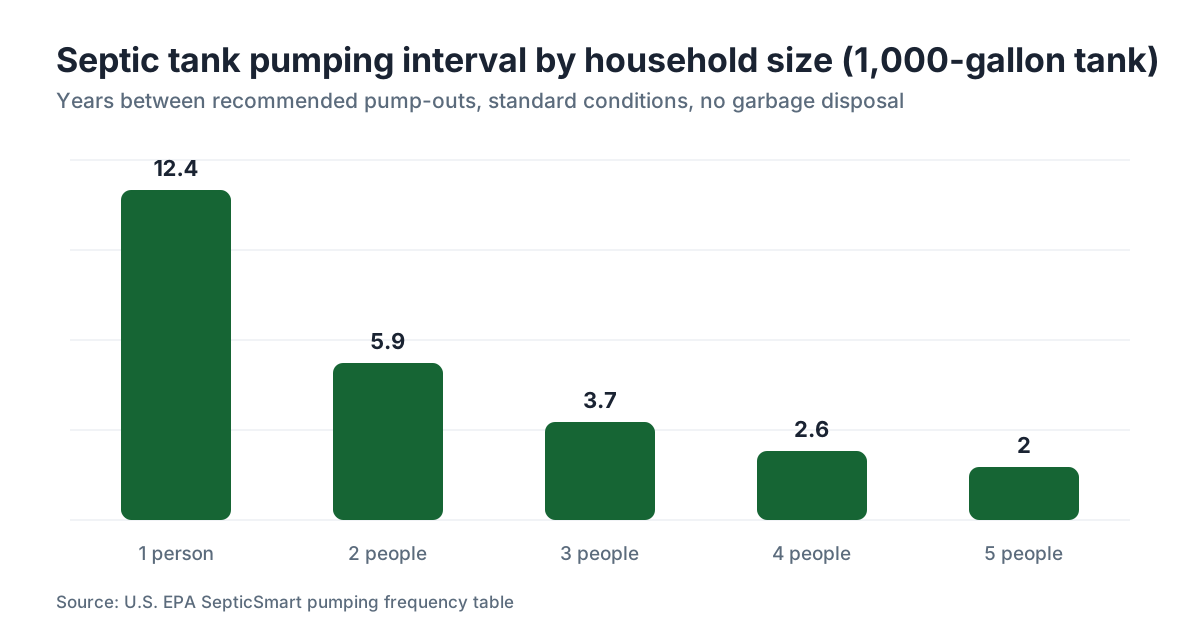
Every 5 to 7 years for two people on a 1,000-gallon tank with normal water use. That range comes straight from EPA SepticSmart, whose household lookup table puts a 1,000-gallon tank serving two occupants at roughly 5.9 years to the recommended pumping threshold [1]. Round down to 5 if you run a garbage disposal or do heavy laundry. Round up toward 7 if you travel a lot or conserve water.
EPA's own words: "Have your septic system inspected (more frequently) and pumped as necessary (generally every 3 to 5 years)." [1] That "generally" describes an average household. Two people on a correctly sized tank sit at the far end of the bracket, sometimes past it.
Get three things straight before you circle a date. Pumping frequency is not inspection frequency; inspect every 1 to 3 years no matter when you pump, because inspections catch things pumping never reveals. The schedule assumes your tank is sized right for the house. Plenty of older homes still have 750-gallon tanks put in for a single occupant, and a 750-gallon tank serving two people needs pumping about every 4 years [1].
Know your tank size before you trust any schedule.
How does household size change the pumping interval?
Tank size and household size drive the whole calculation together. EPA's pumping frequency table [1] gives hard numbers for the common combinations. Here it is in a usable form:
| Tank size (gallons) | 1 person | 2 people | 3 people | 4 people | 5 people |
|---|---|---|---|---|---|
| 500 | 5.8 yrs | 2.6 yrs | 1.5 yrs | 1.0 yr | 0.7 yrs |
| 750 | 9.1 yrs | 4.2 yrs | 2.6 yrs | 1.8 yrs | 1.4 yrs |
| 1,000 | 12.4 yrs | 5.9 yrs | 3.7 yrs | 2.6 yrs | 2.0 yrs |
| 1,250 | 15.6 yrs | 7.5 yrs | 4.8 yrs | 3.4 yrs | 2.6 yrs |
| 1,500 | 19.1 yrs | 9.1 yrs | 5.9 yrs | 4.2 yrs | 3.3 yrs |
| 2,000 | 25.7 yrs | 12.4 yrs | 8.0 yrs | 5.9 yrs | 4.5 yrs |
Source: EPA SepticSmart household pumping frequency table [1]
Two numbers jump off that table. Going from 2 people to 4 on the same 1,000-gallon tank more than halves the interval: 5.9 years drops to 2.6. So if you're asking how often to pump a septic tank for a family of 4, expect every 2.5 to 3 years on a standard tank. A family of 3 lands around 3.5 to 4 years on that same system.
The math is nonlinear because sludge packs down over time instead of stacking up evenly. More people means more solids per day, and those solids compress as they age. That's why a house that jumps from 2 to 4 occupants (kids, an adult child moving back, a live-in parent) should recalculate the interval, more than halve the old one.
What factors shorten or lengthen the pumping window?
The EPA table is a starting point, not the verdict. Real habits push the interval by 1 to 3 years in either direction.
What shortens it:
A garbage disposal adds roughly 50% more solids to the tank than a household without one [2]. Use it heavily and you should schedule like a household with one extra person. Big laundry days pile on too. More than two loads a day can flood the tank and shove partly settled solids toward the drain field before they've dropped out.
What lengthens it:
Low-flow fixtures cut hydraulic load. Swap older toilets (3.5 to 5 gallons per flush) for WaterSense models (1.28 gallons per flush) and tank turnover drops noticeably [3]. A vacation home with two occasional occupants stretches even further, though you still pump before any long stretch of disuse so sludge doesn't harden.
What doesn't change the interval but wrecks the system anyway:
Anything down the toilet besides toilet paper causes trouble at any household size. Wipes labeled "flushable" don't break down. Neither do feminine hygiene products or medications, and they build up faster than organic solids. Pour chemical drain cleaners in volume and you kill off the bacteria that digest waste, which slows everything down and quietly shortens your real pumping window even if nothing on the calendar changed [4].
How do you know if your tank needs pumping sooner than the schedule says?
Signs show up before failure. Learn them and you rarely get surprised.
The most reliable early warning is slow drains in more than one fixture at once. A single slow drain is usually a clog in that pipe. Several draining slow together points at a tank or leach field that's overwhelmed. Gurgling when you flush belongs in the same bucket.
Outdoor signs count too. Grass over the drain field that's suddenly greener and lusher than the rest of the yard means liquid is surfacing, which happens when the field takes in more than it can absorb. Wet spots or puddles near the tank after dry weather are a worse version of the same thing.
Inside, a sulfur or rotten-egg smell coming up through drains, worst first thing in the morning, means the tank is full enough that gases are backing into the plumbing instead of venting.
See any of these and skip the calendar. Call for a septic tank pump out and an inspection. Pumping early costs a few hundred dollars. Letting the drain field fill with solids costs you a septic system repair that runs into the thousands.
What does septic tank pumping actually cost for a small household?
Pumping runs $250 to $600 for a standard residential tank across most of the country, with a national average near $400 [5]. That spread is about region, not headcount. The pump truck doesn't charge you less for being a household of two. Tank size moves the price more than the number of people.
A 750-gallon tank usually costs $250 to $350 to pump. A 1,000-gallon tank runs $300 to $450. Tanks of 1,500 gallons and up can hit $500 to $700. Some contractors charge a flat rate within a size range; others charge per gallon pumped.
A family of 2 pumping every 5 to 7 years spends roughly $55 to $85 a year. That's the cheapest insurance you'll ever buy on a system that costs $15,000 to $30,000 or more to replace [6]. Skip pumps long enough to wreck the drain field and you're staring at $5,000 to $20,000 in repairs before replacement even enters the picture. The math isn't close.
For what a service call includes and what to ask for, the septic tank cleaning guide walks the full process. Adding an inspection on top of pumping runs $100 to $300 more depending on the type and your state's rules.
Does a two-person household still need annual inspections?
Yes. Inspection and pumping are separate questions with separate answers, and a small household doesn't get a pass on either.
EPA recommends annual inspections for alternative systems with mechanical parts (aerobic treatment units, pump systems, and the like) and at minimum every 3 years for conventional gravity systems [1]. A near-empty tank is no reason to skip. Inspections catch problems that have nothing to do with sludge: cracked lids, failed baffles, root intrusion, blown distribution boxes, and early drain field stress.
Many states write inspection schedules into their onsite wastewater rules. North Carolina requires periodic inspections under its 15A NCAC 18E rules [7]. Massachusetts requires inspection at property transfer, with detailed criteria under Title 5 [8]. Check your own state, because the interval in your owner's manual or a pumper's pitch may not match what the law demands.
For a family of 2 on a gravity-fed system, the practical rhythm is a full inspection every 2 to 3 years, then pump when the inspector confirms the levels warrant it. Don't pump on the calendar alone. A good technician drops a calibrated measuring tool into the tank and tells you exactly where you sit against the one-third rule: pump when sludge and scum together fill more than a third of the tank's liquid depth.
Can a family of 2 go longer than 7 years without pumping?
Technically yes. Practically, it's a bet you'll usually lose.
The EPA table shows a 1,500-gallon tank serving two people at 9.1 years and a 2,000-gallon tank at 12.4 years [1]. If your home came with an oversized tank, those numbers are real. But things quietly compress that window with no warning: a garbage disposal you forgot to factor in, a season when the house held 3 or 4 people, a stretch of heavy water use.
Running past 7 years without at least measuring sludge is a gamble. Pump a year early and you waste $300. Go two years too long and you push solids into the drain field, which is the failure that leads to a septic tank repair bill starting near $1,500 and climbing to full replacement. Nobody has clean numbers on exactly how many systems fail each year from deferred pumping alone, but EPA is blunt about the mechanism: "Regular pumping helps prevent solids from migrating into the drainfield." [1]
My rule: never exceed the EPA table, inspect every 2 to 3 years anyway, and pump the moment a warning sign shows up.
How do you find and verify your tank size and last pump date?
Don't know your tank size? Start with the property's as-built drawing. Most jurisdictions require it on file with the county health department or environmental health office when a system gets permitted. Call and ask for the septic permit records for your address. They usually have tank size, install date, and sometimes the full layout.
If the as-built isn't there, a pumping technician can estimate the size by measuring the tank during a pump-out. The formula is simple: length times width times depth in feet, times 7.48, gives you gallons.
For the last pump date, ask the previous owners if you bought recently. Many states require a septic tank inspection at property transfer, so the transaction file may hold inspection records. With no records at all, treat the system as due and pump it.
Some operators and homeowners track service history digitally now. Software like SepticMind lets operators log pump dates, tank sizes, and service notes in one place owners can reference between visits, which helps when you're reconstructing the history on a property you didn't build.
What state rules apply to pumping frequency?
State rules vary more than most homeowners expect. EPA's 3-to-5-year guidance is federal best practice, not a federal mandate. Enforcement happens at the state and county level, and it ranges from voluntary to strict.
Massachusetts Title 5 (310 CMR 15.000) [8] is one of the most prescriptive in the country. It requires inspection at property sale and sets specific sludge and scum thresholds that trigger mandatory pumping. Pumpers there must be licensed, and inspection reports go to the local board of health.
North Carolina's 15A NCAC 18E [7] governs operation permits and required maintenance for many system types. Some advanced systems require annual inspection and a service contract.
Florida Chapter 64E-6 of the Florida Administrative Code requires septic tanks to be pumped at least once every 5 years [9]. That's a legal requirement, not a suggestion.
California leaves most of it to the counties, and there's real variation across the state's 58 of them. Some coastal counties impose tight requirements because of nitrogen loading near water bodies.
Look up your own state's onsite wastewater regulations before you assume any schedule is enough. Your county health department's environmental health division is the place to start. Seeing what goes into these systems from the ground up explains why the rules get so specific; the cost to put in a septic tank and septic tank installation guides cover that.
What happens at a septic tank pump-out and what should you ask the technician?
A standard septic tank pump out takes 20 to 45 minutes for a residential tank. The technician finds the access lid (or lids, on a two-compartment tank), opens it, drops in the vacuum hose, and pulls out the liquid, sludge, and scum. It all goes into the truck's sealed tank for transport to a licensed treatment facility.
Before they close up, ask for three things.
Measure and record the scum and sludge layers before pumping. That's your baseline for the next interval. Sludge at 15% of tank depth after 4 years tells you the system is handling the load and you can reasonably push to 6 years. Sludge at 35% after 4 years tells you your household runs hotter than the table predicted.
Inspect the inlet and outlet baffles while the tank is open. Baffles direct flow and keep scum out of the drain field. They're plastic or concrete, and they fail. A replacement runs $100 to $300. Ignoring a failed one costs you the drain field.
Check the lid and riser. A cracked or settling lid is both a safety hazard and a door for surface water, which overloads the system.
Get a written service report with the date, gallons pumped, sludge and scum levels, and any observations. Keep it. You'll want it for the next technician, for state records if required, and for disclosure if you ever sell.
Are septic additives worth buying to reduce pumping frequency?
No. Skip them.
EPA's position on biological and chemical additives is that there's no scientific evidence they eliminate the need for regular pumping [4]. A healthy tank already holds billions of anaerobic bacteria breaking down organic solids. More bacteria doesn't move the needle, because the limit isn't bacterial count. It's the physics of settling and the plain fact that some solids never break down.
The National Environmental Services Center at West Virginia University reviewed the literature on additives and found no credible evidence they extend pumping intervals [2]. Some chemical additives, the solvents and acids sold as drain cleaners, actively harm the system by killing off the bacterial community and, in some cases, chewing up tank and pipe materials.
For a household of two, the additive pitch is especially thin. Your tank already has plenty of runway against the solids load. There's nothing to speed up. Save the $15 to $40 a bottle and put it toward the next pump.
Frequently asked questions
How often should a family of 2 pump a 1,000-gallon septic tank?
Every 5 to 6 years under normal water use. EPA's pumping frequency table puts a 1,000-gallon tank serving two people at about 5.9 years. Add a garbage disposal or above-average water use and you're closer to 4 to 5 years. Cut those factors and you can stretch toward 6 to 7 years, but get the sludge level measured before you make that call.
How often should a family of 4 pump their septic tank?
A family of 4 on a standard 1,000-gallon tank should pump every 2.5 to 3 years. EPA data shows the interval at 2.6 years for that combination. A 1,250-gallon tank gets you to about 3.4 years. Four people plus a garbage disposal should assume the short end, closer to 2 to 2.5 years.
How often should a family of 3 pump their septic tank?
For a 1,000-gallon tank, plan on every 3.5 to 4 years. The EPA table puts the interval at 3.7 years for three people on that tank size. A 1,250-gallon tank stretches to about 4.8 years. A household of 3 with a garbage disposal should schedule like a household of 4.
What is the minimum pumping frequency required by law?
It depends on your state. Florida mandates pumping at least every 5 years by rule. Massachusetts requires inspection at property transfer and pumping when sludge and scum exceed specific thresholds under Title 5. Many states treat EPA's 3-to-5-year guidance as best practice with no hard legal mandate. Check your county health department for the rules that actually apply.
Does a garbage disposal really change how often I need to pump?
Yes, meaningfully. Garbage disposals add roughly 50% more solids to the tank than households without one. For a family of 2, that can pull the interval from around 6 years down to closer to 4. EPA recommends households with disposals either pump more often or keep the disposal to light food waste only.
Can I go 10 years without pumping a septic tank for 2 people?
Possibly, if your tank is 1,500 gallons or larger. The EPA table shows a 1,500-gallon tank serving two people lasting about 9.1 years. Going past 7 years without at least measuring sludge depth is risky at any tank size, because garbage disposal use, guests, and laundry habits can compress the real interval below what the table predicts.
How do I know how big my septic tank is?
Start with the county health department's permit records for your property. Most jurisdictions file the original septic permit with tank size, layout, and install date. If records are gone, a licensed pumping technician can estimate the size by measuring the tank during a pump-out. The formula is length x width x depth in feet, times 7.48 to convert cubic feet to gallons.
How much does it cost to pump a septic tank for a small household?
Pumping typically costs $250 to $600 for a standard residential tank, with a national average near $400. Tank size matters more than household size. A 750-gallon tank runs $250 to $350; a 1,000-gallon tank runs $300 to $450. Regional labor rates fill in the rest. A two-person household pumping every 5 to 6 years spends roughly $60 to $80 a year.
Do septic additives let me go longer between pump-outs?
No. EPA states there's no scientific evidence that biological or chemical additives reduce the need for regular pumping. A healthy tank already has the bacteria it needs. Some chemical additives can harm the system. Save the money and spend it on actual pumping and inspection.
What are the signs that my septic tank needs pumping before the scheduled date?
Multiple slow drains at once (more than one fixture), gurgling after flushing, sewage odors rising through drains, or unusually lush green grass over the drain field all mean the system is overwhelmed. Wet spots near the tank during dry weather are worse. Any of these means call a pumping service now, not at your next scheduled date.
How often should I inspect my septic system even if it doesn't need pumping?
Every 1 to 3 years for a conventional gravity system, per EPA guidance. Alternative systems with pumps or mechanical parts should be inspected annually. Inspections catch baffle failures, lid damage, root intrusion, and early drain field stress, none of which show up during routine use until they've already done damage. Inspection and pumping are separate schedules.
Does water softener use affect how often a two-person household needs to pump?
This one is genuinely debated. Some research suggests high-salt brine from softener backwash can disrupt the bacterial community and add to the solids load. EPA recommends against discharging softener backwash directly to conventional septic systems. If you run a softener, set the regeneration cycle as infrequently as the unit allows to hold down the impact.
Should I pump my septic tank before selling my house?
Yes, and in many states you're legally required to have it inspected first. Massachusetts, for one, mandates a Title 5 inspection before property transfer. Even where it isn't required, pumping and inspecting before you list heads off surprises during buyer due diligence and hands the new owners a clean baseline and service record.
Sources
- U.S. EPA SepticSmart, 'Septic System Maintenance': EPA household pumping frequency table showing 5.9 years for 1,000-gallon tank with 2 occupants; general recommendation to pump every 3 to 5 years; quote 'Have your septic system inspected (more frequently) and pumped as necessary (generally every 3 to 5 years)'; note that regular pumping prevents solids from migrating into the drainfield.
- National Environmental Services Center, West Virginia University, 'Septic System Additives': Review of literature finding no credible evidence that additives extend pumping intervals; garbage disposals increase solids load to septic tanks by roughly 50%.
- U.S. EPA WaterSense, 'Bathroom Faucets and Fixtures': WaterSense toilets use 1.28 gallons per flush versus 3.5 to 5 gallons for older models, reducing hydraulic load on septic systems.
- U.S. EPA SepticSmart, 'What Not to Put Down the Drain': EPA states there is no scientific evidence that biological or chemical additives eliminate the need for regular pumping; some chemical additives can harm tank and pipe materials.
- HomeAdvisor / Angi, 'Septic Tank Pumping Cost Guide': National average cost to pump a septic tank is approximately $400, with typical range of $250 to $600 for residential tanks.
- U.S. EPA SepticSmart, 'Septic System Costs': Septic system replacement costs $15,000 to $30,000 or more; drain field repair costs $5,000 to $20,000.
- North Carolina Department of Health and Human Services, 15A NCAC 18E Onsite Wastewater Rules: North Carolina 15A NCAC 18E governs operation permits and required maintenance for onsite wastewater systems, including periodic inspection requirements.
- Massachusetts Department of Environmental Protection, Title 5 (310 CMR 15.000): Massachusetts Title 5 requires septic inspection at property transfer, mandates pumping when sludge and scum levels exceed specific thresholds, and requires licensed pumpers to submit reports to local boards of health.
- Florida Department of Health, Chapter 64E-6 Florida Administrative Code, Onsite Sewage Treatment and Disposal Systems: Florida requires septic tanks to be pumped at least once every 5 years under Chapter 64E-6 of the Florida Administrative Code.
- U.S. EPA, 'Septic Systems Overview': Approximately 21 million homes in the United States rely on septic systems; EPA recommends alternative systems with mechanical components be inspected annually.
Last updated 2026-07-09