How deep is a septic tank? Burial depth explained
By the SepticMind Editorial Team
TL;DR
- Most septic tank lids sit 4 inches to 4 feet below the surface, and a few go deeper.
- Three things set the number: where the sewer pipe exits your house, the local frost line, and how the lot is graded.
- The exact depth for your tank is on the as-built permit drawing at your county health department, or you can find it by probing the soil near the sewer exit with a thin rod.
How deep is a septic tank, really?
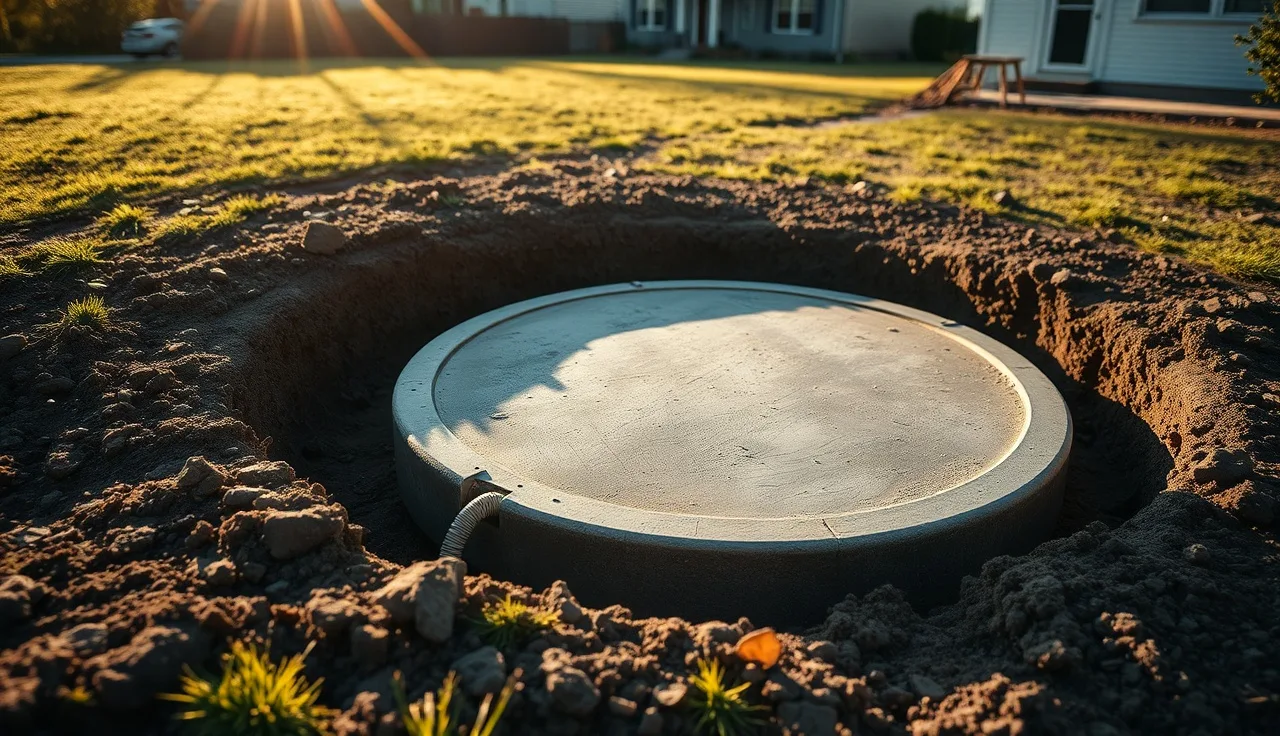
The honest range is 4 inches to 4 feet of soil over the lid. Most residential tanks land between 6 inches and 30 inches deep, but that spread is wide enough that guessing gets you nowhere. Check before you dig. [1]
Depth isn't a fixed standard the way tank size is. It's a byproduct. It depends on where the sewer pipe exits the house, how steep the lot is, what the local frost depth is, and whether the installer wanted an easy pump-out. Those variables get locked in at installation and stay put for the life of the tank.
A few tanks are deliberately deep, sometimes 5 or 6 feet to the lid, usually because a low foundation or a flat lot forced the inlet pipe to drop a long way before reaching the tank. Those are outliers. They exist. If you book a septic tank pump out and the pumper has to dig 5 feet to reach the lid, expect to pay more for the access time.
What actually controls how deep a septic tank is buried?
Four things set the depth, and they push against each other.
Inlet pipe elevation. The sewer line leaving your house drops at a fixed slope, usually 1/8 inch to 1/4 inch per foot of run. [2] After 10 to 30 feet of travel to the tank, that pipe can already sit 2 to 4 feet below grade. The tank top has to fall below the inlet elevation, so a long run from house to tank means a deeper tank.
Local frost line. In cold climates, installers bury the tank deeper to keep the inlet pipe below frost and stop it from freezing. Frost reaches about 42 inches in northern Minnesota and closer to 12 inches in Georgia. [3] That's a 30-inch swing in minimum burial depth from geography alone. Warm-climate tanks routinely sit a few inches under the surface.
Lot grading. A sloped lot lets the pipe drop naturally and keeps the tank relatively shallow on the downhill side. A flat lot forces deeper burial to hit the required slope. On flat lots, contractors sometimes add a pumping chamber to sidestep the depth problem entirely.
Code minimums. Most state onsite wastewater codes want at least 6 inches of soil over the tank, and some allow 4 inches with a riser installed. Maximum depth rules vary. A few states cap gravity-flow systems at 36 inches of cover before requiring a pump. Read your state's rule, because the variation is real.
How deep are septic tanks buried in different states?
There is no federal minimum burial depth for septic tanks. The EPA's SepticSmart program sets design and maintenance guidance but leaves burial depth to state and local authority. [4] The number you actually care about lives in your state's onsite wastewater code, not a federal table.
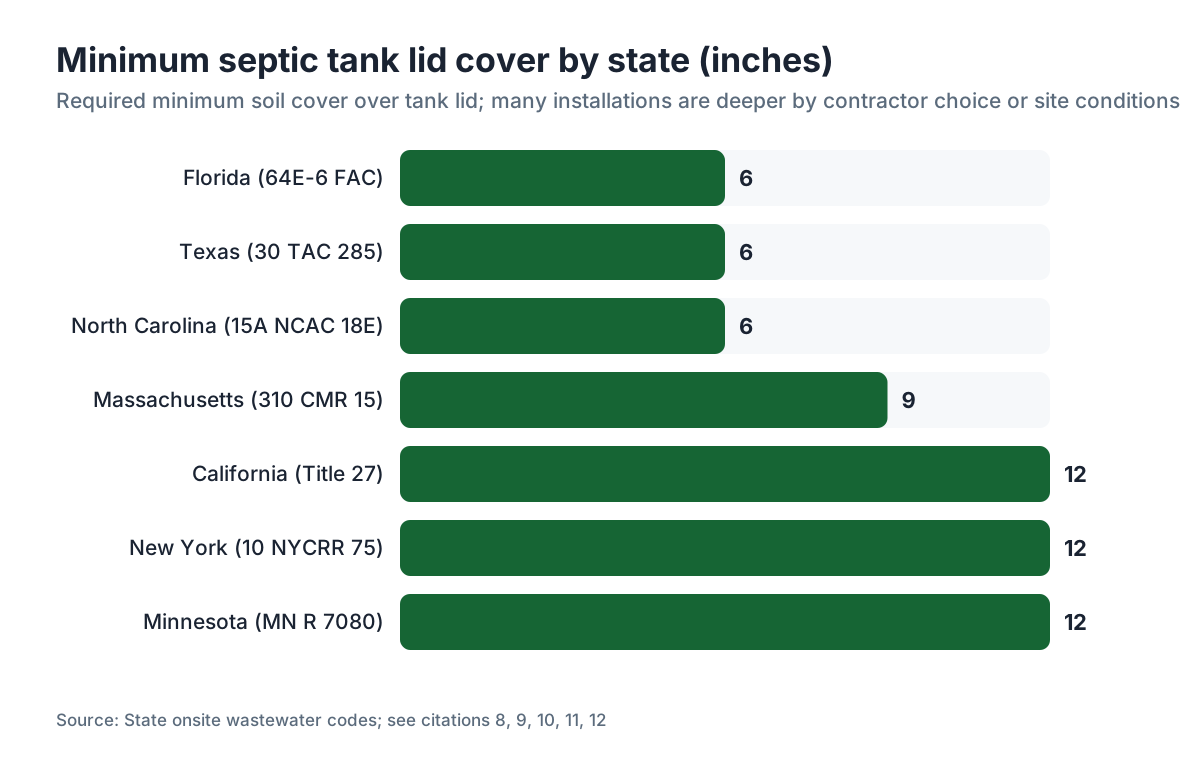
The table below is a representative sample. These are approximate ranges pulled from state administrative codes. Always get the current version from your state environmental or health agency before designing a system.
| State | Minimum cover over tank lid | Notes |
|---|---|---|
| Florida | 6 inches | FAC 64E-6 |
| Texas | 6 inches | 30 TAC 285 |
| North Carolina | 6 inches | 15A NCAC 18E |
| Minnesota | 12 inches | MN R 7080 |
| New York | 12 inches | 10 NYCRR Part 75 |
| California | 12 inches | Cal Code Regs Title 27 |
| Massachusetts | 9 inches over inlet fitting | 310 CMR 15 |
Frost depth drives most of the regional spread. The USDA puts frost depth at about 42 inches in northern Minnesota and under 6 inches along the Gulf Coast. [3] That gap is why a Minnesota tank might sit nearly 4 feet deep while a Florida tank is practically at the surface.
One practical note. Even where the code allows 6-inch cover, plenty of installers go deeper on purpose to protect the tank from surface traffic and to hide the lids. Cosmetic burial is common in subdivisions where homeowners don't want concrete rings breaking up the lawn.
How do you find out how deep your specific tank is?
Start with paper, not a shovel.
Your county health department or permitting office holds the as-built drawing for every permitted septic system. That document shows the tank location, the inlet and outlet elevations, and usually the lid depth. Most states now put these online through a parcel search or environmental records portal. If it isn't online, a call to the county sanitarian usually gets you a scanned copy the same day.
When the records are gone (older rural properties sometimes have no permit on file), you probe. Push a thin metal rod or soil probe down near where the sewer exits the foundation, then work outward along the expected pipe path. Concrete gives a distinct thud and resistance compared to soil. Most tanks sit within 10 to 25 feet of the house. Hit the lid, measure from the surface down to it, and that's your burial depth.
Some homeowners just pay for a septic tank inspection and let a pro answer the question. An inspector with a camera, or a pumper who's found the tank before, can tell you the exact depth in 20 minutes. That's not a bad use of money when the records don't exist and you're planning any digging.
For operators running fleets of properties, tools like SepticMind let you log as-built specs including lid depth, so you're not restarting the search on every service call.
Does burial depth affect how the septic system works?
Functionally, no. A tank at 12 inches does the same settling and anaerobic digestion as a tank at 48 inches. Depth doesn't change retention time, treatment quality, or how often you pump.
What depth changes is access and cost. A tank with 4 inches of cover needs a riser so pump-out doesn't mean digging every single time. A tank buried 4 feet deep without risers forces a pumper to hand-dig or bring excavating equipment to reach the lid. That adds real labor. septic tank pumping at that depth can cost a lot more than a standard shallow-lid job, and the pumper still has to backfill the hole afterward.
Depth also touches freeze risk. A shallow tank in a cold climate, especially one barely used in winter (vacation homes), can freeze at the inlet. A frozen inlet backs sewage up into the house. You can't fix that after the fact by adding depth. You insulate the pipe or bury it below frost, which is a real repair. If you're staring at a freeze-related failure, see our notes on septic system repair.
Very deep tanks can also create vacuum lock during pump-out. Pumpers need enough hose and sometimes a stronger truck unit to pull sludge from 6-foot depths. It works. It's just slower.
What is a septic tank riser and how does it solve depth problems?
A riser is a vertical pipe or concrete ring extension that brings the tank's access point up to or near the surface. You set it over the existing lid opening so future pump-outs and inspections skip the excavation.
Risers are almost always the right call when a lid sits more than 12 inches below grade. They run $200 to $600 installed per opening, covering both the inlet and outlet access points. [5] Most modern tanks now ship with plastic riser ports built in.
The payback is fast. If your pumper adds $75 to $100 in labor to dig out a buried lid, a $300 riser earns its cost back in three or four visits. On a tank you pump every 3 to 5 years, that's under 15 years to break even, and the riser also cuts the odds of cracking the lid while digging.
PVC risers are the standard now. They're lighter, they don't crack from freeze-thaw, and their watertight sealing rings keep groundwater out. Concrete risers still work, but they're heavy and prone to cracking. If you're booking a septic tank cleaning on an older buried-lid system, ask the pumper to quote a riser at the same time. The hole is already open.
How deep is a concrete septic tank versus a plastic or fiberglass tank?
Material doesn't set the depth. All three tank types get buried to whatever the site conditions demand. What differs is how each one handles deep burial structurally.
Concrete takes deep burial well. The weight and compressive strength mean soil pressure doesn't deform it. That's part of why concrete owned the market for decades. The real risk is cracking from differential settling or root intrusion, and depth itself isn't the villain there.
Plastic and fiberglass tanks are lighter, which makes them easier to install, but they can float in high-water-table areas and deform under deep soil loads if the backfill is wrong. Most manufacturers publish a maximum burial depth, often around 36 inches of cover, and require specific backfill procedures beyond that. [6] Drop a plastic tank 5 feet deep without following the manufacturer's backfill spec and you're inviting a collapsed wall.
If you're planning a septic tank installation on a site that forces deep burial, your contractor should pull the manufacturer's installation manual and follow the load tables. That part isn't optional.
Can a septic tank be too shallow?
Yes, and it makes real trouble.
A tank with an inch or two of cover can have its lid damaged by surface traffic, even foot traffic over the years. Lawnmowers, trucks, and frost heave crack or shift a shallow lid. A cracked or open lid is a safety hazard (people and animals can fall in) and a maintenance failure (rainwater seeps in, dilutes the tank, and pushes partially treated effluent early into the leach field).
Shallow tanks also insulate poorly against cold. In northern states, a tank under 12 inches deep is a freeze risk whenever the air stays below 20 degrees F for a stretch.
Most state codes set 6 inches as the minimum cover, but that number assumes the soil above insulates well and the tank isn't under a driveway or parking area. If your lid is right at the surface, put in a riser with a locking lid. It brings the access to grade, protects the opening, and costs a fraction of a septic tank repair.
How deep is the septic tank lid versus the bottom of the tank?
These are two different depths, and mixing them up causes real confusion.
Lid depth is the distance from your lawn down to the concrete or plastic cover you pull for access. That's the number this whole article has been talking about, typically 6 inches to 4 feet.
The total height of the tank (bottom of the tank to top of the lid) depends on capacity. A standard 1,000-gallon concrete tank runs about 4.5 to 5 feet tall. A 1,500-gallon tank often runs 5.5 to 6 feet. So if the lid sits 18 inches down, the bottom of a 1,500-gallon tank is roughly 7 to 7.5 feet below your lawn.
Why care? Because it matters the moment you plan excavation, plant a tree, or run a utility line. You need both the lid depth and the tank-bottom depth to avoid punching into the tank with a post-hole digger or a trencher. It also matters for pump selection, since effluent pumps and grinder pumps are sized partly by the lift depth.
If you're budgeting a new system, knowing these dimensions helps you read cost to install septic system estimates, because deeper burial means more excavation and a higher contractor bill.
What are the safety rules for digging near a septic tank?
Before any digging near where you think the tank is, call 811 (the national Dig Safe line in the US). That triggers a free utility locate service that marks underground electric, gas, water, and telecom lines. It does not mark septic tanks, but it keeps you from hitting a gas line while hunting for your lid. [7]
Once the lid is open, take the confined space seriously. Septic tanks hold hydrogen sulfide, methane, and carbon dioxide. Hydrogen sulfide is heavier than air, builds up fast, and goes odorless at lethal concentrations. The EPA warns that septic gases kill people every year, almost always when someone enters without ventilation or a gas detector. [4]
Never enter a septic tank. Pump-outs and inspections happen from the surface. If someone falls in, do not jump in after them without a self-contained breathing apparatus. The rescuer dying is a documented pattern. Call 911 first.
For routine lid access during a pump-out, a pumper standing at the surface with a 4-inch hose has no meaningful exposure as long as they aren't hanging their face over the open port. Common sense, not panic, is the right level of caution.
How do you tell if your septic tank depth is causing a problem?
A handful of symptoms point to depth trouble.
If you've never found the lid without heavy digging, and your pump-out bills carry a "locating" or "excavation" line, the tank is probably buried more than 18 inches with no risers. The fix is risers, installed once, done for good.
If drains slow down in winter, especially up north, and clear up in spring, a frozen inlet pipe is the usual suspect. The inlet may be too shallow or uninsulated. A plumber or septic contractor can insulate the exposed section or reroute it below frost.
If you see wet spots or unusually green grass over where the tank should be, that can mean a cracked lid or damaged top slab letting groundwater in or effluent out. Depth doesn't cause cracks, but shallow tanks take more surface-load abuse that does.
Any of these deserves a professional look. See what's involved in a septic tank inspection before you assume the worst about cost.
Frequently asked questions
How deep is a septic tank?
Most septic tank lids sit between 6 inches and 30 inches below the surface, and the full honest range runs 4 inches to 4 feet or more. The exact depth depends on where the sewer pipe exits your house, local frost line requirements, and how the lot is graded. Check your county health department's as-built permit drawing for the precise measurement on your property.
How deep are septic tanks buried?
Septic tanks are buried anywhere from a few inches to over 4 feet deep, with most residential tanks landing between 6 and 30 inches of soil cover over the lid. Cold-climate states like Minnesota and New York often require 12 or more inches of cover to keep inlet pipes from freezing. Warm-climate states like Florida allow as little as 6 inches, and many tanks there sit close to the surface.
How do I find out how deep my septic tank lid is?
Start by requesting the as-built drawing from your county health or permitting department. It shows lid elevation and location. If no record exists, use a thin metal probe rod to find the concrete lid by feel and sound, working outward from where the sewer exits your foundation. Once you hit the lid, a tape measure gives you the exact burial depth. A septic inspector can also do this quickly.
Does septic tank depth affect how often I need to pump it?
No. Burial depth has no effect on how fast a tank fills with solids. Pump frequency depends on tank size and household usage. The EPA's general guidance is every 3 to 5 years for a typical residential system. Depth does affect how much a pump-out costs if the lid is deeply buried without risers, since the pumper has to dig to reach the access port.
What is a good depth for a septic tank lid?
From a maintenance standpoint, a lid 6 to 12 inches below grade with a riser extending to just below or at ground level is ideal. That protects the lid from surface traffic and frost while keeping pump-out access easy with no digging. Lids closer to the surface with locking risers work well too. Lids deeper than 18 inches without risers create needless labor and cost at every service visit.
Can a septic tank float up out of the ground?
Yes. Empty or nearly empty plastic and fiberglass tanks can float in high-water-table conditions, sometimes called hydrostatic uplift. It's most common after heavy rain or during spring snowmelt. Concrete tanks are heavy enough to resist flotation in most conditions. If you're in a high-water-table area and considering a plastic tank, your installer should anchor or ballast it per the manufacturer's spec.
How deep should the inlet pipe to a septic tank be?
The inlet pipe should slope at 1/8 to 1/4 inch per foot of run from the house and enter the tank below the frost line in cold climates. In Minnesota, that means at least 42 inches deep at its shallowest point. In Florida, a few inches of cover usually does it. The inlet tee inside the tank should extend about 6 to 10 inches below the liquid surface level.
Is it expensive to add risers to a buried septic tank lid?
Riser installation typically costs $200 to $600 per access opening. Most tanks have two openings, inlet and outlet, so budget $400 to $1,200 total if both need risers. That's a one-time cost. Given that a pumper may charge $75 to $100 extra per visit to hand-dig a buried lid, risers usually pay for themselves within a handful of pump-out cycles.
How do I know if I'm standing on top of my septic tank?
Signs include slightly raised or depressed ground in a rectangular shape, concrete visible at grade, or a noticeable lack of grass roots when you probe the soil. The tank is almost always within 10 to 25 feet of where the main drain line exits the house, usually on the downhill or sewer side of the foundation. The county as-built drawing is the most reliable confirmation.
What happens if a septic tank is too deep for gravity flow?
If the tank depth blocks gravity flow from the house drain to the inlet, or from the tank outlet to the drain field, the system needs a pump. A lift station or effluent pump raises the wastewater to the next component. Pumped systems are more complex, needing a pump vault, electrical connection, and regular pump inspection, but they run reliably when maintained. They also add to installation and long-term operating costs.
How deep is a 1,000-gallon septic tank from top to bottom?
A standard 1,000-gallon precast concrete tank runs roughly 4.5 to 5 feet tall (top of lid to bottom of tank). Dimensions vary by manufacturer, but most fall in that range. If the lid is buried 18 inches below grade, the tank bottom sits about 6 to 6.5 feet underground. Plastic and fiberglass 1,000-gallon tanks are generally similar in height but vary more by design.
Do I need a permit to dig up and inspect my septic tank lid?
Just locating and opening your own tank lid for an inspection or pump-out generally does not require a permit in most states. Any repair work, riser installation, or modification to the tank or its components typically does require a permit from your local health department. Check your county rules before doing anything beyond basic access. An unpermitted repair can create headaches when you sell the property.
Can tree roots reach a septic tank at typical burial depths?
Yes, easily. Roots chase moisture and nutrients, and a tank at 2 feet deep sits well inside the root zone of most large trees. Willow, maple, and poplar are the most aggressive. Roots enter through cracks in lids, around riser seams, or through inlet and outlet pipe joints. Keep large trees at least 10 feet from the tank, and 50 feet is better. If you suspect root intrusion, a camera inspection confirms it.
How deep is the drain field compared to the septic tank?
Drain field (leach field) pipes typically sit 6 to 24 inches below grade, shallower than the tank in most cases, because they need to be in the biologically active soil zone where treatment happens. The tank outlet pipe connects the two, sloping down from the tank outlet to the distribution box or manifold. In gravity systems, the drain field must be lower than the tank outlet by elevation, not necessarily by burial depth.
Sources
- EPA SepticSmart, Homeowner's Guide to Septic Systems: General guidance on residential septic system design and installation; burial depth varies by site conditions and local code.
- International Code Council (International Plumbing Code, pipe slope requirements): Drain pipes require a minimum slope of 1/8 inch per foot (1/4 inch per foot preferred) to ensure gravity flow.
- EPA SepticSmart, Septic System Maintenance and Safety: The EPA warns that septic tank gases including hydrogen sulfide are responsible for fatalities each year; never enter a septic tank.
- Penn State Extension, Septic System Owner's Guide: Riser installation is recommended for tanks with lids more than 12 inches below grade; typical installed cost ranges from $200 to $600 per opening.
- Infiltrator Water Technologies, Tank Installation Manual: Plastic septic tanks have manufacturer-specified maximum burial depths (often 36 inches of cover) and require specific backfill procedures for deeper installations.
- Common Ground Alliance, Call 811 Before You Dig: Calling 811 triggers a free utility locate service that marks underground utilities; required before excavation in all U.S. states.
- Florida Department of Health, Chapter 64E-6 FAC, Onsite Sewage Treatment and Disposal Systems: Florida requires a minimum of 6 inches of soil cover over septic tank lids.
- Minnesota Pollution Control Agency, MN Rule 7080, Individual Sewage Treatment Systems: Minnesota requires a minimum of 12 inches of soil cover over septic tank lids and inlet pipes buried below the frost line.
- North Carolina Department of Health and Human Services, 15A NCAC 18E, Wastewater Systems: North Carolina sets a minimum cover of 6 inches over septic tank lids for residential onsite systems.
- Massachusetts Department of Environmental Protection, 310 CMR 15, Title 5 Septic Code: Massachusetts Title 5 requires a minimum of 9 inches of cover over the inlet fitting; tank lids must be accessible for inspection.
- Texas Commission on Environmental Quality, 30 TAC 285, On-Site Sewage Facilities: Texas requires a minimum of 6 inches of soil cover over septic tank lids in standard gravity-flow installations.
Last updated 2026-07-09