How does a drain field work, and how long does it last?
By the SepticMind Editorial Team
TL;DR
- A drain field (also called a leach field) is a network of perforated pipes buried in gravel trenches.
- Clarified liquid from your septic tank flows into those pipes and seeps into the soil, where bacteria and soil particles remove pathogens and nutrients before the water reaches groundwater.
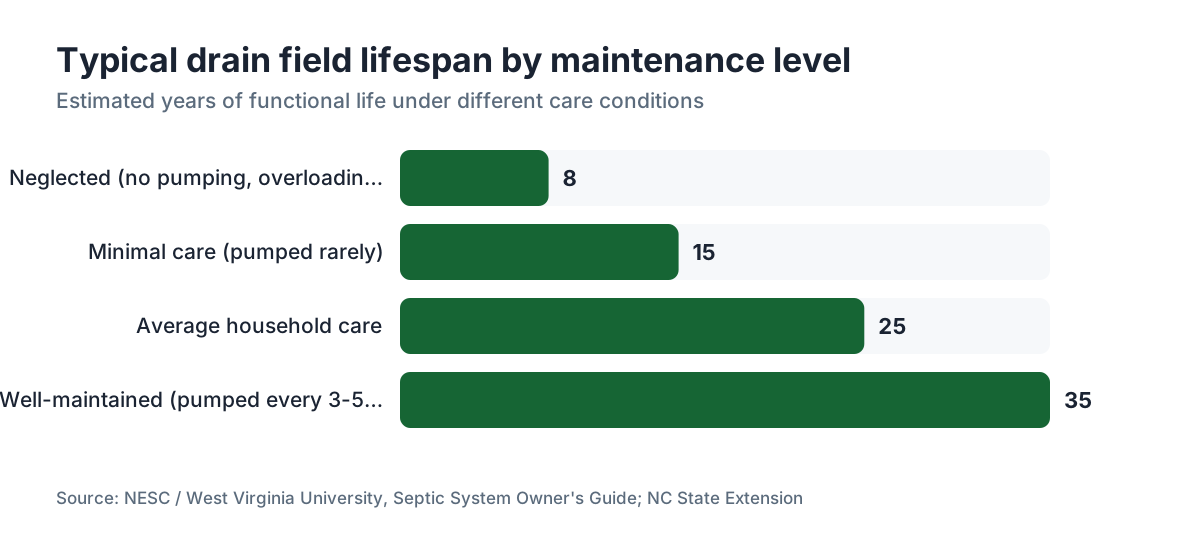
- A well-maintained drain field lasts 25 to 30 years or more; a neglected one can fail in under 10.
What is a drain field and what does it actually do?
A drain field is the final treatment stage of a conventional septic system. The septic tank handles solids. The drain field handles everything else.
Here's the short version: wastewater leaves your house, hits the septic tank where solids sink and scum floats, and the clarified middle layer (called effluent) flows out to the drain field. There, it spreads through perforated pipes into a gravel bed and soaks down through the soil. The soil does the real work. Natural filtration and billions of soil microbes consume pathogens, nitrogen, and organic matter before the water percolates down to the water table [1].
The EPA describes this plainly: the soil acts as the treatment medium. Without adequate soil depth and the right soil texture, the system doesn't work. That's why a perc test or soil evaluation is required before any drain field is designed [2].
Most residential drain fields are passive gravity systems. No pumps, no electricity, just physics and biology. Some lots with high water tables or shallow bedrock need a pressurized system or a mound system, but the underlying biology is identical.
You'll also see the terms leach field and drain field used interchangeably. Same thing.
How does a septic drain field work step by step?
Walk through it from the toilet to the groundwater:
- Wastewater flows by gravity from the house to the septic tank through the inlet pipe.
- Inside the tank, solids settle to the bottom as sludge; grease and light materials float as scum. The clarified effluent in the middle layer is the only fraction that leaves.
- Effluent exits through the outlet baffle (ideally an effluent filter) and travels to a distribution box or directly to the header pipe.
- The distribution box (D-box) splits flow equally among the lateral pipes. Poor D-box leveling is one of the most common causes of uneven loading and premature failure in one section of the field [3].
- Effluent trickles out through the perforations in the laterals and falls into a gravel or aggregate bed, sometimes called the drain rock.
- Below the gravel sits a biomat zone: a thin layer of microbial slime that forms at the gravel-soil interface. A healthy biomat actually improves treatment by slowing flow enough for microbes to work. An overfed biomat gets too thick and blocks drainage entirely. That distinction matters.
- Treated water percolates through native soil, ideally sandy loam or loam, where pathogens die off and nitrates get further reduced.
- Fully treated water eventually recharges the groundwater or evapotranspires from the root zone above.
The whole thing depends on the soil staying aerobic. Saturated or compacted soil goes anaerobic, and anaerobic conditions speed up biomat buildup and kill the treatment function [1].
What are the main parts of a drain field system?
Understanding the components makes it much easier to diagnose problems and talk to a contractor.
| Component | Function | Common failure mode |
|---|---|---|
| Distribution box (D-box) | Splits effluent evenly among laterals | Settles, cracks, or gets root-invaded |
| Header pipe | Carries effluent from tank to D-box | Offset joints from settling |
| Lateral pipes (perforated) | Distribute effluent along trench length | Crushed by vehicles or root intrusion |
| Gravel/aggregate bed | Supports pipes, allows lateral movement | Biofouled or fines-clogged |
| Geotextile fabric | Keeps soil out of gravel | Migrates if not installed correctly |
| Biomat layer | Provides biological treatment | Overloads and seals field |
| Inspection ports | Allow monitoring of effluent levels | Often omitted or forgotten |
Newer systems sometimes replace gravel with plastic chamber systems (Infiltrator-type arches) or fabric-wrapped pipe. These have a larger void space for storage during peak flow and are easier to install in tight lots. Biologically, they work the same way [4].
Septic service operators who manage dozens of accounts often track D-box condition and lateral loading separately. Platforms like SepticMind let operators log those field notes per asset so problems get caught before they escalate to a full replacement call.
How long does a septic drain field last?
The honest answer: 20 to 30 years is typical, with well-cared-for systems reaching 40 years and neglected ones failing before 10 [5].
The most commonly cited figure in state extension guidance is 25 years as a design life for a conventional gravity system. NC State Extension puts the median at 20 to 25 years under average household use [6]. The University of Minnesota Extension's onsite wastewater program has documented systems still working at 40 years with consistent maintenance.
There is no single authoritative national dataset for drain field lifespan. Failures get recorded locally by county health departments, and reporting is inconsistent across states. So when you see a hard number like "25 years," treat it as a planning benchmark, not a guarantee.
What actually determines lifespan:
- Soil type: sandy soils drain fast and are forgiving; clay soils drain slowly and fail faster under load
- Household water use: a household using 400 gallons a day stresses a field sized for 250
- Pumping frequency: tanks that go 10 years without pumping push solids into the field
- Root intrusion: willow, poplar, and silver maple roots will find perforated pipe
- Physical damage: one vehicle crossing a field can crush pipe and compact the trench backfill permanently
So how long does a drain field last? As long as you protect it from the things that kill it.
What kills a drain field faster than anything else?
Solids carry-over from an un-pumped tank is the single biggest killer. When the tank fills past capacity, sludge and scum exit with the effluent and clog the gravel bed and soil pores. Once the pores clog with organic solids, you can't unclog them mechanically. The field is done [1].
Hydraulic overload runs a close second. Every drain field is designed for a specific daily volume, typically 100 to 150 gallons per bedroom per day under most state design standards. Garbage disposals, extra residents, a leaking toilet flapper, or a water softener that backwashes into the septic can all push the field past its design load. Water softener brine in particular has been linked to soil structure breakdown in some soil types, though the research is mixed.
Compaction from vehicles is irreversible without excavation. Even one pass from a riding mower on saturated soil can compress the trench backfill enough to eliminate the air pockets the biology needs.
Root intrusion is slower but equally final if left unchecked. Copper sulfate treatments can slow root growth in pipes, but they also harm soil bacteria. Most extension programs don't recommend them for routine use.
And flushing the wrong things. Wipes labeled "flushable" don't break down in septic tanks. Cooking grease, heavy antibacterial soap use, and prescription medications all harm the bacterial population in the tank, which changes the character of the effluent that reaches the field.
How do you know if a drain field is failing?
Some signs are obvious. Some aren't.
The obvious ones: sewage smell in the yard, soggy or spongy ground over the field area, sewage backing up into house drains, and standing water or lush green patches directly over the field even during dry weather. That last one gets misread as good drainage. It's not. It means effluent is surfacing instead of percolating.
The less obvious signs: slow drains throughout the house (more than one fixture), gurgling sounds when you flush, or an unusually high water bill that turns out to be a running toilet sending excess water to an already-stressed field.
A failing field almost always shows elevated effluent levels inside the inspection ports, if the system has them. A qualified inspector can open those ports, measure depth to liquid, and tell you whether the field is saturated [7].
Getting a septic tank inspection done every 3 to 5 years is the single most reliable way to catch field stress before it becomes field failure. An inspector can pump the tank, check baffle condition, and probe the D-box at the same visit.
If the field is backing up from biomat overgrowth and not physical damage, some contractors offer aeration treatments (introducing oxygen to the drain field area) or enzyme injection. Results vary. There's no independent peer-reviewed evidence that enzyme products reliably restore failed fields, and the EPA does not endorse them. Aeration has more mechanistic support but is also expensive and not widely available.
Can a failed drain field be repaired or does it need full replacement?
It depends on why it failed and how badly.
If the problem is a crushed lateral, a cracked D-box, or a single offset joint in the header pipe, that's a septic system repair job that costs a fraction of replacement. Pipe repairs run $500 to $2,000 in most markets. A D-box replacement is typically $300 to $800 including labor.
If the gravel bed and biomat are fully clogged with solids, you generally can't fix it in place. Options:
- Rest the failing field and activate an alternate field (if your lot has a designated reserve area, which many older systems don't)
- Excavate and replace the field, which costs $3,000 to $15,000 depending on system size, soil conditions, and local permit fees [8]
- Install an alternative system: mound system, aerobic treatment unit, drip irrigation system. These are more expensive upfront but work on lots where conventional replacement isn't possible
A full drain field replacement on a 3-bedroom home averages $5,000 to $10,000 in most U.S. regions, though you can easily exceed that in tight urban lots or states with strict setback requirements. For full system cost context, see our article on cost to install a septic system.
Before you agree to full replacement, get at least two opinions. Some contractors push replacement when repair would do. Others will sell you a repair when the field is genuinely finished and you're just delaying the inevitable.
How do you maintain a drain field to get 25+ years from it?
The maintenance list is short. The discipline to follow it is what most homeowners lack.
Pump the septic tank on schedule. For a typical household, that's every 3 to 5 years, depending on tank size and number of occupants. The EPA SepticSmart program states: "Have your septic system inspected at least every 3 years by a certified professional and pump your tank every 3 to 5 years." [2] That schedule keeps solids from reaching the field. Read more about how often to pump your septic tank if your situation varies.
Protect the field surface. No vehicles, no heavy equipment, no parking. No deep-rooted trees or shrubs within 30 feet. Grass is ideal cover because shallow roots don't threaten pipes and the plants help with evapotranspiration.
Manage water use. Spread laundry loads across the week instead of running six loads on Saturday. Fix leaking faucets and toilets immediately. If your household grows, have the system evaluated for capacity before you add bedrooms or occupants.
Don't add anything to the tank trying to "boost" it. Commercial septic additives have not been shown to extend field life in peer-reviewed research. The bacteria you need are naturally present. Adding chemicals or enzymes is at best neutral and at worst harmful.
Keep the area over the field mowed and drained. If surface water from gutters, driveways, or slopes is draining toward the field, redirect it. A saturated field has no capacity to absorb effluent.
For the tank itself, regular septic tank pumping is the most cost-effective preventive step you can take for field longevity.
What soil types work best, and does my soil affect drain field life?
Yes, dramatically.
The best performing soils for drain fields are sandy loams and loams: they drain well enough to accept effluent without flooding, but slowly enough to allow adequate treatment time before water reaches groundwater [1]. The EPA and most state onsite wastewater codes require a soil evaluation before any system is approved, specifically to determine soil texture, permeability, and the depth to seasonal high groundwater or restrictive layers.
Soil type affects both design and longevity:
| Soil type | Drainage behavior | Field life risk |
|---|---|---|
| Coarse sand/gravel | Drains too fast, poor treatment | Moderate (contamination risk) |
| Sandy loam | Ideal range | Low |
| Loam / silt loam | Good, slight saturation risk | Low to moderate |
| Clay loam | Slow drainage, overload risk | Higher |
| Heavy clay | Poor drainage, fails quickly | High |
| Fractured rock | Bypasses treatment entirely | Very high |
Most states set a minimum depth to the seasonal high water table (often 24 to 36 inches below the trench bottom) and a maximum percolation rate. North Carolina, for example, requires a separation distance of at least 12 inches between the trench bottom and the seasonal high water table for a conventional system, per NC Administrative Code 15A NCAC 18E [9].
If your soil doesn't qualify for conventional installation, that's when you start looking at mound systems, advanced treatment units, or drip irrigation systems, all of which cost more but can work where conventional fields cannot.
What does a drain field inspection involve?
A drain field inspection is more than walking across the yard and not smelling anything.
A thorough inspection starts with a tank pump-out, or at minimum a visual of the tank interior, to check baffle condition and effluent clarity. From there, the inspector checks the D-box: is it level, intact, and not receiving solids from the tank? They'll probe effluent depth in any accessible inspection ports in the laterals. Standing effluent partway up the port is a warning sign; effluent at or above the top of the pipe means the field is hydraulically failing.
A dye test involves flushing a non-toxic dye through the system and watching for it to surface in the field or in nearby ditches or surface water. It's a simple screen, not a full evaluation.
More sophisticated inspections use a camera run through the distribution box and into the laterals. A camera can show root intrusion, crushed pipe, and sediment buildup that a dye test misses entirely.
Some buyers order a septic tank inspection before purchasing a home with an existing system. Given that a drain field replacement can cost $5,000 to $15,000, this is money well spent.
Operators managing multiple properties find it worthwhile to log inspection findings digitally per property. Without records, you're guessing about service history when a field shows distress.
After any inspection, get a written report. Verbal assessments are useless if you need to make a repair claim or disclose condition at resale.
How much does drain field repair or replacement cost?
The range is wide because site conditions, soil work, permit requirements, and local labor markets vary a lot.
| Work type | Typical cost range (U.S.) |
|---|---|
| D-box replacement | $300 to $800 |
| Lateral pipe repair (single line) | $500 to $2,000 |
| Full conventional field replacement (3-bed home) | $5,000 to $15,000 |
| Mound system installation | $10,000 to $20,000 |
| Aerobic treatment unit (ATU) | $10,000 to $20,000 |
| Drip irrigation system | $8,000 to $20,000+ |
Costs at the low end assume decent soil, an accessible site, and modest permit fees. Costs at the high end reflect poor access, need for soil importation on a mound system, or high-cost-of-living markets like coastal New England or California.
Permit fees alone range from $100 in rural counties to over $1,000 in some states with detailed onsite wastewater regulations. Some states require a licensed engineer to design any replacement system, adding $500 to $1,500 in design fees.
If you're also replacing the tank, see our breakdown of the cost to put in a septic tank for what that adds.
One thing to know: some states and counties have loan or grant programs for low-income homeowners replacing failed septic systems, particularly in areas where failing systems are contaminating groundwater or surface water. The USDA Rural Development program (Section 504) offers repair loans and grants for qualifying rural homeowners [10]. Check it before you put $10,000 on a credit card.
Are there alternatives to a conventional drain field?
Yes, and for a lot of lots they're the only legal option.
Mound systems raise the drain field above the natural soil surface, importing sandy fill to create adequate depth to the water table where the native soil doesn't provide it. They're common in Wisconsin, Minnesota, and coastal areas. They work well but need periodic inspection of the pump chamber that pressurizes them.
Aerobic treatment units (ATUs) add an aeration step between the tank and the field, producing much higher-quality effluent that has less impact on the biomat zone. Some jurisdictions allow smaller drain fields with an ATU because the effluent is cleaner. The tradeoff is mechanical complexity: ATUs have aerators and pumps that need maintenance, and many states require a maintenance contract with a licensed provider.
Drip irrigation systems pump treated effluent through small-diameter tubing buried just 6 to 18 inches below the surface, distributing it over a large area at low doses. They work on steep slopes and odd-shaped lots where trenches won't fit. They require advanced pre-treatment (usually an ATU or at minimum a media filter) before the drip lines.
Chamber systems (like Infiltrator chambers) aren't an alternative system so much as a different drain field construction method. They replace the gravel bed with arch-shaped plastic chambers that create void space for effluent storage and infiltration. Many states now accept them in place of stone-and-pipe for new installs, and they tend to perform well.
None of these alternatives is inherently better or worse than a conventional field in the right application. The best choice depends on your soil, your lot, your local code, and your budget. A licensed soil scientist or professional engineer who designs onsite systems is the right person to make that call, not a contractor who only installs one type.
Frequently asked questions
How long does a septic drain field last on average?
A conventional septic drain field lasts 20 to 30 years under typical household use, with well-maintained systems reaching 40 years. The most commonly cited design life in state extension guidance is 25 years. The biggest variables are how often the tank gets pumped, daily water use versus the field's design capacity, and whether vehicles or tree roots have damaged the field.
What happens to a drain field when it fails?
When a drain field fails, effluent can no longer percolate into the soil. It either surfaces as wet, smelly patches in the yard, backs up into the house through floor drains or toilets, or both. The cause is usually a saturated biomat layer blocking soil pores, physical damage to the pipes, or hydraulic overload. A failed field needs inspection before you can know whether repair or replacement is the right call.
Can you repair a drain field or does it always need replacement?
It depends on the failure mode. Crushed pipe, a cracked distribution box, or an offset joint are repairable for $500 to $2,000. A fully clogged gravel bed and soil layer from years of solids carry-over can't be fixed in place: you need to replace the field or activate a reserve area. Get two opinions before agreeing to full replacement.
What should never go into a septic system to protect the drain field?
Never flush wipes (even those labeled flushable), cooking grease, pharmaceuticals, or paint. Avoid heavy use of antibacterial soaps and bleach, which kill the bacteria the tank needs. Don't put coffee grounds or food waste through a garbage disposal connected to septic: it increases solids loading significantly and shortens the time between pumpings. All of these eventually affect what reaches the drain field.
How far should trees be planted from a drain field?
Most extension programs recommend keeping trees and large shrubs at least 30 feet from the drain field edges, with some fast-growing species like willow or poplar requiring 50 feet or more. Grass is the ideal surface cover. Shallow-rooted plants are acceptable, but anything with aggressive root systems will find perforated pipe. Root intrusion damage requires excavation to fix.
Does a drain field need to be pumped?
The drain field itself is not pumped. The septic tank upstream of it is what gets pumped, every 3 to 5 years for most households. Keeping the tank pumped on schedule is the main thing that protects the drain field from solids carry-over, which is the leading cause of premature field failure. Some pressurized or mound systems have a pump chamber that requires separate inspection.
How do I find where my drain field is located?
Start with your local health department or county records office: most jurisdictions keep the original septic permit with a site plan showing tank and field locations. If records are missing, a septic inspector can probe the yard or use a pipe locator to trace the outlet line from the tank. The field is often visible as a roughly rectangular area of slightly different grass color or texture.
How does rain or wet weather affect a drain field?
Heavy rain saturates soil and raises the water table temporarily, reducing the field's ability to accept effluent. A single storm won't harm a properly designed field. But if your field sits in a low area that stays wet for extended periods, or if surface water is draining toward the field from roofs or driveways, the repeated saturation speeds up biomat buildup and shortens field life significantly. Redirecting surface drainage is a cheap fix.
Can a drain field be in a garage or driveway area?
No. Driving or parking over a drain field compacts the soil and can crush the pipes. Paving over a drain field is prohibited under virtually all state septic codes because it eliminates evapotranspiration, prevents inspection, and can cause the system to back up. If you're adding a driveway or structure, check your as-built septic plan first to confirm the field location and required setbacks.
What is a reserve drain field area?
Many states require that new septic systems designate a reserve area next to the primary field, left undisturbed. If the primary field fails, the reserve area can be developed as a replacement without needing new soil evaluations. This is why you often can't build a pool or addition over an area your contractor says is "just grass." Losing your reserve area can make future replacement extremely difficult and expensive.
Do septic additives help a drain field recover?
The evidence does not support it. The EPA does not endorse biological or chemical additives for septic systems, and peer-reviewed research has not shown that commercial enzyme or bacteria products reliably restore failing drain fields or extend field life. The bacteria needed for treatment are naturally present. Spending $20 to $50 a month on additives is money better spent on a pumping schedule.
How do I know if my drain field is working correctly?
A working field has no odor in the yard, no wet or spongy spots over the field area, and no slow drains or backups in the house. Inspection ports (if installed) should show effluent below the top of the lateral pipe. A professional inspection every 3 to 5 years, timed with a tank pump-out, is the most reliable way to confirm function before problems become visible.
Sources
- EPA, How Your Septic System Works: Soil acts as a treatment medium; aerobic conditions required for biomat and pathogen control; solids carry-over is a leading cause of field failure
- EPA, SepticSmart Program: EPA guidance: have system inspected at least every 3 years and pump tank every 3 to 5 years
- University of Minnesota Extension, Septic System Owner's Guide: Uneven D-box leveling causes uneven lateral loading and is a common contributor to partial field failure
- Infiltrator Water Technologies, Chamber System Technical Data: Chamber systems provide larger void volume than stone-and-pipe and are accepted as equivalent in many state codes
- National Environmental Services Center (NESC), West Virginia University, Septic System Owner's Guide: Conventional drain field design life is 20 to 30 years; neglected systems can fail in under 10 years
- NC State Extension, Septic Systems and Their Maintenance: Median drain field lifespan cited as 20 to 25 years under average household use
- EPA, Septic System Inspection and Pumping Checklist: Elevated effluent levels in inspection ports indicate hydraulic failure in the drain field
- HomeAdvisor / Angi, Septic System Replacement Cost Guide: Full drain field replacement cost range of $3,000 to $15,000 depending on size, soil, and regional labor
- North Carolina Department of Health and Human Services, 15A NCAC 18E Onsite Wastewater Rules: NC code requires minimum 12-inch separation between trench bottom and seasonal high water table for conventional systems
- USDA Rural Development, Section 504 Home Repair Loans and Grants: USDA Rural Development Section 504 program offers repair loans and grants to qualifying low-income rural homeowners for septic system replacement
- University of Minnesota Extension, Mound Systems: Mound systems and aerobic treatment units are alternatives for lots where conventional drain fields are not feasible due to soil or water table conditions
- EPA, Decentralized Wastewater Treatment Systems: A Program Strategy: Approximately 20 percent of U.S. homes rely on onsite septic systems; soil evaluation required before system design
Last updated 2026-07-09