EF-6 commercial series effluent filter: the complete guide
By the SepticMind Editorial Team
TL;DR
- The Tuf-Tite EF-6 is a 6-inch commercial effluent filter that fits inside a septic tank outlet baffle and strains solids out of the effluent before it reaches the drain field.
- It handles higher flow than residential 4-inch models, suits commercial and large-residential systems, and needs cleaning every 1 to 3 years, sometimes annually under heavy loading.
What is the EF-6 commercial series effluent filter?
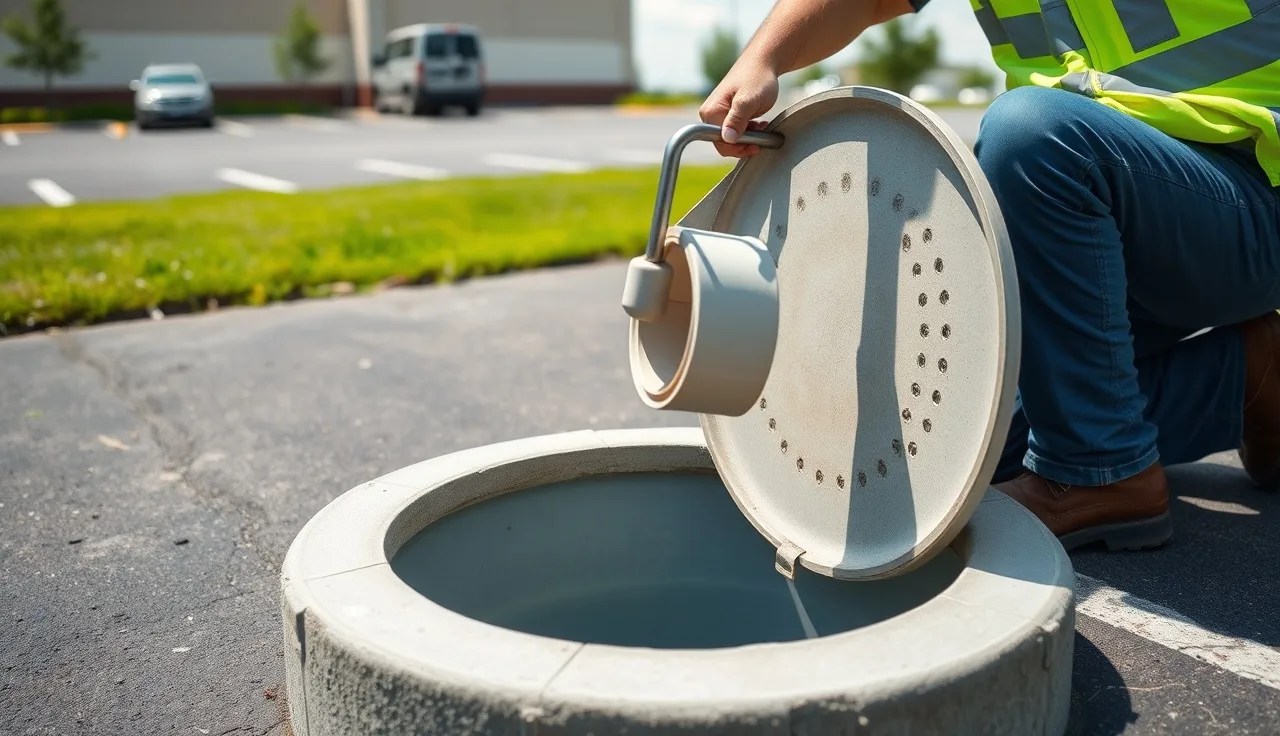
The EF-6 is Tuf-Tite's 6-inch effluent filter. It goes at the outlet end of a septic tank, where the clarified liquid leaves toward the drain field or pump chamber, and it sits inside the outlet baffle or tee to strain that liquid on its way out. Tuf-Tite, based in Wauconda, Illinois, has made plastic septic components since 1988, and the EF series is their core filter line. [1]
A standard 4-inch residential filter handles the flow from one house. The EF-6 is built for tanks with a 6-inch outlet pipe. You see that size on commercial properties, multi-family housing, restaurants, schools, and larger single-family systems where daily flow runs past roughly 600 to 800 gallons per day. The wider barrel gives you more flow area, so the filter doesn't choke the system under peak demand.
The filter body is high-density polyethylene. The screen is a slotted tube with openings around 1/16 inch. Solids bigger than the slot get caught on the outside of the screen and stay in the tank, where they settle or get hauled out during routine septic tank pumping. Liquid passes through the slots, up through the filter body, and out the outlet pipe to the leach field.
Here's what trips people up. The EF-6 is not a treatment device. It kills nothing and removes no nutrients. What it does is cut the suspended solids in the effluent, and suspended solids are the main mechanical threat to drain field soil. Clogged soil pores are the reason drain fields die, which makes an effluent filter one of the cheapest insurance policies you can buy against a five-figure repair. [2]
How does an effluent filter work inside a septic tank?
Wastewater comes into the tank and splits into three layers. Scum (grease and light solids) floats on top. Sludge (heavy solids) sinks. The middle layer of fairly clear liquid, the effluent, is what flows out to the field. The outlet baffle draws from that middle band, below the scum and above the sludge, and the EF-6 clamps a physical screen onto that outlet to catch whatever solids are still riding along.
The housing slides into the outlet fitting. Effluent flows into the gap between the housing and the screen, passes through the slots, travels up the inside of the tube, and exits out the top into the outlet pipe. Gravity or pump pressure moves it. The filter itself uses no electricity.
Solids build up on the outside of the screen. Enough buildup creates a pressure drop across the filter, and that's the signal to clean it. Some EF-6 models include an alarm port so you can wire in a high-water float. When the filter clogs, effluent can't get out fast enough, the tank level rises, and the alarm trips. That's how you want to find out. The wrong way is sewage backing up into the building.
The EPA's SepticSmart program treats effluent filters as one of the better tools for stretching drain field life. EPA guidance for homeowners notes that filters, properly installed and maintained, reduce the solids that leave the tank. The physics don't care about the scale of the system. What works in a house works in a restaurant. [3]
EF-6 vs. EF-4: which filter do you actually need?
It comes down to your outlet pipe diameter. The EF-4 fits a 4-inch outlet. The EF-6 fits a 6-inch outlet. Most single-family tanks built after the mid-1990s have 4-inch outlets. Commercial systems, multi-family buildings past four or five units, and any tank bigger than about 1,500 gallons often run a 6-inch outlet, because a smaller pipe would create hydraulic back-pressure at that flow rate.
Measure your outlet pipe. If it's 6 inches, you need the EF-6. An EF-4 dropped into a 6-inch baffle won't seal and won't screen the full stream. The body just doesn't fill the opening.
| Filter Model | Outlet Pipe Diameter | Typical Application | Flow Capacity |
|---|---|---|---|
| EF-4 | 4 inch | Single-family residential | Up to ~600 GPD |
| EF-6 | 6 inch | Commercial, multi-family, large residential | 600+ GPD |
| EF-4 with extension | 4 inch | Deep tanks, pump chambers | Up to ~600 GPD |
| EF-6 with extension | 6 inch | Deep commercial tanks | 600+ GPD |
GPD = gallons per day. These thresholds are practical rules of thumb installers use. Your state's onsite wastewater code sets the actual design flow. [4]
One more thing. If the system has a pump chamber between the tank and the field, you still want an effluent filter on the septic tank outlet, whether or not there's a pump screen in the chamber. They aren't redundant. The tank filter protects the pump from solids. The pump chamber screen is a backup. Keep both.
What are the EF-6 dimensions and installation specs?
Tuf-Tite publishes specs for the EF-6 series on its product sheets. The base filter body is nominally 6 inches in diameter and comes in several lengths for different tank depths. Standard bodies run roughly 18 to 24 inches, with extension tubes for deeper tanks or baffles that reach further down. [1]
The filter slides into a 6-inch outlet tee or baffle from inside the tank. The top cap seals against the baffle or a grommet so effluent can't slip around the screen. Installer tip: test the fit before the tank gets buried. Push it in, pull it back out by the handle, confirm it comes free without tools. You'll be doing exactly that at every service call.
The handle is part of the top cap and rises above the outlet opening, so a tech can grab it without reaching deep into the tank. On a busy commercial site, a filter that's a pain to pull gets skipped. Skipped filters clog. Clogged filters fail.
Rough steps for a retrofit:
- Access the tank at operating level, or pump it down first. You don't need it empty, but lower is easier. See septic tank pump out.
- Find the outlet baffle or tee. It's on the downhill side, usually opposite the inlet.
- Confirm the outlet tee or baffle is intact. Cracked or missing? Replace it before the filter goes in. Septic tank repair may come first.
- Pick a length so the bottom of the screen sits well below the scum layer but doesn't rest on the sludge.
- Slide the filter into the outlet fitting. The top cap should sit flush or slightly proud of the baffle outlet.
- Replace the access lid and backfill.
State codes differ on whether a licensed contractor has to do this work. In many states a homeowner can add an effluent filter to an existing tank without a permit, but a new installation or a system repair needs a licensed installer. Check your state's onsite wastewater regulations. [4]
How often does the EF-6 commercial effluent filter need cleaning?
It depends on loading, and nobody has clean universal data on how fast commercial filters load up. Tuf-Tite and state extension programs put residential filters at every 1 to 3 years. Commercial applications usually need more, often annually, and more often still if the system takes high-solid waste like a restaurant or a food processing line. [5]
A high-water alarm changes the math. With an alarm, you clean the filter when it trips and skip the fixed schedule. No trip in two years means the filter hasn't restricted flow, so you inspect it at the next pump-out and move on. Trips every six months mean something is overloading the system, and you go find the source instead of just rinsing the screen again.
Cleaning the EF-6 is simple:
- Pull the filter out by the handle.
- Hose the screen off, rinsing solids back into the tank. Do it over the open access port so nothing lands on the ground.
- Look for cracks or deformation. A damaged screen isn't filtering. Replace it.
- Slide the filter back in.
Don't hit the screen with a pressure washer at full pressure. It can collapse the slots or crack the HDPE. A garden hose on a strong spray setting does the job.
Operators running multiple sites can let a scheduling system like SepticMind flag when each filter is due, based on the last service date and the site's loading history. Documentation matters on commercial accounts, because regulators and property owners both ask for the service records eventually.
What does the EF-6 filter actually cost?
The EF-6 retails in the range of $60 to $120, depending on model, length, and whether extensions are bundled in. Prices move by distributor. Septic supply wholesalers usually beat online retail marketplaces, especially for contractors buying in volume. [6]
Installation adds labor. A retrofit on an accessible existing tank runs 30 to 60 minutes for a competent tech, so labor lands at $75 to $200 depending on local rates, whether the tank needs pumping first, and how buried the outlet baffle is. Some baffles sit in spots that force physical entry or awkward reaching, and that pushes labor up.
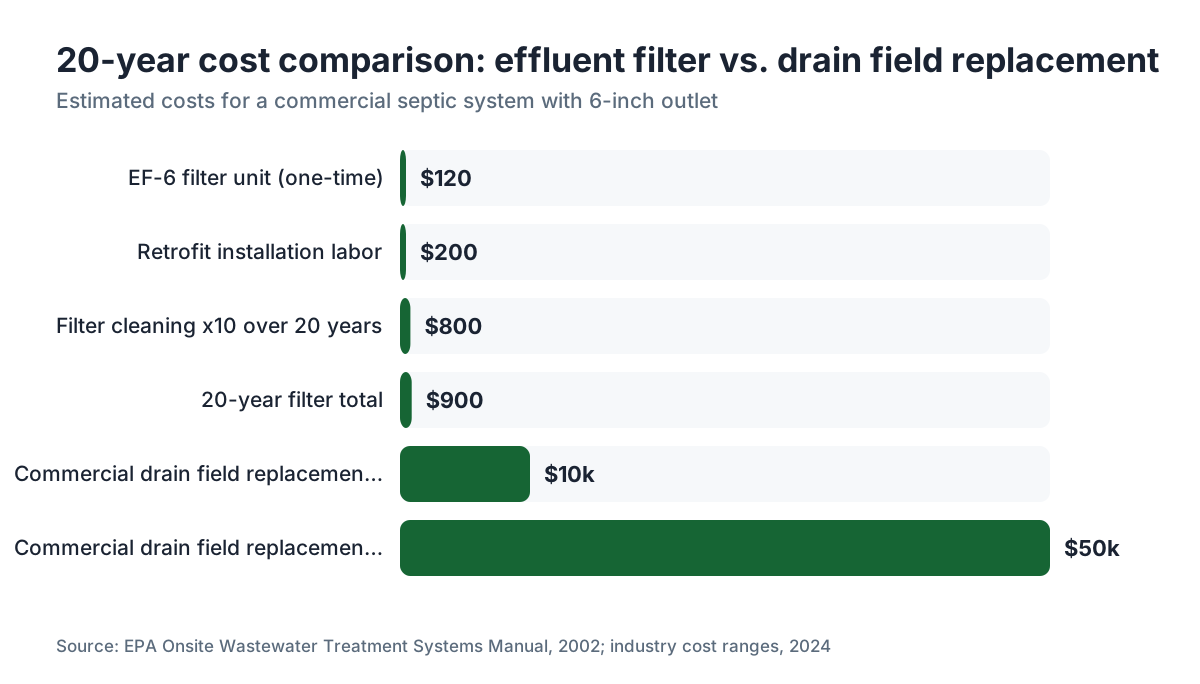
Over a 20-year drain field life, the math is not close. A commercial drain field replacement runs $10,000 to $50,000 or more depending on soil, system size, and permit fees. See cost to install septic system. A filter that costs $100 installed and $50 to clean every two years runs about $600 over 20 years. That's the whole comparison.
The one case where the filter doesn't pay off is an old system already on borrowed time, with a drain field that's shot. A filter won't save a failing field. It might buy a year, but if the soil pores are already biomat-clogged, cutting solids now is too little, too late. See leach field.
| Cost Item | Typical Range |
|---|---|
| EF-6 filter unit | $60 to $120 |
| Retrofit installation labor | $75 to $200 |
| Cleaning (per service visit) | $40 to $80 |
| Drain field replacement (commercial) | $10,000 to $50,000+ |
| 20-year filter total cost estimate | $500 to $900 |
Does an effluent filter affect drain field performance and longevity?
Yes. The evidence is consistent enough to be confident about this even without a single definitive randomized trial. The mechanism is plain: suspended solids in the effluent speed up biomat formation on drain field soil surfaces. Biomat is the biological crust that forms when anaerobic bacteria colonize soil pores and work over organic matter. Some biomat is normal and even helps treatment. Too much of it, fed by high-solids effluent, clogs the soil faster than natural die-off can keep up, the soil stops absorbing, and the field fails. [2]
University soils and environmental engineering programs recommend effluent filters as a low-cost preventive step. The University of Minnesota Extension, for one, puts effluent filters in its routine septic maintenance advice alongside regular pumping. [5]
EPA's SepticSmart guidance ties maintenance to system life the same way, telling homeowners that regular pumping, inspection, and protecting the drain field are the central things they can do. Cutting solids loading with a filter sits inside all three. [3]
For commercial systems the case is stronger. Commercial loading runs heavier and less predictable than residential. A restaurant can push grease, food solids, and detergent through the system in ways a household almost never does. The EF-6's larger screen area handles the higher volume and catches the higher-solid commercial effluent that would otherwise chew through a field. Grease interceptors handle the extreme fats-oils-grease load upstream of the tank. The EF-6 catches what slips past. They work together.
A septic tank inspection that finds no filter, or a failed one, on a commercial system is an urgent finding, not a footnote. Replacement timelines on commercial properties can stretch for months once you factor in permit backlogs, design work, and soil testing.
What state codes govern commercial effluent filter requirements?
Requirements change by state and sometimes by county. Some states mandate effluent filters on all new septic systems. Some require them only on systems with pumped dosing or pressure distribution. A few have no filter mandate at all but allow them as options. Commercial systems usually face tighter rules than residential, because their discharge volumes and waste characteristics draw more regulatory attention. [4]
At the federal level, EPA regulates onsite wastewater mostly through guidance, not direct rules, and leaves the rule-making to states. EPA's 2002 guidance, the Onsite Wastewater Treatment Systems Manual, describes effluent filters as a best management practice for reducing suspended solids. States fold that guidance into their own codes at varying strictness. [7]
A few state examples show the range:
- California: the State Water Resources Control Board oversees onsite systems, and many county codes require effluent filters on new systems and replacements.
- Florida: Department of Health rules under Chapter 64E-6 require effluent filters on new systems, and commercial systems carry extra design standards.
- Texas: TCEQ rules under Title 30 TAC Chapter 285 cover onsite sewage facilities and include filter requirements for certain configurations.
- Minnesota: Minnesota Pollution Control Agency rules under Minnesota Rules Chapter 7080 spell out onsite system requirements, including filter specs for different system types. [8]
If you're specifying or installing an EF-6, pull the applicable state code before the work starts. Don't assume what's fine in one state is legal in the next. Your state environmental agency or health department is the authoritative source, and most post their onsite wastewater codes on their websites.
Homeowners can sort out whether their system should have a filter with a call to the local health department. Many jurisdictions don't chase retrofits on their own, but a missing filter can surface as a deficiency when you sell the property or run a septic tank inspection.
What are common EF-6 installation problems and how do you fix them?
The most common problem is the wrong length. Measure the tank depth and the outlet baffle depth before ordering. Too short, and the screen won't reach below the scum line, so floating solids sail past. Too long, and it rests on the sludge and clogs almost immediately. Tuf-Tite makes extension tubes for exactly this reason, because tank depths vary and one length doesn't fit every install. [1]
Bypassing is the next failure mode. If the top cap doesn't seal against the outlet baffle or tee, effluent flows around the filter instead of through it. This usually traces to an outlet fitting that's cracked, broken, or was never the right diameter. Replace a broken baffle before the filter goes in. See septic tank repair.
Forcing the filter or over-tightening it can crack the HDPE cap. HDPE holds up fine under normal use, but it doesn't like being pried with metal tools in cold weather. If it won't slide in smoothly, check for obstructions or a size mismatch before you push harder.
On commercial systems, one recurring issue is biofilm on the screen between cleanings. This isn't the loose solids you rinse off. Biofilm is a sticky biological layer that keeps the slots clogged even after a rinse. A dilute bleach solution (1 cup per gallon of water) on the screen for a few minutes breaks it down. Rinse thoroughly before reinstalling. Never pour bleach into the tank. It kills the bacteria that make the tank work.
Last thing: document every service visit. Record the date, the filter's condition when you pulled it, whether the alarm had tripped, and the date of the next cleaning. On commercial accounts, that paper trail protects the service company and gives the owner proof of good-faith maintenance if a regulator comes asking. SepticMind's operator platform captures this per-site service history automatically.
How does the EF-6 compare to other commercial effluent filter brands?
Tuf-Tite is the most widely distributed septic effluent filter brand in the U.S., but it isn't the only choice. Orenco Systems makes the Biotube line, which uses a finer mesh and shows up often on pressure-dosed systems. Polylok makes the PL-122 series. Zabel Anderson makes the A-Series. All of them offer products that fit 6-inch outlet configurations.
The differences that matter are screen slot size, filter area, material grade, alarm compatibility, and price. Finer slots catch smaller particles and clog faster. More screen surface stretches the time between cleanings but takes up more room. Alarm compatibility counts on commercial installs, where code often requires monitoring.
Installers give the EF-6 a good name for durability and easy cleaning. The handle design gets praised because it makes field service faster. On a commercial site where the tech works a time-limited visit, anything that trims access time is money.
For most commercial installs where the goal is excluding solid particles, the EF-6 performs on par with others in its class. The choice usually comes down to what your local distributor stocks and what your installing contractor knows. Mixing brands across a fleet of properties just breeds confusion at service time.
| Brand | Key Commercial Model | Slot Size | Notable Feature |
|---|---|---|---|
| Tuf-Tite | EF-6 | ~1/16 inch | Wide distribution, easy-pull handle |
| Orenco | Biotube | Finer mesh | Common on pressure-dosed systems |
| Polylok | PL-122-6 | Variable | Competitive price |
| Zabel Anderson | A-1800 | Variable | Long track record |
Verify slot sizes and exact specs directly against each manufacturer's current product sheet.
Can the EF-6 be installed in a pump chamber or only in the septic tank?
The EF-6 is made for the septic tank outlet, and that's where it belongs in a conventional gravity system. In a system with a pump chamber, the filter goes on the septic tank outlet, not inside the pump chamber. The pump chamber has its own screen (a pump screen or vault screen) that keeps solids off the pump impeller if any slip past the tank filter.
Some systems run a separate pump chamber with a high-capacity effluent pump that doses a pressure distribution field. There, the EF-6 on the septic tank outlet protects the pump chamber from solids loading, and the pump chamber screen acts as the second barrier. Both protect the drain field, from different spots in the treatment train.
Putting an effluent filter inside a pump chamber on the pump's inlet side is possible in some configurations, but it's specific to the pump chamber manufacturer's design, and you shouldn't improvise it without the system design documents. If you're unsure where the filter belongs in a complex layout, check the original design or ask a licensed engineer.
For a simple setup with a gravity tank and gravity field, the EF-6 sits in the septic tank outlet. That's the standard job, and it's the one this guide covers throughout. How often to pump the tank alongside filter maintenance is its own question: how often to pump septic tank.
Is the EF-6 worth installing on an existing system, or only on new builds?
Retrofitting an EF-6 onto an existing system makes sense in most cases, especially if there's no filter on the outlet now. Older systems, particularly those from before the mid-1990s when effluent filters became common, often have plain outlet baffles or crumbling concrete outlet tees that let solids run straight through. Adding a filter at the next pump-out is one of the highest-value upgrades you can make to an aging system.
The retrofit case weakens if the outlet baffle is in bad shape. A corroded steel tee or cracked concrete baffle can't hold a filter properly and lets effluent bypass. Fix the outlet fitting first. Septic system repair may also be in order if the tank itself has structural trouble.
There's no point putting a filter on a system whose drain field is already gone. If effluent is surfacing in the yard or sewage is backing up, the field needs diagnosis and probably replacement. The filter prevents problems. It doesn't rescue a system that's already down. See septic system repair for what to do when things have already failed.
Commercial owners who don't know whether their system has a filter should check at the next pump-out. Ask the pumping contractor to confirm whether an effluent filter is on the outlet baffle and whether it's serviceable. No filter? Add one. There's one that hasn't been cleaned in years? Clean or replace it during the same visit. A septic tank cleaning visit is the natural time to handle both.
Frequently asked questions
What size tank does the EF-6 commercial effluent filter fit?
The EF-6 fits any septic tank with a 6-inch outlet pipe, whatever the tank volume. Commercial and large-residential tanks from 1,500 gallons up to 10,000 gallons or more commonly use 6-inch outlet fittings. Tank volume alone doesn't decide which filter you need. The outlet pipe diameter does. Confirm that diameter before you order.
How do I know if my septic tank outlet has a 4-inch or 6-inch pipe?
Easiest way is to measure the outlet pipe directly with the tank lid open. A 4-inch pipe has an inner diameter around 4 inches (outer diameter closer to 4.25 inches for PVC). A 6-inch pipe has an inner diameter around 6 inches. If you can't measure it yourself, the original system design documents, usually on file with your local health department, will list the outlet pipe size.
Can I install the EF-6 myself or do I need a licensed contractor?
Many states let homeowners add an effluent filter to an existing accessible tank without a permit, treating it as routine maintenance rather than a system change. Commercial properties usually require a licensed contractor. Check your state's onsite wastewater code first. Either way, the tank has to be safely accessible. Never enter a septic tank without confined-space safety equipment.
How long does a Tuf-Tite EF-6 filter last before it needs to be replaced?
The HDPE body and screen can last 10 to 20 years with proper cleaning and handling. The usual reason for replacement is physical damage during cleaning, cracking from the wrong tools, or deformation from chemical exposure. Inspect the screen slots every time you clean it. Cracks, collapsed slots, or torn sections mean it's time to replace the unit.
Will an effluent filter cause sewage backups if it clogs?
A severely clogged filter can raise the tank effluent level, which can back up into the building's plumbing if it's left alone. That's why commercial EF-6 installs should include a high-water alarm wired to the outlet baffle. The alarm warns you before backups happen. A filter kept on a normal service schedule should never clog badly enough to cause one.
Does an effluent filter replace the need to pump the septic tank?
No. The filter is not a substitute for pumping. Sludge and scum still pile up in the tank no matter how clean the filter is. When sludge reaches the bottom of the outlet baffle or scum reaches the inlet baffle, the tank needs pumping, clean filter or not. Most commercial systems need pumping every 1 to 3 years. Filter and pumping work together, not instead of each other.
What happens to the solids that the EF-6 captures?
Solids caught on the outside of the screen stay inside the tank. When you clean the filter by rinsing it over the open access port, those solids drop back into the tank. They settle into the sludge layer and get removed at the next pump-out. Nothing leaves the tank except the effluent that passes through the screen.
Is the EF-6 approved for use under state septic codes?
Tuf-Tite EF-series filters are listed under NSF/ANSI Standard 46, which covers components used in wastewater treatment. Many states reference NSF 46 listing in their onsite wastewater codes as a basis for product approval. Approval still varies by jurisdiction. Verify the specific model you're using is approved in your state before installation, especially for new systems or permitted repairs.
Can the EF-6 be used on a mound or drip system?
Yes. Mound systems and drip irrigation systems benefit even more from filtration than conventional gravity fields, because their distribution networks clog more easily from suspended solids. The EF-6 installs in the septic tank outlet as usual, before the effluent reaches the pump chamber or dosing system. Orenco Biotube filters are also commonly specified for pressure-dosed systems, so compare options with your system designer.
What commercial properties typically need a 6-inch effluent filter like the EF-6?
Restaurants, schools, office buildings, small hotels and motels, multi-family properties past four or five units, campgrounds, and light commercial facilities on septic commonly use 6-inch outlet tanks that call for the EF-6 or an equivalent. If daily flow tops 600 to 800 gallons per day and the system was designed right, the outlet pipe is almost certainly 6 inches.
How do I clean the EF-6 without contaminating the surrounding area?
Pull the filter straight up and hold it directly over the open tank access port. Rinse with a garden hose so the water and dislodged solids fall back into the tank. Never set the filter on the ground or rinse it away from the access port. Wear nitrile gloves and eye protection. Wash your hands and any exposed equipment well afterward. Effluent carries pathogens that need standard hygiene precautions.
Does grease from a restaurant kitchen pass through an effluent filter?
Liquid grease can slip through the filter slots. Solidified grease in particle form gets caught. That's why grease interceptors are required upstream of septic tanks serving food service in most jurisdictions. The EF-6 is not a substitute for a properly sized, maintained grease interceptor. It handles what the interceptor misses, not the main grease load from a commercial kitchen.
What is NSF/ANSI Standard 46 and why does it matter for effluent filters?
NSF/ANSI Standard 46 sets evaluation criteria for components used in water treatment systems, including effluent filters for septic use. Products tested and listed under NSF 46 have been verified for material safety and performance claims by a third-party certifier. Many state septic codes require or prefer NSF 46-listed components for new installations. The listing gives regulators and inspectors confidence the product meets defined criteria.
What's the difference between an effluent filter and a grease interceptor for a commercial system?
A grease interceptor sits between the kitchen drains and the septic tank, catching fats, oils, and grease before they reach the tank. An effluent filter sits at the tank outlet, catching suspended solids before they leave toward the drain field. They're at opposite ends of the tank and address different threats. A commercial food service septic system needs both, properly sized and regularly maintained.
Sources
- Tuf-Tite Inc., EF-Series Effluent Filter product information: Tuf-Tite manufactures the EF-6 commercial series effluent filter; company based in Wauconda, Illinois; EF series is their core filter line
- EPA, Onsite Wastewater Treatment Systems Manual (EPA/625/R-00/008): Suspended solids in septic effluent accelerate biomat formation and drain field failure; effluent filters described as best management practice for solids reduction
- EPA SepticSmart program: EPA SepticSmart states that properly installed and maintained filters reduce the amount of solids that leave the tank; regular pumping, inspection, and protecting the drain field are the central recommended actions
- National Onsite Wastewater Recycling Association (NOWRA), state code reference resources: State onsite wastewater codes govern design flow thresholds and effluent filter requirements; commercial systems often face stricter requirements than residential
- University of Minnesota Extension, Septic Systems: University of Minnesota Extension recommends effluent filters as part of routine septic maintenance alongside regular pumping; residential filters generally cleaned every 1 to 3 years
- National Precast Concrete Association, Septic System Products pricing reference: Commercial effluent filter units in the 6-inch class retail in the range of $60 to $120 depending on model and distributor
- EPA, Onsite Wastewater Treatment Systems Manual (EPA/625/R-00/008), 2002: EPA 2002 guidance describes effluent filters as a best management practice for reducing suspended solids in onsite wastewater systems
- Minnesota Pollution Control Agency, Minnesota Rules Chapter 7080, Individual Sewage Treatment Systems: Minnesota Rules Chapter 7080 includes detailed requirements for onsite systems including filter specifications for different system types
- Florida Department of Health, Chapter 64E-6 Onsite Sewage Treatment and Disposal Systems: Florida Chapter 64E-6 requires effluent filters on new onsite sewage systems; commercial systems follow additional design standards
- NSF International, NSF/ANSI Standard 46: Evaluation of Components and Devices Used in Wastewater Treatment Systems: NSF/ANSI Standard 46 covers evaluation criteria for effluent filters and other components used in onsite wastewater treatment; many state codes reference NSF 46 listing for product approval
Last updated 2026-07-09