Ecoflo septic system cost: what homeowners actually pay
By the SepticMind Editorial Team
TL;DR
- An Ecoflo compact biofilter septic system costs roughly $8,000 to $20,000 fully installed, depending on site conditions, tank size, and local labor.
- Annual maintenance runs $300 to $600.
- Ecoflo is a Premier Tech brand approved across most US states and Canadian provinces as an advanced treatment unit for hard lots where a conventional system won't pass.
What does an Ecoflo septic system cost to install?
Most homeowners pay $8,000 to $20,000 to have an Ecoflo system fully installed. That price covers the biofilter unit, a septic tank (if one isn't already in place), distribution components, and labor. For a three-bedroom home on a moderately difficult lot in the US Northeast or Canada, the quoted price usually lands around $12,000 to $15,000. [1]
The range is wide because the unit is only part of the bill. The Ecoflo compact biofilter (the Premier Tech coconut husk or peat moss filter unit) retails between $3,000 and $5,500 depending on model and supplier markup. Everything else piles on top: the tank, the risers, the effluent pump if you need one, the outlet disposal area, the permits, the excavation, and the engineer's stamp.
Already have a code-compliant tank in good shape? An Ecoflo retrofit gets cheaper fast, sometimes $5,000 to $9,000, because you're only replacing the treatment stage. Ask your installer point-blank whether your existing tank qualifies. Many retrofits pair with tanks built after 1990 that still have structural integrity.
A basic gravity-fed conventional system on an easy lot runs $3,000 to $7,000. You pay the Ecoflo premium because it treats effluent to a much higher standard, which is what regulators require when your lot has a high water table, poor soil percolation, a well or water body nearby, or too little room for a full drain field. [2]
What factors push the price higher or lower?
Site preparation is the single biggest variable. Rocky ground, a shallow water table, steep slopes, or slow-draining soil can add $2,000 to $6,000 in excavation, extra pumping equipment, and engineered workarounds. Flat, sandy, accessible lots cost the least.
Household size matters too. Ecoflo sizes its units by daily hydraulic load. A two-bedroom cottage needs a much smaller unit than a five-bedroom house. Bigger units cost more to buy and to maintain, and they often demand a larger primary tank.
Permit fees swing hard by county and state. Some jurisdictions charge $200 to $300 for a septic permit. Others in New England or the Pacific Northwest charge $800 to $1,500 and require a licensed engineer's design before they'll issue anything. [3] Get the permit cost in writing before you sign.
Labor rates are the next big driver. A rural installer in the Midwest may bill $75 to $95 an hour. A contractor near a coastal metro often charges $110 to $150 an hour. The cost to install septic system tracks these regional labor swings across every system type.
Then there's the effluent pump. Ecoflo is a passive, gravity-driven filter. But if the outlet has to reach a raised mound or a pressure distribution field, you'll need a pump chamber and controls, which add $800 to $2,000.
How does Ecoflo compare in cost to other advanced treatment systems?
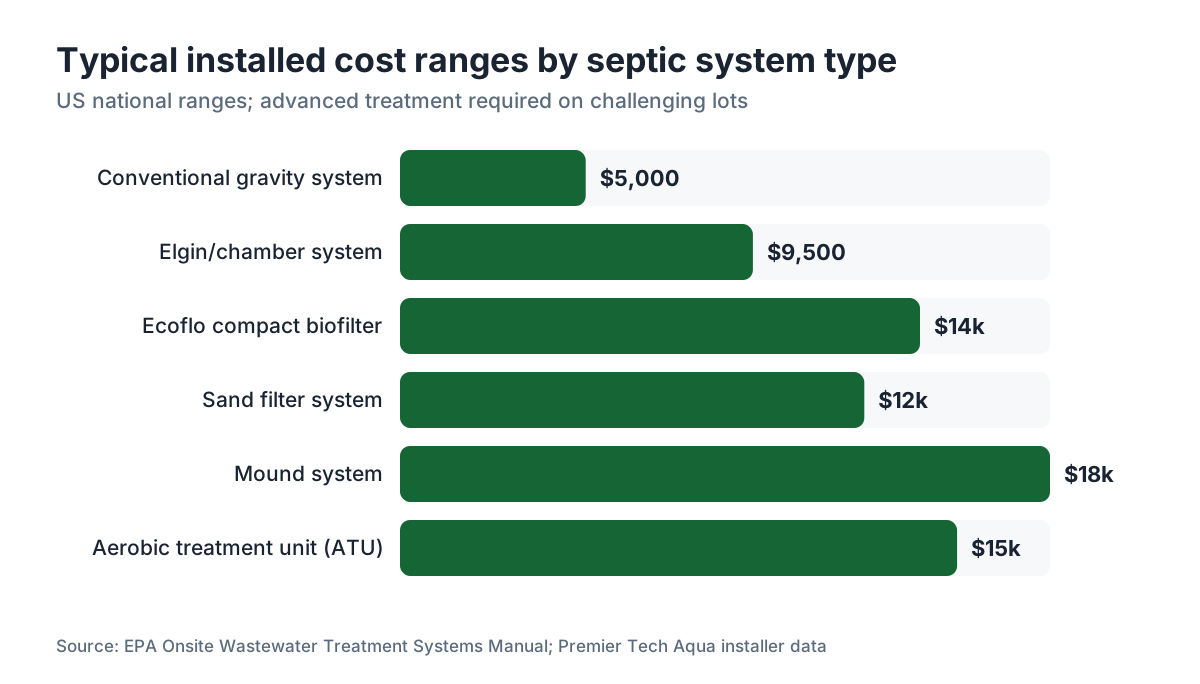
The table below shows typical installed price ranges for Ecoflo against other common advanced treatment options. These are US national ranges. Your region may differ by 20 to 30 percent.
| System type | Installed cost range | Annual maintenance | Typical use case |
|---|---|---|---|
| Ecoflo compact biofilter | $8,000 to $20,000 | $300 to $600 | Poor perc, high water table, small lots |
| Conventional gravity system | $3,000 to $7,000 | $0 to $100 | Standard soil, adequate area |
| Mound system | $10,000 to $25,000 | $200 to $400 | High water table, clay soils |
| Aerobic treatment unit (ATU) | $10,000 to $20,000 | $400 to $900 | Nitrogen reduction, strict setbacks |
| Elgin septic system (Infiltrator/EZflow) | $5,000 to $14,000 | $100 to $300 | Replacement leach fields, expansions |
| Sand filter system | $7,000 to $18,000 | $300 to $500 | Phosphorus or nitrogen sensitive areas |
Elgin-style chamber systems (named after the Elgin Butler plastic chamber design) cost less per linear foot of trench than Ecoflo, but they don't provide advanced biological treatment. If your permit only asks for basic treatment, an Elgin chamber field on a standard tank almost always costs less. If your permit demands secondary or tertiary treatment to hit nutrient limits, Ecoflo goes head to head with ATUs and sand filters, and it usually wins on operating cost. No moving parts, no aeration blower, no UV lamp to swap out. [4]
The EPA's SepticSmart program states that "homeowners are responsible for operating and maintaining their septic systems" and recommends advanced treatment units for properties near sensitive water bodies. [3] That's the exact regulatory logic that puts Ecoflo in most permit files.
What does ongoing Ecoflo maintenance cost per year?
Ecoflo needs an annual inspection and filter media check by a licensed technician. Premier Tech requires this through its certified installer network to keep the warranty valid. A maintenance contract runs $300 to $600 a year, which usually covers one annual visit, a filter media top-off if needed, and a compliance report filed with your health department. [1]
The peat moss or coconut husk media needs partial replacement roughly every three to five years, depending on hydraulic load and how strong your wastewater is. A media refresh costs $400 to $900 in most markets. Some contractors fold this into an extended service contract, which makes it easier to budget for.
You still pump the primary tank on a regular schedule, typically every three to five years for a properly loaded tank. septic tank pumping costs $300 to $600 in most US markets. Skipping pumps is the fastest way to kill an Ecoflo unit. Excess solids reaching the biofilter blind the media and force a full, expensive replacement. [5]
Here's a rough 20-year total cost of ownership: $14,000 installed (midpoint), plus $400 a year in maintenance across 20 years ($8,000), plus two media refreshes ($1,400), plus four tank pump-outs ($1,800). That's about $25,200. A conventional system installed at $5,000 with only pump-out costs ($1,800 over 20 years) totals $6,800. But that comparison only holds where a conventional system is actually approvable. If it isn't, the Ecoflo number is the only one that matters.
Is an Ecoflo system worth the extra cost?
If a conventional system is approved for your lot, Ecoflo is hard to justify on cost alone. But that's not why most people buy one.
Most Ecoflo buyers are stuck with a lot regulators won't approve for a standard system. Think properties near lakes, streams, or wetlands where nutrient loading rules apply. Lots with shallow bedrock or a seasonal high water table. Places where the only available disposal area is small and needs a compact footprint. In those cases, Ecoflo is often the cheapest option that actually gets a permit. [3]
Seasonal homes are a good fit too. When a system sits idle for months, Ecoflo's passive design (no blower, no electricity for treatment) beats aerobic treatment units, which can go anaerobic and stink badly when left unused. Several state extension services report that passive peat and coconut biofilters handle on-and-off seasonal loading better than ATUs. [4]
The warranty deserves a hard look. Premier Tech offers a limited warranty on the Ecoflo unit, typically five years, and only if you keep up the annual service. That's short for a $4,000 piece of equipment, so confirm the current terms with your installer before you buy.
Operators managing several properties can use platforms like SepticMind to track Ecoflo service intervals and maintenance records across a portfolio. That matters when permits require annual compliance filings.
What permits and approvals does an Ecoflo system require?
Every US state and Canadian province requires a permit before you install any septic system. For advanced treatment units like Ecoflo, the bar sits higher than for conventional systems. Most jurisdictions want a site evaluation, a soil percolation test or soil morphology assessment, a design by a licensed professional engineer or soil scientist, and sign-off from the county or state health department. [3]
Ecoflo systems carry NSF/ANSI 40 certification for residential onsite wastewater treatment, the baseline most US health departments require for proprietary treatment units. [6] Some states with nutrient-sensitive watershed rules (Virginia, Maryland, Florida, Massachusetts) require added nitrogen or phosphorus reduction certifications. Ecoflo's coconut husk filter (the Ecoflo Hybrid) has some phosphorus adsorption capacity, but if your permit demands certified nitrogen reduction to specific limits, ask your engineer whether your exact Ecoflo model meets those numeric targets under your state's testing protocol.
Permit timelines run anywhere from two weeks to six months depending on the backlog. Budget time as carefully as money. A handful of counties in New England and the Pacific Northwest are running three to five month review queues for advanced treatment systems as of mid-2025.
How long does an Ecoflo system last?
The biofilter housing and tank components are built to last 25 to 40 years with proper maintenance. The filter media is a consumable. It needs partial replacement every three to five years and full replacement after roughly 15 to 20 years, depending on load. [1]
The biggest longevity risk isn't the Ecoflo unit. It's the primary tank. A cracked, corroded, or settled tank can bring down the whole system. A septic tank inspection every three to five years catches tank wall failures, baffle deterioration, and inlet/outlet problems before they turn into a $10,000 emergency. septic tank repair costs $500 to $3,000 depending on the defect. Catch problems early and you stay at the low end.
Systems that get consistent annual maintenance, regular pump-outs, and stay within their designed hydraulic load usually reach 25 years without major structural trouble. Overload one (picture a four-bedroom house running as a weekend rental with six guests) or neglect it, and it can fail in eight to twelve years.
Can I get financing or rebates to offset Ecoflo installation costs?
Some states and counties offer low-interest loans or direct rebates to homeowners upgrading to advanced treatment systems, especially near sensitive water bodies. Virginia's Chesapeake Bay nutrient credit work, Massachusetts Title 5 septic loan programs, and several Minnesota lake protection programs have all included provisions for advanced treatment upgrades. Check with your state environmental or health agency for current availability. [7]
The USDA Rural Development program offers Section 504 grants and loans for sanitation system repairs and replacements in qualifying rural areas. Income limits apply, but the program can cover up to $10,000 in grants for very-low-income homeowners. [8]
USDA's Section 306C Water and Waste Disposal loans and grants also fund wastewater improvements in rural communities, though these usually flow through utilities or municipalities rather than individual homeowners.
There's no current federal tax credit specifically for residential septic installation or upgrade (as of mid-2025). The federal residential energy credit does not cover septic systems. A few states offer a property tax exclusion for the added value a septic upgrade brings, which softens the blow a little without putting cash in your pocket up front.
Rolling the work into a mortgage is an option. Septic systems are allowable expenses under FHA 203(k) rehabilitation loans and USDA Single Family Housing Guaranteed Loans, both of which let septic work ride along with the mortgage. [8]
What questions should I ask an Ecoflo installer before signing?
Get at least three quotes. Ecoflo sells through a certified installer network, and pricing discretion is wide. The cheapest quote isn't automatically bad, but ask why it's lower. Are they skipping the secondary tank, spec'ing a smaller unit, or cutting corners on the distribution field?
Ask specifically whether the price includes the permit fee, the engineer's design, site clearing, tank risers to grade, and the first annual maintenance visit. These line items vanish from low-ball quotes more often than not.
Ask which Ecoflo model they're specifying (the original peat moss filter, the coconut husk Ecoflo Hybrid, or the Ecoflo Biofilter with Coconut) and whether that exact model is approved by your county health department. Some counties keep an approved products list, and not every Ecoflo variant makes every list.
Ask how the warranty registration works. Premier Tech requires registration within a set window after installation. If your installer doesn't file it, you may find yourself unregistered when you need warranty service.
Operators running a service fleet and quoting Ecoflo maintenance contracts should look at SepticMind's scheduling and compliance tracking, given how documentation-heavy Ecoflo permit files get.
Last one: ask for references from Ecoflo jobs the installer finished at least five years ago. A system that worked at startup is nice. A system that still works after five years of daily use tells you far more.
How does the cost compare if I'm replacing an existing failed system?
Replacing a failed septic system almost always costs more than putting a new one on vacant land. You're paying to decommission the old system, maybe remove contaminated soil, and work around a yard full of established landscaping, utility lines, and other obstacles. septic system repair and full replacement projects run $8,000 to $30,000 and up in most markets. [9]
If your old system failed because of a poor-performing leach field and the tank itself is structurally sound, an Ecoflo retrofit can be a smart, cheaper path. The Ecoflo unit goes in-line with the existing tank, and a smaller replacement absorption area (often a drip irrigation field or compact pressure-dosed trench) takes over for the failed field. That can save $5,000 to $12,000 against a full replacement when the tank passes inspection.
If the failure showed up as sewage surfacing in the yard or backing up into the house, get a camera inspection of the tank and distribution lines before you assume a repair path. Sometimes a septic tank pump out and a baffle replacement fix what looked like a field failure. Sometimes the field really is saturated and needs full replacement. Diagnose first, commit second, and you save money.
For baseline installation pricing to compare against, the cost to put in a septic tank guide breaks out tank-only costs from the full system.
How often does an Ecoflo system need to be pumped?
The Ecoflo biofilter itself never gets pumped. It's a passive filter media bed. But the primary septic tank feeding it absolutely does, and skipping that is the most common reason Ecoflo media fails early.
For a household of four with average water use, the EPA's general guidance is a tank pump-out every three to five years. [10] A two-person household on a properly sized tank may stretch to five to seven years. A large family or vacation rental may need pumping every two years. The how often to pump septic tank guide has a sizing table if you want your household's specific interval.
Some Ecoflo maintenance contracts include an annual tank level check during the service visit. If the technician measures sludge and scum layers creeping toward the one-third tank capacity threshold, they'll recommend pumping even before your scheduled interval. Take that recommendation. Don't wave it off to save $400.
After pumping, homeowners often ask whether they need to re-seed the Ecoflo media with bacterial additives. The manufacturer and most extension guidance say no. The media re-colonizes on its own within a few days of normal use, and commercial additives haven't shown a measurable benefit in controlled trials. [11]
Frequently asked questions
How much does an Ecoflo septic system cost in total?
Fully installed, an Ecoflo system runs $8,000 to $20,000 in most US markets, with a common midpoint of $12,000 to $15,000 for a three-bedroom home. That covers the biofilter unit ($3,000 to $5,500), a septic tank if needed, distribution components, excavation, and permits. Annual maintenance adds $300 to $600 a year on top.
Is Ecoflo cheaper than an aerobic treatment unit?
Installation costs run roughly the same, both in the $10,000 to $20,000 range. Ecoflo usually wins on annual operating cost because it has no blower, no UV lamp, and no aeration motor. ATU maintenance contracts run $400 to $900 a year against $300 to $600 for Ecoflo. Over 20 years, the operating cost gap can top $3,000 to $6,000 in Ecoflo's favor.
What is the Ecoflo Hybrid and does it cost more?
The Ecoflo Hybrid uses a coconut husk granulate filter medium instead of peat moss. It generally has better phosphorus adsorption and gets used in phosphorus-sensitive watersheds. Pricing is close to the peat model, though some suppliers add a small premium of $200 to $500 for the coconut media. Confirm which model your health department's approved products list covers before you spec it.
Do I need an annual maintenance contract for an Ecoflo system?
Yes, in practice. Premier Tech requires annual service visits to keep the warranty valid. More to the point, most state and county health departments that approve Ecoflo as an advanced treatment unit write the annual inspection into the permit conditions. Skip it and you can end up in violation of your septic permit, which becomes a problem the moment you try to sell the property.
Can Ecoflo be installed on a small lot?
Yes. The compact footprint is one of its main selling points. The biofilter unit is roughly 4 feet across and 3 to 4 feet tall depending on model. The outlet still needs a disposal area (drip field, shallow trench, or pressure-dosed bed), but that area can be much smaller than a conventional leach field because the effluent is so much cleaner. That's why small and oddly shaped lots often end up with Ecoflo.
Does Ecoflo work in cold climates?
Yes, with caveats. Ecoflo was developed in Quebec and is widely used across cold Canadian climates. The unit must sit below the frost line or be insulated per local code. Treatment efficiency dips at very low temperatures but stays above most regulatory minimums. Some northern installers add insulation blankets over the unit in winter. If your lot sees deep sustained freezes, ask your installer about cold-weather performance for your specific region.
How does Ecoflo treat wastewater compared to conventional systems?
A conventional septic system uses soil absorption for final treatment. Ecoflo adds a biological filtration stage first: wastewater trickles through a packed bed of peat moss or coconut media where microorganisms break down organic matter and pathogens. NSF/ANSI 40 certification requires effluent at or below 30 mg/L BOD and 30 mg/L TSS, which Ecoflo meets. The cleaner effluent allows a smaller, shallower disposal area.
What's the difference between Ecoflo and an Elgin septic system?
An Elgin-style system is a plastic chamber or aggregate-free leach field used to disperse effluent. It's a disposal component, not a treatment component. Ecoflo is a treatment unit that cleans effluent before it reaches any disposal field. You could use an Elgin chamber field as the outlet for an Ecoflo system. They do different jobs, so comparing their costs directly is like comparing a water filter to a drainage pipe.
Will an Ecoflo system add value to my home?
It can, in markets where buyers care about environmental compliance. A property that couldn't pass a conventional septic inspection but has a code-compliant advanced treatment system sells easier than one with a failing system. That said, appraisers rarely add explicit value for septic upgrades. The real value is that the home passes inspection and stays mortgageable. Without that, the sale may not close at all.
How long does Ecoflo installation take?
The physical installation usually takes one to three days once permits are approved and equipment is on-site. The slow part is the permit process, which can run two weeks to six months depending on your jurisdiction. Budget four to twelve weeks from first contractor call to a working system in normal cases, more if you're in a backlogged county or starting from raw land.
What happens if the Ecoflo media gets clogged?
A blinded media bed backs effluent up into the primary tank, then into the house, or surfaces it in the yard. The fix is a partial or full media replacement, costing $400 to $1,500 depending on severity. This almost always traces back to excess solids passing through from an overfull primary tank, or to grease, chemicals, and non-biodegradable material going down the drain. Regular tank pumping is the prevention.
Can I install an Ecoflo system myself to save money?
No, not legally. Every US state and Canadian province requires a licensed installer (and usually an engineer's design) for an advanced treatment unit like Ecoflo. Premier Tech's warranty also requires a certified installer. DIY work voids the warranty and almost certainly fails the permit inspection. The permit, engineering, and inspection steps exist because a failed septic system can contaminate drinking water for your neighbors. This is not one to cut corners on.
Does Ecoflo require electricity to operate?
The biofilter itself does not. It works by gravity. If your site needs an effluent pump to move treated water to a raised dispersal field, that pump runs on electricity and adds a small power cost, typically $30 to $80 a year. The absence of a continuously running aeration blower is one reason Ecoflo's operating costs sit below aerobic treatment units, which run blowers around the clock.
How do I find a certified Ecoflo installer near me?
Premier Tech keeps a certified installer locator on their website (premiertechaqua.com). Cross-reference that list with your county health department's approved contractor list, which some counties require. Get at least three quotes. Prices vary widely between installers even inside the same county, and experience with local permitting is as valuable as the price.
Sources
- Premier Tech Aqua, Ecoflo product documentation and installer resources: Annual maintenance contract requirement and media replacement intervals for Ecoflo systems
- EPA, Onsite Wastewater Treatment Systems Manual (EPA/625/R-00/008): Advanced treatment unit cost context and site conditions requiring advanced treatment
- EPA SepticSmart homeowner guidance: Homeowners are responsible for operating and maintaining their septic systems; advanced treatment units recommended near sensitive water bodies; permit and inspection requirements for onsite systems
- Penn State Extension, Onsite Wastewater Treatment resources: Passive peat and coconut biofilters handle seasonal loading better than aerobic treatment units; Elgin chamber fields provide dispersal without advanced treatment
- EPA, Onsite Wastewater Treatment Systems Manual (EPA/625/R-00/008): Excess solids reaching the biofilter blind the media and require full media replacement
- NSF International, wastewater treatment standards (NSF/ANSI 40): NSF/ANSI 40 certification standard requires 30 mg/L BOD and 30 mg/L TSS for residential onsite treatment units
- Virginia Department of Environmental Quality, Nutrient Credit Exchange: State-level rebate and nutrient credit programs applicable to advanced septic treatment upgrades
- USDA Rural Development, Single Family Housing Repair Loans and Grants (Section 504): USDA Section 504 grants up to $10,000 for very-low-income rural homeowners for sanitation system repairs and replacements; FHA 203(k) and USDA guaranteed loans allow septic work
- EPA, Onsite Wastewater Treatment Systems Manual (EPA/625/R-00/008): Full septic system replacement cost context and decommissioning considerations
- EPA SepticSmart, How to Care for Your Septic System: EPA general guidance on septic tank pump-out frequency every three to five years for a typical household
- Penn State Extension, septic system additives guidance: Commercial bacterial additives have not shown measurable benefit in controlled trials; media re-colonizes naturally
- Massachusetts Department of Environmental Protection, Title 5 septic system upgrade loans: State low-interest loan programs for septic system upgrades including advanced treatment systems
Last updated 2026-07-09