Installing a leach field: costs, steps, and what can go wrong
By the SepticMind Editorial Team
TL;DR
- Installing a leach field runs $3,000 to $15,000 for a conventional gravity system on a standard residential lot.
- Perc test, permits, excavation, pipe, gravel, and inspection fees all add up.
- Mound and drip systems cost more.
- The dig-and-install work takes one to three days once permits are in hand.
- Permitting itself can take weeks.
What is a leach field and how does it actually work?
A leach field (also called a drain field or absorption field) is the part of your septic system that takes liquid effluent from the septic tank and spreads it into the surrounding soil. The soil does the real work. Bacteria and natural filtration treat the wastewater before it reaches groundwater. [1]
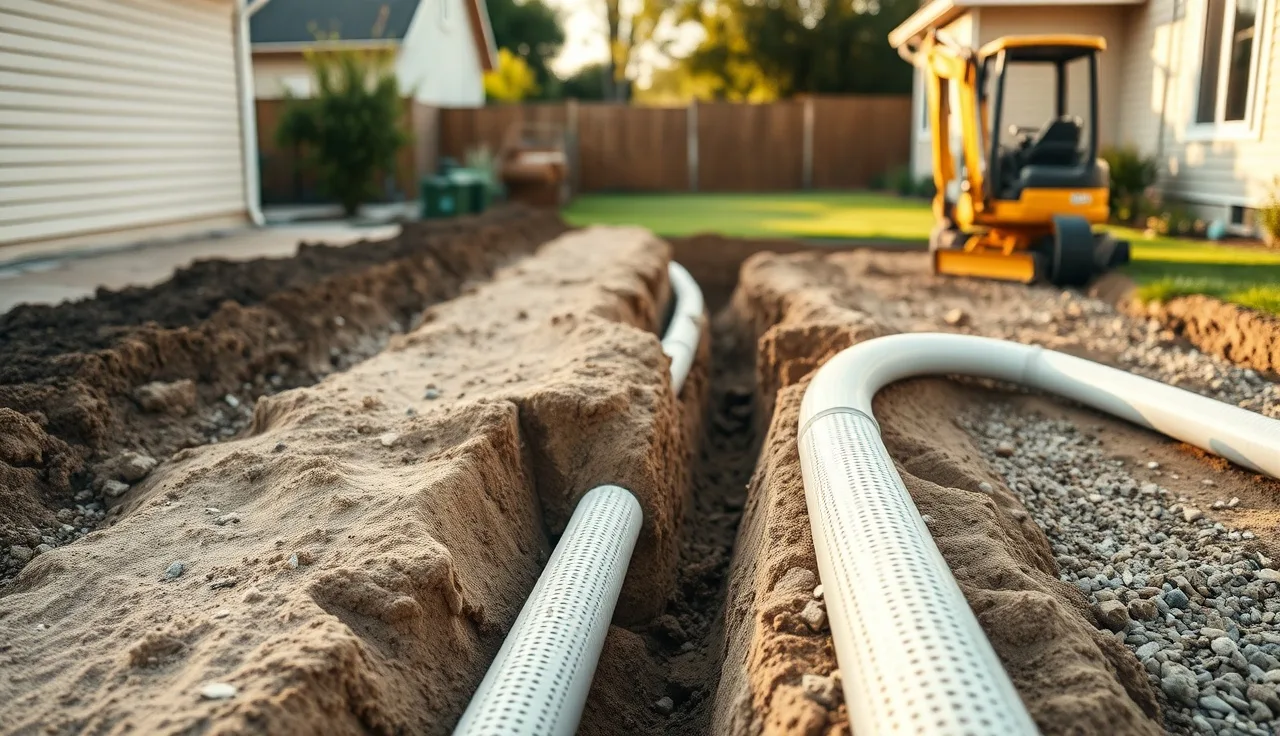
Effluent flows from the tank through a distribution box, then out into a network of perforated pipes laid in gravel-filled trenches. The liquid seeps down through the gravel and into the native soil beneath. A field that's working right is silent and invisible: no odors, no standing water, no lush green stripes across the lawn.
The EPA's SepticSmart program describes the drain field as the point where "wastewater percolates into the soil, naturally removing harmful bacteria, viruses, and nutrients." [1] That treatment depends entirely on the soil being the right type and the field being sized correctly for the household load.
Most conventional systems use gravity to move effluent from the tank to the field. Pressure-dosed systems use a pump to push effluent out in timed doses, which rests the field between cycles and stretches its life. Both designs rely on the same soil treatment principle.
What steps are involved in installing a leach field?
The process has more steps than most homeowners expect, and you can't skip any of them without risking a permit denial or a failed system.
Site evaluation and perc test. Before any design happens, a licensed soil evaluator or engineer tests your soil's ability to absorb water. The percolation (perc) test measures how fast water drops in a test hole. Some states also require a soil profile evaluation to check for limiting layers like clay, bedrock, or a seasonal high water table. [2] These results decide whether you can have a conventional system at all, and if not, what alternative you need.
Design and permitting. A licensed designer (a sanitarian, civil engineer, or septic contractor, depending on state law) draws up a system based on perc results, soil data, lot size, setback requirements, and bedroom count. You submit that design to your county or state health department for a permit. Review takes anywhere from a few days to six weeks. [3]
Excavation. Once permits clear, a contractor digs the trenches. Conventional trenches typically run 18 to 36 inches deep and 18 to 36 inches wide, with trench bottoms set at the elevation the permit specifies. [4] The contractor also excavates for any distribution box or pump chamber.
Pipe and gravel installation. Perforated PVC pipe goes into the trenches on a bed of clean washed gravel (usually 3/4-inch crushed stone). Gravel surrounds and covers the pipe to a specified depth, often 2 to 12 inches above the pipe crown. A layer of geotextile fabric goes over the gravel to keep soil out of the stone voids.
Backfill and inspection. Trenches get backfilled with native soil and lightly mounded to allow for settling. In most states, a health department inspector has to approve the installation before backfill. [3] Bury the system before inspection and you risk digging it all back up.
Seeding and restoration. Contractors seed or sod the disturbed area. Grass is the best cover for a leach field. Tree roots and hard surfaces like pavement or concrete are not.
The dig-and-install work takes one to three days on a typical residential lot. The full project, perc test to final inspection, commonly runs four to twelve weeks once you count permit time.
How much does it cost to install a leach field?
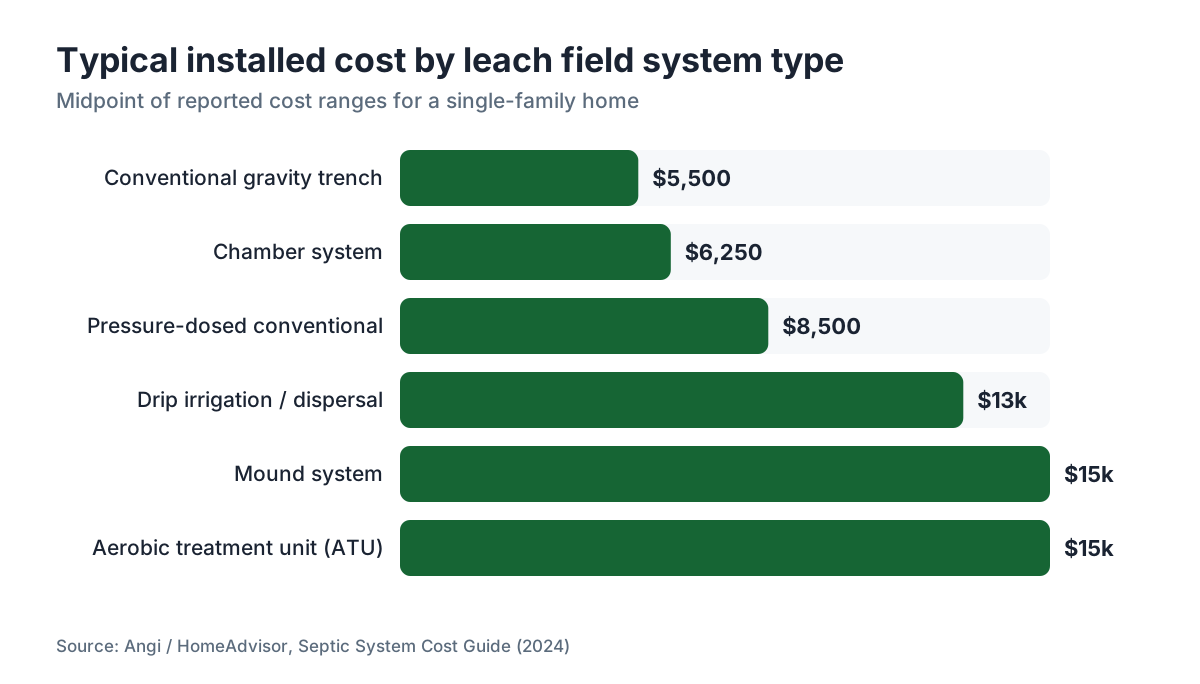
A conventional gravity leach field on a standard single-family lot with good perc results usually costs $3,000 to $8,000 installed. [5] Poor soil, a high water table, or an alternative system pushes that number to $15,000 or higher. Costs swing more than almost any other home system because they ride on soil conditions, system type, lot access, local labor, and permit fees.
That base range covers perc testing ($150 to $700 [5]), permit fees ($100 to $1,500 depending on state and county [3]), excavation, gravel, pipe, and a distribution box.
What drives costs up. Poor soil or a high water table forces you into alternative systems. Mound systems, which build an elevated sand mound when native soil won't perc, cost $10,000 to $20,000 or more because of the fill material and extra excavation. [5] Drip irrigation systems (pressure-dosed drip lines) run $8,000 to $18,000 installed because of the pumps, controls, and finer distribution network. Aerobic treatment units (ATUs) with spray heads can top $15,000 in some markets.
Soil and site factors. Rocky soil or poor equipment access raises excavation costs. Long trench runs on big lots add pipe and gravel. Steep slopes may require engineered designs with retaining features.
Labor market differences. Rural areas in the Midwest and South tend to run cheaper than the Pacific Coast or Northeast, sometimes by a lot. Getting three bids from licensed contractors is the most reliable way to read your local market.
| System type | Typical installed cost range | Best for |
|---|---|---|
| Conventional gravity trench | $3,000 to $8,000 | Good-percing sandy or loamy soil |
| Chamber system (no gravel) | $3,500 to $9,000 | Similar to conventional; no gravel trucked in |
| Pressure-dosed conventional | $5,000 to $12,000 | Marginal soil; rest cycles extend field life |
| Mound system | $10,000 to $20,000+ | High water table, clay soil |
| Drip irrigation / drip dispersal | $8,000 to $18,000 | Limited space, slow-perc soil |
| Aerobic treatment unit (ATU) | $10,000 to $20,000+ | Very slow perc, near water bodies |
If you're replacing the tank at the same time, budget that separately. Our guide to septic tank installation covers what that piece adds to the total.
How much is a new leach field if you're replacing a failed one?
Replacing a failed leach field costs roughly the same as a fresh install, $3,000 to $15,000 depending on system type. Two extra complications can push it higher.
First, you may not have enough usable yard for a replacement field at the required setbacks. Most state codes require the new field to sit in undisturbed soil that has never held a previous drain field, at setback distances from wells, property lines, buildings, and surface water. [3] On a tight lot, that can force an alternative design costing more than the original.
Second, the failed field has to be abandoned properly. Local rules usually require pumping the old system, filling old trenches with clean material, or otherwise decommissioning the failed area so it doesn't cause future problems. That adds pump-out costs and some labor. See our overview of septic system repair for what a full system failure usually involves.
Here's the part people miss. If the field failed because the tank wasn't pumped and solids pushed into the trenches, a new field alone doesn't fix anything. You need a tank you'll actually maintain going forward. Our guide on how often to pump a septic tank explains why neglect is the top cause of early field failure.
What permits and regulations do you need?
No reputable contractor installs a leach field without a permit, and you shouldn't let one try. Every state regulates onsite wastewater systems, and the authority to issue permits almost always sits at the county or local health department. [3]
Permit requirements generally include a completed application, a site plan showing the lot and setbacks, soil evaluation or perc test results, a system design meeting state minimum standards, and sometimes a licensed engineer's or sanitarian's stamp. Many states let only licensed or certified septic contractors pull permits and do installations.
Setback rules are worth understanding before you assume you have a buildable site. Common minimums:
- 50 to 100 feet from a well or drinking water source (varies widely by state) [3]
- 5 to 25 feet from a property line
- 10 to 25 feet from a building foundation
- 25 to 100 feet from a surface water body like a stream or pond
The EPA's SepticSmart resources note that "proper siting, design, installation, and maintenance" are all required for a system to protect public health and water quality. [1] That's exactly why the permit process exists.
Some counties stack local rules on top of state minimums. Check with your local health department before buying land on the assumption you can build a septic system there.
How big does a leach field need to be?
Two things set the size: your household's daily wastewater flow and your soil's absorption rate from the perc test.
Flow is usually estimated by bedroom count. Most state codes use 100 to 150 gallons per bedroom per day as the design flow. [4] A three-bedroom house at 150 gallons per bedroom generates a design flow of 450 gallons per day.
The absorption rate tells the designer how many square feet of trench-bottom area you need to handle that flow. Fast-percing soils (1 minute per inch or faster) need less area. Slow soils (30 to 60 minutes per inch) need much more. Most state codes set a maximum allowable perc rate for conventional systems, commonly 60 minutes per inch. Anything slower requires an alternative design. [9]
A rough result: a three-bedroom house with moderately good soil might need 600 to 900 square feet of trench-bottom absorption area. Turn that into real dimensions and you're looking at maybe four to six trenches, each 50 to 75 feet long and 18 to 24 inches wide. Add the required undisturbed buffer around the trenches and a reserve area for a future replacement field, and the total footprint hits 2,500 to 5,000 square feet or more.
State design manuals spell out the exact math. Virginia's sewage handling and disposal regulations and similar state documents are public and give you a concrete feel for how the calculation runs in your jurisdiction. [4]
What soil conditions disqualify a conventional leach field?
Not every lot can carry a conventional trench system, and a perc test tells you fast whether yours can.
Very slow perc rates, usually above 60 minutes per inch, mean the soil can't take effluent fast enough to handle daily flow in a reasonable trench area. [4] Clay-heavy soils often land here.
A high seasonal water table is often the bigger disqualifier. If groundwater rises within 24 inches (sometimes 18 inches under stricter state rules) of the planned trench bottom at any point in the year, a conventional system can't treat effluent adequately before it reaches groundwater. [2] That's why site evaluators read soil profile indicators of seasonal saturation, like mottled soil colors, instead of trusting the water table on the day they happen to be standing there.
Bedrock at shallow depth limits how deep trenches can go. Some states allow engineered alternatives in these spots. Others restrict development entirely.
A lot that fails conventional criteria doesn't automatically mean no septic system. It means a mound, drip, ATU, or another engineered alternative, plus a designer who knows those systems. The cost climbs, but workable solutions exist for most sites.
How long does a leach field last and what shortens its life?
A well-designed, well-installed field that gets routine maintenance should last 20 to 30 years, sometimes much longer. [6] Some systems built in the 1970s and 1980s are still running fine. Others fail in under ten years.
The number one killer is solids from an under-maintained septic tank. When a tank isn't pumped, solids overflow into the field and clog the soil pores that do the treatment and absorption. Once that biomat gets thick enough to stop absorption, the field is essentially done. Pumping the tank on schedule, typically every three to five years depending on household size and tank volume, is the single most useful thing you can do. [7]
Other things that shorten field life:
- Hydraulic overloading (too much water use for the field size)
- Driving or parking vehicles over the field, which compacts soil and can crush pipes
- Planting trees or shrubs in or near the field (roots invade pipes and gravel)
- Diverting roof drains or sump pumps into the system
- Sending non-biodegradable items or harsh chemicals down the drains
Wet spots, odors, or sewage surfacing over your field? The EPA says call a licensed professional right away instead of waiting. [1] Catching a problem early, like a distribution box failure or a partly clogged line, can sometimes save the field. Waiting until it's fully saturated almost never ends well.
Operators tracking maintenance across many properties can use SepticMind's service software to schedule pump-outs and log inspection records, which heads off the missed pumpings that lead to field failures.
Can you install a leach field yourself, or do you need a licensed contractor?
In most states, the honest answer is no, you can't legally do this yourself.
State licensing laws for septic installers vary, but the majority require a licensed or certified contractor to do the installation, and some require a licensed engineer or sanitarian to design the system. [3] The permit won't go to an unlicensed individual in those states, and unpermitted work creates real liability when you sell.
A handful of states let owner-builders install their own systems on their own property with a permit. Even those states require licensed professionals for the design and inspection. You'd still need a perc test, a permitted design, a health department inspection, and the right equipment (a backhoe that can hold the correct depth and width consistently).
Here's the practical part. Excavating a field wrong (wrong depth, wrong grade, a trench bottom compacted by heavy equipment) can ruin the system before it carries a drop of effluent. Contractors who do this weekly know the tolerances cold. First-timers with a rented excavator usually don't.
Want to control costs? Save on the design side (get multiple quotes from engineers), on material sourcing (ask if you can supply your own gravel), and on restoration (seed the lawn yourself after the crew leaves). Not on the excavation and installation.
What are the signs that a leach field is failing?
Field failure is usually obvious once it's serious, but earlier signals are worth knowing.
The clearest sign is effluent surfacing above the field: soggy ground, standing water, or a wet area that stays wet in dry weather, right over the drain field. That's a health hazard, more than a nuisance. The EPA classifies surfacing sewage as a public health concern requiring immediate action. [1]
Slower signs:
- Slow drains throughout the house when the tank isn't due for pumping
- Gurgling from fixtures or toilets
- Odors inside the house or outside near the field
- Unusually lush, green grass over the field during dry spells (effluent is fertilizing it)
- Sewage backing up into the lowest fixtures in the house
Seeing any of these? Start with a septic tank inspection to find out whether the tank is the problem (full, or baffles failed) or the field itself. Tank problems cost far less to fix than field problems. Our guides on septic tank repair and full septic system repair walk through how those diagnoses and repairs typically go.
One thing to know: a failed leach field cannot be brought back by additives, enzymes, or bacteria treatments off the hardware store shelf. Once the biomat has sealed the soil pores, the field needs replacement or a long rest with an alternative field carrying the load.
How do you find and hire a qualified leach field installer?
Start with your county or state health department website. Most publish a list of licensed septic installers and designers for your area. [3] That list alone filters out unlicensed operators.
Get at least three bids on the same scope: perc test (if not already done), design, permit application, excavation, materials, installation, and inspection coordination. If one bid comes in far below the others, ask what's different. Sometimes it's a genuinely efficient contractor. More often, something is missing from the scope.
Ask each bidder:
- Are you licensed and insured in this state for septic installation?
- Will you pull the permit, or do I?
- What happens if the field location has to shift after excavation starts?
- Who handles the final inspection, and what's the process if it fails?
- Do you provide a warranty, and what does it cover?
Check for complaints with your state contractor licensing board. A few reference-checkable jobs in their portfolio doesn't hurt either.
One thing to avoid: contractors who float skipping the permit to save time or money. It saves neither. An unpermitted system creates legal headaches at resale and leaves you zero recourse if the install goes wrong.
What happens after the leach field is installed?
The stretch right after installation matters more than most homeowners expect.
The soil around new trenches is disturbed and still settling. Don't drive vehicles or heavy equipment over the field for at least six months. Keep foot traffic light. The grass or seed needs to establish undisturbed.
Load new systems gradually if you can. A household of four using the full water load from day one is fine, but if you have any flexibility, a gentle start gives the bacterial community in the tank and field time to build.
Get a copy of the as-built drawing from your contractor. That's the diagram showing exactly where the distribution box, pipes, and field sit. Keep it with your property records. When you sell, this document is often required at inspection. It also saves you serious grief if you ever dig near the system for landscaping, fence posts, or a utility repair.
Schedule your first tank pump-out. For a new system, many contractors suggest pumping after the first year or two to confirm normal solids accumulation, then settling into a regular schedule. Our guide on septic tank pumping explains what that service involves and what to ask your pumper.
Operators managing multiple residential accounts can use SepticMind's platform to log installation records, set follow-up service reminders, and track permit and inspection documents across the whole customer base.
Frequently asked questions
How much does it cost to install a new leach field on a typical residential lot?
A conventional gravity leach field on a single-family lot with good soil typically costs $3,000 to $8,000 installed, including perc testing, permitting, excavation, gravel, pipe, and a distribution box. Alternative systems like mound or drip fields run $10,000 to $20,000 or more. Local labor markets and soil conditions account for most of the variation.
How long does it take to install a leach field from start to finish?
The excavation and installation work takes one to three days on a standard residential lot. The full timeline, from perc test through permit approval to final inspection, commonly runs four to twelve weeks. Permit review is the biggest variable. Some counties turn around approvals in a week, others take six weeks or longer.
Do you need a permit to install a leach field?
Yes, in every U.S. state. Permits are issued by county or local health departments and require soil evaluation results, a system design, and often a licensed contractor. Installing without a permit is illegal in most jurisdictions, creates significant liability at property sale, and leaves you no recourse if the installation is done wrong.
Can a leach field be repaired, or does it always need full replacement?
Sometimes partial repairs work: a crushed distribution pipe, a failed distribution box, or a single saturated trench can occasionally be fixed or rested. But if the soil pores throughout the field are sealed by a biomat from years of inadequate maintenance, replacement is the only real option. A licensed inspector can tell you which situation you're in before you commit.
What is a perc test and do you always need one?
A percolation test measures how fast water drains into your native soil. It's required before system design in almost all states because the result decides whether a conventional field is even feasible and what size it needs to be. Some states also require a soil profile evaluation alongside the perc test. You cannot design or permit a system without this data.
How many linear feet of pipe does a typical leach field have?
A three-bedroom house with moderate soil typically needs 300 to 600 linear feet of perforated pipe laid in trenches. The exact number comes from the required trench-bottom absorption area and trench width, using perc test results and state design standards. More bedrooms, larger households, or slower-percing soil all push that number higher.
Can you build a deck, shed, or driveway over a leach field?
No. Impermeable surfaces like concrete or pavement block the oxygen exchange the field needs and prevent evapotranspiration, both of which cut its treatment capacity. Heavy structures compact the soil and can crush pipes. Most state codes prohibit any permanent structure over a leach field, and your permit documents will spell out that restriction explicitly.
What is the difference between a leach field and a mound system?
A conventional leach field uses native soil in trenches dug below grade. A mound system builds an elevated sand bed above the existing ground, then distributes effluent into that imported sand media. Mound systems get used when native soil won't perc fast enough, when the water table is too high, or when there isn't enough separation to bedrock or groundwater.
How often should you pump your septic tank to protect the leach field?
The EPA's SepticSmart program recommends inspecting every three years and pumping every three to five years for a typical household. Larger families or smaller tanks may need more frequent service. Failing to pump on schedule is the leading cause of premature leach field failure, because solids overflow into the field and permanently clog the soil pores.
What trees or plants can you put near a leach field?
Grass is the ideal cover: shallow roots, good evapotranspiration, no structural damage. Avoid any woody plants, trees, or shrubs within 10 to 20 feet of field trenches. Tree roots actively chase the moisture and nutrients in leach field soil and will invade perforated pipes and gravel beds, causing blockages and structural damage over time.
Does homeowners insurance cover leach field replacement?
Standard homeowners policies typically exclude septic failures caused by wear, neglect, or gradual deterioration, which covers most leach field failures. Some insurers offer septic system riders or service line endorsements with limited coverage. Read your policy carefully and ask your agent specifically about underground system coverage before assuming you have protection.
How much reserve area do you need to leave for a replacement leach field?
Most state codes require you to identify and protect a replacement field area equal to 50 to 100 percent of the primary field size on the same lot. That area has to stay undisturbed: no structures, no pavement, no septic components. This is one of the main reasons small or narrow lots sometimes can't support any septic system at all.
Sources
- U.S. EPA, SepticSmart: Protect Your Investment: Effluent percolates into soil, naturally removing harmful bacteria, viruses, and nutrients; surfacing sewage requires immediate action; proper siting, design, installation, and maintenance are all required.
- U.S. EPA, Onsite Wastewater Treatment Systems Manual (EPA/625/R-00/008): Seasonal high water table within 18 to 24 inches of trench bottom disqualifies conventional trench systems; soil profile evaluation required to assess limiting layers.
- U.S. EPA, Septic System Regulations and Standards: Permits issued at county or local health department level; licensed contractors required in most states; setback requirements from wells, property lines, and water bodies; permit review timelines vary by jurisdiction.
- Virginia Department of Health, Sewage Handling and Disposal Regulations (12VAC5-610): Design flow estimated at up to 150 gallons per bedroom per day; trench dimensions and maximum perc rates for conventional systems specified in state design standards.
- HomeAdvisor / Angi, Septic System and Drain Field Cost Guide: Conventional leach field installation costs $3,000, $8,000; perc testing costs $150, $700; mound systems cost $10,000, $20,000+; drip systems cost $8,000, $18,000.
- U.S. EPA, SepticSmart: How Your Septic System Works: A properly designed, installed, and maintained septic system can last for decades; drain field longevity depends on soil suitability and routine maintenance.
- U.S. EPA, SepticSmart: Maintenance Tips: EPA recommends septic system inspection every three years and tank pumping every three to five years; failure to pump is the leading cause of drain field failure.
- National Environmental Services Center (NESC), West Virginia University: Percolation test measures rate of water absorption; results determine field sizing; most state codes set maximum allowable perc rate of 60 minutes per inch for conventional systems.
- Texas Commission on Environmental Quality (TCEQ), On-Site Sewage Facility Program: State licensing required for septic system installation; owner-builder permits available in limited circumstances; reserve field area must be identified and protected on all permitted lots.
Last updated 2026-07-09