How to find your septic system location (tank and drain field)
By the SepticMind Editorial Team

TL;DR
- Your septic tank usually sits 10 to 25 feet from the house foundation, along the sewer line leaving the building.
- The drain field runs further out, often 20 to 100 feet past the tank.
- Start with your county health department records, then trace the sewer pipe, then probe or use a metal detector.
- Most tanks are buried 6 to 24 inches deep.
Why does knowing your septic system location matter?
If you don't know where your tank and drain field are, you can't pump the tank without expensive digging, you risk driving over the field and crushing the pipes, and any contractor doing landscaping or construction near the house could rupture a distribution line without knowing it.
The consequences run from annoying to catastrophic. A crushed distribution pipe sends raw sewage pooling in your yard. A vehicle over the tank lid cracks it. A fence post driven through the drain field takes out a lateral in minutes.
Location also matters at septic tank inspection time, when you sell the house, and before any deck or addition project. Many mortgage lenders now require a septic inspection before closing, and the inspector needs to know where to go.
Here's the good news. In most counties, your septic permit and as-built drawing are public record. The answer may be sitting in a county file right now.
Where is the septic tank typically located relative to the house?
Most tanks sit 10 to 25 feet from the foundation, directly along the path of the main sewer line leaving the house [1]. That line almost always exits through the lowest level of the building (basement, crawl space, or slab) and runs in a straight line to the tank inlet.
The EPA's SepticSmart program notes that tanks are generally buried between 6 inches and 4 feet deep, with most residential tanks landing in the 1 to 2 foot range [1]. Tanks installed before the 1980s sometimes sit deeper because older codes had different cover requirements.
A few patterns worth knowing:
- The sewer cleanout (a capped pipe sticking up near the foundation) almost always points toward the tank. Follow that bearing.
- Tanks are rarely under a driveway, but they can be, especially on narrow lots where the installer had no other choice.
- On sloped lots, the tank tends to be downhill from the house because gravity is doing the work.
- Tanks almost never sit under a deck or patio that existed at installation time, but additions built after the system was permitted sometimes end up over them.
The drain field (also called the leach field) starts 5 to 10 feet past the tank outlet in most configurations and fans out from there. Total field dimensions depend on soil perc rate and household size, but a standard 3-bedroom home on average soil might have 400 to 600 linear feet of perforated pipe [2].
One caution. "Typical" varies a lot by region, lot shape, and installation era. Trust your records more than any rule of thumb.
How do you find your septic tank if you have no records?
Six methods work, roughly in order of ease and cost.
1. Check your county health department or environmental department records. Most counties that permit septic systems keep the as-built drawing (sometimes called a plot plan or installation sketch) on file. Call the environmental health office with your parcel number. Many counties have digitized these records and can email you a scan the same day. This is always your first move [3].
2. Look for paperwork in the house. Previous owners, your home inspector, or your real estate file may hold a copy of the permit, the pumping record, or the as-built. Pumping companies sometimes leave a sticker on the tank riser or inside a utility closet showing the date and location.
3. Trace the sewer line from inside the house. Find where the main drain exits the building (look in the basement or crawl space for a 4-inch pipe heading toward an exterior wall). Note the direction and go outside. The tank inlet is along that bearing, typically 10 to 25 feet out [1]. Mark the spot and probe from there.
4. Use a soil probe. A soil probe or a 3/8-inch steel rod does the job. Push it into the ground every foot or two along your estimated path. Concrete tanks and lids give back a distinct hard, flat surface at consistent depth, different from soil or rock. Plastic tanks flex slightly. You're feeling for a change in resistance.
5. Use a metal detector or flush a radio transmitter. If the tank has a metal lid or metal access risers, a decent metal detector finds it. For plastic tanks with no metal, a plumber can flush a small radio transmitter (a "sonde") down the toilet, and you walk the yard with a compatible locator wand to track it to the tank inlet.
6. Hire a locating service. Ground-penetrating radar (GPR) is the most reliable non-invasive method. A technician walks a grid pattern and the radar returns a cross-section image showing voids (the tank) and dense soil disturbance (old excavation for the drain field). Cost runs roughly $200 to $600 depending on lot size and equipment [4].
Once you find the tank, mark it permanently. A 4-inch riser brought up to grade (cost: $100 to $300) means you never search again, and septic tank pumping visits go faster and cheaper.
What setback distances are required for septic systems?
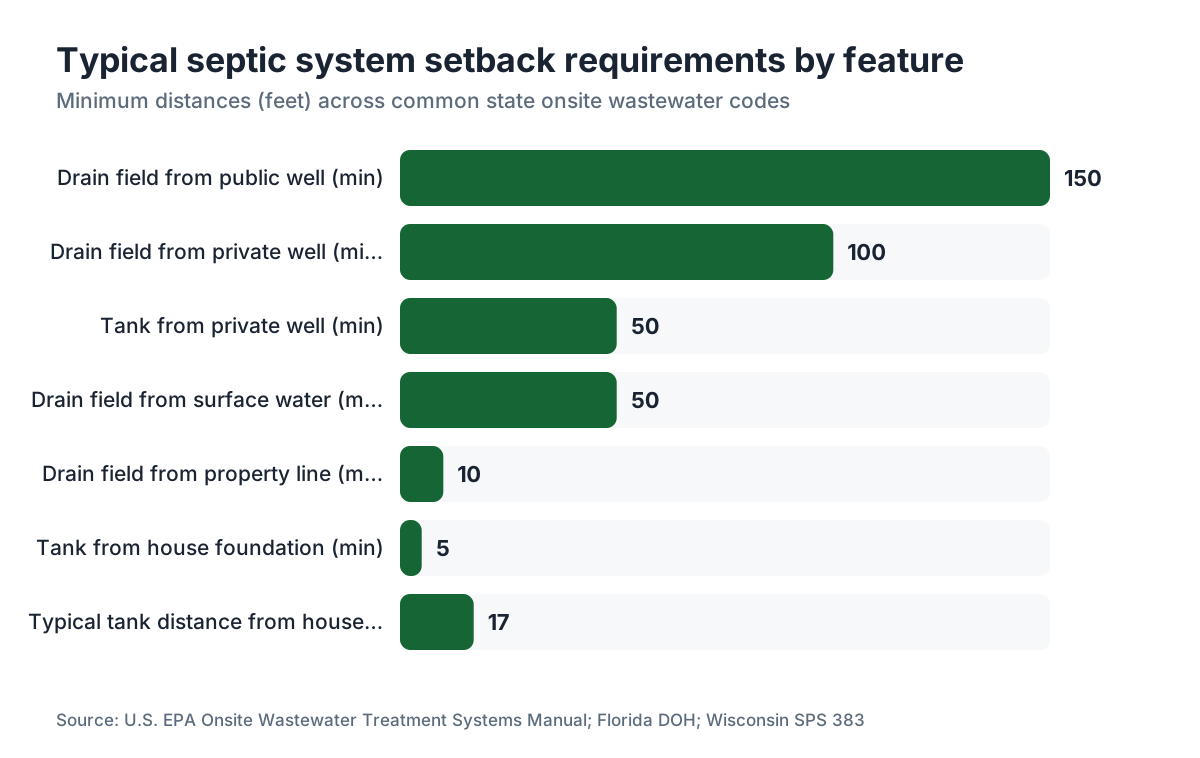
Setbacks are minimum distances the system has to keep from various features. They protect drinking water, prevent surface breakout, and stop the system from undermining structures. Every state writes its own rules, and counties often stack stricter requirements on top of state minimums [5].
The table below shows common setback ranges from state onsite wastewater codes. These are ranges across states, not universal minimums. Always check your specific state and county code.
| Feature | Typical setback range (tank) | Typical setback range (drain field) |
|---|---|---|
| Private well or drinking water source | 50 to 100 ft | 100 to 150 ft |
| Public water supply well | 100 to 200 ft | 150 to 200 ft |
| Property line | 5 to 10 ft | 10 to 25 ft |
| House foundation | 5 to 10 ft | 20 to 50 ft |
| Swimming pool | 15 to 25 ft | 25 to 50 ft |
| Surface water (streams, ponds, lakes) | 50 to 75 ft | 50 to 100 ft |
| Wetlands | 50 to 100 ft | 100 ft or more |
| Trees (large root systems) | 10 ft | 20 to 30 ft |
These ranges are compiled from state onsite wastewater regulations including those of Florida, Wisconsin, and others [5][6][13]. Your state may be tighter. California's Title 22 and local county ordinances, for example, frequently require 100-foot setbacks from wells for the drain field [7].
The EPA's guidance on system placement states that "the location of the system on the lot is determined by the results of soil tests, local setback requirements, and the proximity of water sources" [1]. Read that plainly: you can't just pick a convenient spot. All three constraints have to be satisfied at once.
Buying land and planning a new system? Have a site evaluator run percolation and soil morphology tests before you close. A failed perc test or impossible setback geometry has killed plenty of building permits on land that looked fine from the road.
How do you find the drain field location?
The drain field is harder to find than the tank because there's no single object to hit. It's a network of perforated pipes in gravel trenches, usually 18 to 36 inches wide and 3 to 6 feet deep, spread across a rectangular or irregular area.
Start from the tank outlet (the side opposite the inlet pipe). The distribution box, or D-box, typically sits 5 to 20 feet past the outlet. From the D-box, laterals fan out in parallel lines, usually 6 to 10 feet apart on center.
Signs of the field from above ground:
- Greener, lusher grass in dry weather, because the field adds moisture and nutrients just below the root zone.
- Frost-free strips in early winter in cold climates (the microbial activity throws off a little heat).
- Subtle linear depressions or raised strips where the field settled unevenly.
- No large trees, since most installers kept trees off the field.
GPR works well here too, because the gravel trench and pipe show up against undisturbed soil. If you're stuck, a licensed septic inspector or pumper can often locate the field from the tank position, the lot dimensions, and plain experience with systems of that era in your county.
You'll also find the field on your county as-built drawing if one exists. That document shows the tank location, D-box location, and lateral layout to scale. Spend the hour to track it down before you dig anything.
What records tell you where the septic system is?
Three types of records earn their keep.
County permit and as-built drawing. When the system went in, the installer submitted a plot plan showing distances from the house and property lines. Most counties keep these indefinitely. Call your county environmental health, planning, or building department and ask for the septic as-built or installation record for your parcel. Have your parcel number ready. Some states, including Florida, make these searchable online [3][6].
Pumping records. Pumping companies are required in many states to log each service call, including the tank location relative to the property. If you know who pumped it last, call them. Some outfits keep a GPS coordinate for return visits.
Home inspection or real estate disclosure. In many states sellers must disclose the location and condition of the septic system. Your closing file may hold a sketch or a prior inspection report.
If all three come up empty, that tells you something. The system is either very old (pre-permit era, which in many rural counties means before the 1970s) or was installed without a permit. Both cases warrant a professional inspection before you do any work near the system. A licensed inspector can usually locate the system and produce a sketch for around $200 to $400 [4].
SepticMind's operator tools let pumping and inspection companies log GPS tank coordinates and as-built sketches in a shareable record homeowners can access. If your service provider keeps that kind of digital record, the information may already be in your account.
Can you build over or near a septic system?
Short answer: not over the drain field, and only with permits near the tank.
Building any permanent structure over a drain field is almost universally prohibited. The weight compacts the soil and crushes pipes, the impermeable surface blocks the oxygen exchange the field needs to treat effluent, and access for repairs becomes impossible [1][5]. A concrete patio or deck over the field can turn a working system into a failing one within a few years.
Over the tank, the rules loosen a little. Most codes allow a removable deck or light structure over the tank as long as the access lids stay reachable. A permanent concrete slab is typically off-limits because it blocks inspection and pumping. Some homeowners pour a patio over the tank lid and set a square hatch into it; a few codes allow this with an approved riser, but check locally before you pour a single bag of concrete.
Driveways over tanks are common, especially on older properties. If yours has one, make sure the lid is rated for vehicle loads (traffic-rated lids and risers are a real product category) or that the tank has enough cover depth to carry the load without cracking.
Any addition, shed, pool, or fence inside the setback zones from the previous section needs a permit review in most jurisdictions. The permitting office checks whether the proposed structure conflicts with the recorded septic location. One more reason to have your as-built on file.
For the cost of moving or replacing a system that's been built over, see our guide to cost to install septic system.
How deep is a septic tank buried?
Most residential septic tanks sit with their tops 6 inches to 4 feet below grade [1]. The most common installation puts the lid 12 to 18 inches underground. That's deep enough to beat frost across most of the country, shallow enough to dig up without heavy effort.
Depth changes with:
- Climate. In Minnesota, Wisconsin, or Maine, tanks may sit 4 to 5 feet deep to stay below the frost line [8]. In Florida or Texas, 6 to 12 inches of cover is common because freezing isn't a concern.
- Lot topography. On a steeply sloped lot, the tank may be shallow on the uphill side and several feet deep on the downhill side, depending on how the installer leveled the excavation.
- Age and era. Pre-1980s systems were sometimes set deeper, and some old cesspools or seepage pits run 8 to 15 feet deep.
- Cover requirements. Some codes want a minimum of 6 inches of cover, others 12 inches. A few jurisdictions allow 3-inch cover if a traffic-rated riser is used.
When probing, start shallow (6 inches) and work down. If you hit solid resistance at 18 to 24 inches along the expected bearing from the sewer cleanout, that's a strong candidate. Confirm by probing the corners to check for a flat rectangular surface consistent with a tank rather than a rock.
What are the rules for septic system location on your property?
Placement rules come from three levels: federal guidance, state code, and local ordinance.
At the federal level, the EPA sets no binding location rules for most residential septic systems. The Safe Drinking Water Act and the Clean Water Act give the EPA authority over larger systems and public water supplies, but individual household systems fall to the states [9]. The EPA's SepticSmart guidelines are educational, not regulatory.
State code is the binding layer for most homeowners. Every state with significant rural or suburban development runs an onsite wastewater treatment code that spells out minimum lot size, soil requirements, setback distances, and system design. The National Onsite Wastewater Recycling Association (NOWRA) keeps a state-by-state code index, though checking your specific state's current code directly is always the right move [10].
County and municipal ordinances add another layer. Some counties demand larger setbacks than the state minimum in sensitive watershed areas. Some require engineered designs when lots fall under a certain size or when soil tests show slow percolation.
Here's the practical takeaway. Planning a new system or any modification? Call your county environmental health office first. They'll tell you exactly what the local requirements are and whether your lot is even eligible for a conventional system. Some small or poor-draining lots need alternative systems (mound systems, aerobic treatment units, drip irrigation systems) with different space footprints entirely [5][11].
For new construction cost implications, our guide to cost to put in a septic tank covers what drives the price up or down.
What happens if the septic system was installed in the wrong location?
A mislocated system, meaning one placed too close to a well, a property line, or surface water, creates legal liability, health risk, and expensive remediation.
The most common scenario in older homes: the system predates current setback requirements, or went in without a permit, or the original sketch is long gone. Many of these systems run fine for decades. Trouble shows up when you try to sell the house (a title search or buyer inspection surfaces the issue), when the system fails and repair needs a permit, or when a neighbor's well tests positive for nitrates or fecal coliform.
When a system installed in violation of setbacks gets discovered, most states require remediation before the property can transfer [6]. That can mean relocating the drain field, installing a nitrogen-reducing system, or in the worst cases, connecting to municipal sewer if it's available.
Less dramatic but more common: a system that's technically legal but poorly sited because the installer picked the easiest spot instead of the best one. A field too close to a slope breakout point. A tank hidden under a later-built addition. These aren't violations, but they cause maintenance headaches for years.
If you suspect your system sits too close to your well or a neighbor's well, a water test (around $30 to $100 for a basic coliform and nitrate panel) is the fastest way to get information [12]. University extension services in most states publish guidance on well water testing.
Once you know what you're facing, a septic system repair or redesign conversation with a licensed engineer is the right next step.
How do you mark and protect the septic system location permanently?
Finding your system once isn't enough. You need a permanent record and permanent physical markers.
The best record is a scaled sketch showing the tank inlet and outlet with measurements from two fixed reference points (house corners, property pins), the D-box location, and the drain field lateral layout. Keep a copy inside the house and file a copy with your county if they accept voluntary updates to the as-built record.
For physical markers on the ground:
- Install 4-inch risers on the tank access ports so the lids come to within a few inches of grade. Mark the lid locations with a landscape stake or a discreet flush marker. This alone saves $50 to $150 per pump-out visit because the pumper skips the digging.
- Mark the drain field corners with non-invasive flags or durable ground stakes. Some homeowners plant a specific low ground cover on the field to set it apart visually without adding root mass.
- Keep a GPS coordinate in your phone. Simple. Works.
Tell your family where the system is. A new driver, a contractor hauling materials, or a landscaper bringing a skid steer won't know to stay off that part of the yard unless someone says so.
Regular septic tank pump out visits (the EPA recommends every 3 to 5 years for most households [1]) also keep your pumping company's records current, which gives you a backup location record in their system. Read our guide on how often to pump septic tank for the factors that set your specific schedule.
If the system needs maintenance once you've located it, septic tank cleaning covers what the service actually involves.
Frequently asked questions
How do I find my septic tank if there are no records?
Start by tracing the 4-inch sewer pipe from where it exits the foundation. Walk that bearing 10 to 25 feet and probe the soil with a steel rod for a hard, flat surface at 6 to 24 inches deep. A metal detector helps if the lid has metal parts. If that fails, a plumber can flush a radio transmitter down the toilet and you walk the yard with a locator wand to track it.
How far is the septic tank from the house?
Most residential tanks sit 10 to 25 feet from the foundation, directly along the sewer line leaving the building. Older systems on large rural lots can be 50 feet away. Minimum setback from the foundation is 5 to 10 feet in most state codes. The exact distance depends on the lot layout, setback requirements, and where the installer found suitable soil.
Can I drive over my septic tank or drain field?
Driving over the drain field risks crushing distribution pipes and compacting the soil the field depends on. It's generally not allowed and causes real damage. Driving over the tank is possible if the lid is traffic-rated and the burial depth is adequate, but most residential lids aren't rated for vehicle loads. Check your lid type and cover depth before you allow it.
How deep is a septic tank usually buried?
Most tanks have their top 6 inches to 2 feet below grade, with 12 to 18 inches being most common in temperate climates. In cold-climate states like Minnesota or Wisconsin, tanks can sit 4 to 5 feet deep to stay below the frost line. In warm states like Florida, 6 to 12 inches of cover is common. Probe slowly and start shallow when searching.
What are the setback rules for septic systems near wells?
Most state codes require 50 to 100 feet between a private drinking water well and the septic tank, and 100 to 150 feet between the well and the drain field. Some states and counties require 200 feet in sensitive watersheds. Check your specific state onsite wastewater code, because these rules vary a lot. California, for example, often requires 100 feet to the drain field under Title 22.
How do I find the drain field location on my property?
Start at the tank outlet, then look for the distribution box 5 to 20 feet further out. Laterals fan from the D-box in parallel lines, usually 6 to 10 feet apart. From above, the field may show greener grass in dry weather or slight linear depressions. Ground-penetrating radar is the most reliable non-invasive method. Your county as-built drawing, if available, shows the exact layout.
Can I build a deck or shed over the septic system?
Not over the drain field. Any permanent structure over the field compacts soil, blocks oxygen exchange, and makes repairs impossible. Over the tank, a removable deck that keeps the lids reachable is allowed in many jurisdictions, but a permanent concrete slab over the lids is almost universally prohibited. Always check your local code before building anything near the system.
Who do I contact to get my septic system as-built records?
Call your county environmental health, public health, or building department with your parcel number. Most counties that require permits keep the installation sketch indefinitely. Some states have digitized these records and can email a scan the same day. If the county has no record, try your home inspector's report, your real estate closing file, or the pumping company that last serviced the system.
What is the minimum lot size required for a septic system?
Minimum lot sizes vary widely by state and county. Many states set a baseline of 0.5 to 1 acre for a conventional gravity system, but the real constraint is whether the soil passes a percolation test and whether all required setbacks fit on the lot. A lot that's technically large enough may still fail to hold a system if the setback geometry doesn't work out.
How do I protect my drain field from damage?
Keep vehicles and heavy equipment off it. Don't plant trees or shrubs on it, because roots invade lateral pipes. Don't cover it with impermeable surfaces. Route gutter downspouts and sump pump discharge away from it so it doesn't get saturated. Spread your water use across the week instead of doing all the laundry in one day. And pump the tank on schedule so solids don't overflow into the field.
What does a septic system plot plan look like, and where do I get one?
A plot plan is a simple sketch drawn to scale showing your house, property lines, tank location with measurements from two reference points, distribution box, and drain field lateral layout. The county environmental health office should have one on file from the original installation permit. If not, a licensed septic inspector can produce one after physically locating the system for about $200 to $400.
Does the septic system location affect my home's value?
Indirectly, yes. A system that's well-documented, accessible, properly set back from the well, and sited with room for a repair or expansion area adds value. A system buried under an addition, too close to a well, or with no room for a replacement field is a liability. Buyers' home inspectors flag these issues, and lenders sometimes require remediation before closing.
How do I know if my septic system is too close to my neighbor's well?
Get a copy of your septic as-built from the county and your neighbor's well permit (also usually a county environmental health record). Measure the distance between the drain field boundary and the well. If it falls under your state's required setback, you have a potential compliance issue. A water quality test of the well for nitrates and coliform bacteria gives direct evidence of whether contamination is happening.
What tools do professionals use to locate a septic system?
The common tools are soil probes (steel rods for manual probing), electronic pipe locators, radio sonde transmitters flushed through the drain to track pipe runs, and ground-penetrating radar for non-invasive imaging of buried voids and disturbed soil. GPS receivers record coordinates once the system is found. Most professional locates take one to three hours and cost $150 to $600 depending on method and lot size.
Sources
- U.S. EPA, SepticSmart: Homeowner's Guide to Septic Systems: Tanks are generally buried 6 inches to 4 feet deep; the location of the system is determined by soil tests, local setback requirements, and proximity of water sources; pumping every 3 to 5 years recommended.
- Penn State Extension, Septic System Sizing and Design: A standard 3-bedroom home on average soil typically requires 400 to 600 linear feet of perforated pipe in the drain field.
- University of Minnesota Extension, Septic System Basics for Homeowners: Ground-penetrating radar and professional locating services typically cost $200 to $600; professional inspection to locate and sketch an unknown system runs approximately $200 to $400.
- U.S. EPA, Onsite Wastewater Treatment Systems Manual (EPA/625/R-00/008): State onsite wastewater codes specify minimum setbacks from wells, property lines, foundations, and surface water; building permanent structures over drain fields is prohibited because it prevents oxygen exchange and repair access.
- Florida Department of Health, Onsite Sewage Program: Florida requires setbacks and retains as-built installation records; systems found in violation of setbacks must be remediated before property transfer in many cases.
- California State Water Resources Control Board: California's Title 22 and local county ordinances frequently require 100-foot setbacks between septic drain fields and drinking water wells.
- University of Minnesota Extension, Cold-Climate Septic Systems: In cold-climate states such as Minnesota and Wisconsin, septic tanks may be buried 4 to 5 feet deep to remain below the frost line.
- U.S. EPA, Safe Drinking Water Act Overview: The EPA does not set binding location rules for most individual household septic systems; regulation is delegated to states under the Safe Drinking Water Act and Clean Water Act framework.
- National Onsite Wastewater Recycling Association (NOWRA), State Regulatory Codes Index: NOWRA maintains a state-by-state index of onsite wastewater treatment codes for verifying setback and design requirements by jurisdiction.
- U.S. EPA, Types of Septic Systems: Small or poor-draining lots may require alternative systems such as mound systems, aerobic treatment units, or drip irrigation systems with different space footprints.
- Penn State Extension, Testing Your Water: A Guide for Private Water System Owners: Basic coliform and nitrate water testing for private wells costs approximately $30 to $100 and is the fastest way to detect septic-related contamination.
- Wisconsin Department of Safety and Professional Services, Private Sewage System Code (SPS 383): Wisconsin state code specifies setback distances for septic tanks and drain fields from wells, surface water, and property lines, and requires county retention of as-built records.
Last updated 2026-07-09