Septic system filter: what it does, when to clean it, and what it costs
By the SepticMind Editorial Team
TL;DR
- A septic effluent filter sits in the outlet baffle of your tank and stops suspended solids from reaching your drain field.
- Skip it and those solids can wreck a leach field that costs $5,000 to $20,000 to replace.
- Clean the filter every 1 to 3 years, usually when the tank gets pumped.
- The filter itself costs $20 to $200.
What is a septic system filter and what does it do?
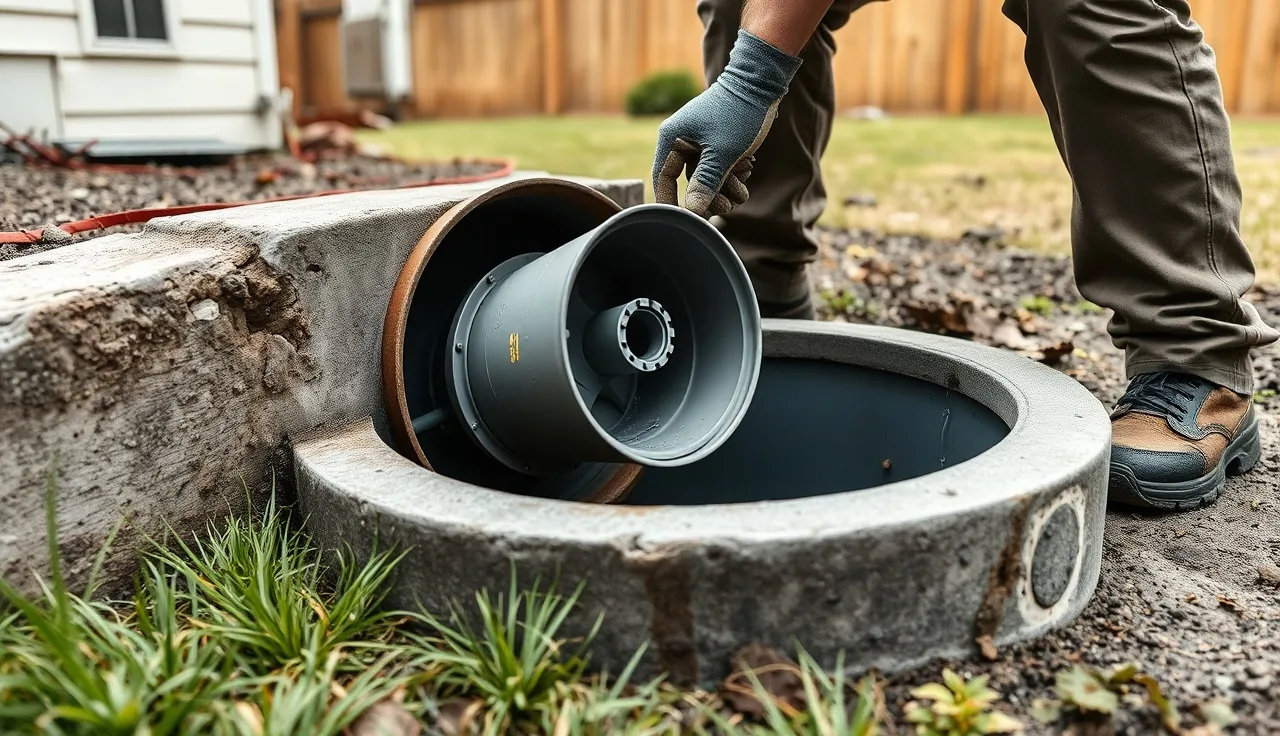
An effluent filter is a cartridge that fits inside the outlet baffle of your septic tank. Its one job is to stop floating solids and suspended particles from leaving the tank with the liquid effluent headed for your drain field. It is the last line of defense in front of the most expensive part of your system.
Inside the tank, waste separates into three layers: a scum layer floating on top, a clear-ish middle zone, and a sludge layer on the bottom. The outlet tee draws from that middle zone. But the middle zone is never perfectly clear. Fine particles, toilet paper fibers, and grease globules drift into it constantly. With no filter, all of that leaves the tank freely.
Effluent filters became standard in most new construction across the United States in the mid-1990s. The EPA's SepticSmart program lists effluent filters among the protective components homeowners should maintain. [1] Many state onsite wastewater codes now require them on new and replacement systems, including California (Title 22 and county health codes), North Carolina (15A NCAC 18A .1900 series), and Florida (64E-6, F.A.C.). [2]
Here is what the filter does not do. It does not treat the water. It does not replace your tank or your drain field. It keeps solids where they belong, in the tank, until a pumper hauls them off. That distinction matters, because plenty of marketing blurs the line between "filtration" and "treatment." They are not the same thing.
How does an effluent filter work inside the tank?
Most residential effluent filters are slotted PVC or a mesh screen inside a rigid housing. The slots block particles bigger than roughly 1/16 to 1/32 of an inch (about 1.5 to 3 mm on common models). Effluent has to squeeze through those slots to exit the tank. Anything wider stays behind.
The housing slides into or threads onto the outlet baffle. When a pump truck tech lifts the access riser lid, the filter handle is usually right there at the outlet end. Pull the filter up and the accumulated gunk drops back into the tank instead of washing downstream. That drop is on purpose.
Some premium models carry a built-in alarm float. When solids load the filter fast enough to back up the effluent level, the float trips an alarm at a panel inside the house. That early warning can save you from a sewage backup on the kitchen floor. EPA guidance on septic operation calls out filter alarms as a useful homeowner tool. [1]
A sand filter septic system is a different animal. There, partially treated effluent from the tank runs through a bed of washed sand, usually 24 to 36 inches deep, where biological treatment happens before the water moves to a dispersal area. That sand filter is a treatment unit, not a tank insert. [3] The two can work together: a tank effluent filter protects the inlet of a sand filter system the same way it protects a conventional drain field.
What types of septic effluent filters are there?
The market has settled around a handful of designs, and the differences matter when you buy a replacement.
| Filter Type | Slot/Pore Size | Typical Price | Common Brands |
|---|---|---|---|
| Standard slotted PVC | 1/16 in (1.6 mm) | $20, $60 | Zabel A100, Orenco BF-04 |
| Fine mesh PVC | 1/32 in (0.8 mm) | $50, $100 | Polylok 3008-PL |
| High-capacity (large tanks) | 1/16 in | $80, $150 | Zabel A500, Orenco BF-08 |
| Filter + alarm float combo | 1/16 to 1/32 in | $100, $200 | Polylok 3008-PL-A, Orenco |
| Sand filter bed (system-level) | N/A (media depth) | $3,000, $10,000 installed | Site-built or precast |
Zabel and Polylok are the two brands you will see most often in residential tanks in the U.S. Orenco Systems dominates pressure-dosed and advanced treatment systems. For a standard 1,000-gallon tank serving a three-bedroom home, a Zabel A100 or a Polylok 3008-PL covers you. The filter that came out is your best guide to what goes back in. Measure the housing diameter and the outlet pipe size before you order.
The alarm-float combo is worth the extra $50 to $100 if your filter loads up fast, meaning you run a garbage disposal daily or you have more people in the house than the system was sized for. It is not a luxury. It is cheap insurance against sewage on your floor.
How often should you clean a septic system filter?
It depends on your household load and how fast the filter plugs. The standard advice from state extension services and most manufacturers is to inspect and clean the filter every 1 to 3 years, and the easy way to do that is every time the tank gets pumped. [4]
Most households pump a 1,000-gallon tank every 3 to 5 years, per EPA pumping guidance that accounts for household size and tank volume. [1] A household of four with a 1,000-gallon tank typically pumps every 2.6 to 5 years depending on use. [5] Clean the filter at each pump-out and you stay on a sensible schedule without paying for a separate visit.
Several situations push the filter toward yearly cleaning.
Garbage disposals roughly double how fast solids build up in the tank. Use one daily and you should inspect the filter every year. High-occupancy houses (more people than the system was sized for, common in multi-generational homes) fill filters faster. After an unusual event like a big party or a plumbing backup, check the filter within a few months.
The clearest sign a filter needs attention right now is slow drains all over the house with no obvious plumbing blockage. A fully plugged filter backs up the tank, and that backup shows first in the lowest fixtures. Some homeowners mistake this for drain field failure. Before you spend a dime on septic system repair, pull the filter and clean it. It is a 20-minute fix if that is the cause.
You can also check the filter yourself between pump-outs. Open the access riser over the outlet end of the tank, the one closer to your drain field. Pull the filter handle straight up. If it is coated with a thick grey or brown mat of solids, clean it.
How do you clean a septic system filter yourself?
Cleaning the filter is one of the few septic tasks most homeowners can handle alone, as long as you have a riser with an accessible lid at the outlet end of the tank.
What you need: a garden hose with good pressure, rubber gloves (heavy nitrile or chemical-resistant), eye protection, a bucket, and maybe a stiff-bristle brush.
Step one: Find the outlet access riser. It is usually the riser closest to your field line or your distribution box. If you have two risers, one sits over each end of the tank, and the outlet is the one farther from the house in most installations.
Step two: Open the lid carefully and spot the filter handle. Do not rinse the filter over the ground or a storm drain. Rinse it back into the tank opening or into a bucket so the solids go back into the tank.
Step three: Pull the filter straight up and out. Expect it to be slimy and coated with grey or brown biosolids. Lower it partway back into the tank opening and hose it down so the rinsed solids drop into the tank liquid.
Step four: Once the slots run clear and water flows through freely, check the housing gasket and the baffle fitting. Reinstall the filter firmly until it seats.
Step five: Replace the lid and secure it. If it is a child-safety lid (required in many states), confirm it locks.
Total time: 20 to 30 minutes. If you are uneasy working around the tank opening, or your access needs a shovel to expose the lid, call a pumping contractor. The cleaning adds $25, $75 to a pump-out invoice at most shops. Worth paying.
For operators running multiple accounts, tracking filter cleaning dates per property is exactly where a platform like SepticMind (septicmind.com) earns its keep. The software logs each service event and fires automated reminders when a filter is due for re-inspection.
What does septic filter replacement cost?
The filter itself runs $20 to $200 depending on size and whether it carries an alarm float. Labor is usually bundled with a pump-out and adds $25, $100 to the bill. A standalone replacement visit from a service company typically costs $75, $200 total including the part. [6]
If the filter housing (the baffle fitting inside the tank) is cracked or falling apart, the job gets bigger. A baffle repair or replacement runs $100, $400 depending on tank access and whether the concrete or fiberglass around the outlet is also damaged. Now you are into septic tank repair territory.
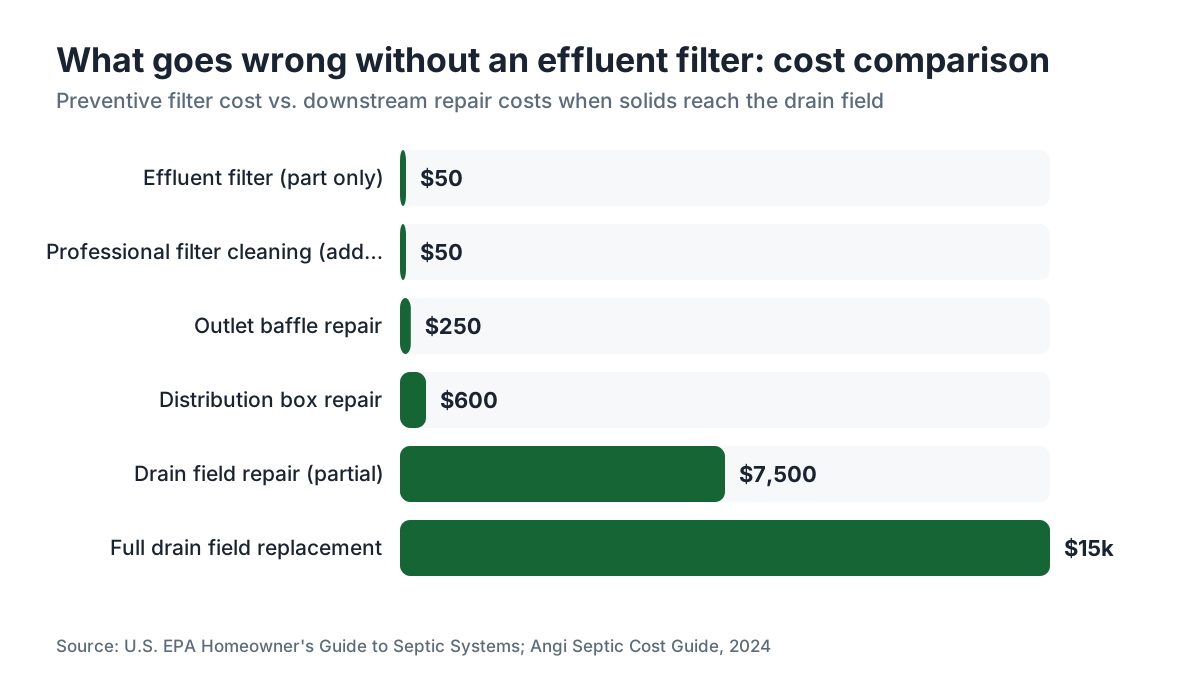
Put a $50 filter in context. The leach field it protects costs $5,000 to $20,000 to replace, and a drain field repeatedly dosed with fine solids from a filterless outlet can fail within 5 to 10 years of installation. [7] The math is not close.
A few states and counties run cost-share programs for septic upgrades, including effluent filter retrofits on older tanks. USDA Rural Development (Section 504) and some state revolving fund programs through EPA's Clean Water State Revolving Fund have paid for these retrofits. [8] If your household income qualifies, look into these before paying out of pocket for a system upgrade.
What happens if you don't have a septic filter or never clean it?
Two different problems, both bad.
No filter at all means every flush sends whatever the outlet baffle cannot screen straight into the distribution box and drain field trenches. Over years, a biomat builds at the soil interface. The soil stops accepting water. The system backs up. This is the most common cause of early drain field failure, and it is entirely preventable.
A filter that never gets cleaned eventually plugs solid. A plugged filter behaves like a closed valve. Effluent cannot leave the tank, so the liquid level climbs. Once it rises past the inlet pipe, sewage flows back toward the house. First sign: gurgling toilets and slow drains. Second sign: a soggy, sewage-smelling patch over the tank. Neither is something you want to find on a holiday weekend.
The EPA's SepticSmart program puts it plainly: "Have your septic system inspected and pumped regularly by a licensed contractor." [1] That inspection includes the filter. Skip it and $50 maintenance turns into $15,000 in repairs.
One thing that catches homeowners off guard: a plugged filter can be misread as a failing drain field by contractors who never check the filter first. Always confirm the filter got checked before you accept a drain field failure diagnosis. You are not obligated to spend thousands on a septic tank pump out and field evaluation if nobody has looked at the filter yet.
Do all septic tanks have an effluent filter?
No. Tanks installed before roughly 1995 almost never have one. The effluent filter became common in new construction after the mid-1990s as state codes tightened, but tens of millions of older tanks in the U.S. still run with only a concrete or plastic outlet baffle and no filter insert. [9]
The good news: retrofitting a filter is straightforward on most tanks. If your outlet tee accepts a standard 4-inch or 6-inch filter housing, a contractor can drop one in during your next pump-out for $75, $200 including parts. On old tanks with a crumbling concrete baffle, you may need a new outlet tee first, which pushes the cost to $150, $400. [6]
Before you schedule a retrofit, confirm which end of the tank is the outlet. Sounds obvious. It is a common mistake. The outlet is on the side where the pipe runs toward the drain field, not toward the house. Your septic tank inspection report, if you have one, notes this.
Buying a home on septic and the inspection does not mention a filter? Ask specifically. A home inspection that skips whether an effluent filter is present is missing a real piece of information about system condition and maintenance history.
How does an effluent filter differ from a sand filter septic system?
The names overlap and the confusion is real, so let's be direct.
An effluent filter (also called a septic tank filter or outlet filter) is a small insert inside your septic tank. It costs $20, $200. It does not treat wastewater; it screens particles. It works with any conventional septic system.
A sand filter septic system is a bigger, pricier piece of infrastructure. It is an engineered treatment unit, usually a buried bed of washed concrete sand 24 to 36 inches deep, through which tank effluent is dosed (often via a pump and timer) before dispersal. [3] The sand bed supports a microbial community that cuts biological oxygen demand (BOD) and suspended solids by 85 to 95% before the treated water reaches the soil. NSF International's standards for alternative onsite systems (NSF/ANSI 40 and 245) set the treatment performance benchmarks these systems must hit. [10]
Sand filter systems show up where soils are poor, lots are small, or setbacks from wells or water bodies make conventional drain fields impractical. They cost $3,000, $10,000 or more installed, need a pump that requires maintenance, and the sand bed itself has a 15 to 25 year service life before the media may need replacing. [3]
You can, and often should, have both: a tank effluent filter protecting the inlet to a sand filter system. Cut the particle load reaching the sand bed and you extend the sand's useful life by a wide margin.
What should septic service operators know about effluent filters?
Filter service is a real value-add and recurring revenue, and most shops undercharge for it relative to what it prevents.
On every pump-out, the tech should pull the filter, rinse it into the tank, inspect the housing and baffle fitting, and record the filter model, slot size, and condition on the work order. Those 10 minutes of documentation are what prevent the callback six months later when the homeowner's toilets back up.
Here is a practical read: a filter that loaded to capacity in under 18 months is a signal. It says the system is undersized, the garbage disposal is overused, or something is loading it hard (laundry lint, for one, which slotted filters catch but which sails through systems without them). Flagging that to the homeowner is good service, not an upsell.
Retrofitting filters on older accounts is a genuine service to offer. Incremental cost to the homeowner is low, the benefit is measurable, and it cuts the odds of a panicked sewage-backup call in year two of the relationship. Tracking which accounts have filters, what model, and when they were last serviced is the operational detail that separates organized shops from reactive ones. SepticMind's service management tools are built around this kind of per-property record for operators running dozens or hundreds of accounts.
State requirements to know: North Carolina requires effluent filters on all new systems under 15A NCAC 18A .1961. [11] Florida's 64E-6 code requires them on systems with pump chambers. [2] California's rules vary by county, but many require filters on repairs and new installations. Always check your state's current onsite wastewater code. These rules have been tightening steadily since 2010.
How often should you pump a septic tank with a filter?
A filter does not change how often you pump. The EPA's pump-out frequency table, based on household size and tank volume, stays the baseline. A household of four with a 1,000-gallon tank should pump every 2.6 years under typical conditions, per EPA's pumping frequency reference table. [5]
What the filter does is protect the drain field during the stretches between pump-outs. It does not slow sludge buildup in the tank. Sludge accumulates at the same rate whether you have a filter or not. The filter just stops the byproducts of that buildup from escaping.
Some homeowners install a filter and then stretch their pump-out intervals, figuring the filter is catching what would have left the tank. Wrong conclusion. The filter extends drain field life. It does not extend tank capacity. Skip the pumping and sludge eventually reaches the outlet pipe, overwhelms the filter, and you fail anyway. See our full guide to how often to pump a septic tank for the complete frequency table by tank size and occupancy.
One practical note. A tank that has never been pumped but has had its filter cleaned is a tank waiting to fail. Septic tank cleaning and filter maintenance are not substitutes. You need both.
Frequently asked questions
Where exactly is the effluent filter located in my septic tank?
The effluent filter sits inside the outlet baffle or tee at the downstream end of your septic tank, the end closest to the drain field. An access riser (a vertical PVC pipe with a lid at ground level) usually sits directly above it. If your tank has two risers, the outlet riser is the one farther from the house and closer to the field lines.
Can a clogged septic filter cause sewage backup in the house?
Yes. A fully plugged effluent filter acts like a closed valve. Effluent cannot leave the tank, so the liquid level rises inside it. Once it rises past the inlet pipe, sewage backs up toward the house. The first signs are slow drains and gurgling toilets throughout the home. Pulling and cleaning the filter often fixes it immediately, no further repair needed.
How do I know if my septic tank has a filter?
Open the outlet access riser lid (the one closer to your drain field) and look down into the tank. If you see a handle or a cylindrical housing sticking up from the outlet baffle, you have a filter. If you see only a concrete or PVC tee with no insert, you do not. A licensed inspector can confirm this during a septic tank inspection, which should always note filter presence and condition.
How much does it cost to have a septic filter cleaned professionally?
Most pumping companies include filter cleaning with a standard pump-out at no charge or for an add-on fee of $25, $75. A standalone cleaning visit without pumping typically costs $75, $150 depending on access and travel. If the filter needs replacing, add $20, $200 for the part. The total lands under $250 even in high-cost markets.
What is the best septic tank effluent filter brand?
Zabel (the A100 for standard tanks) and Polylok (3008-PL series) are the two most widely used residential brands in the U.S. and have the best parts availability. Orenco Systems makes strong filters for advanced treatment and pressure-dosed systems. For most single-family homes, a Zabel A100 or Polylok 3008-PL at $25, $60 is the practical pick. The alarm-float version costs about $50, $100 more and is worth it.
Can I install a septic effluent filter on an older tank that doesn't have one?
Usually yes. If the outlet baffle is intact and accepts a standard 4-inch or 6-inch filter housing, a contractor can install one during your next pump-out for $75, $200. If the concrete baffle is deteriorated, a new outlet tee goes in first, bringing the total to $150, $400. Retrofitting a filter is one of the highest-value maintenance upgrades you can make to an older system.
Does a septic effluent filter need to be replaced or just cleaned?
Cleaning is enough in most cases. Rinse the filter back into the tank opening so solids fall in rather than onto the ground, then reinstall it. Replace it when the PVC slots are broken or cracked, the housing is warped, or the gasket is shot and no longer seals. A well-maintained filter can last 10 or more years before replacement is genuinely necessary.
Does a sand filter septic system need the same maintenance as a regular tank?
A sand filter septic system needs its own maintenance schedule on top of regular tank pumping. The pump and timer that dose effluent onto the sand bed should be inspected every year. The sand surface needs periodic raking if a mat forms. The sand media has a 15 to 25 year service life. An effluent filter in the primary tank upstream of the sand bed also needs regular cleaning, same as in a conventional system.
Will a septic filter alarm tell me when the filter needs cleaning?
Yes, if your filter has a built-in alarm float. When solids load the filter enough to raise the effluent level past the float's trigger point, the alarm activates a panel inside the house, usually an audible beep or a light. That signal means the filter is loaded and needs cleaning within a day or two. It is not an emergency, but do not ignore it past a week or the backup risk climbs.
Are there state codes that require effluent filters on septic systems?
Yes, and the list keeps growing. North Carolina requires filters on all new systems under 15A NCAC 18A .1961. Florida requires them on systems with pump chambers under 64E-6 F.A.C. Many California counties require them on new installations and permitted repairs. If you are unsure about your state, check with your county environmental health department or your state's onsite wastewater code. Permits for new systems almost universally specify filter requirements now.
Can I use additives or enzymes instead of cleaning the filter?
No. Biological additives and enzyme products do not clean a physical filter screen. The EPA has not found septic additives to improve system performance in any consistent or measurable way, and no product dissolves the mat of solids coating a loaded filter. The only way to clean a slotted PVC or mesh filter is mechanical: pull it out and rinse it. Additives are not a substitute for maintenance.
How long does a septic effluent filter last before it wears out?
A well-made PVC effluent filter, cleaned on schedule, typically lasts 10 to 20 years. The failure modes are cracked slots from impact or freeze-thaw stress, a warped housing that no longer seals in the baffle, or a deteriorated gasket. Inspect it each time you clean it. If you see cracked ribs, broken slots, or a housing that wobbles in the fitting, replace it. At $20, $60 for most models, there is no reason to push a damaged filter.
Sources
- U.S. EPA SepticSmart Program: EPA SepticSmart lists effluent filters as a protective component and advises regular inspection and pumping by a licensed contractor.
- Florida Department of Health, Rule 64E-6 F.A.C. Onsite Sewage Treatment and Disposal: Florida 64E-6 requires effluent filters on septic systems with pump chambers.
- University of Florida IFAS Extension, Septic Tank Effluent Filters: State extension guidance recommends inspecting and cleaning effluent filters every 1 to 3 years, ideally at each pump-out.
- U.S. EPA, Septic System Frequency of Pumping Reference Table: EPA's pumping frequency table shows a household of four with a 1,000-gallon tank should pump every 2.6 to 5 years depending on use.
- HomeAdvisor (Angi) Septic System Cost Guide: Effluent filter replacement including labor typically costs $75, $200; a baffle repair costs $100, $400.
- U.S. EPA, A Homeowner's Guide to Septic Systems: Drain field replacement costs $5,000, $20,000; premature drain field failure is frequently caused by solids loading from inadequate tank maintenance.
- USDA Rural Development, Section 504 Home Repair Program: USDA Rural Development Section 504 funds can cover septic system upgrades including effluent filter retrofits for qualifying low-income rural households.
- U.S. EPA, Onsite Wastewater Treatment Systems Manual (EPA/625/R-00/008): Tens of millions of older U.S. tanks predate the 1990s-era code requirements for effluent filters and operate without them.
- NSF International, NSF/ANSI 40 and 245 Standards for Onsite Wastewater Treatment Systems: NSF/ANSI 40 and 245 set treatment performance benchmarks for alternative onsite systems including sand filter designs.
- North Carolina Administrative Code, 15A NCAC 18A .1900 Series, Sewage Treatment and Disposal Systems: North Carolina requires effluent filters on all new systems under 15A NCAC 18A .1961.
- U.S. EPA, Voluntary National Guidelines for Management of Onsite and Clustered (Decentralized) Wastewater Treatment Systems: EPA decentralized wastewater guidelines support effluent filters as a management practice to extend drain field service life.
Last updated 2026-07-10