Septic system field lines: how they work, fail, and get fixed
By the SepticMind Editorial Team
TL;DR
- Septic field lines (also called drain field lines or leach lines) are perforated pipes buried in gravel trenches that slowly release treated wastewater into the soil.
- A typical residential system has 300-1,000 linear feet of pipe.
- They last 20-30 years with good maintenance, fail faster with overloading or neglect, and replacement costs $5,000-$20,000 or more depending on soil and system type.
What are septic system field lines and how do they work?
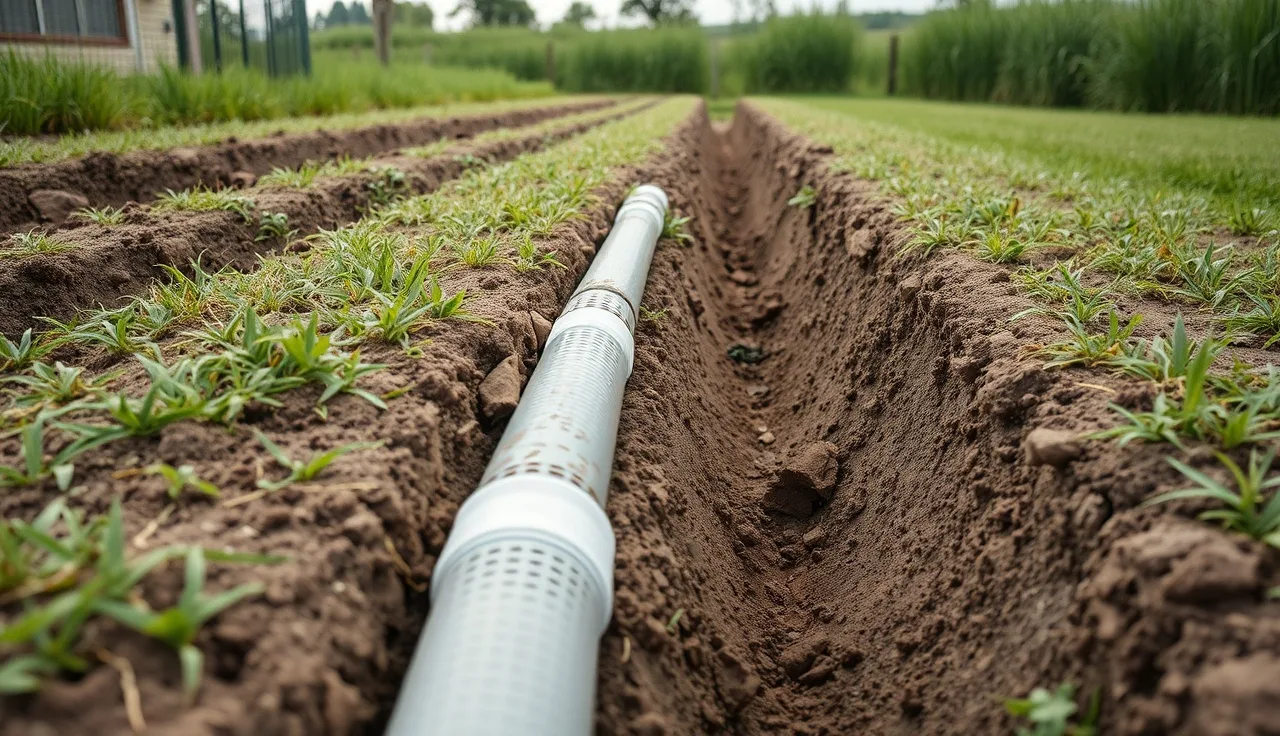
Field lines are the part of your septic system you never see and rarely think about until the yard gets soggy. They're perforated pipes, usually 4-inch diameter PVC or corrugated plastic, laid in gravel-filled trenches 18-36 inches deep and anywhere from 50 to 150 feet long per trench. Effluent flows out of your septic tank by gravity (or with a pump in pressure-dosed systems), enters a distribution box or manifold, then spreads through the field lines. It seeps out the perforations, drains through the gravel, and soaks into the native soil beneath.
The soil is the real treatment engine. A healthy biomat, a thin layer of partially decomposed organic matter that forms naturally at the gravel-soil interface, slows the effluent down long enough for bacteria in the soil to consume pathogens and nutrients. Without that biological action, you'd be pumping partially treated sewage straight into the ground. The EPA's SepticSmart program describes the soil as a natural filter that protects groundwater when the system is properly sited and maintained [1].
A standard system has 3-5 trenches running parallel, each 1-3 feet wide, spaced at least 6 feet apart center-to-center. Total pipe footage depends on your perc test result and household size. Slow-percolating soils need more trench length. Fast-draining sandy soils need less. That's why a site evaluation comes before any system is designed, not after.
What are field lines actually made of?
Older homes often have clay or Orangeburg (a tar-paper composite) pipe that was standard through the 1960s and 70s. Both break down over time. Clay cracks. Orangeburg delaminates and collapses. If your house was built before 1980 and the field lines have never been inspected, there's a real chance at least some of your pipe is in rough shape.
Modern systems use Schedule 40 PVC perforated pipe or corrugated HDPE pipe with perforations on the bottom half. Both hold up underground for decades when the surrounding soil isn't compacted or saturated. Some newer systems skip the pipe-and-gravel setup entirely: plastic arch-shaped chambers sit directly in the trench, and effluent weeps through the open bottom. Chambers hold more water during peak flow events and are easier to inspect with a camera.
The gravel matters too. Clean, washed stone (typically 3/4-inch diameter) keeps the trench permeable. Fines, silt, or dirty stone speeds up clogging. Most state codes specify gradation requirements for septic stone [2].
How long do field lines last?
The honest answer is that it depends enormously on how you treat the system. A well-maintained field line system in moderate soil can last 30-40 years or more. A neglected one can fail in 10. The biggest killer is letting solids carry over from the tank into the field lines, which is exactly what happens when you skip septic tank pumping.
Here's the rough reality broken down by factor:
| Factor | Effect on lifespan |
|---|---|
| Tank pumped on schedule (3-5 years) | Field lines may never need replacement |
| Tank never pumped | Solids enter lines; biomat over-thickens; failure in 10-15 years |
| High water table | Soggy trenches; slow absorption; shorter life |
| Clay-heavy soil | Slower perc; trenches saturate faster under load |
| Root intrusion | Pipe blockage; potential structural damage |
| Compaction from vehicles | Crushed pipe, collapsed trenches |
| Excess household water use | Hydraulic overload; flooding before treatment completes |
The EPA says a properly designed, installed, and maintained onsite system can last for decades, but that phrase "properly maintained" is doing a lot of work [1]. Most field line failures are preventable. That's the part homeowners hate to hear.
What causes field lines to fail?
Biomat overgrowth is the most common cause. Every drain field grows a biomat naturally. The trouble starts when the biomat gets too thick, sealing the soil surface so water can't pass through fast enough. This happens when the system takes on more effluent than the soil can handle, whether from a tank overflowing solids or simply too many people using too much water.
Root intrusion is the second most common cause. Tree roots follow moisture and nutrients straight to your field lines. Willows, maples, and poplars are the worst offenders, but any tree planted too close is a risk. Many state codes require trees to sit at least 50-100 feet from drain field trenches for exactly this reason [2].
Hydraulic overloading happens when more water enters the system than the soil can absorb. It can be one event (a huge party, a leak running for days) or chronic (a family of six in a house permitted for three bedrooms). Once the trenches flood, they stay saturated longer and longer between uses. Eventually they stop recovering at all.
Compaction from driving or parking over the field area crushes the gravel trenches and collapses pipes. This one is completely avoidable and somehow happens constantly. Keep vehicles, heavy equipment, and even riding mowers off the field.
Pipe deterioration from age, freezing, or chemical damage causes physical breaks that short-circuit flow. A camera inspection finds these fast. For broader system problems beyond just the lines, see our guide on septic system repair.
What are the signs that field lines are failing?
Wet, spongy ground over the drain field is the clearest sign. If you're leaving footprints in the grass above your trenches and it hasn't rained in a week, effluent is surfacing. You'll usually smell it before you see it, a sulfurous sewage odor that gets worse in warm weather.
Slow drains throughout the house point to a field line problem more than a single pipe clog does. One slow drain is usually a blockage in that drain line. Every drain running slow at once means the septic system is backing up because the field can't take more liquid.
Lush, unusually green grass in stripes above the trench lines is a giveaway. The grass is getting fertilized by surfacing effluent. It looks great until you step in it.
Sewage backing up into your lowest fixtures (basement floor drain, first-floor toilet) means the system is full and has nowhere to go. This is a health emergency, not a maintenance item. Call a septic tank pump out service right away to relieve the pressure, then get an inspection.
A gurgling sound from your toilet or drains when you flush or run water is an early warning. The system is fighting to move liquid through.
Can you repair field lines, or do they always need full replacement?
Partial repair is genuinely possible in some cases, and it's worth exploring before you commit to a full replacement. The answer depends on what's wrong.
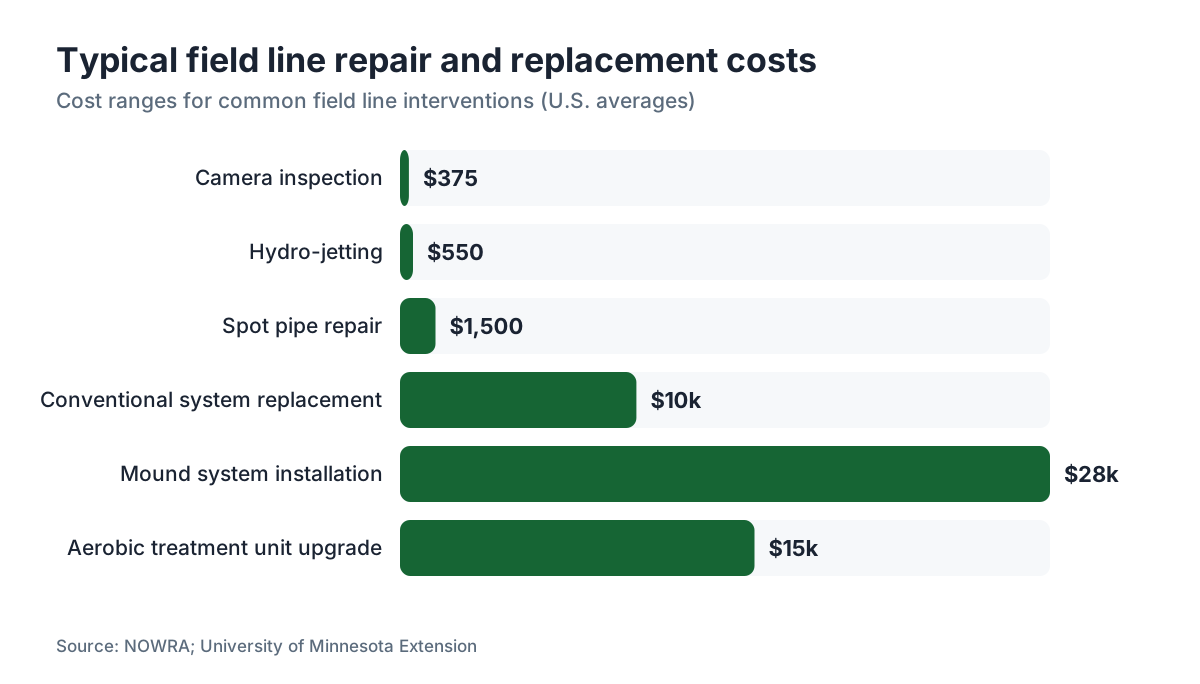
If the failure comes from root intrusion or a physical pipe break, a contractor can often trench to the damaged section, cut out the bad pipe, and splice in new pipe. That's a repair costing $500-$2,500 depending on access and depth [3].
If the failure comes from biomat overgrowth, aerobic treatment upgrades or a process called resting can help. Resting means rotating the system to an alternate field (if your property has one) and letting the saturated trenches dry out over 6-18 months. As the biomat dries, microorganisms decompose it and permeability partially returns. This only works if you have a second field to switch to.
Hydro-jetting the lines clears biomat and soft blockages temporarily. Some contractors add a surfactant or bacterial treatment after jetting. The results are all over the map. For some systems it buys years. For others the biomat is back in months. I wouldn't spend money on bacterial additives alone without jetting first.
Full replacement is necessary when the soil itself has failed, when multiple trenches have collapsed, or when the system was undersized for the property from day one. A new conventional system runs $5,000-$15,000. A mound system or other alternative in difficult soils can push $20,000-$40,000 [3][4].
How much does field line repair or replacement cost?
Costs vary widely by region, soil, and the type of replacement you need. Here are realistic ranges based on contractor pricing and state regulatory guidance:
| Repair/Replacement Type | Typical Cost Range |
|---|---|
| Camera inspection of field lines | $250-$500 |
| Hydro-jetting existing lines | $300-$800 |
| Spot repair (single pipe section) | $500-$2,500 |
| Full conventional system replacement | $5,000-$15,000 |
| Mound system (poor soil/high water table) | $15,000-$40,000 |
| Aerobic treatment unit (ATU) upgrade | $10,000-$20,000 |
| Permit fees | $200-$1,500 (varies by county) |
The ranges are wide because labor rates differ a lot between rural and urban markets, and soil conditions drive the scope of work. A straightforward replacement on a flat lot with good sandy loam is a different animal from a mound system on a half-acre with 12 inches of seasonal high water table.
For full system cost context, see our article on the cost to install septic system. If you're also replacing the tank, the cost to put in a septic tank article breaks that piece out separately.
Most homeowners don't realize that field line replacement usually requires a new permit and a site evaluation. Budget time for it. Some counties have backlogs of 4-8 weeks before an inspector can visit.
How far from your house, well, and property lines do field lines need to be?
Setback requirements are set by state and local codes, not federal law, so the exact numbers vary. Common minimums give you a working frame of reference.
From a drinking water well: 50-100 feet is the most common state requirement. Some states require 100 feet from a private well and 200 feet from a public water supply intake [2][5]. That distance is non-negotiable from a groundwater protection standpoint.
From the house foundation: typically 10 feet minimum, but 20 feet is more common in modern codes. You need enough separation to keep saturated soil away from the foundation.
From property lines: usually 5-10 feet. From surface water (streams, ponds, wetlands): 25-100 feet depending on the state. From storm drains and dry creek beds: 25-50 feet.
These setbacks are why small lots sometimes can't fit a conventional septic system at all. If a failing system can't be replaced in place because the property has no room for new setbacks, you're looking at an alternative system (mound, drip irrigation, aerobic unit) or connecting to municipal sewer if it runs nearby.
Always verify your county's specific requirements with the local health department before designing or replacing a system. The EPA's SepticSmart resources point homeowners toward state contacts for exactly this [1].
What can you do to make field lines last longer?
Keep the tank pumped. That's the one thing that matters most. Solids that carry over from an overfull tank are the field line's main enemy, and a tank pumped every 3-5 years (more often for larger households) keeps that from happening. If you're not sure when yours was last pumped, see how often to pump septic tank for a household-size-based guide.
Watch your water use. Spreading laundry across the week instead of running 6 loads on Saturday gives the field lines time to drain between loads. Fix leaky toilets fast. A flapper that runs constantly can add 200 gallons a day to your system, enough to hydraulically overload a correctly sized field [9].
Keep the field area clear. No parking, no heavy equipment, no garden sheds or patios built on top. Plant only shallow-rooted grass over the trenches. Don't irrigate the field. It's already getting water from below.
Divert surface water away from the field. If your yard drains toward the drain field, regrade to send it elsewhere. Saturated trenches can't treat effluent properly.
Don't treat your toilet or drains as a trash can. Grease, wipes (even the "flushable" ones), feminine hygiene products, and medications all cause problems in the tank or in the lines. The EPA's SepticSmart program warns against flushing anything other than human waste and toilet paper [1].
For operators tracking multiple properties, tools like SepticMind can flag overdue maintenance across a service territory so nothing slips through the cracks.
Get a septic tank inspection every 1-3 years once your system passes 15 years old. Early warning is cheap. Field line replacement is not.
What's the difference between a leach field, drain field, and field lines?
These terms get used interchangeably in the industry, which confuses a lot of homeowners. They all point to the same component: the buried distribution system that disperses treated effluent into the soil.
"Drain field" and "leach field" are regional terms for the same thing, the entire disposal area including trenches, gravel, and pipe. "Field lines" usually means the perforated pipes within that area specifically. In practice, most people and most contractors use all three to mean one thing. You'll sometimes hear "absorption field" in regulatory documents, which is also the same component.
Where it matters: on a permit application or engineering drawing, the exact wording your county uses may affect which form you fill out. In a conversation with a contractor or at the hardware store, don't worry about it.
For a full treatment of the leach field as a subsystem, including sizing, perc testing, and design types, the leach field article covers all of it.
One distinction that does matter: some alternative systems use drip irrigation lines or spray heads instead of buried trenches. They work on the same principle but need a pump, a filter, and much more regular maintenance. You'll often see them on lots that can't pass a conventional perc test.
Do septic additives actually help field lines?
Here's my direct opinion: most additives are a waste of money.
The idea behind biological additives (packets of bacteria or enzymes you flush) is that they boost the microbial population in your tank and lines. The catch is that a healthy septic system already runs on billions of active bacteria. A packet doesn't meaningfully change the population or the performance. The EPA has stated there is no scientific evidence that microbial additives improve the performance of a properly functioning system [1].
Chemical additives are worse. Solvents like methylene chloride were sold to "unclog" field lines by dissolving the biomat. They do dissolve the biomat, along with the bacteria that make the biomat work. They also contaminate groundwater. Many states have banned specific chemical additives outright.
The one additive-style treatment with some documented benefit is hydrogen peroxide injection or oxygen sparging to rehabilitate saturated soils. Those are contractor-applied, not off-the-shelf, and the evidence base is still thin. If a contractor recommends it, ask for the specific studies they're citing.
Spend the additive money on a pump-out instead. You'll get a better return.
When do field lines need a permit, and what does the inspection process look like?
Any new installation, any replacement, and in most states any repair beyond minor pipe patching requires a permit from the local health department or environmental agency [7]. The process usually runs like this:
- A site evaluation with a percolation (perc) test or soil morphology assessment to see how well the soil drains.
- A system design from a licensed engineer or soil scientist.
- Permit application with the design, plot plan, and setback calculations.
- Installation by a licensed contractor.
- An inspection by the county before the trenches are backfilled. This is the step most homeowners don't know to ask about. If a contractor buries the system before the inspector sees it, you can fail the final inspection and have to dig it back up.
The inspection itself checks trench depth, gravel depth and gradation, pipe slope (typically 1/8 inch per foot for gravity systems), perforation orientation (holes down, usually), and setback compliance [10].
After installation, some counties require a final report filed with the deed or recorded in a septic records database. That matters when you sell the house. A buyer's inspector will look for those records during a septic tank inspection.
For operators managing permitting and inspection across multiple jobs, scheduling software like SepticMind centralizes permit status, inspection dates, and site documentation in one place.
Permit fees run $200 to $1,500 depending on the county and system complexity. Processing time ranges from a few days to several months in jurisdictions with backlogs.
Frequently asked questions
How do I know if my field lines are clogged or failing?
Look for wet or spongy ground over the drain field, sewage odors in the yard, unusually lush green grass in stripes above the trenches, slow drains throughout the house (more than one fixture), or sewage backing up into the lowest drain in your home. Any one of these warrants a call to a septic professional. Backing up into fixtures is a health emergency requiring immediate pump-out.
Can roots really destroy my field lines?
Yes, and faster than most people expect. Tree roots seek moisture and nutrients and will find perforated pipes within a few growing seasons if trees sit nearby. Willows, maples, and poplars are the worst offenders. Many state codes require at least 50 feet of separation between trees and drain field trenches. Once roots are inside the pipe, they're very hard to clear completely without replacing the affected section.
What happens if I drive over my field lines?
The weight of a vehicle, even a passenger car, compacts the soil over the trenches and can crush the perforated pipe or collapse the gravel voids that allow drainage. Compacted trenches don't drain properly, and the damage is usually permanent without excavation and replacement. Keep all vehicles, riding mowers, heavy equipment, and construction machinery off the drain field area permanently.
How many field lines does a typical residential septic system have?
Most residential systems have 3 to 5 lateral trenches, each 50 to 150 feet long. Total pipe length typically runs 300 to 1,000 linear feet. The exact number depends on household size, the percolation rate of the soil, and local code. A slow-draining clay soil needs more total trench length than a sandy soil to handle the same daily flow.
How deep are septic field lines buried?
Typical installation depth is 18 to 36 inches below grade, measured to the top of the gravel. The pipe sits in 6-12 inches of gravel with 2-6 inches of gravel above it, then a barrier fabric (geotextile) to keep soil from migrating in, then native soil. In cold climates, some codes require deeper installation to stay below the frost line, though most field lines are shallow enough that they rely on the soil's insulating properties rather than depth alone.
Can a failed field line be repaired without full replacement?
Sometimes. A localized pipe break or root blockage can be repaired by excavating just the damaged section and splicing in new pipe, typically $500-$2,500. Hydro-jetting can clear biomat buildup and buy time. Resting the field by switching to an alternate trench lets saturated soil recover over 6-18 months. Full replacement is necessary when the soil itself is permanently sealed or the system was undersized from the start.
How long does it take to install new field lines?
The physical installation typically takes 1 to 3 days for a conventional system once the permit is approved and equipment is on site. But the full timeline from application to backfill often runs 4-12 weeks, because you have to wait for the site evaluation, permit approval, and an inspection before covering the trenches. In counties with permit backlogs, the process can stretch to 4-6 months.
Will homeowners insurance cover septic field line failure?
Standard homeowners policies almost never cover septic system failure because it's treated as a maintenance item rather than a sudden, accidental loss. Some insurers offer separate septic riders or home warranty products that cover repair or replacement up to a set dollar limit, but read the fine print because most exclude failure caused by neglect or lack of maintenance. This is a real gap in coverage for rural homeowners.
Do septic additives help restore failing field lines?
The EPA has stated there is no scientific evidence that microbial additives improve the performance of a properly functioning system, and that position extends to struggling systems too. Biological packets and enzymes don't meaningfully change the microbial population in a failing drain field. Chemical additives can actively harm the system and contaminate groundwater. Contractor-applied oxygen sparging has limited supporting evidence but more legitimacy than off-the-shelf products.
How often should field lines be inspected?
A visual check of the field area (looking for wet spots, odors, or unusually green grass) every spring and fall takes about five minutes and should be a habit. A professional inspection with a camera every 3-5 years is reasonable for systems older than 15 years. If your tank is being pumped, ask the technician to check the distribution box and the inlet to the first lateral at the same time.
What is the minimum lot size needed for a conventional field line system?
There's no single federal minimum. States set their own requirements based on soil type, trench sizing, and setbacks. A rough guide: most conventional systems need at least 10,000-20,000 square feet of usable land once you account for setbacks from the well, house, and property lines. Lots smaller than a quarter acre often can't fit a conventional system and require alternative designs like mounds or drip systems.
Can heavy rain damage or flood my field lines?
Yes. Sustained heavy rain saturates the soil around the trenches, cutting off the oxygen that aerobic soil bacteria need to treat effluent. A temporarily flooded drain field usually recovers within a few days once rain stops and the soil drains. But frequent or chronic flooding, common in high-water-table areas, speeds up long-term failure. If your field floods every time it rains hard, you may need a mound or pressure-dosed system designed for those conditions.
What plants are safe to grow over septic field lines?
Shallow-rooted grasses are the best choice. Turf grass holds the soil, allows evapotranspiration, and doesn't send roots into the trenches. Wildflowers and native groundcovers with fibrous root systems are acceptable. Avoid trees or large shrubs anywhere near the field area. Vegetable gardens are a bad idea over field lines because of pathogen risk. Do not irrigate the field area. It's already getting moisture from below.
How does a perc test affect field line design?
A percolation test measures how fast water drains into the soil, usually in minutes per inch. Faster perc rates mean smaller, shorter trenches can handle the required daily flow. Slower rates (above 60 minutes per inch in many states) may disqualify the site for a conventional system entirely and require alternative designs. The perc rate directly sets the required square footage of trench absorption area per bedroom in the house.
Sources
- U.S. EPA, SepticSmart Program: EPA description of soil as a natural filter; guidance against flushing non-waste items; statement that no scientific evidence supports microbial additive efficacy; note that properly designed and maintained onsite systems can last for decades
- U.S. EPA, Onsite Wastewater Treatment Systems Manual: Standard setback requirements from wells and surface water; gravel gradation requirements for drain field trenches; tree setback guidance
- National Onsite Wastewater Recycling Association (NOWRA): Cost ranges for field line repair, spot repair, and conventional system replacement
- University of Minnesota Extension: Cost ranges for mound systems and alternative system types in difficult soil conditions
- Minnesota Pollution Control Agency, Subsurface Sewage Treatment Systems (SSTS): Minimum setback of 50 feet from private wells and 200 feet from public water supplies for drain field trenches
- North Carolina State University Extension: Description of biomat formation, function, and failure; relationship between pumping frequency and field line lifespan
- Virginia Department of Health: Permit requirements for field line installation and replacement; inspection steps before backfill
- Washington State Department of Health: Percolation test requirements and minimum perc rate thresholds for conventional drain field eligibility
- Penn State Extension: Guidance on water conservation to prevent hydraulic overloading; leaky toilet water use estimate; recommended inspection frequency for aging systems
- U.S. EPA, Onsite Wastewater Treatment Systems Manual: Standard pipe diameter, trench dimensions, gravel depth, and pipe slope specifications for conventional field line systems
Last updated 2026-07-09