Clifton VA septic tank inspection: what homeowners need to know
By the SepticMind Editorial Team
TL;DR
- A septic tank inspection in Clifton, VA runs $150 to $500 depending on scope.
- Fairfax County requires inspections at property transfer and on a maintenance schedule under Virginia's Sewage Handling and Disposal Regulations (12VAC5-610).
- Inspectors check tank condition, effluent levels, inlet and outlet baffles, and drain field function.
- A pump-out inspection gives the most accurate picture.
Why does a Clifton VA septic inspection matter?
Clifton sits in western Fairfax County, a heavily wooded, low-density area where nearly every home runs on a private septic system rather than public sewer. There is no municipal backup for most of these properties. When a system fails, the homeowner owns the problem entirely, and drain field replacements in Fairfax County routinely run $10,000 to $30,000 or more depending on soil type and lot constraints [1].
Regular inspections catch small problems before they get expensive. A cracked baffle costs a few hundred dollars to fix. Ignore it for three more years and you can end up with a flooded drain field that needs full replacement. That math is not subtle.
Virginia law gives Fairfax County Health Department authority to regulate all onsite sewage systems under the Virginia Sewage Handling and Disposal Regulations (12VAC5-610), which the State Board of Health adopted under the Code of Virginia [2]. Those regulations set minimum standards for design, installation, maintenance, and inspection. They are the floor, not the ceiling. Fairfax County sometimes adds requirements on top of them.
For real estate deals specifically, Virginia Code 32.1-164.1:1 requires that a certified inspector evaluate the onsite sewage system before closing in most cases. That result stays with the property record. Buyers and sellers in Clifton should both understand what the report actually measures, because a passing grade on a surface inspection does not guarantee a system will last another decade.
What does a septic inspection in Clifton actually include?
There are three tiers of inspection in common practice. Confuse them and you get blindsided.
Visual or basic inspection. The inspector finds the tank access lids, checks for surface odors, looks for wet or unusually lush areas over the drain field, and pulls the age and permit history from county records. This takes 30 to 60 minutes. It rules out obvious failures but misses anything below grade. Cost is typically $100 to $200.
Standard inspection with pump-out. The tank gets pumped and the inspector physically examines the interior: inlet and outlet baffles or tees, sidewall condition, scum depth before pumping, sludge depth, and any structural cracking or root intrusion. The distribution box gets checked too, if it's accessible. This is the minimum I'd recommend for any real estate transaction, or for a homeowner who hasn't had an inspection in five or more years. Cost in the Clifton area runs roughly $300 to $500 once you factor in the septic tank pump out service [3].
Full system evaluation. Everything above, plus a hydraulic load test or dye test, a camera run of the inlet or outlet lines, and a written assessment of the drain field's current absorption capacity. Some inspectors use a probe to check soil saturation. This is what a buyer should request on a home with a system older than 20 years, or one with no documented maintenance history. Expect $500 to $900.
The EPA's SepticSmart program recommends that homeowners "have your system inspected by a qualified professional at least every three years" and pumped every three to five years depending on household size [4]. Fairfax County Health Department echoes that guidance and can require inspections more often on systems with prior violations.
One thing worth knowing: inspectors in Virginia who perform real estate transaction inspections must hold a valid onsite soil evaluator or AOSE license, or work under one, per Virginia DEQ and VDH requirements [2]. Ask for the license number before you hire anyone.
How much does a septic inspection cost in Clifton VA?
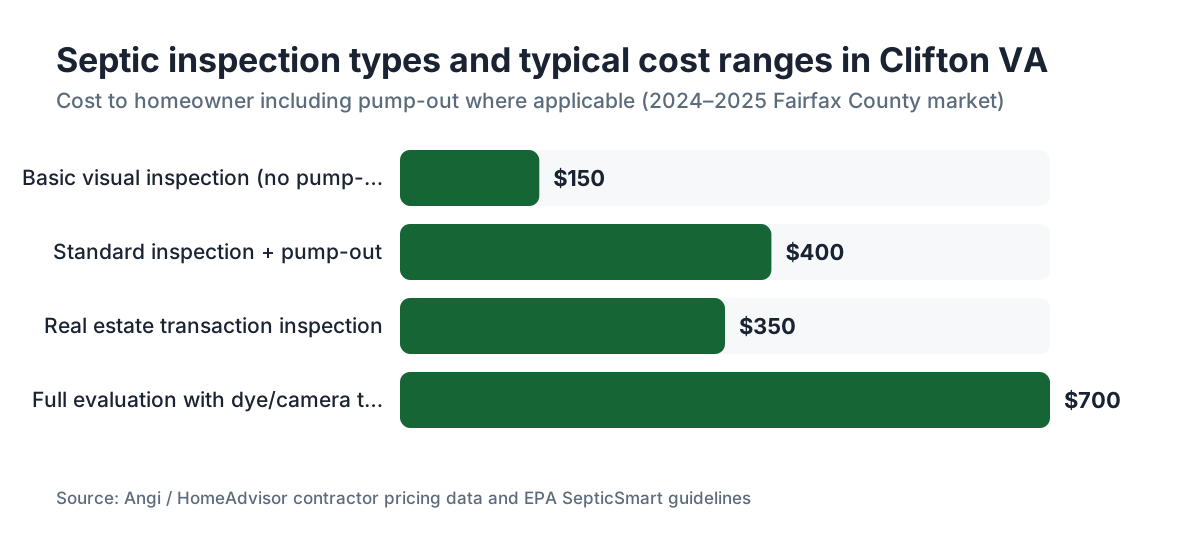
Cost depends on inspection type, whether pump-out is included, and the contractor. Here is a realistic range for the Clifton and broader Fairfax County market:
| Inspection Type | Typical Cost Range | Includes Pump-Out? |
|---|---|---|
| Basic visual only | $100, $200 | No |
| Standard inspection + pump-out | $300, $500 | Yes |
| Full evaluation with dye/camera | $500, $900 | Yes |
| Real estate transaction inspection | $250, $450 | Sometimes |
These figures reflect typical contractor pricing in northern Virginia as of 2024 and 2025. No government agency publishes them, so treat them as a baseline and get at least two quotes [3].
Pump-out on its own, without inspection, runs $300 to $600 in Fairfax County. Tank size matters: a 1,000-gallon tank costs less to pump than a 1,500-gallon one. Some contractors bundle the septic tank pumping and inspection into a flat rate. Others itemize. Ask upfront.
Gainesville VA homeowners (Prince William County, just southwest of Clifton) see similar pricing, though Prince William County runs its own health department permitting process under the same state framework. A Gainesville VA septic tank inspection from a contractor who also serves Clifton is common, because the service areas overlap.
If you are buying a home in Clifton, push for the seller to pay the inspection or at least the pump-out portion. It is standard practice in this market, and the cost is trivial next to what a failing system costs.
What are Fairfax County's rules for septic inspections?
Fairfax County Health Department administers onsite sewage permits and inspections under authority delegated from the Virginia Department of Health (VDH) and the Virginia Department of Environmental Quality (DEQ) [2]. The key regulatory document is 12VAC5-610, Virginia's Sewage Handling and Disposal Regulations, which covers everything from initial site evaluation and soil percolation testing to ongoing maintenance.
For existing systems, the county's main enforcement tool is the property transfer inspection requirement. When a property with a private septic system changes hands, the seller must disclose known defects, and many lenders and buyers require a formal inspection report as a condition of sale. Virginia Code 32.1-164.1:1 gives the Board of Health authority to require inspection upon transfer [5].
Fairfax County also tracks maintenance on alternative onsite systems (any system that is not a conventional gravity-flow tank and soil absorption field). Those systems typically require annual inspections and service contracts with licensed operators. If your Clifton home has a drip irrigation system, a mound system, or an aerobic treatment unit, you almost certainly have a mandatory annual inspection requirement, and you may not know it.
For conventional systems, the county does not currently mandate a fixed inspection frequency for homeowners who are not selling. The state regulations do require that systems be maintained in a way that prevents public health hazards. A system that is backing up or surfacing sewage can draw a VDH complaint inspection and enforcement action. The advice is simple: pump and inspect on a regular schedule and you will never hear from the health department involuntarily.
How do you find a licensed septic inspector in Clifton VA?
Virginia licenses three categories of professionals who can inspect onsite systems: Licensed Onsite Soil Evaluators (AOSE), Licensed Professionals (PE or soil scientist with an onsite endorsement), and registered operators for alternative systems [2]. For a standard inspection at an existing home, look for a contractor who employs or is supervised by an AOSE.
The Virginia Department of Professional and Occupational Regulation (DPOR) keeps a license lookup database where you can verify any contractor's current status [6]. Use it. License fraud is rare, but the check takes 30 seconds.
Practical search steps:
- Call Fairfax County Health Department's environmental health division and ask for their current list of registered septic contractors working in the county. They will not officially endorse anyone, but they know the active players.
- Ask your real estate agent. Agents who close deals in western Fairfax routinely know two or three inspectors who consistently produce accurate, bankable reports.
- Check the National Association of Wastewater Technicians (NAWT) member directory for certified inspectors [7].
Avoid any contractor who says they can do a full inspection without accessing the tank. Lift the lids. If they don't, you don't know what's inside. Also avoid anyone who says a visual pass means the system is "fine for another ten years." No honest inspector makes that claim.
What do inspectors look for in the septic tank itself?
Once the tank is open and pumped, a thorough inspector checks several specific things. Knowing what they are helps you read the report and ask better questions.
Inlet and outlet baffles or tees. These keep scum and solids from flowing out toward the drain field. A deteriorated or missing outlet baffle is one of the most common findings and one of the most damaging: solids that reach the drain field clog the soil pores permanently. Baffle replacement costs $100 to $300. Ignoring it can cost $15,000 [8].
Tank walls and bottom. Inspectors look for cracking, spalling, or root intrusion. Concrete tanks in Fairfax County's clay-heavy soils occasionally crack along the bottom seam from ground movement. A hairline crack may be monitorable. A fractured tank needs replacement. See septic tank repair for what repair looks like in practice.
Effluent level. After pumping, the tank should refill to a predictable level. If it fills faster than normal household water use would explain, groundwater infiltration is likely, which dilutes treatment and overloads the drain field.
Scum and sludge accumulation rate. If a tank was pumped three years ago and is already 40 percent full of sludge, either the household is overloading it or the tank is undersized. Virginia's sizing guidelines require a minimum 1,000-gallon tank for homes up to three bedrooms, with larger tanks above that [2].
Distribution box condition. The D-box splits effluent evenly across drain field laterals. A tilted or cracked D-box sends all flow to one lateral, killing it early. Inspectors probe for saturation in individual laterals when they can reach them.
A good inspector finishes with a written report that describes findings in plain language, assigns a condition rating, and lists recommended actions in rough priority order. If you get a verbal summary and a checkbox form, push for more.
What happens if your Clifton septic inspection reveals a problem?
Inspection findings fall into three buckets: maintenance items, repairs needed, and system failures.
Maintenance items are things like an overdue pump-out, minor baffle wear, or a lid that needs a new riser installed for easier future access. These run $100 to $500 to address and should not derail a real estate transaction.
Repairs needed covers broken baffles, a cracked distribution box, damaged risers, or minor pipe issues. Septic system repair costs in this range run $300 to $2,000 depending on what's broken. In a sale, these are usually negotiated as a seller credit or a seller repair before closing.
System failures are a different animal. A failed drain field, a collapsed tank, or sewage surfacing in the yard is a material defect that must be disclosed under Virginia law. The seller cannot patch over it cosmetically and move on. Full system replacement in Clifton, on a lot with challenging soils or limited space, can run $15,000 to $50,000 [1]. That covers site work, permits, soil evaluation, and installation. See cost to install septic system for a detailed breakdown.
If you are the buyer and the inspection reveals a failed system, you hold the stronger hand. Some buyers walk. Others negotiate a big price reduction and handle the replacement themselves. Neither is wrong. What is wrong is closing without knowing.
For homeowners not in a transaction: a failed system is not optional to fix. VDH has enforcement authority and can issue a notice of violation that requires repair within a set timeframe. Ignoring it does not make it go away.
How does the Clifton drain field factor into the inspection?
The drain field, also called the leach field or soil absorption system, is where treated effluent from the tank disperses into the soil. It is the most expensive component to replace and the one most often damaged by neglect. Inspectors assess it several ways.
Surface inspection looks for wet spots, odors, unusually green grass over the field lines, or soil mounding. Any of these signals that effluent is not absorbing properly. Wet, sewage-smelling ground over a drain field is a failure, full stop.
Probe testing means pushing a soil probe into the ground above the laterals to feel for saturation. Soil that stays saturated between household water uses suggests biomat buildup, a layer of organic material that cuts soil permeability over time.
Dye testing introduces a brightly colored dye tracer into the system and watches for it to surface, or to show up in nearby ditches or streams. Virginia does not require dye testing on every inspection, but it is a common add-on for older systems or systems near surface water.
Western Fairfax County and the Clifton area have mostly clay and silty clay loam soils [9]. These soils drain slower than sandy soils, which shapes both the original system design and how fast a biomat becomes a problem. A system designed 30 years ago for that clay may be near its practical end of life, even if it passes a basic inspection. Ask the inspector to comment on remaining useful life, more than current condition.
Learn more about how leach field function and failure work if the inspector flags anything in that area.
How often should Clifton homeowners pump and inspect their septic system?
The EPA's SepticSmart program states that "household septic systems should be inspected at least every three years by a septic service professional" and pumped "every three to five years" [4]. Virginia's state regulations do not set a stricter mandatory interval for conventional systems, so the EPA guidance is effectively the working standard.
Household size changes that math. A 1,000-gallon tank serving two people fills with sludge far slower than one serving five. The EPA published a table showing that a 1,000-gallon tank with two occupants needs pumping roughly every 5.9 years, while the same tank with five occupants needs pumping every 2.0 years [11]. Those are estimates, not guarantees, but they are a fair planning tool.
For Clifton homeowners specifically, I'd pump every three years regardless of household size. The clay soils here make drain field failures expensive and slow to diagnose. Knowing your tank is clean and the baffles are intact every three years is cheap insurance.
See how often to pump septic tank for a deeper look at the variables that affect your specific pumping schedule.
Alternative systems (aerobic treatment units, drip systems, mound systems) require annual inspection and often quarterly or semi-annual service visits. If your system has a control panel, an air compressor, or spray heads, you are almost certainly under a mandatory maintenance contract requirement in Fairfax County.
What should Clifton homeowners do between inspections?
A three-year inspection schedule does not mean ignoring the system for 1,095 days in between. There are practical things homeowners can do that genuinely extend system life.
Watch your water use. A household generating 50 to 100 gallons per person per day is normal. Running multiple loads of laundry in one day, filling a hot tub, or hosting extra guests all spike hydraulic load. Spread laundry over the week. Fix leaky toilets immediately. A running toilet can waste 200 gallons a day and is one of the most common causes of premature drain field saturation [4].
Keep the drain field area clear. No vehicles, no structures, no deep-rooted trees within 10 feet (Virginia recommends keeping trees 10 to 25 feet away depending on species) [2]. Grass over the field is fine, and actually good. It takes up moisture and prevents erosion.
Do not flush anything except waste and toilet paper. Wipes labeled "flushable" are not. Grease, medications, and harsh chemicals disrupt the bacterial balance inside the tank and can cause premature sludge buildup.
Keep a simple record: date of last pump-out, any repairs, and the inspector's name and findings. If you ever sell, that document is worth money. Buyers pay more for a documented, maintained system than for an unknown one.
Some homeowners buy septic tank cleaning additives. The evidence for most commercial additives is weak. The EPA and most extension services do not recommend them as a substitute for pumping [4]. Save the money.
How does a septic inspection work for real estate transactions in Clifton?
Real estate septic inspections in Clifton follow a specific sequence. Knowing it protects both buyers and sellers.
The listing agent or seller usually schedules the inspection before or during the listing period, or the buyer's agent requests it as part of the home inspection contingency. Virginia Code 32.1-164.1:1 gives the Board of Health authority to require inspection at transfer, and many lenders (particularly FHA and VA loans) require a passing septic inspection before they will fund the loan [5].
The inspector visits, usually with a pump truck if a pump-out is included, and produces a written report within 24 to 72 hours. The report goes to both parties and, in some cases, to the health department.
If the system passes, the transaction proceeds. If it fails, Virginia law requires disclosure and the failure becomes a negotiated item. A seller who has not maintained the system and discovers a failing drain field at inspection has three options: fix it, credit the buyer, or accept a price reduction. Most lenders will not fund a loan on a home with a failed septic system without repair or escrow.
One practical note: the 2-to-4-week lead time to schedule a pump truck and inspector in Fairfax County during spring and summer (peak real estate season) is real. Build that into your contract timeline. A buyer who waits until week four of a 21-day contingency to schedule the inspection is taking a risk they don't need to take.
For operators managing inspection scheduling across many transactions, tools like SepticMind can track permit status, maintenance history, and upcoming inspection deadlines in one place. That matters when you're juggling dozens of properties across Fairfax and Prince William counties.
What is the difference between a septic inspection in Clifton and in nearby Gainesville VA?
Clifton is in Fairfax County. Gainesville is in Prince William County. Both operate under the same Virginia state framework (12VAC5-610 and VDH oversight), but they run separate health departments, separate permitting offices, and sometimes different local requirements for alternative systems [2].
For a homeowner, the difference is mostly administrative: you call a different county health department office, permits come from different staff, and enforcement comes from a different office. The inspection process itself, what an inspector checks and what standards apply, is essentially the same, because both counties draw authority from the same state code.
Pricing for a Gainesville VA septic tank inspection is similar to Clifton: $300 to $500 for a standard inspection with pump-out. Many septic contractors serve both counties, so a contractor who quotes you for a Clifton inspection can often handle a Gainesville property too.
Soil types differ somewhat between the two areas. Prince William County has more varied geology, with some areas draining better than Fairfax County's mostly clay profiles [9]. That can affect drain field sizing and longevity, which in turn affects what inspectors flag.
If you are buying or selling in either jurisdiction, verify the contractor knows that specific county's permit records system. Fairfax County's online permit lookup and Prince William County's system are different databases. An inspector who can pull the permit history quickly can find problems (like an unpermitted system addition) that a less familiar contractor might miss.
Frequently asked questions
How much does a septic inspection cost in Clifton VA?
A basic visual inspection runs $100 to $200. A standard inspection that includes a pump-out costs $300 to $500. A full evaluation with dye testing or camera work runs $500 to $900. These are typical Fairfax County market rates as of 2024 to 2025. Get at least two quotes, and make sure the price clearly states whether pump-out is included.
How often should I get my septic tank inspected in Clifton VA?
The EPA recommends inspection every three years and pumping every three to five years for conventional systems. Fairfax County does not set a stricter mandatory interval for conventional systems, but given the area's clay soils and the cost of drain field replacement, pumping and inspecting every three years is sound practice. Alternative systems (aerobic, drip, mound) typically require annual inspections under county maintenance agreements.
Is a septic inspection required when selling a home in Clifton VA?
Virginia Code 32.1-164.1:1 gives the Board of Health authority to require septic inspection at property transfer. Most lenders, especially FHA and VA loans, require a passing inspection before funding. Even when not legally mandated in a specific transaction, failing to disclose known septic defects violates Virginia real estate disclosure law. Buyers should always request an inspection as part of their contingency.
What can fail a septic inspection in Virginia?
Common failures include sewage surfacing over the drain field, a cracked or collapsed tank, missing or deteriorated inlet and outlet baffles, a failed distribution box, evidence of hydraulic overloading in the soil absorption area, or an unpermitted system. Minor findings like an overdue pump-out or a worn riser lid generally do not constitute a failure but will appear on the report as items requiring attention.
Who can legally perform a septic inspection in Virginia?
Real estate transaction inspections must be conducted by or under the supervision of a Licensed Onsite Soil Evaluator (AOSE) or a licensed professional with an onsite endorsement, per Virginia DEQ and VDH requirements. You can verify any inspector's current license through the Virginia Department of Professional and Occupational Regulation (DPOR) license lookup database.
How long does a septic inspection take in Clifton VA?
A basic visual inspection takes 30 to 60 minutes. A standard inspection with pump-out takes 1.5 to 3 hours, depending on tank size and access. A full evaluation with dye testing or camera inspection can take 3 to 5 hours. Written reports typically arrive within 24 to 72 hours after the site visit. In spring and summer, schedule at least two to three weeks in advance.
What should I do if my Clifton septic inspection fails?
If you are selling, you must disclose the finding and either repair the system, offer a buyer credit, or negotiate a price reduction. Most lenders will not fund on a failed system without repair or escrow. If you are a current homeowner, the Virginia Department of Health can require repairs within a specified timeframe. Contact a licensed contractor for a repair assessment and get Fairfax County Health Department involved before doing any work so you can pull the correct permit.
Can I do a septic inspection myself in Virginia?
A homeowner can visually check for obvious signs of failure: wet spots over the drain field, sewage odors, slow drains, and the condition of access lids. But a real inspection requires opening and pumping the tank to assess baffles, structural integrity, and sludge levels. Real estate transaction inspections specifically require a licensed professional. DIY observation is useful between professional visits but is not a substitute.
What is the difference between a septic inspection and a septic pump-out?
A pump-out removes accumulated solids and scum from the tank. An inspection evaluates the system's structural condition and function. They are different services, though the best inspections are done with the tank pumped because you cannot see the walls, bottom, or baffles through sludge. Many contractors bundle them, but some charge separately. Always confirm what is included before booking.
How do Clifton VA septic inspections differ from Gainesville VA inspections?
Both areas operate under the same Virginia state regulations (12VAC5-610). The difference is administrative: Clifton is in Fairfax County and Gainesville is in Prince William County, each with its own health department and permit records system. Inspection content, standards, and typical pricing are similar. Many contractors serve both counties. Verify the inspector knows how to pull permit history in the specific county where the property sits.
What soil types in Clifton VA affect septic system performance?
Western Fairfax County, including Clifton, has predominantly clay and silty clay loam soils with slower percolation rates than sandy soils. This affects original drain field sizing and how quickly biomat buildup becomes a problem. Clay soils are less forgiving of hydraulic overloading, which is why regular pumping and inspection intervals matter more here than in areas with faster-draining soils.
Does Fairfax County require a septic inspection permit?
Fairfax County Health Department issues permits for septic system installation, repair, and modification under Virginia's Sewage Handling and Disposal Regulations. A standard maintenance inspection and pump-out does not require a separate permit. However, any repair work discovered during an inspection, such as replacing a distribution box or repairing a drain field, does require a health department permit before work begins.
How do I find my existing septic system records in Fairfax County?
Fairfax County Health Department maintains permit records for onsite sewage systems. You can request records through the county's environmental health division, and some records are available through the county's online permit portal. Your system's as-built drawing (showing tank location, distribution box, and drain field layout) should have been filed at permit issuance. If you cannot find records, a licensed inspector can often locate the system with probing and a metal detector.
Sources
- Fairfax County Health Department, Onsite Sewage and Well Programs: Fairfax County administers onsite sewage permits; drain field replacements in the county involve permitting, soil evaluation, and site work that drives costs into the tens of thousands of dollars.
- Virginia Department of Health, 12VAC5-610 Sewage Handling and Disposal Regulations: Virginia's Sewage Handling and Disposal Regulations (12VAC5-610) set minimum standards for design, installation, maintenance, and inspection of onsite sewage systems statewide, including tank sizing minimums and AOSE licensing requirements.
- HomeAdvisor / Angi, Septic Tank Inspection Cost Guide: Typical septic inspection costs nationally range from $150 to $450 for a standard inspection; pump-out costs typically add $300 to $600 in the Mid-Atlantic region.
- U.S. Environmental Protection Agency, SepticSmart Program: EPA SepticSmart recommends household septic systems be inspected at least every three years and pumped every three to five years; a running toilet can waste 200 gallons per day and overload a septic system.
- Virginia General Assembly, Code of Virginia 32.1-164.1:1: Virginia Code 32.1-164.1:1 gives the Board of Health authority to require inspection of onsite sewage systems at property transfer.
- Virginia Department of Professional and Occupational Regulation (DPOR), License Lookup: DPOR maintains a publicly searchable database of licensed onsite soil evaluators and other regulated professionals in Virginia.
- National Association of Wastewater Technicians (NAWT), Inspector Certification Program: NAWT offers a certified inspector program and maintains a member directory of certified onsite system inspectors.
- Virginia Cooperative Extension, Homeowner's Guide to Septic Systems (Publication 448-834): Deteriorated or missing outlet baffles allow solids to reach the drain field, permanently clogging soil pores and leading to drain field failure requiring full replacement.
- USDA Natural Resources Conservation Service, Web Soil Survey: Western Fairfax County soils are predominantly clay and silty clay loam with slower percolation rates; Prince William County has more varied geology with some faster-draining soil series.
- Virginia Department of Environmental Quality, Onsite Sewage and Water Programs: Virginia DEQ shares oversight of onsite sewage system regulations and licensing with VDH; licensed professionals must hold current state credentials to perform real estate transaction inspections.
- U.S. EPA, Septic System Fact Sheet (EPA-832-F-99-072): EPA data show a 1,000-gallon tank serving two occupants requires pumping approximately every 5.9 years; the same tank serving five occupants requires pumping approximately every 2.0 years.
Last updated 2026-07-09