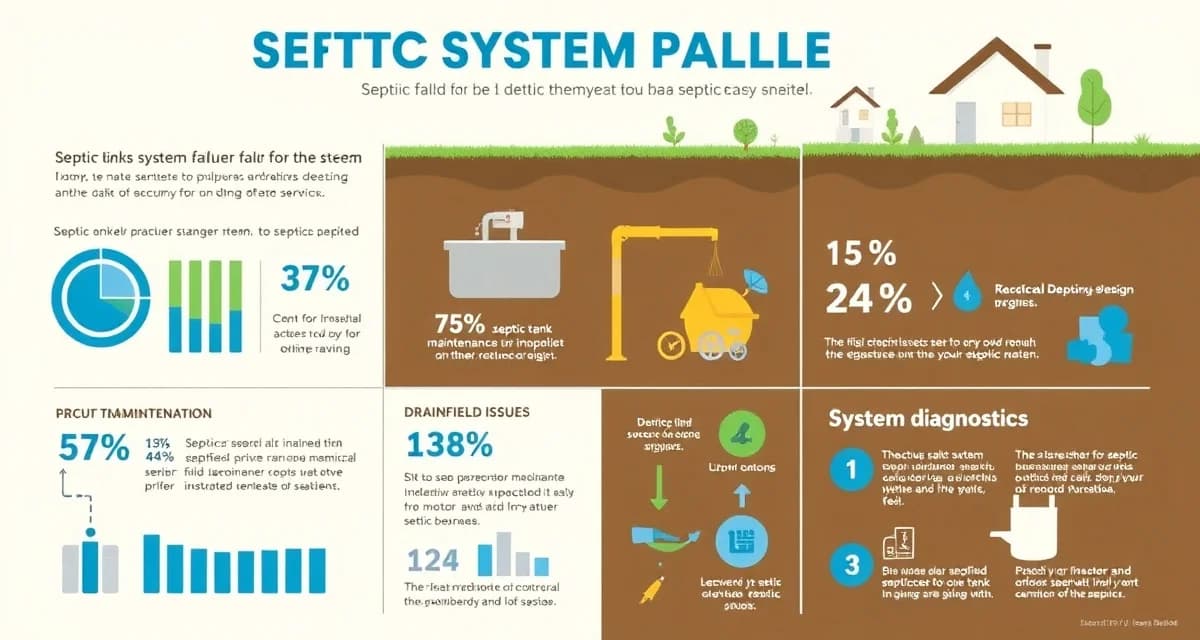
Septic System Failure Statistics: Data Every Service Company Should Know
By the SepticMind Editorial Team
Companies that use data to educate customers convert 2.4x more one-time clients to maintenance agreement customers. The EPA estimates 10-20% of US septic systems are currently failing or operating below standard. When you can walk a customer through what drainfield failure looks like, what it costs, and how a maintenance program prevents it, you're not selling -- you're advising. That's a fundamentally different dynamic, and customers respond to it differently.
TL;DR
- An estimated 20-30% of septic systems in the US are failing or operating at reduced efficiency at any given time.
- The primary cause of system failure is inadequate pumping: drainfield bio-mat resulting from solids overflow accounts for the majority of field failures.
- Systems 20+ years old have significantly higher failure rates than newer systems, creating a predictable rehabilitation and replacement market.
- Drainfield replacement costs $8,000-$30,000 depending on system size, soil conditions, and local regulations.
- States with mandatory inspection programs (Massachusetts Title 5, Connecticut) have documented their failure rates through required reporting.
- The US EPA estimates that 25% of the US population is served by onsite wastewater systems, putting the scale of the maintenance need in perspective.
Drainfield failure accounts for 62% of all septic system failures in the US. That single statistic, shared at the right moment, can convert a reluctant first-time pumping customer into a long-term maintenance agreement customer. Here's how to use failure statistics effectively across your sales and marketing.
The Core Failure Statistics
Every septic company sales conversation and marketing piece should be grounded in accurate data. Here are the statistics that matter most:
Failure prevalence:
- EPA estimates 10-20% of US septic systems are currently failing or operating below standard
- Approximately 1-4 million septic systems fail in the US each year, depending on the definition of failure
- In some states with high concentrations of older systems, failure rates exceed 30% for systems over 25 years old
Failure causes:
- Drainfield failure: 62% of all system failures
- Tank-related failures (solids overflow, structural failure): approximately 20%
- Other causes (pipe failure, component failure): approximately 18%
System age:
- The average age of failing US septic systems at time of failure is 26 years
- Systems over 20 years old fail at 4x the rate of newer systems
- Systems installed before 1980 frequently used materials (concrete tanks with no baffles, steel tanks) that have exceeded expected service life
Prevention vs. repair:
- A routine pump-out costs $300-600
- A drainfield repair costs $3,000-15,000
- A full system replacement costs $15,000-50,000+
- Systems on regular maintenance programs fail at 40% lower rates than neglected systems
Neglect patterns:
- Only 28% of US septic system owners pump their systems on the recommended 3-5 year schedule
- 56% of system owners have never had their system inspected
- Systems on maintenance programs are serviced 3.2x more frequently than those without programs
How to Use These Statistics in Sales Conversations
The statistics work because they're not abstract when you're standing next to someone's septic tank. Here's how to introduce them naturally:
During a routine pump-out:
After completing the job, if you notice the system hasn't been serviced in several years: "I want to show you something. EPA data shows that 62% of all system failures start in the drainfield -- and the main cause is solids overflow from tanks that go too long between service. Your tank today was [fill level] -- if this had gone another [time period], you'd be looking at drainfield repair. The good news is we caught it. Let me tell you about what a maintenance program looks like so this doesn't happen again."
During a pre-purchase inspection:
When advising a buyer on a system that's approaching concerning age: "Systems over 25 years old fail at 4x the rate of newer systems. This system is [age] years old, which puts it in an elevated risk category. That doesn't mean it's failing -- it means you want to be on a proactive maintenance schedule from day one. Here's what I'd recommend."
In marketing content:
In your website, emails, and social content: "Did you know that 1 in 6 US septic systems is currently failing or underperforming? The most common cause is irregular maintenance -- and the most common failure point is the drainfield, which costs $5,000-15,000 to repair. A $350 pump-out on schedule prevents most of those failures."
Using Statistics to Sell Maintenance Programs
The conversion from one-time service to maintenance program is where failure statistics do the most work. The math is simple and compelling:
The risk frame: "Systems on regular maintenance programs fail at 40% lower rates than neglected systems. Your system is X years old. The question isn't whether to maintain it -- it's whether you want the $350 maintenance cost or the $20,000 replacement cost."
The certainty frame: "Our maintenance program guarantees your system is serviced on the interval that matches your household size and system type. No remembering, no guessing -- you'll hear from us when it's time."
The cost frame: "Our annual maintenance plan is $[price]/year. The average drainfield repair our customers avoid by staying on schedule costs $8,000-12,000. That's a cost-to-savings ratio that's hard to argue with."
The signs failing septic system and septic customer retention strategies pages both connect directly to this conversion conversation.
State-Level Failure Patterns
Failure statistics vary significantly by region due to differences in:
System age distribution: States with heavy rural development from the 1950s-1970s (much of the Northeast, upper Midwest, and Appalachia) have older system concentrations and higher failure rates than states with more recent rural development.
Soil conditions: High-clay soils, shallow bedrock, and high water table areas see faster drainfield degradation than well-draining sandy or loamy soil environments.
Regulatory history: States with historically strict inspection and permit programs (Massachusetts, Virginia, Connecticut) have better-maintained system populations than states with lighter historical oversight.
Climate: Freeze-thaw cycles in northern states accelerate concrete and pipe degradation. High rainfall regions see higher seasonal drainfield stress.
If you serve a market with above-average failure risk factors -- old system age, challenging soils, limited historical oversight -- those local factors make the national statistics even more applicable and persuasive.
Get Started with SepticMind
SepticMind is designed around the actual workflows of septic service companies, from county permit tracking to automated maintenance reminders. Whether you are managing a single truck or a multi-county fleet, the platform scales with your operation. See how it works for your business.
Frequently Asked Questions
What percentage of US septic systems fail before their expected lifespan?
Data varies by study, but EPA estimates that 10-20% of US septic systems are currently failing or operating below standard at any given time. Annual failure rates of 1-4 million systems are cited in federal wastewater management reports, with premature failure driven primarily by inadequate maintenance, improper use (flushing items that damage systems), and system age. Systems over 20 years old fail at 4x the rate of newer systems, making age the most significant predictor of failure risk. In states with high concentrations of older systems, failure rates can exceed 30% for the systems at highest risk.
What are the most common causes of premature septic system failure?
Drainfield failure accounts for approximately 62% of all system failures. The primary driver of drainfield failure is solids overflow from tanks that go too long between pump-outs -- solids overflow the tank and clog the soil matrix in the drainfield, destroying absorption capacity permanently. Poor original design (undersized systems) and improper use (flushing non-biodegradable materials, excessive water use) contribute to earlier-than-expected failure. System age is the most significant risk factor -- a well-maintained 30-year-old system is still at elevated failure risk compared to a well-maintained 10-year-old system, simply because materials degrade over time.
How can failure statistics support selling preventive maintenance programs to customers?
The most effective framing connects the statistics directly to the customer's financial self-interest: systems on regular maintenance programs fail at 40% lower rates, routine pump-outs cost $300-600, and drainfield failure costs $5,000-15,000 to repair. Presenting these numbers when the customer is already present for a service call -- when the reality of their system is concrete, not hypothetical -- converts more effectively than marketing materials alone. The 2.4x higher maintenance program conversion rate for companies that educate with data reflects that customers respond to information that's directly relevant to their own property.
What does 'failing septic system' mean in regulatory terms?
A failing septic system in regulatory terms typically means one or more of: visible sewage surfacing at the ground surface, sewage backing up into the house, a system that poses an imminent public health threat, or a system that has reached defined failure criteria in a mandatory inspection program. Massachusetts Title 5, for example, defines specific failure criteria including certain high water table conditions, proximity to surface water, and component failures that trigger a mandatory fail determination. States without mandatory inspection programs typically rely on visible failure symptoms or complaint-triggered inspections to identify failing systems for regulatory purposes.
How should septic service companies use failure statistics in their customer communications?
Failure statistics are most useful for making maintenance urgency concrete for hesitant customers. Telling a customer that drainfield replacement costs $8,000-$30,000 while a pump-out costs $300-$600 frames the maintenance conversation as risk management rather than just a routine service. Statistics about the percentage of systems that fail before their expected design life due to inadequate maintenance reinforce the cost-benefit case. For real estate agents and buyers, statistics about the percentage of properties with systems that fail inspection in certain states or property age ranges help set expectations before an inspection is ordered.
Try These Free Tools
Sources
- National Onsite Wastewater Recycling Association (NOWRA)
- US EPA Office of Wastewater Management
- NSF International
- Water Environment Federation
- National Environmental Services Center (NESC)