Septic system enzymes: do they actually work?
By the SepticMind Editorial Team
TL;DR
- Septic enzyme and bacterial additives claim to improve system performance, but the EPA and most state extension programs find no reliable evidence they help a properly functioning system.
- A healthy septic tank grows its own bacterial community.
- Additives won't replace regular pumping, can't fix a failing drain field, and a few formulations can actually harm your system.
What are septic system enzymes and how are they supposed to work?
Septic enzyme additives are packaged products, usually sold as tablets, powders, or liquids, that contain either enzymes, live bacteria cultures, or both. The pitch is simple: pour them down the toilet monthly and they'll break down waste faster, cut sludge buildup, and keep your drain field healthy.
Enzymes are proteins that speed up chemical reactions. In a septic context, the relevant ones are lipases (fats), proteases (proteins), and cellulases (paper and plant material). Bacteria produce these enzymes naturally as they digest organic waste. So the question isn't whether enzymes matter in a septic tank. They clearly do. The question is whether adding more of them from outside the tank changes anything you'd notice.
Most products contain one of two things, or both. The first is concentrated enzyme solutions made from fermentation. The second is dried or encapsulated bacterial strains, often Bacillus species, marketed as "seeding" the tank with extra microbes. Some products also throw in surfactants or other chemicals, which is where things get more complicated and occasionally more dangerous.
A working septic tank already hosts billions of bacteria per milliliter of liquid [1]. The biological community that digests your household waste manages itself under normal conditions. Whether you're pouring in extra players matters far less than whether you're killing off the ones already there.
Does the EPA say septic enzyme additives are worth using?
The EPA's SepticSmart program is about as direct as a federal agency gets. Its guidance says research has not shown that the biological and chemical additives on the market are necessary or beneficial to a well-functioning septic system [2]. That's not a soft maybe. That's the agency saying the evidence isn't there.
The EPA also warns that some additives can harm the system or contaminate groundwater, especially products with organic solvents or strong surfactants. These can dissolve the grease layer in the tank, push partially treated solids into the drain field, and clog the soil pores that do the final treatment work.
SepticSmart's core advice is to pump regularly, protect the drain field, and avoid flushing harmful products. Enzyme additives don't show up on the recommended list. They show up in the cautionary discussion.
This doesn't mean every product is useless. It means the EPA, reviewing available research, couldn't endorse the category. Individual products haven't been proven to cause widespread harm either, with one exception: additives with chemical solvents, which have documented cases of contaminating groundwater and are banned in some states [3].
What does independent research actually show about septic additives?
The most cited independent review comes from University of Minnesota Extension researchers, who examined 22 commercially available septic additives. The study found no statistically significant improvement in septic tank effluent quality from any tested product compared to control tanks [4].
University of Wisconsin Extension reached the same conclusion: no documented evidence that biological additives improve the performance of a normally operating septic system [10]. Their position, echoed by extension programs in North Carolina, Virginia, and Pennsylvania, is that additives are an unnecessary expense for a system handling normal household wastewater.
Nobody has great long-term data here. Most studies run one to two years in controlled conditions, and real septic systems are messier than a controlled tank. It's possible some bacterial products give a marginal benefit in specific situations, like after a tank has been pumped clean and needs to rebuild its microbial community, but that use case hasn't been proven rigorously either.
Here's the honest read of the literature. No study has shown consistent, repeatable benefit from enzyme or bacterial additives in normally functioning systems, and a few studies have documented harm from chemical additive products [3].
| Product Type | Proven Benefit? | Potential Harm? | EPA Stance |
|---|---|---|---|
| Biological (bacteria) | No evidence | Low risk | Not recommended |
| Enzyme-only | No evidence | Low risk | Not recommended |
| Chemical solvents | No evidence | Yes, documented | Avoid / banned in some states |
| Yeast (folk remedy) | No evidence | Very low risk | Not addressed |
| Combined bio+enzyme | No evidence | Low risk | Not recommended |
Can enzymes or bacteria additives reduce how often you need to pump?
This is the claim marketing leans on hardest, and it has the clearest answer: no. No credible study has shown that enzyme or bacterial additives cut sludge accumulation enough to stretch pumping intervals.
Sludge builds up in the bottom of your tank because not everything gets fully digested. Inorganic material, like grit and non-biodegradable solids, doesn't break down at all. Even the biological fraction only breaks down so far before the leftover matter settles. Bacterial communities, no matter how large or active, can't remove the need to physically pump out accumulated solids.
The standard pumping recommendation from the EPA and most state programs is every three to five years for a typical household [2]. Some states, including North Carolina and Massachusetts, set specific intervals by tank size and household size that homeowners are legally required to follow [5]. No state I'm aware of offers a regulatory exemption from pumping based on additive use.
If a salesperson says their product lets you skip a pump-out, reject the claim. A pump-out costs $250 to $600 in most markets [6]. A failing drain field costs $3,000 to $15,000 or more to repair or replace [7]. Skipping needed maintenance to save on service never pencils out, whatever's in the bottle.
For a detailed look at pumping schedules and what drives them, see our guide to how often to pump septic tank.
Are there any situations where a septic additive might actually help?
There are a handful of situations where biological additives have at least a plausible rationale, even if the evidence stays thin.
After a tank has been pumped completely clean, the bacterial community gets partially disrupted. Some practitioners suggest adding a bacterial starter here to rebuild the population faster. The theory is reasonable. The evidence that it makes a measurable difference is not strong. Your tank will re-populate on its own within a few weeks under normal use.
If a household has taken heavy antibiotics for a long stretch, or if a big bleach spill went into the drain system, the bacterial community could be genuinely suppressed. A targeted bacterial product might speed recovery. But that's a specific scenario, not a reason to dose the tank every month.
Some contractors report anecdotally that biological additives help with odor in certain edge cases, though the mechanism isn't well documented. Persistent odor is usually better traced to the real cause: a cracked inlet baffle, a venting issue, or a failing effluent filter.
For most homeowners with a normally loaded, properly maintained system, enzyme additives are a solution looking for a problem. The system already has what it needs to do the job.
Which septic additive ingredients should you actually avoid?
Not all additives are equally harmless. The ones worth actively avoiding fall into a few categories.
Organic solvents, including methylene chloride and 1,1,1-trichloroethane, were common in older formulations and are now banned in several states because they can carry contaminants through the soil into groundwater [3]. Read labels for solvent-based ingredients and skip those products.
Strong surfactants can break up the floating scum layer in the tank. That layer sounds unpleasant, but it does a job: it holds down odors and slows oxygen infiltration. Break it up and you push grease and fats down toward the drain field, which speeds up clogging.
Products marketed with very high enzyme concentrations sometimes carry preservatives or stabilizers that aren't spelled out on the label. A vague ingredient list is a reason for skepticism.
Yeast, the folk remedy version, is basically harmless. Flushing a packet of active dry yeast every few months won't hurt your system, and there's no peer-reviewed evidence it helps either. Don't pay a premium for a product waving yeast around as a special ingredient.
If your state keeps an approved products list or additive rules, your state environmental agency's website is the most reliable way to know what's permitted where you live [5].
What actually keeps a septic system's bacteria healthy without additives?
Your septic system's bacterial community mostly runs itself if you don't actively wreck it. The real threats are things homeowners pour or flush, not a shortage of microbes.
Antibacterial soaps, bleach, and disinfectants in large amounts can suppress bacterial activity. This doesn't mean you toss out every cleaning product. Normal household use of bleach-based cleaners, in the amounts most people use, hasn't been shown to crash a tank's bacterial population in peer-reviewed studies. Dumping a whole bottle of bleach into a toilet, or running industrial disinfectants regularly, is a different story.
Flushable wipes, feminine hygiene products, grease, and medications are more immediate threats to system function than bacteria levels. They either clog pipes and baffles or, in the case of pharmaceuticals, pass through the tank and hit the environment downstream.
The practices that genuinely protect your bacterial community cost nothing. Spread laundry across the week instead of six loads on Saturday. Fix leaky toilets so you're not hydraulically overwhelming the tank. Skip the garbage disposal on a septic system, or use it sparingly, because raw food waste jacks up the solids load.
For a full rundown of what regular maintenance looks like and why septic tank pumping is the single most important service you can schedule, that guide covers the mechanics in detail.
Operators tracking maintenance schedules and customer communications across many accounts often use platforms like SepticMind to manage service records and flag overdue pump-outs before a customer calls with an emergency.
How do you know if your septic system actually has a bacterial problem?
Most of the time, you don't, because most functioning septic systems don't have bacterial problems in any real sense. What looks like a "bacterial problem" is usually mechanical or hydraulic: a full tank, a clogged inlet baffle, a saturated drain field, or a broken distribution box.
Signs that something is genuinely wrong include slow drains throughout the house (more than one fixture), sewage odors inside or outside, wet or soggy ground over the drain field, or sewage backup. None of these reliably point to a bacterial shortage an additive could fix. All of them point to a professional inspection.
A septic tank inspection by a licensed inspector tells you whether your tank has the right sludge-to-liquid ratio, whether the baffles are intact, and whether effluent is reaching the drain field at the right quality. That information is actionable. A bacterial count of your tank water is not something most inspectors do, and the results wouldn't tell you much anyway given how much microbial populations naturally swing.
If your system has a specific problem, like a partially failing leach field, the fix is almost certainly physical, not biological. No enzyme product will restore soil permeability in a clogged drain field.
Are septic enzyme additives regulated, and are any products actually certified?
Federal regulation of septic additives is loose. The EPA does not approve or certify septic additive products, and no federal certification standard exists for this category [2]. The market is essentially unregulated at the federal level, which is part of why marketing claims can be so bold and so free of evidence.
State-level regulation varies widely. Some states take a hands-off approach. Others, including Washington and Wisconsin, keep lists of approved or prohibited additives. A few states require that any additive sold in-state disclose its full ingredient list to the state environmental agency.
The National Sanitation Foundation offers a certification standard, NSF/ANSI 46, for septic additives that covers ingredient disclosure and label accuracy, but the standard does not certify that a product actually improves septic system performance [8]. NSF certification means the label is honest, not that the product works.
If you're an operator advising clients, the most defensible line is this: no additive has been independently certified as effective, the EPA does not recommend them, and the money is better spent on scheduled maintenance. That advice holds up in any state.
For context on what legitimate septic services cost and what they include, the guides on septic tank cleaning and septic tank pump out break down those services and their pricing.
How much do septic enzyme products cost, and is the money worth it?
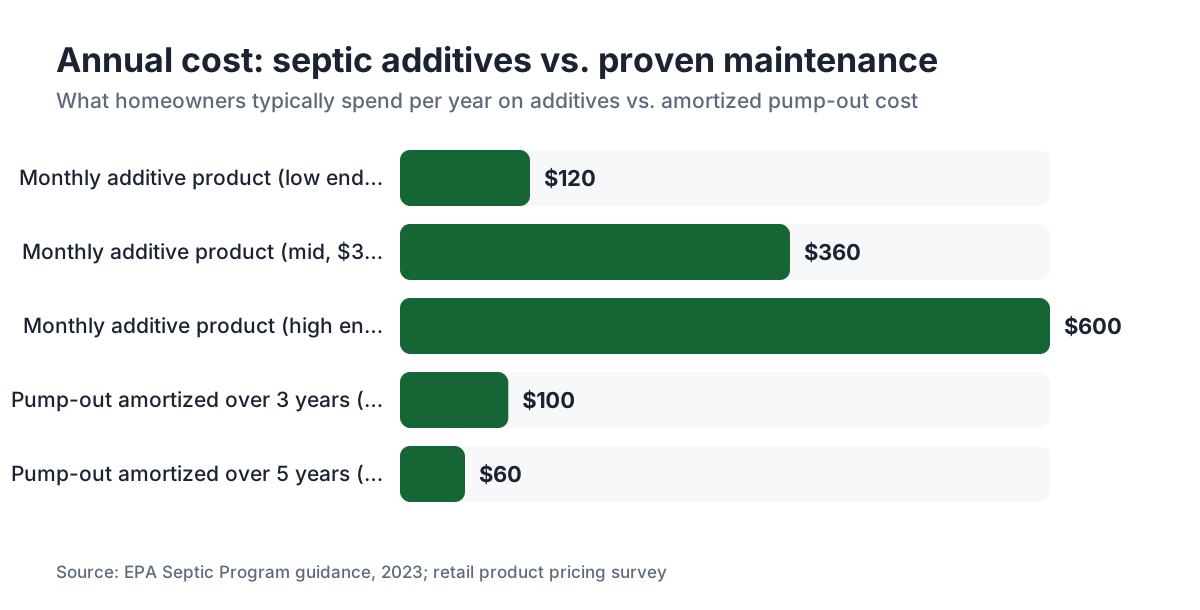
Retail enzyme and bacterial additives typically run $10 to $50 per month when used as directed, depending on format and brand. Annual cost lands between $120 and $600 for a homeowner using them consistently.
Over the three-to-five-year interval between pump-outs, that's $360 to $3,000 on a product with no documented benefit in a normally functioning system. Compare that to the $250 to $600 cost of a professional pump-out, which has a clear, documented job: removing accumulated solids the biology cannot eliminate.
The math is straightforward. Spend $30 a month on additives ($360 a year) instead of putting that money toward prompt inspection and pumping, and you're picking an unproven product over a proven one. A properly timed pump-out is the single maintenance action with the clearest documented link to longer system life.
There are cases where spending $10 on a bacterial packet after a pump-out feels like cheap insurance and does no harm. That's a reasonable call. Signing up for a monthly subscription to dose your tank year-round is much harder to justify on the evidence.
If your system needs actual repair, no additive substitutes for that. The costs for septic system repair or a full septic tank repair dwarf what you'd spend on additives, which is exactly why mechanical maintenance matters more than supplemental biology.
What do septic service professionals actually think about enzyme products?
Opinions among licensed pumpers and system designers run from mild skepticism to flat dismissal, with a small minority who think biological starters have situational value.
The National Association of Wastewater Technicians doesn't recommend routine additive use. Most state septic professional associations line up with the EPA position that properly functioning systems don't need supplemental bacteria or enzymes [9].
Pumpers who've been at it for decades often report seeing no meaningful difference in tank condition between households that dose additives religiously and those that don't, once you control for household size and water use. Anecdotes aren't data. But consistent field experience across thousands of tanks carries some weight.
The pros most likely to see a benefit from biological products are those working on stressed systems: overloaded, sitting unused for a long stretch, or hit by chemical disruption. In those edge cases, a concentrated bacterial inoculant might speed recovery. Those cases are the exception.
SepticMind's operator community includes hundreds of licensed service providers across multiple states, and the conversations there track what the literature shows. Scheduling and physical maintenance drive system longevity, not what's poured in between pump-outs.
For homeowners trying to nail down the right service cadence, our guide on how often to pump septic tank walks through the EPA's household-size and tank-size framework in detail.
Frequently asked questions
Do septic enzyme tablets actually prevent drain field failure?
No. Drain field failure is almost always caused by hydraulic overload, biomat buildup from solids escaping the tank, or soil compaction. Enzyme tablets address none of these. The only interventions with documented effectiveness are regular pumping to keep solids low, reducing water use, and in some cases aeration or field resting. No additive product has been shown to restore a failing drain field.
Is it safe to use Rid-X or similar products in my septic tank?
Rid-X and similar biological additives contain Bacillus bacteria and enzymes and are generally low-risk for the tank itself. They won't damage your system. But the EPA's guidance and independent research don't support the claim that they improve performance or cut pumping needs. You can use them without worrying about harm, but don't expect measurable benefit from a normally functioning system.
Can I add yeast to my septic tank to help bacteria?
Flushing active dry yeast is a common folk remedy. It's essentially harmless and costs almost nothing. Yeast does produce enzymes during fermentation, but there's no peer-reviewed evidence that occasional yeast additions make a meaningful difference to a functioning tank. If you want to try it, it won't hurt anything. It also probably won't help. Save the real money for scheduled pump-outs.
How long does it take for bacteria to establish in a new septic tank?
A newly installed or freshly pumped tank typically builds a working bacterial community within two to four weeks of normal household use. The bacteria come from the wastewater itself. You don't need a starter product to seed the tank, though some contractors add a small amount of existing sludge back after pumping to jump-start the process. Normal use is enough.
Do antibiotics flushed down the toilet kill my septic bacteria?
Normal antibiotic excretion from a person taking a typical prescription course has minimal effect on the tank's microbial community, given how much dilution is involved. Flushing unused antibiotic pills is a different concern, more for groundwater than bacterial kill. The bigger threat to your tank bacteria is concentrated disinfectants like bleach used in large amounts, not trace pharmaceutical residues.
Are there any states where septic additives are banned or regulated?
Yes. Several states regulate or ban specific additive types. Products with organic solvents like methylene chloride have been banned in multiple states over groundwater contamination risk. Washington State maintains a list of approved additives. Wisconsin requires ingredient disclosure. If you're unsure about your state, check with your state's department of environmental quality or onsite wastewater program before buying a product.
What kills septic tank bacteria the fastest?
Large amounts of concentrated bleach or disinfectants flushed straight into the drain system pose the greatest risk. Extended or industrial use of antibacterial cleaning products can suppress populations over time. Gasoline, paint solvents, and other chemicals should never enter the system. In practice, most normal household chemical use doesn't create a serious bacterial problem. The tank is more resilient than marketing copy suggests.
Should I add bacteria to my septic tank after it's been pumped?
It's a common recommendation, but the evidence behind it is thin. Your tank rebuilds its bacterial community naturally through normal wastewater flow within a few weeks. Some pumpers add a small bucket of the removed sludge back as a starter, which has more biological logic than a packaged product. If you want to add a commercial bacterial product post-pump, it's unlikely to harm anything, but it's probably not necessary.
What is the difference between septic enzymes and septic bacteria additives?
Enzyme products contain pre-made proteins that catalyze breakdown reactions but don't reproduce. Bacterial products contain live or dormant microorganisms that reproduce and make their own enzymes. Many commercial products contain both. Bacteria-based products have a more plausible mechanism since they can establish in the tank environment, but neither type has shown consistent, measurable benefit in independent research compared to control systems.
Can septic enzyme additives damage my pipes or tank components?
Biological enzyme and bacterial products generally don't damage pipes, concrete tanks, or plastic components. Chemical additives with organic solvents are the exception and can degrade certain materials and contaminate groundwater. Always read the ingredient list and avoid any product with solvent-based ingredients. If a product claims it dissolves grease or roots, look closely at what chemicals are doing that work.
How do I know if my septic tank bacteria are healthy?
There's no simple home test. A healthy system shows no odors indoors, normal drain speed throughout the house, no wet spots over the drain field, and no sewage backup. If everything is working normally, your bacterial community is almost certainly fine. If you see warning signs, the issue is more likely mechanical than microbial. Have a licensed inspector check the tank and baffles rather than assuming biology is the problem.
Do septic enzyme products affect the drain field or leach field?
Biological enzyme products have minimal direct effect on the drain field under normal use. Chemical solvent-based additives can push fats and partially treated solids into the drain field, speeding up biomat buildup and clogging. Properly functioning tank biology, whether natural or supplemented, should produce effluent that doesn't overload the soil. If your drain field is struggling, the cause is almost certainly tank management or hydraulic load, not enzyme activity.
Sources
- EPA, Septic Systems Overview: Functioning septic tanks host large, self-regulating microbial communities that naturally digest household wastewater
- EPA, SepticSmart Program Guidance: EPA SepticSmart states: 'research has not shown that the biological and chemical additives on the market are necessary or beneficial to a well-functioning septic system'
- EPA, Septic System Additives: Chemical solvent-based additives have documented cases of groundwater contamination and are banned in some states
- University of Minnesota Extension, Septic System Additives Review: A review of 22 commercial septic additives found no statistically significant improvement in effluent quality compared to control tanks
- Massachusetts Department of Environmental Protection, Title 5 Septic Systems: Some states set legally required pumping intervals and maintain additive rules through their environmental agencies
- EPA, Septic System Costs and Maintenance: Professional septic pump-out costs approximately $250 to $600 in most markets
- EPA, Septic System Repair and Replacement: Drain field repair or replacement can cost $3,000 to $15,000 or more depending on system type and soil conditions
- NSF International, NSF/ANSI Standard 46: Evaluation of Components and Devices Used in Wastewater Treatment Systems: NSF/ANSI 46 certifies ingredient disclosure and label accuracy for septic additives, not that a product improves system performance
- National Association of Wastewater Technicians (NAWT), Best Practices: Professional wastewater technician associations generally do not recommend routine additive use for properly functioning septic systems
- University of Wisconsin Extension, Septic System Care: University of Wisconsin Extension found no documented evidence that biological additives improve performance of a normally operating septic system
Last updated 2026-07-09