Septic system drain field: how it works, fails, and gets fixed
By the SepticMind Editorial Team
TL;DR
- A septic drain field (also called a leach field) is the network of perforated pipes buried in gravel trenches that returns clarified wastewater to the soil.
- It's the most expensive part to replace ($5,000 to $20,000+), the one that fails most often, and the one homeowners ignore until the yard smells.
- Regular pumping, water conservation, and keeping vehicles and roots off the field are the only reliable ways to extend its life.
What is a septic system drain field and how does it work?
The drain field is where your septic system actually treats wastewater. Solids settle in the tank. The liquid effluent that floats off the top flows by gravity (or by pump, in pressure-dosed systems) into a distribution box, then out through perforated pipes buried in shallow trenches filled with washed gravel or crushed stone. Effluent seeps through the pipe holes, trickles down through the gravel, and enters the native soil below, where bacteria and other soil organisms break down remaining pathogens and nutrients before the water reaches groundwater.
The soil under the gravel does the real treatment work. The EPA describes this zone as the place where "most of the treatment of wastewater occurs," and points to a healthy biomat, a thin layer of organic material that forms at the soil-gravel interface, as the thing that slows effluent movement just enough to let treatment happen [1]. Let that biomat get too thick, from overloading or skipped pump-outs, and it seals the field shut.
A standard gravity-fed drain field for a three-bedroom home usually covers 300 to 900 square feet of trench area [10]. The actual footprint depends on your soil's percolation rate, local code, and the number of bedrooms. States set these sizing rules on their own, and most follow the EPA's Onsite Wastewater Treatment Systems Manual or their own onsite wastewater code [2].
Some systems use chambers (plastic arched units instead of gravel), drip irrigation lines, or mound systems when the soil is poor. They all do the same job: get treated effluent into the soil safely. The gravel-trench design is still the most common in the U.S.
For more on the distribution side of the system, see our guide to leach field basics.
What are the main types of drain fields?
Not every lot gets a standard trench system. Soil type, depth to groundwater, lot size, and slope all drive the design a licensed site evaluator or engineer recommends.
| System type | Best soil condition | Relative install cost | Notes |
|---|---|---|---|
| Gravity trench (gravel) | Sandy loam, good perc | Lowest | Most common; passive, no mechanical parts |
| Chamber system | Similar to gravel trench | Slightly higher | Plastic arches replace gravel; easier inspection |
| Mound system | High water table, slow perc | High ($10,000, $20,000+) | Engineered fill mound above grade |
| Drip irrigation | Various | High | Pressurized, requires pump and timer |
| Aerobic treatment unit (ATU) | Tight soils, small lots | Highest | Pre-treats effluent before field; requires maintenance contract |
| Seepage pit / cesspool | Deep permeable soils | Low (but often illegal now) | Banned in many states; not a true drain field |
Mound systems and ATUs are what you get when a standard trench won't pass a perc test. They're not exotic. In states with shallow bedrock or heavy clay (parts of Minnesota, Wisconsin, and the Mid-Atlantic), mound systems are routine [3]. You pay for it in mechanical complexity and higher upkeep.
If your property has no conventional drain field at all, you're likely on a cesspool, a holding tank, or an aerobic system. A septic system without drain field setup almost always means more frequent pump-outs or a mechanical treatment unit under an annual service contract.
How do you know if your drain field is failing?
The signs are hard to miss once you know them, and easy to explain away until they get expensive. Soggy or spongy ground over the field during dry weather is the loudest one. Effluent is surfacing because the soil can't absorb it fast enough anymore.
You might smell sewage outside near the field, or inside the house. Slow drains, gurgling when you flush, and sewage backups are late-stage signs. They mean the field is so clogged that effluent has nowhere to go but back up the pipes.
Bright green stripes of grass directly over the trenches are an early warning. Grass over a healthy field looks about the same as the grass around it. Lush stripes mean nutrients and effluent are near the surface.
A site visit from a licensed inspector tells you more. A probe-and-observation visit costs roughly $100 to $300 and can separate a temporarily saturated field (maybe fixable) from a fully failed one (replacement territory). A camera inspection of the distribution lines runs $200 to $500 and sometimes finds a broken pipe instead of failed soil, which is a far cheaper fix [4].
Run the septic tank inspection step before you blame the field. A full tank pushes solids into the field and mimics drain field failure when the real fix is a pump-out.
What causes a septic drain field to fail?
Most drain field failures trace back to one of four causes. Three of them are preventable.
Solids carryover from the tank. This is the most common cause. When the tank isn't pumped often enough, the sludge layer rises until solids spill into the drain field pipes. Those solids clog the gravel, starve the biomat of oxygen, and eventually seal the soil pores. The EPA's SepticSmart program is blunt about it: "Have your septic system inspected and pumped regularly" is their lead recommendation precisely because it protects the field [1].
Hydraulic overload. More water through the system than it was built for. A family of six in a house permitted for three bedrooms. A leaking toilet running 200 gallons a day. A water softener discharging into the septic. All the laundry crammed into Saturday morning instead of spread across the week. Any of these can saturate a field faster than the soil recovers.
Driving or parking over the field. Compaction crushes the pore space the system depends on. A loaded pickup is enough. And it's essentially permanent without digging the field back up.
Root intrusion. Tree and shrub roots chase moisture and nutrients straight into drain field pipes. Willows, poplars, and silver maples are the worst offenders. A single tree planted 20 years ago can send roots 50 feet or more from the trunk [5]. Most codes want 10 to 25 feet of clearance between plantings and the field, but clearance doesn't stop roots from traveling.
Other causes: biomat buildup from heavy grease, chemical damage from solvents or a flood of antibacterial products down the drain, and plain age. Most fields have a design life of 20 to 30 years, though well-maintained ones can run 40 or more.
Can you repair a failing drain field, or does it need full replacement?
Sometimes you can save it. Sometimes you're just delaying the funeral. The honest answer depends on why it failed.
A single broken pipe or a cracked distribution box is a cheap, clean fix ($500 to $2,500 typically). Dig up the damaged section, replace it, backfill. A camera inspection pins down exactly where the break is.
A field that got overwhelmed by a stretch of wet weather or a short-term overload sometimes recovers with rest. That means diverting flow to a reserve field if you have one, cutting water use hard, and giving the soil weeks or months to dry out. No guarantee, but it costs nothing but time.
When the soil is fully clogged with biomat, there are products sold as septic drain field cleaner treatments (mostly bacterial or enzyme additives) plus aeration devices that claim to break up biomat and restore percolation. The evidence is thin. A University of Minnesota Extension review found no consistent, peer-reviewed evidence that biological additives improve drain field performance, and warned that some products with chemical solvents can damage the system or contaminate groundwater [6]. Some installers report anecdotal success with Terralift-style air-injection equipment, which fractures compacted soil and injects polystyrene pellets to hold the fissures open. Talk to a licensed installer about it if you want, but go in skeptical and get any guarantee in writing.
Full replacement is almost always the answer when the soil has been overloaded for years, when effluent surfaces over a large zone, or when a perc test confirms the native soil no longer accepts water. At that point you're excavating the old field, maybe importing new fill, redesigning the layout, pulling permits, and installing fresh lines.
For the full contractor and permit process, our septic system repair guide walks through it step by step.
How much does drain field repair or replacement cost?
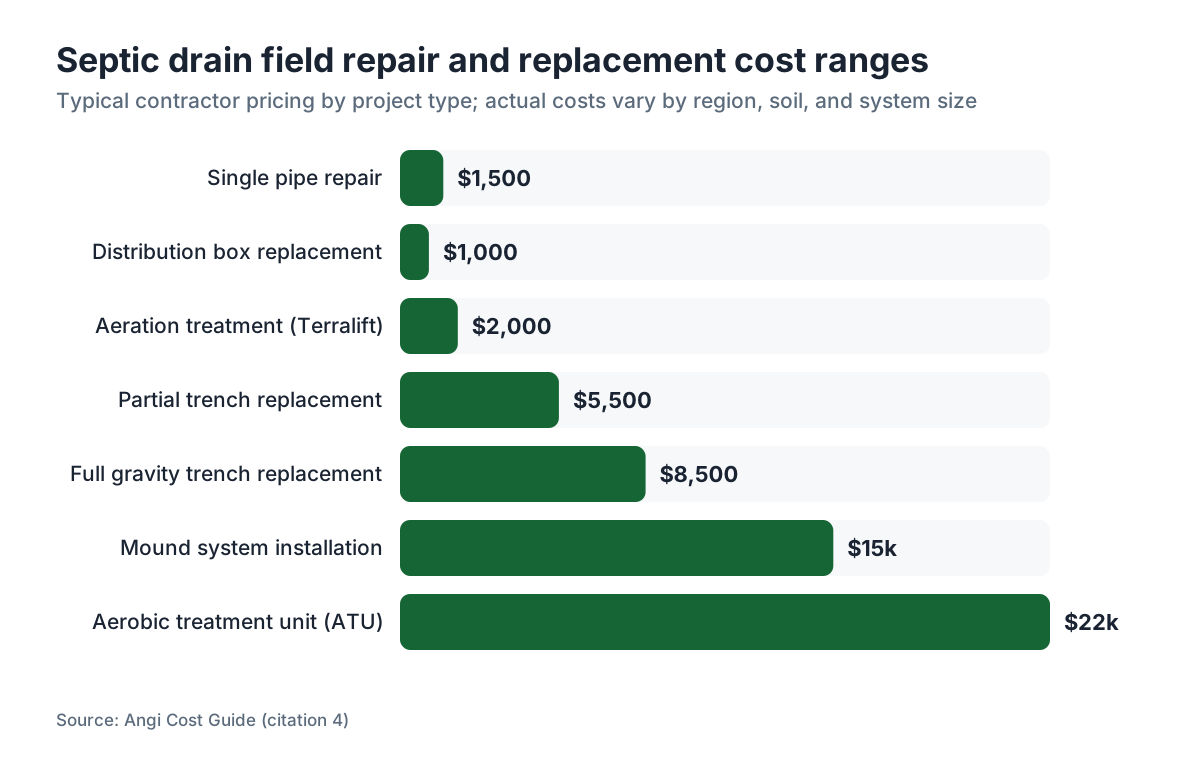
Drain field repair runs from about $500 for a single pipe fix to $30,000 for a new aerobic treatment unit. Full gravity trench replacement, the common big-ticket job, usually lands between $5,000 and $12,000. The number swings hard on region, soil, and system size. Here are honest ranges based on contractor pricing and industry data.
| Repair or replacement type | Typical cost range |
|---|---|
| Single pipe repair (spot dig) | $500, $2,500 |
| Distribution box replacement | $500, $1,500 |
| Terralift / aeration treatment | $1,000, $3,000 |
| Partial trench replacement | $3,000, $8,000 |
| Full gravity trench replacement | $5,000, $12,000 |
| Mound system installation | $10,000, $20,000+ |
| ATU (aerobic system) installation | $15,000, $30,000 |
Permit fees add $200 to $1,000 on top of installation, depending on state and county. Some states require a licensed engineer to design a replacement; that design fee alone runs $1,500 to $5,000 for complex sites [4].
Homeowner's insurance almost never covers drain field failure. Most policies treat it as a maintenance issue, not a sudden accidental loss. Read yours. A few cover sudden collapse or accidental breakage but exclude failure from neglect.
For total project pricing on a new system (tank, lines, permit), see the cost to install septic system article.
One more thing. Replacing a failed field while the house is on the market almost always costs more under time pressure. Get at least three bids, ask each contractor to itemize permit fees separately, and confirm the contractor is licensed in your state for onsite wastewater work.
How do you maintain a drain field to make it last?
The maintenance list is short. The discipline is the hard part.
Pump the tank on schedule. For most households that's every three to five years, though annual pumping is smarter for garbage-disposal-heavy homes or large families. Solids carryover is the single biggest killer of drain fields, and pumping is the only way to stop it. Our how often to pump septic tank guide has a household-size calculator and the data behind those intervals. For the actual service, see septic tank pumping.
Spread laundry across the week. One household can push 300 to 400 gallons through the system on a Saturday laundry day. That slug hits the field all at once and can saturate trenches that would have handled the same volume fine over four days.
Fix leaking fixtures right away. A running toilet wastes 100 to 200 gallons per day, per EPA WaterSense [7]. Over a year that's 36,000 to 73,000 gallons of extra water through your field.
Keep vehicles off the field. All vehicles, always. A single compaction event can do damage that stays invisible for years.
Plant grass over the field and nothing else. No trees, no shrubs, no raised beds. Grass roots stay shallow, help pull moisture up, and leave the pipes alone.
Go easy on drain cleaners, bleach, and antibacterial soap. None of these kills your system by itself, but the soil bacteria doing the treatment work don't like a steady chemical load. The EPA recommends minimizing antibacterial product use in septic households [1].
For operators running multiple accounts, tracking pump-out intervals and field maintenance across a customer base is exactly the workflow SepticMind is built for. Service history and inspection data live in one place, so nothing slips.
Get a professional inspection every one to three years. A licensed inspector spots a struggling biomat or slightly saturated soil long before it surfaces in your yard. Catching it early is the difference between a $300 pump-out and a $12,000 replacement.
What regulations govern drain field installation and location?
Drain field rules are set at the state and county level, not federally, though the EPA publishes guidance most states reference [2]. Every state has onsite wastewater regulations that spell out minimum setback distances, trench depth, soil evaluation requirements, and design criteria.
Typical setback minimums you'll see across state codes:
| Feature | Common minimum setback |
|---|---|
| Property line | 5 to 10 feet |
| Water well (private) | 50 to 100 feet |
| Surface water (stream, pond) | 50 to 100 feet |
| Foundation / basement | 10 to 20 feet |
| Driveway / parking | 5 to 10 feet |
These are floors, not targets. Your county may require more. Many states also require a perc test or soil morphology evaluation by a licensed evaluator before issuing a permit. Virginia, for example, requires a licensed onsite soil evaluator and a separate installer license for any field work under its Sewage Handling and Disposal Regulations [8].
If you're buying, the septic tank inspection should always confirm the drain field sits in its permitted location and hasn't been altered without permits. Unpermitted modifications can trigger a required upgrade at sale.
The EPA's SepticSmart program (epa.gov/septic) is a solid starting point for federal guidance, and most state environmental or health department sites publish their actual code online. Search for "[your state] onsite wastewater regulations" to find the primary document.
What is a septic system without a drain field, and is it viable?
Some properties, especially older ones or those on tiny lots, have no conventional drain field. Instead they usually have one of three things: a cesspool (a buried pit that takes raw sewage and leaches it out with minimal treatment), a holding tank (no leaching at all, just storage you pump out on a schedule), or an aerobic treatment unit that produces highly treated effluent sent to surface drip or a very small dispersal area.
Cesspools are the most common "no drain field" situation on older properties. Most states banned new cesspool construction decades ago, and some have gone further. Hawaii, the most aggressive example, set deadlines under Act 125 requiring existing cesspools to be upgraded to permitted systems [9]. If you're on a cesspool, count on an eventual mandatory upgrade of $10,000 to $30,000+ depending on what the soil and lot allow.
Holding tanks stay legal in many states where no soil-based option exists (very small lots, very tight soils, closeness to water). The trade-off is pump-outs every few weeks at $200 to $500 each, which adds up to $3,000 to $6,000 a year [4]. That's a heavy operating cost next to a working drain field.
Aerobic systems with surface drip are increasingly common where soil is restrictive. They make cleaner effluent that needs less soil treatment, but they demand annual service contracts and electricity. A real solution, just a pricier and more hands-on one.
How do perc tests and soil evaluations affect drain field design?
Before any drain field gets permitted, the soil has to be tested to confirm it can handle the expected effluent load. Two methods are common: the percolation test (perc test) and the soil morphology evaluation.
A perc test measures how fast water moves through a saturated soil column. You dig test holes, pre-soak them for several hours or overnight, then time how long the water level takes to drop one inch. A result of 1 to 60 minutes per inch (MPI) is generally acceptable for a conventional trench system. Faster than 1 MPI (very sandy soil) may need a different design to give effluent enough treatment time. Slower than 60 MPI usually means the soil can't accept effluent fast enough, and a mound or ATU is needed [2].
Soil morphology evaluation is more reliable and increasingly preferred. A licensed evaluator reads a pit profile: soil color, texture, structure, and mottling (grayish or orange blotchy patterns that mark seasonal saturation). Mottling at shallow depth tells the evaluator where seasonal high groundwater reaches, which sets the minimum trench depth. Unlike a perc test, it doesn't require waiting for specific soil moisture conditions.
Both tests happen before permit issuance in virtually every state. If you're building new or replacing a system on a site that's never been tested, budget $300 to $1,000 for the evaluation. The evaluator decides more than whether a system is feasible; they decide what kind.
For new construction costs including site evaluation, the cost to put in a septic tank article breaks down what the full process typically runs.
How do you find and map your drain field?
Plenty of homeowners have no idea where their drain field is. That becomes a problem the day you plant a tree, build a deck, or hand a landscaper the keys to a skid steer.
Start with your property records. Most counties keep records of permitted septic systems, often called "as-built" drawings or site plans. Call your county health department or environmental services office and ask for the system record on file for your parcel. Many counties have digitized these, and some post them online.
If records are missing or the system predates permits, a licensed inspector can locate the field by probing the soil with a metal rod (feeling for gravel zones) or by running a camera or locating wire through the distribution lines. Ground-penetrating radar handles tough cases, though it costs more.
Once you find it, mark the corners with permanent stakes or GPS coordinates and sketch a simple diagram. Keep that diagram with your property records. Future owners and contractors will thank you. Our septic tank inspection guide explains what a professional inspection record should include.
For operators on SepticMind, attaching field location data and as-built scans to a customer's account means any technician on a service call can pull up the field map without phoning the office. That cuts time on every visit.
What should you do before buying a home with a septic drain field?
A real estate deal is the worst time to find a failing drain field. Repair costs can blow past the seller's concession ceiling, and some failures require full system replacement that stalls closing.
Always get a full septic inspection before you finalize the purchase, more than a tank level check. A proper inspection pumps the tank, inspects the baffles, checks the distribution box, and probes the drain field for surfacing effluent, compaction, or root intrusion. Some inspectors also run a load test, sending significant water through the system and watching how the field responds. Expect to pay $300 to $600 for a thorough one [4].
Ask for the permit history and any as-built drawings. Confirm the system was installed with permits and that no unpermitted additions were made. A second bedroom added without a permit often means the drain field was never resized for the extra load.
Ask when the tank was last pumped. If the seller can't produce a pump-out record from the last three to five years, budget for an immediate pump-out and inspection. Our septic tank pump out guide explains what that service should include.
If the inspection turns up concerns, get a field repair estimate from a licensed contractor (not the inspector) for a real number to negotiate with. Don't let a seller's "it works fine" stand in for documented evidence.
Frequently asked questions
How long does a septic drain field last?
A well-maintained conventional drain field typically lasts 20 to 30 years, and some run 40 or more. The biggest factors are pumping frequency, water use habits, soil type, and whether vehicles ever drove over the field. Neglected systems, especially those with rare pump-outs, often fail in under 15 years. There's no expiration date, but age plus any warning sign means it's time for a professional evaluation.
Can you use bleach or antibacterial cleaners with a septic drain field?
Occasional household bleach and antibacterial soap won't kill your drain field. Regular heavy use, like disinfecting with straight bleach daily or running commercial sanitizing wash cycles over and over, can knock back the bacteria in the tank and field that do the treatment work. The EPA recommends minimizing these products in septic households. Moderate, normal use is fine.
What can you plant over a drain field?
Grass, in most situations. Shallow-rooted ornamental grasses are fine. Trees and shrubs should stay at least 10 to 25 feet away (check your state code). Root intrusion from trees is a major cause of pipe damage. Skip vegetable gardens too: wastewater effluent can carry pathogens that may contaminate produce, and garden watering adds hydraulic load to a field that's already working.
Do septic drain field additives and cleaners actually work?
The evidence is thin. A University of Minnesota Extension review found no consistent peer-reviewed data showing biological additives improve drain field performance. Some enzyme and bacteria products are harmless and may offer minor benefit; others with chemical solvents can damage the system or groundwater. Aeration methods like Terralift have anecdotal support from some installers but lack controlled study data. Save the money for pumping and inspection unless a licensed pro recommends a specific treatment.
How many bedrooms can a drain field handle?
Drain fields are sized by expected daily flow, usually estimated at 75 to 150 gallons per bedroom per day depending on state code. A three-bedroom home might need a field designed for 300 to 450 gallons per day. Adding bedrooms without upgrading the system overloads it. If you're adding living space, check with your county health department before the renovation, not after.
What is the difference between a drain field and a leach field?
They're the same thing. "Drain field," "leach field," "absorption field," and "soil absorption system" all name the network of perforated pipes in gravel trenches that disperses septic effluent into the soil. Regional terminology varies. The EPA and most state codes use "soil absorption system" in formal documents. In everyday contractor talk you'll hear all four used interchangeably.
Can a drain field be repaired without full replacement?
Sometimes. Broken pipes or a cracked distribution box can be fixed for $500 to $2,500. A temporarily saturated field may recover with a rest period and reduced water use. Aeration treatments may help mild biomat cases. But if the soil itself is permanently clogged or the field has been overloaded for years, full replacement is usually the only reliable fix. Get an inspection before assuming the worst or the best.
How far does a drain field need to be from a well?
Most state codes require 50 to 100 feet of horizontal separation between a drain field and a private drinking water well. Some states require more, especially for sandy or fractured soils where pathogens travel farther. The EPA recommends 50 feet as a baseline, but your state code controls. Check the actual regulation for your state; your county health department can point you to it.
What happens if you ignore a failing drain field?
Effluent eventually surfaces in your yard, backs up into the house, or reaches groundwater or nearby surface water, all public health violations. Most states give homeowners a compliance deadline once a failure is documented, often 60 to 120 days, and can fine you for continued non-compliance. Beyond legal risk, a documented failed system makes the property very hard to sell and may require disclosure to buyers even after you fix it.
Does rain or wet weather damage a drain field?
Heavy rain temporarily raises the water table and can saturate the soil around the trenches, slowing or stopping percolation. It shows up as slow drains or minor surfacing during or right after a prolonged wet spell. That's usually temporary and clears as the soil drains. Repeated, prolonged saturation over many wet seasons can degrade soil structure, but one rainy season isn't a death sentence for a healthy field.
Is it legal to install a drain field yourself?
In most states, no. Onsite wastewater installation requires a licensed installer and a county permit, and the work must be inspected before backfill. A few states allow homeowner-installed systems on your own property with a permit, but even those require a soil evaluation by a licensed evaluator and design approval. Installing without permits creates serious liability at sale and can result in a mandatory removal and reinstallation order.
How do I know if my drain field is in the right place?
Request your system's as-built drawing from your county health department. It should show the tank, distribution box, and field trench layout relative to the house and property lines. If no record exists, a licensed inspector can probe the yard to locate gravel trenches and compare the actual footprint to setback requirements. An unpermitted or wrongly located field is a real problem at resale and may require correction.
What is a reserve drain field area?
Many state codes require property owners to designate and protect a reserve area large enough for a second drain field in case the primary one fails. You can't build on it, park on it, or plant trees on it. If the primary field fails, the replacement goes here. If the reserve area has been compromised, you may face a much more expensive replacement requiring imported fill or an alternative system design.
Sources
- U.S. EPA, SepticSmart: Protect Your Investment: EPA states that most treatment of wastewater occurs in the soil below the drain field and recommends regular inspection and pumping to protect the field.
- U.S. EPA, Onsite Wastewater Treatment Systems Manual (EPA/625/R-00/008): EPA Design Manual specifies perc test acceptable range of 1 to 60 minutes per inch for conventional trench systems and provides state-referenced sizing guidance.
- University of Minnesota Extension, Mound Septic Systems: Mound systems are described as routine for Minnesota properties with shallow bedrock, clay soils, or seasonally high water tables.
- Angi, Septic System Cost Guide: Industry pricing ranges for drain field inspection ($100-$500), partial repair ($3,000-$8,000), full replacement ($5,000-$12,000), and mound systems ($10,000-$20,000+).
- University of Florida IFAS Extension, EDIS: Tree root systems can extend 50 feet or more from the trunk, with moisture-seeking roots known to infiltrate septic drain field pipes and gravel zones.
- University of Minnesota Extension, Septic System Additives: Review found no consistent peer-reviewed evidence that biological additives improve drain field performance; some chemical-solvent products may damage systems or contaminate groundwater.
- U.S. EPA WaterSense, Fix a Leak Week: EPA WaterSense data shows a running toilet wastes 100 to 200 gallons per day, representing significant hydraulic overload for a septic drain field.
- Virginia Department of Health, Sewage Handling and Disposal Regulations (12VAC5-610): Virginia regulations require a licensed onsite soil evaluator and a separate licensed installer for septic drain field installation and major repair.
- Hawaii Department of Health, Cesspool Conversion Program (Act 125): Hawaii Act 125 set mandatory deadlines requiring existing cesspools to be upgraded to permitted septic systems, with phased compliance dates by cesspool age and proximity to water.
- National Environmental Services Center, West Virginia University: Conventional gravel-trench drain fields for a three-bedroom home typically cover 300 to 900 square feet of trench area, with sizing driven by soil percolation rate and state code.
- U.S. EPA, Septic Systems Homeowner Guidance: EPA guidance recommends 50 feet as minimum horizontal separation between a drain field and a private drinking water well, with state codes often requiring more.
Last updated 2026-07-09