Septic system additives: do they actually work?
By the SepticMind Editorial Team
TL;DR
- Most septic additives, biological and chemical, do nothing useful, and some wreck drain fields.
- The EPA and most state health agencies advise against them.
- A healthy tank already grows all the bacteria it needs.
- The one narrow exception is reseeding after heavy antibiotic use or a full pump-out, and even that benefit is small and fades in days.
What are septic system additives and what do they claim to do?
Septic additives are products sold to homeowners with a promise: better tank performance, fewer solids, no odors, no pump-outs. They fall into three groups. Biological products (bacteria and enzymes). Chemical products (solvents, acids, alkaline compounds). And a grab bag of "natural" remedies like yeast, baking soda, and activator powders.
The pitch never changes. Pour this in, and your tank runs better and longer without service. Some go further and claim you can skip pump-outs entirely. That one claim should end the conversation. A septic tank collects inorganic solids, hair, grease, and other junk that no biology on earth breaks down fast enough to stop sludge from building at real household loading rates.
The market is big. A 2000 review commissioned by the Washington State Department of Ecology looked at 169 products and sorted them into four groups by composition: inorganic compounds, organic solvents, biological additives, and combinations [1]. That review plus the EPA's SepticSmart guidance draws the map cleanly. Most products are harmless at best, harmful at worst, and useful at almost nothing [2].
What does the EPA say about septic additives?
The EPA's position leaves little room. The agency's SepticSmart program states that the EPA "has not approved any additives for use in septic systems" and that research does not support claims that additives improve performance or reduce the need for pumping [2].
The EPA also warns that some additives can hurt system performance. This isn't a fringe view. It matches what state environmental and health agencies say across the country.
The National Environmental Services Center, which runs the EPA-funded Small Flows Clearinghouse, read the studies the same way. Most lab and field research shows no statistically significant benefit from biological or enzymatic additives, and organic solvent products in particular can kill tank bacteria, push fats and oils into the drain field, and contaminate groundwater [3]. That groundwater risk is real, not theoretical. Several state bans exist because of documented field failures tied to chemical additives.
Do biological additives like bacteria and enzymes help your septic tank?
This is the question most homeowners want answered, and the honest answer is: probably not in any way you could measure, though they likely won't hurt you either.
A working septic tank already holds a huge population of anaerobic bacteria. Estimates put the count in healthy tank effluent at 100 million to 1 billion colony-forming units per milliliter [4]. Adding a few billion more from a dried packet is like pouring a glass of water into a swimming pool. The system isn't short on bacteria. It's short on time and volume.
Enzymes are trickier. They break down organic molecules, but they're catalysts that work alongside living bacteria, not stand-ins for them. Commercial enzyme mixes don't change the basic constraint: solids pile up faster than biology can fully digest them, and that's the point. The tank is built to separate solids from liquid, not make them disappear.
One scenario makes biological reseeding defensible. After heavy antibiotic use (a long course of broad-spectrum antibiotics can suppress tank bacteria for a while), or right after a full pump-out that strips the tank of its microbial seed. Even then, most researchers note that tanks reseed naturally from incoming wastewater within days to weeks [1]. If you want to add a biological product after a pump-out, it won't hurt and might buy you a small head start. Just don't pay more than about $10 to $20 for it.
Aerobic septic systems change the picture a little. Aerobic treatment units (ATUs) run on oxygen and depend on aerobic bacteria rather than the anaerobic communities in conventional tanks. Some ATU makers recommend aerobic additives during startup or after a maintenance disruption. Whether those products actually speed startup versus natural colonization from wastewater isn't well established in independent literature, but the biology is at least coherent here in a way it isn't for a conventional tank.
Are chemical additives dangerous to your septic system?
Yes. This is the category where the evidence of harm is strongest.
Organic solvent additives, the ones sold as "drain cleaners" or "grease busters" with compounds like methylene chloride, trichloroethylene, or 1,1,1-trichloroethane, can wreck the bacterial ecosystem in your tank. They break down the scum layer in ways that push fats and oils into your leach field instead of holding them back, and then they leach straight into groundwater [1]. These solvents don't biodegrade quickly in soil.
Some states have moved to flat prohibition. Oklahoma's Department of Environmental Quality restricts chemical additives containing organic solvents in onsite wastewater systems. New Hampshire's administrative code cautions against any additive the state hasn't approved [5].
Acid-based products are a real hazard too. Strong acids kill tank bacteria, corrode concrete tank walls over time, and give off hazardous gases as they react. None of that helps the system. All of it can move up the timeline on septic tank repair.
Alkaline products like baking soda and lye are less acutely dangerous, but they shift tank pH in ways that slow bacterial activity. The tank works best in a mildly acidic to neutral range. Dump alkaline compounds in repeatedly and you knock that off balance.
Does the Washington State study actually prove additives don't work?
The 2000 Washington State study is the most thorough independent review of septic additives ever done, and it's worth understanding in detail [1].
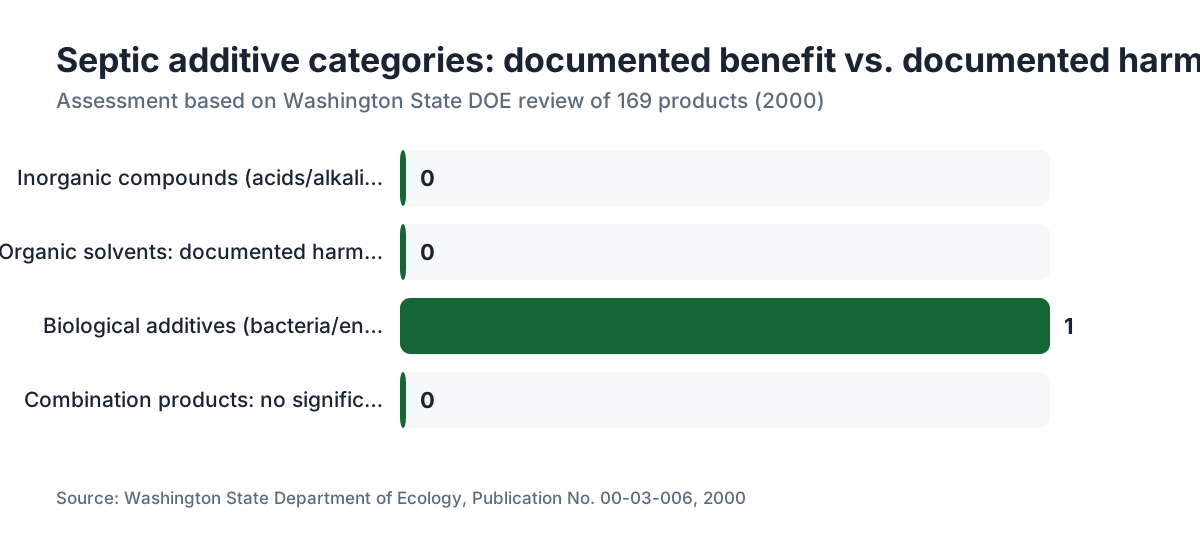
Researchers reviewed 169 additive products across the four composition categories and dug through lab studies, field studies, and manufacturer claims. Here's what they found:
- Inorganic compounds (acids and alkalis) generally harm bacterial populations and show no documented benefit.
- Organic solvents are hazardous and documented to push contaminants into groundwater.
- Biological additives showed no statistically significant improvement in effluent quality, solids reduction, or drain field performance in controlled studies.
- Combination products did no better.
The review also noted that most manufacturer studies aren't peer-reviewed, use non-standardized conditions, and cherry-pick outcome metrics. Independent attempts to replicate manufacturer results consistently failed to reproduce the claimed benefits.
The study's conclusion: "There is no reliable evidence that commercial septic system additives benefit septic system performance." [1]
No one has produced a large-scale, independently funded, peer-reviewed field trial since that overturns these findings. The closest thing is a University of Wisconsin study from the 1990s that tested enzyme additives in real septic tanks and found no significant effect on effluent quality or sludge accumulation rates.
What about yeast and other home remedies for septic tanks?
Active dry yeast is the most stubborn folk remedy in septic lore. Flush a packet of baker's yeast every few months, the story goes, and your tank stays healthy. It's harmless. Yeast is a living organism that adds a little fermentation activity for a short while. Whether it does anything measurable for system performance is a different question, and the answer is almost certainly no.
Yeast produces carbon dioxide and ethanol as it metabolizes. Small amounts of ethanol won't hurt tank bacteria, but it's no substitute for the full set of anaerobic organisms already in there. The inside of a septic tank isn't a friendly place for yeast compared to its native environment, and it gets out-competed fast.
Rotten tomatoes, buttermilk, meat scraps, and the rest all run on the same logic: add organic material, add biology, tank improves. But your tank already gets plenty of organic loading from normal household wastewater. Piling on more organic material without adding the bacterial capacity to process it faster just raises the BOD (biological oxygen demand) load for no net gain.
Can septic additives replace regular pumping?
No. Full stop.
This is the most dangerous claim on the shelf, and it's demonstrably false. The EPA recommends pumping a typical household septic tank every 3 to 5 years, though the right frequency depends on tank size, household size, and usage [2]. Skip pump-outs because you're using an additive and you end up with a septic system repair bill in the tens of thousands.
Sludge accumulation is a physical process. Inorganic solids, including sand, grit, and non-biodegradable material, settle and pile up at the bottom of the tank. No additive digests that. Even organic solids build up at rates biology can slow but not erase. When the sludge layer gets deep enough, it starts reaching the outlet baffle and flowing into the drain field. Once fines and biological mat clog a drain field, you're looking at a major repair or a full system replacement.
A typical septic tank pump out costs $300 to $600. A drain field replacement runs $5,000 to $20,000 or more depending on the site and the local market [6]. Skipping a $400 pump-out to save money while you spend $8 a month on additives is a bad trade.
Our guide on how often to pump septic tank breaks it down by tank size and household.
Which states have banned or restricted septic additives?
State regulation of additives is patchy but real. A few states have outright bans or strict restrictions. Most have advisory language and no formal prohibition.
Massachusetts Title 5, the state's septic code, prohibits adding any substance to a septic system that the Department of Environmental Protection hasn't approved. In practice, no additive has gotten that approval, which makes using commercial products technically non-compliant [7].
Oklahoma's onsite wastewater rules prohibit chemical additives containing organic solvents. New Hampshire's administrative rules restrict unapproved additives. Florida's Department of Health advises against any additive and says they're not a substitute for routine maintenance [8].
If you run a service business across multiple states, tracking these differences actually matters. Recommending or applying an additive in Massachusetts that's common in Georgia could put your license at risk.
Operators tracking state-level compliance across a customer base might find that maintenance scheduling software like SepticMind helps flag jurisdiction-specific rules during dispatch, though the real work is knowing the regulations, not running the software.
The EPA hasn't issued a federal ban, but its guidance is clear enough that any state building a case for restriction can point straight at EPA SepticSmart materials [2].
Are there any additives that actually work in specific situations?
This one deserves an honest answer, not a blanket dismissal.
For aerobic treatment units (ATUs), there's at least a logical case for aerobic bacteria startup products. ATUs work differently from conventional anaerobic tanks. They inject air, hold an aerobic environment, and depend on a different bacterial community. When an ATU is brand new or has been offline for a long stretch, adding a bacterial seed made for aerobic conditions can speed colonization of the treatment media. It's not proven to matter much in most cases, but the biology holds up.
For systems recovering from a documented biological disruption, say a household that's been on heavy broad-spectrum antibiotics for months, or a vacation home whose tank has sat empty for a year, a biological additive at restart won't hurt and might give a small benefit. The key word is "might." Don't pay $50 for it.
For grease trap management in commercial kitchens, enzyme products have more evidence behind them than they do in residential septic. Commercial grease traps run under different conditions, and the lipase enzyme products made for them are more concentrated and more targeted. That's not the same thing as the additives on the hardware store shelf.
For a residential conventional system under normal use, no additive on the market has credible independent evidence of benefit. Regular pumping, water conservation, and keeping harmful stuff out of the drain are the only maintenance practices with real evidence behind them [2].
What should you actually do to keep your septic system healthy?
The practices that actually protect a septic system are boring, and they're all free or already covered by routine service.
Pump on schedule. For a typical 1,000-gallon tank serving four people, that's every 3 to 5 years. EPA SepticSmart guidance and most state codes land on the same range [2]. Our page on septic tank pumping covers what the service includes and what to expect.
Watch what goes down the drain. Antibacterial soaps in large amounts, heavy bleach use, and flushed medications can suppress tank bacteria. You don't need to obsess over it, but regular heavy use of quaternary ammonium disinfectants (the active ingredient in many household antibacterial products) has been shown in lab studies to cut bacterial populations in tank simulators.
Protect your drain field. Don't park on it. Don't plant deep-rooted trees within 20 feet of it. Don't send surface water toward it. Physical damage and hydraulic overload kill drain fields faster than any biological problem.
Get a septic tank inspection before you buy a house on septic, and any time you're worried about performance. A visual inspection plus a pump-out every few years is the most cost-effective maintenance plan there is.
Keep a record. Know your tank size, location, last pump date, and system type. If you ever need a septic system repair, a provider who can't find your tank or doesn't know the system type will bill you for the time it takes to figure that out.
For operators running schedules across dozens or hundreds of customer systems, SepticMind has dispatch and maintenance tracking built for septic service businesses. Worth mentioning once, because record-keeping is where most service gaps happen.
How do additive manufacturers get away with these claims?
Fair question. The FTC regulates advertising claims. The EPA regulates environmental products. So why are shelves still full of products that promise to end pump-outs and rescue failing drain fields?
A few reasons. The FTC requires substantiation for advertising claims, but enforcement actions against specific septic additive products have been rare. The market is small and diffuse enough that it hasn't drawn sustained federal attention.
Most additives count as neither pesticides nor drugs, so they dodge the strictest pre-market approval pathways. The EPA requires registration for products that make pesticidal claims, but "improves bacterial activity" doesn't cross that line.
Confirmation bias does a lot of the selling. A homeowner adds a product in March, has no trouble through September, and credits the additive. The counterfactual, that the system would have run exactly the same without it, is invisible.
The Washington State study authors put it plainly. Claims made by manufacturers of septic additives "are not supported by scientific evidence," and the burden of proof "remains with the manufacturers" [1]. That burden still hasn't been met, 25 years on.
Frequently asked questions
Do septic tank additives really work?
No credible independent evidence shows that commercial septic additives improve tank performance, reduce sludge, or extend drain field life. The EPA's SepticSmart program states the agency has not approved any additive and that research does not support their use. Chemical additives can be harmful. Biological products are mostly inert under normal operating conditions.
Can I skip septic tank pumping if I use additives?
No. Skipping pump-outs because you're using an additive is one of the most reliable ways to ruin a drain field. Inorganic solids and accumulated sludge can't be biologically digested at the rate they build up. The EPA recommends pumping every 3 to 5 years regardless of additive use. A skipped pump-out that kills a drain field turns a $400 service into a $10,000 repair.
What does the EPA say about septic additives?
The EPA's SepticSmart program states clearly that the agency has not approved any septic additives and that research does not support claims they improve performance or reduce the need for pumping. Some additives are flagged as potentially harmful to system function. The EPA recommends routine pumping and water conservation over any additive product.
Are biological septic additives safe to use?
Biological additives (bacteria and enzyme products) are generally safe in the sense that they're unlikely to harm your system under normal use. They're also unlikely to help. Your tank already holds a large population of active bacteria from incoming wastewater. Adding more from a commercial packet doesn't change the rate-limiting factors that control system performance.
Are chemical drain cleaners bad for septic systems?
Yes. Organic solvents and strong acids or alkalis can kill tank bacteria, break down the scum layer, push oils and fats into the drain field, and leach contaminants into groundwater. Several states restrict or ban chemical additives for this reason. If you have a slow drain in a septic home, mechanical clearing (snake or hydrojetting) is far safer than any chemical product.
Is yeast good for a septic system?
Flushing baker's yeast is harmless but almost certainly useless. Yeast adds minor fermentation activity, but your tank already holds billions of bacteria far better suited to the anaerobic conditions inside. There's no peer-reviewed evidence that yeast improves effluent quality, reduces sludge, or does anything measurable for system performance.
Do aerobic septic system additives work differently than additives for conventional tanks?
Aerobic treatment units use oxygen and aerobic bacteria rather than the anaerobic communities in conventional tanks. Aerobic bacteria additive products made for ATU startup or reseeding after maintenance have more biological logic behind them than general-purpose additives, though independent evidence is limited. Follow your ATU manufacturer's guidance rather than general-market products.
Can additives fix a failing drain field?
No reliable evidence supports this claim, and several products marketed this way have drawn FTC complaints. A failing drain field usually comes from hydraulic overload, biomat formation, or physical damage, none of which an additive can reverse. Legitimate options for a failing drain field include resting the field, mechanical rehabilitation, or replacement.
Are septic additives banned in any states?
Yes. Massachusetts Title 5 effectively prohibits commercial additives by requiring DEP approval that no product has received. Oklahoma prohibits additives containing organic solvents. New Hampshire restricts unapproved additives. Florida's health department advises against their use. About a dozen other states have regulatory language discouraging or restricting specific product categories.
How often should I add bacteria to my septic tank?
You don't need to add bacteria to a normally functioning septic tank. The system reseeds itself continuously from incoming wastewater. If you've been told to add bacteria monthly or weekly, that's a marketing claim, not a maintenance requirement. The only scenario with any logic is a one-time addition right after a full pump-out or after prolonged heavy antibiotic use.
What happens if I put too much bleach in a septic system?
Normal household bleach use, a load of laundry or a weekly toilet cleaning, won't kill your tank bacteria. The volume of wastewater dilutes it before it reaches the tank. Heavy, repeated use of concentrated bleach or disinfectants can suppress bacterial populations. Switching to unscented, lower-concentration products and spreading cleaning tasks across the week cuts the peak disinfectant load.
What's the best way to maintain a healthy septic system without additives?
Pump every 3 to 5 years, watch your water use (high hydraulic loading is the most common cause of premature failure), keep non-biodegradables out of the drain, protect your drain field from traffic and tree roots, and get an inspection if you notice slow drains, odors, or wet spots near the field. These practices have actual evidence behind them. Additives don't.
Do septic activator products work?
Septic activators, often sold as starter products for new or newly pumped tanks, usually contain bacteria and enzyme mixes. No independent peer-reviewed study shows they meaningfully speed system startup compared to natural reseeding from incoming wastewater, which happens within days to weeks. They're not harmful and might give a small head start, but they're not necessary.
Can additives reduce septic odors?
Maybe temporarily, by masking or neutralizing odor compounds in the tank itself, but they don't fix the cause of persistent odors, which is usually a venting problem, a full tank, or a failing component. If your septic system smells, the right move is an inspection and likely a pump-out, not a deodorizing additive.
Sources
- Washington State Department of Ecology, 'A Critical Assessment of Septic System Additives' (Publication No. 00-03-006): Review of 169 septic additive products found no reliable evidence that any category of additive improves system performance; organic solvents documented to contaminate groundwater.
- U.S. EPA SepticSmart Program: EPA has not approved any additives for use in septic systems and states that research does not support claims they improve performance or reduce the need for pumping.
- National Environmental Services Center (EPA-funded), West Virginia University: Most laboratory and field studies show no statistically significant benefit from biological or enzymatic additives; solvent-based products documented to mobilize fats into drain fields.
- Water Environment Research Foundation, 'Nutrient and Pathogen Removal in Onsite Wastewater Systems': Bacterial counts in healthy septic tank effluent estimated at 100 million to 1 billion colony-forming units per milliliter.
- New Hampshire Department of Environmental Services, Subsurface Systems Bureau: New Hampshire administrative rules restrict the use of unapproved additives in onsite wastewater systems.
- U.S. EPA SepticSmart, 'How to Care for Your Septic System': EPA cites septic system replacement costs as potentially tens of thousands of dollars compared to routine pump-out costs of a few hundred dollars.
- Massachusetts Department of Environmental Protection, Title 5 (310 CMR 15.000): Massachusetts Title 5 requires DEP approval for any substance added to a septic system; no commercial additive has received that approval.
- Florida Department of Health, Onsite Sewage Program: Florida Department of Health advises against commercial septic additives and states they are not a substitute for routine maintenance.
- U.S. EPA SepticSmart, 'Protect It: Simple Steps': EPA recommends pumping a typical septic tank every 3 to 5 years as the primary maintenance action.
Last updated 2026-07-09