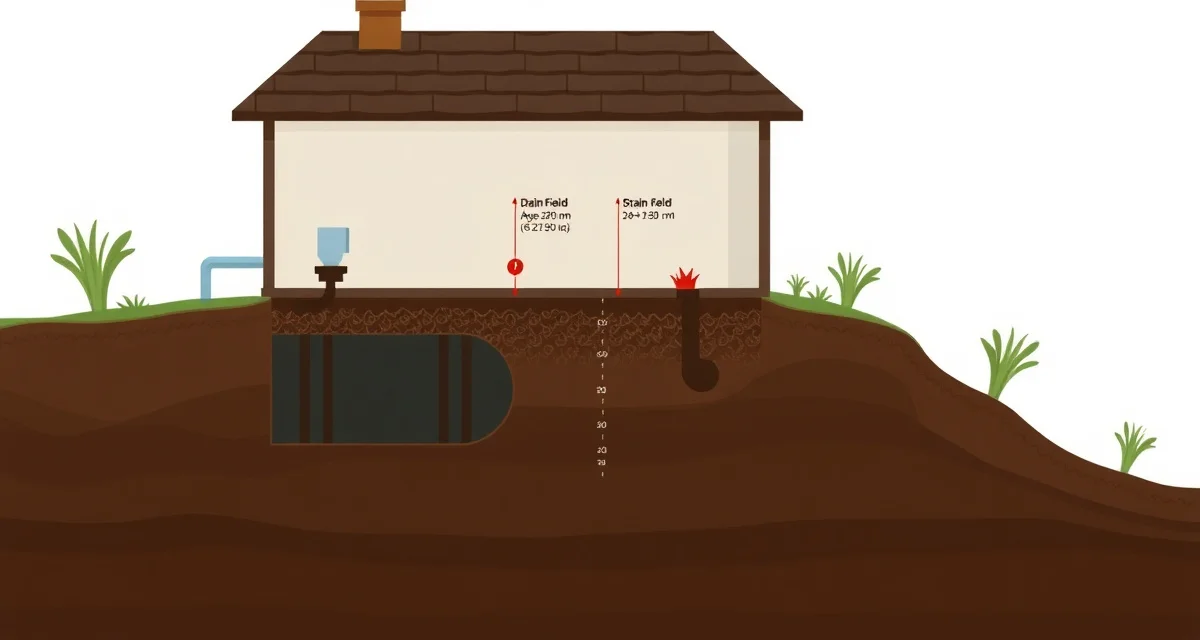
Septic System Inspection Needs by System Age
By the SepticMind Editorial Team
Systems over 20 years old fail at 4x the rate of new systems and require more comprehensive inspection protocols. The average age of failing US septic systems at time of failure is 26 years. SepticMind flags systems over 20 years old for enhanced inspection checklists automatically.
TL;DR
- Systems over 20 years old have significantly higher failure rates and require more thorough inspection protocols than newer systems.
- Concrete baffles installed before the 1990s degrade over time; inspection should check for cracking, scaling, and missing baffle sections at every visit.
- Camera inspection of the outlet line is advisable every 5 years for systems over 20 years old to identify root intrusion and pipe deterioration.
- Tank seam integrity and lid condition are the most common structural issues in aging concrete tanks in aggressive soil environments.
- A 5-year projection report for systems approaching or past 20 years of age helps homeowners plan for potential rehabilitation or replacement costs.
- Real estate inspections for properties with systems 20+ years old should include a note on remaining design life expectation alongside pass/fail status.
System age is the single best predictor of inspection thoroughness requirements. A 5-year-old system that's been properly maintained needs a different inspection than a 25-year-old system that may have materials approaching end of service life. This guide maps inspection priorities to system age milestones.
Years 1-10: Baseline Inspection Needs
A well-installed system in its first decade should be functioning normally and requires standard inspection protocols:
Primary concerns:
- Confirm the system was installed correctly per permit (installation quality varies)
- Verify baffle condition (new systems occasionally have installation defects that appear early)
- Confirm appropriate service frequency for household size and use
What to inspect:
- Tank interior condition (baffles, tank structure, inlet and outlet)
- System record review (permit, installation documentation)
- Access point condition
- Drainfield surface observation (baseline observation for future comparison)
What's not yet a major concern: Material degradation, drainfield biomat accumulation, or age-related structural failure. These systems are in their low-risk period if they were properly installed.
Inspection note for lenders: A system under 10 years old on a well-maintained property with current service records is generally low-risk collateral. The inspection report can reflect this without extensive age-related qualifications.
Years 10-20: Mid-Life Assessment Points
This is the period when age-related factors begin to require more attention, even in systems that have been well-maintained.
Primary concerns:
- Tank material condition: Are there signs of concrete carbonation, steel corrosion, or plastic degradation?
- Baffle condition: Fiberglass or concrete baffles that were properly installed should be in reasonable condition; deteriorating baffles create failure risk
- Distribution system: Distribution boxes and pipes can develop issues in this period
- Drainfield: 10-20 years of loading begins to accumulate biomat; a system that was slightly undersized for the actual use starts showing effects
What to inspect:
- Tank interior thoroughly, with specific attention to baffle attachment points
- Distribution box or manifold condition and even flow distribution
- Drainfield surface observation with attention to vegetation patterns (lush green stripes indicate loading)
- Access point seal condition
System-specific concerns:
- Steel tanks: Begin showing corrosion in this period; may need more frequent assessment
- Concrete tanks: Lid condition, inlet/outlet pipe seal condition
- Older mound systems: Mound height, vegetation, and performance indicators
Years 20-25: Enhanced Protocol Required
This is the beginning of the elevated-risk period. Systems over 20 years old fail at 4x the rate of newer systems, and inspection protocols should reflect this.
Primary concerns:
- Steel tank condition: Many steel tanks installed in the 1960s-1980s are at or past service life. A steel tank at 25 years should be carefully assessed for structural integrity.
- Concrete tank cracking: Age-related concrete carbonation and chemical exposure can create structural issues
- Distribution system failure: Older distribution boxes and pipe materials may have deteriorated
- Drainfield biomat accumulation: 20+ years of loading creates significant biomat that reduces absorption capacity
- Component obsolescence: Older systems may lack baffles entirely (pre-1980 installations in some states), or use materials no longer permitted for new installations
Enhanced inspection elements at 20+ years:
- Tank probing to assess structural integrity
- Distribution box detailed assessment (is effluent distributing evenly?)
- More intensive drainfield probe testing
- Historical performance interview with owner
- Review of any prior inspection reports for trend patterns
SepticMind flags systems over 20 years old for enhanced inspection checklists automatically, ensuring the age-appropriate protocol is applied.
Years 25+: The Critical Risk Period
The average failing US septic system is 26 years old at time of failure. This is not coincidence -- it marks the period when many age-related failure mechanisms converge.
What you're looking for specifically:
- Steel tank: Any evidence of structural compromise (collapsed areas, thin walls, separated seams)
- Concrete tank: Significant cracking, especially in the bottom and at the inlet/outlet
- Drainfield: Significant saturation patterns, surfacing effluent, or biomat that extends to the surface
- Components: Failed baffles that have allowed solids to reach the drainfield
What to tell lenders about 25+ year old systems:
The report should include:
- Explicit note that the system is beyond average service life
- Current condition assessment (is it still functioning?)
- Professional judgment on estimated remaining useful life
- Recommendation for system evaluation at a defined interval (e.g., "recommend re-inspection in 2 years given system age")
A system at 28 years that's currently functioning is not the same as a system at 28 years that's showing signs of stress. The report should distinguish these situations clearly.
Pre-1980 Systems: The Legacy Challenge
Systems installed before 1980 may lack features that became standard requirements:
No inlet or outlet baffles: Some pre-1980 systems were installed without baffles, allowing direct flow from the tank to the drainfield without the treatment baffles provide.
No access risers: Older systems are often buried with no above-ground access points, making inspection difficult and service expensive.
Sub-standard materials: Early polyethylene pipes, rudimentary distribution systems, and older concrete mixes that have deteriorated significantly.
Unapproved original designs: Some older installations don't conform to any current design standard because they predate current standards.
When inspecting pre-1980 systems, document these characteristics explicitly. A 45-year-old system without baffles serving a property in a real estate transaction needs a report that clearly communicates what the buyer is inheriting.
Get Started with SepticMind
Inspection work is the highest-visibility service in the septic trade, and your documentation quality directly affects your reputation with real estate agents, lenders, and county officials. SepticMind generates state-formatted inspection reports in the field with photo documentation attached. See how it supports your inspection workflow.
Frequently Asked Questions
What additional inspection points should be checked for a 25-year-old septic system?
At 25 years, intensive steel tank structural assessment (probing for compromised areas if the tank appears steel), detailed concrete integrity review if the tank is concrete, distribution system flow evenness testing, and more thorough drainfield probing for saturation are all warranted beyond the standard protocol. The inspection should include an estimated remaining useful life assessment, which lenders often require for systems at or near expected service life. If available, prior inspection reports should be reviewed for trend patterns. Document any signs of historical stress that suggest the system has been under-maintained or overloaded during its life.
At what system age should a homeowner consider a full system evaluation?
Any system over 20 years old deserves a full system evaluation rather than just a routine pump-out and brief visual. At 20 years, the probability of significant age-related issues has reached the level where a thorough assessment adds meaningful information beyond what a routine service visit provides. The evaluation should include tank condition assessment, distribution system review, and intensive drainfield observation. For systems over 25 years on properties near sensitive water resources (wells, lakes, streams), a professional system evaluation is both prudent and, in some states, required.
Does SepticMind automatically apply age-based enhanced inspection protocols?
Yes. When a system's installation date in the property record indicates the system is over 20 years old, SepticMind flags the account for the enhanced inspection protocol and applies an age-appropriate inspection template. Inspectors working the property see the age flag before arrival. The enhanced template prompts for the additional inspection elements appropriate for older systems -- tank structural assessment, distribution system flow testing, more intensive drainfield probing -- beyond what the standard protocol requires. Inspection reports generated for age-flagged properties include an age notation and space for remaining useful life assessment.
What is the difference between a septic inspection and a septic pump-out?
A pump-out removes accumulated sludge and scum from the tank. An inspection evaluates the condition of all accessible system components: tank structure, baffles, distribution box, drainfield, and in some cases the outlet line. A real estate or regulatory inspection produces a written report in the state-required format with findings and a pass/conditional pass/fail determination. Many inspection visits include a pump-out as part of the service, but the pump-out alone is not the inspection.
Can inspection reports be submitted electronically to the county?
Yes, most counties and state agencies accept electronic inspection report submissions and many now prefer or require them. The report must be in the state-required format and include all required fields, the inspector's credentials, and any required signatures or attestations. Purpose-built inspection software generates the report in the correct state format and can submit it electronically directly from the field.
Try These Free Tools
Sources
- National Onsite Wastewater Recycling Association (NOWRA)
- US EPA Office of Wastewater Management
- NSF International
- American Society of Home Inspectors (ASHI)
- Water Environment Federation