Septic leach field not draining: causes, fixes, and costs
By the SepticMind Editorial Team
TL;DR
- A leach field stops draining when biomat clogs the soil, the tank overflows solids into the field, or the soil itself fails from saturation or compaction.
- Some fields recover with rest and pumping.
- Others need full replacement, which runs $10,000 to $30,000 or more depending on soil and system type.
- Knowing which situation you have decides everything else.
What does it actually mean when a leach field stops draining?
Your leach field, also called a drain field, is a network of perforated pipes buried in gravel-filled trenches. Wastewater flows from the septic tank into those pipes and percolates down through the soil, where bacteria treat it before it reaches groundwater. When percolation stops, liquid backs up. It has nowhere to go.
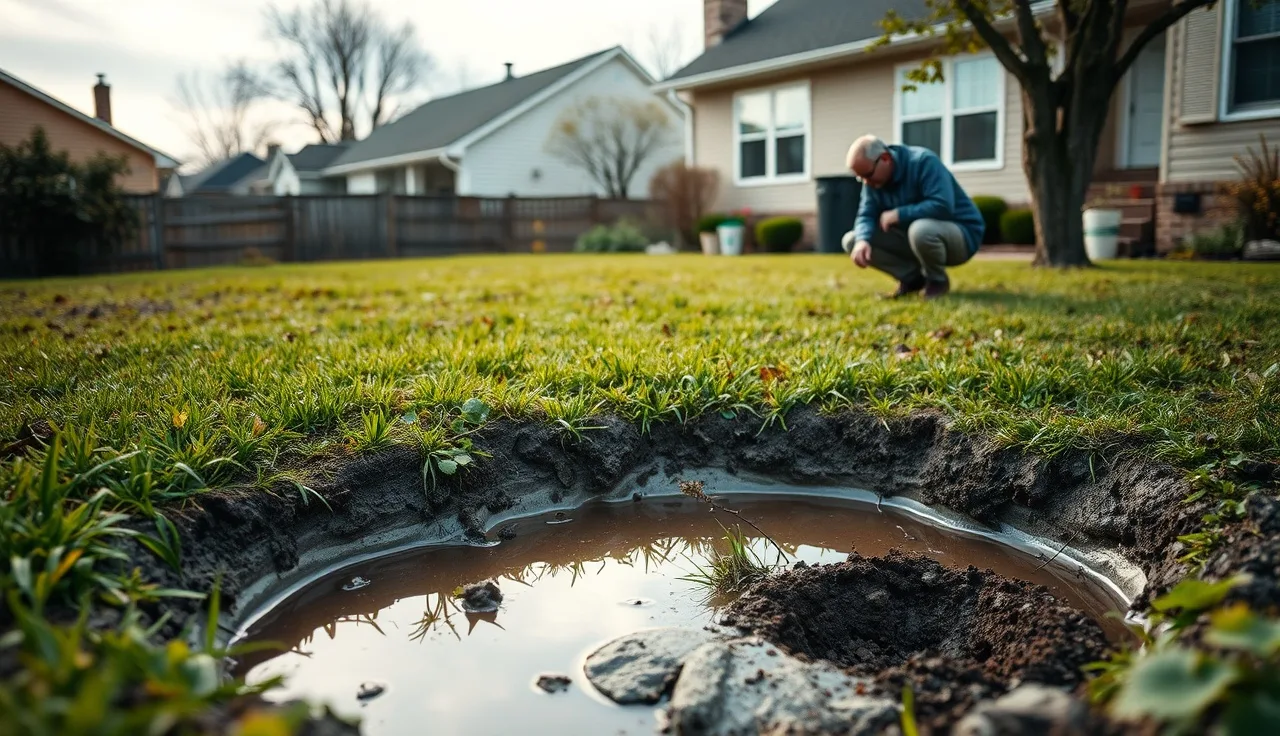
You notice it a few ways. Toilets and drains get sluggish or start gurgling. Wet, spongy patches show up in the yard above the field, sometimes with a sewage smell. In bad cases, sewage backs up into the lowest drain in the house, usually a basement floor drain or a shower. Puddles of grayish water sit on the grass even when it hasn't rained.
None of those symptoms tell you why the field failed, only that it has. The cause matters enormously, because some problems cost $500 to fix and others cost $25,000. A pump-out and a camera inspection before you do anything else is almost always money well spent.
The EPA's SepticSmart program puts the stakes plainly: household wastewater carries nutrients and pathogens that the soil-treatment process removes, and when that process breaks down, those contaminants reach groundwater. That's the real risk here, more than a wet yard [1].
What are the most common causes of a leach field failing to drain?
Seven causes account for the large majority of drain field failures. Sort them apart, because they don't share a fix.
1. Biomat buildup. A biomat is a dark, rubbery layer of anaerobic bacteria and organic material that forms where the gravel meets the native soil. Every field grows some. That's normal. But when a tank goes too long between pump-outs, solids and grease spill into the field and speed up biomat growth until the layer turns nearly waterproof [2]. This is the single most common reason residential fields fail.
2. Solids or grease carried over from a full tank. If the tank hasn't been pumped in years, the sludge and scum layers grow, retention time drops, and solid particles escape into the distribution pipes. Grease is the worst of it. It coats pipe perforations and the surrounding gravel and binds the whole mass into something close to concrete. See how often to pump septic tank for maintenance schedules.
3. Hydraulic overload. Too much water entering too fast saturates the soil before it can drain. Leaky faucets, running toilets, back-to-back laundry loads, or adding people to the household can push daily flow well past the system's design capacity. The EPA estimates fixing one leaky toilet saves about 200 gallons a day [1].
4. Soil saturation from high groundwater or long rain. Soil that's already full can't take more water. This can look like a failed field but clears on its own once the water table drops. The catch is that repeated saturation speeds up real soil failure over time.
5. Compaction. Parking vehicles, storing heavy equipment, or years of foot traffic crushes the air pockets in the soil. Compacted soil drains far slower than the engineered design assumed. Trampolines, sheds, and garden beds land on top of fields all the time, and each one does damage.
6. Root intrusion. Tree and shrub roots follow moisture. They find the perforated pipes, slip in through the openings, and eventually choke off flow. Willows, maples, and any fast-growing tree within 30 feet of the field are the usual culprits.
7. Soil structure failure (irreversible). Some soils, clay-heavy ones especially, hit what engineers call structural soil clogging. The fine particles reorganize under years of hydraulic pressure into a layer that water barely moves through. No treatment brings this back. Replacement is the only fix [3].
How can you tell whether your leach field can be fixed or needs replacement?
This is the question that costs homeowners the most when they answer it wrong. Some contractors push replacement when remediation would work. Others sell remediation products to fields that are already dead. Here's the honest diagnostic order.
First, get the tank pumped and inspected. A septic tank pump out clears the solids and lets the contractor see whether solids have been reaching the field, whether the baffles are intact, and whether the effluent looks reasonable. A septic tank inspection at the same visit checks the tank structure, the distribution box, and the outlet baffle. Both together usually run $300 to $600.
Second, run a perc observation or a load test. The contractor feeds measured amounts of water into the system and watches how fast the field takes it, or whether it backs up. Some states require a licensed inspector to run this under their onsite wastewater code, so check your state environmental agency's rules.
Third, pull a camera through the distribution lines if you can get access. Root intrusion, crushed pipe, and grease all show up clearly on camera. A camera inspection of a drain field runs roughly $200 to $500 depending on access.
If the field is overloaded by a temporary condition (high water table, a spell of abnormal water use), resting it for 4 to 8 weeks while using water carefully sometimes brings it back. State extension programs, including the University of Minnesota Extension, have documented partial recovery in biomat-clogged fields after rest periods [2].
If the soil has failed structurally, or the gravel is cemented with grease, recovery isn't realistic. Get two or three quotes for replacement before you sign anything.
What does it cost to fix or replace a failing leach field?
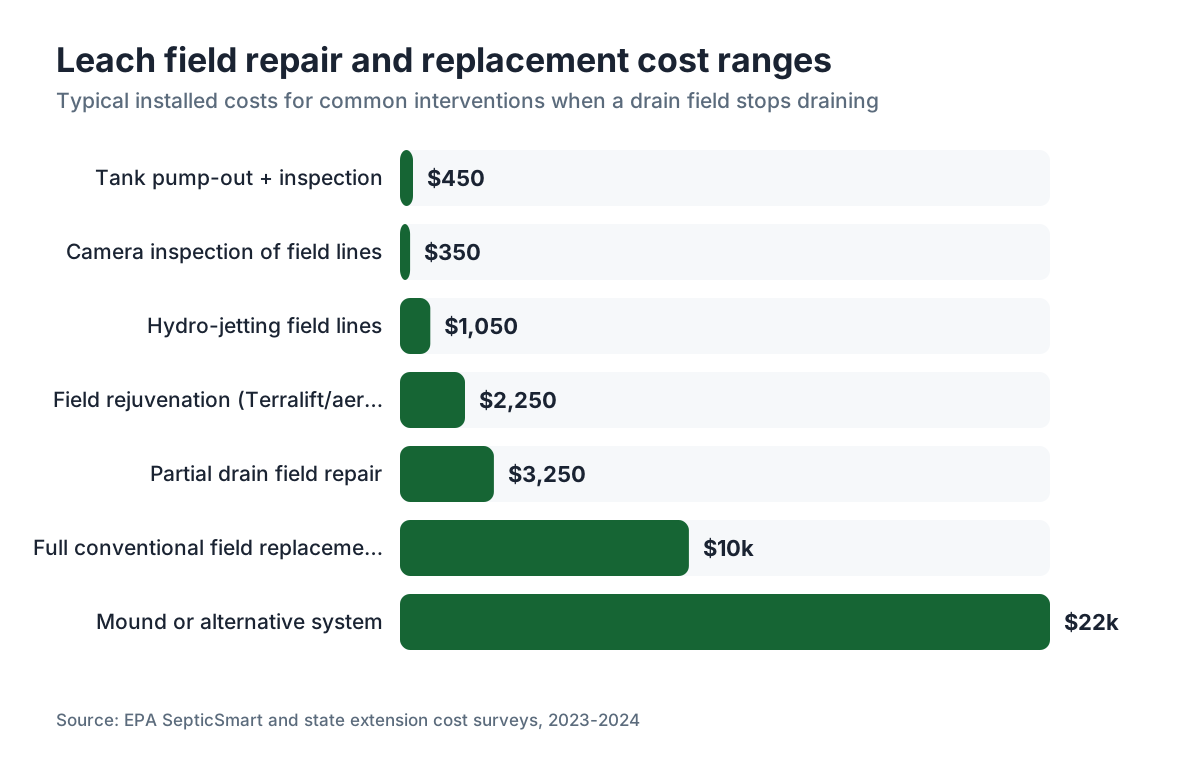
Cost swings more here than on almost any other home system repair, because soil conditions, local permit rules, and system type all drive the number. Here are realistic ranges based on contractor pricing and state cost studies.
| Repair or replacement option | Typical cost range | Notes |
|---|---|---|
| Septic tank pump-out + inspection | $300, $600 | Always the first step |
| Camera inspection of field lines | $200, $500 | Confirms cause before spending more |
| Hydro-jetting field lines | $600, $1,500 | Works for root intrusion and partial clogs |
| Shock treatment / field rejuvenation (Terralift, Bioxygen) | $1,000, $3,500 | Works on some biomat cases; no guarantees |
| Drain field repair (partial line replacement) | $1,500, $5,000 | When only a section is failed |
| Full conventional drain field replacement | $5,000, $15,000 | Standard gravity system in good soil |
| Mound system or alternative system replacement | $15,000, $30,000+ | Required when native soil fails perc |
| Aerobic treatment unit (ATU) upgrade | $10,000, $20,000 | Higher-quality effluent, may save the field |
Replacement costs for a full septic system (tank plus field) get more detail at cost to install septic system. If only the drain field needs replacing, you may keep the existing tank, which cuts the bill.
State permit fees add $200 to $2,000 depending on the jurisdiction. Some states require a licensed engineer to design any replacement system, which adds another $500 to $2,000. Don't skip permits. Unpermitted drain fields create title problems when you sell, and real liability if they contaminate a neighbor's well.
The EPA notes that a conventional septic system with proper maintenance costs far less over its lifetime than the $30,000-plus replacement bill deferred maintenance eventually forces [10].
Can you restore a clogged leach field without replacing it?
Sometimes. The honest version is that remediation success depends heavily on what failed and how long the problem has been building.
For biomat-clogged fields that haven't yet caused structural soil damage, the combination of tank pumping, field rest (stopping or sharply cutting water use for 4 to 8 weeks), and aerobic treatment has shown real results in university extension research. The University of Minnesota Extension notes that biomat can shrink when oxygen returns to the soil around the pipes, because aerobic bacteria digest the anaerobic biomat layer [2].
Products like hydrogen peroxide injection, Terralift aeration, and biological additives (specific enzyme or bacteria formulations, not grocery-store septic tablets) have anecdotal support. Controlled studies are thin. The closest rigorous work comes from the Small Scale Waste Management Project at the University of Wisconsin, which found aerobic restoration improved soil permeability at some test sites but ran inconsistent across soil types [3]. Nobody has good data on how long these treatments hold up.
Hydro-jetting the distribution pipes is one of the more reliable mechanical fixes when the blockage sits in the pipe rather than the soil. A jetting truck drives high-pressure water through the lines and clears roots and grease from the inside of the pipe. It doesn't fix the soil, but it restores flow through the pipes, which can buy years if the soil still works.
When the native soil has clogged for good, no product reverses it. This is where homeowners lose money on "miracle" additives. If your contractor can't show you perc data suggesting the soil still works, be skeptical of any remediation pitch that skips a real performance guarantee.
SepticMind's operator database tracks remediation outcomes over multi-year windows. For a contractor trying to advise clients honestly, that history, sorted by system type and soil condition, is the only way to give real odds instead of a guess.
How do you know if the problem is the tank rather than the field?
This confusion gets expensive fast. Homeowners see symptoms that point at the field, pay for field remediation or replacement, then find out the real problem was a crushed outlet pipe, a failed baffle, or a full tank nobody ever pumped.
A few checks sort this out before the big spending starts.
Pull the lid on the tank and look at the liquid level. If the tank is unusually full (liquid at or above the outlet pipe), the tank may just need pumping, or something is blocking the outlet. If the level is normal and the field is still wet, the problem sits downstream, in the distribution system or the field itself.
Check the distribution box (D-box) if your system has one. The D-box splits flow evenly to the field trenches. A cracked or shifted D-box dumps all effluent into one trench and starves the rest, so that one trench fails early while the rest of the field stays fine. Fixing or replacing a D-box runs $500 to $1,500, far cheaper than field replacement.
A septic tank repair or septic system repair aimed at the tank and distribution parts first can save a lot of money versus jumping straight to field work.
Check for pump failure too, if your system uses a dosing pump. A dead pump means the field gets no effluent (no symptoms until the tank backs up) or gets flooded if the float switch sticks in the on position. A replacement pump runs $300 to $800 for most residential systems.
What happens if you ignore a leach field that isn't draining?
It gets worse. That's the short version.
A failing field that keeps taking sewage without treating it sets off a chain of escalating problems. Partially treated effluent saturates the soil, and pathogens including bacteria and viruses can reach groundwater that neighboring properties draw on for drinking water. The EPA's SepticSmart program flags drain field failure as one of the top causes of drinking water contamination in rural areas [1].
At your own property, the liquid has to go somewhere. It surfaces. Sewage pooling in a yard is a public health violation in every state. Most state onsite wastewater codes require that a failed system be repaired or replaced within a set window, often 30 to 90 days, after the local health department is notified or finds it. Violations can carry daily fines.
The house turns unusable once sewage backs up into the living space. And the longer you wait, the worse the soil damage gets, which usually means a more expensive replacement.
A failed septic system also has to be disclosed in most states when you sell. A system in active failure can kill a real estate deal or force a big price cut to cover the buyer's repair cost.
Then there's the well. If your property has a private well, a failed drain field 50 or 100 feet away is a genuine contamination risk. The CDC recommends testing private well water once a year and right away after any known sewage event nearby [4].
What are your options if the soil fails and you can't put a conventional field in the same spot?
When the native soil is the problem, or there just isn't enough undisturbed land for a replacement conventional field, alternative systems exist. They cost more, and they work in conditions where conventional systems can't.
Mound systems build a raised bed of engineered sand above the natural soil surface. Effluent drains into the sand and gets treated there before reaching the native soil. Mounds are common in high water table areas and cost $15,000 to $30,000 installed [5].
Aerobic treatment units (ATUs) use mechanical aeration to produce highly treated effluent before it reaches the field. That cleaner effluent is less likely to clog the soil and can sometimes save a marginal field. ATUs cost $10,000 to $20,000 and require ongoing maintenance contracts in most states.
Drip irrigation systems send effluent slowly through a network of surface-level drip lines, keeping the soil from ever hitting hydraulic saturation. They work well in poor soil but need filtration to keep the emitters from clogging.
Constructed wetlands and other passive treatment systems are approved in some states for specific site conditions.
The right choice depends on your soil perc rate, setback distances from wells and property lines, lot topography, and what your state's onsite wastewater code allows. Not every alternative system is approved in every state. Your state environmental or health agency's onsite wastewater program page is the authoritative source, and the EPA indexes links to state programs [6].
For full system replacement costs including tank and field, see cost to install septic system and how often to pump septic tank.
How do you prevent a leach field from failing in the future?
Most drain field failures are slow-motion events that take years to build and could have been stopped at several points along the way. The prevention list is short and mostly cheap.
Pump the tank on schedule. For a three-bedroom home with four people, that's every 3 to 5 years. The EPA's SepticSmart guidance uses every 3 to 5 years as the baseline, with actual frequency riding on household size and tank volume [1]. Skipping pump-outs is the most direct path to biomat failure. More on schedules at how often to pump septic tank and septic tank pumping.
Cut the hydraulic load. Spread laundry across the week instead of running every load on one day. Fix leaky toilets and faucets right away. Put in low-flow fixtures if you haven't. High-efficiency toilets use 1.28 gallons per flush against 3.5 gallons for pre-1992 models.
Keep vehicles, heavy equipment, and structures off the field. The crush zone for most residential drain field pipe is smaller than people expect. One pass with a loaded pickup can crack distribution pipes.
Plant only grass above the field. Grass roots stay shallow and won't reach the pipes. Tree roots will. The standard guidance keeps trees at least 20 to 30 feet from the field edge, more for aggressive species like willows, silver maples, and poplars.
Don't flush what doesn't belong in a septic system. Wipes (even the "flushable" ones), feminine hygiene products, medications, cooking grease, and heavy garbage disposal use all speed up tank and field trouble. Septic tank pump out and septic tank pumping services remove what builds up despite good habits.
Get a leach field inspection every time you pump the tank. A contractor who sees both the tank and the distribution box has enough to catch small problems before they turn into replacement-level failures.
What does your state require when a leach field fails?
State rules vary a lot, but the pattern holds: once a system is in documented failure, you're legally required to repair it within a defined window, and repairs have to be permitted and inspected.
Most state onsite wastewater codes define failure as any condition where untreated or partially treated sewage surfaces, backs up into the house, or reaches groundwater above standards. Two examples of how state codes are built:
North Carolina's rules under 15A NCAC 18E require that a failing system be reported to the local health department and that a repair permit be obtained before any work begins [7]. Texas Commission on Environmental Quality rules under 30 TAC Chapter 285 similarly require a licensed installer, a site evaluation, and a permitted design for any replacement system [8].
At the federal level there's no single national septic code. The EPA sets guidance and provides resources through its SepticSmart and Nonpoint Source programs but leaves regulatory authority to the states [6]. Some counties stack extra requirements on top of state rules, especially in wellhead protection areas or near surface water.
Financial help sometimes exists. The USDA Rural Development program offers loans and grants for septic repair in qualifying rural areas under Section 504 and the Household Water Well System Grant Program [9]. State revolving funds in some states also lend at low interest for septic repairs.
If you're dealing with a failed system, call your county health department before anything else. They can tell you exactly what your jurisdiction requires, and sometimes they'll point you to assistance programs you'd never find on your own.
When should you call a professional versus try to diagnose it yourself?
You can do a fair bit of first-pass diagnosis yourself. Read the symptoms, check whether they line up with rain events or heavy water use, find the tank lid and look at the liquid level (don't go inside or put your face over the opening without ventilation precautions), and watch the yard above the field.
But the DIY line is clear: the moment you need to open the tank for anything past visual observation, start work in the field, or make the call that decides whether you spend $500 or $25,000, you need a licensed septic contractor.
Call a professional right away if sewage is backing up into the house (public health issue, don't wait), you see sewage surfacing in the yard, you smell sulfur or sewage indoors, or you're buying or selling a home with a septic system and aren't sure of its condition.
For operators: if you're a septic service company tracking dozens of customer systems and trying to spot the ones at risk before they fail outright, systematic data on pumping history, system age, soil type, and inspection findings is what separates reactive calls from proactive retention. That's the gap SepticMind's platform closes for service operators.
For homeowners who want to stay ahead of trouble, the best tool is an honest contractor relationship. Find someone who tells you the system looks fine when it does, instead of pushing remediation products on every visit.
Frequently asked questions
How long does a leach field last before it needs replacement?
A conventional leach field in good soil, properly maintained, typically lasts 20 to 30 years. Some go longer. Some fail in 10 years if the tank was never pumped or the soil is marginal. The University of Minnesota Extension and other state programs cite 20 to 25 years as the realistic average for residential systems. Pumping the tank on schedule is the single biggest factor in reaching that lifespan.
Can heavy rain cause a leach field to stop working?
Yes, temporarily. When the water table rises during a long wet stretch, the soil under the field saturates and can't take more liquid. Drains slow or back up. In many cases this clears within days to weeks once the water table drops. If it keeps happening after every real rain, the field may be too shallow for your soil, which is a design or site problem that needs an engineering look.
What are the signs that a leach field is failing?
The clearest signs are slow or gurgling drains across the house (more than one fixture), soggy patches or actual puddles of gray-smelling water above the field, sewage odor in the yard, and sewage backing up into the lowest drain in the house. Any one of these warrants a professional inspection. Several at once usually means the field has been failing for a while.
Will pumping the septic tank fix a failing leach field?
Pumping the tank is the necessary first step, but it doesn't fix a field that's already clogged. What it does is stop more solids from entering the field, which can slow or halt further damage. If the clogging is early-stage biomat, cutting the source load plus a rest period sometimes allows partial recovery. But if grease and solids have reached the field for years, pumping alone won't restore drainage.
How much does leach field replacement cost?
A full conventional leach field replacement runs $5,000 to $15,000 in most areas. If your soil fails perc testing and you need a mound or alternative system, expect $15,000 to $30,000 or more. Permit fees, engineering design, and soil testing add $500 to $3,000 on top of installation. Get at least three quotes. Pricing varies a lot by region, soil, and whether the tank needs replacing too.
Can tree roots destroy a leach field?
Yes. Roots from willows, maples, poplars, and other moisture-seeking trees enter perforated field pipes and eventually block flow completely. Root intrusion can be cleared by hydro-jetting the lines ($600 to $1,500), but roots come back unless the tree is removed. The standard safe distance is 20 to 30 feet from any tree to the field edge, more for aggressive species.
Is it safe to use a house with a failing leach field?
For a short stretch while you arrange repairs, generally yes, but with serious caveats. Cut water use as much as possible to slow further damage. If sewage is backing up into the house or surfacing in the yard, that's a public health issue, so minimize use, call the health department, and get emergency service. Prolonged use of a failed system risks contaminating groundwater and creates legal liability in most states.
Do septic additives help a clogged drain field?
The honest answer: sometimes, for specific causes, but not reliably and not for structural soil failure. Biological additives that introduce aerobic bacteria have shown modest results in biomat reduction in some university extension studies. Enzyme treatments and hydrogen peroxide injection have limited and inconsistent evidence. No product reverses a field where the native soil has permanently lost permeability. The EPA does not endorse septic additives as a substitute for maintenance and pumping.
Can you put a new leach field in the same location as the old one?
Usually not. Most state onsite wastewater codes require a new system on undisturbed soil that passes current perc testing. The old field area has already been altered by years of effluent loading. Some jurisdictions allow repair-in-place under specific conditions, but that's the exception. Your local health department or a licensed site evaluator can tell you what's allowed and whether suitable area exists on your lot.
How do you find a leach field that isn't draining but has no obvious surface signs?
Slow drains across the house plus a full or high tank liquid level usually point to the field before surface symptoms appear. A contractor can run a camera through the distribution lines and do a load test (measuring how fast the field accepts a controlled volume of water) to confirm failure. Some contractors also use ground-penetrating radar or dye testing to locate problem areas within the field.
Does homeowner's insurance cover leach field replacement?
Standard homeowner's policies exclude septic failures from wear, neglect, or gradual deterioration, which covers most leach field failures. Some policies cover sudden and accidental damage, such as a vehicle crushing a pipe. Specialty riders for service lines or sewer/septic exist from some insurers and are generally inexpensive. Read your policy carefully and ask your agent specifically about septic coverage before you need it.
How long does it take to replace a leach field?
The physical installation of a replacement field typically takes one to three days on site. But permit approval runs anywhere from one week to three months depending on state and county. Site evaluation, engineering design (if required), and scheduling the contractor add more weeks. In practice, plan for four to twelve weeks from first call to finished system in most jurisdictions, and budget accordingly if the house is occupied.
What is a distribution box and can it cause drain field drainage problems?
A distribution box (D-box) is a small concrete or plastic chamber that splits effluent flow from the tank evenly among the field trenches. If the D-box cracks, settles unevenly, or clogs, it funnels all flow into one trench and starves the others. That one trench fails quickly while the rest of the field stays healthy. Replacing a D-box costs $500 to $1,500 and is worth checking before you assume the whole field needs replacement.
Can you sell a house with a failing leach field?
You can, but in most states you're legally required to disclose a known failure. A failed or marginal septic system will almost certainly show up on a buyer's inspection, and lenders typically won't approve mortgages on properties with failed septic systems. Most deals either require the seller to repair before closing or cut the sale price by the estimated repair cost. Some states require a septic inspection as part of any real estate transfer.
Sources
- EPA SepticSmart Program: Properly maintained septic systems prevent pathogen contamination of groundwater; fixing a leaky toilet can save 200 gallons per day; pumping every 3-5 years is the recommended baseline.
- University of Minnesota Extension, Septic System Owner's Guide: Biomat formation at the soil-gravel interface is the most common cause of drain field failure; aerobic restoration and rest periods can reduce biomat in some cases.
- University of Wisconsin, Small Scale Waste Management Project: Aerobic restoration treatments showed measurable improvement in soil permeability in some test sites but results were inconsistent across soil types; structural soil clogging is irreversible.
- CDC, Private Ground Water Wells: CDC recommends testing private well water annually and immediately after any known nearby sewage event.
- EPA, Mound Systems: Mound systems are used in high water table and poor soil conditions; costs are higher than conventional systems.
- EPA, Septic Systems Overview and State Program Index: EPA sets national guidance but delegates onsite wastewater regulatory authority to states; state program links are indexed by EPA.
- North Carolina Department of Health and Human Services, 15A NCAC 18E Onsite Wastewater Rules: North Carolina rules require that a failing system be reported to the local health department and a repair permit obtained before any work begins.
- Texas Commission on Environmental Quality, 30 TAC Chapter 285, On-Site Sewage Facilities: Texas requires a licensed installer, site evaluation, and permitted design for any replacement onsite sewage system.
- USDA Rural Development, Section 504 Home Repair Loans and Grants: USDA Rural Development offers loans and grants for septic system repair in qualifying rural areas under Section 504 and related programs.
- EPA, Septic System Maintenance Costs and Benefits: The EPA notes that a conventional septic system with proper maintenance costs far less over its lifetime than the $30,000+ replacement cost that deferred maintenance eventually forces.
Last updated 2026-07-09