Septic leach field failure: causes, signs, and what to do
By the SepticMind Editorial Team
TL;DR
- A septic leach field fails when the soil can no longer absorb treated wastewater, usually from biomat buildup, hydraulic overload, or physical damage.
- Warning signs include soggy ground, sewage odors, and slow drains.
- Repairs range from resting the field ($0) to full replacement ($10,000, $20,000+).
- Catching it early cuts cost dramatically.
What is leach field failure and how common is it?
A leach field (also called a drain field or absorption field) fails when the soil beneath the distribution pipes can no longer accept effluent at the rate your household produces it. Wastewater backs up, surfaces as wet spots or sewage, and eventually reaches places it absolutely should not: your basement, your yard, and sometimes your neighbors' property or a nearby waterway.
The EPA estimates that roughly 10 to 20 percent of the 21 million septic systems in the United States are malfunctioning at any given time [1]. Not all of those are full leach field failures, but a large share involve some degree of drain field impairment. The problem is especially common in systems older than 25 to 30 years, systems that have never been pumped on schedule, and systems installed in soils that were marginal to begin with.
Failure rarely announces itself. It creeps. A slow drain here, a faint smell there. By the time you have a swampy corner of the yard, the biomat or soil compression has usually been building for months or years. That's why the mechanics matter: the earlier you catch the underlying cause, the more options you have.
What causes a septic leach field to fail?
Several distinct failure mechanisms exist, and they're not all fixed the same way. Knowing which one you're dealing with changes your entire repair strategy.
Biomat accumulation is the most common cause by a wide margin. Anaerobic bacteria in the effluent produce a black, gelatinous layer at the soil-gravel interface. This biomat is partly beneficial (it filters pathogens) but if the field is hydraulically overloaded or the tank isn't pumped often enough, the mat thickens until it essentially seals the soil. The EPA's SepticSmart program describes the biomat as "a natural part of the treatment process" that becomes a problem "when the wastewater application rate exceeds the soil's ability to accept it" [1].
Hydraulic overload means too much water enters the system too fast. A household that consistently runs multiple loads of laundry in a day, has a slow toilet leak, or has grown in size since the system was sized is chronically over-feeding the field. The soil never gets a rest cycle to drain and aerate, anaerobic conditions worsen, and the biomat grows faster than it can degrade.
Solids carryover from the tank happens when the septic tank hasn't been pumped on schedule. Solids that should settle in the tank get pushed out into the distribution pipes and bury in the aggregate. Once gravel is fouled with solids, it rarely recovers without mechanical intervention. This is why the connection between the septic tank pump out schedule and leach field life is so direct: skipping pumps doesn't save money, it transfers the cost to the field.
Roots from trees and large shrubs can infiltrate perforated distribution pipes, block flow, and physically disrupt the aggregate bed. Common offenders: willows, maples, and poplars within 30 to 50 feet of the field.
Physical damage from driving or parking vehicles on the field compacts the soil, collapses pipes, and destroys the aerobic zone that allows wastewater to percolate. Even one pass from a heavy vehicle can crack distribution lines.
Saturated or high water table conditions prevent percolation regardless of how well the system is maintained. This is a design and site problem, and it tends to surface during wet seasons or after unusually wet years.
Age and soil chemistry changes matter too. Sandy soils can eventually develop a calcium or iron crust from years of effluent deposition. Clay soils swell and shrink with moisture cycles, compressing the pores. A well-maintained system in a suitable soil can last 25 to 50 years. A neglected one in marginal soil can fail in under a decade [2].
What are the warning signs of leach field failure?
The signs range from subtle to unmissable. Here's how to read them in rough order of severity.
Early signs:
- Slow drains throughout the house (more than one fixture, which usually signals a pipe clog upstream)
- Gurgling sounds from toilets or drains when other fixtures run
- A faint sewage or rotten-egg odor outside near the drain field area, especially after rain
Mid-stage signs:
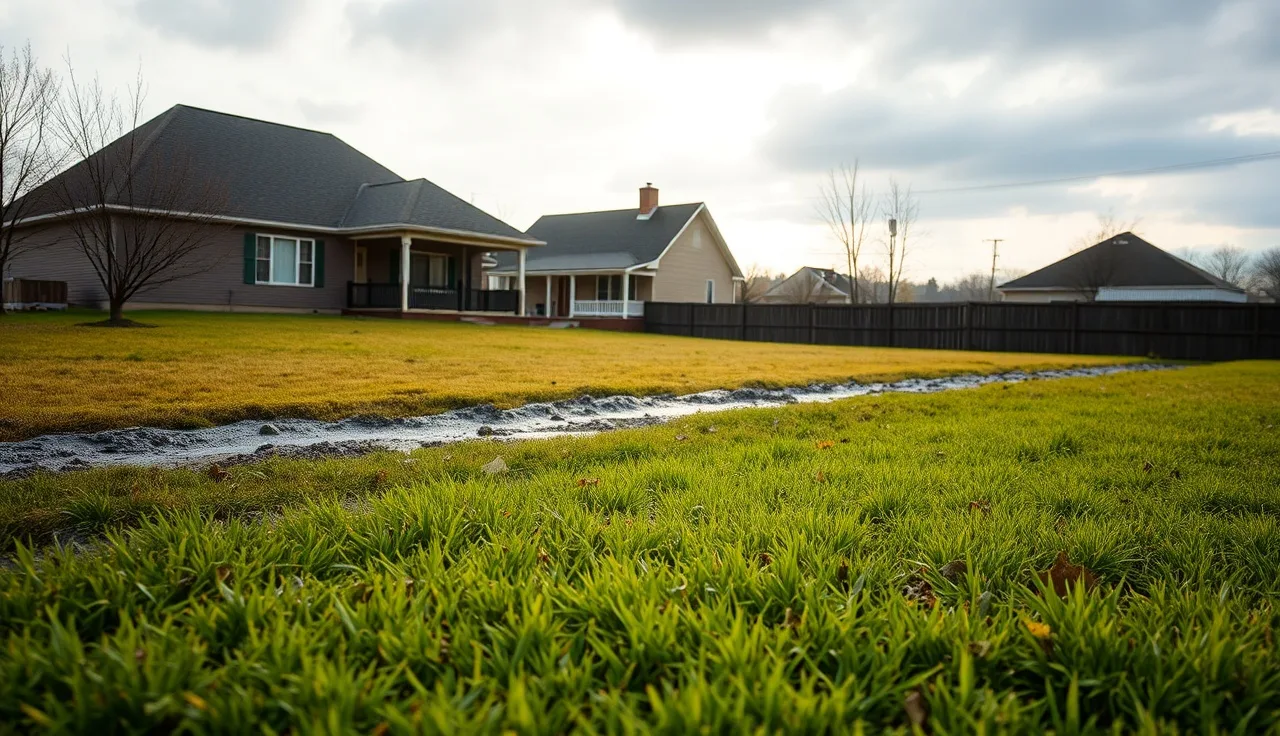
- Unusually green or lush grass directly over the drain field, even in dry weather (the effluent is fertilizing the surface)
- Soft or spongy ground over the field
- Sewage odor inside the house, especially on the lowest floor
Late-stage signs:
- Standing water or visible sewage surfacing on the field
- Sewage backup into the lowest drains in the house (floor drain, lowest toilet)
- Effluent reaching a nearby ditch, stream, or property line
If you're at the backup-into-the-house stage, you need a licensed inspector or pumper today, not next week. Surfacing sewage is a public health violation in every state. Most state onsite wastewater codes require the homeowner to report or remediate a surfacing failure within a defined window, sometimes as short as 24 to 72 hours [3].
One cue matters more than the rest. A lush green stripe over a distribution pipe in an otherwise brown summer lawn is often the first and only visual warning you'll get before things get expensive. Walk your field area every few months.
How does a septic pump to leach field affect failure risk?
In a conventional gravity system, effluent flows from the tank to the field passively. But many systems, especially those where the field sits uphill from the tank or at a significant distance, use a pump chamber. The pump doses the field in timed or demand-triggered bursts rather than letting effluent trickle in continuously.
A pump-dosed system, when properly programmed, actually protects the leach field by giving soil time to rest and drain between doses. The dose volume and rest period should match the soil's percolation rate. If the pump timer is misconfigured to dose too frequently or in volumes the soil can't absorb, it's equivalent to hydraulic overload from a gravity system: the field stays wet, anaerobic conditions set in, and the biomat grows.
Pump failures in the pump chamber create a different problem. If the septic pump to leach field stops working, sewage backs up into the pump tank and eventually the main septic tank, causing backups into the house. This is a mechanical failure rather than a soil failure, and it's fixable with a pump replacement (typically $500 to $1,500 for the pump itself, plus service call) [4]. A pump alarm that's going off is telling you to act fast, not to hit snooze.
Maintaining the pump chamber means checking the float switches and alarm annually, and replacing the pump on its expected service life (usually 7 to 15 years depending on brand and duty cycle). Many homeowners don't know they have a pump chamber at all until the alarm sounds at 2 a.m.
How do you diagnose leach field failure properly?
A visual inspection of the yard tells you something. A proper diagnosis tells you what you're dealing with and what your options are.
A licensed inspector or sanitarian will typically do some combination of the following:
Camera inspection of the distribution pipes. A drain snake with a camera head goes through the cleanout or inspection ports and shows whether pipes are broken, root-intruded, or buried in solids.
Probing or soil borings. A soil probe pushed into the aggregate zone around the laterals reveals whether the gravel is saturated, fouled, or has lost void space. Some inspectors use a simple percolation test to compare current absorption against the original design rate.
Dye testing. Fluorescent dye is flushed through the system; inspectors check the field surface, nearby ditches, and downslope areas for dye emergence. A positive result (dye found at the surface or off-property) is hard evidence of failure and, in most states, triggers a mandatory repair timeline [3].
Effluent sampling. In some cases, inspectors pull effluent samples from the distribution system to assess the quality of what's reaching the field, which helps separate a tank treatment problem from a soil problem.
A septic tank inspection is usually part of this process because the condition of the tank and its output directly determines what the field is receiving. Skipping the tank inspection and only looking at the field is like diagnosing a cough without taking a chest X-ray. You're missing half the picture.
Expect to pay $200 to $600 for a full field inspection, more if soil borings or lab sampling are involved [4].
What are your repair options when a leach field fails?
People want a simple answer here. The honest one is that it depends heavily on the cause, your soil, your local codes, and your lot size. Here's what's actually available.
Resting the field. If the failure is biomat-related and hasn't progressed too far, taking the field offline for 3 to 6 months (routing flow to a temporary system, a secondary field if you have one, or reducing water use dramatically) can allow aerobic decomposition to break down the biomat. It costs almost nothing and works in maybe 30 to 40 percent of early biomat cases. Nobody has great controlled data on the success rate; the most-cited guidance comes from University of Minnesota Extension, which describes field resting as a legitimate but unpredictable option for biomat-impaired fields [2].
Hydro-jetting the distribution pipes. Pressure washing the laterals removes solids from inside the pipes and can restore flow in cases where the pipe interior is fouled but the surrounding soil is still viable. It costs $300 to $600 and is often done as a first step before more invasive work.
Aeration/fracturing. Some contractors use air injection or terralift equipment to fracture compacted soil around the laterals and inject polystyrene beads or oxygen to restore pore space and encourage aerobic decomposition of the biomat. Results are genuinely mixed. Some peer-reviewed work has found modest percolation improvements; other studies found no lasting benefit after 12 months [5]. I'd treat this as worth trying on a field that's borderline, not as a substitute for replacement on a genuinely failed field.
Septic field additives. Products claiming to digest biomat are sold at every hardware store. The EPA's position is that "biological and chemical additives... have not been shown to eliminate the need for regular pumping" and some can harm the soil structure [1]. Skip them.
Lateral replacement or partial replacement. If only one or two distribution laterals are failed and the soil around others is intact, replacing the failed sections and aggregate in those runs is a middle-ground repair. It costs $2,000 to $6,000 depending on depth, access, and local labor rates.
Full leach field replacement. New trenches, new pipe, new aggregate, and in some cases a new distribution box, on a fresh area of the lot. This requires available land, permitting, and a perc test on the new site. Cost runs $5,000 to $20,000+ depending on system size, soil conditions, and whether an engineered system is required [6]. See cost to install septic system for a detailed breakdown.
Alternative system installation. If your lot doesn't have space for a conventional replacement field or the soil doesn't pass a perc test, you're looking at an engineered alternative: mound systems, drip irrigation fields, aerobic treatment units, or constructed wetlands. These cost more, require electricity and maintenance contracts in most states, and need permits. But they're often the only legal path on constrained lots.
SepticMind's inspection and job-tracking tools are used by service operators to document site conditions and manage permit timelines across multiple repair projects, which matters when you're coordinating subcontractors and county approvals on a complex alternative system install.
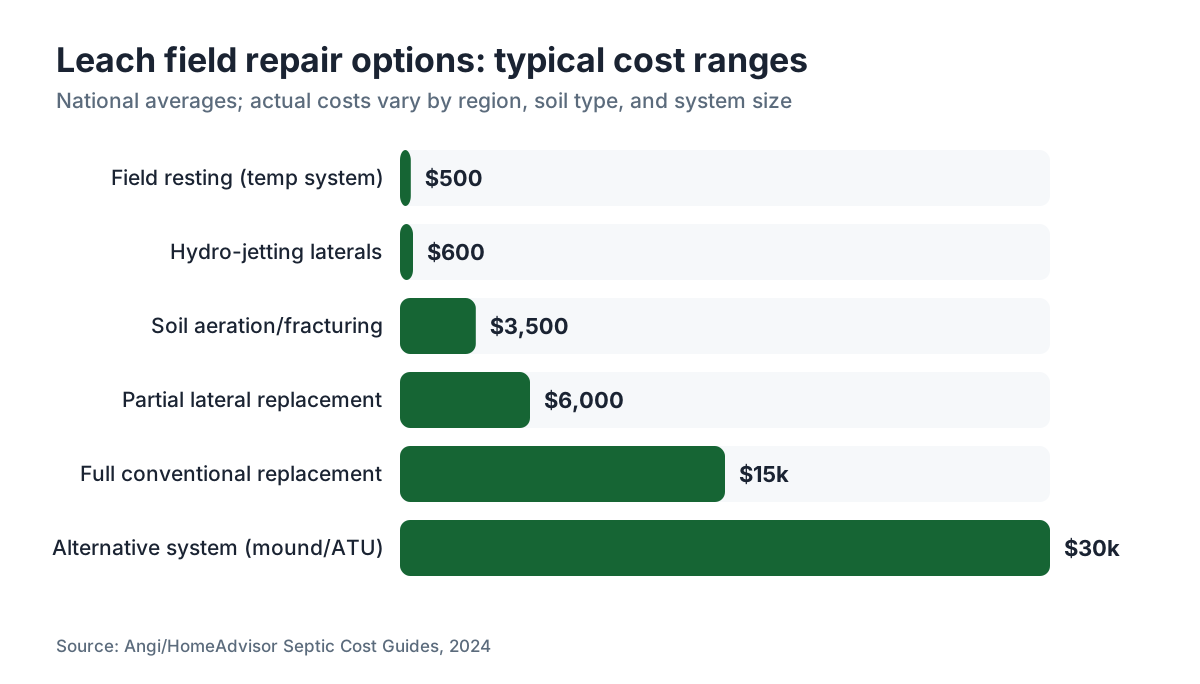
The table below summarizes repair options and realistic cost ranges.
| Repair option | Typical cost | Best for |
|---|---|---|
| Field resting | $0, $500 (temp system) | Early biomat, small fields |
| Hydro-jetting laterals | $300, $600 | Pipe fouling, solids carryover |
| Soil aeration/fracturing | $1,000, $3,500 | Compacted soil, moderate biomat |
| Partial lateral replacement | $2,000, $6,000 | Isolated pipe/gravel failure |
| Full conventional replacement | $5,000, $15,000 | Complete soil failure, space available |
| Alternative system (mound, drip, ATU) | $10,000, $30,000+ | Failed perc, constrained lot |
Sources: HomeAdvisor/Angi cost data, contractor range surveys [4][6]
How much does leach field repair or replacement cost?
Cost is the question everyone asks first, and the honest range is wide because it's driven by local labor markets, soil type, system size, and local permitting fees.
For a conventional replacement in a region with reasonable labor costs and adequate lot space, figure $8,000 to $15,000 all-in, including permits and inspection. In high-cost metro areas or on small lots requiring engineered systems, $20,000 to $30,000 is realistic. According to HomeAdvisor's national cost survey, the average leach field replacement in the U.S. runs about $10,000 to $15,000, with most homeowners paying in the $7,000 to $18,000 range [4].
Permitting alone runs $200 to $800 in most counties but can exceed $1,500 in states with stricter onsite wastewater regulations (Massachusetts Title 5 inspections and permits, for instance, carry well-documented administrative costs) [7].
If you're in the early-warning stage and act before the field is completely saturated, your repair options are cheaper. A hydro-jet and a pump (see septic tank pumping) might buy you years. Waiting until you have surfacing sewage forces the most expensive solution.
Homeowner's insurance almost never covers leach field failure. A few specialty policies exist (USAA, some farm bureau programs) but standard HO-3 policies explicitly exclude "seepage or leakage of water or sewage" as a gradual-loss exclusion. Verify your policy before assuming coverage.
Property value impact: a confirmed failed leach field must be disclosed in most states' real estate transactions. It can reduce a property's appraised value by more than the repair cost because buyers apply a risk discount on top of the estimated repair. Fixing it before listing almost always pencils out.
Can a failed leach field be restored without full replacement?
Sometimes, yes. The candidates for restoration rather than replacement share certain traits: the failure is relatively recent, the underlying soil permeability was originally adequate, there's no major root intrusion or pipe collapse, and the homeowner is willing to aggressively cut water use during the recovery period.
The most evidence-backed restoration approach is resting the field combined with reducing hydraulic load. University of Minnesota Extension research found that "resting a failed mound or trench system for three months to one year, while routing household flows to a temporary holding tank or secondary system, allows aerobic decomposition of the biomat" [2]. Success rates are better on sandy soils than on silts or clays.
Aerobic bacteria do break down the biomat, but only if oxygen reaches it. That's why resting works: with no influent, air penetrates the trench and the aerobic organisms get to work. Products that claim to add bacteria to an active, waterlogged field are working against physics.
Hydro-jetting improves pipe hydraulics but does nothing for soil permeability. It makes sense as a first step to confirm whether the problem is pipe-side or soil-side.
My honest take: if you're being offered a $2,000 aeration treatment on a field that has been wet for 18 months and has standing water, be skeptical. Ask the contractor to show you case studies or documented success rates, and ask what happens if it doesn't work. If the answer is "we'll apply it again," that's not a treatment plan.
For more on the full repair landscape, see septic system repair.
How long does a leach field last, and when is replacement inevitable?
A properly designed and maintained leach field in suitable soil should last 25 to 50 years. Many last longer. The variables that shorten that lifespan are almost entirely controllable: pumping frequency, water use habits, what goes down the drain, and whether vehicles ever park on the field.
Replacement is essentially inevitable once:
- The soil permeability is permanently reduced by colmation (physical or chemical sealing of soil pores) that resting and aeration cannot reverse
- The distribution pipes are structurally failed across multiple runs
- The system has been saturated continuously for more than a year
- The perc rate on a new test falls below the state's minimum acceptance threshold (varies by state, but commonly around 60 to 120 minutes per inch)
- The county has issued a notice of violation and mandated a specific repair
State onsite wastewater regulations set the legal floor here. For example, California's State Water Resources Control Board regulates onsite wastewater treatment systems under the Onsite Wastewater Treatment System (OWTS) Policy, which requires replacement when a system poses a risk to public health or water quality [3]. Most states have parallel provisions.
If you're buying a home with an older septic system, a real estate inspection is not enough. Get a dedicated septic tank inspection that includes the leach field. A system that's technically functioning on inspection day but is 30 years old and has never been pumped is not a system you want to inherit without a written estimate for likely near-term costs.
How do you prevent leach field failure?
The preventive steps are not complicated. They're just consistently ignored until something goes wrong.
Pump the tank on schedule. For a typical three-bedroom home, that's every 3 to 5 years depending on household size and tank volume [8]. If you don't know the last pump date, schedule one now. A pumped tank sends clean effluent to the field; an overfull tank sends solids. For specifics on timing, see how often to pump septic tank.
Manage water use. Spread laundry across the week instead of running six loads on Saturday. Fix running toilets immediately: a single flapper leak can waste 200 gallons a day, enough to hydraulically overload a small system [9]. Install water-efficient fixtures if the system is near capacity.
Keep the field clear. No vehicles, no heavy equipment, no garden beds, no deep-rooted trees within 30 feet. Grass is the ideal cover: shallow roots, good evapotranspiration, no equipment needed for mowing.
Mind what goes down the drain. Grease coats the biomat and makes it harder to degrade. Wipes (even "flushable" ones) pass the tank and foul the distribution pipes. Harsh chemical drain cleaners kill the tank bacteria that produce cleaner effluent. The EPA's SepticSmart campaign specifically lists these as top threats to system longevity [1].
Divert surface water. Gutters and downspouts that drain toward the field saturate the soil from above. Grade the surrounding lawn to drain away from the field area.
Inspect regularly. An inspection every 1 to 3 years for pump-dosed systems, and at minimum every time you pump for gravity systems, catches developing problems early. The cost of an inspection is roughly 1 to 2 percent of the cost of a replacement field.
SepticMind helps service operators track system inspection histories and pump intervals across their customer base, which makes proactive outreach to at-risk systems much more manageable at scale.
Prevention is genuinely cheap relative to repair. The math is simple: $400 for a pump-out every four years over a 20-year period is $2,000. A leach field replacement because the tank was never pumped is $10,000 to $15,000 minimum.
What are the environmental and legal consequences of a failing leach field?
Untreated or partially treated sewage reaching groundwater or surface water is a serious public health and environmental problem, not a technicality. The nitrogen and pathogens in septic effluent are linked to harmful algal blooms, shellfish bed closures, and groundwater contamination of drinking water wells [10].
The legal consequences vary by state but are universally unpleasant. Most state environmental agencies treat a surfacing failure or a confirmed off-property discharge as a violation of the state's water quality or public health code. Consequences can include:
- A notice of violation requiring repair within a defined window (30 to 90 days is common; emergency situations can be shorter)
- Fines that accrue daily until the system is brought into compliance
- Mandatory connection to a public sewer system if one is within a certain distance (varies by state)
- Restrictions on property use or occupancy until the system is repaired
In Massachusetts, for instance, Title 5 of the State Environmental Code (310 CMR 15.000) imposes mandatory inspection and repair timelines triggered by property sale, system failure, or proximity to a resource area [7]. Other states with large septic populations (Florida, North Carolina, Virginia, Minnesota, California) have similarly detailed onsite wastewater regulations.
If you suspect your system is failing and you're not sure whether you're obligated to report it, call your county environmental health department and ask. That beats waiting almost every time. They can tell you the threshold for mandatory reporting and what the repair timeline looks like in your jurisdiction. Proactive engagement consistently gets better outcomes than waiting for an enforcement notice.
Should you repair or replace a failing leach field?
This is the decision point most homeowners get wrong by defaulting to whichever option sounds cheaper in the moment. The right answer depends on a few specific factors.
Repair makes sense when the failure is early-stage, the soil has shown some residual permeability, the pipes are structurally intact, and you have a contractor with documented success at restoration work on comparable soils. Field resting plus aggressive water conservation costs little and can genuinely work.
Replacement makes sense when the field has been saturated for a long time, the perc rate no longer meets code minimums, the distribution pipes are physically collapsed or fully fouled, or you've already spent money on restoration attempts that failed. Throwing $3,000 at aeration on a field that needs replacement is $3,000 you could have put toward the replacement.
Get two or three quotes, and ask each contractor to name the failure mechanism they've identified, more than quote a solution. A contractor who says "we'll aerate it and see" without doing a soil permeability assessment is not giving you a diagnosis. A contractor who recommends full replacement without explaining why the soil can't be restored is also not giving you enough information.
For detailed guidance on what comes next after you've decided, the septic tank repair and leach field guides cover the downstream decisions in more depth. If you're looking at a full system replacement, cost to put in a septic tank covers the tank side of that project.
Frequently asked questions
How do I know if my leach field is failing?
The clearest signs are slow drains throughout the house (not a single fixture), soggy or spongy ground over the drain field area, unusually lush green grass above the field in dry weather, and sewage odors outside or inside. Surfacing sewage or sewage backing up into the lowest drains is a confirmed failure. If you see any of these, get a licensed inspector on site before the problem advances.
Can a failed leach field be fixed without replacing it?
Sometimes. If the failure is biomat-related and caught early, resting the field for three to six months combined with dramatically reducing water use can allow aerobic bacteria to break down the biomat. Hydro-jetting clears fouled pipes. Aeration treatments have mixed evidence. Full restoration is more likely in sandy soils and early-stage failures; severely saturated fields with permanently impaired permeability generally need replacement.
How much does leach field replacement cost?
Most conventional replacement projects run $8,000 to $15,000, with a national average around $10,000 to $15,000 according to HomeAdvisor cost surveys. High-cost markets and lots requiring engineered alternatives (mound systems, drip fields) can reach $20,000 to $30,000 or more. Permits add $200 to $1,500 depending on state. Acting before the field is fully saturated opens cheaper repair options.
What happens if I ignore a failing leach field?
Sewage will eventually surface in your yard or back up into your home. Beyond the health hazard, a surfacing failure is a legal violation in every state and typically triggers a mandatory repair timeline. Continued use of a failed system can result in daily fines, occupancy restrictions, and in some jurisdictions, a required connection to public sewer. Repair costs also increase significantly as the failure progresses.
How long does a leach field last?
A properly designed and maintained leach field in suitable soil typically lasts 25 to 50 years, sometimes longer. Systems that are never pumped, are hydraulically overloaded, or sit in marginal soils can fail in under 10 years. The single biggest factor within a homeowner's control is keeping the septic tank pumped on schedule so solids don't carry over into the distribution pipes.
Does homeowner's insurance cover leach field failure?
Almost never. Standard HO-3 policies exclude gradual damage, including seepage and sewage leakage. A few specialty riders or farm bureau policies cover septic systems, but they are not common. Verify your policy before assuming coverage. This is one of the reasons proactive maintenance matters: the full cost of a replacement typically lands on the homeowner out of pocket.
What is the difference between a septic tank failure and a leach field failure?
A septic tank failure involves the tank structure itself: cracks, a failed baffle, a broken lid, or pump failure in a dosing system. A leach field failure is a soil absorption problem. Both produce similar symptoms (slow drains, backups, odors) but require different repairs. A professional inspection separates the two; fixing the wrong component wastes money and leaves the real problem unaddressed.
How do roots damage a leach field?
Tree and large shrub roots follow moisture and nutrient gradients directly into perforated distribution pipes. Once inside, they block flow and can crack or collapse the pipe. Outside the pipe, large roots compact the soil and disrupt aggregate. Willows, maples, and poplars are particularly aggressive. Keeping trees at least 30 feet from the field boundary is the standard recommendation, though root extension varies by species and soil moisture.
Can too much rain cause leach field failure?
Yes. Saturated soil from prolonged heavy rain can't accept effluent regardless of system condition. If your system backs up only during or after heavy rain, the soil's absorption capacity is likely already near its limit, and seasonal saturation is pushing it over. Permanently high water table conditions require an engineered system designed for those conditions; periodic saturation may improve with better surface drainage around the field.
What is the role of the septic pump in leach field health?
In pump-dosed systems, the septic pump to leach field controls dose timing and volume. When properly set, dosing in timed bursts gives soil rest periods that prevent hydraulic overload. A failed pump causes backups; an improperly programmed pump doses too frequently and mimics hydraulic overload, accelerating biomat growth. Pump alarms should be taken seriously: a failed pump can back sewage into the home within hours.
How do I find my leach field if I don't know where it is?
Start with the as-built drawings from when the system was permitted; these are typically on file with the county health or environmental department. If drawings aren't available, a licensed inspector can locate the system using a drain snake transmitter through a cleanout or by probing the yard systematically. The field is usually downhill from the tank and away from the house, in an open, unplanted area.
Are septic field additives worth using?
No, in most cases. The EPA states that biological and chemical additives have not been shown to eliminate the need for regular pumping or to restore a failed leach field. Some chemical additives can harm soil structure by dispersing clay particles, which worsens clogging. The money spent on additives is better applied to a pump-out, which actually removes the solids that cause downstream problems.
How does leach field failure affect a home sale?
Most states require disclosure of known septic system defects in a real estate transaction. A failed or compromised leach field typically reduces the appraised value by more than the repair cost because buyers apply a risk premium. In some states, a failed Title 5 inspection (Massachusetts) or equivalent assessment blocks the property sale until repairs are completed. Fixing the field before listing almost always produces better net proceeds than selling as-is.
Sources
- U.S. EPA, SepticSmart Program: Roughly 10 to 20 percent of the 21 million U.S. septic systems are malfunctioning at any given time; biomat is described as natural but problematic when loading exceeds soil capacity; additives have not been shown to eliminate pumping needs.
- California State Water Resources Control Board, OWTS Policy: California's OWTS Policy requires repair or replacement when a system poses a risk to public health or water quality; surfacing failures trigger mandatory remediation.
- Angi (HomeAdvisor), Septic System Cost Guide: National average leach field replacement cost runs $10,000 to $15,000; pump replacement typically $500 to $1,500; professional inspections $200 to $600.
- Journal of Environmental Quality, aerobic treatment and biomat decomposition studies: Peer-reviewed work found mixed results from soil aeration/fracturing treatments, with some studies showing no lasting percolation benefit after 12 months.
- Angi (HomeAdvisor), Drain Field Replacement Cost: Full conventional leach field replacement costs $5,000 to $20,000+; engineered alternatives (mound, drip, ATU) can reach $10,000 to $30,000+ depending on lot conditions.
- Massachusetts Department of Environmental Protection, Title 5 (310 CMR 15.000): Massachusetts Title 5 imposes mandatory inspection and repair timelines triggered by property sale, system failure, or proximity to a resource area; permitting administrative costs are well-documented.
- U.S. EPA, How to Care for Your Septic System: EPA recommends pumping a typical septic tank every 3 to 5 years depending on household size and tank volume.
- U.S. EPA, WaterSense Program: A leaking toilet flapper can waste 200 gallons or more per day, sufficient to hydraulically overload a small septic system.
- U.S. EPA, Nutrient Pollution: Nitrogen and pathogens from failing septic systems contribute to harmful algal blooms, shellfish bed closures, and contamination of drinking water wells.
Last updated 2026-07-10