Septic drain field materials: what they are and which to choose
By the SepticMind Editorial Team
TL;DR
- A conventional drain field uses perforated pipe, washed crushed stone (usually 3/4-inch to 2.5-inch gravel), and geotextile fabric laid in trenches over native soil.
- Chamber and drip-irrigation systems skip the gravel entirely.
- What you can use depends on soil type, local code, site access, and budget.
- Guess wrong and a replacement runs $10,000 to $30,000.
What materials make up a septic drain field?
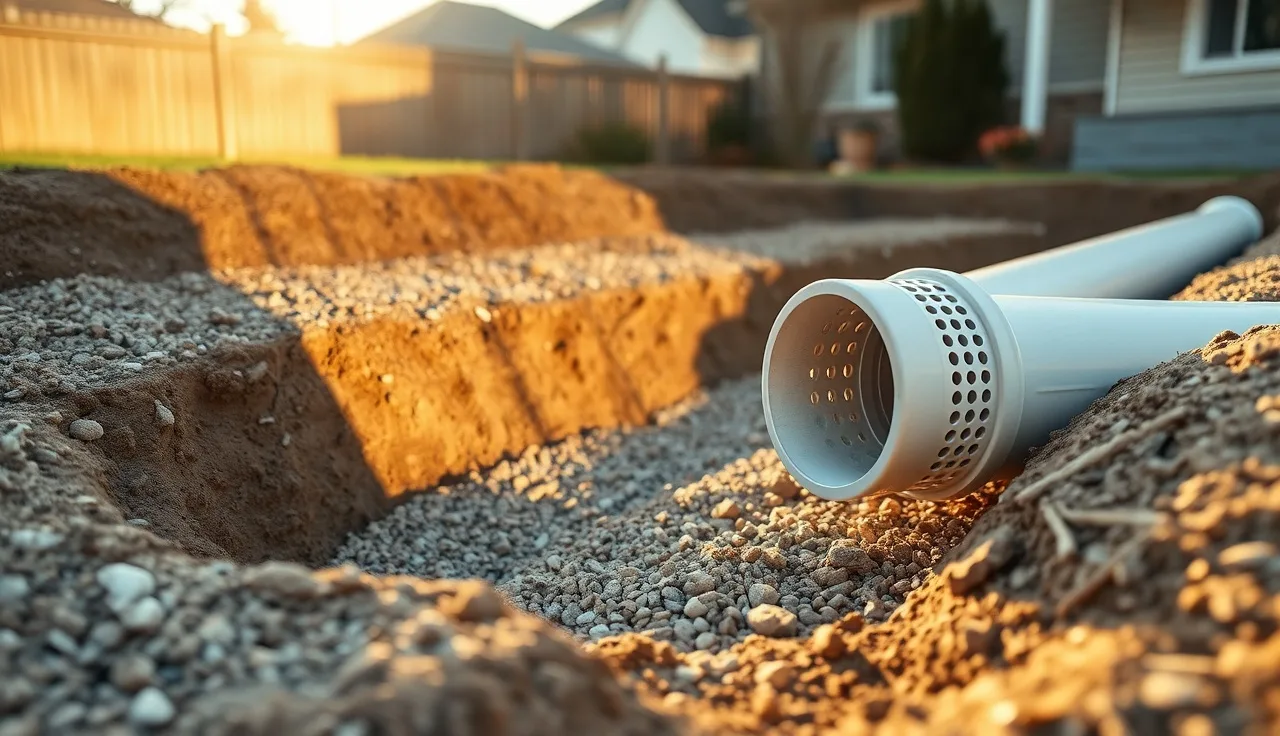
A drain field takes liquid effluent from the septic tank and spreads it underground so soil microbes treat it before it reaches groundwater. People also call it a leach field or a soil absorption system. Every version needs three things: something to carry the flow (pipe or chamber), something to spread and aerate it (aggregate or open chamber space), and something to keep fine soil out of that distribution layer (geotextile fabric or a molded shield). [1]
The EPA's SepticSmart program describes a conventional system this way: "wastewater flows from the septic tank to the drainfield, where it percolates into the soil." [1] Simple on paper. On a real lot, engineers and contractors mix and match five material categories to fit the site.
Those five are perforated distribution pipe, crushed stone aggregate, plastic chamber systems, geotextile filter fabric, and the native or imported soil that does the final treatment. Newer systems also use gravelless media like expanded polystyrene (EPS) aggregate or foam-filled textile bundles. Pipe-and-gravel still runs the country by a wide margin. [2]
Knowing what each material does, and what kills it early, saves you real money. That is the whole point of this guide.
What pipe is used in a septic drain field?
Perforated PVC is the standard. ASTM D2729 covers perforated PVC sewer and drain pipe, and it shows up in nearly every state onsite wastewater code as an accepted product. [3] Residential drain field laterals run 4 inches in diameter. The perforations are small slots or holes along the lower half of the pipe that let effluent weep out into the gravel.
Homes built before the mid-1980s sometimes have perforated clay tile or rigid concrete pipe. Both move water fine. Clay tile joints separate over the decades and invite root intrusion. Concrete pipe is heavy and rarely goes into new residential work anymore.
Flex-corrugated HDPE pipe (sometimes sold pre-wrapped in a geotextile sock) shows up in some regions, especially where a contractor wants a little give for grade changes. It is cheaper per foot than Schedule 40 PVC and more likely to crush under a heavy load. Many state codes accept it. Some limit it by depth or traffic. Check your state's onsite wastewater rules before you spec it.
Slope matters more than pipe brand. A conventional distribution lateral sits at about 1/16 inch per foot, roughly a 0.5 percent grade. Too steep and effluent dumps at the far end of the trench instead of spreading. Too flat and you get ponding. No pipe material rescues a sloppy install.
What kind of gravel or aggregate goes in a drain field?
The EPA and most state codes call for washed, crushed stone with no fines, usually graded 3/4 inch to 2.5 inches. [1] Soil scientists and extension programs use "clean aggregate" to mean stone with less than 3 percent passing a No. 200 sieve, which is almost no silt or clay. [4] Fines are the enemy. They wash down into the soil interface and clog the biomat faster than anything else you can do wrong.
Granite and limestone both work. Angular crushed stone beats rounded river gravel because the sharp faces lock together and resist migration. Rounded pea gravel shifts under load, and some state codes reject it for exactly that reason.
A residential trench runs 2 to 3 feet wide, with 6 to 12 inches of stone below the pipe and 2 inches above. Aggregate depth is regulated because it sets the hydraulic capacity of the trench. North Carolina's onsite rules require at least 6 inches of aggregate below the pipe and 2 inches above. [5] Your state will publish its own numbers.
Here is the quotable part. A 1,000-square-foot drain field with 12-inch aggregate depth uses roughly 30 to 40 tons of crushed stone, and delivered stone runs $25 to $65 per ton depending on region and type. [6] So the stone alone costs $750 to $2,600 on a small field, before labor, pipe, or fabric.
| Aggregate size | Typical use | Notes |
|---|---|---|
| 3/4" to 1.5" crushed stone | Standard residential drain field | Most widely accepted; good void space |
| 1.5" to 2.5" crushed stone | High-flow or deep systems | Some codes require this range for commercial |
| Pea gravel (3/8" rounded) | Gravelless media backfill | Limited; check local code; poor interlock |
| Recycled EPS (expanded polystyrene) | Gravelless alternative systems | Lighter, easier to handle; ASTM C578 governs |
| Washed river rock | Sometimes allowed | Round faces reduce interlock; verify locally |
How do chamber systems differ and when are they better?
Chamber systems drop the gravel and use interlocking open-bottomed plastic arches instead. Effluent leaves the pipe, fills the chamber, and seeps straight into native soil through the open bottom and lower sides. The most installed brand is Infiltrator Water Technologies (the Quick4 series), and several other manufacturers make similar HDPE arches. [7]
Chambers have real advantages. No aggregate delivery, which is a big deal on a lot with bad truck access. They are lighter and go in faster. And the exposed soil surface they offer can run 35 to 50 percent larger than an equal-length gravel trench, which is why many states let you build a shorter system with chambers. Infiltrator's sizing data shows a Quick4 Plus Standard chamber provides 6.8 square feet of infiltrative area per linear foot versus about 4.5 square feet for a 2-foot-wide gravel trench of similar footprint. [7]
The catch is upfront cost. Chambers run $8 to $20 each, and a 500-square-foot field might need 40 to 80 of them. Labor savings usually eat that premium.
Chambers do not fit every site. They need at least 12 inches of suitable soil below the chamber bottom, and some codes want 18. Vehicle traffic can crush them unless you use a rated endcap and access setup. They are generally not allowed in very coarse soils where water races down and skips treatment, or over fractured bedrock. [8]
Want the total installed picture? The next section has the cost table.
What does a drain field cost to install by material type?
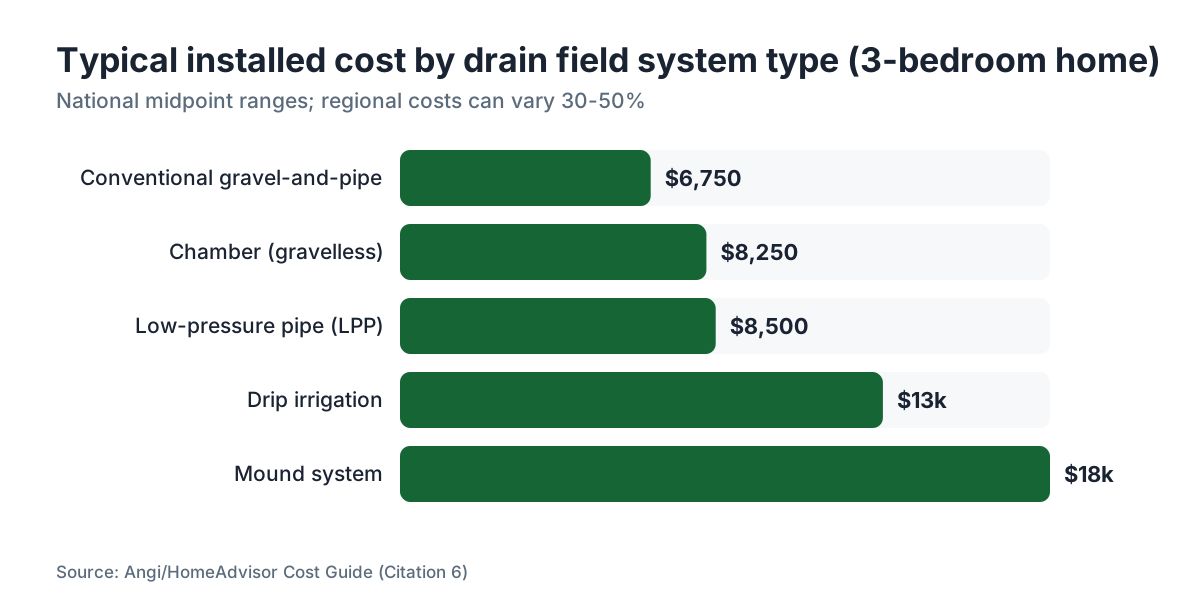
Installed cost swings hard by region, system size, and soil. The numbers below are national midpoint estimates from contractor pricing data and extension publications, and your local market can land 30 to 50 percent above or below them. [6]
| System type | Typical installed cost (3-bedroom home) | Notes |
|---|---|---|
| Conventional gravel-and-pipe | $3,500 to $10,000 | Most common; aggregate delivery drives cost |
| Chamber (gravelless) | $4,500 to $12,000 | Less truck access needed; faster install |
| Drip irrigation | $8,000 to $18,000 | Requires pump, timer, controls; best for difficult soils |
| Mound system | $10,000 to $25,000 | Imports fill material; used when native soil fails perc |
| Low-pressure pipe (LPP) | $5,000 to $12,000 | Small-diameter drilled orifices; pressurized distribution |
The wide ranges are honest. A sandy-loam site with good truck access in a rural area hits the low end. A clay suburban lot that needs a mound and engineered fill hits or blows past the top.
Repairs are where the bill climbs. A full drain field replacement runs $10,000 to $30,000 once you add design, permits, excavation, and new materials. [6] That is the whole argument for choosing the right materials on day one and protecting the field afterward. For the broader system numbers, see our guide on cost to install septic system.
What is geotextile fabric and does every drain field need it?
Geotextile fabric is a permeable nonwoven polypropylene or polyester sheet laid over the top of the gravel or chamber before backfill. It lets water pass while blocking soil particles from washing down into the stone and choking it. Skip the fabric and backfill soil slowly invades the aggregate, cutting hydraulic capacity year by year. Most state codes now require it on new installs. [5]
Not all geotextile is equal. Drain field fabric is rated by weight (grams per square meter) and Apparent Opening Size (AOS). A common spec is a 4-oz nonwoven fabric with an AOS around US Sieve 70 to 100, meaning openings of roughly 0.15 mm to 0.21 mm. Tighter is not automatically better. If the AOS is too fine, the fabric turns into a barrier instead of a filter.
Chamber systems often use a lighter fabric or a molded plastic shield at the endcap, since the arch itself keeps soil out of the infiltration zone. The manufacturer's installation spec controls, and the wrong fabric voids the warranty in most cases. [7]
Fabric costs $0.05 to $0.20 per square foot retail. It is one of the cheapest things in the whole system. Do not skip it, and do not swap in landscape weed-barrier cloth. That fabric weaves too tight and will strangle drainage over time.
What soil conditions determine which drain field materials you can use?
Native soil is the final treatment medium. Microbes in the top few feet break down pathogens and nutrients before treated water reaches groundwater, so soil type decides what field is even legal on your lot. A percolation test or a soil profile evaluation by a licensed soil scientist tells you how fast water moves through the ground. [8]
The EPA and most state agencies classify soils by perc rate and texture together. The range that supports a conventional field runs roughly 1 to 60 minutes per inch (MPI). [1] Faster than 1 MPI (coarse sands and gravels) and water blows through too quickly for treatment, so some states require low-pressure pipe or drip to spread the load. Slower than 60 MPI (heavy clay) and the soil cannot take effluent fast enough, which usually pushes you into a mound system with imported sand fill.
Separation distance is the other big site factor: the vertical space from the bottom of the trench or chamber to the seasonal high water table or bedrock. Most state codes want 2 to 4 feet. If your lot has only 18 inches of good soil over rock, no standard drain field material gets approved and you are into a mound or another alternative. [5]
Operators running multiple sites can flag perc and soil data by property in SepticMind's service software, so crews arrive knowing whether a site is chamber-eligible or needs a mound. That cuts diagnostic time on the complicated jobs.
What gravelless and alternative media are used in modern drain fields?
Gravelless products arrived in the 1990s to cut weight, speed installs, and lean less on aggregate supply. Three categories are common now.
First, expanded polystyrene (EPS) aggregate. Small beads or chips made from recycled foam, used as a lightweight stand-in for crushed stone. They meet ASTM C578 for density and ASTM E84 for flame spread when used in confined spaces. Some states accept EPS-filled bundles wrapped in geotextile as a direct swap for gravel trenches. Weight comes in under 2 pounds per cubic foot versus about 100 pounds per cubic foot for stone, which is huge for sites with bad access or steep slopes. [2]
Second, textile-wrapped bundles. Cylindrical bundles of looped polyester filament inside a geotextile sleeve, sold under names like Eljen (the GSF system). The filament gives surface area for aerobic microbes to treat effluent inside the bundle before it reaches native soil. Eljen states its Geotextile Sand Filter system can cut required field size by up to 50 percent in some soils thanks to that pre-treatment. [9] State extension studies have generally found better effluent quality at the soil interface than conventional systems, though long-term clogging data is still coming in.
Third, drip irrigation tubing. Pressure-dosed systems run small-diameter drip line (usually 1/2 inch or 5/8 inch polyethylene with inline emitters) buried 6 to 18 inches deep. They need a pump, filter, timer, and control panel, which adds cost but opens up sites with shallow soil, steep slopes, or high water tables where no conventional field passes. The EPA lists drip distribution as an option for "difficult site conditions" in its onsite systems guidance. [1]
None of these are universally legal. Every state keeps an approved-products list, and you verify local acceptance before you spec anything. North Carolina, Florida, and Texas run some of the most detailed lists in the country, covering dozens of gravelless products with specific sizing rules. [5][10]
What materials are used for drain field repair vs. full replacement?
Repair depends on what failed and why. Three scenarios cover most jobs, and each calls for different materials.
Cracked or separated pipe is the easy one. Dig up the bad section, cut out the damaged pipe, splice in new perforated PVC with approved couplings. Cheap, usually $500 to $2,500 depending on depth and access, and you barely disturb the aggregate. [6]
When the biomat (the black, greasy layer at the soil interface) goes anaerobic and the field is hydraulically failing, pipe work does nothing. The aggregate and soil surface need aerobic recovery. Some contractors inject Terralift or similar air-fracturing treatments to break up compaction. Others rest and rotate if you have an alternating two-field setup. A 6-to-12-month rest sometimes lets the biomat oxidize and permeability come back, but nothing is guaranteed and nobody has clean long-term data on recovery rates.
When the native soil itself has failed (consistently above-60-MPI soils that squeaked through under older, looser standards), the only honest fix is a mound or drip system. Both import new material and build a fresh treatment layer above the failed native soil. Our septic system repair guide walks through the full diagnostic.
One product sold as a fix is "drain field conditioner," packed with bacterial cultures, enzymes, or sulfuric acid. The EPA and most extension services are not buying it. SepticSmart guidance states plainly that additives "have not been proven to benefit septic system performance," and some can damage system components. [1] Pay for a real inspection before you pay for additives. Our septic tank inspection guide shows what a proper evaluation looks like.
What materials are used to protect a drain field from damage?
Protection is the category nobody thinks about until the field is dead. Two things wreck drain fields faster than anything else: compaction from vehicle or machinery traffic, and root intrusion. Both are physical. No amount of biological treatment fixes either.
For compaction, you have physical markers (warning tape, surface stakes, concrete wheel stops at the perimeter) and load-spreading panels. Plastic ground protection mats rated for construction equipment can go down temporarily if you truly must cross the field. The honest advice is shorter: never drive over your drain field, and mark it so contractors do not either. Plenty of failures in systems 5 to 15 years old, systems that looked well designed, trace back to a single heavy-vehicle event. A concrete truck. A delivery box truck. A skid-steer during yard work.
For roots, chemical barriers like slow-release potassium hydroxide products (RootX and similar) can go in at the trench perimeter. They do not kill existing roots. They discourage new growth at the treated boundary. The better fix is not planting trees or big shrubs near the field at all. The University of Minnesota Extension recommends keeping all trees and large shrubs at least 50 feet from the drain field. [11]
For surface water, perforated drain pipe (the same ASTM D2729 pipe used in the field) can run as an interceptor drain upslope to divert runoff. Soaking a drain field with stormwater is one of the quickest routes to hydraulic failure.
Pumping the tank on schedule protects the field as much as anything you bury. A tank that spills solids into the field clogs the aggregate for good. [12] See our guides on septic tank pumping and how often to pump septic tank for the right intervals.
Which drain field materials are approved by code and how do you verify?
Every state runs its own onsite wastewater code, and they differ more than people expect. What passes in Texas may not pass in Washington. The federal baseline comes from EPA guidance, but the EPA does not regulate onsite systems directly. That authority sits with state environmental agencies and, in many states, county health departments. [1]
The National Environmental Services Center at West Virginia University keeps a clearinghouse of state onsite wastewater regulations. [13] For any specific product, look for your state's "approved products list" or "innovative/alternative system" list, usually published by the state environmental quality or health department.
Three verification steps that actually work:
Ask your local health department for the exact code section that governs drain field aggregate and pipe. In most states it is a short numbered section of the onsite wastewater administrative code.
For gravelless or chamber products, request the manufacturer's current approval documentation for your state. Approvals expire and products change. A chamber approved in 2010 may have had its conditions modified since.
If your county requires a licensed soil scientist or registered sanitarian for system design, that professional takes legal responsibility for product selection. Their stamp is your verification.
The EPA's SepticSmart homeowner resources point at the legal framework directly: "Your local health department can tell you about the regulations in your area." [1] That is the right first call. Operators tracking scheduled maintenance across many properties can record material types and code status by jurisdiction; SepticMind builds that property-level record-keeping into its operator tools.
How long do drain field materials last?
A well-designed, protected gravel-and-pipe field should last 25 to 40 years, and plenty go longer. The aggregate is essentially permanent as long as it stays clean. PVC pipe lasts decades under normal conditions. Geotextile fabric breaks down slowly over 20 to 50 years, and once buried, UV exposure barely touches it. [2]
What fails is not the material. It is the soil interface. The biomat at the gravel-soil boundary is part of how the system works (it slows flow so treatment can happen), but over years it thickens and goes anaerobic and gradually chokes off infiltration. That process speeds up three ways: the tank goes unpumped and solids ride into the field, water use sits above the design load, or the field gets non-biological clogging agents like grease, big volumes of bleach, or synthetic laundry fibers. [12]
Chamber systems have a similar life. Infiltrator rates its chambers for 50-plus years of structural life, but the soil interface will biomat on the same schedule as gravel if the biological load matches. [7]
Drip systems have shorter-lived mechanical parts. Pumps, filters, and solenoids typically need replacement every 5 to 15 years. The tubing can last 20 to 30 years if effluent quality stays clean.
The most reliable way to stretch field life is regular tank pumping, which keeps solids out. [12] A septic tank pump out every 3 to 5 years for a standard household is the industry consensus. That one habit extends drain field life more than any material upgrade you can buy.
Frequently asked questions
Can I use regular PVC pipe instead of perforated pipe in a drain field?
No. Solid PVC carries effluent without releasing it. Drain field laterals need ASTM D2729 perforated PVC (or equivalent) so effluent can seep out into the aggregate bed. Solid pipe is used only for the distribution manifold or drop boxes that route flow to the laterals, not in the actual absorption trenches.
What is the difference between a drain field and a leach field?
They are the same thing. "Drain field," "leach field," and "soil absorption system" all name the buried network of perforated pipe or chambers and surrounding aggregate that receives effluent from the tank and spreads it for soil treatment. Regional terms vary; the function and materials are identical. See our full guide on the leach field for more detail.
Can I use recycled crushed concrete as drain field aggregate?
Generally no. Recycled concrete fines leach lime, which raises soil pH and can bind phosphorus in ways that affect treatment. More important, recycled concrete often fails the "clean aggregate" standard because it holds cement paste fines. Most state onsite codes require natural crushed stone for that reason. Check your specific state code before substituting any recycled aggregate.
How deep should the gravel be in a septic drain field trench?
Most state codes require 6 inches of aggregate below the pipe invert and 2 inches above, for a minimum of 8 inches total. Some codes want more for commercial or high-flow systems. The trench is then covered with geotextile fabric and backfilled with native soil to grade. Always check your state's specific onsite wastewater regulations.
Do chamber systems really work as well as gravel drain fields?
Yes, in comparable soils. State extension studies and EPA-funded research have found chambers perform on par with gravel-and-pipe in standard conditions. Chambers offer more open infiltrative area per linear foot, which is why many states allow a smaller footprint with them. They are not right for every site, especially very coarse soils where rapid downward movement skips treatment.
What happens to a drain field if it gets too much water all at once?
Hydraulic overload saturates the aggregate, pushes effluent to the surface or back into the tank, and can create anaerobic conditions that speed up biomat formation. Short overloads (a party, house guests) rarely cause lasting damage. Chronic overloading from a running toilet or high occupancy shortens field life a lot. Spread water use through the week and fix plumbing leaks fast.
Is it okay to plant grass over a drain field?
Yes, grass is ideal. A shallow-rooted lawn evapotranspires moisture, holds soil against erosion, and does not send roots into the pipe or aggregate. Avoid deep-rooted plants, shrubs, and trees. The University of Minnesota Extension recommends keeping trees and large shrubs at least 50 feet from the field perimeter. Vegetable gardens directly over the field are also discouraged because of pathogen uptake risk.
What drain field supplies do I need for a DIY repair?
For a minor pipe repair: ASTM D2729 perforated PVC (4-inch diameter), PVC couplings, PVC primer and cement, and geotextile fabric to replace the disturbed section. For aggregate in a small area: 3/4-inch to 1.5-inch washed crushed stone delivered by the ton. Note that many states require a licensed contractor and a permit for any drain field work beyond minor pipe patching.
How do I know if my drain field material has failed?
Warning signs include slow-draining fixtures inside, wet or spongy ground over the field, sewage odors in the yard, and surfacing effluent (the most obvious). A licensed inspector can probe the soil above the trenches and check tank effluent levels to confirm hydraulic failure. Early diagnosis often means repair is possible; waiting until effluent surfaces usually means full replacement. See our guide on septic system repair.
Can I add a new drain field section to extend a failing one?
Sometimes, yes. If your lot has space and perc-suitable soil in an unused area, a licensed engineer can design an expansion or a replacement field while the old one rests. This is the "reserve area" approach, and it is why most state codes require a designated reserve area at original installation. If no reserve area was set aside and the lot is tight, options get thin.
Do septic tank additives help drain field materials recover?
The EPA's SepticSmart program states that additives "have not been proven to benefit septic system performance," and some may damage components. No credible independent study shows a bacterial additive or enzyme reversing established biomat clogging. Save that money for a proper inspection and a real pumping schedule, both of which have evidence behind them.
What permits do I need to replace drain field materials?
In nearly every state, replacing or repairing a drain field requires a permit from the county health department or state environmental agency. Requirements typically include a site evaluation, a soil test, and licensed contractor or engineer involvement. Working without a permit can bring fines and, in some states, a forced removal and redo at the homeowner's expense. Contact your local health department before any field work.
How much does drain field aggregate (gravel) cost?
Delivered washed crushed stone runs $25 to $65 per ton nationwide, with big regional variation. A typical 1,000-square-foot residential field needs 30 to 40 tons. That puts aggregate material cost alone at $750 to $2,600 before delivery fees. Prices have trended up with fuel and quarry costs, so get at least two local quotes when you budget.
What is low-pressure pipe (LPP) and what materials does it use?
LPP systems use small-diameter (1.25 to 1.5 inch) solid polyethylene pipe with precisely drilled orifices (about 1/8 inch) to pressure-dose effluent across a wide, shallow trench. They need a pump and pressure controls but allow installation in difficult soils and slopes where gravity systems fail. Aggregate requirements resemble conventional systems; some states accept LPP with chamber beds instead of gravel.
Sources
- U.S. EPA, SepticSmart: Protect Your Investment: Describes conventional drainfield operation, discourages additives, and notes local health departments govern onsite system regulations.
- National Environmental Services Center (NESC), West Virginia University, Onsite Wastewater Treatment Systems: Overview of gravelless and alternative media drain field systems including EPS aggregate and long-term material durability.
- ASTM International, ASTM D2729 Standard Specification for Poly(Vinyl Chloride) (PVC) Sewer and Drain Pipe and Fittings: Governs perforated PVC pipe used in residential drain field lateral construction.
- North Carolina Department of Health and Human Services, Onsite Wastewater Section Rules (15A NCAC 18E): Requires minimum 6 inches of aggregate below pipe and 2 inches above; specifies approved gravelless products and geotextile requirements.
- HomeAdvisor / Angi, Septic System Installation and Repair Cost Guide: Provides national cost ranges for drain field installation by system type and aggregate material costs per ton.
- Infiltrator Water Technologies, Quick4 Chamber Installation and Design Manual: States Quick4 Plus Standard chamber provides 6.8 sq ft of infiltrative area per linear foot; manufacturer rates chambers for 50-plus-year structural life.
- U.S. EPA, Onsite Wastewater Treatment Systems Manual (EPA/625/R-00/008): Specifies perc rate range of 1 to 60 minutes per inch for conventional drain field soils; describes site evaluation requirements including separation distances.
- Eljen Corporation, GSF Geotextile Sand Filter System Technical Documentation: Claims GSF system can reduce required drain field size by up to 50 percent in certain soil conditions due to in-bundle aerobic pre-treatment.
- Florida Department of Health, Onsite Sewage Treatment and Disposal Systems Program: Maintains a state-level approved products list for alternative drain field materials and gravelless systems.
- University of Minnesota Extension, Septic System Owner's Guide: Recommends keeping trees and large shrubs at least 50 feet from the drain field perimeter to prevent root intrusion.
- U.S. EPA, How to Care for Your Septic System: States that failing to pump the tank regularly allows solids to enter and irreversibly clog drain field aggregate.
- National Environmental Services Center (NESC), State Onsite Wastewater Regulations Clearinghouse: Maintains a database of state onsite wastewater administrative codes for product and material verification.
Last updated 2026-07-09