Septic drain field rehab: what actually works and what doesn't
By the SepticMind Editorial Team
TL;DR
- Septic drain field rehab runs from shock-dosing bacteria to jetting laterals, pneumatic fracturing, and swapping out failed trenches.
- Early and mid-stage failures often recover if you fix the cause.
- A field that's fully biomat-saturated or drowning in a high water table rarely comes back without digging.
- Budget $500 to $4,000 for non-invasive work and $8,000 to $25,000+ for replacement.
What is drain field rehab and when does it make sense?
Drain field rehab is any deliberate effort to restore wastewater absorption in a leach field that has slowed or stopped, short of tearing the whole system out. It ranges from resting the field for a few weeks to injecting compressed air fractures into the surrounding soil. The goal never changes: get liquid moving through the soil again.
Rehab makes sense when the failure is partial and recent. A field that's been sluggish for a few months, where the tank gets pumped on schedule and the soil isn't permanently compacted or drowning under a high water table, is a reasonable candidate. A field that's been seeping sewage for two years, or one sitting on a lot that floods every spring, is not. Throwing money at a broken site is a common and expensive mistake.
The EPA's SepticSmart program puts it plainly: most premature drain field failures trace back to poor tank maintenance, not bad soil. That matters, because if you fix the cause before the biomat fully seals off, the field can often recover. [1] If the cause is wrong soil, a botched original design, or a rising water table, no surface treatment holds up long-term.
Before you spend a dime on rehab, get the tank pumped and inspected. A surprising number of "drain field failures" are actually full tanks, cracked baffles dumping solids into the field, or one clogged distribution box. Fixing the upstream problem costs $300 to $600 and sometimes resolves the whole thing. Our guide on septic tank pumping covers what that inspection should include.
What causes a drain field to fail in the first place?
Biomat is the number one culprit. It's a dense layer of anaerobic bacteria and their byproducts that forms where the soil meets the gravel at the bottom and sides of the trenches. In a healthy system, aerobic soil bacteria keep that layer thin enough for liquid to pass. Overload the field, or let solids escape a neglected tank, and the biomat thickens until it's nearly waterproof. [2]
Compaction is the second big one. Drive equipment over a field, or wear a path across it over years, and you collapse the void spaces in the gravel and soil. No biological treatment brings those voids back. That's physical remediation or replacement, full stop.
Hydraulic overload gets ignored too often. Turn a two-person household into a six-person household, or let a leaking toilet dump hundreds of extra gallons a day into the system, and even a healthy field chokes. The fix there is behavior first, then decide whether the field itself needs help.
Tree roots, crushed or offset laterals, and failed end caps fill out the list. Roots and pipe damage usually show up on a camera inspection of the lines. Crushed laterals need excavation to confirm. Both need physical repair, not a jug of bacteria.
Here's a reality check: nobody has clean population-level data on how often each failure mode happens. The closest published figures come from state extension programs and the National Onsite Wastewater Recycling Association (NOWRA), which keep finding that more than half of premature failures involve either skipped tank pumping or hydraulic overload. [3]
How do you unclog a septic drain field without digging?
Most homeowners start here, and the honest answer is: it depends on what's clogging it, and the non-invasive methods work only on early-stage biomat or minor gravel crusting.
Rest and reduction. The oldest and cheapest method is cutting the load and giving the field time. Aerobic bacteria in the soil slowly eat the biomat when it isn't constantly fed. Research from Colorado State University Extension and other programs finds that resting a field with diverted flow restores partial function in 3 to 6 months in suitable soils. For most households that isn't practical without a portable toilet or a second field, but the mechanism is real and it's free.
Biological additives. Products packed with Bacillus bacteria, enzymes, or microbial blends get marketed hard to homeowners hunting for a cheap fix. The EPA's consumer guidance is blunt: no additive has been shown to restore a failed field or replace pumping. [1] A few researchers see modest short-term biomat reduction in the lab; most field studies show no lasting benefit. I'd skip them during active failure. In a healthy system they're harmless, and probably a waste of money.
Hydro-jetting the laterals. A licensed contractor runs a high-pressure water jet through each lateral to break up biomat and flush grease and debris toward the pipe end. This clears pipe-level clogging, not soil saturation. It works when the laterals are caked but the surrounding soil still absorbs. Cost runs $500 to $1,500 depending on field size and access. [5]
Terralift and pneumatic fracturing. A long probe drives into the soil next to each lateral, then fires compressed air (sometimes mixed with polystyrene beads) in short bursts to fracture compacted soil and biomat. The fractures open new flow paths. Results are genuinely mixed. Some contractors report good luck on clay soils where fractures last; others watch the biomat re-seal within months. Expect $1,000 to $4,000 for a standard field. [5]
Trench aerators (Advantex, Infiltrator AirDome style systems). These push oxygen straight into the trench, shifting it from anaerobic to aerobic and holding biomat down. They work best as prevention after a partial rehab, not as a standalone clog buster. Installation adds $600 to $2,000 depending on the system.
For operators juggling multiple service accounts, tracking which properties got non-invasive treatments and whether those treatments held is exactly the workflow where software like SepticMind saves you a repeat visit with no records to show for it.
What does drain field rehab actually cost?
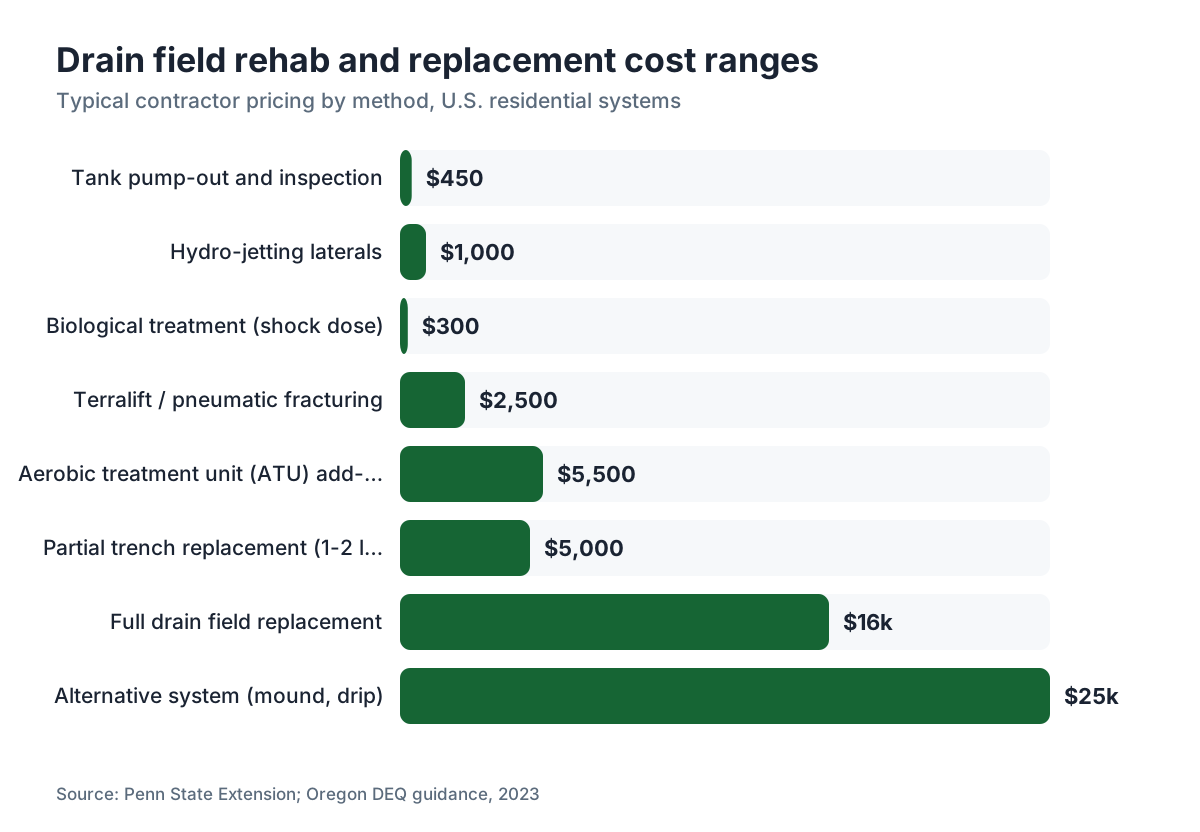
Cost swings hard by region, soil type, field size, and how bad the failure is. The table below shows typical ranges from contractor pricing and published state extension estimates. [5][6]
| Method | Typical cost range | Best for |
|---|---|---|
| Tank pump-out and inspection | $300, $600 | Always first step |
| Hydro-jetting laterals | $500, $1,500 | Pipe-level clogging |
| Biological shock treatment | $100, $500 | Minimal evidence; low-risk low-cost |
| Terralift / pneumatic fracturing | $1,000, $4,000 | Compacted soil, moderate biomat |
| Aerobic treatment unit (ATU) add-on | $3,000, $8,000 | Improving effluent quality to reduce load |
| Partial trench replacement (1-2 laterals) | $3,000, $7,000 | Localized failure |
| Full drain field replacement | $8,000, $25,000+ | Complete failure, poor soil |
| New alternative system (mound, drip) | $10,000, $40,000+ | Marginal or limited sites |
Labor rates in the Northeast and on the West Coast push jobs toward the high end. Rural Midwest and Southeast markets often land at the low end. Permit fees add $200 to $1,000 depending on your county. Some states require an engineer or licensed designer for any replacement or significant repair, which tacks on $500 to $2,000. [6]
A rule of thumb experienced contractors use: if the repair runs more than 60% of replacement cost, replacement usually wins on a 10-year basis. You're not getting 10 more years out of a partial fix on a dying field.
When should you give up on rehab and replace the drain field?
Some fields can't be saved. Knowing when to stop paying for rehab and commit to replacement saves real money and months of grief.
Replace instead of rehab when the soil has been permanently altered (compacted by equipment, drowned by a seasonal high water table, or built over), when a camera shows multiple crushed or offset laterals, when the original install was undersized for the soil's percolation rate and the lot can't hold a bigger field in the same footprint, or when the field has been actively failing for more than two years with sewage surfacing.
Surfacing sewage is a regulatory trigger in most states. Many onsite wastewater codes require the homeowner to repair or replace within 30 to 90 days of confirmed surfacing. North Carolina's onsite water protection rules (15A NCAC 18E) require corrective action within a set timeline, and your state will have equivalent language. [7] Ignoring it isn't a choice. It's a public health problem, full stop.
If replacement is the answer, the cost to install septic system and septic tank installation guides walk through what to expect. And if the tank itself is damaged, get a septic tank repair assessment at the same time, so you're not dropping a new field downstream of a failing tank.
Does resting a drain field actually work?
Yes, sometimes. It's the most underused tool a homeowner has, mostly because it demands real sacrifice (temporarily leaving the house or diverting waste to a portable unit), but the mechanism is solid.
Anaerobic biomat can't survive without a steady diet of BOD (biochemical oxygen demand) from incoming effluent. Cut off the supply long enough and aerobic soil bacteria outcompete it, breaking down the crust and slowly restoring permeability. Extension research on failed fields finds that 3 to 6 months of resting restores measurable infiltration in loamy soils. Clay soils take longer and recover less.
For a vacation home or a seasonal rental, this is a genuinely useful trick. If your field shows early stress, a long off-season may give it enough recovery time to buy several more years. Pair that with pumping the tank at the start of the season and you've done about the best non-invasive rehab there is.
The practical limit: most primary residences can't go three months without flushing. Some counties permit a temporary connection to a holding tank during resting, but that means pumping the holding tank every 1 to 3 weeks at $200 to $400 a pop.
How do you know if your drain field is failing before it's too late?
Early warning signs are easy to miss because they mimic other problems. Here's what to watch.
Slow drains across the house (more than one fixture) plus gurgling when water goes down are the first internal signals. One slow drain is probably a local pipe clog, not the field. When several slow down at once, suspect the field or the distribution box.
Wet spots or oddly lush green grass over the field lines, especially in dry weather, mean effluent is surfacing or close to it. Don't walk in it. Keep kids and pets out. That's partially treated sewage.
Odors near the field, sulfur or raw sewage, mean gas is escaping instead of venting. That often shows up alongside saturation.
A tank that's full at the normal pumping interval, or needs pumping more often than usual, sometimes means the field isn't accepting liquid and it's backing up.
A septic tank inspection by a licensed inspector measures the scum and sludge layers, checks the baffles, and runs a hydraulic load test (running water and watching tank levels) to see whether the field takes flow. It costs $200 to $500 and gives you real data instead of guesswork. Do this before you pay for any rehab treatment.
What are the most effective drain field rehab methods for severe cases?
When biological and pressure treatments fall short, three physical approaches sit at the top tier of rehab, just below full replacement.
Lateral replacement (selective excavation). If a camera shows one or two laterals collapsed or blocked while the rest are fine, replacing just those laterals can bring the system back. The contractor digs those specific trenches, swaps pipe and gravel, and leaves the working laterals alone. It's the most targeted physical option when the failure is local. Cost runs $3,000 to $7,000 per lateral depending on depth and access.
Distribution box replacement and rebalancing. If the D-box has settled, cracked, or is feeding flow unevenly, some laterals drown while others sit dry. Replacing or releveling the D-box and adding outlet filters to balance the flow can turn field performance around. It's cheap next to the other options ($400 to $1,200) and badly underdiagnosed.
Mound system addition. When the native field is truly spent and the lot can't hold another conventional trench (usually a high water table or shallow soil), adding a mound on an adjacent part of the property gives the old field a permanent rest while providing compliant treatment. Mounds run $10,000 to $30,000, but they solve the problem instead of postponing it.
For operators pricing these jobs and tracking follow-ups, our septic system repair article breaks down the repair types and when each one fits.
Can additives or bacteria products unclog a septic drain field?
This is one of the most-searched questions about drain field rehab, and it deserves a straight answer.
The EPA, in its SepticSmart guidance, states: "Commercial septic tank additives are not necessary and, in some cases, may even be harmful to your system." [1] That's about as clear as federal guidance gets.
The theory sounds fine at first: if anaerobic bacteria are sealing the soil, introducing aerobic competitors or enzymes that chew through organic matter should help. The problem is delivery. Pour a product down the toilet and it runs through the tank (where most of the bacteria die or get diluted) and dumps into the inlet end of the field. Getting a real dose to the biomat at the soil interface, deep in the trenches, is nearly impossible from that path.
A 2020 review in the Journal of Environmental Management evaluated commercial additive products and found no consistent evidence of improved soil permeability or reduced biomat thickness against controls. [8] Individual products occasionally shine in manufacturer-funded studies. Independent replication is rare.
My honest take: if you're asking how to unclog a drain field and hoping the answer is a $40 box of powder, the answer is no, not for active failure. In a healthy field, as a maintenance habit, additives are harmless, probably pointless, and no substitute for pumping. Save the money and put it toward the septic tank pump out that actually prevents field trouble.
What permits and regulations govern drain field repair?
Almost every state requires a permit for drain field repair or replacement, and most require a licensed installer or engineer to do the work. This isn't red tape for its own sake. Drain fields treat sewage, and a bad install creates a genuine public health risk.
The Clean Water Act sets the federal framework, but onsite wastewater regulation lives almost entirely at the state and county level. [9] In practice, that means requirements vary a lot. In Florida, any repair to a septic system needs a permit from the county health department under Florida Statute 381.0065. [10] In Texas, TCEQ rules under 30 TAC Chapter 285 govern repair of on-site sewage facilities. [11]
What most states have in common:
- Permit application with a site plan before work begins
- Percolation or soil morphology testing if a new field area is involved
- Inspection by a county or state official before backfill
- A licensed contractor (many states require a specific onsite wastewater license)
- Final sign-off and updated system records on file
Working without a permit is a real gamble. Unpermitted repairs can trigger mandatory removal and reinstallation at your expense, and they complicate home sales badly. When a house sells, a septic tank inspection that turns up an unpermitted field repair can kill or stall the deal.
Pull the permit. It costs $200 to $1,000 and takes a few days to a few weeks. It's not optional.
How long does a rehabbed drain field last?
Everyone asks this, and nobody can give a single number, because it hangs entirely on what was wrong and how completely you fixed it.
A field that failed because the tank went unpumped, then got a full pump-out, baffle repair, and proper pumping every 3 to 5 years afterward, can genuinely recover and run another 10 to 20 years. The soil was never the problem. The management was.
A field hydraulically overloaded because the household grew from two to six people, where the fix was cutting water use and adding a second D-box outlet filter, can stabilize and last 5 to 15 more years if the load stays controlled.
A field that got a terralift treatment and nothing else, with an unmaintained tank and the same crowded household, will likely re-fail within 1 to 3 years. The treatment opened temporary flow paths. The biomat grew back because the conditions that built it never changed.
Here's the honest benchmark from contractor experience (not a published study, because this specific number isn't well documented): non-invasive rehab that fixes the root cause has roughly a 60 to 70% chance of buying 5 or more extra years. Physical repair of specific failed parts, done with proper permitting and inspection, comes close to new-install durability for those parts.
For comparison, a new conventional drain field carries a design life of 20 to 30 years under proper conditions. Measure your rehab spending against that number. [12]
Frequently asked questions
Can a completely failed drain field be restored without replacement?
Rarely, and it depends on the cause. Complete biomat saturation with impermeable soil can't be reversed by non-invasive treatment. If the failure came from years of skipped tank pumping, a pump-out plus field resting can sometimes restore partial function. If the soil is compacted or permanently saturated, replacement is the practical answer. A licensed inspection before you spend anything tells you which situation you're in.
How long does it take to unclog a septic drain field?
Hydro-jetting and terralift take one day. Field resting takes 3 to 6 months for meaningful biomat reduction. Partial trench replacement takes 2 to 5 days of contractor work plus permit time. Full replacement usually takes 3 to 10 days of active work. Permit approval before work starts adds days to weeks depending on your county, so file the application early.
What's the difference between a drain field and a leach field?
They're the same thing. Drain field, leach field, absorption field, and lateral field all refer to the network of perforated pipes buried in gravel trenches that disperse tank effluent into the soil for final treatment. Terminology is regional; contractors in the Southeast tend to say drain field, the Northeast often says leach field. See our leach field guide for a full breakdown of types.
How much does it cost to replace a drain field completely?
Full conventional replacement typically costs $8,000 to $25,000 depending on soil, field size, required depth, and regional labor rates. Sites with high water tables, rocky soil, or limited area may need alternative systems like mounds or drip irrigation, pushing costs to $15,000 to $40,000 or more. Permit fees, soil testing, and engineering add $500 to $3,000 on top of installation.
Will pumping the septic tank fix a failing drain field?
Sometimes, and it's always the right first move. If the field looks like it's failing because solids escaped a full tank and clogged the inlet end of the laterals, pumping and baffle repair can stop further damage and allow partial recovery. But if the soil itself is biomat-saturated, pumping only clears the backup; it won't restore soil permeability. Pump the tank first, then reassess after 2 to 4 weeks.
Is it safe to use the house while the drain field is being rehabbed?
During non-invasive treatments like hydro-jetting or terralift, normal water use is usually fine the day after. During field resting, you need an alternative disposal method (holding tank, portable toilet) or drastically reduced water use. During excavation and trench replacement, the system may be offline for 2 to 5 days. Your contractor should tell you exactly what's allowed during their specific scope of work.
Do I need a permit to rehab my drain field?
Almost certainly, for any physical repair or replacement. Minor maintenance like tank pumping doesn't require one, but replacing laterals, adding a distribution box, or installing any new field area needs a permit from your county or state health department in nearly every U.S. jurisdiction. Unpermitted work can require mandatory removal and reinstallation at your expense. Always check with your local health department before work begins.
How do I know if my drain field is failing or if it's just a clog in the house pipes?
Multiple fixtures draining slowly at the same time points to the septic system, not house plumbing. Run water for 10 to 15 minutes and watch for backup into floor drains or tubs. Wet spots or odors over the field area are a near-certain sign. A single slow drain is almost always a local clog. A licensed inspection with a hydraulic load test confirms which problem you have.
Can tree roots clog a drain field and how are they removed?
Yes. Roots follow moisture and nutrients straight into perforated laterals and can block a line completely. A sewer camera inspection ($150 to $400) pinpoints root intrusion. Removal means mechanical cutting with a root saw attachment on a jetter, sometimes followed by a root-killing treatment (copper sulfate or herbicide formulations labeled for septic use). If roots have cracked or crushed the pipe, section replacement is needed.
What routine maintenance prevents drain field failure?
Pump the tank every 3 to 5 years (more often with a garbage disposal or large household). Never park vehicles or set heavy objects over the field. Divert roof drains and sump pumps away from the field area. Spread laundry loads across the week instead of running several in one day. Fix leaking toilets and faucets fast. Flush nothing but toilet paper. These steps hit the top causes of premature failure.
How often should a septic drain field be inspected?
Most extension programs recommend a full system inspection every 1 to 3 years. At minimum, inspect the tank every time it's pumped (every 3 to 5 years). Buying a home on septic? An inspection before closing is essential. For an older field showing any symptoms, an annual inspection catches deterioration early enough to rehab instead of replace. See our septic tank inspection guide for what a thorough inspection covers.
What happens if I ignore a failing drain field?
Sewage surfaces on your lawn or backs up into the house. Both are health hazards involving partially treated wastewater full of pathogens. Most state codes require corrective action within 30 to 90 days of a confirmed surfacing or backup. Ignoring it can bring permit orders, fines, and in some places condemnation of the property until the system is fixed. The cost of delay is always higher than the cost of acting early.
Can I rehabilitate a drain field myself, or do I need a contractor?
Reducing water use, spreading loads, fixing leaks, and dosing with approved additives are all DIY-appropriate. Hydro-jetting needs professional equipment and training. Terralift is contractor-only. Any excavation, pipe replacement, or permitted repair requires a licensed contractor in nearly all states. Even if you're technically capable, unpermitted work creates liability on resale and may not meet code for your local soil and setback conditions.
Does homeowner's insurance cover drain field repair or replacement?
Standard homeowner's policies exclude septic failures from wear and tear or lack of maintenance, which is how most field failures get classified. Some policies cover sudden and accidental damage, like a vehicle crushing a field or a specific collapse. Specialty home warranty products sometimes include septic coverage with caps of $500 to $3,000. Read your policy language carefully before assuming coverage. Most drain field rehab and replacement is out of pocket.
Sources
- U.S. EPA, SepticSmart homeowner guidance: EPA states commercial septic additives are not necessary and may be harmful; most premature failures trace to inadequate tank maintenance rather than defective soil.
- U.S. EPA, How Your Septic System Works: Biomat accumulation at the soil-gravel interface is the dominant mechanism of drain field failure in residential systems.
- National Onsite Wastewater Recycling Association (NOWRA), industry technical resources: More than 50% of premature drain field failures involve inadequate tank pumping frequency or hydraulic overload.
- Colorado State University Extension, Septic System Maintenance: Field resting for 3 to 6 months with load diversion can restore measurable infiltration rates in loamy soils; clay soils recover more slowly and less completely.
- Penn State Extension, Septic System Maintenance and Repair: Hydro-jetting costs $500 to $1,500; terralift pneumatic fracturing costs $1,000 to $4,000 for a standard residential field.
- Oregon DEQ, Onsite Septic System Repair and Replacement guidance: Full drain field replacement costs $8,000 to $25,000+ depending on site conditions; alternative systems can exceed $40,000. Permit fees add $200 to $1,000.
- North Carolina DHHS, Environmental Health, 15A NCAC 18E: North Carolina requires corrective action within a defined timeline when surfacing sewage is confirmed; most states have equivalent provisions.
- Journal of Environmental Management, review of commercial septic additives (2020): A 2020 review of commercial additive products found no consistent evidence of improved soil permeability or reduced biomat thickness compared to controls.
- U.S. EPA, Summary of the Clean Water Act: The Clean Water Act provides the federal framework for wastewater treatment; onsite wastewater regulation sits primarily at state and county level.
- Florida Department of Health, Onsite Sewage Programs, Florida Statute 381.0065: Florida requires a permit from the county health department for any repair to a septic system under Florida Statute 381.0065.
- Texas Commission on Environmental Quality (TCEQ), 30 TAC Chapter 285, On-Site Sewage Facilities: Texas TCEQ rules under 30 TAC Chapter 285 govern repair of on-site sewage facilities, including permitting and licensed installer requirements.
- U.S. EPA, Septic Systems Overview: Conventional septic drain fields have a design life of 20 to 30 years under proper conditions and management.
Last updated 2026-07-09